Wildfire Insurance Coverage Guide for California Homes

You're probably reading this with one tab open to your policy, another open to a wildfire map, and a third open to quote requests. That's where a lot of California homeowners are right now. The worry usually sounds simple: “Am I covered if a wildfire hits?” But that's not quite the right question.
The better question is how much your insurer will pay, under which part of the policy, after which deductible, and with which limits or sublimits in the fine print. That's where California home insurance gets confusing. It's also where many people discover too late that having a policy isn't the same as having enough protection.
This guide walks through wildfire insurance coverage the way I'd explain it to a client sitting across the desk. Plain language. Real policy mechanics. No panic, no jargon overload. I'll also touch on related California insurance issues, including auto insurance, car insurance, renters insurance, and life insurance, because most families review all of these together when costs rise.
What Wildfire Insurance Coverage Means for California Homeowners
A homeowner in the foothills gets a text alert on a windy evening. The fire isn't on their street, but it's close enough that they pack medication, laptops, photo albums, and the dog's leash. On the drive out, they're not thinking about policy forms. They're thinking, “If we come back to smoke damage, or worse, what happens next?”
That's what wildfire insurance coverage means in real life. It usually isn't a separate policy sold on its own in the standard market. Instead, wildfire protection is commonly built into California home insurance through the parts of the homeowners policy that respond to fire, smoke, damage to the structure, personal belongings, and the cost of living somewhere else if the home can't be occupied.
What trips people up is that a “yes” answer can still hide a painful shortfall. You may have coverage for the house but not enough for rebuilding. You may have coverage for belongings but not enough for valuables or landscaping. You may have loss-of-use coverage, but not enough if displacement lasts longer than expected.
If any policy wording feels unfamiliar, a plain-language California insurance glossary can help translate the terms before you compare quotes or file a claim.
The first question to ask
Don't start with “Does my policy cover wildfire?”
Start with these:
- What is my dwelling limit: Will it rebuild the home?
- What applies to my belongings: Are contents covered at replacement cost or actual cash value?
- What pays if I evacuate: Is there enough additional living expense coverage?
- Where are the weak spots: Are there wildfire deductibles, exclusions, or sublimits?
Practical rule: Wildfire coverage is only as good as the limit, deductible, and wording attached to it.
That shift in thinking matters more than ever in California, where wildfire risk now affects availability, pricing, and which insurers will even offer a quote in some areas.
How California Home Insurance Handles Wildfire Risk
A fire starts three ridges over. You evacuate, the house survives, and then the harder question arrives. If smoke gets into the attic, insulation, cabinets, and HVAC system, how much will your insurer pay?
That is the right question for California homeowners. Wildfire risk is not just about whether fire is a covered cause of loss. It is about how the policy divides payment across the house, your belongings, temporary living costs, and smaller buckets that can run short faster than people expect.
For the house itself, California regulators have long stressed a basic rule: insure for rebuilding cost, not local sale price. A home can have a high market value because of the lot, school district, or location, while the amount needed to rebuild after a wildfire follows labor, materials, debris removal, and code requirements instead.
Read the policy like separate buckets of money
A homeowners policy works like a row of labeled containers, not one giant pool of cash. If one container is too small, money does not always spill over from another.
Here is how wildfire risk is usually handled:
- Dwelling coverage pays toward repairing or rebuilding the main house after a covered fire loss.
- Personal property coverage pays for belongings damaged by fire, heat, soot, or smoke, subject to the policy terms.
- Additional living expense coverage helps with the extra cost of living elsewhere if a covered loss makes the home unfit to live in.
- Other structures coverage applies to detached garages, sheds, fences, and similar structures, usually with a separate limit tied to the dwelling amount.
The payment problem often starts here. Homeowners see a six-figure or seven-figure dwelling limit and assume the rest of the claim will fall into place. In practice, each coverage part can have its own cap, conditions, and settlement method. That is why a policy can include wildfire protection on paper and still leave a painful gap at claim time.
Broad coverage can still produce a short payout
Many California homeowners policies use broad forms that can respond to a wide range of direct physical losses unless the policy excludes them. That sounds reassuring, and it often is. The catch is that broad coverage answers what category of loss may be covered. It does not answer how far the available dollars will go after a regional wildfire pushes up labor, materials, cleanup costs, and time out of the home.
A simple example helps. Suppose the house needs heavy smoke remediation, partial rebuilding, tree removal, and months of temporary housing. The claim may touch four different coverage buckets, plus a deductible. If the dwelling limit is thin, if belongings are settled on actual cash value, or if living expense coverage runs out before repairs are done, the homeowner still writes checks out of pocket.
This is why a smart review focuses less on the word "covered" and more on the payment mechanics. Look at limits. Look at deductibles. Look at whether key items are replacement cost or a depreciated value. If you are comparing options, this guide to California home insurance coverage choices can help you line up those parts side by side.
One sentence to keep in mind: wildfire insurance is only as strong as the smallest limit that a major claim depends on.
What Is Covered Limited or Excluded After a Wildfire
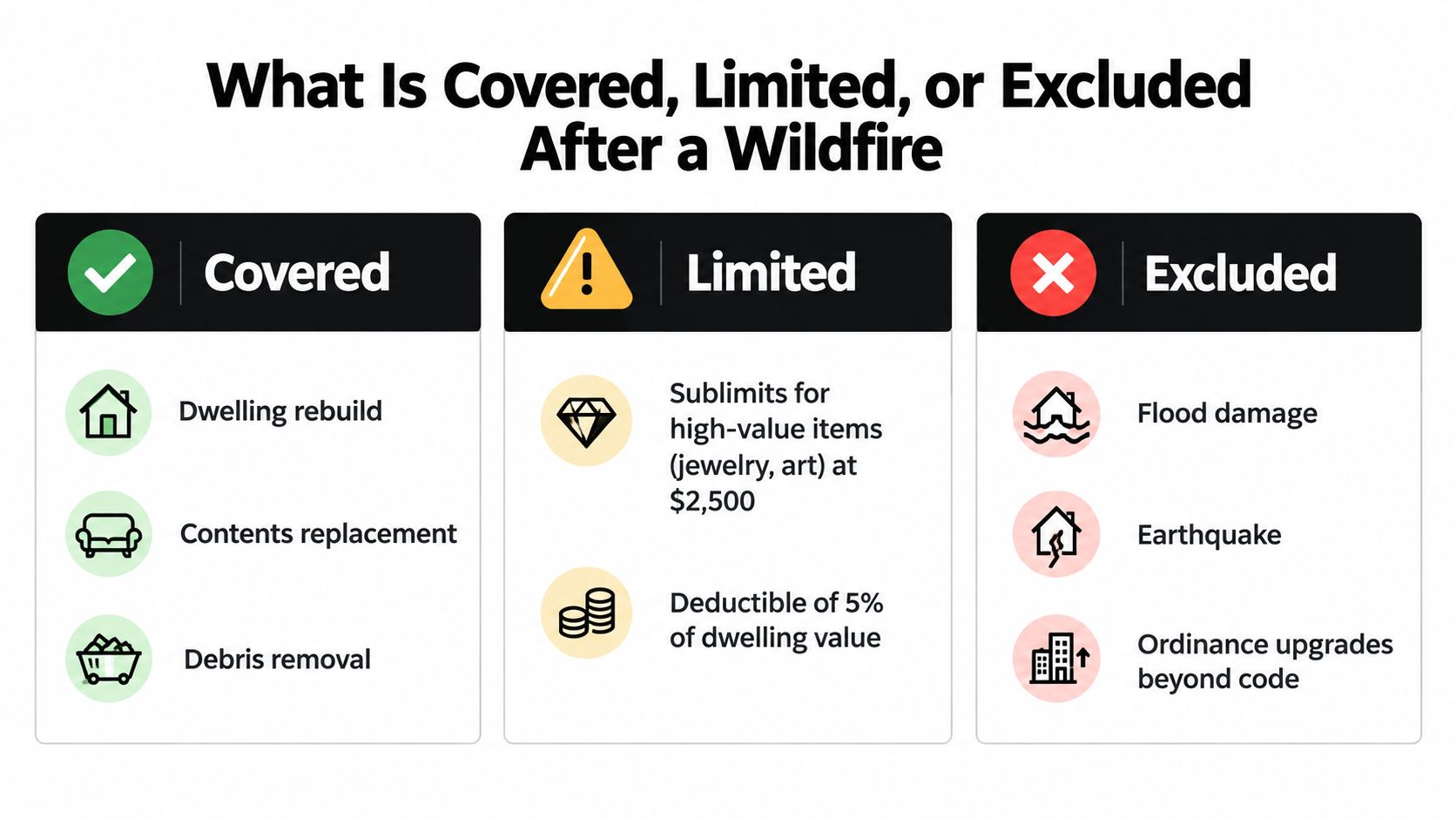
Homeowners often expect wildfire insurance coverage to handle the obvious damage. Burned framing, a destroyed roof, smoke throughout the house, and a hotel bill after an evacuation all feel like the kinds of losses insurance should address. Often, they are. The problem starts when homeowners assume every wildfire-related cost falls neatly into a fully paid claim.
What is commonly covered
In a standard homeowners policy, wildfire losses often connect to several buckets of coverage:
- The home itself: Repair or rebuild of the insured structure after covered fire damage.
- Belongings inside the home: Clothing, furniture, appliances, and electronics damaged by fire or smoke.
- Temporary living costs: Hotel, rental, and related living expenses if the house can't be occupied because of a covered loss.
- Cleanup and related property categories: Debris removal and, depending on the policy, some payment for outbuildings or landscaping.
Smoke damage deserves extra attention because it's often more invasive than people expect. Soot can move through HVAC systems, settle inside cabinets, and cling to textiles long after the flames are gone. If you want a practical walkthrough of cleanup issues, this guide to fire damage advice from PostDamage is useful because it breaks down how smoke damage can linger in places homeowners don't immediately notice.
Where payouts often shrink
The painful surprises usually come from limitations, not total denials. Recent California industry reporting says carriers are increasingly using wildfire sublimits, high deductibles, and wildfire-specific exclusions, and that means a homeowner may technically be insured while still facing a large uncovered loss, according to the California Department of Insurance press release on market reforms and FAIR Plan issues.
That's the heart of the question: not “Am I covered?” but “How much will be paid if wildfire is the cause?”
Here's where to look closely:
| Loss area | What can reduce payment |
|---|---|
| Personal property | Sublimits for certain categories of items |
| Temporary housing | Time or dollar limits that don't match a long rebuild |
| Exterior features | Landscaping or detached structure limits |
| Wildfire loss overall | A higher deductible tied to the event |
What may be excluded or outside the wildfire claim
Some losses are adjacent to wildfire but not automatically included. A common example is flood or mudflow damage after a burn scar event. Another is earthquake damage that happens separately. Code upgrade costs can also create dispute or shortfall issues depending on the policy structure and endorsements.
If two homes burn on the same street, one owner can still walk away with a much larger out-of-pocket bill because of lower limits, tighter sublimits, or a deductible that looked manageable before the loss.
That's why a coverage review should test the policy against a total-loss scenario, a smoke-only scenario, and a long-displacement scenario.
California Fair Plan and Standard Market Options Compared
When homeowners can't get acceptable coverage through a traditional insurer, the California FAIR Plan often becomes the fallback. It's important, but it isn't the same thing as a full standard homeowners policy. Treat it as a specific tool for a specific problem.
The FAIR Plan is described as a last-resort wildfire and fire policy, and its standard residential coverage is limited to fire, lightning, internal explosion, and smoke damage, according to this explanation of the California FAIR Plan and its coverage mechanics. Optional add-ons can include structure replacement, other structures, personal property, wildfire debris removal, landscaping, flood insurance, and earthquake insurance.
Side by side comparison
| Feature | Standard Market Policy | California FAIR Plan |
|---|---|---|
| Basic role | Broad homeowners coverage through an admitted or traditional carrier | Last-resort fire-focused coverage when standard options are limited |
| Wildfire and fire response | Usually part of the homeowners policy structure | Built around fire-related perils in the base form |
| Personal property | Commonly included within the policy package | May require optional add-ons depending on needs |
| Additional living expense | Often part of a standard homeowners package | Needs close review because FAIR Plan structure differs |
| Other perils | Broader overall package depending on form | Narrower base coverage |
| Gaps to review | Deductibles, valuation method, sublimits | Need for supplemental coverage to fill non-fire gaps |
Who tends to fit each option
A standard market policy is usually the cleaner fit when available at workable terms. It's more likely to package the home, belongings, liability, and living expense coverage in one contract.
The FAIR Plan fits homeowners who've run into nonrenewal, limited availability, or underwriting restrictions because of wildfire exposure. In those cases, the challenge isn't just getting the FAIR Plan in place. It's identifying what the FAIR Plan does not cover well enough on its own and whether a companion policy is needed for broader protection.
The practical review point
Ask for a side-by-side review with your current policy declarations and the proposed FAIR Plan setup. Don't compare by premium first. Compare by:
- Dwelling scope: What exactly rebuilds the structure?
- Contents treatment: What happens to your belongings after smoke or fire loss?
- Living expense support: What pays if you can't return for months?
- Missing perils: What needs separate protection?
That comparison is where many California homeowners finally see the difference between being insured and being adequately insured.
What Drives Cost Deductibles and Availability in Wildfire Areas
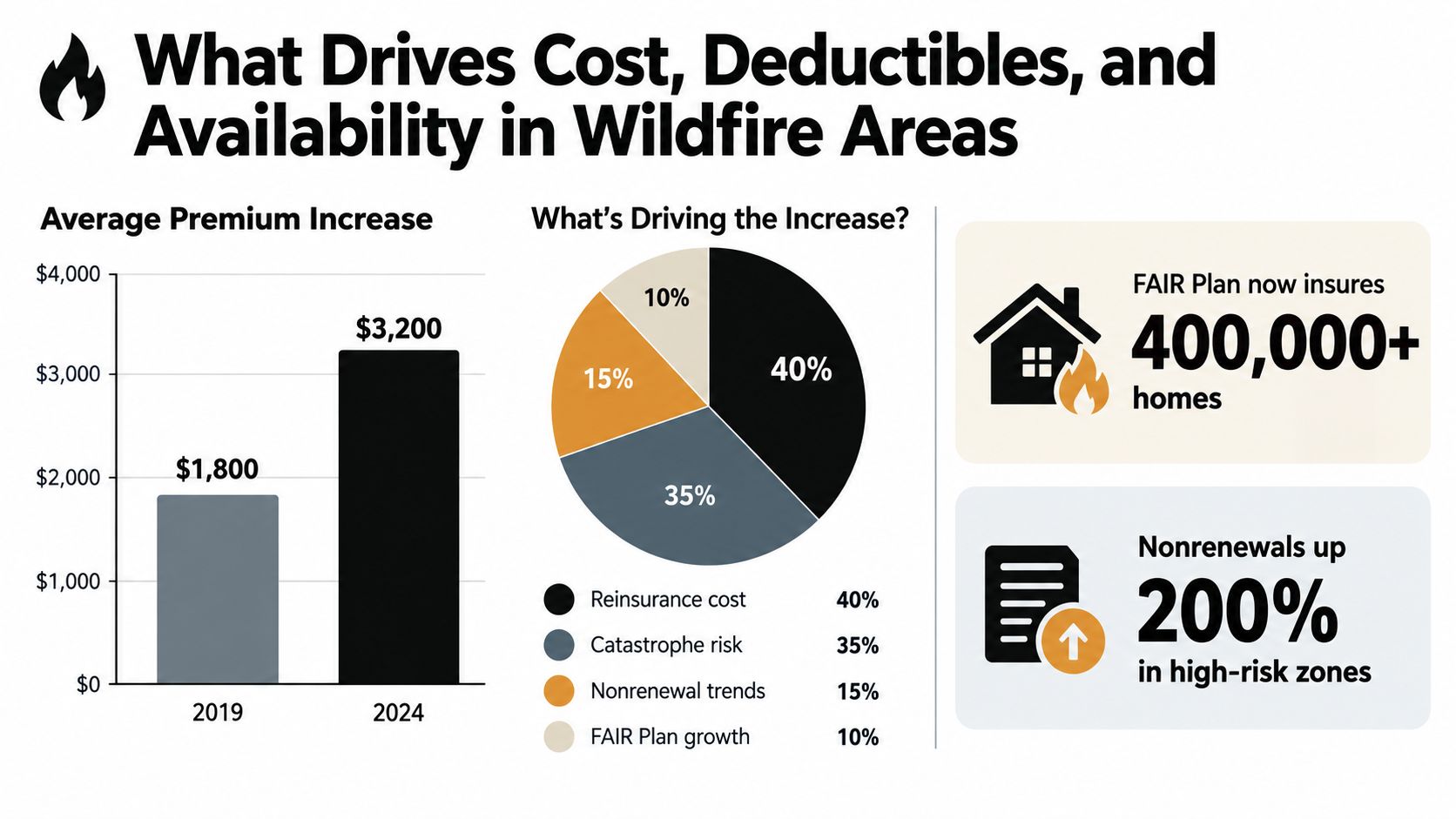
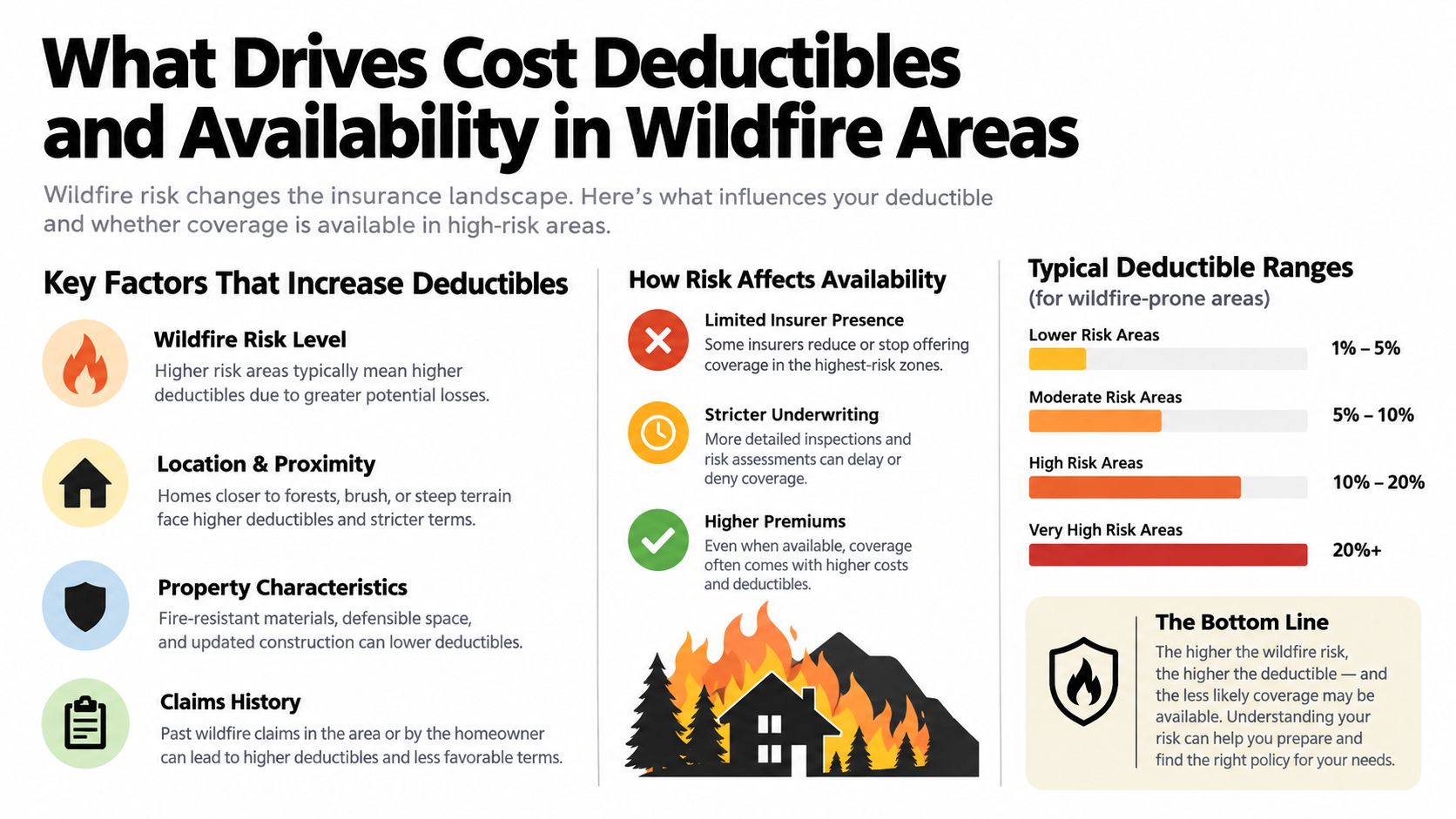
Premiums in wildfire-prone parts of California don't rise for just one reason. Insurers price for expected losses, concentrated catastrophe exposure, and the cost of protecting their own balance sheets through reinsurance. Homeowners usually feel all of that at quote time as higher premiums, tighter underwriting, larger deductibles, or a nonrenewal notice.
One of the clearest signs of stress is how much risk has moved into the FAIR Plan. Its total insured value reached $633 billion as of Sept. 30, 2025, a 314% increase since 2021, and by December 2025 its total exposure was reported at $724 billion with 668,609 policies in force, up 230% since September 2022, according to MoneyGeek's analysis of California wildfire insurance, FAIR Plan growth, and insurer retreat. That same analysis says the FAIR Plan now represents about 6.2% of California's residential property and casualty market. A separate analysis cited there found that the 10 California counties with the highest wildfire exposure had nonrenewal rates of 16.3% in 2023, nearly double the statewide rate of 8.7%, and up from about 5% in 2015.
Reinsurance is part of your premium whether you see it or not
Wildfire coverage is increasingly structured around catastrophe reinsurance, not just the insurer's direct promise to pay. The California FAIR Plan's 2024 to 2025 program covered the first $900 million of wildfire losses itself and then extended total protection to nearly $5.8 billion, while reinsurance spending rose from about $299 million in 2023 to $425 million in 2024, a roughly 42% increase, according to the RAND analysis of the FAIR Plan's wildfire reinsurance structure.
When reinsurance gets more expensive, primary insurance rarely gets cheaper.
Why quotes feel harsher after big fire events
McKinsey estimated that California's private homeowners insurance market faces a total coverage shortfall of $1.35 trillion to $2.00 trillion, including a wildfire-only private-insurance gap of $800 billion to $1.3 trillion for single-family homes and an additional potential FAIR Plan exposure of $550 billion to $700 billion, according to McKinsey's analysis of California's homeowners insurance resilience challenge. The same analysis notes that after the January 2025 Los Angeles wildfires, insurers had paid more than $4 billion within weeks, with preliminary insured-loss estimates ranging from $28 billion to $45 billion. By February 5, 2025, a UCLA analysis cited there reported 33,717 insurance claims filed and $6.94 billion paid out for residential and commercial claims.
Higher deductibles and harder underwriting aren't random. Insurers are reacting to concentrated losses, the cost of reinsurance, and the sheer amount of property value exposed in wildfire zones.
For the homeowner, the takeaway is practical. Don't chase the lowest premium without checking the dwelling limit, the wildfire deductible, and whether the quote comes with restrictions that weaken the payout after a loss.
Mitigation Steps That Protect Your Home and Your Coverage
A lot of homeowners ask, "What can I do to stay covered?" The better question is, "What will help my insurer say yes to the risk, and what will help me get fully paid after a loss?" Those are related, but they are not the same.
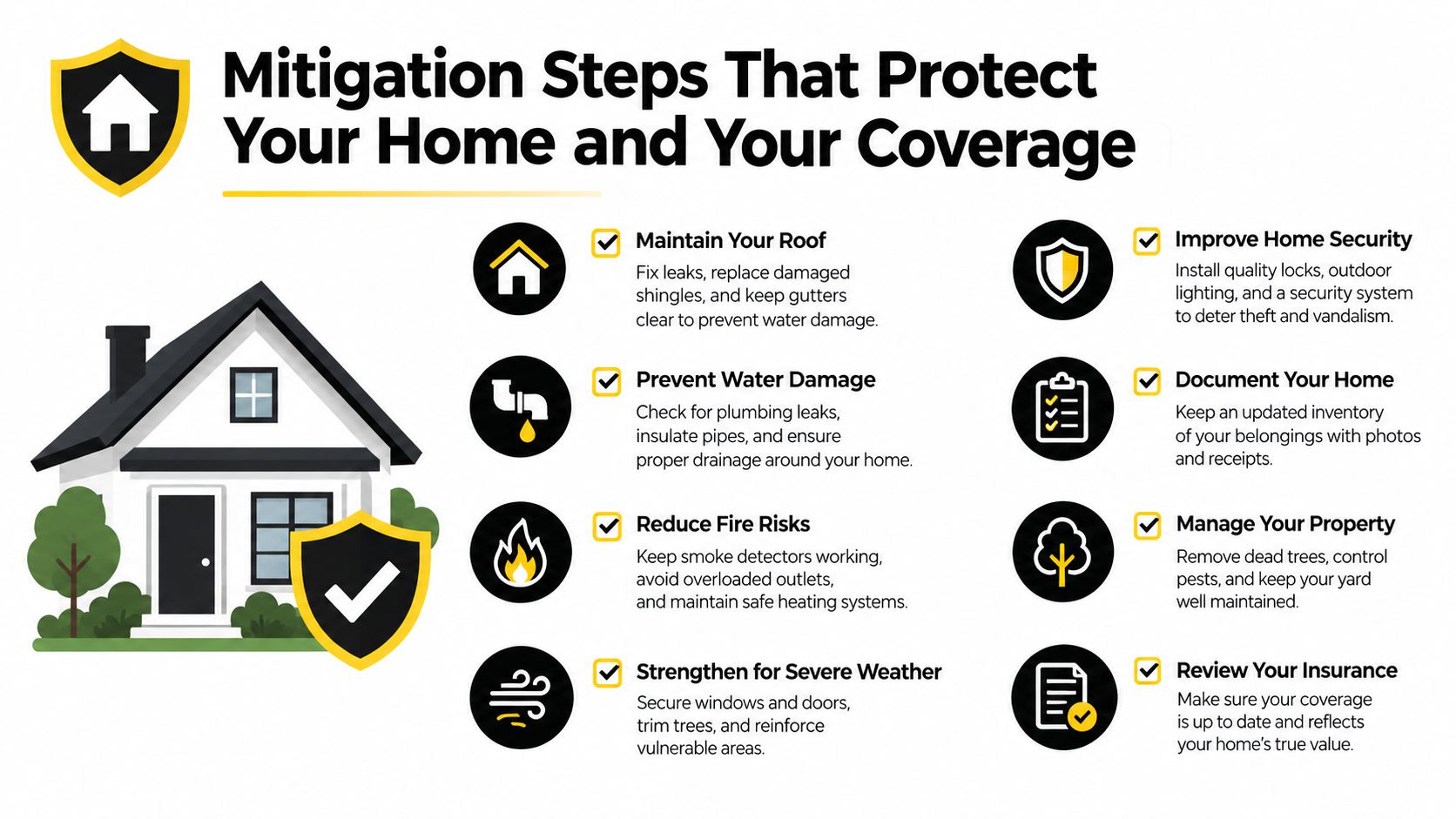
Wildfire protection works like two layers. One layer is the house itself: roof, vents, gutters, siding, landscaping. The other layer is your paperwork: limits, photos, receipts, and proof of upgrades. If either layer is weak, the payout can fall short even when the policy exists.
A practical checklist
- Clear the immediate surroundings: Remove combustible debris, keep roofs and gutters clean, and maintain defensible space required or recommended for your area.
- Use fire-aware materials where possible: Roofing, vents, siding details, and ember-resistant screening can affect both fire risk and underwriting.
- Document the home before there's a loss: Keep photos, video walkthroughs, and major purchase records stored offsite or in the cloud.
- Review the dwelling limit every year: Replacement cost should track what it would take to rebuild the home, not what a buyer might pay for the property.
- Inventory belongings room by room: Personal property claims are easier to value when you have a list, photos, and receipts instead of trying to rebuild your memory after an evacuation.
- Keep proof of upgrades: If you replaced a roof, windows, or vents, save the invoices and provide them during underwriting or renewal review.
One step causes confusion, so let's slow it down. Cleaning brush and upgrading vents can help you qualify for coverage or keep coverage. Updating your dwelling limit and documenting belongings helps determine how much money comes back to you after a claim. Home hardening helps reduce the chance of loss. Good records help reduce the chance of being underpaid.
That difference matters.
A wildfire claim often turns into a documentation claim within days. After a sudden evacuation, people usually remember the big items first. Then they forget the ladder in the garage, the patio set, the backup fridge, the holiday decorations, the power tools, and the small kitchen appliances. Those missing details can add up fast, especially if your policy already has sublimits or a deductible that takes the first slice out of the payment.
I tell clients to treat a home inventory like a phone backup. You hope you never need it, but when something disappears all at once, you do not want to rebuild it from memory. If you want a plain-English starting point on related coverage topics, these California insurance coverage guides can help.
The smoother wildfire claims are often the ones with better records, clearer upgrade history, and limits that were reviewed before the fire, not after it.
How to Obtain and Compare Wildfire Coverage With Confidence
When you start shopping, keep the comparison controlled. Ask each carrier or agent to quote the same dwelling amount, similar deductible structure, and the same assumptions about contents and additional living expense. If one quote looks dramatically cheaper, there's usually a reason. It may be a narrower form, a higher deductible, a lower limit, or a hidden restriction that only shows up after a loss.
A clean comparison process
Use this sequence:
Start with rebuilding math
Make sure the dwelling limit reflects replacement cost, not market value.Check how the policy pays for belongings
Replacement cost and actual cash value don't feel the same after a fire.Ask about wildfire-specific restrictions
Sublimits, exclusions, and higher deductibles show up.Compare standard-market and FAIR Plan paths if needed
If availability is tight, review both instead of assuming one route is automatically better.Bundle carefully, not blindly
Many households review home insurance alongside auto insurance, car insurance, renters insurance, and life insurance because overall premium changes can affect the budget.
For drivers, remember that California's auto insurance minimums increased for policies issued or renewed on or after January 1, 2025, to 30/60/15, meaning $30,000 for bodily injury or death to one person, $60,000 per accident for bodily injury or death to more than one person, and $15,000 for property damage per accident, according to the California Department of Insurance alert on 2025 insurance changes. That matters if you're reviewing your whole insurance picture at once.
Working with an agent
An independent agency can help if you want multiple carrier options reviewed side by side, especially when wildfire risk complicates placement. One example is getting a California insurance quote through an agency that can compare home insurance, renters insurance, auto insurance, and FAIR Plan combinations in one review. Mai & Associates is one such California agency.
Ask for the quote review in writing. You want to see:
- The dwelling limit
- The deductible
- Whether wildfire has special restrictions
- How contents are valued
- What temporary housing support looks like
- Whether a FAIR Plan setup needs supplemental coverage
The right policy is the one that still makes sense on the worst day, not the one that only looks good on the quote screen.
If you want a second set of eyes on your wildfire insurance coverage, Mai & Associates can review standard home insurance, California FAIR Plan arrangements, renters insurance, auto insurance, car insurance, and life insurance with a focus on coverage gaps and budget fit. If you'd like to compare options or check whether your current limits are enough for a wildfire loss, visit Mai & Associates.