Wildfire Insurance California: Essential Guide for 2026

You step outside in October and find ash on the hood of your car. An evacuation alert is already on your phone. Then comes the question most homeowners postpone until it's too late: Will my insurance pay to rebuild this house, replace what's inside, and cover somewhere for my family to live?
That question now reaches far beyond the highest-risk hillside communities. California wildfire insurance affects home insurance, renters insurance, car insurance, and even life insurance planning because a major loss can disrupt housing, transportation, income, and family finances at the same time. The California FAIR Plan, once treated as a narrow insurer of last resort, has become a major pressure point for the entire market.
This guide gives you a practical path. You'll see what wildfire coverage includes, why private carriers are tightening underwriting, where the FAIR Plan falls short, how supplemental policies fit together, what mitigation can accomplish, and how to prepare for a claim before smoke is on the horizon.
Why Wildfire Insurance in California Is Different Now
A renewal notice can arrive while your home still has a current policy. The difficult questions follow quickly: are your dwelling limits enough, will the carrier renew, and would a claim pay for rebuilding, belongings, and temporary housing? Wildfire coverage isn't one single promise. It combines dwelling protection, other structures, personal property, additional living expenses, and personal liability. The policy wording and limits control what you receive.
Private insurers are under pressure from fires that produce frequent, severe losses. California homeowners' policies generated 108,330 claims and $12.7 billion in incurred losses from 2018 through 2021. Across six residential policy types, that period produced 199,363 fire-and-smoke claims and $16.2 billion in incurred losses, according to the California Assembly insurance committee background document.
That loss history reaches your next renewal. A carrier can raise the premium, narrow its appetite for a neighborhood, order a property inspection, or issue a nonrenewal notice. Reinsurance costs, catastrophe models, vegetation, roof condition, and access for fire crews all affect the decision. Your practical response is to review coverage before the notice arrives, not after.
The backstop is carrying more of the market
The California FAIR Plan has moved beyond a niche last resort. It grew from about 202,897 dwelling policies in 2020 to 451,799 in 2024, while total exposure reached roughly $458 billion, nearly tripling from 2020 levels, as reported in coverage of California's changing insurance rules and FAIR Plan growth.
That growth affects private-market shoppers too. As more homes enter the residual market, the state-backed system holds larger concentrations of wildfire risk. In Los Angeles County, independent analysis reported 112,945 FAIR Plan policies representing $112.2 billion in exposure as of September 30, 2024, alongside California's wildfire and insurance analysis resources.
Treat wildfire protection as a coverage design problem. Check limits, compare private insurance with FAIR Plan options, document mitigation, and organize claim records now. A Santa Rosa home insurance review can identify gaps tied to a fire-exposed property.
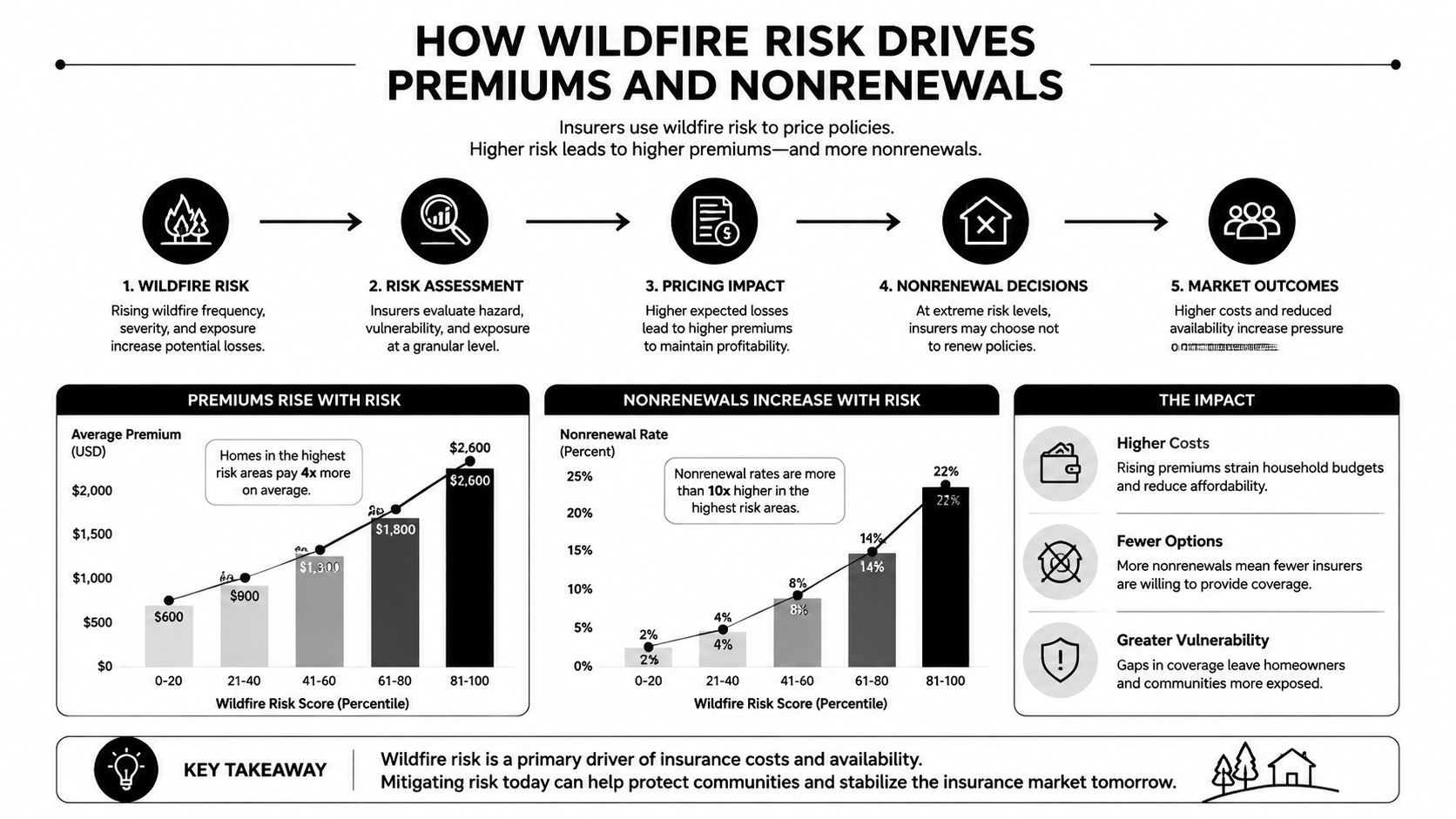
How Wildfire Risk Drives Premiums and Nonrenewals
A renewal notice can change your budget even when nothing about the house has changed. Private insurers combine catastrophe models, fire history, brush and wildland-urban interface exposure, road access, roof materials, defensible space, nearby structures, and claims history. Those factors place the property in an underwriting tier that determines whether a carrier will offer coverage and what it will charge.
Two homes in the same ZIP code can receive different decisions. A Class A roof and documented vegetation clearance may help one property, while wood shakes, overgrown vegetation, or narrow access roads hurt another. Reinsurance matters too. As reinsurance becomes more expensive or less available, carriers can raise rates, restrict new business, increase deductibles, or reduce exposure through nonrenewals.
The pressure is not theoretical. Moody's reported that wildfires caused more than US$70 billion in insured losses across 40 major wildfires over the past decade. Insurers paid US$1.08 for every dollar of premium, producing a 108% loss ratio, according to the data summarized earlier.
What to inspect on a renewal notice
Read beyond the premium. Compare the dwelling limit, fire deductible, other structures limit, personal property settlement method, additional living expense limit, liability limit, exclusions, and endorsements with the prior declaration page.
- Premium change: Ask which rating factors changed and verify the new total against the previous policy.
- Deductible structure: A percentage-based wildfire deductible can create a far larger out-of-pocket obligation than a flat dollar deductible.
- Nonrenewal language: Start looking for replacement coverage as soon as the notice arrives. Waiting until the final week can leave you with fewer private-market choices and may push you toward the FAIR Plan.
- Property facts: Correct inaccurate roof, construction, occupancy, acreage, or mitigation information before binding a new policy.
California is also using forward-looking wildfire catastrophe models. The Department of Insurance framework allows insurers using Department-reviewed models to commit to writing at least 85% of their statewide market share in wildfire-distressed areas within two years of rate approval. The models must account for homeowner and community mitigation. The California Department of Insurance announcement describes the framework as a way to improve voluntary-market availability and help policyholders transition away from the FAIR Plan.
Your next move is practical: verify the notice, document mitigation, and shop before the deadline.
California FAIR Plan vs Private Wildfire Coverage
The FAIR Plan can keep a homeowner from having no basic fire policy at all, but it shouldn't automatically be treated as a full replacement for private home insurance. It's a state-mandated association offering basic fire protection within statutory limits. Private coverage usually offers a broader package, but it comes with stricter eligibility rules and can disappear from an area when the carrier's underwriting appetite changes.
The right comparison is not “cheap versus expensive.” It's limited backstop versus broader protection with tighter underwriting.
| Feature | California FAIR Plan | Private Wildfire Coverage |
|---|---|---|
| Eligibility | Designed for eligible applicants who can't obtain comparable coverage in the voluntary market | Depends on carrier underwriting, property condition, location, mitigation, and occupancy |
| Core protection | Basic fire coverage for covered property, subject to policy terms and statutory limits | May include broader dwelling, personal property, liability, and additional living expense protection |
| Dwelling settlement | Capped and not guaranteed to provide full replacement cost | May offer replacement-cost features, subject to limits and policy conditions |
| Personal property | Available, but coverage and settlement terms require close review | Often broader, with options for replacement cost and scheduled valuables |
| Liability | Limited or may require separate protection | Typically available through the homeowners policy, with higher-limit options |
| Other perils | Narrower fire-focused protection | May include theft, water, liability, and other covered perils |
| Deductibles | Can be less flexible and may be substantial | More deductible choices, depending on the carrier |
| Market availability | Backstop when private options are unavailable | Tighter in high-risk areas and may be affected by moratoria or nonrenewals |
| Common structure | FAIR Plan plus a Difference in Conditions or wrap policy | Standalone homeowners, dwelling fire, surplus lines, or specialty wildfire policy |
Why the wrap policy matters
A FAIR Plan policy often handles the core fire risk, while a Difference in Conditions policy, commonly called a DIC or wrap, fills important gaps. Depending on the contract, it may provide liability, water damage, theft, broader personal property protection, and additional living expense coverage.
Don't assume the two policies fit together automatically. Confirm that the dwelling limits align, the loss settlement language is coordinated, and the combined deductibles are affordable. The California FAIR Plan's official key statistics show how far the system has grown. As of June 2026, it had 696,562 policies in force, up 8% since September 2025 and 157% since September 2022.
That growth makes a policy review more important, not less. If you're on the FAIR Plan, ask an agent to test private, surplus lines, DIC, and specialty-market combinations rather than accepting the first available structure.
Coverage Options You Can Layer On
A homeowner in a wildfire-prone area may need several policies working together. The mistake is buying the fire policy first and discovering later that liability, water damage, contents, or temporary housing protection was never attached.
Start with the underlying home policy or dwelling fire policy. A standard HO-3 may be available with a wildfire endorsement, but a carrier can restrict eligibility, apply a special deductible, or limit protection in brush-exposed areas. Standalone wildfire products from specialty carriers such as Palomar and Anchor may offer another route, subject to their underwriting rules and policy wording.
Match the layer to the gap
| Coverage Type | What It Covers | Best For | Typical Limits |
|---|---|---|---|
| Wildfire endorsement | Adds or modifies fire protection on an existing home policy | Homeowners who can retain a standard policy but need stronger wildfire terms | Set by the underlying policy and endorsement |
| Standalone wildfire policy | Dedicated protection for wildfire-related property exposure | Homes that don't fit ordinary carrier underwriting | Set by the specialty carrier and property valuation |
| Difference in Conditions wrap | Can add broader perils, liability, theft, water protection, and living expense coverage | FAIR Plan policyholders needing a more complete insurance package | Selected through the wrap policy, subject to underwriting |
| Dwelling fire policy | Structure-focused protection, sometimes with limited contents or liability options | Rental homes, secondary homes, or properties outside standard homeowners underwriting | Selected by the insurer |
| Excess or umbrella liability | Adds liability limits above underlying policies | High-net-worth households, landlords, and homeowners with substantial assets | Must coordinate with required underlying limits |
| Earthquake policy | Covers earthquake damage, which ordinary home policies generally exclude | Homeowners concerned about ground movement alongside wildfire exposure | Separate policy limits, deductibles, and exclusions apply |
Don't confuse earthquake and wildfire protection
Earthquake and wildfire coverage respond to different causes of loss. A fire following an earthquake can create a difficult causation and coverage question, so ask how the policies coordinate and whether one policy's exclusion affects the other. Also check for brush-zone sublimits, debris-removal wording, ordinance or law protection, and what happens to coverage after a declared fire.
Order matters. Secure the underlying policy, confirm the wildfire endorsement or standalone policy, add the DIC wrap if needed, and then place excess liability after verifying the required underlying limits. Endorsements and supplemental policies should be attached before binding, not promised for later.
A California home insurance review is useful when you need to compare these layers against your actual rebuild cost, belongings, liability exposure, and budget. Renters should use the same discipline. A renters policy won't insure the building, but it can protect contents, liability, and additional living expenses when a covered wildfire loss makes the unit uninhabitable.
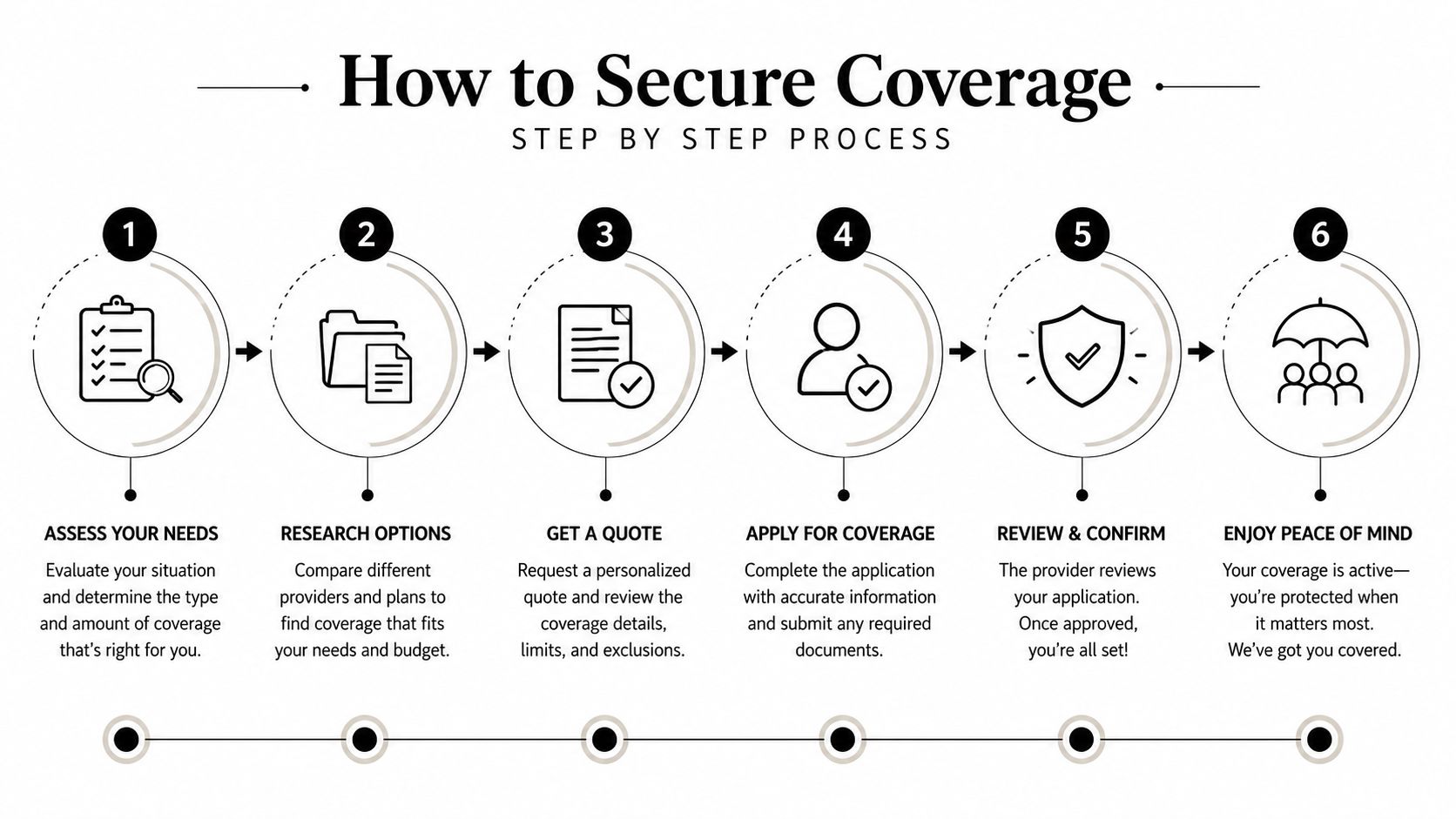
How to Secure Coverage Step by Step
Wildfire underwriting rewards preparation. Carriers want clean property information, proof of replacement cost, visible mitigation, and a credible explanation of prior losses. You'll move faster when those materials are ready before an agent submits the application.
1. Build the submission file
Gather your current declaration page, replacement-cost estimate, prior claims history, property photographs, roof information, inspection reports, and mitigation receipts. Include permits or invoices for roofing, windows, decks, vegetation removal, ember-resistant vents, and other hardening work.
2. Verify the property description
Confirm the year built, square footage, construction type, roof age and material, heating system, occupancy, detached structures, acreage, and distance from surrounding brush. An incorrect property record can trigger an avoidable referral or decline.
3. Document defensible space
Take clear photographs of the immediate area around the house, access roads, fences, decks, propane tanks, wood piles, and outbuildings. Show that vegetation has been cleared and maintained, rather than relying on a verbal statement.
4. Prepare for inspection
The inspector may check the roof, eaves, vents, windows, gutters, siding, decks, garage, and clearance around the structure. A Class A fire-rated roof, enclosed eaves, ember-resistant vents, and defensible space can make a meaningful difference in underwriting review.
5. Address red flags before submission
Wood-shake roofing, unmanaged brush, vacant status, prior nonrenewals, repeated losses, and difficult fire access can lead to a declination or surcharge. Fix what you can and provide evidence. Don't hide a prior nonrenewal or claim. Underwriting databases and application disclosures can expose inconsistencies later.
6. Bind and confirm every layer
Before the policy starts, confirm the effective date, payment arrangement, deductibles, endorsements, policy numbers, inspection requirements, and certificate delivery. Keep the binder, invoices, signed applications, and final declarations page together.
Start well before your current policy expires. A California insurance guides resource can help you organize the documents, but an agent still needs enough time to obtain alternatives if the first carrier declines the property.
Mitigation That Actually Lowers Your Risk
Mitigation isn't just a safety project. It's underwriting evidence. A carrier may use the condition of your roof, vents, windows, decks, vegetation, and access route when deciding whether to quote, renew, surcharge, or refer the property.
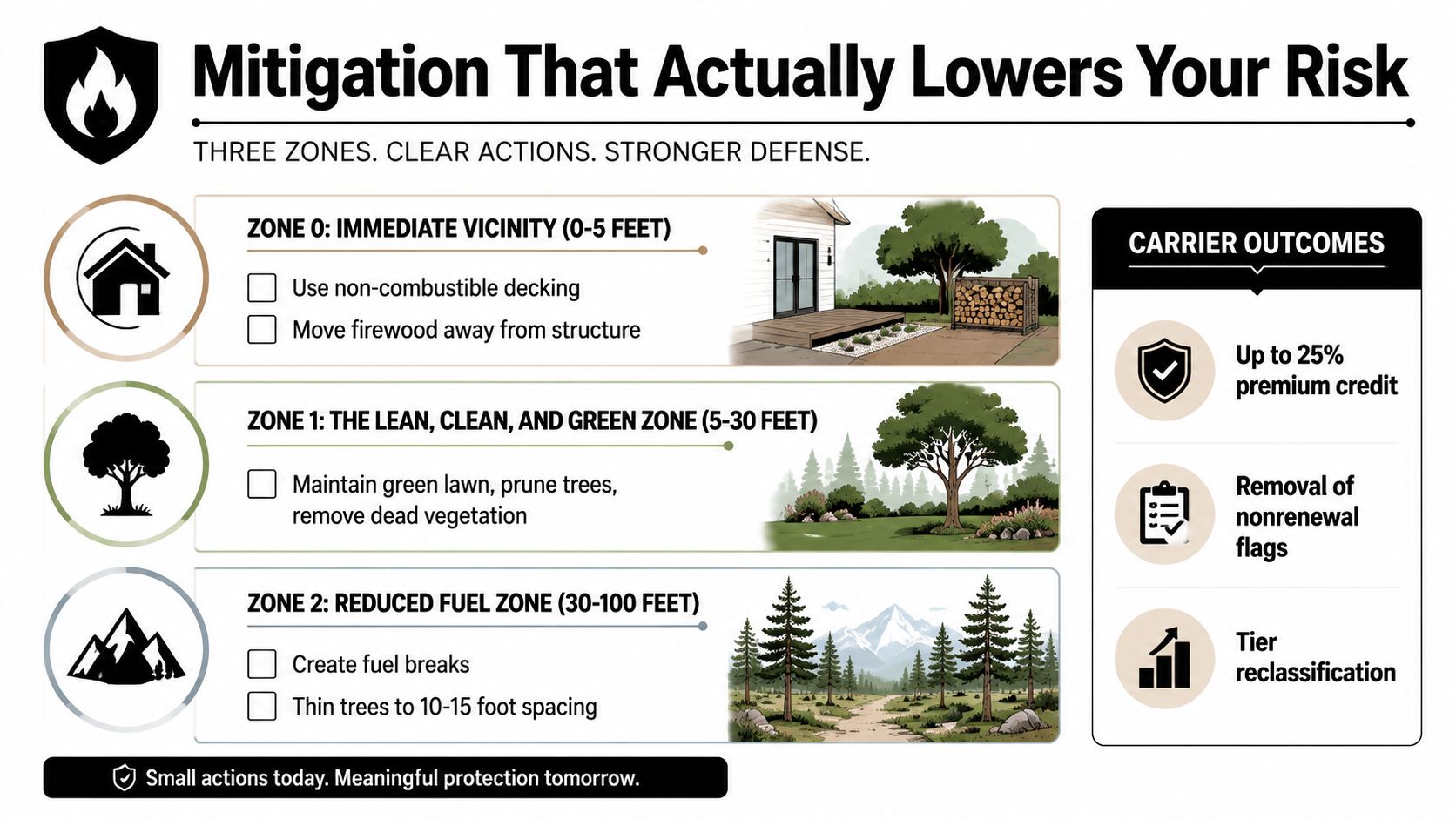
Start at the structure, then work outward. The area closest to the house deserves the most attention because windblown embers can collect under decks, in gutters, beside fences, and around vents. Use noncombustible materials where practical, move firewood away from the structure, seal garage gaps, and keep gutters clear.
Make the work visible to the carrier
California's defensible-space rules under PRC 4291 are a starting point, not a substitute for a property-specific plan. Maintain the areas around the home, prune trees, remove dead vegetation, thin dense growth, and keep access clear for emergency responders. Upgrade vulnerable decks, install dual-pane tempered glass where appropriate, enclose exposed eaves, and use gutter guards that don't create a maintenance problem.
- Immediate area: Focus on noncombustible decking, ember entry points, firewood placement, fences, gutters, and the structure's perimeter.
- Near-home vegetation: Keep grass and plants maintained, prune branches, remove dead material, and separate ornamental landscaping from the building.
- Outer fuel area: Thin trees, manage brush, create practical fuel breaks, and maintain the space over time instead of treating clearance as a one-time project.
Document every improvement with dated photographs, invoices, permits, contractor descriptions, and before-and-after images. The Insurance Institute for Business & Home Safety's Wildfire Prepared designation may also support a carrier's property review when the home meets the relevant requirements.
There's no honest universal premium reduction to promise. Mitigation can improve eligibility, support a credit, remove a concern, or help a carrier classify the property more favorably, but each insurer applies its own rules. Ask for the exact documentation the underwriter needs before spending heavily.
A backup generator can also support household resilience during utility shutoffs, although it doesn't replace insurance or defensible space. Homeowners looking for a qualified local resource can review Redding standby power installers before choosing an installation company.
Filing a Wildfire Claim the Right Way
A strong wildfire claim starts before the fire. After a total or partial loss, the insurer can only evaluate what you can prove, what the policy covers, and what it costs to repair or replace. Your documentation becomes key.
Create a home inventory now. Photograph and video every room, closet, garage, exterior wall, appliance, tool, piece of furniture, electronics setup, and valuable item. Record serial numbers, save receipts for major purchases, and store the inventory offsite or in secure cloud storage. Keep copies of your declarations page, FAIR Plan policy, DIC wrap, endorsements, mortgage information, and contact details in a fireproof location and somewhere outside the home.
Practical rule: Don't wait for an evacuation warning to begin documenting your property.
The first 72 hours
Notify the carrier immediately through its wildfire claims hotline or claims portal. Ask for the claim number, assigned adjuster, emergency-expense instructions, temporary housing process, and rules for emergency repairs.
Photograph damage before cleanup whenever it's safe. Keep receipts for hotels, meals, transportation, clothing, storage, security, board-up work, and other reasonable emergency expenses. Don't discard damaged property until the insurer has inspected it unless a safety issue requires removal. Preserve samples or photographs when disposal is unavoidable.
You can consult a licensed public adjuster, but review any contingency agreement before signing. Understand the fee, services, termination terms, and who controls communications. Don't accept the first estimate just because you're exhausted. Compare it against your policy's dwelling limit, replacement-cost provisions, code-upgrade coverage, debris removal, contents settlement, and additional living expense protection.
California losses can involve the FAIR Plan and private supplemental policies, so notify every relevant insurer. After the January 2025 fires, the Department of Insurance reported that the FAIR Plan had received 4,794 claims from the Palisades and Eaton fires and paid $914 million to policyholders, as described in its updated guidance on FAIR Plan assessment recoupment.
For complex losses, specialized storm damage claim assistance can help you organize damage evidence and claim communications. Use any outside professional carefully, and keep your own complete file.
Questions California Homeowners Quietly Worry About
Why am I paying a wildfire surcharge if my house hasn't burned?
Insurance pricing reflects pooled risk, not only your personal loss history. After the Los Angeles wildfires, California ordered a $1 billion assessment on private insurers in 2025, and a 2026 court ruling upheld wildfire surcharges on home policies. The median fee was reported as $28 in the Reuters report on the statewide wildfire bill.
That charge is a reminder that wildfire losses can reach ordinary policyholders through assessments and premiums, including homeowners outside the most damaged ZIP codes. Ask your agent to show where a surcharge appears and whether it's a one-time assessment, a renewal adjustment, or a policy-level charge.
Can the FAIR Plan pay a major loss?
The FAIR Plan is designed as a backstop, but its growing exposure deserves a candid conversation. The plan's total exposure reached $768 billion by June 2026, up 11% since September 2025 and 250% since September 2022, according to the California Assembly FAIR Plan hearing materials.
The plan can assess participating insurers and uses reinsurance, but homeowners shouldn't interpret that structure as unlimited replacement-cost protection. Review policy limits, settlement terms, assessment mechanics, and the availability of a DIC wrap. A full loss in an expensive community can exceed the limits you selected, even if the FAIR Plan pays according to its contract.
Does a broker give me more options than a captive agent?
Usually, an independent agent or broker can compare more markets than an agent tied to one carrier. That can include private admitted carriers, surplus lines, specialty wildfire products, FAIR Plan placement, and supplemental coverage. The quality of the advice still depends on the professional's access, licensing, and willingness to explain exclusions.
Mai & Associates offers California home, auto, renters, and life insurance, including FAIR Plan reviews and wildfire protection planning, and can compare coverage options for homeowners who need a coordinated solution.
Should I drop fire coverage to reduce the premium?
For a homeowner who could not rebuild without insurance, dropping fire coverage is generally a poor trade. A lower premium doesn't protect the mortgage, replacement cost, personal property, temporary housing, or liability exposure after a catastrophic loss. A better approach is to adjust limits and deductibles carefully, remove unnecessary extras, document mitigation, and compare layered policies.
What triggers a nonrenewal?
Carriers may reassess roof condition, vegetation, access, occupancy, prior claims, property location, and overall wildfire appetite. A nonrenewal isn't the same as a claim denial, but it can leave you with little time to find a replacement. Start shopping as soon as the notice arrives, and don't cancel the current policy until replacement coverage is confirmed.
Does an umbrella policy fix FAIR Plan liability gaps?
No. An umbrella generally sits above underlying liability policies and requires specific minimum limits. If the FAIR Plan provides limited liability or no suitable underlying coverage, the umbrella may not respond as you expect. Confirm the underlying requirements in writing, then coordinate the FAIR Plan, DIC wrap, auto insurance, and umbrella.
California insurance decisions now affect more than one policy. Your home insurance, renters insurance, car insurance, auto insurance, and life insurance should reflect the financial disruption a wildfire could create. Use the California homeowners insurance FAQ to prepare questions, then ask for a written comparison that shows limits, deductibles, exclusions, and the order in which each policy responds.
Mai & Associates can review your current home insurance, California FAIR Plan placement, DIC options, wildfire endorsements, and related auto, renters, or life insurance needs. Visit Mai & Associates to request a no-obligation comparison and speak with a licensed California agent before your next renewal notice arrives.