Why Is My Car Insurance So High and How Can I Lower It?
If you're staring at your latest bill wondering, "Why is my car insurance so high?" you're not alone. It's a question we hear all the time. The simple answer is that your rate is a unique blend of your personal profile—things you can often control, like your driving record—and broader market forces that are pushing prices up for everyone.
Knowing the difference between the two is the key to finding ways to save.
The Key Reasons Your California Car Insurance Is So High
That feeling of sticker shock when you open your auto insurance renewal is a frustratingly common experience for drivers all over California. The premium can feel like a random, confusing number, but it's actually the result of a very detailed risk calculation by your insurance provider.
Think of it like a recipe. The final price is cooked up from two main groups of ingredients: your personal risk factors and external market forces. Your personal factors are things like your driving history, the car you drive, where you park it at night, and the coverage levels you choose. Market forces, on the other hand, are the bigger economic trends affecting everyone—like inflation driving up the cost of car parts and rising medical expenses for injuries after a crash.
This chart gives you a great visual breakdown of how these different elements come together to create your final premium.
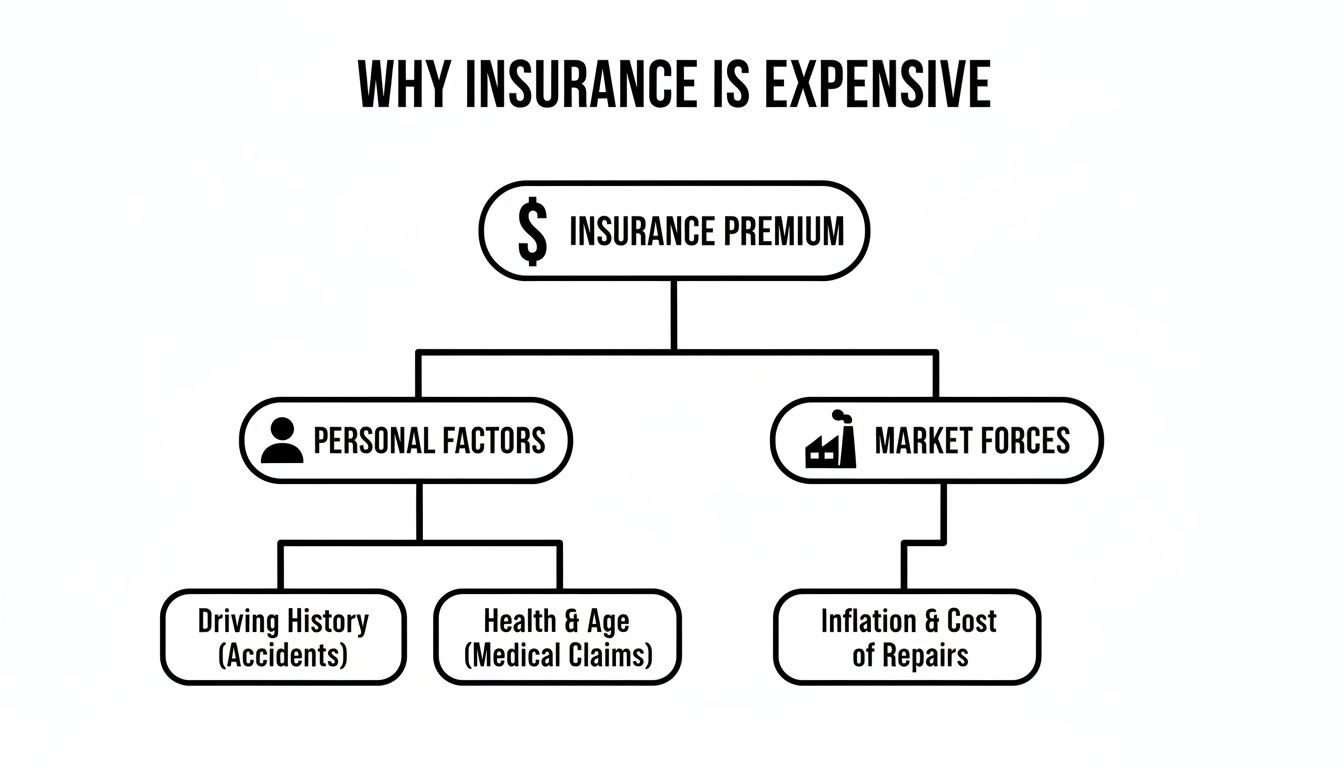
As the diagram shows, while you can't do much about industry-wide cost increases, you have a surprising amount of influence over your personal factors. That's where your real power to lower your bill lies.
Let's quickly break down the most common reasons your rate might be higher than you'd like.
| Factor | Why It Increases Your Premium | Can You Control It? |
|---|---|---|
| Driving Record | Tickets, accidents, or DUIs signal higher risk. | Yes |
| Vehicle Type | Expensive, sporty, or frequently stolen cars cost more to insure. | Yes |
| Location (ZIP Code) | Urban areas with more theft, vandalism, and accidents have higher rates. | Partially |
| Coverage Choices | Higher limits and lower deductibles increase your premium. | Yes |
| Claims History | A history of filing claims, especially at-fault ones, raises rates. | Yes |
Understanding these key areas helps you focus your efforts where they'll have the biggest impact on your wallet.
A Nationwide Trend Hits Home
This isn't just a California problem; it's a major financial squeeze on drivers everywhere. Between 2023 and 2025 alone, the average cost for full coverage car insurance skyrocketed by 31% across the country. That's a massive jump, adding an average of $625 to annual premiums as the entire industry scrambled to adjust for much higher claim costs.
In this guide, we'll unpack each of these cost drivers one by one. More importantly, we'll give you clear, actionable steps you can take to get a handle on your premium and find more affordable auto insurance in California. Once you pinpoint exactly why your rate is so high, you can start making smart changes that lead to real savings.
How Your Driving Record Impacts Your Insurance Rate

When you ask, "why is my car insurance so high?", the first place to look is usually in the rearview mirror. Of all the things that determine your premium, your driving record is arguably the most powerful.
Think of it like a report card for your driving habits. Every decision you make behind the wheel—good or bad—gets noted, and insurers use that history to predict how likely you are to file a claim in the future. A long history of safe, uneventful driving shows them you're a low-risk driver, which earns you better rates.
On the flip side, a record dotted with tickets and accidents tells a different story. It flags you as a higher risk, and your premium will climb to match.
Common Violations That Send Rates Soaring
Even a minor speeding ticket can nudge your rates up, but serious offenses can make them skyrocket. Insurance companies look at both the type of violation and how often they happen.
These are the usual suspects behind a premium hike:
- Speeding Tickets: One ticket for going just a few miles over the limit might only cause a small increase. But get a few of them, or get caught for excessive speed, and you'll be labeled a risk-taker with a much higher bill to show for it.
- At-Fault Accidents: If an accident is determined to be your fault, you can bet your premium is going up at renewal. The more damage you caused and the bigger the insurance payout, the steeper that increase will be.
- DUI/DWI Convictions: This is one of the biggest red flags for an insurer. A conviction for driving under the influence can cause a shocking rate increase, and some carriers may even cancel your policy altogether. You'll likely be required to get a special high-risk policy (known as an SR-22) just to legally drive again.
In California, most moving violations and at-fault accidents will hang around on your driving record—and affect your insurance rates—for at least three years. A major conviction like a DUI can haunt your premiums for a decade or more. It’s a powerful reminder that safe driving is a long-term financial game.
Your Claims History: The CLUE Report
It’s not just about what the DMV sees. Insurers also have their own tool: a shared database called the CLUE (Comprehensive Loss Underwriting Exchange) report.
This report is a seven-year history of every auto insurance claim you’ve ever filed. It shows the date of the claim, what it was for (collision, theft, a cracked windshield), and how much the insurance company paid out.
Even small claims matter. A pattern of frequent claims, regardless of size, can signal to an insurer that you're more likely to cost them money down the road. This is why it often makes more sense to pay for a minor repair out of your own pocket instead of filing a claim.
Every state has its own way of tracking these things. For instance, you can learn more about understanding Florida's points system and its effect on insurance to see how different regulations work.
At the end of the day, your best weapon for getting a lower car insurance rate is a clean driving and claims history. It’s the clearest way to prove you’re a safe bet.
Why The Car You Drive Is a Major Cost Factor
The car sitting in your driveway is a lot more than just a way to get from point A to point B. To an insurance company, it's a bundle of risk factors that they can translate directly into a price. Just like a clean driving record signals a safe driver, the specific vehicle you own tells an insurer a story about how much a potential claim might cost them.
In the world of insurance underwriting, not all cars are created equal. An underwriter will dig into the details of your car’s make, model, and year to size up a few critical things: its sticker price, how much parts and labor typically cost, its safety performance in crash tests, and unfortunately, how popular it is with car thieves.
Performance and Repair Costs
It probably comes as no surprise that a high-performance sports car with a roaring engine is seen as a bigger risk than a modest family sedan. The logic is pretty straightforward: a car built for speed is more likely to be driven at high speeds, which naturally increases the odds of a serious accident.
But it goes deeper than that. The cost to actually fix your car after a collision is a massive part of the equation. Luxury cars and those packed with modern tech—think integrated sensors, cameras, and sophisticated onboard computers—are incredibly expensive to repair. A simple fender bender on a basic commuter car might be a few hundred bucks, but the same exact incident in a high-end vehicle could easily run into the thousands. That drives up the potential claim cost, and your premium right along with it.
Key Takeaway: Think of it like this—insuring a simple, sturdy tool watch is always going to be cheaper than insuring a complex, diamond-encrusted luxury timepiece. The more valuable and intricate the item, the more it costs to protect because the potential loss is that much greater. The same principle applies directly to your car insurance.
Safety Ratings and Theft Rates
Insurers absolutely love safety. Vehicles that earn top marks in crash tests from organizations like the Insurance Institute for Highway Safety (IIHS) often come with lower premiums. Why? Because features like automatic emergency braking, blind-spot detection, and advanced airbag systems can significantly reduce the severity of accidents and injuries, meaning smaller claim payouts for the insurance company.
On the flip side, some of the most popular and reliable cars can become victims of their own success. Certain models are stolen far more often than others. If your car happens to be on that "most wanted" list, you can bet your comprehensive coverage rate will be higher to offset the increased theft risk.
The type of vehicle you drive is a huge piece of the puzzle. Understanding specific considerations, like the nuances of insuring a category car, can really clarify why your costs are what they are and how you might find more affordable options.
To make this clearer, let's break down how different types of vehicles are viewed by insurers.
Vehicle Type and Its Impact on Insurance Premiums
This table compares how different vehicle categories are typically assessed for insurance risk.
| Vehicle Type | Key Insurance Cost Factors | Typical Premium Impact |
|---|---|---|
| Family Sedan | Strong safety ratings, lower repair costs, widely available parts. | Lower |
| Sports Car | High horsepower, higher likelihood of speeding, expensive repair costs. | Higher |
| Luxury Vehicle | High replacement value, specialized parts and labor, advanced tech. | Highest |
| Electric Vehicle (EV) | High replacement value, specialized battery repair/replacement costs. | Higher |
| Minivan | Excellent safety features, associated with cautious driving habits. | Lowest |
| Large SUV/Truck | Higher potential to cause damage in an accident, moderate repair costs. | Moderate to High |
As you can see, a vehicle's primary purpose and features create a distinct risk profile that directly influences what you pay.
The Rise of Electric Vehicles in California
As more Californians make the switch to electric vehicles (EVs), many are getting a dose of sticker shock when their insurance renewal arrives. This trend is a perfect example of how new technology impacts rates.
In fact, it's projected that in 2025, insurance for a new EV will be about 23% more expensive than for a new gasoline-powered car. The reason comes down to cost: EVs are more expensive to repair, their high-tech battery systems require highly specialized technicians, and their higher initial value means a much bigger payout if the car is totaled in an accident. Your choice of vehicle is a critical piece of the puzzle when you're trying to figure out, "why is my car insurance so high?"
How Your California ZIP Code Shapes Your Premium
When an insurance company figures out your rate, they aren't just looking at you and your driving habits. They’re looking at your neighborhood. Where you park your car at night is a surprisingly huge factor, and your specific California ZIP code has a direct line to your final bill.
Think of it this way: your driving record helps predict how likely you are to file a claim. Your location, on the other hand, predicts the everyday risks your car faces just by being there. This is a core reason why your car insurance is so high if you happen to live in a busy or statistically riskier area.
What Insurers See in Your Neighborhood
Your address gives an insurance carrier a snapshot of the local environment. They crunch a ton of data to get a sense of the collective risk in your area, and a few key factors tend to drive costs up.
Traffic and Accident Frequency: It’s simple math—more cars on the road means a higher chance of a fender bender. Densely populated urban centers with constant traffic jams will almost always have higher insurance rates than sleepy rural towns.
Crime and Vandalism Rates: Insurers keep a close eye on local stats for car theft, break-ins, and vandalism. If your ZIP code has a reputation for these issues, the comprehensive coverage portion of your policy will cost you more.
Weather and Natural Disasters: California’s landscape is beautiful but unpredictable. Living near the coast might bring flood risks, while other areas have to worry about wildfires. Both can lead to a surge in claims, and that potential risk is baked into your premium.
The City vs. Suburb Scenario
Let's put this into perspective. Imagine two drivers with identical cars and spotless driving records. One lives in a bustling Los Angeles neighborhood, and the other lives in a quiet suburb just an hour outside the city. The L.A. driver will almost always pay more.
It’s not personal; it’s just risk. Their car is more likely to get sideswiped in heavy traffic, broken into while parked on the street, or caught in an accident at a chaotic intersection. Even if they're the safest driver in the world, they’re paying for the elevated risks of their surroundings. This is a perfect example of how your premium is tied to the collective risk of your entire community.
To dig deeper into the specifics, you can learn more about finding auto insurance in Los Angeles and see how local factors play out.
The Economic Forces Pushing All Insurance Rates Higher

Sometimes, the answer to "why is my car insurance so high?" has very little to do with you personally. Even if you have a perfect driving record and haven’t filed a claim in years, you’ve probably noticed your premium creeping up. That’s because powerful economic trends are hitting the entire insurance industry, pushing costs up for everyone.
Think of it like this: all the premiums paid by drivers go into a massive "community pool" of money. When someone gets into an accident, the funds to cover repairs and medical bills are drawn from that pool.
Lately, that pool is draining much faster than it can be refilled. Thanks to inflation, supply chain problems, and sky-high costs for parts and labor, every single claim is more expensive for insurers to pay out.
The Rising Cost of Everything
Just about everything costs more these days, and car repairs are a prime example. All the new technology packed into modern vehicles—advanced sensors, cameras, and intricate computer systems—is fantastic for safety but incredibly expensive to fix. A "simple" bumper replacement is anything but simple now; it often means recalibrating a whole suite of sensitive electronics.
On top of that, there's a real shortage of skilled auto mechanics, which has driven labor costs through the roof. When there are fewer experts to do the work, their time becomes a premium commodity, and that cost gets passed down the line. This one-two punch of pricier parts and costlier labor is a huge reason why your rates are climbing.
Key Insight: When the average cost to fix a car after a crash jumps significantly, insurers have to raise rates across the board. They have to make sure the "community pool" of funds doesn't run dry. Your higher premium helps cover these new, much larger expenses that affect every single driver.
Tariffs and Supply Chain Headaches
Global economics also plays a big part in your local premium. Import tariffs and persistent supply chain bottlenecks, for example, have become major contributors to rising auto insurance costs. In fact, forecasts show that U.S. auto repair and replacement costs are expected to climb by 3.8% in 2025 alone, partly because of how these tariffs impact both parts and labor. You can dive deeper into how global market dynamics are reshaping insurance costs for a more detailed look.
At the end of the day, your higher bill is part of a nationwide trend. While your personal driving habits are still the most important factor, these wider economic forces have set a new, higher baseline where car insurance, home insurance, and even renters insurance are simply more expensive for companies to offer.
Get Expert Help to Lower Your California Insurance Costs
So, you’ve figured out why your car insurance is so high. That's a huge first step. But just knowing the problem isn't enough—you have to do something about it. The real challenge is navigating California’s crowded insurance market to find a better deal without sacrificing quality.
This is where having a professional in your corner can make all the difference. You could spend your entire weekend plugging your information into a dozen different websites, or you could let an independent insurance agent do all that heavy lifting for you. Think of them as your personal insurance shopper, armed with years of industry know-how.
An expert can pull quotes from multiple top-rated carriers in one go, giving you a bird's-eye view of your options. This kind of strategic comparison almost always turns up better rates than you'd find going it alone.
Unlocking Every Possible Discount
Comparing base rates is just the start. A good agent is a pro at finding savings, digging into the details to see where they can trim your premium.
A quick review with an expert can uncover discounts you might not have known existed, like:
- Multi-Policy Discounts: Bundling your auto insurance with your home insurance, renters insurance, or even life insurance is usually the fastest way to get a serious price break.
- Good Driver Savings: If you have a clean record, an agent knows which carriers will reward you the most for it.
- Vehicle Safety Features: They’ll make sure your anti-theft system and other safety features are properly listed to maximize your discounts.
- Good Student Discounts: Have a young driver on your policy? Their A's and B's can actually lower your bill.
A personalized policy review isn't just about finding the cheapest plan; it's about finding the best value. An expert makes sure you have the right protection for your assets without paying for coverage you don't actually need.
Working with a professional puts you back in the driver's seat. Instead of just sighing and accepting another high renewal notice, you can proactively shop the market with a guide who knows the way. Learn more about how you can get a personalized insurance quote and let a professional navigate the California market for you.
Answers to Your Top Questions About High Car Insurance Costs
Even after breaking down all the reasons your rates might be high, you probably still have a few questions specific to your own situation. That’s completely normal. Let's tackle some of the most common concerns we hear from California drivers to give you a bit more clarity.
Does My Credit Score Affect My Car Insurance Rate in California?
Nope, not one bit. California is one of the few states that prohibits insurance companies from using a consumer's credit score when setting car insurance prices.
This is a huge advantage for drivers here. Insurers must stick to factors directly related to your driving risk, like your driving record, how many miles you drive each year, and how long you've been a licensed driver.
How Much Can I Really Save by Bundling Policies?
Bundling your auto insurance with your homeowners, renters, or even a life insurance policy is genuinely one of the simplest and most effective ways to lower your bill.
For most California drivers, the savings are significant—typically between 10% and 25%. The best way to maximize this is to work with an independent agent who can shop around and see which company offers the most generous multi-policy discount for your specific needs.
Will One Accident Haunt My Insurance Rate Forever?
Thankfully, no. An at-fault accident will definitely cause your premium to jump, but that increase has an expiration date.
In California, most accidents and tickets will only impact your rates for about three years. As long as you keep your record clean after the incident, that surcharge will eventually drop off, and your premium should come back down. Some companies even offer "accident forgiveness" as a policy feature, which is something an agent can help you find.
My Driving Record Is Perfect, So Why Did My Rate Still Go Up?
This is easily one of the most frustrating things a driver can experience. You do everything right, and your bill still increases. It feels unfair, but it usually has nothing to do with you personally.
Your rates can climb due to factors completely out of your control. We're talking about broad economic trends like inflation pushing up the cost of car parts and medical care, or even just a spike in accidents and claims in your specific ZIP code. Sometimes, the insurance company itself just gets state approval for a rate hike that affects everyone.
This is precisely why you can’t just “set it and forget it.” Shopping your policy regularly is the only way to know if you're still getting a fair deal. For more answers, feel free to check out our detailed insurance FAQ page.
Ready to stop wondering "why is my car insurance so high" and start finding real savings? The licensed experts at Mai & Associates are here to help. We'll do the shopping for you, comparing quotes from multiple top-rated California carriers to find every discount you're entitled to. Our goal is to build a policy that gives you great protection without breaking the bank.
Visit us online at cahomeauto.com for a free, no-obligation quote today!