Why Are Homeowners Insurance Rates Going Up in 2026
A Sacramento County family can open a renewal notice, see a 28% premium increase, and find that nothing inside the house changed. No remodel. No claim. No new pool or expensive addition. The surprise is that the bill moved because the insurance market moved, and that's the part most homeowners never see.
That's the answer to why homeowners insurance rates are going up. The price isn't just about your house, it's about the insurer's expected losses, the cost of backstopping those losses, and how risky your location looks in the company's models. Nationally, the average U.S. property insurance premium rose from $1,902 in 2020 to $2,530 in 2023, a 33% jump, with the sharpest pressure in hurricane- and wildfire-exposed areas (Wharton). California homeowners feel that pressure hard because wildfire risk, rebuild costs, and market rules all stack on top of one another.
If you've ever compared a renewal bill to a neighbor's and wondered how two similar homes can land so far apart, this guide breaks down the pricing mechanics in plain English. You'll see where the money goes, why California's market is especially jumpy, and which moves can trim the bill without leaving you underinsured. For a quick coverage refresher while you read, the handy coverage insights from Hand Vetted Co. are a useful companion, and this California home insurance resource can also help you compare policy basics.
A California Homeowner's Wake-Up Call
A Sacramento County family opens a renewal letter and sees a larger bill with no obvious reason. Their roof is still in good shape. Their plumbing is unchanged. They haven't filed a claim. Yet the new premium is higher, and the note from the carrier says only that the policy has been re-rated.
That kind of shock is common because insurance pricing does not begin with what changed inside the home. It starts with what changed around the home, in the broader market, and in the carrier's view of future losses. California's average premium now sits above $2,500, according to the U.S. Treasury's Federal Insurance Office (U.S. Treasury/FIO). Broader consumer data also shows the average annual premium for a typical homeowner rose by $648 between 2021 and 2024 (Wharton). In California, wildfire exposure and rebuilding costs make those market shifts feel sharper.
What the renewal notice is really saying
A renewal letter is usually a short summary of a much larger pricing model. It means the insurer expects the next year of coverage to cost more, even if your house has not changed.
Practical rule: if a renewal jumps and the home is unchanged, look first at market-wide drivers, not just your personal claim history.
That is why Californians in wildfire-prone neighborhoods can see a jump that feels disconnected from their own behavior. The insurer is pricing the chance of future loss, the cost of paying it, and the cost of staying solvent in a rougher market. For a clearer breakdown of policy basics, the handy coverage insights can help, and a local California home insurance resource like this guide from Mai & Associates can help you compare coverage choices side by side.
The Three Forces Driving Every Rate Hike
A homeowner's premium usually rises for the same three reasons, and they often move together. Claims severity rises when losses are larger after disasters. Rebuilding cost inflation makes the same house cost more to repair or replace. Economic inflation raises the price of adjusting claims, paying contractors, and completing repairs.
Losses, rebuild costs, and inflation don't move separately
A renewal notice is usually the end result of several cost pressures feeding into one number. If an insurer expects higher losses next year than it collected in premium this year, the rate gets adjusted to close that gap. That matters in California, where weather-related damage is a major driver of home insurance claims, and more than 90% of homeowners claims are tied to weather extremes (RFF).
Rebuilding costs matter for the same reason a mechanic's estimate matters before a repair starts. A house is not priced like a fixed object, it is priced like a future repair bill. If lumber, labor, fixtures, or contractor availability become more expensive, the insurer has to insure a larger replacement value even when the home itself has not changed.
| Driver | Mechanism | Key Data Point | Impact on Premiums |
|---|---|---|---|
| Claims severity | Bigger disasters mean larger losses and more expensive claims | More than 90% of homeowners claims are tied to weather extremes, as noted in the RFF brief above | Raises the expected payout per policy |
| Rebuilding cost inflation | Labor and materials make repair and replacement more expensive | Replacement-cost inflation outpaced premium growth from 2018 to 2022 (U.S. Treasury/FIO) | Increases the amount insurers must charge to stay ahead of claim costs |
| General inflation | Adjusting claims, hiring contractors, and settling losses all cost more | Premium growth outpaced inflation in Treasury analysis over 2018 to 2022 | Pushes rates higher even without a catastrophe in your ZIP code |
The pressure gets stronger when these forces overlap. A home in a high-risk area can face more severe losses and a more expensive rebuild at the same time, which gives the insurer less room to absorb the cost. California's wildfire exposure makes that math even harder to ignore.
If the insurer expects more expensive claims and a more expensive rebuild, the renewal notice is where those costs show up.
For homeowners who also carry auto insurance, renters insurance, or even life insurance, the comparison matters because every line of coverage is part of the household budget. If you are reviewing mortgage paperwork or coverage requirements, meet LendingXpress insurance rules can help you understand how lenders think about policy requirements.
Reinsurance and the Invisible Backstop on Your Bill
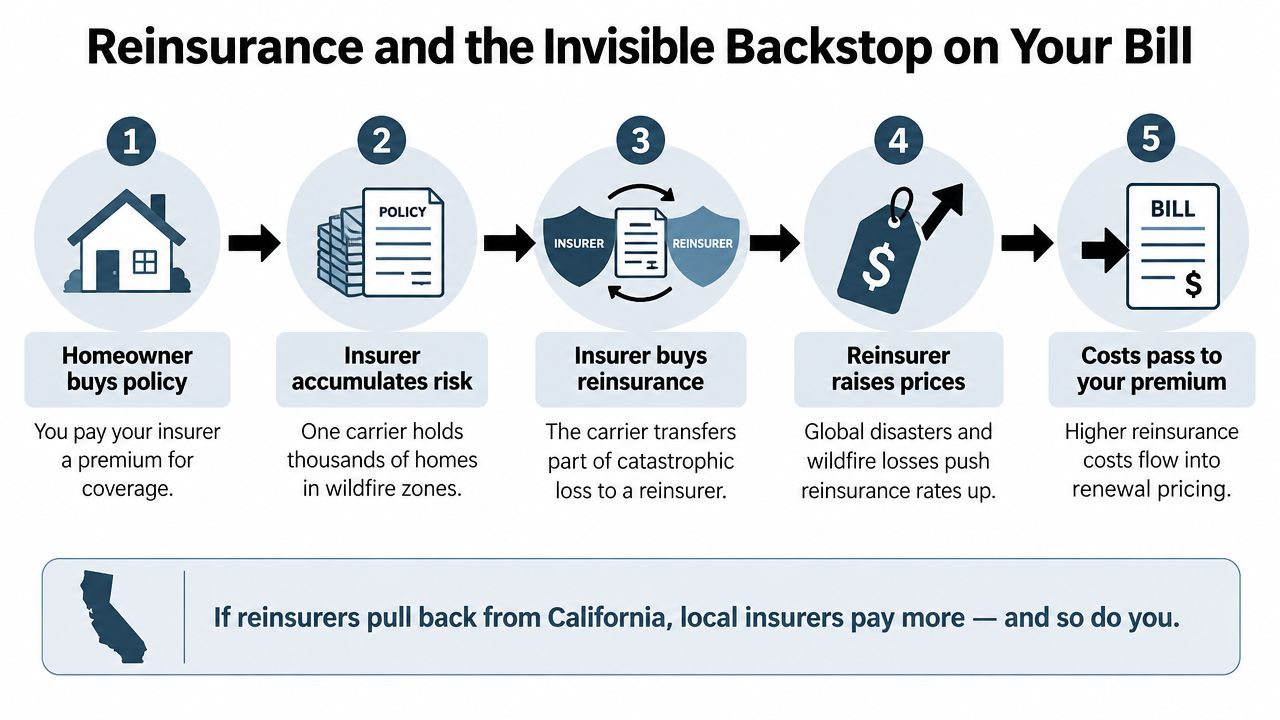
Reinsurance is insurance for insurers. Your carrier buys it so one major disaster does not wipe out its ability to pay claims. That makes reinsurance the hidden backstop behind your policy, and when that backstop costs more, your premium usually shows it.
How the backstop reaches your renewal
Your insurer does not keep every dollar of risk on its own books. It buys backup protection from a reinsurer, much like a large landlord buys extra coverage for a building that could suffer a costly loss. When that backup gets pricier, the insurer has to recover the difference somewhere, and the renewal notice is the most common place to do it.
As noted earlier, U.S. property and casualty reinsurance costs doubled between 2018 and 2023. That helps explain why premium pressure has stayed high in disaster-prone states. It also helps explain why a homeowner can live through a calm year and still see a higher bill, because the insurer's cost of protection is not limited to local claims.
Global market reporting has described reinsurance as a hard market, with reinsurers tightening terms and asking primary insurers to keep more risk on their own balance sheets. In California, that can mean narrower underwriting, higher deductibles, or higher prices as carriers try to protect their finances. When a carrier fails or retreats after a catastrophe, the remaining insurers inherit more pressure.
Why wildfire ZIP codes feel it first
That backstop effect is strongest in places with repeated wildfire stress. Insurers want to know not only whether a house burned once, but whether the area is likely to produce another expensive claim next season. That is why reinsurance pressure tends to hit hardest in ZIP codes already seen as difficult to price.
For homeowners, the main point is simple. The extra cost on your bill is not always only about your house, it is also about the price your insurer pays to stay in the market. If you are trying to make sense of terms such as surplus lines, mitigation credit, or wildfire surcharge, this glossary resource can make the renewal language easier to read.
Where You Live and How Wildfire Risk Reshapes Pricing
Two houses can look nearly identical and still fall into very different price buckets. Insurers do not price only the building itself, they price the location risk around it. ZIP-code catastrophe models, fire history, vegetation, slope, access roads, roof material, and defensible space all feed into the premium.
How the model turns geography into a premium
A low-risk ZIP code often has more carrier competition and steadier renewals. A high-wildfire-score area can face fewer offers or sharper increases. The model is not judging curb appeal. It is estimating how likely a loss is, how severe it could be, and how hard the property would be to defend or rebuild if fire strikes.
That is why two homes with the same square footage can be rated differently. A Sacramento suburb with easier access and less brush exposure may look safer than a foothill community with dense vegetation, narrower roads, and more difficult evacuation routes. Insurers see those differences in the data they use to score risk.
Practical rule: wildfire pricing is driven more by the surroundings than by the homeowner's personality, claims history, or mortgage size.
Forward-looking climate modeling matters here too. Insurers are not only looking at old claims. They are also projecting what could happen next, which means a bill can rise before a street has ever had a loss. That is why mitigation, roof upgrades, and clearance around the home can affect a reinspection and the renewal offer that follows.
A home-hardening conversation starts with roof class, ember-resistant vents, and defensible space. For communities trying to cut exposure, this reducing fire hazards guide offers a practical look at what risk reduction can look like on the ground.
The inputs insurers care about most
- Vegetation density: More fuel near the home raises risk.
- Slope and access: Steeper terrain and difficult roads can slow response.
- Roof and exterior materials: Fire-resistant materials can improve a property's profile.
- Fire perimeter history: Past fire behavior helps shape expectations for future loss.
- Defensible space: Clear space around the home can lower exposure.
If you want a local comparison point, this Santa Rosa home insurance page shows how wildfire risk can shape pricing in one California market differently from another.
California's Wildfire Reality and the 2025 Market Shift
California's insurance problem is a market shift shaped by wildfire exposure, reinsurance costs, and tighter underwriting. Stanford-reported data show average homeowner premiums in the state rose 84% between end-2020 and March 2026, while deductibles also climbed and insurers narrowed new business in higher-risk areas, sending more households toward the FAIR Plan (Stanford). For a homeowner, that is like watching the price tag change after the store also changes what it will sell you.
Why the FAIR Plan matters more now
The FAIR Plan is California's backstop for people who cannot get standard coverage. It keeps a home insurable, but it is not designed to replace a full voluntary-market policy. Many homeowners still need a Difference in Conditions policy to fill gaps, especially for belongings, liability, or water-related losses.
California regulators also changed how the market works in 2025. The Department of Insurance said carriers that use catastrophe modeling or include reinsurance costs in rate filings must write at least 85% of their statewide market share in wildfire-distressed areas (California Department of Insurance). The goal is to keep more people in the voluntary market and reduce pressure on the FAIR Plan.
That shift matters because market exits and returns make the billing structure harder to read. A homeowner in the Bay Area or the Sierra foothills may now receive one policy from a standard carrier, one from the FAIR Plan, and one supplemental policy to close the gaps. The total can look fragmented, but it reflects how insurers are dividing wildfire risk across the market.
California homeowners insurance at a glance
| Metric | 2020 | 2025 |
|---|---|---|
| Average homeowner premium | About $1,400 | More than $2,500 |
| Underwriting access | Broader standard-market availability | More reliance on distressed-area rules and the FAIR Plan |
| Pricing method | More backward-looking in many filings | More use of catastrophe models and reinsurance cost inputs |
For homeowners, the lesson is straightforward. California insurance is being priced around wildfire reality, and the bill now reflects the full chain of costs behind that risk. If you have been placed into the FAIR Plan or asked to buy layered coverage, the annual premium is showing you how much the market has changed.
Smart Moves to Lower Your Premium Without Losing Protection
Homeowners often see savings only after they understand how insurers price the home. A carrier is not guessing at random, it is weighing the dwelling limit, the cost to rebuild, the property's risk features, and the cost of passing wildfire exposure to others through reinsurance. Once that is clear, the right savings move becomes easier to spot.
First 30 Days
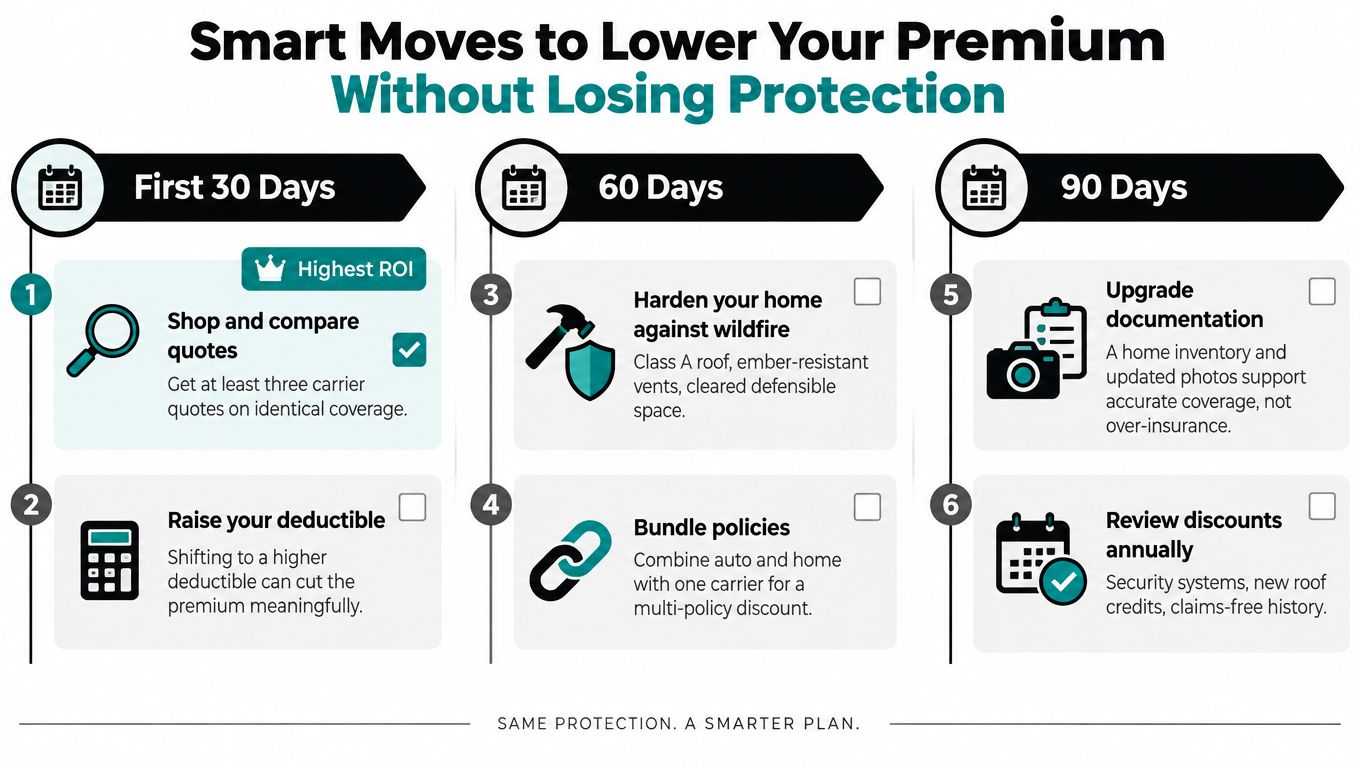
Start with the fastest changes. Ask for a reinspection after home-hardening work, because a Class A roof, ember-resistant vents, and cleared defensible space can change how the home is rated. Then request at least three quotes with the same coverage limits so you are comparing the policy design, not just the headline price.
A higher deductible can lower the premium, but only if your emergency fund can absorb the larger out-of-pocket cost. In California, that tradeoff matters because wildfire and wind losses can be severe, and a cheap policy with weak protection can leave a homeowner exposed later.
Practical rule: don't shop for the lowest premium until you know the dwelling limit matches current rebuild cost.
Sixty days and beyond
By the 60-day mark, review bundle options if the numbers make sense. Home and auto coverage can produce savings together, but the combined package still needs to fit your household. For a step-by-step walkthrough of the review process, see our insurance guides. For older homes, documentation matters too, because photos, a home inventory, and records of roof or electrical upgrades can help support more accurate pricing.
At 90 days, read the policy line by line. Confirm that dwelling coverage follows rebuild cost, not market value. Check whether you are paying for duplicate endorsements or optional coverages you do not need. Ask about full replacement cost on personal property if that protection fits your budget and risk tolerance.
A broker who understands high-risk California markets can also help when standard insurers decline. A company like Mai & Associates may be useful because it works across home, auto, renters, and life coverage and can compare options from several carriers instead of forcing one quote.
A simple annual habit
- Review every renewal: Prices change, and so do discounts.
- Document upgrades: New roof, security systems, and fire hardening can matter.
- Ask about mitigation credits: Carriers often price verified improvements better than assumed safety.
- Compare both cost and coverage: The cheapest policy can leave the biggest gap.
If you already carry auto insurance, the same review habit helps there too, because California auto rates move for their own reasons. A household budget improves fastest when you look at the whole insurance stack, not just the home policy by itself.
What Comes Next and How to Take Action
Homeowners are seeing the same pressure from several directions. Claims cost more to pay. Rebuilding costs more to price. Reinsurance raises the backstop carriers rely on. In California, wildfire exposure pushes some homes into tougher risk tiers, and recent market changes affect how insurers write and price policies. The renewal notice can start to look less like a simple bill and more like a snapshot of the insurance market.
That pattern is likely to keep shaping the next few renewal cycles. California homeowners may keep seeing wildfire-related nonrenewals, tighter underwriting in higher-risk ZIP codes, and pricing models that weigh forward-looking climate data more heavily. Once you understand those mechanics, it becomes easier to ask better questions and spot coverage that costs more without giving you more protection.
A short checklist can keep the next renewal from catching you off guard. Schedule a policy review before the next billing cycle. Request a replacement-cost estimate. Compare at least three carriers. Document home improvements. Ask an agent about mitigation credits.
A line-by-line coverage check before renewal can reveal whether the policy still fits the home you own. The goal is a premium that reflects your risk accurately, while still protecting the structure and belongings you would actually need to rebuild.