Unlocking Whole Life Insurance Cash Value in California

When you hear "life insurance," you probably think of a death benefit—a financial safety net for your family after you're gone. But what if it could also be a powerful financial tool for you, right now? That's exactly what the cash value component of a whole life insurance policy is all about. It's an integral part of a comprehensive California insurance plan that looks beyond basic protection.
Think of it as a savings account that’s built right into your life insurance policy. It's a living benefit, meaning you don't have to pass away for it to be useful. A portion of every premium you pay goes toward building this tangible asset, creating a pool of money that grows steadily over your lifetime.
What Is Whole Life Insurance Cash Value?

Unlike term insurance, which is temporary and offers only a death benefit, whole life is designed to cover you for your entire life. As long as you keep paying the premiums, a slice of each payment is funneled into a separate component called the cash value.
This account grows at a guaranteed rate, completely insulated from the ups and downs of the stock market. For many Californians, this kind of stability is a welcome anchor in their financial plan, providing a reliable source of liquidity to navigate the state's high costs—from home insurance to car insurance—and unexpected financial curveballs.
How Your Cash Value Builds
The growth of your cash value isn't a mystery; it's driven by a powerful, two-part engine that provides both safety and upside potential. Let's break down exactly how your money accumulates.
How Your Cash Value Builds Over Time
This table breaks down the two primary engines that drive the growth of your whole life insurance cash value.
| Growth Component | Description | Key Feature |
|---|---|---|
| Guaranteed Interest | The insurance company contractually guarantees a minimum interest rate. Your cash value is certain to grow at this baseline rate, no matter what happens in the economy. | Predictable Growth: Acts as a safety net, ensuring steady, tax-deferred accumulation. |
| Potential Dividends | If you have a policy from a mutual insurer, you may receive annual dividends, which are a share of the company's profits. You can use these to buy more insurance, reduce premiums, or simply add them to your cash value. | Enhanced Returns: While not guaranteed, dividends can significantly accelerate your cash value's growth over the long term. |
This combination is what makes whole life so compelling. Your growth is tax-deferred, meaning you don't pay taxes on the gains each year. This lets your money compound much more efficiently than it would in a regular savings or brokerage account.
The core idea is simple: a portion of your premium builds a tangible asset. It’s a disciplined way to save that provides a death benefit for your loved ones and a source of accessible funds for you.
Why Cash Value Matters for Californians
In a state like California, financial flexibility is everything. One day you might face an unexpected home insurance deductible from a high-risk fire zone; the next, you might get a chance to put a down payment on a dream property. Having a source of ready capital is crucial.
That's where your cash value shines. You can access this money through tax-free policy loans (without a credit check!) or partial withdrawals. This turns your policy into a versatile tool for handling all sorts of life events:
- Supplementing your retirement income
- Paying for a child's college tuition
- Funding a new business venture
- Covering unexpected medical bills or other emergencies
This built-in savings feature transforms a simple protection product into a multi-purpose financial instrument. While the primary job of any policy is to protect your family, the cash value offers immense benefits for you, the policyholder. As you weigh your choices, it’s worth understanding the full landscape of life insurance in California to see how each type of policy aligns with your unique goals.
Ultimately, the cash value in a whole life policy offers a powerful way to build wealth, secure your family’s future, and create a financial safety net you can count on for a lifetime.
The Mechanics of Cash Value Growth
Your whole life policy's cash value doesn’t just appear out of nowhere. It grows through a steady, two-part process that’s designed for reliability over the long haul. Think of it less like a speculative stock market bet and more like a carefully managed fund built for predictable growth.
This is how a simple premium payment transforms into a valuable financial asset. It's a disciplined way to build wealth, combining contractual promises with the potential for even better returns. For many Californians, it’s a dependable asset they can count on, right alongside their home insurance or auto insurance policies.
The Foundation of Growth: Guaranteed Interest
The first and most important part of this growth is the guaranteed interest rate. This is the minimum rate of return your cash value will earn, year in and year out. It’s a promise written directly into your policy contract by the insurance carrier—it’s the bedrock of your policy's growth.
This guaranteed rate acts as a safety net, ensuring your money accumulates value no matter what the stock market is doing or what the economy looks like. For anyone in California seeking a financial tool that isn’t at the mercy of market swings, this provides a level of stability that's hard to find.
Think of it like the interest you'd earn in a high-yield savings account, but with a crucial difference: the growth is tax-deferred. This means your money compounds more efficiently because you aren’t paying taxes on the gains every year.
The Accelerator: Non-Guaranteed Dividends
While the guaranteed interest provides a solid foundation, non-guaranteed dividends can really accelerate your policy's growth. If your policy is with a mutual insurance company, you're technically a part-owner. That means you get to share in the company's success.
Dividends aren't guaranteed, but they are a powerful way to boost your policy's performance. They're paid out when the insurer has a good year—thanks to smart investing, efficient operations, and lower-than-expected claims.
When dividends are paid, you have a few choices for what to do with them, which gives you direct control over how your policy performs.
- Purchase Paid-Up Additions (PUAs): This is the most common choice for a reason. PUAs are like small, fully paid-up life insurance policies that add to your cash value and death benefit, giving your policy an immediate boost.
- Accumulate at Interest: You can let your dividends sit in a separate, interest-earning account with the insurance company.
- Pay Premiums: You can use the dividends to cover your premium payments, lowering or even eliminating your out-of-pocket costs over time.
- Take as Cash: You always have the option to take the dividend payment as a direct cash payout.
This one-two punch of guaranteed growth and potential dividends creates a truly robust financial tool. Historically, this combination has produced some impressive results. For example, during the high-interest-rate environment of the late 1970s and 1980s, one Northwestern Mutual policy purchased in 1983 delivered actual returns of 10.51% and 8.6% over its lifetime—far more than what was initially projected.
We know these concepts can get a little technical. That's why our team put together a helpful glossary of insurance terms to make sense of all the details.
Ultimately, these two growth drivers work together to build a substantial, liquid asset. This methodical approach is what makes whole life insurance cash value a cornerstone of a solid financial plan for so many people here in California.
How to Read Whole Life Cash Value Charts
When your insurance agent hands you a policy illustration, it can look like a spreadsheet that goes on forever. All those columns of numbers stretching decades into the future can be intimidating, but this document is your roadmap. Learning to read it is the key to comparing policies and truly understanding how your money will grow.
Think of it as a financial forecast, tailored just for you. For a 35-year-old in California, these charts turn abstract concepts into a tangible picture of what their whole life insurance cash value might look like at major life milestones. The most important thing is knowing the difference between what's promised and what's projected.
The Guaranteed vs. Non-Guaranteed Columns
Every illustration is built around two key columns: “guaranteed” and “non-guaranteed.” Getting this distinction is everything.
The guaranteed values are your policy's bedrock foundation. This is the absolute minimum your cash value and death benefit will grow, based only on the contractually guaranteed interest rate. It’s the worst-case scenario, and the insurance company is legally bound to deliver it. No matter what happens in the market, these numbers are locked in.
The non-guaranteed values column, on the other hand, shows what could happen if the company continues paying dividends at its current rate. This is the more optimistic—and often more realistic—view. It includes the guaranteed growth plus potential dividends, giving you a much clearer sense of your policy's true potential.
Seeing these two projections side-by-side lets you appreciate both the safety net and the opportunity for much stronger growth. For a deeper dive into other financial topics, including auto insurance and renters insurance, check out our collection of guides to California insurance.
The chart below helps visualize how these pieces fit together. You can see how the guaranteed value forms a base, with dividends stacking on top to create the total cash value.
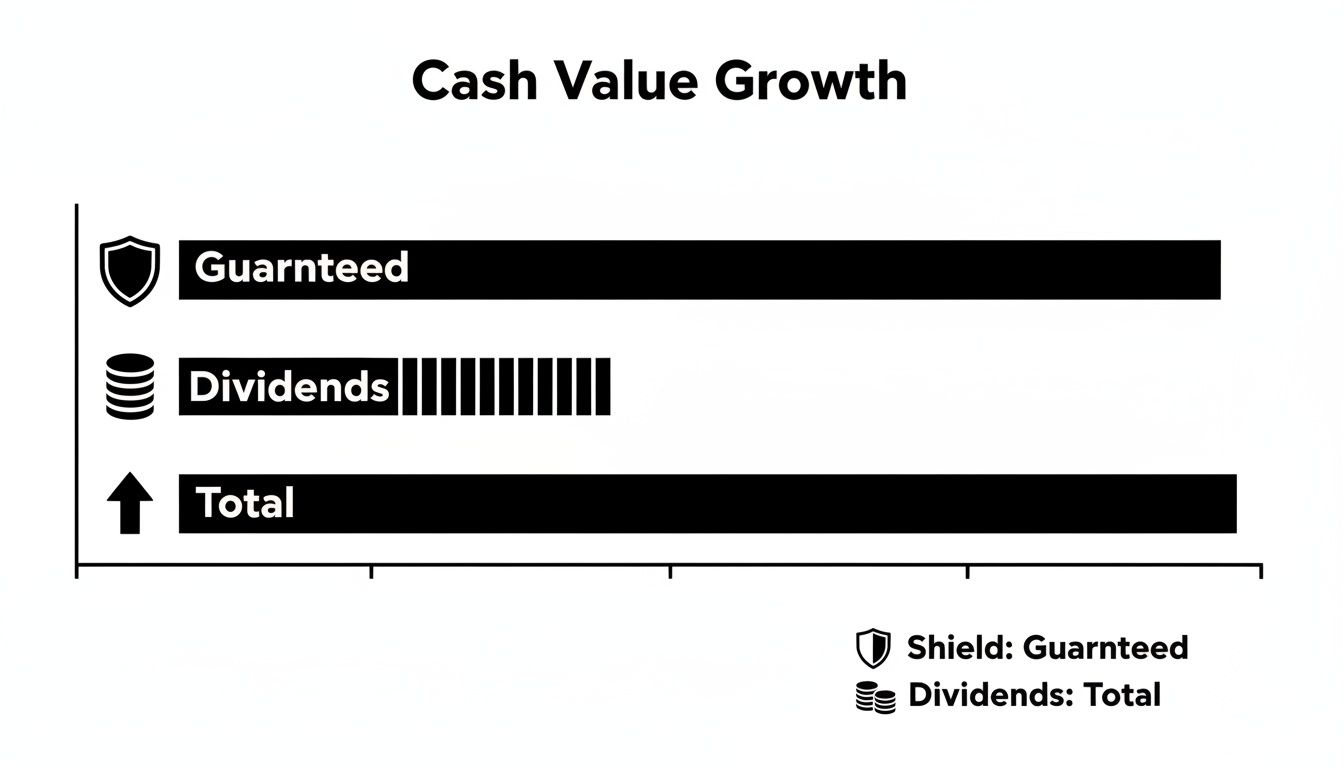
Notice how dividends become a more powerful driver of growth over time, often making up a significant chunk of your policy's value as it matures.
Charting Your Financial Milestones
These illustrations are powerful because they map out steady, predictable growth over a lifetime. For example, a healthy 35-year-old with a $500,000 whole life policy might see their cash value hit roughly $50,000 by year 10, grow to $150,000 by year 20, and surpass $400,000 by year 40 (assuming current dividend scales continue).
It’s a massive asset class; by 2020, total cash and invested assets in U.S. life insurance policies reached an incredible $4.7 trillion, and whole life is a huge part of that foundation.
When you're looking at your own illustration, don't just see a wall of numbers. Pinpoint the key years—10, 20, and 30, and especially your target retirement age. Suddenly, those numbers transform into real financial goals, helping you see the policy as a future source for tax-free income or a safety net for major life events.
Once you know how to read these charts, you're in the driver's seat. You can confidently compare offers from different insurance carriers, understand what to expect from your policy, and see exactly how it can become a cornerstone of your family's financial security.
Accessing Your Cash Value Through Loans and Withdrawals

The real magic of whole life insurance cash value isn't just watching it grow—it's knowing you can actually use it. This growing reservoir of capital is a flexible financial tool you can tap into during your lifetime. But to make the most of it, you have to understand the right way to access it.
For Californians, this liquidity can be a lifesaver. Whether you're hit with an unexpected emergency, like a large deductible on your auto insurance, or presented with a timely opportunity, knowing your options is everything. You have three main ways to get to your cash value: taking a policy loan, making a withdrawal, or surrendering the policy altogether.
Each path comes with its own set of rules and consequences, particularly for your taxes and the death benefit left for your family. Let’s walk through how each one works so you can make a smart, strategic choice for your specific needs.
Taking a Tax-Free Policy Loan
One of the most powerful features of whole life is the ability to take out a policy loan. The best way to think of this is borrowing money from yourself. The insurance company gives you a loan and simply uses your own cash value as collateral.
This setup comes with some pretty unique perks:
- No Credit Check: Your cash value secures the loan, so there’s no credit application or lengthy approval waiting game.
- Flexible Repayment: You’re not locked into mandatory monthly payments. You can pay it back on your own timeline, or even not at all.
- Favorable Interest Rates: The interest rates are typically much better than what you’d find with credit cards or personal loans, usually falling between 5% to 8%.
The money you receive is generally income tax-free. It's crucial to know, however, that interest does accrue on your loan. If you don't pay that interest as you go, it gets added to your loan balance. If you pass away with a loan outstanding, the total amount is simply subtracted from the death benefit before it's paid to your beneficiaries.
A policy loan can be a fantastic way to fund major life events—like a down payment on a California home or covering college tuition—without having to sell off other investments. It gives you immediate cash without derailing your long-term financial strategy.
The main thing to watch out for is letting the loan balance spiral until it's bigger than your remaining cash value. This can cause the policy to lapse, which could trigger a surprise tax bill and wipe out the death benefit. Active management is key.
Making a Withdrawal
Another way to get to your funds is by making a partial withdrawal, sometimes called a partial surrender. A withdrawal is fundamentally different from a loan—it’s a permanent removal of money from your policy. You are taking out your own funds, not borrowing against them.
Withdrawals are usually tax-free up to the total amount you’ve paid in premiums, which is known as your "cost basis." If you withdraw more than your cost basis, that extra amount is considered a gain and will be taxed as ordinary income.
The biggest trade-off with a withdrawal is that it permanently reduces your death benefit. While you can repay a loan to restore the full death benefit, a withdrawal permanently shrinks the amount your loved ones will receive. This makes it a less attractive option if maximizing your legacy is a top priority.
Surrendering Your Policy for Cash
Surrendering your policy is the most drastic move and should really only be a last resort. When you surrender, you're terminating the insurance contract completely. The insurance company then pays you the policy's net cash surrender value.
This payout is your total cash value, minus any surrender charges and outstanding loan balances. Just like a withdrawal, any amount you get that’s above what you paid in premiums is taxable income. But more importantly, you will no longer have any life insurance coverage.
Your family gets nothing when you pass away. Because of this finality, surrendering a policy should only happen after you’ve carefully weighed all your options, ideally with a financial professional.
The table below gives you a quick, side-by-side look at these three methods.
Comparing Ways to Access Your Cash Value
Here's a side-by-side comparison of policy loans, withdrawals, and surrendering your policy to help you decide which option best fits your financial situation.
| Access Method | Tax Impact | Impact on Death Benefit | Best For |
|---|---|---|---|
| Policy Loan | Generally tax-free. | Reduced by the outstanding loan balance upon death. | Short-term liquidity needs, funding major purchases, or supplementing income without creating a tax liability. |
| Withdrawal | Tax-free up to your cost basis; gains are taxed. | Permanently reduced. | Accessing smaller amounts of cash when the full death benefit is no longer the top priority. |
| Surrender | Gains above your cost basis are taxed. | Eliminated entirely. | When you no longer need life insurance coverage and want to liquidate the asset as a last resort. |
Ultimately, the right choice comes down to your financial goals. For most people, a policy loan is the winner because it preserves the death benefit and offers tax-free access to cash. A withdrawal might fit certain retirement scenarios, but surrendering the policy should always be the absolute final option.
Choosing the Right Insurance for Your California Lifestyle
In a place as dynamic and financially diverse as California, there's no such thing as a one-size-fits-all life insurance policy. What works for your neighbor in the Bay Area might be a terrible fit for you in the Central Valley. The key is to match the right tool to your specific financial goals.
Are you trying to protect a mortgage, build a retirement nest egg, or just create a safety net for the unique risks of living in the Golden State? Whether you're looking for life insurance, home insurance, or car insurance, let's break down the main options to see what makes the most sense.
Term Life Insurance: Simple, Affordable Protection
The easiest way to think about term life insurance is like renting an apartment. You get a huge amount of protection for a set period—usually 10, 20, or 30 years—for a very low monthly cost. It's clean, simple, and perfectly designed to cover temporary needs.
For instance, a young family in San Diego might get a 30-year term policy. It’s peace of mind, ensuring the mortgage gets paid and the kids can afford college if a parent passes away too soon. When the term is up, the coverage simply ends. There's no savings account or cash value—just pure, affordable protection for when you need it most.
Universal Life Insurance: The Flexible Alternative
Universal life insurance is a form of permanent coverage, but it’s built for flexibility. It lets you adjust your premium payments and even your death benefit over time (within policy limits, of course). If you have a variable income, like many freelancers or small business owners in California, this can seem very attractive.
But that flexibility comes with a catch. The cash value growth isn't guaranteed; it's tied to current interest rates. If rates fall, your cash value might stall, and you could find yourself needing to pour more money into the policy just to keep it from lapsing. It lacks the built-in certainty of whole life.
Whole Life: A Foundation for Lifelong Security
That brings us back to whole life insurance. It’s permanent, the premium is locked in for life, and it includes a whole life insurance cash value account that grows at a guaranteed rate. Think of it as owning your financial house—you're building equity with every payment.
For many Californians, this stability is its greatest asset. The growing cash value becomes a liquid financial tool you can tap into for anything life throws your way, from dealing with sky-high property taxes to recovering from the financial shock of an earthquake or wildfire.
In California, where financial resilience is everything, a whole life policy does double duty. It protects your family's future while building a stable, accessible asset that can provide cash when your other investments are down or tied up.
Historically, participating whole life policies have been solid performers, often doing better than the initial projections. Still, a surprising 40% of insured Americans say they regret not buying their policy sooner, mostly because the premiums start higher than term life.
While the initial cost is more, whole life is the only option that builds guaranteed equity. This is a game-changer for families who also need strong home insurance and renters insurance, creating a complete financial safety net.
If you're ready to dig deeper, reviewing the 12 Best Whole Life Insurance Policies for 2025 is a great next step. Ultimately, the right policy for your California lifestyle comes down to your personal goals, your budget, and your vision for the future.
Partner with Mai & Associates to Secure Your Future

Understanding the ins and outs of whole life insurance cash value is a great first step. But knowing is one thing; acting on it is what truly secures your family's future and builds a powerful financial tool for your life here in California. This is where theory meets reality, and our team at Mai & Associates is here to walk with you through every part of the process.
We know that finding the right policy can feel overwhelming. Our licensed agents specialize in taking those complex policy illustrations and breaking them down into simple, clear insights. We’ll show you exactly how your cash value is projected to grow and how it can be used to meet your goals, whether that’s protecting your legacy or creating a reliable source of funds for an emergency.
Your Local California Insurance Experts
The insurance marketplace is crowded, with dozens of carriers all claiming to be the best. We cut through that noise for you. At Mai & Associates, we use our relationships with multiple top-rated insurance providers to instantly shop for the best rates, ensuring you get the right coverage for your budget and your family. We are your one-stop shop for California insurance.
We're more than just a website; we're your neighbors. With offices in Glendale, Westlake Village, Escondido, and Costa Mesa, we offer personal, face-to-face service for life insurance, home insurance, renters insurance, and auto insurance to our clients across the state. We believe in building real relationships.
Guidance in Your Language
Making a major financial decision requires total clarity. We want you to feel completely confident and in control of the choices you're making for your family.
To ensure nothing gets lost in translation, our diverse team offers expert guidance in five languages: English, Spanish, Armenian, Russian, and Vietnamese. We take the time to answer every single question, so you understand all the details of your coverage and the real-world benefits of your cash value.
This commitment means your family's financial plan is built on a solid foundation of trust and understanding. We're dedicated to helping every Californian protect what matters most.
From Quotes to Confidence
Whether you need life insurance, auto insurance, home insurance, or renters insurance, we make getting covered quick and straightforward. We can also help you bundle policies to find extra savings and close any gaps in your protection, creating a complete safety net for your California lifestyle.
Ready to see what a whole life policy could look like for you? You can get an insurance quote from our team today. Let’s work together to build a plan that not only protects your loved ones but also grows a valuable asset for your future. Contact Mai & Associates for a no-obligation chat and start your journey toward real peace of mind.
Frequently Asked Questions About Cash Value
It's natural to have questions when you first dig into whole life insurance. The cash value component, in particular, has a lot of moving parts. Let's clear up some of the most common questions people ask.
How Long Until I See Significant Cash Value?
You'll start building a small amount of cash value with your very first premium, but it's a slow burn at the beginning. Most of your early payments go toward the policy's setup costs and, of course, the death benefit coverage.
Real, meaningful growth usually kicks in after the first few years, typically somewhere between year 3 and 5. From there, the growth starts to pick up speed. Many policyholders in California find that after 10 to 15 years, they've built a substantial asset they can actually use, which is why it's best viewed as a long-term strategy.
Is the Cash Value Paid Out in Addition to the Death Benefit?
This is a great question, and the answer is no. Think of the cash value as the portion of the policy you own—your "living benefit." You can borrow against it or withdraw from it while you're alive.
When you pass away, your beneficiaries are paid the policy's full face amount (the death benefit). The insurance company uses the cash value you've built up to help fund that payment. Any outstanding loans you took against the cash value will simply be subtracted from the final amount paid to your family.
This dual-purpose structure is what makes whole life unique: it provides a financial safety net for your loved ones and builds a pool of capital for you.
Can I Lose the Money in My Cash Value Account?
One of the bedrock features of whole life insurance is that your core cash value is guaranteed. It can't be lost if the stock market crashes. This is completely different from a 401(k) or other investment accounts that are exposed to market risk. Your money grows at a fixed, predictable rate that the insurance company guarantees in your contract.
That said, your cash value balance isn't totally untouchable. It could go down, but only if you take specific actions:
- You make a permanent withdrawal from the account.
- You stop paying your premiums and the policy eventually lapses.
- You take out a policy loan and let the unpaid interest build up to the point where it starts eating into your principal.
Are the Interest Rates on Policy Loans a Good Deal?
Absolutely. Compared to most other forms of borrowing, policy loan rates are excellent. You'll typically find rates in the 5% to 8% range, which is often much lower than what you'd get with a personal loan or, especially, a credit card.
The reason the rates are so favorable is simple: you're borrowing against your own money. Your cash value acts as the collateral, so there's almost no risk for the insurer. This means no credit checks and no lengthy approval process. For many Californians, it’s a smart and simple way to get cash for a home project, cover an emergency car insurance deductible, or even supplement income in retirement.
Ready to explore how a whole life insurance policy can fit into your financial plan? The experts at Mai & Associates can provide a personalized quote and guide you through your options. Visit us at https://cahomeauto.com to learn more.