When to Replace Shocks and Struts: A California Guide 2026
Most shocks and struts should be inspected annually and are commonly replaced between 50,000 and 100,000 miles, but the trigger is performance decay, such as excessive bouncing, nose-diving under braking, or fluid leaks, rather than mileage alone. In California, where smooth freeways, rough pavement, mountain roads, heavy traffic, and loaded weekend trips all test suspension components, waiting for a complete failure is a poor maintenance strategy.
You may notice the problem during an ordinary drive. The car keeps bobbing after a freeway expansion joint, the front dips sharply at a red light, or the steering feels vague through a fast interchange. Drivers often adapt to those changes gradually, so a vehicle can feel “normal” even after its suspension has lost meaningful control. My recommendation is straightforward: use mileage to schedule inspections, but use handling, tire condition, and visible damage to decide whether replacement is due.
The Mileage and Condition Thresholds for Replacement
A practical rule of thumb places many shock and strut replacements somewhere between 50,000 and 100,000 miles, or approximately 3 to 10 years, depending on road conditions and vehicle use. That range is summarized in broader service guidance from Kevin's Auto, but it shouldn't be treated as a promise that every vehicle will reach the same mileage.
A driver who spends most days on smooth highway pavement may get longer service from original equipment. Towing, hauling, potholes, broken pavement, and frequent rough-road driving can shorten useful life considerably. California drivers also face very different environments, from urban stop-and-go traffic to mountain routes and deteriorated local streets. The odometer is a scheduling tool, not a diagnosis.
Use mileage to schedule the check
Major shock and strut manufacturers commonly recommend inspection every 20,000 kilometers, with replacement around 80,000 kilometers, because original-equipment gas-charged units can show measurable degradation by that point even without obvious external damage. 80,000 kilometers equals roughly 49,700 miles, which sits close to the widely recognized 50,000-mile service milestone. That benchmark is detailed in Monroe's technical guidance.
Schedule suspension checks when you rotate tires, replace tires, service the brakes, or receive a wheel alignment. Those appointments give a technician access to the exact areas where leaks, damaged mounts, uneven tire wear, and looseness may become visible.
Practical rule: If your vehicle has crossed the 50,000-mile area, inspect it annually even if the ride still feels acceptable. If symptoms appear earlier, inspect it earlier.
Replace based on evidence
Mileage becomes decisive when it lines up with performance loss. Continued oscillation, braking dive, excessive cornering roll, steering wander, cupped tire wear, or fluid leakage should move the vehicle from “monitor” to “obtain a professional inspection.” A vehicle with higher mileage but strong control may need observation, while a lower-mileage vehicle exposed to harsh roads may already need parts.
The historical shift matters. Older advice often treated a single mileage point as an automatic replacement deadline. Modern guidance pairs mileage with condition because suspension wear isn't uniform. Drivers should ask for the inspection findings, not just accept a number pulled from the odometer.
What Shocks and Struts Do for Your Vehicle
Your springs support the vehicle and absorb the first force from a bump. Without damping, they would keep releasing that energy, causing the body to rise and fall repeatedly. Shock absorbers control that movement, turning uncontrolled bouncing into a settled response.
A shock absorber is usually a separate component that works beside the spring. A strut combines damping with a structural role in the suspension, often supporting the spring and helping position the wheel assembly. Many vehicles use struts at the front, while others use different arrangements at the front and rear. That difference matters because replacing a strut can affect steering geometry and may require an alignment.
A spring works like a pogo stick, while the damper controls its rebound. A healthy damper lets the wheel move over a bump and helps the tire return to a stable position quickly. A worn damper allows excess movement, reducing consistent road contact during braking, cornering, and lane changes. Cars.com's explanation of shock absorber service life connects replacement decisions with symptoms including bouncing, nose-diving, body roll, and leakage.
Gas-charged and hydraulic designs can both lose effectiveness as seals, valves, and internal components wear. The decline is usually gradual rather than a sudden failure. Drivers may notice a softer, looser ride only after comparing the vehicle with a newer car or after a technician identifies tire cupping.
A strut can also develop faults in its mount, bearing, boot, or related hardware. Replacement should address the complete assembly, not only the visible cylinder. The goal extends beyond a smoother ride. It is consistent wheel control and predictable vehicle behavior, both of which support safer driving and help California drivers reduce the liability and claim complications that can follow from neglected maintenance.
Recognizing the Warning Signs of Worn Suspension
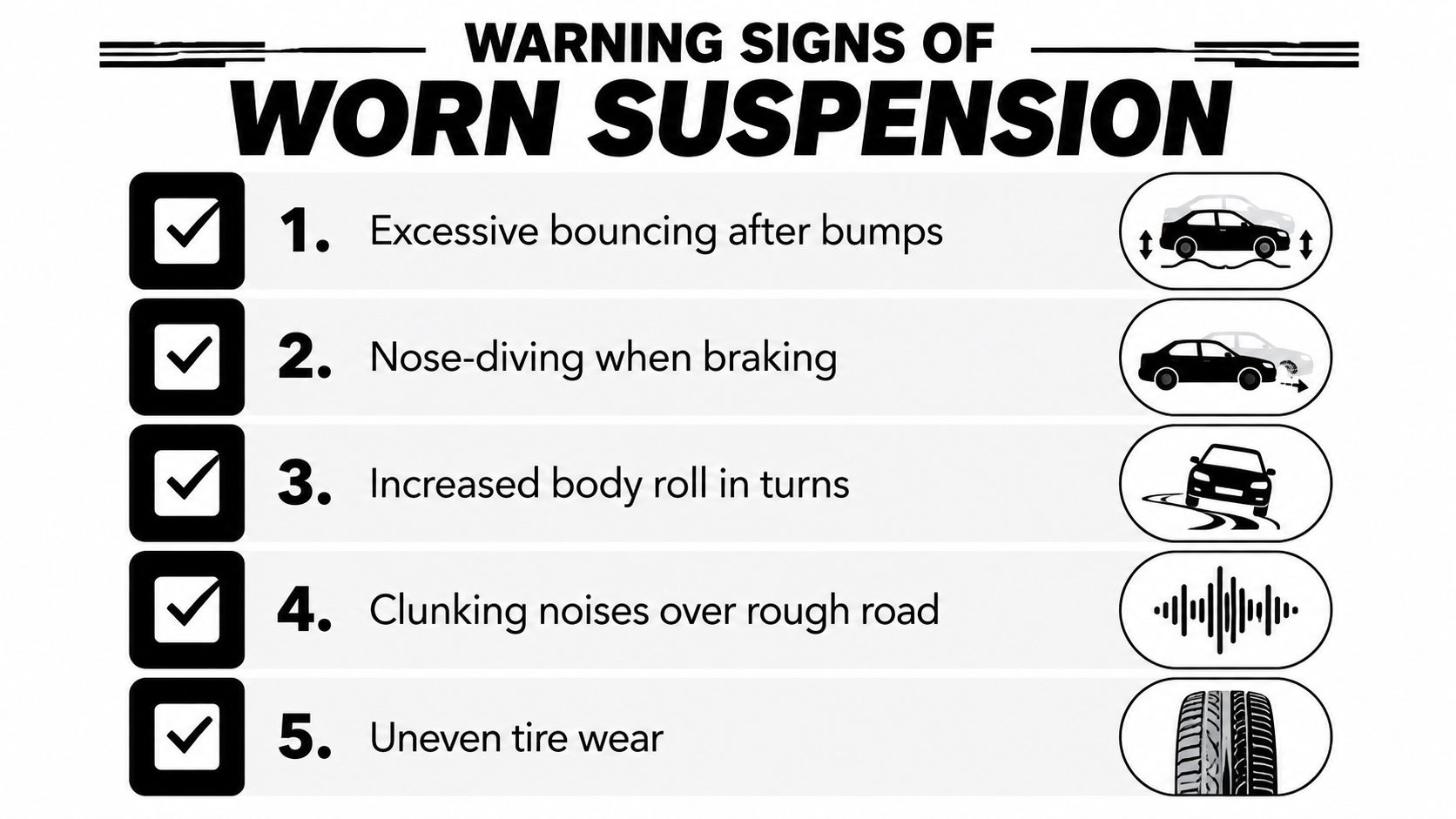
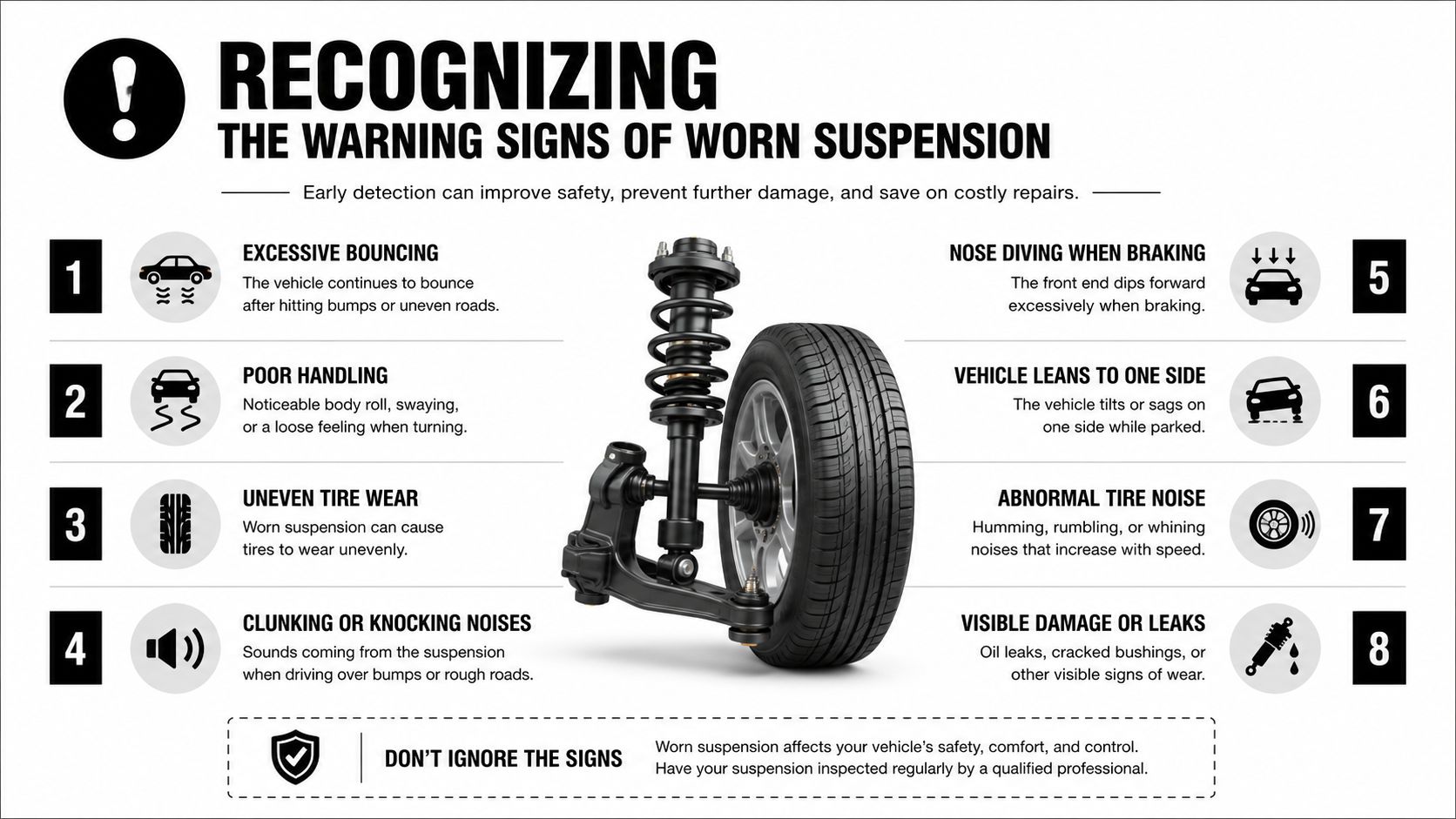
Worn suspension rarely announces itself with one unmistakable event. Instead, several small changes begin appearing during familiar driving tasks. The car may bounce after a bump, dip under braking, lean through a curve, wander within its lane, or produce tire wear that looks like alternating high and low spots.
Match the symptom to the mechanical problem
Excessive bouncing means the spring is cycling without enough damping. After crossing wavy pavement, railroad tracks, or a pothole, the vehicle should settle rather than continue oscillating. AutoZone's suspension guidance links this loss of control to possible tire cupping, reduced braking stability, and weaker lane-change response.
Nose-diving under braking shifts the body forward more dramatically than it should. That movement can make braking feel unsettled, especially when the pavement is uneven. Body roll in turns produces a delayed, leaning sensation and may make an ordinary freeway ramp feel less controlled.
Steering wander deserves attention even when the wheel itself doesn't shake. Excess suspension movement can make the vehicle react inconsistently to grooves, crosswinds, and quick steering inputs. Cupped or scalloped tire wear is another valuable clue because the tire may be bouncing against the pavement instead of maintaining even contact.
A visible oily film or fluid running down the shock or strut body points to a seal problem. Clunks, rattles, squeaks, or creaks may instead involve mounts, bearings, bushings, or other suspension hardware, so noise alone doesn't identify the failed part.
Drivers often normalize deterioration because the change arrives slowly. Compare how the vehicle behaves over the same familiar road, and note whether braking, turning, and settling after bumps have changed. For a broader checklist before visiting a shop, review this resource on when to check your vehicle's suspension. California drivers can also use the Mai & Associates auto resource library to keep maintenance and insurance questions organized.
How to Inspect Your Shocks and Struts at Home
A driveway inspection can identify obvious trouble, but it can't prove that a damper meets its original performance specification. Park on level ground, set the parking brake, and inspect one corner at a time without placing any part of your body beneath an unsupported vehicle.
Start with a simple visual check
Look behind each wheel for wet oil residue on the shock or strut body. A dented housing, torn protective boot, broken spring, cracked mount, or displaced hardware also deserves professional attention. Check the tire tread for uneven scalloping and compare left and right sides for noticeable differences in appearance or ride height.
Next, push down firmly on a body corner and release it. The vehicle should settle promptly. Repeated bouncing suggests weak damping, but the test has limits. Modern vehicles vary in spring rate, body design, and suspension layout, and a bounce test won't reveal every internal or mounting problem.
Ask better questions during a shop inspection
A technician should inspect the damper, upper mount, bearing, spring, bump stop, boot, control-arm connections, and tire pattern. If the vehicle pulls, wanders, or shows irregular wear, the evaluation should include alignment and steering or suspension components rather than blaming the shock automatically.
Don't jack up a vehicle or shake a wheel unless you have the correct lifting points, stands, and experience. A loose wheel can indicate several different faults, and a casual test can create a safety hazard. For unfamiliar terminology, the automotive maintenance glossary can help you understand the inspection report before approving work.
The most efficient timing is usually alongside tire rotation, brake service, alignment checks, or new-tire installation. Those events reduce duplicate labor and let the technician connect suspension condition with the tire and steering evidence already in front of them.
Safety Risks and Hidden Costs of Delayed Replacement
Worn shocks and struts affect control and safety risk, not just ride comfort. As damping weakens, the tires may lose consistent contact with the road during bumps, braking, and directional changes. The risk rises when a California driver carries passengers or cargo on uneven pavement.
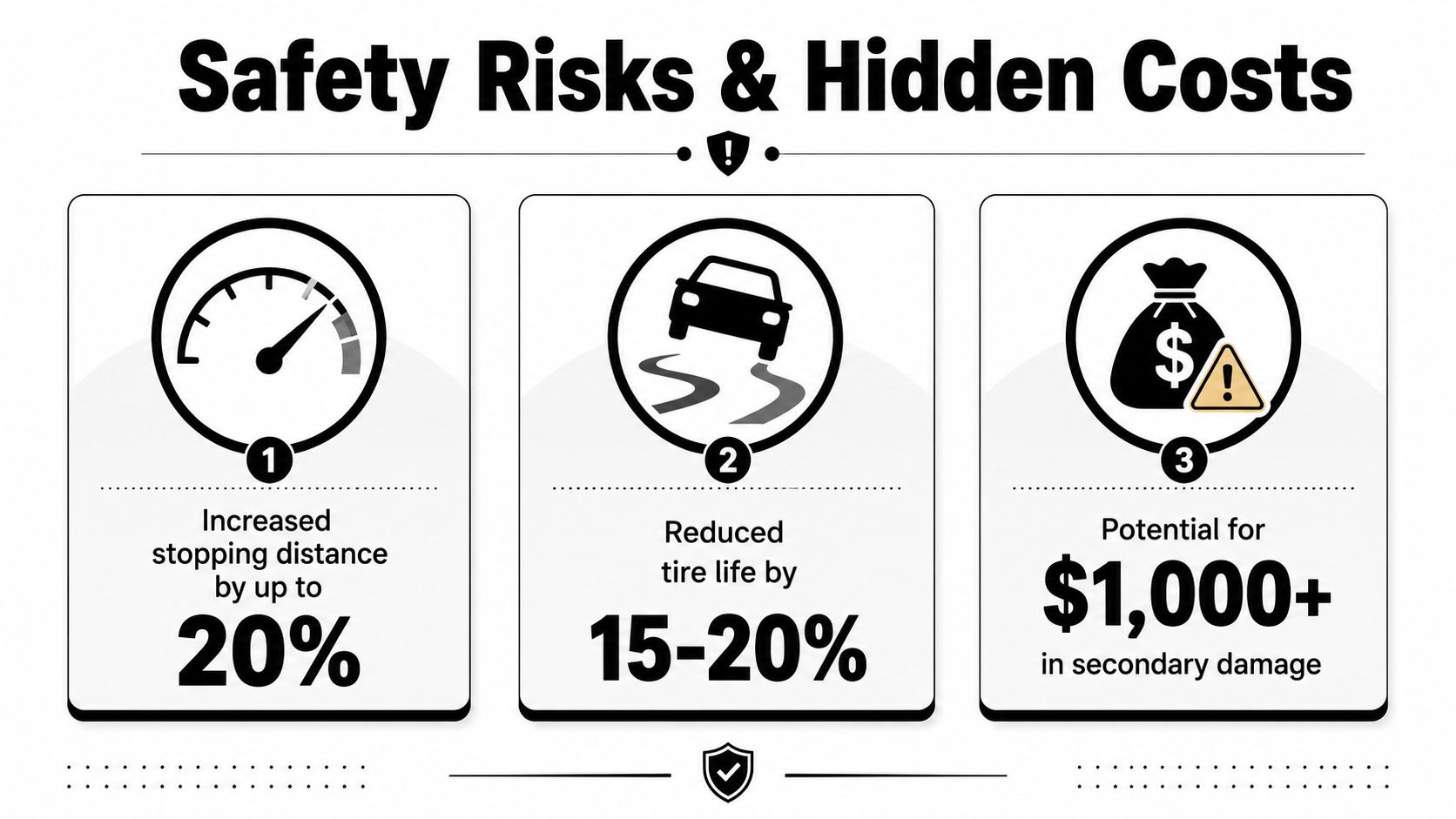
Independent safety guidance reports stopping-distance increases of 2.6 meters at 80 km/h and 11.3 meters at 70 km/h when a vehicle is fully loaded on an uneven road with worn shocks. Those figures appear in the Road and Motor Industry Organization guidance on worn shocks. For California drivers, the practical concern is clear: a suspension defect can matter most while transporting family, luggage, tools, or recreational equipment.
The tire bill often arrives first
A weak damper can let a tire skip or bounce, producing cupping and uneven tread wear. That shortens the tire's useful service life and may force replacement sooner than expected. Uneven wear can also cause noise and vibration, symptoms sometimes mistaken for a wheel-bearing or alignment issue.
The costs can spread beyond the tires. Excess suspension movement adds stress to mounts, bushings, springs, steering connections, and related components. Delaying a focused damper repair can turn it into a larger suspension job, with more downtime and a higher bill.
Worn suspension changes how the vehicle responds before it changes whether the engine starts. That makes it easy to postpone and dangerous to ignore.
A suspension problem also creates liability concerns. If poor control contributes to a collision, a driver may face difficult questions about known maintenance issues, even though insurance coverage depends on the policy and claim circumstances. A vehicle that feels familiar is not necessarily operating safely.
If inspection finds a leaking damper or clear control problem, postponement leaves handling less predictable while tire and suspension wear continue. Pay for a properly diagnosed repair before a manageable suspension issue becomes a safety, liability, and insurance problem.
DIY Replacement Versus Professional Service
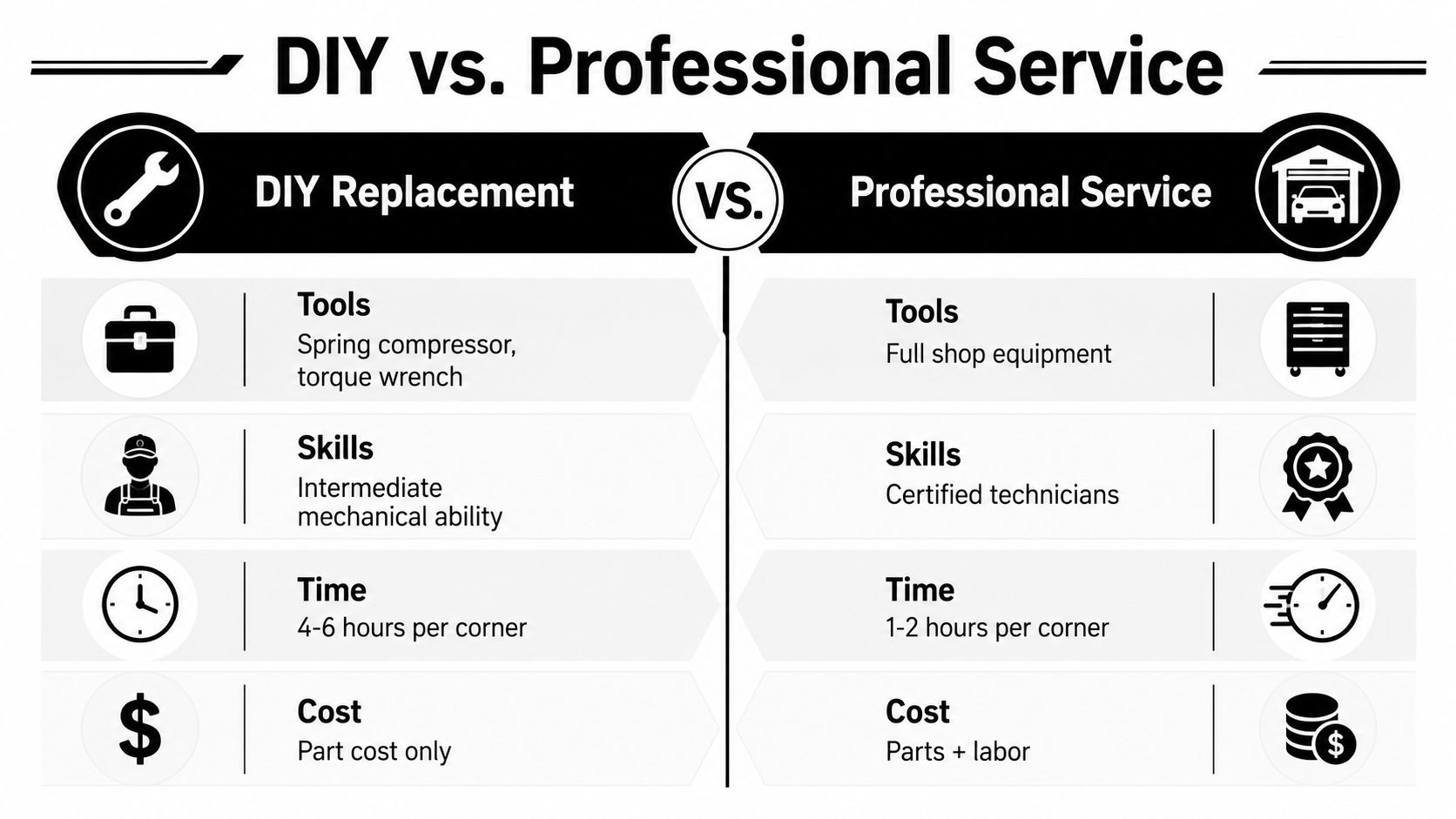
Shock replacement and strut replacement aren't equal jobs. A separate rear shock may be manageable for an experienced home mechanic with a torque wrench, correct lifting equipment, and the service procedure for that vehicle. A complete strut assembly is more demanding because the spring stores substantial energy and the assembly can influence steering geometry.
Choose DIY only when the risk is familiar
A capable DIYer needs safe jack stands, a breaker bar, a torque wrench, penetrating oil, vehicle-specific instructions, and the right spring-compression equipment when the spring must be transferred. The work also requires enough mechanical judgment to identify seized fasteners, damaged mounts, and parts that shouldn't be reused.
Don't improvise with a spring compressor or work beneath a vehicle supported only by a jack. If you can't verify torque specifications or safely control the spring, professional service is the correct choice.
Professional service buys diagnosis as well as installation
A shop can inspect related components, install matched parts, torque fasteners correctly, and check alignment after strut work. That final alignment matters because changing a strut can alter the wheel's position relative to the road. A new part won't solve a worn tie rod, damaged mount, or alignment issue that was never diagnosed.
For a decision guide covering repair planning and vehicle upkeep, use the California auto maintenance guides. In general, replace components in matched pairs on the same axle when practical, especially when one side has clearly worn and both sides have similar service history. Replacing all four at once makes sense when inspection shows widespread degradation, but it isn't an automatic requirement for every vehicle.
California Auto Insurance and Suspension Maintenance
California auto insurance protects against covered losses. It doesn't turn neglected maintenance into a covered mechanical repair. A worn shock or strut generally remains a maintenance issue, but the condition of the vehicle can become relevant after a collision if poor braking, handling, or tire contact contributes to what happened.
That doesn't mean an insurer automatically denies a claim because a suspension part was old. Claims depend on the facts, policy language, evidence, and applicable law. It does mean drivers should take maintenance seriously when a vehicle has known control problems. Repair invoices, inspection records, tire-service records, and alignment documentation can help establish that the owner responded responsibly to a safety concern.
Liability limits make risk management more important
California's minimum auto liability limits became 30/60/15 effective January 1, 2025, meaning $30,000 bodily injury per person, $60,000 bodily injury per accident, and $15,000 property damage. The limits are documented in the California insurance coverage reference. Those minimums may be inadequate after a serious collision, particularly when multiple people suffer injuries or property damage exceeds the policy limit.
A driver should treat suspension maintenance and car insurance as separate parts of the same risk plan. Maintenance helps reduce the chance of losing control. Liability coverage helps protect finances if the driver is responsible for damage or injury. Neither replaces the other.
Coverage reminder: Don't wait for a claim to discover that your liability limits, collision coverage, or comprehensive coverage don't match your vehicle, assets, and driving exposure.
Review the policy whenever you change vehicles, add a driver, alter how the vehicle is used, or discover a recurring maintenance issue that affects safety. A knowledgeable California insurance advisor can explain how the policy responds to accidents, while a qualified mechanic should diagnose the vehicle itself. For policy questions and California auto insurance guidance, keep the insurance review focused on actual coverage rather than assumptions about maintenance.
Your Suspension Maintenance Action Plan
California drivers should follow a condition-based schedule:
- Inspect annually. Ask for a suspension check during tire, brake, rotation, or alignment service.
- Watch the mileage. 50,000 to 100,000 miles is a common replacement consideration, not an automatic deadline. Use the documented service range as context.
- Act on symptoms. Excess bouncing, braking dive, body roll, steering wander, cupped tires, or fluid leakage requires prompt inspection.
- Align after strut work. Confirm steering geometry was checked after installation.
- Keep records. Save inspection findings, invoices, tire observations, and alignment results for future maintenance decisions, resale, and insurance discussions.
For household or fleet vehicles, a printable download fleet maintenance PDF helps organize recurring checks. Do not approve parts on mileage alone. Ask what failed, what evidence supports replacement, which related components were inspected, and whether alignment is needed. Delaying a documented repair can increase crash risk and complicate a liability claim.
Mai & Associates helps California drivers review auto insurance alongside vehicle and liability risks. Visit Mai & Associates for a no-obligation policy review and licensed coverage comparison.