What is uninsured motorist coverage and why you need it for California insurance
When you're a responsible California driver, you carry auto insurance to cover any damages you might cause. But what happens when the tables are turned? What if someone hits you, and they don't have any insurance at all?
This is where Uninsured Motorist (UM) coverage steps in. It's a critical piece of your own car insurance policy that acts as a financial backstop, protecting you and your family from the fallout of an accident with an uninsured or hit-and-run driver.
Your Financial Shield Against Uninsured Drivers
Think about it: without this coverage, you could be stuck paying for everything yourself, even when you did nothing wrong. We're talking about massive medical bills from an emergency room visit, the cost of ongoing physical therapy, or even lost wages because you can't work. It’s a nightmare scenario for any driver, potentially impacting your ability to pay for other essentials like home insurance or renters insurance.
This is precisely why Uninsured Motorist coverage is so vital. It ensures that another person's lack of responsibility doesn't destroy your financial stability.
The Two Pillars of Protection
In California, UM coverage is usually split into two distinct parts. Each one protects you from a different kind of financial hit.
- Uninsured Motorist Bodily Injury (UMBI): This is your personal safety net. It covers medical bills, lost income, and even pain and suffering for you and any passengers in your car if an uninsured driver injures you.
- Uninsured Motorist Property Damage (UMPD): This part helps pay to fix your car. If an identified uninsured driver damages your vehicle, UMPD kicks in to cover the repair costs, often letting you avoid dipping into your own collision coverage and paying a deductible.
The risk is real and growing. A 2025 Insurance Research Council (IRC) study found that in 2023, an alarming 15.4% of all drivers on the road were uninsured. That’s more than 1 in every 7 cars you pass.
An auto insurance policy is all about managing risk. Uninsured motorist coverage directly tackles one of the biggest and most frustrating risks out there: being hit by someone who can't pay for the damage they've caused.
To make sense of these terms, which you can explore further in our insurance glossary, let’s look at how they apply in the real world.
Uninsured Motorist Coverage At A Glance
This table breaks down what UM coverage handles and when it comes into play.
| Coverage Type | What It Covers | Common Scenario |
|---|---|---|
| Uninsured Motorist Bodily Injury (UMBI) | Medical bills, lost wages, and pain and suffering. | You're stopped at a red light and get rear-ended by someone with no insurance, causing a neck injury that requires treatment. |
| Uninsured Motorist Property Damage (UMPD) | The cost to repair your vehicle. | An uninsured driver runs a stop sign and T-bones your car, and you're able to identify them before they leave the scene. |
At the end of the day, UM coverage is far more than just another charge on your insurance bill. For any California driver, it’s a non-negotiable part of a smart, protective financial plan that complements your home insurance and life insurance strategies.
The Growing Risk of Uninsured Drivers on the Road
Let's be honest: the thought of getting into an accident with a driver who has no insurance isn't just a worst-case scenario. It's a real, and frankly, growing risk on California roads. For those of us who do the right thing and carry proper car insurance, understanding this trend isn't just about statistics—it's about protecting ourselves.
The number of people driving without a policy is heading in the wrong direction, and it puts responsible drivers in a tough spot.
This isn't happening in a vacuum. Tough economic times, the high cost of living, and even simple forgotten payments mean more drivers are hitting the road without a safety net. When one of them causes a crash, the financial fallout doesn't just vanish. It lands squarely on the shoulders of the victim and their insurance company.
Why Every Uninsured Driver Costs You Money
Think of it this way: every uninsured driver out there adds to a giant pool of risk. Insurance companies know they'll have to pay for accidents where the at-fault driver has no coverage to contribute. So, where does that money come from? They have to spread that cost across everyone's policy.
That's right—you end up paying more for your own auto insurance, in part, because so many others are driving without it. This makes having solid uninsured motorist coverage less of a luxury and more of a non-negotiable financial shield.
This isn't a small problem, either. A 2025 study from the Insurance Research Council (IRC) found that the nationwide rate of uninsured motorists hit 15.4% in 2023. That’s a significant jump from the 11-12% range we saw just a few years ago. If you're curious about the data, you can take a closer look at the full findings on uninsured motorist statistics.
California's Place in the National Picture
While some states have it worse—five have rates over 20%—California’s sheer number of cars and crowded freeways make it a high-stakes environment. Even if our rate is near the national average, the odds of crossing paths with an uninsured driver here are incredibly high.
This trend really picked up steam during the pandemic, and it proves that your own liability insurance is only half the story. Real protection means having a policy that steps up for you when the other driver has nothing.
This is why you can't afford to be reactive. Finding out your policy has gaps after you've been hit is a recipe for financial disaster. The first step is to really understand what uninsured motorist coverage is and how it works.
Without it, you’re essentially betting your financial well-being on the hope that every other driver on the road is as responsible as you are. A truly complete safety net, combining things like auto, home, and renters insurance, is what closes these dangerous gaps for good.
Understanding Your California Coverage Options
When you start digging into an auto insurance policy, the jargon can feel a bit overwhelming. You'll see terms like "uninsured" and "underinsured" thrown around, and they might sound like the same thing. But in the real world of California insurance, they cover two totally different—and equally dangerous—situations. Getting this right is the key to building a policy that actually has your back when you need it most.
It’s not enough to just check the box and say you have insurance; you need the right kind of protection for the risks you face every day on the road. Let's pull back the curtain on these crucial coverages and see what they really do.
Uninsured Motorist Bodily Injury (UMBI)
First, let's talk about Uninsured Motorist Bodily Injury (UMBI). The name says it all: this coverage is your lifeline if you or your passengers are hurt by a driver who has zero liability insurance. It’s also the coverage that kicks in for those awful hit-and-run accidents where the other driver disappears.
Think of UMBI as a substitute for the insurance the at-fault driver was supposed to have. It steps up to pay for things like:
- Medical bills, from the emergency room visit to ongoing physical therapy.
- Lost wages if your injuries keep you from working.
- Compensation for pain and suffering.
Without it, you’re left holding the bag for someone else’s illegal mistake. UMBI makes sure their irresponsibility doesn't wreck your finances along with your health.
Uninsured Motorist Property Damage (UMPD)
On the flip side, you have Uninsured Motorist Property Damage (UMPD). This one is all about your car. If an identified driver without insurance damages your vehicle, UMPD helps pay to get it fixed.
This is a fantastic alternative to filing a claim under your own collision coverage. Why? UMPD often has a much lower, fixed deductible, and using it means you avoid a "not-at-fault" claim on your collision record. Just remember, this coverage doesn't apply to hit-and-runs in California—for that, you'll need to rely on your collision policy.
The big idea behind Uninsured Motorist (UM) coverage is simple: It stops a driver who broke the law from leaving you with the bill, whether it’s for your medical care or your car repairs.
The Critical Role of Underinsured Motorist (UIM) Coverage
Now, this is where a lot of people get tripped up. Underinsured Motorist (UIM) coverage tackles a different, and frankly, more common problem. It comes into play when the at-fault driver does have insurance, but their policy limits are laughably low and can't cover all your bills.
Let's paint a picture. You're in a bad wreck, and your medical expenses hit $50,000. The person who hit you only has California's minimum liability coverage of $15,000 for bodily injury. Their insurance pays out the $15,000, and then you’re stuck looking at a $35,000 gap. This is the exact moment UIM coverage becomes your hero, stepping in to cover that remaining balance, up to the limits of your own policy.
Without UIM, your only option would be to sue the at-fault driver personally, which is often a long, expensive, and frustrating dead end. To see how these coverages work together in a solid policy, check out our complete guide to auto insurance in California.
To make it even clearer, here’s a quick breakdown of how these two distinct coverages work.
UM vs. UIM Coverage: A California Comparison
Understanding the key differences between Uninsured Motorist (UM) and Underinsured Motorist (UIM) coverage.
| Feature | Uninsured Motorist (UM) Coverage | Underinsured Motorist (UIM) Coverage |
|---|---|---|
| When It Applies | The at-fault driver has no insurance or is a hit-and-run. | The at-fault driver has insurance, but their limits are too low to cover all your bills. |
| What It Covers | Your medical bills (UMBI) and, in some cases, your vehicle repairs (UMPD). | The financial gap between the at-fault driver's low policy limit and your total costs. |
| Core Purpose | Protects you from drivers who illegally have zero coverage. | Protects you from drivers who are legally insured but carry minimal, inadequate coverage. |
In California, insurance companies are required to offer you UM/UIM coverage, usually in amounts that mirror your own liability limits. While you have the option to reject it in writing, seeing the scenarios side-by-side makes it pretty clear why that’s a huge gamble on your financial future.
How Uninsured Motorist Coverage Works In Real Life
Insurance policies can feel a bit abstract, just a bunch of terms on a page—until you’re standing on the side of the road with a crumpled fender. Let’s bring these concepts to life and walk through a few real-world scenarios to show you exactly how Uninsured Motorist (UM) and Underinsured Motorist (UIM) coverages spring into action for California drivers.
These stories show how this protection, a key part of any good California insurance plan, really works when it matters most.
Scenario 1: The Parking Lot Hit-And-Run
Picture this: You’ve just finished grocery shopping and walk out to your car, only to find a massive dent and a long, ugly scrape down the side. The driver who did it? Long gone. It’s a classic hit-and-run, and it’s a frustratingly common thing to happen in a busy parking lot.
Now you’re left with a damaged car and no one to hold responsible. Since the at-fault driver is a ghost, you can't file a claim against their insurance.
This is where your own policy comes to the rescue. While your regular collision coverage could handle the repairs, Uninsured Motorist Property Damage (UMPD) is designed for situations where the other driver is identified but uninsured. For a true hit-and-run where the driver vanishes, you’d typically use your collision coverage. Still, knowing the ins and outs of what is uninsured motorist coverage helps you prepare for these exact moments.
Scenario 2: The Freeway Crash With An Uninsured Driver
Now, let's dial up the seriousness. You and a family member are cruising on the freeway when another car suddenly swerves into your lane, causing a major crash. The other driver is clearly at fault. But when you exchange information, they drop the bomb: they have no insurance.
The ambulance takes you both to the hospital, and the medical bills start piling up fast. To make matters worse, you're forced to miss two weeks of work while you recover, which means lost wages.
This is the exact moment Uninsured Motorist Bodily Injury (UMBI) becomes your financial lifeline. Instead of trying to sue the at-fault driver and hoping they have assets to pay for your damages—a long and often fruitless process—you file a claim with your own insurance company.
Your UMBI coverage steps in to pay for things like:
- Your emergency room visit and all the follow-up medical care.
- Your family member's physical therapy sessions.
- The wages you lost from being unable to work.
Without UMBI, you’d be on the hook for all of it. A physical crisis would quickly become a devastating financial one.
Scenario 3: The Collision With An Underinsured Driver
Here’s one final, and very common, scenario. Another driver blows through a red light and T-bones your car. The accident is 100% their fault, and the good news is, they have insurance. The bad news? They only carry California's minimum liability limit of $15,000 for bodily injury per person.
Your injuries are pretty serious, leading to $40,000 in medical bills and lost income. The other driver's insurance pays out its full $15,000 limit, but that still leaves you with a $25,000 gap.
This is where Underinsured Motorist (UIM) coverage proves its worth. After the at-fault driver's policy is maxed out, your UIM coverage kicks in to cover the remaining $25,000 in expenses, right up to your own policy's limits. It fills that dangerous financial hole left by someone who was technically insured, but not nearly enough.
UIM coverage ensures your financial safety isn't dictated by the poor choices of another driver. It allows your own responsible policy limits to shield you when their minimal coverage inevitably falls short.
This decision tree gives you a great visual for how your coverage path changes depending on whether the at-fault driver has insurance or not.
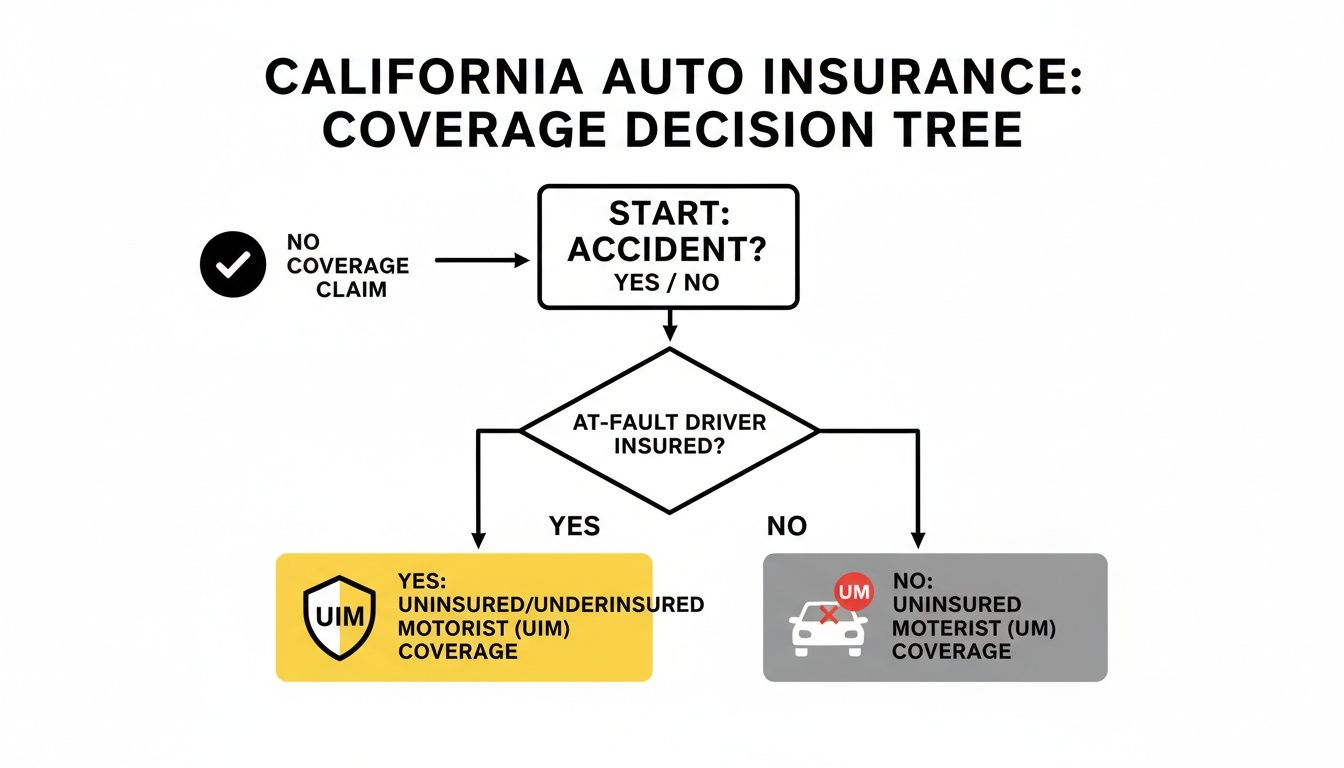
The key takeaway here is simple: after an accident, the first question is always about the other driver's insurance. Their answer determines whether you’ll need to lean on your UM or UIM coverage. Each of these stories underscores why just having basic liability isn't enough to truly protect yourself on California's unpredictable roads.
Decoding California Policy Limits and Common Exclusions
Knowing what your auto insurance covers is half the battle; the other half is understanding its limits. When we talk about Uninsured (UM) and Underinsured Motorist (UIM) coverage, the details in the fine print really matter. Overlooking them can lead to some nasty financial surprises just when you need that protection the most.
Let's start with a big one: "stacking." You might have heard about this. In some states, if you insure, say, three cars, you can often "stack" the UM/UIM coverage from each one. So, three cars with $100,000 in UM coverage could give you a $300,000 safety net for a single, serious accident.
Here's the crucial part for us: California is a "non-stacking" state. That's a deal-breaker. It means you can't combine the limits from multiple cars on your policy. The coverage limit listed for the specific car you were in during the accident is the hard cap on what your policy will pay, period. It doesn't matter if you have five other vehicles insured.
What Your Policy Doesn't Cover
Just as critical as your coverage limits are the exclusions. Think of these as the specific situations where your UM/UIM coverage simply won't kick in. They aren't hidden traps; they're standard contract terms that set the boundaries of your protection. Knowing them ahead of time can save you a world of headache.
A few common exclusions you'll find in most California policies include:
- Driving for Dollars: If you're using your car for Uber, Lyft, or DoorDash and get hit by an uninsured driver, your personal UM/UIM coverage probably won't apply unless you have a specific rideshare endorsement.
- Government Vehicles: Got hit by a city bus or a state-owned truck? Your UM/UIM policy typically bows out. Claims against government entities are a whole different ballgame with a separate, often trickier, legal process.
- "No-Contact" Accidents: This one trips a lot of people up. If an uninsured driver cuts you off, causing you to swerve and hit a tree, but their car never actually touches yours? Your Uninsured Motorist Property Damage (UMPD) coverage might not cover the repairs.
Knowing the rules of the road for your insurance policy is just as important as knowing them for driving. Exclusions and non-stacking rules are the guardrails of your coverage—they define your safe operating zone.
Putting This Knowledge to Work
Once you understand these details, you can have a much smarter conversation about your insurance needs. The fact that California bans stacking, for example, really drives home the importance of choosing high enough limits on your primary vehicle. That single limit is your entire safety net against an uninsured driver.
It also highlights why you should look at your insurance as a complete package—how your auto insurance, home insurance, and umbrella policies can work together.
By being aware of the common exclusions, you can either get the right add-ons for your situation (like a rideshare endorsement) or steer clear of activities that could leave you holding the bag financially. The goal is never just to have insurance; it's to build a reliable shield that actually works when you need to make a claim.
Choosing The Right Coverage To Protect Your Assets
You now have a solid grasp of what uninsured motorist coverage is and why it's so important. The next step? Turning that knowledge into real-world protection. The single best thing you can do right now is to proactively review your own car insurance policy.
Don’t wait for an accident to find out you have a major gap in your financial armor. Take a few minutes today to pull out your policy and ask some tough questions. A simple five-minute check-up could save you from financial ruin.
Your Personal Coverage Checklist
Start by finding clear answers to these critical questions on your policy's declaration page. If you can't find them easily, that's a red flag—it’s time to call your agent.
- Do I actually have UM/UIM? First things first, confirm both Uninsured and Underinsured Motorist coverages are listed on your policy. Never assume they're included automatically.
- Are my limits high enough? Think about your assets—your home equity, savings, investments, and future income. Do your coverage limits reflect what you have to lose? A single, serious accident could put it all at risk.
- Is my coverage realistic for California? Given that 1 in 7 drivers here don’t have insurance, minimum coverage just doesn't cut it. Are your limits truly prepared for a worst-case scenario on our busy roads?
Paying a bit more for higher UM/UIM limits isn't just another bill. It's one of the smartest, most cost-effective investments you can make in your family's long-term financial security.
Protecting your assets goes beyond a homeowners insurance policy. A major car accident can threaten everything you've built, making your auto insurance the first line of defense for your financial future.
Creating A Comprehensive Safety Net
Your car insurance policy isn’t an island. It needs to work hand-in-hand with your other coverages, like your home insurance, renters insurance, or umbrella policies, to form a complete financial shield. A weakness in one area can leave everything else exposed.
This is where getting professional guidance really pays off. A knowledgeable insurance expert can look at your entire financial picture, spot the vulnerabilities, and make sure your policies work together. They can help you see how a bad car accident could impact your home and savings, then recommend the right levels of protection across the board, including options like life insurance.
Take a proactive step to secure your assets today. By taking a few moments to get a personalized insurance quote online, you can see your options clearly and ensure your coverage is truly built to protect what you value most. Don't leave your family's well-being to chance.
Your Questions, Answered
Auto insurance policies can feel like they're written in another language. To cut through the confusion, here are some straightforward answers to the questions we hear most often from California drivers about uninsured motorist coverage.
Is Uninsured Motorist Coverage Required In California?
No, it's not legally required, but there's a catch. California law mandates that every insurance company must offer you UM/UIM coverage when you buy a policy. You can say no, but you have to formally reject it in writing.
Honestly, turning it down is a huge gamble, especially with so many uninsured drivers out there. That's why we almost always strongly recommend it for every single driver in California.
How Much Uninsured Motorist Coverage Do I Need?
The best rule of thumb is simple: match your uninsured motorist (UM/UIM) limits to your own liability coverage. So, if your policy has liability limits of $100,000 per person and $300,000 per accident, you should get the same amount for your UM/UIM protection.
Think of it this way: you're giving yourself the same level of financial protection that you're required to give to others. It creates a balanced policy where your own safety net is just as strong as the one you provide for everyone else on the road.
Matching your UM/UIM limits to your liability coverage is the simplest way to ensure your own financial assets—like your home, savings, and future income—are adequately shielded from another driver's mistake.
Will Filing A UM Claim Raise My Insurance Rates?
This is a worry for a lot of people, but California law is on your side here. Insurers are legally forbidden from jacking up your rates for an accident that wasn't your fault.
By definition, an uninsured motorist claim means someone else was at fault. Because of this, filing a UM claim should not impact your insurance rates at all. You're just using the exact coverage you've been paying for to fix a problem someone else created.
What Is The Difference Between Deductibles For Collision And UMPD?
This is a great question because the deductibles work very differently. Uninsured Motorist Property Damage (UMPD) is specifically for when a known, identified uninsured driver hits your car. Its deductible is usually a lower, fixed amount, like $500.
Your collision deductible, on the other hand, is what you pay for most other physical damage claims, and it's often higher. This is the one you'd use for a hit-and-run, since the at-fault driver is unknown and can't be identified. For more answers like this, you can also check out our general insurance FAQ page.
Figuring out the ins and outs of car insurance, home insurance, and life insurance can be a headache, but you don’t have to go it alone. The licensed agents at Mai & Associates are here to offer clear, no-pressure advice that fits your life. Stop by https://cahomeauto.com to compare quotes in minutes and make sure you have the right protection for your California lifestyle.