What is umbrella insurance coverage? Protect Your Assets in California
Think of umbrella insurance as an extra layer of liability protection that sits on top of your existing policies, like your California auto or home insurance. It’s designed to kick in right when your primary coverage runs out, protecting your assets and future earnings from a major lawsuit or accident. It’s your financial safety net for the big, unexpected events in life.
Your Financial Raincoat for California Life
Your standard insurance policies—your California car insurance or homeowners insurance—are like your everyday jacket. They're great for most situations, offering solid protection against common California risks, whether it’s a fender bender on the I-5 or a guest taking a tumble in your backyard. For most minor incidents, that jacket is all you need.
But what if you get caught in a torrential downpour? I’m talking about a catastrophic car accident with serious injuries, or a lawsuit with a judgment that blows past your policy limits. In those moments, your standard coverage gets soaked, leaving your personal assets completely exposed. This is where umbrella insurance comes in, acting as your heavy-duty financial raincoat. It provides that crucial, extra layer of liability protection right when you need it most.
Understanding the Basics
An umbrella policy doesn't work on its own; it's a companion to your existing coverage. Its sole purpose is to shield you from liability claims that are large enough to cause financial devastation. While it doesn't cover life insurance needs, it's a critical component of a comprehensive personal protection plan.
This includes protection for scenarios involving:
- Bodily Injury Liability: Covers severe injuries you cause to someone else in a car crash or an accident on your property.
- Property Damage Liability: Pays for significant damage you cause to another person's property, like in a multi-car pileup.
- Personal Injury Claims: Defends you against lawsuits for things like slander, libel, or false arrest—risks often excluded from standard home or California renters insurance policies.
To give you a clearer picture, here's a quick summary of what umbrella insurance is all about.
Umbrella Insurance at a Glance
| Concept | Description |
|---|---|
| What It Is | An extra layer of liability insurance that goes beyond the limits of your primary policies (home, auto, etc.). |
| Who It's For | Homeowners, drivers, and individuals in California with significant assets or high earning potential who want to protect their financial future. |
| How It Works | It activates once the liability limits on your underlying policy have been reached, covering the remaining costs up to its own limit. |
| What It Covers | Major claims involving bodily injury, property damage, and personal injury situations like libel or slander. |
Essentially, it’s a high-limit, broad-coverage policy designed to prevent a single catastrophic event from wiping you out financially.
An umbrella policy is designed to protect you from the unexpected. In a state as populous and fast-paced as California, a single unforeseen event can result in a claim that dwarfs the limits of a standard insurance policy, making this extra protection invaluable.
Why It Matters for Californians
Living in California comes with a high cost of living and, unfortunately, a greater potential for high-stakes lawsuits. Relying on basic California insurance coverage alone can be a huge gamble. A serious accident can easily rack up medical bills and legal judgments in the millions, far exceeding the typical $250,000 or $500,000 liability limits on most auto or home policies.
If you're ever faced with a claim that big, you’d be on the hook for the difference—putting your savings, your home, and even your future income on the line. For a deeper dive into insurance terminology, feel free to check out our comprehensive glossary of insurance terms. This guide will walk you through how this surprisingly affordable coverage can be the key to securing your financial future.
How Umbrella Coverage Works With Your California Insurance Policies
Think of your current California auto insurance and home insurance policies as your first line of defense. They’re absolutely essential for handling the everyday risks you face on the road or at home. But what happens when a lawsuit or claim is so large that it completely blows past those limits? That’s where an umbrella policy steps in.
It doesn’t replace your existing policies. Instead, it’s a powerful second layer of protection that sits on top, waiting quietly in the background. It only activates when a major claim exhausts the liability coverage on your primary policies, like your auto or homeowners insurance. Once that happens, the umbrella opens up to shield you from the rest.
This visual gives you a great sense of how umbrella insurance provides that extra layer of security over your existing auto and home policies.
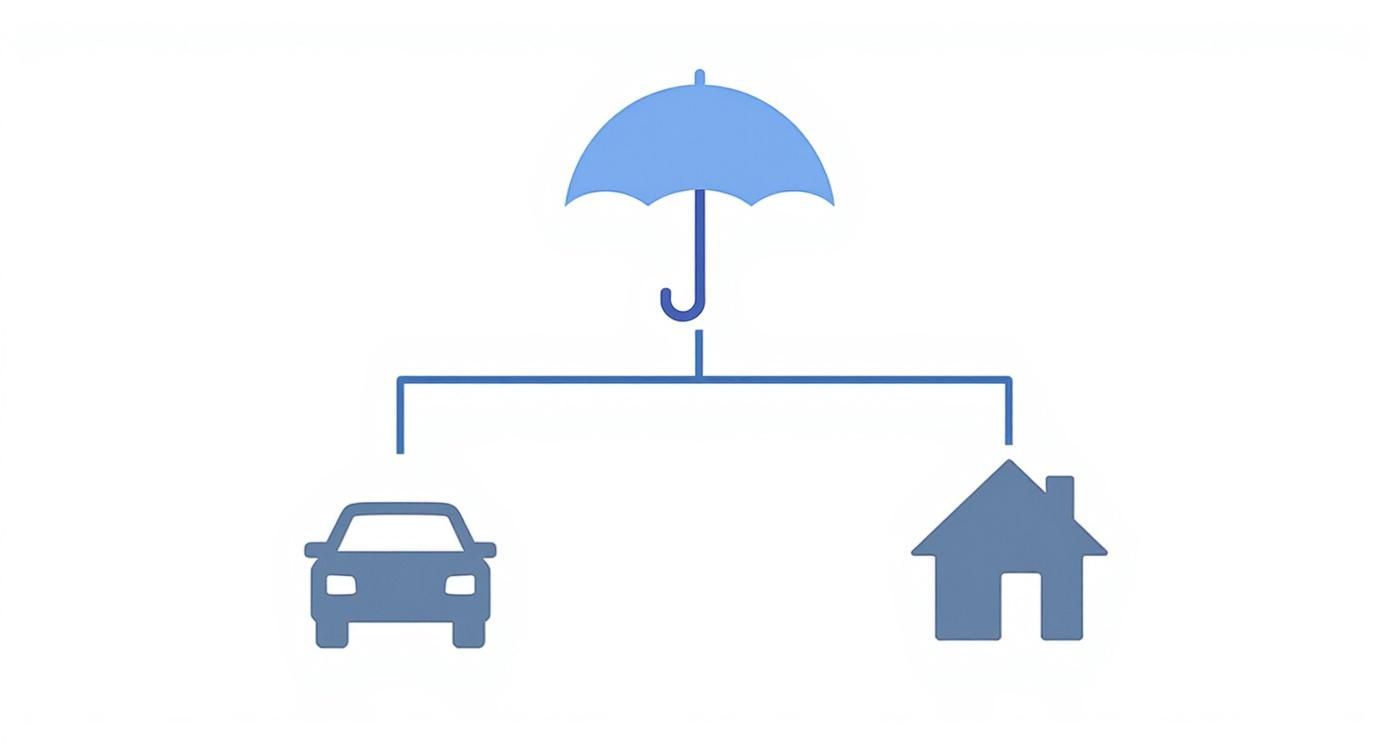
As you can see, it’s not a standalone product. It’s a supplemental shield designed specifically to extend the protection you already have.
Understanding Underlying Limits
Before a California insurance company will sell you an umbrella policy, they need to see that your first line of defense is solid. This is where the term underlying limits comes in. It’s simply the minimum amount of liability coverage you’re required to have on your base policies before you can even qualify for an umbrella.
Think of it like building a house—you can’t put the roof on until the foundation and walls are sturdy. Your auto and home insurance policies are that foundation.
These minimums aren't just arbitrary numbers. They exist to make sure the umbrella policy is used for its intended purpose: protecting you from truly catastrophic events, not smaller, more common claims. Insurers in California set these requirements to ensure your primary policies are robust enough to handle the majority of incidents on their own.
For example, most carriers will require you to have at least:
- $250,000 in bodily injury liability per person and $500,000 per accident on your California auto insurance policy.
- $300,000 in personal liability coverage on your California homeowners or renters insurance policy.
While these amounts can vary a bit between companies, they’re a pretty standard starting point. You can get a better sense of building that strong foundation by reading our guide to navigating auto insurance in California. When you meet these underlying limits, you're showing that you're already managing your risk responsibly.
Why Insurers Mandate These Limits
The whole point of an umbrella policy is to give you a massive amount of protection for those rare but financially devastating events. By insisting on strong underlying limits, insurers ensure your regular car insurance and home insurance in California are well-equipped to handle the more frequent, less severe claims. This smart structure is what keeps umbrella insurance surprisingly affordable.
This tiered system keeps your primary policies as the workhorses. Your umbrella policy then acts purely as secondary, or excess, coverage for claims that spill over those primary limits.
In essence, your primary policies act as a massive deductible for your umbrella insurance. They handle the initial damages up to their limit before the much larger umbrella protection ever has to kick in.
Let’s walk through a real-world scenario. Say you cause a serious multi-car pile-up on a California freeway, and you're found liable for $1 million in damages. If your auto insurance has a liability limit of $500,000, your policy pays that amount first. Then, your $1 million umbrella policy would activate to cover the remaining $500,000. Your personal assets, like your home and savings, are completely untouched.
Without that umbrella, you’d be on the hook for that half-million-dollar shortfall yourself. That’s the kind of financial disaster this coverage is designed to prevent.
What Your Umbrella Policy Actually Covers
An umbrella insurance policy does much more than just give you higher liability limits—it fundamentally broadens the very definition of what you’re protected against. Think of it as a two-part upgrade for your financial safety net. First, it boosts the coverage on your existing policies, like your California auto insurance or home insurance. Second, and maybe even more importantly, it covers you for risks your standard policies won't even touch.
Let's unpack these two powerful functions to see what an umbrella policy really does in the real world.

This dual role is what makes umbrella coverage so essential today, especially in a state like California where liability risks can be significant.
Extending Your Existing Liability Limits
The most straightforward benefit of an umbrella policy is how it stacks millions in extra liability coverage right on top of your current policies. When a truly bad day happens, the financial fallout can easily blow past the limits of even a good car insurance or California homeowners insurance policy.
Let’s say you’re found at fault in a major pile-up on a California freeway. The medical bills and property damage add up to $800,000, but your auto policy’s liability limit is $300,000. Without an umbrella policy, you’d be on the hook for the remaining $500,000, putting your home, savings, and future earnings in jeopardy.
An umbrella policy seamlessly steps in to cover that $500,000 gap. It's the financial backstop that ensures one devastating accident doesn't lead to personal bankruptcy.
This extra layer sits on top of the liability portions of your core policies, including:
- Auto Insurance: For bodily injury and property damage you cause in a crash.
- Homeowners Insurance: If a guest is seriously hurt on your property.
- Renters Insurance: For liability claims if an accident happens in your rented home.
- Boat or RV Insurance: To extend liability for incidents involving your recreational vehicles.
By adding this extra layer, you’re reinforcing your primary defense with millions more in protection.
Adding New Protections Your Standard Policies Exclude
This is where you see the true power of what is umbrella insurance coverage. An umbrella policy doesn't just offer more coverage; it offers broader coverage. It protects you from personal injury claims that are almost always left out of standard home or auto insurance policies in California.
For example, your standard home insurance policy won’t do a thing if you’re sued for something you said or wrote. An umbrella policy, on the other hand, typically provides coverage for situations like:
- Libel: Damaging someone's reputation in writing.
- Slander: Damaging someone's reputation through spoken words.
- False Arrest or Imprisonment: Unlawfully detaining someone against their will.
- Malicious Prosecution: Filing a lawsuit against someone with malicious intent.
- Invasion of Privacy: Intruding on someone's personal life.
In our hyper-connected world, a poorly worded social media post or a negative online review could easily escalate into a costly defamation lawsuit. Without an umbrella policy, you’d be facing that legal battle—and any potential judgment—all on your own. For a closer look at various California insurance topics, you can explore our other helpful insurance guides.
On top of all that, a huge and often-overlooked benefit is coverage for your legal defense. Umbrella policies can pay for your attorney, court costs, and other legal bills, even if the lawsuit is completely frivolous. Defending a baseless lawsuit can still run into the tens of thousands of dollars, so this feature alone can be a financial lifesaver. This expanded scope is precisely why umbrella insurance is so valuable. As one major insurer notes, it not only extends your liability limits but also covers personal injury claims like slander and false arrest, including the significant legal defense costs. You can learn more about how umbrella policies broaden coverage on geico.com.
Who Should Consider Umbrella Insurance in California?
There’s a common myth that umbrella insurance is only for the super-rich. The truth is, it’s a smart move for many everyday Californians whose assets and lifestyles carry more risk than they might think. It isn't just about your net worth; it’s about your risk exposure.
Think about your life here in California. Do you drive on notoriously packed freeways like the 405 or 101? Do you own a home with a pool, host parties, or have a teenage driver on your policy? Each of these common situations can dramatically increase your liability, making you a perfect candidate for the extra layer of protection an umbrella policy offers.
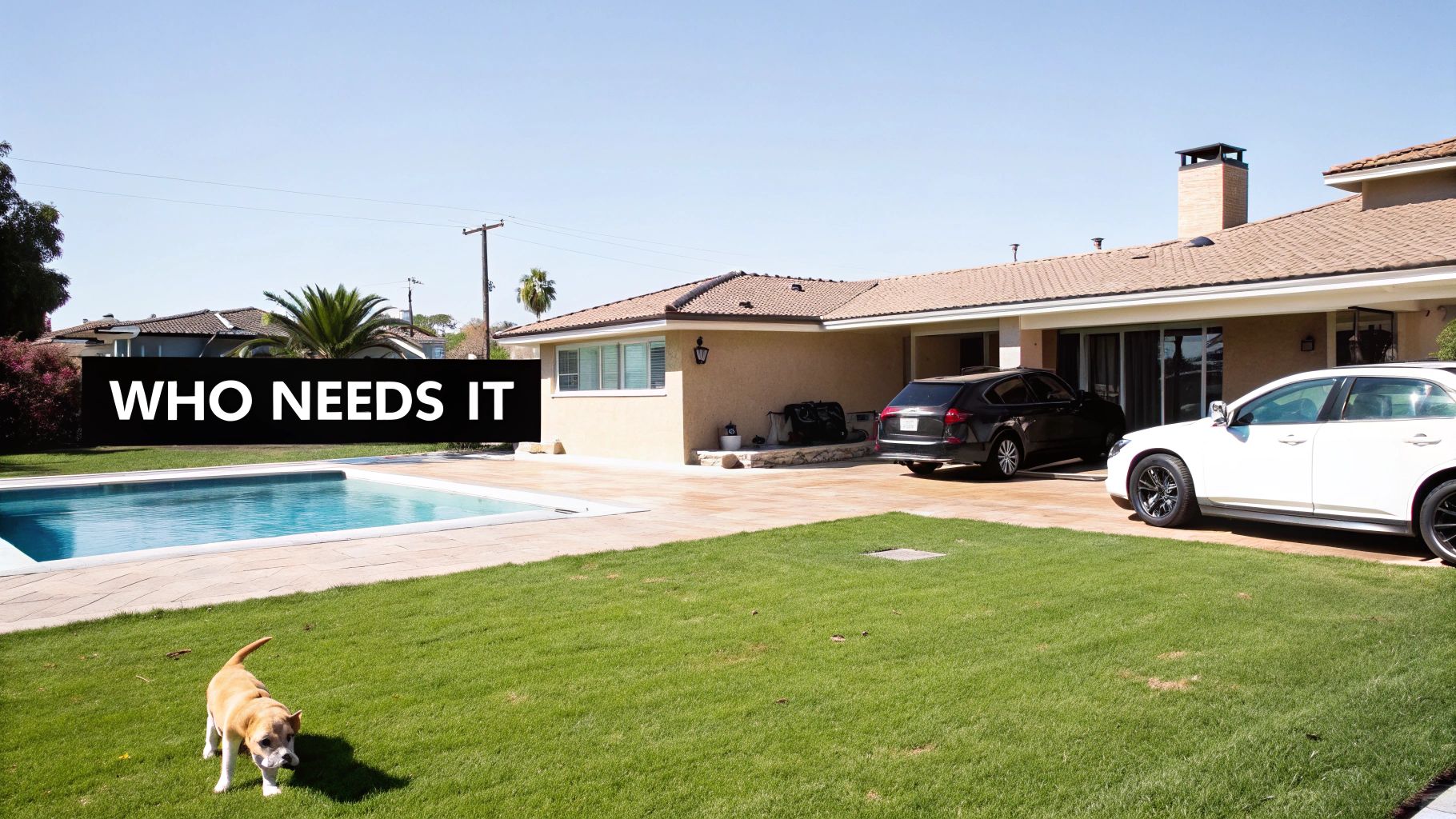
Let’s take a closer look at a few scenarios to help you see if you might have a coverage gap that needs filling. This is all about securing your peace of mind, especially in a state known for its litigious environment.
Homeowners with Significant Equity or Risk Factors
If you own a home in California, chances are you're sitting on a good amount of equity. That equity is a major asset, and it's exactly what a lawsuit could target. An umbrella policy acts as a firewall, protecting your home from being liquidated to pay for a massive judgment.
Certain home features also dramatically increase your risk. Do any of these sound familiar?
- Swimming pools or hot tubs: These are magnets for accidents and, unfortunately, liability claims.
- Trampolines: They're a ton of fun, but they're also notorious for causing injuries.
- Play structures: That awesome swing set or treehouse can become a liability if a guest’s child gets hurt.
- Dogs: Even the sweetest family pet can bite under the right circumstances, leading to serious medical bills and a potential lawsuit.
If a guest is badly injured on your property, the costs can easily blow past the $300,000 or $500,000 liability limit on a standard California home insurance policy. An umbrella policy is built for exactly these kinds of high-stakes situations.
California Drivers and Families
Let's face it, driving in California comes with its own set of challenges. Heavy traffic and long commutes mean the odds of a serious accident are higher. An umbrella policy is particularly crucial for:
- Families with teen drivers: Young, inexperienced drivers are statistically more likely to cause accidents. Adding a teen to your California car insurance is a major reason to boost your liability coverage.
- Owners of multiple vehicles: The more cars your family has on the road, the greater your exposure to a potential accident.
- Commuters on busy freeways: Daily drives on the I-5 or across the Bay Bridge mean you spend more time exposed to the risk of a multi-car pileup.
A single bad accident can lead to a judgment that completely dwarfs the limits of even a high-coverage California auto insurance policy.
Landlords and Rental Property Owners
Owning rental property in California opens you up to a whole different world of liability. You can be held responsible for injuries on your property, from a tenant tripping on a loose step to much more complex situations. Your landlord policy is the foundation, but an umbrella policy is what gives you serious protection.
For landlords, an umbrella policy is a crucial business tool. It protects not just the rental property itself but also your personal assets from lawsuits originating from your tenants or their guests.
The more rental units you own, the more your public exposure—and your potential for lawsuits—grows. This also applies if you rent out your primary home or a vacation spot on a short-term basis. If you're a renter wanting to understand your own liability, our guide on what renters insurance in California covers is a great place to start.
Ultimately, the decision comes down to a simple calculation. Add up your assets—your home equity, savings, investments, and even your future earnings. If that total is higher than the liability limits on your home and auto insurance policies, you have a coverage gap. An umbrella policy is the most effective and affordable way to close it.
What Does an Umbrella Policy Actually Cost?
When you see insurance policies that offer millions of dollars in coverage, it's easy to assume the price tag is sky-high. But umbrella insurance is one of the best-kept secrets in the California insurance world when it comes to value. For the massive financial safety net it provides, the cost is surprisingly down-to-earth.
So, where do those numbers come from? Your premium isn’t just a random figure. It’s a carefully calculated reflection of your unique risk profile, based on a handful of key factors.
What Goes into Your Premium?
When an insurance company in California prices your policy, they’re essentially looking at your total liability exposure. In other words, they're gauging how likely it is that you might be involved in a situation that leads to a major claim. The more risk you present, the higher the premium will be.
Here's what they look at most closely:
- How Much Coverage You Need: This is the biggest piece of the puzzle. A $1 million policy is naturally going to cost less than a $5 million one. Each extra million you add will increase the price, but the cost per million usually gets cheaper the higher you go.
- Your Driving Record: What happens behind the wheel is a major indicator of risk. A clean driving history helps keep your rates low, but a track record of accidents or tickets—for anyone on your California car insurance policy—will push the cost up.
- Your Property Portfolio: The more homes, rental properties, and vehicles you own, the more opportunities there are for something to go wrong. Insuring a larger number of assets will naturally influence your premium.
- Lifestyle Risks: Some things just carry more risk than others. Insurers have a term for this: "attractive nuisances." If you own a swimming pool, a trampoline, a boat, or even certain dog breeds, you can expect to pay a bit more because of the increased chance of an accident.
Why is it so affordable? A big reason is that umbrella policies are designed to kick in for low-frequency, high-severity events. Your regular home and auto insurance policies handle the everyday stuff. Since the umbrella policy is rarely called upon, insurers can keep the premiums low.
Sample Costs and Coverage Tiers
For most California families, a $1 million umbrella policy provides a substantial layer of protection. Premiums for this starting level of coverage typically land somewhere between $150 and $300 per year. Think about that—it's often less than a dollar a day for an incredible amount of peace of mind.
To give you a better sense of the numbers, here are some common annual premium ranges:
- $1 Million Policy: $150 - $300
- $2 Million Policy: $225 - $400
- $5 Million Policy: $400 - $700+
Of course, these are just ballpark figures. Your actual quote will depend on the risk factors we just covered. It's also worth noting that as lawsuit settlements get larger—a trend sometimes called "social inflation"—we're seeing upward pressure on insurance premiums. To get a better handle on these market forces, you can read more about market forecasts on InsuranceJournal.com.
How to Figure Out How Much Coverage You Really Need
Choosing the right limit isn't about picking a random number; it's about protecting everything you've worked so hard for. The goal is to get enough coverage to shield your current net worth and your future income.
It’s simpler than you might think. Just follow these three steps:
- Add Up Your Assets: Tally up the value of everything you own. This means your home equity, all your savings and checking accounts, investment portfolios (stocks, bonds, etc.), retirement funds like 401(k)s and IRAs, and any other big-ticket items like vehicles or a vacation home.
- Factor in Future Earnings: A lawsuit can go after more than just what you have now; it can lead to wage garnishment. You need to protect your ability to earn an income in the years to come.
- Pick Your Limit: Your umbrella limit should be at least equal to your total net worth, and ideally a little more. For instance, if your assets add up to $1.2 million, a $2 million policy is a smart move. It covers everything you own and gives you a comfortable buffer.
By taking a quick inventory like this, you can confidently land on a coverage amount that acts as a true financial fortress for you and your family.
Common Questions About Umbrella Insurance
It's completely normal to have a few "what if" questions rattling around in your head, even after you understand the basics. Let's tackle some of the most common scenarios we get asked about to make sure you have a crystal-clear picture of how umbrella insurance really works day-to-day.
Does an Umbrella Policy Cover My Business Activities?
This is a big one, and the answer is a firm no. Your personal umbrella policy is designed to shield your personal life and assets from liability. It absolutely does not cover liabilities that stem from your business.
Think about it: if a client sues you over a professional error, an employee gets hurt on the job, or a company vehicle is in an accident, those are business risks. You need a separate commercial umbrella policy to handle those. Trying to make one policy do the job of two is a recipe for a massive, uncovered claim.
Keep it simple: Personal umbrella protects you, the individual. Commercial insurance protects you, the business owner. Don't cross the streams, or you could find both your personal finances and your company completely exposed.
Are My Kids Covered When They Are Away at College?
Yes, and this is a huge relief for many parents. Generally, your personal umbrella policy extends to cover your dependent children while they're living away at school, whether in a dorm or an off-campus apartment.
So, if your son or daughter, who is still legally part of your household, is held liable for something, your umbrella can kick in. This could be for a guest getting injured in their apartment, an accidental fire, or even a libel lawsuit from a social media post gone wrong. It’s a crucial feature that keeps the whole family protected under one safety net.
What Happens If My Primary Auto Insurance Lapses?
This is the absolute worst-case scenario, and you have to avoid it. An umbrella policy isn't a replacement for your regular insurance; it's excess liability coverage. That means it sits on top of your existing policies and requires them to be active and in good standing.
If your primary California auto insurance or home insurance policy lapses, your umbrella coverage for that specific risk disappears. It becomes null and void. The insurance company will deny the claim because you didn't hold up your end of the deal by maintaining the required foundational coverage.
- You must maintain your underlying policies. No gaps, no exceptions. Your auto and home insurance have to stay in force.
- You must maintain the required limits. If your umbrella carrier requires you to have $500,000 in auto insurance liability, you can't drop it down to $250,000.
Letting your primary coverage lapse essentially pulls the rug out from under your umbrella policy, leaving you without that extra billion-dollar layer of protection right when you need it most.
Getting the details right on what is umbrella insurance coverage is the key to making sure your assets are truly safe. The team at Mai & Associates is here to walk you through your current policies, find any gaps, and build a plan that lets you rest easy. Get your no-obligation quote and start protecting what matters most today!