What Is Medical Payments Coverage in California Auto Insurance?
When you get into a car accident in California, the first question on everyone’s mind is, "Is anyone hurt?" The second, often unspoken question is, "Who's going to pay for this?" While insurance companies sort out who was at fault, medical bills don't wait. This is where Medical Payments coverage, or MedPay, comes in.
Simply put, MedPay is optional coverage on your California auto insurance policy that handles medical expenses for you and your passengers after a crash, no matter who caused it. It’s like having a dedicated medical fund ready to go, offering a financial first-aid kit when you need it most. It's a key part of a comprehensive car insurance plan, working alongside other coverages like homeowners or life insurance to protect your financial well-being.
Your Financial First Responder After a Car Accident
Picture this: you're in a fender-bender on a busy Glendale freeway. It doesn't seem too serious, but the jolt leaves you with a sore neck. An ambulance ride, an emergency room visit, and a few X-rays later, the bills are already piling up. This is the exact gap MedPay is designed to fill within your California car insurance.
It pays for those immediate medical costs for you, your family, or anyone else in your car without waiting for a lengthy fault investigation. If you want to dive deeper into the basics of this protection, this resource on What is Medical Payments Coverage provides a great overview of its core principles.
Why MedPay Matters in California
In a state like California, with its dense traffic and notoriously high medical costs, this coverage can be a real lifesaver. In 2023 alone, more than 1.2 million Californians were involved in police-reported accidents, many of which resulted in minor but costly injuries.
Even a "minor" injury can get expensive fast. The average emergency room visit can run you $2,600 out-of-pocket. If you need an ambulance or follow-up care, that figure can easily balloon to $20,000 or more. MedPay is your first line of defense against these sudden, unexpected costs associated with your auto insurance.
To give you a clearer picture, here’s a quick summary of how MedPay works for you.
Medical Payments (MedPay) Coverage at a Glance
This table breaks down what MedPay typically covers in California auto insurance, so you can see its value at a glance.
| Coverage Aspect | What It Means for You |
|---|---|
| Who is Covered? | You (the policyholder), your resident family members, and any passengers in your insured vehicle. |
| What is Covered? | Necessary medical treatments like ambulance fees, ER visits, doctor appointments, X-rays, and even dental work. |
| When Does It Apply? | After any auto accident, regardless of who was at fault. It also covers you as a pedestrian or cyclist if you're hit by a car. |
| Key Benefit | Provides immediate payment for medical bills, so you don't have to wait for a fault determination or pay out-of-pocket. |
Essentially, it’s a straightforward way to protect your health and your wallet right when you need it most.
Key Takeaway: MedPay’s primary job is to offer immediate financial assistance. It pays for your initial medical costs without the need to prove fault, giving you a critical safety net when you need it most.
A Closer Look at the Basics
Unlike liability coverage—which is all about paying for the other driver's injuries and damages if you’re at fault—MedPay is focused entirely on you and your passengers. It’s not about blame; it’s about care.
Here are the core features that make it so valuable for California drivers:
- No-Fault Coverage: It pays out whether you caused the crash or not. This means you can get your bills covered right away, without a long, stressful wait.
- Covers You and Your Passengers: Anyone riding in your insured vehicle is protected, from family members to friends you’re carpooling with.
- Follows You: In many cases, your MedPay coverage even follows you outside your car. If you're injured as a pedestrian or while riding in a friend's vehicle, it can often step in to help.
Auto insurance has a lot of moving parts, and the terminology can get confusing. If you ever need a quick refresher, our Mai & Associates insurance glossary is a great resource for clear definitions. Think of MedPay as an affordable and smart addition to your California insurance policy, ensuring one accident doesn't create a financial crisis.
What MedPay Actually Covers and What It Excludes
When you're looking at your car insurance policy, it’s easy for your eyes to glaze over. But for California drivers, it's worth taking a minute to understand exactly what Medical Payments (MedPay) coverage does for you. Think of it as the first responder for your wallet after an accident.
Its main job is simple: to pay for the immediate medical bills for you and anyone in your car, no matter who was at fault. This lets you get the care you need right away without having to drain your bank account while everyone figures out who's to blame for the crash.
What Your California MedPay Policy Covers
When you add MedPay, you're buying a very specific, no-fuss safety net. It’s built to cover the most common and immediate medical costs that pop up right after a collision.
Here’s a practical list of what MedPay will take care of, up to your chosen limit:
- Health Insurance Deductibles and Copays: Have a high-deductible health plan? MedPay can cover that initial out-of-pocket hit. It also handles those pesky copays for doctor visits and specialists.
- Ambulance and Paramedic Fees: That surprise bill for the ambulance ride can easily run into the thousands. MedPay is designed to cover these emergency transport costs.
- Doctor and Hospital Visits: From the ER visit right after the crash to follow-up appointments with your doctor, MedPay helps pay those bills.
- Necessary Dental Work: If the accident chipped or broke a tooth, MedPay can pay for the dental procedures needed to fix the damage.
- X-rays and Diagnostic Imaging: These are crucial for finding out what's wrong, whether it's a broken bone or something else, and they're covered.
- Chiropractic Services and Physical Therapy: For injuries like whiplash, the rehabilitative care you need to get back on your feet is often included.
- Funeral Expenses: In the tragic event of a fatal accident, MedPay provides a benefit to help your family with funeral costs. This feature works alongside any life insurance policy you may have.
Scenario: Let's say you get caught in a nasty multi-car pile-up on a Costa Mesa freeway. You didn't cause it, but you need an ambulance and a trip to the ER. Your health insurance comes with a $5,000 deductible. Instead of you having to write a check for that amount, your $5,000 MedPay coverage can step in and pay it directly, giving you immediate financial relief.
What MedPay Does Not Cover
It's just as crucial to know what MedPay won't cover. This isn't a catch-all solution; it has a very targeted role. Trying to use it for the wrong thing is like trying to fit a square peg in a round hole—other parts of your auto insurance are built for those other jobs.
Here are the kinds of costs that fall outside of MedPay’s scope:
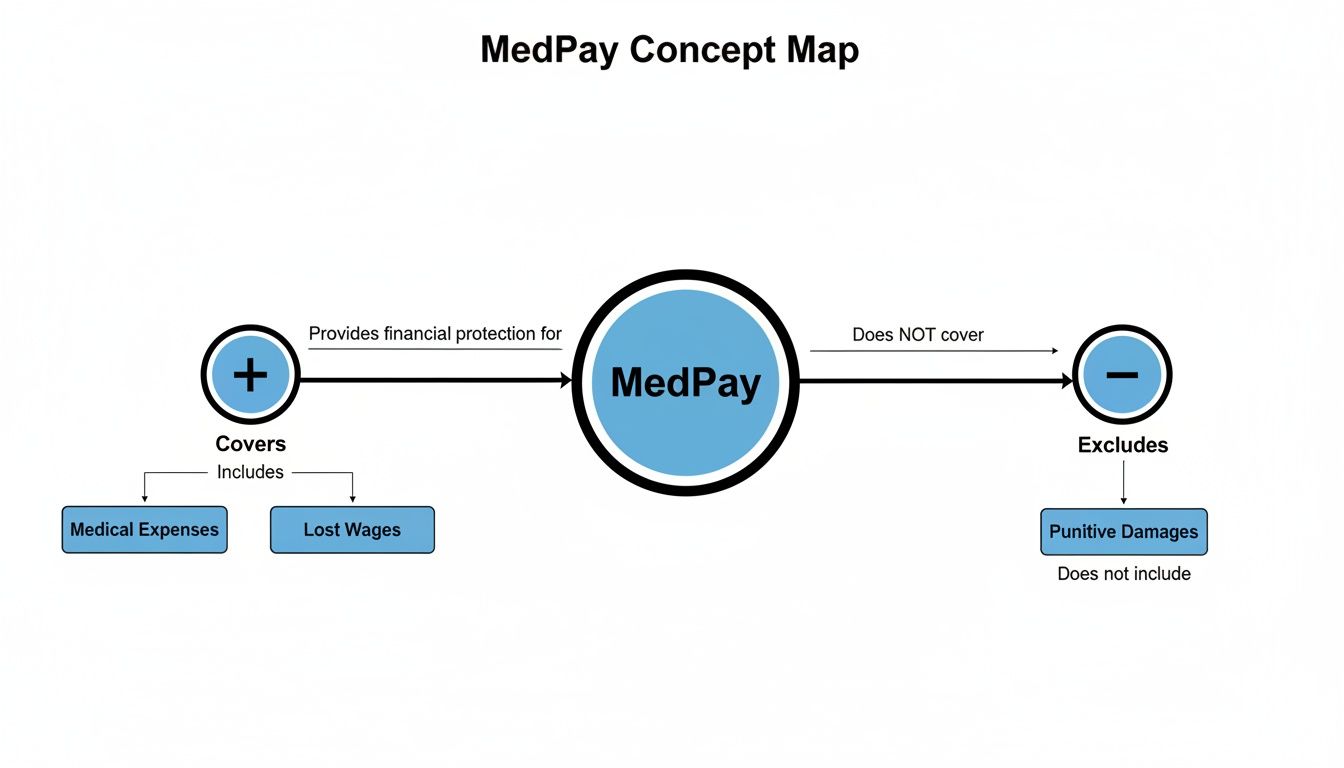
- Lost Wages: If you can't work because of your injuries, MedPay won't replace that lost paycheck. This is a key distinction, as some other states have Personal Injury Protection (PIP) which can cover this, but PIP isn't an option in California.
- Damage to Your Vehicle or Other Property: Getting your car fixed is a job for your collision coverage (if you're at fault) or the other driver's liability coverage (if they're at fault). Damage to personal items might be covered by your homeowners or renters insurance.
- Injuries to People in the Other Car: MedPay is for you and your passengers only. If you cause an accident, your Bodily Injury Liability coverage is what pays for the medical bills of people in the other vehicle.
- Pain and Suffering: MedPay doesn't pay for non-financial damages like emotional distress or chronic pain. That type of compensation is usually pursued through a claim against the at-fault driver's insurance.
Seeing these differences helps you understand how all the pieces of your California auto policy work together as a team. MedPay fills that vital gap for your immediate medical needs, while your liability and collision coverages handle the other major financial risks on the road.
MedPay vs. Other Insurance: A California Comparison
Insurance can feel like a tangled web of policies, and it's easy to get confused about what covers what. When you’re trying to understand MedPay, the best way to see its value is to look at how it fits with other California insurance products, like health, homeowners, or life insurance. Think of your insurance policies as different tools in a mechanic's toolbox—each one is designed for a specific job.
In California, your auto insurance policy has several distinct parts. MedPay plays a unique role, stepping in where other coverages, like Bodily Injury Liability and even your personal health insurance, leave off. Let's break down the differences so you can see how they all work together to protect you after a crash.
MedPay vs. Bodily Injury Liability
The biggest difference between MedPay and Bodily Injury Liability is simple: one covers you, and the other covers them.
Your MedPay coverage is for you and your passengers. It pays for medical bills right away, no matter who was at fault for the accident. It’s your immediate financial first aid.
Your Bodily Injury Liability coverage is for the other driver and their passengers. It only pays out if you're found legally responsible for the accident. It’s designed to cover their medical costs, lost income, and even pain and suffering.
This distinction is critical. The Bodily Injury coverage that's required in California will never pay a dime for your own injuries. That's the exact gap MedPay was created to fill in your car insurance policy.
A Note on Personal Injury Protection (PIP) in California
You might have heard friends in other states talk about Personal Injury Protection, or PIP. While it sounds a lot like MedPay, PIP is not available in California.
PIP is a feature of "no-fault" insurance systems. In those states, each driver's own insurance covers their injuries up to a certain limit, regardless of fault. California, however, is an "at-fault" state. That means we rely on MedPay for no-fault medical coverage on an auto policy.
MedPay vs. Your Health Insurance
This is where things can get a little fuzzy for many drivers. "I have great health insurance," you might think, "so why would I need MedPay?" The answer is that they're designed to work as a team, protecting you from the gaps that your health plan almost certainly has.
After an accident, even with good health insurance, you're often on the hook for:
- Your annual deductible, which can easily be thousands of dollars.
- Copayments for every single doctor’s visit or prescription.
- Coinsurance, which is the percentage of the final bill you have to pay yourself.
MedPay is perfectly suited to cover these immediate out-of-pocket costs. You can use it to pay your health insurance deductible, the ER copay, or follow-up physical therapy sessions. It acts as a financial buffer, so an accident doesn't drain your bank account.
To see how these coverages fit together, it helps to understand their distinct roles.
MedPay vs. Bodily Injury Liability vs. Health Insurance
Understanding the key differences between coverages available to California drivers.
| Feature | Medical Payments (MedPay) | Bodily Injury Liability | Health Insurance |
|---|---|---|---|
| Who It Covers | You and your passengers, regardless of fault. | The other driver and their passengers, only if you're at fault. | You and your family, for general medical needs (not just accidents). |
| What It Pays For | Medical deductibles, copays, ambulance rides, dental, and funeral expenses. | The other party's medical bills, lost wages, and pain & suffering. | A broad range of medical care, subject to deductibles, copays, and network limits. |
| When It Pays | Immediately, without waiting for fault to be determined. | After fault is established, which can take months or longer. | After you receive care, billed according to your plan's terms. |
| Is It Required? | No, it's optional in California auto insurance. | Yes, it's required by law in California. | Not required for driving, but often required by law (ACA). |
As you can see, each policy serves a unique purpose. Relying on just one or two leaves you exposed to significant out-of-pocket expenses when you can least afford them.
This is especially important when you consider how expensive accident-related care can be. Even a seemingly minor case of whiplash can cost between $2,500 and $10,000 to treat. If your health insurance plan has a $5,000 deductible, you'd have to pay all of that yourself before your plan kicks in. With MedPay, that cost is covered.
With healthcare costs projected to climb another 9.6% by 2026, having this layer of protection is more valuable than ever. To dig deeper into how different policies work, you can explore our other Mai & Associates insurance guides.
How to Use Your MedPay Coverage After an Accident
It’s one thing to know you have MedPay on your California insurance policy. It’s another thing entirely to know exactly what to do with it in the chaotic moments after a car accident.
Let's walk through a common scenario. You're in a fender-bender on a busy California freeway. You’re shaken up, and so is your passenger. Thankfully, no one seems seriously injured, but you both know you need to get checked out by a doctor. This is the moment your MedPay coverage steps up to the plate.

The best part about MedPay is that it’s built for speed. It's designed to get cash in your hands—or to your doctors—almost immediately. You don't have to wait for a lengthy investigation into who was at fault, which can take months with liability claims.
The MedPay Claims Process Step by Step
Honestly, using your MedPay is far simpler than most people think. There’s no finger-pointing or complicated fault investigation. Here’s how it usually plays out:
- Get the Medical Care You Need: This is always, always your first priority. Go to the ER, an urgent care clinic, or your primary doctor. Don't put it off.
- Notify Your Insurance Agent: As soon as you’re able, give your Mai & Associates agent a call. Just let us know you’ve been in an accident and plan to use your MedPay. This officially opens the claim and gets the ball rolling.
- Submit Your Medical Bills: When you start getting bills from the ambulance, hospital, or doctor's office, you’ll send them straight to your auto insurer. We can walk you through the easiest way to do this, whether it's via an online portal or a quick email.
- Receive Payment: Your insurance company reviews the bills and pays up to your coverage limit. The money can go directly to the medical provider or to you as a reimbursement. Crucially, this happens right away, without waiting on the other driver's insurance company.
This immediate payment system is what makes MedPay so valuable. Think of it as a financial bridge that covers your upfront medical costs while all the other California insurance details get sorted out. For more practical insurance tips, you can explore other topics on our Mai & Associates blog.
Choosing the Right MedPay Coverage Limit
When adding MedPay to your auto policy, you get to pick a coverage limit. This is the maximum dollar amount your insurer will pay for medical bills for each person, for each accident. Common choices are $1,000, $2,500, $5,000, and $10,000.
So how do you land on the right number for you?
A great rule of thumb I always share with clients is to match your MedPay limit to your health insurance deductible or out-of-pocket maximum. If your health plan has a $5,000 deductible, a $5,000 MedPay limit is a perfect fit. It creates a seamless safety net. Your MedPay can cover that entire deductible, meaning you might not have to pay a single dollar out of your own pocket for medical care after an accident.
Key Insight: Think of your MedPay limit as the antidote to your health insurance deductible. When you align them, you build a financial shield that protects your savings from the immediate, and often high, costs of an accident.
If you don't have health insurance, choosing a higher limit like $5,000 or $10,000 becomes even more critical. That amount can be the difference between getting the care you need and facing a devastating financial hit. Hospitals and clinics often have a detailed insurance verification process, and having MedPay can make that conversation much, much smoother. It’s a small addition to your policy that delivers enormous financial stability right when you need it most.
Is Medical Payments Coverage Worth It for You?
So, you understand what MedPay is, but the big question remains: Is it actually worth your money? When it comes to optional insurance in California, the answer really depends on your specific situation.
Think of it less as a mandatory expense and more as a smart, affordable tool for your financial safety kit. For some people, adding MedPay to their California auto insurance is one of the best decisions they can make for their peace of mind. Let's look at who benefits the most.

We can see how this plays out by walking through a few common scenarios.
Drivers with High-Deductible Health Plans
This is probably the biggest reason people add MedPay. High-deductible health plans (HDHPs) are great for keeping monthly premiums low, but they leave you exposed to a significant upfront cost if you need care. It's not unusual to see deductibles of $5,000 or even higher.
Now, imagine you get into an accident. You need to go to the emergency room for X-rays and a check-up. Those bills show up fast, and your health insurance won't pay a dime until you’ve paid your entire $5,000 deductible out of your own pocket. This is exactly where MedPay steps in. A $5,000 MedPay limit would cover that deductible, so you don't have to drain your savings account just to get the care you need.
Expert Tip: Here’s a strategy we often recommend: Try to match your MedPay limit to your health insurance deductible. This creates a financial buffer, ensuring a car accident doesn’t turn into a sudden financial crisis.
Parents Driving with Children
If you regularly drive with your kids in the car, your insurance isn't just about you—it’s about them. MedPay covers every single passenger in your vehicle, and that includes your children.
The last thing any parent wants after a fender bender is to hesitate before taking their child to an urgent care clinic because of cost. MedPay removes that worry. You can get them checked out immediately, knowing that copays and initial medical bills will be handled, no matter who was at fault for the accident.
Rideshare Drivers and Carpoolers
Do you drive for Uber or Lyft? Or maybe you have a regular carpool to work? Every time a non-family member gets into your car, you're responsible for a passenger who might not have good health insurance—or any at all.
This is another area where MedPay shines. If there's an accident, your MedPay coverage can pay for their initial medical expenses. It’s a sign of a responsible driver and can go a long way toward preventing sticky liability disputes later on. It provides an immediate source of funds for their care, which is a huge relief for everyone involved.
Retirees on Medicare
Medicare is a fantastic program, but it wasn't built with auto accident injuries in mind, which can lead to some surprising coverage gaps. For example, Medicare doesn't always cover ambulance rides, and it may not pay for dental work or chiropractic care needed after a collision.
MedPay is perfect for filling in these gaps. For retirees, it acts as a crucial safety net, making sure they aren't hit with unexpected out-of-pocket bills that Medicare won't touch. For just a few extra dollars a month, it's a simple way to round out their health plan for complete protection on the road.
Ultimately, deciding if MedPay is right for you means looking at your own life and potential risks. If any of these situations sound familiar—or if you simply want an extra layer of financial protection for a small monthly cost—then MedPay is absolutely worth considering for your California car insurance policy.
Frequently Asked Questions About MedPay in California
Even when you have a good handle on the basics, it's natural to have a few more questions about how MedPay really works in the real world of California insurance. We get it. Let's walk through some of the most common questions our agents hear from drivers just like you.
Will Using MedPay Make My Auto Insurance Rates Go Up?
This is probably the number one question we're asked, and the answer is a relief: generally, no. Using your MedPay coverage won't cause your rates to spike.
Here’s why: MedPay is what’s known as a “no-fault” benefit. You’re simply accessing a feature you’ve already paid for, much like using your health insurance. It’s completely different from an at-fault liability claim, which signals to an insurer that you’re a higher-risk driver. A MedPay claim does not impact your premium, so you can use it without worrying about a rate hike later on.
Do I Really Need MedPay if I Have Good Health Insurance?
It’s a fair question. If you already have a good health plan, why add another medical coverage? The answer lies in the gaps. MedPay is designed to be the financial first responder, covering the immediate out-of-pocket costs your health insurance often leaves behind.
Think about your health plan's deductible. Or your copays for doctor's visits and physical therapy. Those can add up fast. MedPay can step in to cover things like:
- Ambulance ride fees
- Dental injuries from the crash
- Chiropractic care or other therapies your health plan might not cover
- Your health insurance deductible or copayments
MedPay acts as a financial bridge, covering those upfront costs so you don't have to drain your savings account just to get the care you need after an accident.
How Much MedPay Coverage Should I Get?
This is all about finding your personal comfort zone. MedPay limits in California typically run from $1,000 up to $10,000 or more, but the "right" amount really depends on your health insurance situation.
Here's a smart rule of thumb: try to match your MedPay limit to your health insurance plan's out-of-pocket maximum. If your health plan has a $5,000 deductible, choosing a $5,000 MedPay limit gives you a perfect safety net. It means you'd have the funds ready to go to cover that deductible if a serious accident happens. If you don't have health insurance, opting for a higher MedPay limit becomes even more crucial.
Hopefully, these answers clear things up! You can find more information on our Mai & Associates FAQ page. Ultimately, think of MedPay as a small, affordable addition to your policy that delivers a huge amount of financial peace of mind when you need it most.
Protect Yourself and Your Passengers with the Right Coverage
When you really think about it, driving on California’s roads comes with a lot of uncertainty. The good news is that your insurance coverage doesn't have to be one of them. We've covered a lot of ground, but the main lesson about Medical Payments coverage is refreshingly simple: it’s an affordable layer of protection that can make a huge difference when you need it most.
At its core, MedPay is your financial first-aid kit after an accident. It steps in to pay for immediate medical needs for you and your passengers, regardless of who was at fault. This means you aren't stuck waiting for a lengthy claims investigation to wrap up before you can cover ambulance rides, urgent care visits, or those surprise dental repairs. It’s designed to fill the exact gaps that high-deductible health insurance plans often leave wide open.
Take the Next Step Toward Peace of Mind
Knowing what MedPay can do for you is one thing, but putting that protection in place is what truly counts. Here at Mai & Associates, our goal is to make it easy for Californians, from Glendale to Costa Mesa, to feel secure behind the wheel. We are experts in California insurance, from auto insurance to homeowners, renters, and life insurance.
We cut through the confusion and get straight to the point:
- Instant Quotes: Quickly see and compare rates from several of our best carriers.
- Dedicated Support: You’ll work with our experienced agents who promise a response within 24 hours.
- Multilingual Service: We're ready to help you in English, Spanish, Armenian, Russian, or Vietnamese to ensure nothing gets lost in translation.
After an accident, the last thing you should worry about is how to pay for your care. Acting on what you’ve learned today is the single most important step you can take for your financial well-being.
Adding MedPay to your policy is a simple adjustment, and our team is here to help. We can review your auto, homeowners, renters, or life insurance to make sure you’re fully protected without any expensive gaps. You've done the hard part by learning why it matters—now let us help you get it done.
Ready to feel confident on the road? Get a free, no-obligation quote from Mai & Associates today. Visit us online or give our team a call to get the right California insurance coverage at a great rate.