What Is Full Coverage Insurance? A Guide for California Drivers
"What is full coverage insurance?" I hear this question all the time from California drivers, and the answer isn't as simple as you might think. There’s no official policy called "full coverage" that you can just pick off a shelf.
Instead, it’s a term we use in the industry for a powerful combination of three core insurance types: liability, collision, and comprehensive. Think of it like a three-legged stool—if one leg is missing, the whole thing is wobbly and your financial protection isn't stable. This concept of bundling protection applies not just to car insurance, but to creating a complete safety net with your home insurance and life insurance as well.
Your Guide to Full Coverage Car Insurance
When you hear someone talk about having "full coverage," they're really describing a bundle of policies that goes far beyond the bare-minimum car insurance required by the state. This setup is designed to protect your vehicle and your finances from a whole host of real-world risks, not just the other driver's.
It's no surprise that 73% of new car buyers opt for this level of protection; they see it as essential for safeguarding their significant investment. While the national average premium might hover between $150–$200 a month, we often see higher rates for California insurance. That’s thanks to our notoriously heavy traffic, higher repair costs, and other unique regional risks that impact both auto insurance and home insurance rates.
Why Is This Combination So Important?
For California drivers, this three-part shield is more than just a good idea—it's often a necessity. Relying only on the state-mandated liability coverage can leave you dangerously exposed. If you're at fault in an accident, basic liability pays for the other person's car repairs and medical bills, but it does absolutely nothing for your own car.
A "full coverage" policy bundle is the foundation of financial security for most vehicle owners. It protects your investment, shields you from the high costs of repairs, and satisfies the requirements set by auto lenders.
This is precisely why banks and leasing companies almost always require it if you have a loan or lease. Without collision and comprehensive coverage, you could total your car and be left with no vehicle but still be on the hook for thousands of dollars in monthly payments. It’s a financial nightmare that this coverage is built to prevent.
To make this crystal clear, let's break down exactly what each piece of a "full coverage" policy does and why it's so crucial for your California car insurance.
Full Coverage at a Glance The Three Core Protections
| Coverage Type | What It Covers | Why It Matters in California |
|---|---|---|
| Liability | This is the state-required foundation. It pays for bodily injury and property damage you cause to other people in an accident where you are at fault. It covers their medical bills, lost wages, and vehicle repairs. | In California's litigious environment and with high medical and repair costs, the state minimums are often not enough. A serious accident can easily exceed those limits, leaving you personally responsible for the rest. |
| Collision | This pays to repair or replace your own vehicle after a collision with another car or an object (like a pole, fence, or guardrail), regardless of who is at fault. It also covers rollovers or pothole damage. | From fender-benders on the 405 to mishaps in tight parking garages, collisions are a daily reality. Without this, you're paying for all your own repairs out-of-pocket, which can easily run into thousands of dollars. |
| Comprehensive | Often called "other than collision" coverage, this protects your car from damage caused by non-collision events. This includes theft, vandalism, fire, falling objects (like tree branches), floods, hail, and hitting an animal. | California's risks go beyond traffic. Think vehicle theft in urban areas, vandalism, or even damage from wildfires and earthquakes. Comprehensive coverage is your protection against these unpredictable, non-driving-related events. |
Putting these three together is what creates the robust protection people call "full coverage."
Building Your Financial Shield
Once you grasp what's inside a full coverage policy, you can see it's the first step toward building a real financial safety net for your car. This bundle is specifically designed to handle the common, and often costly, scenarios California drivers face every day.
- Protecting Your Investment: It covers your car against crashes, theft, and weird non-collision events, preventing a small mistake from turning into a total financial loss.
- Meeting Lender Requirements: If you financed or leased your car, this combination is non-negotiable. It protects the bank's asset—which is your vehicle until it's paid off.
- Providing Peace of Mind: Let's be honest, driving in California can be stressful. Knowing you're properly protected from the most common incidents lets you navigate our busy roads with confidence.
Ultimately, a strong auto policy is just one part of a complete financial plan. At Mai & Associates, we help our clients see the bigger picture. We look at how your car insurance works with your home insurance, renters insurance, and life insurance policies to create a comprehensive wall of protection for you and your family.
To get a clearer picture of your options, you can learn more about auto insurance in California in our detailed guide.
Understanding the Three Pillars of Full Coverage

To really get what "full coverage" means, we have to look under the hood at its three core components. Think of them as the essential, non-negotiable pillars holding up your financial protection.
Each one provides a specific layer of defense. When they work together, they create the strong, reliable shield every California driver needs on the road. Let’s break down exactly how each one works for you.
Pillar 1: Liability Coverage
This is the one piece of car insurance every single driver in California is legally required to carry. But here’s the key thing to remember: liability coverage isn't for you or your car. Its job is to protect your assets by covering the costs of damage you cause to other people when you're at fault in an accident.
Think of it as your financial defense shield. If you cause a crash, this coverage steps in to handle the other party's bills. This prevents them from coming after your personal savings, your home, or other assets to pay for their losses.
Liability is split into two critical parts:
- Bodily Injury (BI) Liability: This covers medical bills, lost wages, and pain and suffering for anyone you injure in an accident you caused.
- Property Damage (PD) Liability: This pays to repair or replace someone else's property—usually their car, but it could also be a fence, mailbox, or even a building.
With the high cost of medical care and vehicle repairs in California, just carrying the state-minimum liability limits is a huge gamble. A single serious accident can blow past those minimums in a heartbeat, leaving you on the hook for the rest.
Pillar 2: Collision Coverage
Okay, so liability takes care of others. Collision coverage is the part that takes care of your car. This is the component of your full coverage policy that pays to fix or replace your vehicle if it gets damaged in a wreck, no matter who was at fault.
Picture this: you're navigating a tight parking garage in LA and accidentally back into a concrete pillar. Or maybe you get caught in a multi-car pileup on the I-5 during rush hour. In either case, collision coverage is what you'd use to repair your own car (after you pay your deductible, of course).
Collision coverage is your safety net for any driving-related incident that damages your car—from a simple fender bender to a serious rollover. Without it, you are 100% responsible for your own repair costs.
This coverage kicks in for a whole range of situations:
- Accidents involving other cars.
- Hitting stationary objects like trees, guardrails, or posts.
- Damage from rolling or flipping your vehicle.
- Damage caused by a nasty pothole that wrecks your suspension.
If you have a newer car or a vehicle you couldn't afford to just go out and replace tomorrow, collision coverage is an absolute must. It’s what turns a potentially devastating, wallet-emptying expense into a much more manageable deductible payment.
Pillar 3: Comprehensive Coverage
The final pillar, comprehensive coverage, protects you from all the weird, unexpected things that can happen when you're not even driving. That’s why it’s often called “other than collision” coverage.
This is especially important here in California, where our risks go way beyond typical traffic accidents. Comprehensive is what protects you from the unique threats we face in the Golden State. For a deeper dive into these and other California insurance terms, our insurance glossary can be a helpful resource.
Here’s a quick look at what comprehensive usually covers:
- Theft and Vandalism: Incredibly important if you live in an urban area where break-ins and car theft are a real concern.
- Fire: Whether it’s from an engine malfunction or a nearby wildfire, you're covered.
- Natural Events: Think damage from hail, floods, or a tree limb falling on your car during a storm.
- Animal Collisions: If you hit a deer on a rural road, it's actually your comprehensive coverage—not collision—that handles the repairs.
So, if your car gets stolen from your driveway in San Diego, damaged by a falling oak branch in NorCal, or vandalized at a concert, comprehensive coverage would pay for the loss or repairs, minus your deductible. It expertly fills in the gaps left by collision, ensuring your car is protected from almost anything life throws at it.
What Full Coverage Typically Does Not Include
One of the biggest mistakes you can make is assuming "full coverage" is a magic wand that protects you from everything. It’s a fantastic foundation for your protection, but it’s not a blank check. Knowing what’s left out is just as critical as knowing what’s included.
Think of your full coverage policy like a well-built house. You've got the essentials: strong walls (liability), a solid roof (comprehensive), and sturdy doors (collision). This setup protects you from the most common threats. But it doesn't automatically come with a swimming pool, a home security system, or flood insurance—those are all separate add-ons for specific risks.
It's the same with car insurance. A standard policy has gaps, and if you're not aware of them, you could be left with a major bill. Let's walk through the common exclusions so you can avoid any nasty surprises down the road.
Common Gaps in a Standard Policy
Even with the big three—liability, collision, and comprehensive—several everyday situations just aren't covered. To get protection for these, you'll need to add a specific endorsement, often called a "rider," to your policy for a small extra cost.
Here are the most common things people assume are covered but usually aren't:
- Rental Car Reimbursement: Your car is stuck in the repair shop after an accident. How do you get to work? Your base policy won't pay for a rental car. You need to specifically add rental reimbursement coverage to have that expense covered.
- Towing and Roadside Assistance: A dead battery in your garage or a flat tire on the 405 isn't something your standard policy will handle. For that, you need to add towing and labor coverage.
- Personal Belongings: If someone smashes your window and snags your laptop or gym bag, your auto insurance won't pay to replace them. The theft of your stuff is actually covered by your home insurance or renters insurance, not your car policy.
- Custom Parts and Equipment: That amazing sound system you installed? Those custom rims? If they get damaged or stolen, they likely won't be covered unless you've added a special endorsement for custom parts and equipment (CPE).
A "full coverage" policy is the core of your protection, but it’s not an all-inclusive package. It's designed to cover damage to vehicles and liability from accidents—not every related inconvenience or peripheral loss.
California-Specific Exclusions to Watch For
Living in the Golden State comes with its own unique set of risks, and a standard policy often doesn't account for them without some tweaking. It's crucial for California drivers to be aware of these.
A huge one is business use. If you use your personal car for ridesharing with Uber or Lyft, or for delivering food, your personal auto policy will almost certainly deny any claim that happens while you're on the clock. You'll need a commercial policy or, at the very least, a specific rideshare endorsement.
Also, while comprehensive coverage is great for things like theft and hail, it has its limits with catastrophic events. For example, damage to your car from an earthquake is typically excluded unless you've specifically purchased earthquake coverage. This is often a completely separate policy or endorsement.
This applies to other types of property, too. It’s important to understand the fine print on all your policies. For instance, many homeowners are surprised to learn about the complexities of whether homeowners insurance covers mold, another common point of confusion. You have to ask direct questions to make sure your coverage is truly built for the realities of living in California.
Tailoring Your Policy with Essential Add-Ons
A standard "full coverage" policy is a fantastic starting point, but it's rarely the whole story. Think of it like buying a house. The basic policy gives you the walls, roof, and floors—the essential structure. But to make it a true home, you need to add the security system, the smoke detectors, and all the things that protect your family from specific risks.
Policy add-ons, often called endorsements, do the same thing for your auto insurance. They're designed to plug the specific gaps we just talked about, letting you build a policy that truly fits your life on the road. These are the smart additions that turn a good policy into a great one, creating a real safety net for things that actually happen.
Let's break down the most important add-ons for California car insurance.
Uninsured and Underinsured Motorist Coverage
If you only consider one add-on, make it this one. Uninsured/Underinsured Motorist (UM/UIM) coverage is your financial defense when you're hit by a driver who has no insurance or not nearly enough to cover your damages.
Here in California, a shocking one in seven drivers is uninsured. That's a huge risk. If one of them injures you, your own UM/UIM coverage kicks in to pay for your medical bills and lost income, essentially taking the place of the insurance that other driver should have had.
Who needs this? Honestly? Every single driver in California. Skipping it means you're betting your financial future on the responsibility of complete strangers on the highway.
Medical Payments Coverage
While UM/UIM protects you from an uninsured driver, Medical Payments (MedPay) coverage works a bit differently. It helps pay for your medical or even funeral costs after an accident, no matter who was at fault.
MedPay can cover you and your passengers for things like health insurance deductibles, co-pays, ambulance fees, or even dental repairs. Its biggest advantage is speed—it provides immediate funds for care, so you're not stuck waiting weeks or months for an insurance settlement to come through.
- Who needs this? It's a lifesaver for daily commuters, parents driving carpools, and anyone with a high-deductible health plan. It’s a quick financial cushion when you need it most.
Gap Insurance and Rental Reimbursement
These two coverages are all about solving the logistical and financial headaches that pop up right after an accident.
Gap Insurance: Imagine your brand-new car gets totaled. Your collision coverage pays out its current market value, but what if you still owe more on your loan? That difference is the "gap," and Gap Insurance is designed to pay it off so you aren't stuck making payments on a car that's now in a salvage yard.
- Who needs this? Anyone leasing or financing a new car, especially if you put little to no money down.
Rental Reimbursement: This one is simple but crucial. It pays for a rental car while yours is being repaired after a covered accident. Without it, you're on the hook for that rental bill, and those costs can skyrocket if repairs take a while.
- Who needs this? Anyone who can't live without their car for daily life and doesn't have a spare vehicle sitting in the driveway.
It's also worth noting that while a typical policy won't cover lost or stolen keys, you can often find specialized car key replacement insurance to fill that very specific need. Understanding these options is just one part of building a complete protection plan. For more insights on customizing California insurance for your needs, you can explore other topics in our guides for California residents.
How Full Coverage Insurance Costs Are Calculated in California
So, you understand what "full coverage" means. The next logical question is always the same: what's it going to cost me? There’s no simple, off-the-shelf price for auto insurance. Instead, your premium is a highly personalized number that insurance companies calculate based on who you are, what you drive, and even where you live.
Think of it like an insurance company creating a risk profile just for you. They take dozens of data points—the "ingredients"—and put them together to determine the likelihood you'll need to file a claim. In California, this recipe is often a bit more complex thanks to our state's unique challenges and regulations.
Key Factors That Shape Your Premium
When an insurance carrier looks at you, they see a collection of risk factors. The more risk they see, the higher your premium will be. While every company has its own formula, a few key ingredients carry the most weight.
Here’s a look at the heavy hitters:
- Your Driving Record: This is, without a doubt, the single biggest factor. A clean record with no accidents or tickets is your best asset. On the other hand, a history of collisions or a DUI will send your rates soaring.
- Your Location (ZIP Code): Where you park your car at night matters. A lot. Insurers meticulously track local claim data, so rates in a ZIP code with high rates of theft and vandalism will be much higher than in a quiet, low-crime area.
- Your Vehicle: The car you drive is a huge piece of the puzzle. A new luxury SUV or a high-performance sports car is expensive to repair and a bigger target for thieves, making it much costlier to insure than a used, reliable sedan.
- How Much You Drive: This one is pure logic. The more time you spend on the road, the higher your chances of getting into an accident. A long daily commute down the 405 will always cost more to insure than a short drive to the local grocery store.
Your insurance premium is a reflection of your unique risk profile. It’s a personalized price based on statistical data about you, your vehicle, and your environment.
Beyond these big four, insurers also consider factors like your age and marital status. One important note for Californians: insurance companies here are prohibited from using your credit score to calculate your auto insurance rates, which isn't the case in most other states.
Example Monthly Premiums for California Drivers
To give you a clearer picture of how these factors play out, the table below shows some estimated monthly premiums for different California driver profiles. Keep in mind these are just examples; your actual quote will depend on your specific details.
| Driver Profile | Vehicle Type | Location Example | Estimated Monthly Full Coverage Cost |
|---|---|---|---|
| Young Driver (22), Clean Record | 2021 Honda Civic | Los Angeles (Urban) | $250 - $350 |
| Established Driver (45), 1 Accident | 2022 Toyota RAV4 | San Diego (Suburban) | $180 - $260 |
| Senior Driver (65), Clean Record | 2019 Lexus ES | Sacramento (Mid-Size City) | $130 - $200 |
| Family (35/38), Teen Driver Added | 2023 Honda Odyssey | Fresno (Rural/Valley) | $280 - $400+ |
As you can see, the same type of coverage can have a dramatically different price tag based on the unique combination of driver, vehicle, and location.
Why California Rates Can Be Higher
If you've ever felt like you're paying a "California tax" on your auto insurance, you're not wrong. Drivers in the Golden State consistently pay more for full coverage than people in many other parts of the country. This isn't arbitrary; it's a direct result of the higher risks and costs associated with driving here.
Here are the main culprits driving up our rates:
- Traffic Density: Cities like Los Angeles and the Bay Area are legendary for their traffic jams. More cars crammed together means more fender-benders and more serious collisions.
- Elevated Repair Costs: From labor rates at the body shop to the price of parts, everything just costs more here. This means the average claim payout for an insurer is significantly higher.
- Higher Risk of Theft: California often leads the nation in vehicle thefts. This risk falls directly under comprehensive coverage, pushing those rates up.
- Natural Disaster Risk: While your policy might not cover earthquake damage to your car, it absolutely covers fire. With the increasing threat of wildfires, the risk of a car being destroyed is a real factor baked into comprehensive rates.
This infographic shows some of the most popular policy add-ons people choose to fill in common coverage gaps.
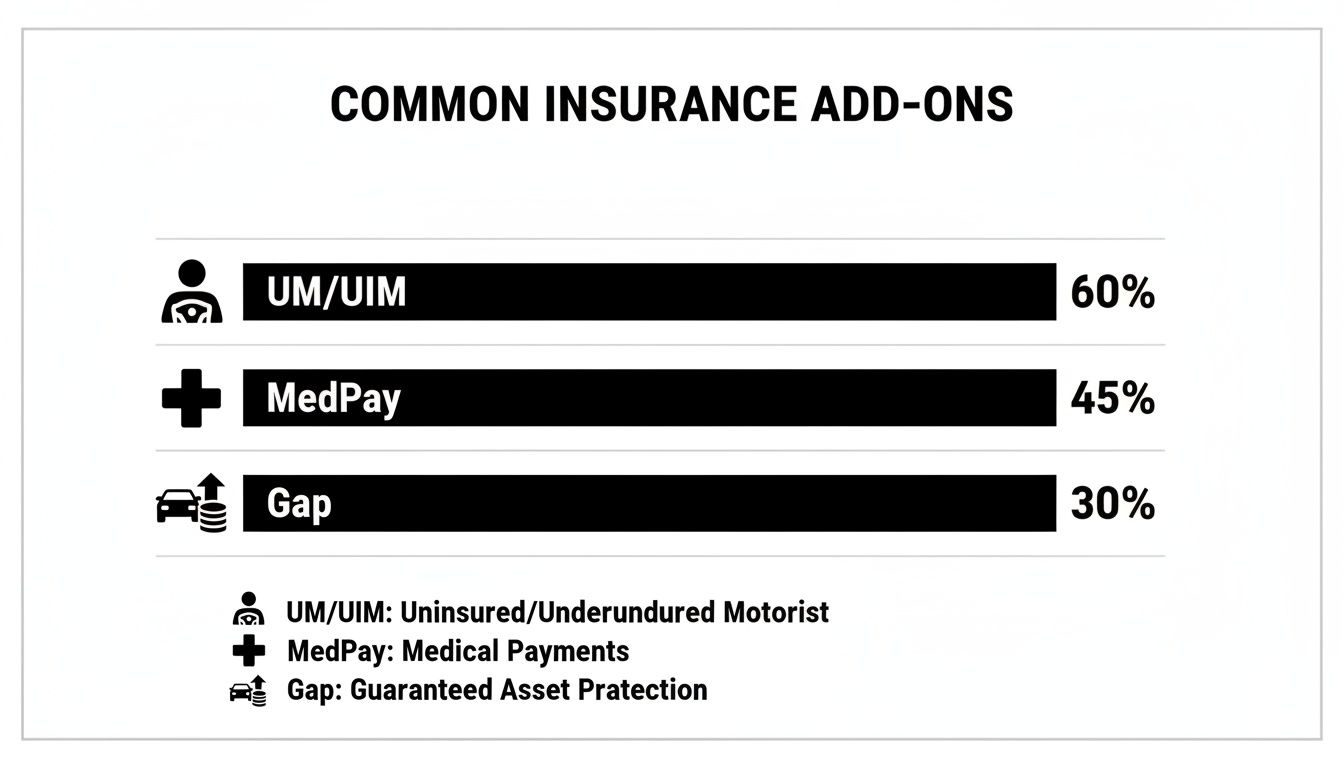
This data is telling. It shows that experienced drivers know the basic policy isn't always enough and are taking proactive steps to protect themselves from uninsured drivers or cover medical bills after a crash.
The True Cost of Protection
Let's be direct: a robust full coverage policy costs more than the state-minimum plan. The nationwide average spend on auto insurance hit $1,127 per vehicle in 2022. For a typical sedan with full coverage, that figure jumps to $1,588 annually—and as we've seen, that number is usually even higher in a state like California. You can dig deeper into these auto insurance statistics to see how they break down.
But thinking of this only as a "cost" is missing the bigger picture. The higher premium you pay for full coverage is an investment in your financial future. A bare-bones policy might save you a little each month, but it can leave you financially exposed—or even ruined—after one bad day on the road. Full coverage is about buying peace of mind and building a financial shield to protect your assets and everything you've worked for.
Partner With Mai & Associates to Find Your Best Coverage

Getting a handle on what "full coverage" truly means is a huge first step. But even with that knowledge, figuring out the right liability limits, deductibles, and endorsements can still feel like trying to solve a puzzle. The good news? You don't have to put all the pieces together by yourself.
At Mai & Associates, our agents are here to be your personal guides, making the whole process straightforward. We specialize in building complete protection plans for our fellow Californians. That means we don't just look at your car insurance in a vacuum; we see how it connects with your home insurance, renters insurance, or life insurance policies to make sure there are no gaps in your safety net.
Your Independent Insurance Partner
As an independent agency, our loyalty is to you, not to a single insurance carrier. This is a big deal. We work with a wide range of top-rated insurance companies, which lets us shop the market for you to find that perfect blend of solid coverage and a great price. It saves you the headache of chasing down dozens of quotes on your own.
Our commitment to our clients shows in everything we do. With offices across California and a team that speaks your language, we make sure expert advice is always easy to find.
We proudly offer support in:
- English
- Spanish
- Armenian
- Russian
- Vietnamese
This ensures you can have a clear, comfortable conversation about your needs, building confidence from the very beginning.
From Knowledge to Action
You now understand what goes into a strong full coverage policy—from the core components to the smart add-ons that address California’s specific risks. It’s time to put that knowledge to work and build a real-world plan that protects what you’ve worked so hard for.
Your insurance policy should be a source of security, not stress. We're here to build a plan with you that delivers genuine peace of mind, so you know your family and your assets are properly covered.
The next step is easy and comes with no strings attached. Let our experts run the numbers and show you a clear, competitive quote that lines up with your goals. When you work with us, you get more than just a policy; you get a dedicated partner committed to finding you the best possible value.
Take a few minutes to get a personalized insurance quote online and see how we can build the right protection for you.
Your Full Coverage Questions, Answered
When it comes to car insurance, the term "full coverage" can kick up a lot of questions. Let's clear the air and tackle some of the most common things we hear from California drivers just like you.
Is Full Coverage Required By California State Law?
Plain and simple: no. The state of California doesn't actually mandate what we call "full coverage." The only insurance you're legally required to have is minimum liability coverage, which is there to cover the costs for other people's injuries or property damage if you're at fault in an accident.
That said, there's a big "but" here. If you're financing or leasing your vehicle, your lender or leasing company will absolutely require you to carry both collision and comprehensive. Why? Because until that car is paid off, it's their asset, and they need to protect their investment.
Do I Really Need Full Coverage for My Older Car?
This is a fantastic question, and the answer really comes down to your personal financial situation. Once your older car is paid off, the choice is completely up to you.
The real test is asking yourself this: "If my car were totaled tomorrow, could I afford to repair or replace it without causing myself major financial stress?"
If the answer is no—if losing your car would be a true financial hardship—then keeping collision and comprehensive coverage is probably the smartest move you can make. It's a safety net. We can help you run the numbers, comparing the premium cost to your car's actual cash value to see if it makes sense.
How Can I Lower the Cost of My Full Coverage Policy?
Great news—you have more control over your premium than you might think. You don't have to gut your coverage to save money. Here are some of the most effective ways California drivers can bring down their rates:
- Raise your deductible. This is one of the quickest ways to see a difference. Moving your deductible from $500 to $1,000, for example, can significantly lower your premium.
- Bundle your policies. Most carriers offer deep discounts when you insure your car with your home or renters policy through them. It's often one of the biggest single discounts available.
- Keep your driving record clean. This is the long game. Staying accident-free and avoiding tickets is the single best way to earn and keep preferred rates over time.
- Ask about every single discount. Don't be shy! Are you a good student? Did you take a defensive driving course? Does your car have anti-theft devices? These can all add up to real savings.
The best way to know you're getting the right protection at the best price is to see the options side-by-side. The team at Mai & Associates can do that work for you, shopping rates from multiple top-tier carriers to build a full coverage plan that fits your life and your budget.
Ready to see your options? Visit us at https://cahomeauto.com to get started on a personalized quote.