What is excess liability coverage? Understanding its value for your California insurance plan
Think of excess liability insurance as a financial safety net, but one that sits on top of the insurance you already have in California. It’s designed to kick in when a really big claim exhausts the limits of your standard policies, like your auto insurance or home insurance.
It's that extra layer of protection standing between a catastrophic lawsuit and your personal assets. When your primary policy, such as your California car insurance, pays out its maximum, excess liability coverage steps in to handle the rest, so you don't have to.
Protecting Your Financial Future in California
Let’s paint a picture. You're driving on a packed California freeway—say, the I-5 during rush hour—and get into a serious multi-car pileup. The injuries and vehicle damage are extensive, and the total cost quickly blows past your California auto insurance policy's $250,000 liability limit.
What happens then? Without another layer of protection, you’re on the hook for the difference. That could mean your house, your savings, and even a chunk of your future income are at risk.
This is exactly why knowing what is excess liability coverage is so important for Californians. It’s the second line of defense that safeguards the life you've worked hard to build from being wiped out by one terrible accident.
Who Benefits from This Extra Protection?
This isn't just for the ultra-wealthy. This extra protection is a smart move for many Californians, especially if you find yourself in one of these situations:
- You own a home with significant equity, covered by California home insurance.
- You’ve built up a decent savings or investment portfolio.
- You own rental properties or a second home.
- Your property has high-risk features like a swimming pool or a trampoline.
- You have young, inexperienced drivers on your California car insurance policy.
Simply put, the more you have, the more you have to lose. Excess liability is a surprisingly affordable way to make sure it all stays protected. If you're looking for clear definitions of other common insurance terms, feel free to explore our detailed insurance glossary.
Demand for this type of coverage is on the rise, and for good reason. With lawsuit costs and major accidents becoming more common, the global excess liability market recently hit $14.78 billion and is projected to reach $15.89 billion next year alone.
At Mai & Associates, our job is to help you figure out your specific risks. Our licensed agents can walk you through whether this crucial layer of protection makes sense for you, ensuring your auto, home, and renters insurance in California provide a solid foundation for this added security.
How Excess Liability Works With Your Existing California Policies
Let's think of your insurance as a safety net. Your primary policies, like your California auto or home insurance, are the first layer. Excess liability coverage is a second, much larger net you place directly on top, dramatically increasing your total protection.
It doesn’t introduce new types of coverage. Instead, it just adds more money to the pile for a claim that’s already covered by your base policy. This extra layer of protection only comes into play after the limits on your primary policy are completely drained. The specific dollar amount where your primary policy taps out and the excess policy takes over is known as the attachment point. It’s a clean handoff from one policy to the next.
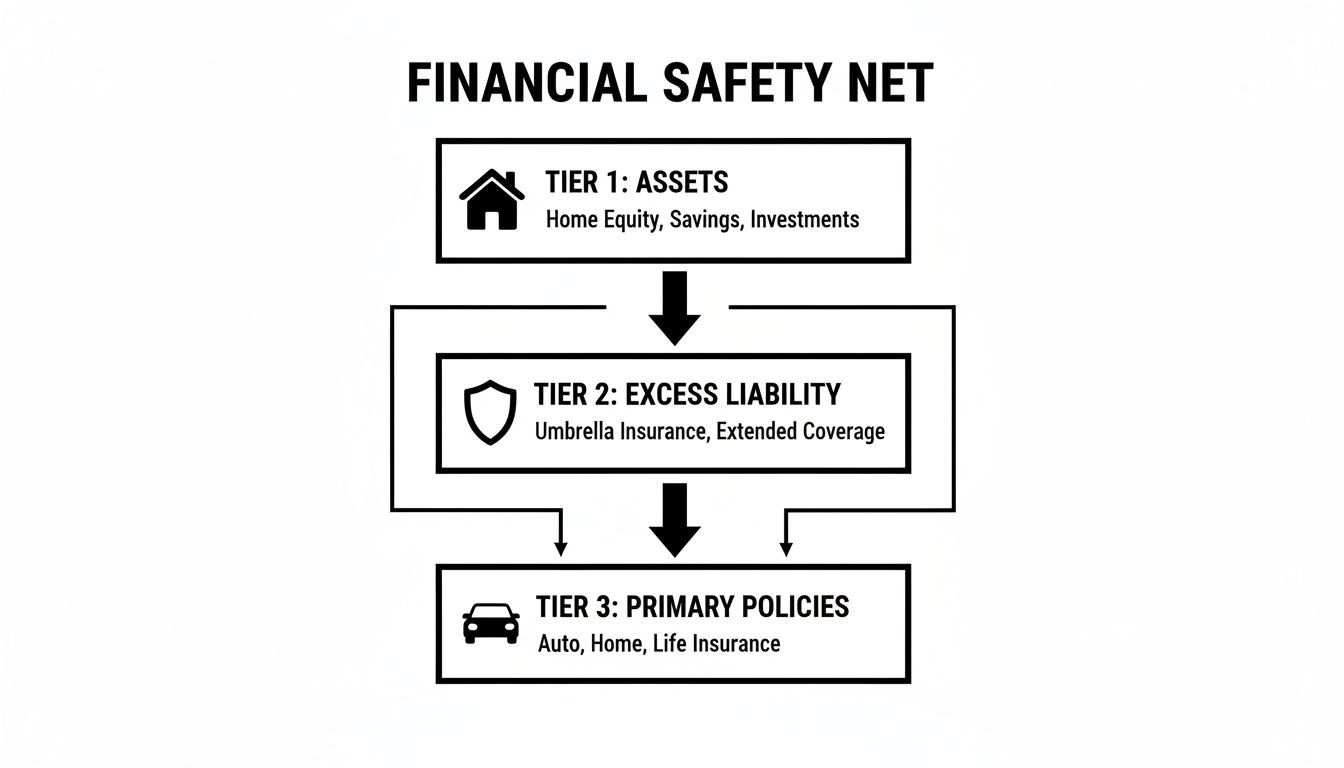
As you can see, this coverage acts as a critical shield, sitting right between your foundational policies and your hard-earned assets. It’s what stops a catastrophic claim from wiping you out financially.
A California Car Insurance Scenario
Picture this: you're in a serious pile-up on a congested California freeway. After the dust settles, a court finds you liable for $800,000 in damages and medical bills. The problem? Your California car insurance policy maxes out at $300,000 for liability.
Without any extra coverage, you're on the hook for the remaining $500,000. That kind of figure could force you to liquidate your retirement savings, sell your house, or even have your future wages garnished for years.
Now, let's see how an excess liability policy completely changes the story:
- Primary Policy Pays First: Your standard auto insurance steps up and pays out its full $300,000 limit.
- Excess Policy Kicks In: Once that money is gone, your excess liability policy activates to cover the leftover $500,000.
- Your Assets Are Protected: You don't have to pay a dime out of your own pocket. Your home, savings, and future are secure.
Understanding Follow Form Coverage
A crucial term you'll hear is “follow form.” Most excess liability policies work this way, and it's a simple but important concept. It means the excess policy perfectly mirrors the terms, conditions, and—most importantly—the exclusions of the underlying policy it sits on top of, like your California home insurance.
It literally "follows the form" of the primary policy. It won't cover anything that your original policy doesn't.
For example, if your homeowners insurance policy specifically excludes damage from floods, your follow-form excess liability policy won't cover a flood-related lawsuit either. It takes its cues directly from the policy below it.
This is why truly understanding your base coverage is the first step. To see how this all connects, it helps to know exactly what your homeowners insurance covers in the first place. For more localized information, our guide on California home insurance can provide a deeper look. Building a solid protection plan starts with a strong foundation, ensuring there are no gaps or surprises when you need your coverage the most.
Excess Liability vs. Umbrella Insurance: What's the Difference?
When you start looking for ways to get more liability protection, you’ll quickly run into two common terms: excess liability and umbrella insurance. It’s easy to get them mixed up. Both options give you coverage beyond your standard policies, but they work in very different ways. For Californians trying to protect their assets, figuring out this difference is the key to making the right choice for their California insurance needs.

Think of an excess liability policy as a simple height extension for your existing insurance. It’s what’s known as a “follow-form” policy, which is just an industry way of saying it copies the exact terms, conditions, and exclusions of the policy it sits on top of. It doesn't introduce any new types of coverage; it just gives you more money for a claim that’s already covered by your auto or home insurance.
The Broader Reach of Umbrella Insurance
An umbrella policy is a different beast altogether—it’s generally much broader. Yes, it also boosts your liability limits, but its real power is that it can cover risks your primary California auto and home insurance policies won't touch. We're talking about things like claims for libel, slander, or even false arrest.
Because it can step in for claims your base policies don't cover, an umbrella policy sometimes comes with its own deductible. This is called a self-insured retention (SIR). It’s the amount you have to pay out-of-pocket before the umbrella coverage kicks in, but only for a claim not covered by your primary insurance.
An easy way to remember the difference: Excess liability just raises the ceiling on a single policy. An umbrella policy spreads a protective canopy over multiple policies and can patch certain coverage gaps.
So, let's say your California auto insurance policy has a specific exclusion. Your excess liability policy will have that exact same exclusion. No help there. A good umbrella policy, however, might just step in and provide that protection after you've paid your SIR.
Comparing Key Features Side-by-Side
To truly make an informed decision between these two powerful tools, you need to see their core differences laid out clearly. For California residents weighing options for their car, home, or renters insurance, this comparison is essential. It helps you see which policy actually aligns with your specific risks and what you’re trying to protect.
Comparing Excess Liability and Umbrella Insurance Policies
Here’s a feature breakdown to help California residents choose the right type of additional coverage for their needs.
| Feature | Excess Liability Policy | Umbrella Policy |
|---|---|---|
| Coverage Scope | Follows the exact terms of one underlying policy (e.g., California auto or home insurance). | Spreads over multiple policies (auto, home, renters) and may cover risks the primary policies exclude. |
| New Protections | No, it only increases the dollar limits of existing coverage. | Yes, it can cover claims like libel, slander, and false imprisonment. |
| Deductible (SIR) | No SIR, as it only covers claims already handled by the primary policy. | May require a self-insured retention for claims not covered by an underlying policy. |
| Best For | Individuals needing higher limits for specific, already-covered risks in California. | Individuals seeking broader protection across various assets and potential liability scenarios in California. |
Ultimately, one isn't universally "better" than the other. The right choice depends on whether you simply need more of the same coverage you already have, or if you need a wider net to catch unexpected risks that could come from anywhere.
Who in California Needs Excess Liability Coverage?
It's a common question: "Do I really have enough to need extra liability coverage?" The truth is, a serious lawsuit doesn't just look at your checking account. It can target your home, your retirement savings, and even garnish your future paychecks. In a state like California, where property values and the cost of living are so high, this added protection over your home and auto insurance is more important than ever.

This isn't just insurance for the ultra-wealthy. It's a crucial safeguard for anyone whose financial future could be completely derailed by one catastrophic event. If any of the following situations sound familiar, it’s time to seriously consider an excess liability policy to supplement your California insurance portfolio.
Homeowners with Attractive Nuisances
Here in California, things like swimming pools, trampolines, and even elaborate swing sets can dramatically increase your personal liability risk. These are legally known as "attractive nuisances" because they can attract children and pose a danger.
Think about it: you're hosting a summer pool party at your home. A guest slips on the wet patio, suffers a major injury, and sues you. The medical bills and long-term care costs quickly blow past the limits on your standard California home insurance. Without extra coverage, the equity you've built in your home could be at risk.
Families with Teen Drivers
We’ve all been there. Adding a teenager to your California auto insurance policy is a rite of passage, but it also sends your risk profile through the roof. A newly licensed driver causing a multi-car pile-up on the 101 freeway could easily result in a lawsuit that dwarfs the limits of a standard car insurance policy.
The financial fallout from a severe accident can be life-altering. A large judgment could mean liquidating college funds, raiding retirement accounts, and selling off other assets you’ve worked your whole life to build.
Excess liability coverage kicks in precisely when your auto policy’s limits are maxed out, preventing a single mistake from destroying your family's financial stability.
Landlords and Rental Property Owners
When you own rental properties, your liability doesn't stop at your own front door. A tenant's guest could trip on a crack in the walkway, or a dog bite incident could be traced back to a pet living in your rental unit. The liability limits on a standard landlord policy or some types of California renters insurance might not be enough to handle a massive claim.
An excess liability policy can be structured to sit on top of your landlord policies, creating a vital safety net. This protects not just your rental income but also your personal assets from a lawsuit originating at a property you don't even live in. It's an indispensable tool for anyone in California with real estate investments.
Understanding the Cost of Excess Liability Insurance
A lot of people in California hear "another insurance policy" and immediately think "expensive." But when it comes to excess liability coverage, you'd be surprised at how much protection you can get for your money. It's genuinely one of the best bargains in personal finance.
For a relatively small premium, you can add $1 million or more in liability protection on top of what your current California home and auto insurance policies provide. Think of it less as an expense and more as a crucial investment in your financial future—a small price to pay to guard against a lawsuit that could cost you everything.
Key Factors That Influence Your Premium
So, what goes into calculating the price? California insurers look at a handful of key factors to figure out your premium. It all boils down to your personal risk profile and how much extra coverage you want.
Here are the main elements they consider:
- How Much Coverage You Want: This is the most straightforward factor. A $1 million policy is naturally going to cost less than a $5 million policy. You choose the limit that matches the assets you want to protect.
- Your Primary Policy Limits: Insurers will want to see that you have solid liability limits on your underlying home and auto insurance first. In fact, having higher primary limits can sometimes earn you a better rate on your excess liability coverage.
- Your Personal Risk Profile: They'll look at things like your driving record, the number of cars and homes you own, and even your credit history. A cleaner record generally means a lower premium.
- High-Risk Property Features: Do you have a swimming pool or a trampoline? These are fun, but they also increase your liability risk, which can nudge your premium up slightly. Living in certain high-risk areas in California can also play a role.
We're in a tough market right now. The entire casualty insurance industry is feeling the pressure of rising rates. We've recently seen risk-adjusted rates for umbrella and excess liability policies jump by 18%, and some people have seen their rates climb over 30% after filing a claim. This is largely due to the growing number of multi-million dollar lawsuits.
At the end of the day, the cost of what is excess liability coverage is unique to you. That's why working with an independent agency makes so much sense. We can instantly pull quotes from multiple California insurance companies to find you the most competitive price for the protection you need.
Ready to see how affordable this essential protection can be? You can easily get an insurance quote with us to start comparing your options and secure your financial future.
Getting an Excess Liability Policy in California
Thinking about adding an excess liability policy? The process is more straightforward than you might think, and it all starts with what you already have. Think of it as putting the finishing touches on your financial security plan.
First things first, you need a clear picture of your existing insurance. Pull out your current auto, home, and renters insurance policies and look for the liability limits. These are your foundational layers of protection, and any excess liability coverage will sit right on top of them.
Next, it's time for a quick personal financial check-up. Tally up your assets—things like your home's equity, your savings accounts, and any investments. Then, subtract your debts. That final number is your net worth, and it’s the best benchmark for figuring out how much extra liability coverage you really need to protect everything you've built.
Finding the Right Fit with an Expert Guide
The insurance world isn't static, and it's important to know what's happening behind the scenes. The market for this kind of coverage has ballooned to $46.2 billion after a recent 13.2% jump. What does that mean for you? Carriers are getting stricter.
We're now seeing insurers require much higher primary policy limits before they'll even consider selling an excess policy. It's not uncommon for them to demand car insurance liability limits jump from $1 million up to $5 million or more in certain cases. An experienced agent is your best bet for navigating these new rules, which are a hot topic in recent excess and surplus market updates.
This is exactly where having a pro in your corner pays off. At Mai & Associates, our licensed agents can sit down with you for a no-obligation review of your current coverage. We'll help you spot any gaps and figure out the precise amount of excess liability you need. As you look into your options, you'll find there are various agencies offering insurance services that can also help with necessary paperwork.
Our job is to make it simple. We instantly compare quotes from multiple top-rated carriers to find a high-quality policy that fits your budget. The whole point is to give you total confidence that your family’s financial future is secure, without any of the usual hassle.
Frequently Asked Questions About Excess Liability Coverage
It's completely normal to have questions when you're digging into the specifics of insurance. Let's tackle some of the most common ones we hear from California residents about excess liability coverage, so you can feel confident you're making the right call.
Does Excess Liability Cover My Life Insurance Policy?
That's a great question, but the answer is no. Excess liability coverage is all about boosting the limits for liability claims—things like property damage or bodily injury you might be responsible for.
Think of it as an extension of your auto insurance, home insurance, or renters insurance. California life insurance is in a totally different category; it's designed to provide a death benefit to your beneficiaries and is not related to liability. Excess liability does not interact with a life insurance policy.
Is There a Minimum Amount of Primary Coverage Required?
Yes, there is. Insurers won't sell you an excess liability policy unless you already have a solid foundation of coverage on your primary policies.
For instance, a California insurance company will likely require you to carry at least:
- $250,000/$500,000 in bodily injury liability on your car insurance.
- $300,000 in personal liability on your home insurance.
These aren't arbitrary numbers. They ensure your main policy can handle most common incidents before the extra layer of protection even needs to kick in.
Can I Buy Excess Liability Coverage By Itself?
You can't. An excess liability policy isn't something you can buy on its own because it has to be attached to an existing primary policy, like your California home insurance or auto insurance.
Think of it this way: You can't add a second story to a house that doesn't have a first floor. The excess policy needs that foundational policy to build upon. Its entire job is to sit on top of your existing coverage.
Without an underlying policy, there's simply nothing for the excess coverage to "follow" or extend. It has to have something to attach to.
Ready to secure your assets and protect your family's future? The expert team at Mai & Associates is here to help you find the right excess liability coverage for your unique needs in California. We'll compare quotes from top carriers to ensure you get quality protection at a competitive rate. Visit us at https://cahomeauto.com to get your no-obligation quote today.