What is dwelling coverage? A Simple Guide to Your California Home Insurance
When you look at your homeowners insurance policy, the very first thing you'll see listed is likely "Coverage A" or Dwelling Coverage. So, what exactly is it?
Think of it as the financial safety net for the physical structure of your house itself. It's the part of your home insurance policy dedicated to repairing or completely rebuilding your home—from the foundation right up to the roof and everything in between—if it's damaged by a covered event like a fire, a windstorm, or a falling tree.
Your Home's Financial Blueprint
Imagine the original blueprints used to build your house. Dwelling coverage is essentially the insurance policy that protects every single component on that plan. This is the absolute core of your California home insurance, ensuring you have the money to put your life back together after a disaster.
Whether you're in a Glendale bungalow or a Costa Mesa condo, getting this part right is the first and most critical step toward feeling financially secure in your own home.
What Does Dwelling Coverage Actually Protect?
This is the part of your policy that kicks in to cover damage from a whole host of common disasters. We're talking about things like:
- Fire and smoke damage
- Windstorms and hail
- Vandalism
- Falling objects (like that big oak tree in the front yard)
- The weight of ice or snow collapsing a part of your roof
It's designed to cover the big, structural parts of your home. To give you a clearer picture, here’s a quick breakdown of what falls under the dwelling coverage umbrella.
Dwelling Coverage at a Glance
| Component | What It Covers |
|---|---|
| Structure | The foundation, framing, walls (both interior and exterior), and roof. |
| Attached Structures | Anything physically connected to your house, like an attached garage, a deck, or a porch. |
| Built-in Systems | Essential home systems like your plumbing, electrical wiring, and HVAC (heating and air conditioning). |
| Built-in Appliances | Items that are permanently installed, such as your water heater or furnace. |
This table covers the essentials, showing how dwelling coverage is designed to protect the integral, permanent parts of your home.
The Heart of Home Insurance
It’s no surprise that this single piece of home insurance is a global powerhouse. According to home insurance market research from Zion Market Research, it accounted for nearly 72% of all market proceeds in 2023. That statistic alone shows just how much homeowners everywhere rely on this coverage to protect their single biggest asset.
This is precisely why setting the right dwelling coverage limit is so important. It’s the largest and most foundational piece of your entire policy.
Key Takeaway: Your dwelling coverage limit should be enough to rebuild your home from scratch today, not its market value. The price someone would pay for your house includes things like land and location, which aren't part of rebuilding. Rebuild cost is all about construction materials and labor prices right now.
Ultimately, dwelling coverage is your primary financial shield for the structure you call home. Without enough of it, the rest of your policy stands on shaky ground. It's the coverage that ensures, should the worst happen, you have the funds you need to put the walls back up and the roof back on, restoring not just your house, but your peace of mind.
What Dwelling Coverage Actually Protects
When you picture your home insurance kicking in after a disaster, what you’re really thinking of is dwelling coverage. This is the heart of your policy, the part that protects the very bones of your house. It’s designed to cover the main structure itself—everything that makes your house a home, from the ground up.
Let's break down exactly what that means. Think of it as a protective shield for the physical building you live in.
- The Foundation: This is literally the bedrock of your home, and your dwelling coverage is there to protect it from covered disasters.
- Walls and Framing: Both your interior and exterior walls, plus the skeleton of the house holding it all together, fall under this umbrella.
- The Roof: A classic example is when a windstorm rips off shingles or a tree crashes through the roof. That’s your dwelling coverage at work.
- Attached Structures: This isn't just the main house. It also includes anything physically connected to it, like an attached garage, a back deck, or a front porch.
This diagram really simplifies it, showing how the foundation, walls, and roof are the core components that dwelling coverage is built around.
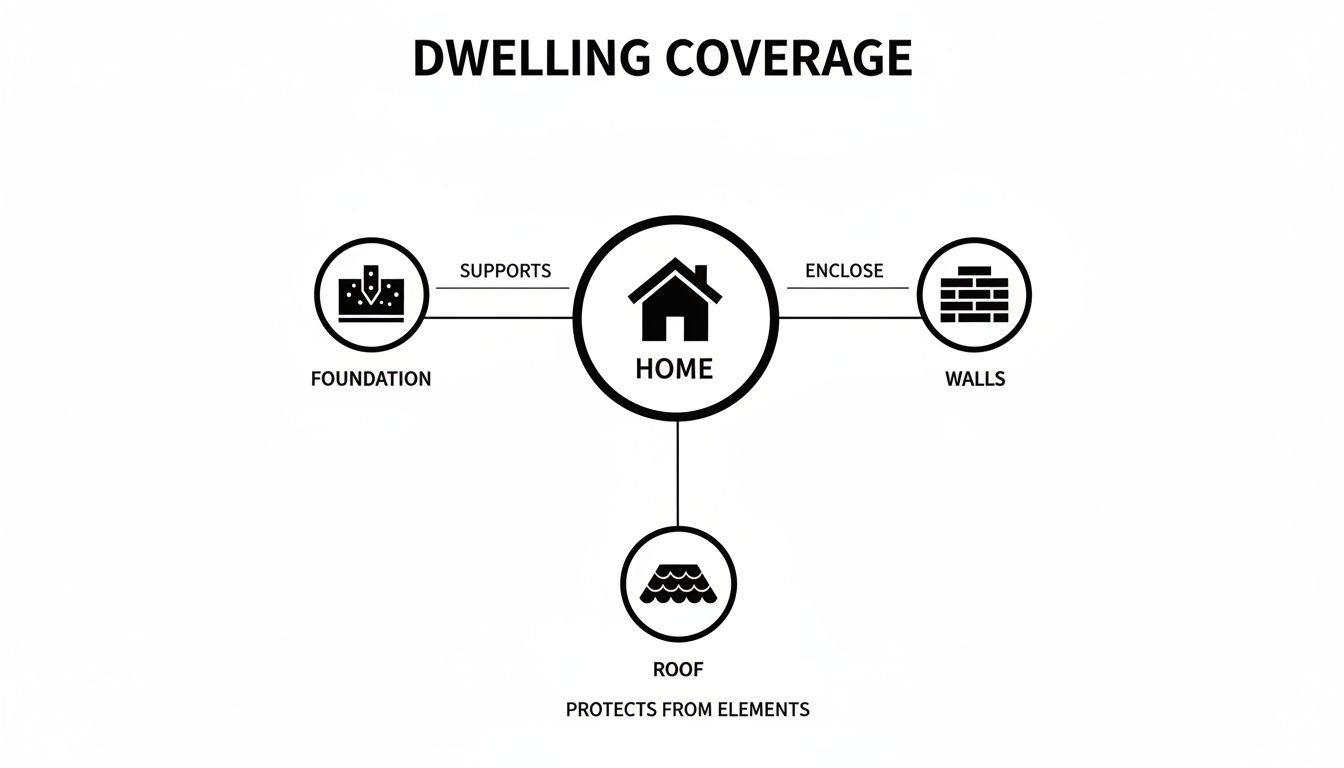
These three elements are the non-negotiable pillars of your home's structure. That’s why they are the central focus of your dwelling protection.
Beyond the Basics: What Else Is Covered?
But it doesn't stop there. Your dwelling coverage also extends to the essential systems that make your house livable. We're talking about the built-in elements you depend on every single day.
This includes things like your home’s electrical wiring, the entire plumbing system, and your HVAC (heating, ventilation, and air conditioning) unit. Even permanently installed fixtures like a built-in oven, water heater, or furnace are typically covered. It’s important not to confuse this with your personal belongings, like your furniture or electronics. Those are covered under a different part of your policy, similar to the concepts in renters insurance in California.
A common question we get is about whether house insurance covers a leaking roof, and the answer often comes down to why it’s leaking—was it sudden and accidental, or a slow maintenance issue?
Crucial Exclusions You Need to Know
Knowing what’s covered is only half the battle. You also need to be crystal clear on what’s not. Every standard homeowner's policy has specific exclusions, and for us here in California, a few of them are particularly important to understand.
Critical Note: Standard dwelling coverage almost always excludes damage from floods, earthquakes, and sinkholes. It also won't pay for damage that results from normal wear and tear, neglecting maintenance, or pest infestations.
For anyone seeking California insurance, the earthquake and flood exclusions are massive. You are not automatically covered for these events. To protect your home, you have to buy separate, specialized policies. Overlooking these gaps in your coverage can be a financially devastating mistake, so it’s absolutely essential to read your policy's exclusion list carefully.
4. Replacement Cost vs. Actual Cash Value: A Critical Choice
When you file a claim for damage to your home, how the insurance company calculates your payout is a huge deal. This is one of the most important decisions you'll make when setting up your home insurance policy, and it all comes down to two options: Replacement Cost Value (RCV) and Actual Cash Value (ACV).
Getting this right can mean the difference between rebuilding your life smoothly or facing a massive, unexpected financial hole.
Let's use a simple analogy. Imagine a hailstorm wrecks your 10-year-old roof. An ACV policy pays you for a 10-year-old roof—meaning it subtracts a decade's worth of wear and tear from the value. In contrast, an RCV policy gives you the money to put on a brand-new roof today, at today's prices.
The Big Problem with Actual Cash Value (ACV)
On the surface, ACV looks tempting because the premiums are usually lower. But that upfront saving can come back to bite you. ACV calculates your payout by starting with the replacement cost and then subtracting depreciation—the value your property has lost over time due to age and use.
This means the check you get from the insurance company could be thousands—or even hundreds of thousands—of dollars short of what you actually need to rebuild. That's a gap you’re expected to fill out of your own pocket.
Crucial Insight: An ACV policy on your home's structure is a massive financial gamble. In a major loss, it virtually guarantees your insurance payout won't be enough to make you whole, forcing you to cover the depreciation difference yourself.
Why Replacement Cost Value (RCV) is the Gold Standard
This is the coverage that truly does its job. Replacement Cost Value (RCV) is designed to put you back in the same position you were in right before the disaster happened.
It pays the full amount needed to repair or rebuild your home using similar materials and quality, at current market prices, without factoring in depreciation. This is what real peace of mind looks like.
For California homeowners, this is non-negotiable. Building costs here, from San Diego to San Francisco, are notoriously high. After a widespread event like a wildfire, demand for labor and materials sends those prices skyrocketing. An RCV policy is your best defense against this post-disaster inflation. This is a vital detail for anyone managing their California home insurance coverage.
Replacement Cost (RCV) vs Actual Cash Value (ACV)
Here’s a direct comparison to help you see the financial impact of each valuation method on your dwelling coverage.
| Feature | Replacement Cost Value (RCV) | Actual Cash Value (ACV) |
|---|---|---|
| Payout Calculation | Covers the full cost to repair or rebuild at current prices. | Pays for repair or rebuilding costs minus depreciation. |
| Financial Outcome | Aims to fully restore your home without major out-of-pocket costs. | Often leaves a significant financial gap you must cover. |
| Premium Cost | Higher premiums due to more extensive coverage. | Lower premiums, reflecting the lower potential payout. |
| Best For | Virtually all homeowners who want to ensure they can fully rebuild. | Rarely recommended for a primary home's dwelling coverage. |
In the end, while RCV comes with a slightly higher premium, it provides the security of knowing you can actually rebuild your home and your life after a catastrophe.
We know these terms can be a bit confusing. You can find simple, clear definitions for RCV, ACV, and more in our online insurance glossary.
Strengthening Your Policy with Essential Endorsements
A standard home insurance policy is a great starting point, but it's not always the complete package. Think of it like a new car—it gets you from A to B, but you might add extras like all-weather floor mats or a better stereo to fit your specific needs. In the world of insurance, we call these add-ons endorsements.
For homeowners in California, endorsements aren't just nice-to-haves; they're often essential for covering the risks we actually face. These small, affordable additions can close up some major gaps in a standard policy, potentially saving you from huge out-of-pocket expenses down the line.
Upgrading for Modern Building Codes
One of the most crucial endorsements is Ordinance or Law coverage. Let's say a small fire damages your kitchen. Your policy will cover the cost to repair the direct fire damage, but what happens when you find out the city's building codes have been updated? Now, you're required to install all-new, much more expensive electrical wiring.
Your base dwelling coverage is designed to replace what you had—the old wiring. It won't pay for the upgrade to meet the new code. That’s where Ordinance or Law coverage comes in. It covers those extra costs to bring your home up to the current legal standard during a repair. Without it, you could be facing a bill for thousands in mandatory upgrades.
Protecting Against Common Exclusions
Another one I always recommend looking into is Water Backup coverage. Standard policies almost universally exclude damage caused by a backed-up sewer line or a failed sump pump. This endorsement specifically adds back coverage for the cleanup and repairs from that kind of messy—and surprisingly frequent—disaster.
Expert Insight: Think of an endorsement as a tool for customizing your policy. It’s how you take a one-size-fits-most plan and truly tailor it to your home and the unique risks of living in California. Customizing your home insurance is just as important as finding the right auto insurance for your vehicle or life insurance for your family's future.
The rising demand for these specific protections is a sign of the times. The global home insurance market is projected to skyrocket from USD 240.26 billion in 2023 to over USD 523.56 billion by 2033. This isn't just a random number; it reflects the growing property risks homeowners face and why having the right coverage is more important than ever. You can explore more data on home insurance market trends and see for yourself how these risks are shaping the industry.
By carefully choosing the right endorsements, you're not just buying insurance; you're building a comprehensive shield that ensures your dwelling coverage is ready for whatever comes its way.
Insuring Your Home in High-Risk California
Let's be honest: living in California is incredible, but it also means dealing with some serious risks that can make finding good home insurance in California a real headache. If you're a homeowner anywhere from Westlake Village to Escondido, you know that wildfires and earthquakes aren't just hypotheticals. They're a constant worry, and they have a huge impact on your insurance options.
Why is it so tough? Because standard home insurance policies almost always exclude damage from these major events. Insurance carriers base their decisions on risk, and in areas where a single wildfire could cause billions in damage, they often pull back, leaving homeowners scrambling for coverage.
When Standard Policies Aren't an Option
So, what happens if you've been turned down by private insurers because of high fire risk? You're not alone, and you do have options. California created a safety net for exactly this situation: the California FAIR Plan.
It’s really important to understand what the FAIR Plan is—and what it isn't. Think of it as a bare-bones policy. It’s a last-resort plan designed to provide essential fire insurance for your home's structure and your belongings when no one else will.
Important Note: The FAIR Plan is a "fire-only" policy. It does not include liability protection, theft coverage, or water damage—all the other critical pieces you’d find in a normal home insurance policy.
Building a Complete Safety Net
Because the FAIR Plan leaves such massive gaps, you need another policy to fill them. This is where a Difference in Conditions (DIC) policy comes in. A DIC policy literally "wraps around" your FAIR Plan coverage, adding back the things you can't live without, like personal liability, medical payments to others, and theft protection. When you put a FAIR Plan and a DIC policy together, you get a package that starts to look and feel like a standard homeowner's policy.
Earthquakes are a whole different story. Damage from seismic activity is never covered by a standard policy or the FAIR Plan. For that, you need a completely separate earthquake policy. Most people get this through the California Earthquake Authority (CEA), though some private insurers offer it as well.
Piecing all of this together can feel overwhelming, but it doesn't have to be. For homeowners trying to protect their biggest asset, understanding these different layers of home insurance in California is the first step. Getting the right combination of policies is the only way to build a safety net strong enough to handle whatever California throws your way.
Calculating How Much Dwelling Coverage You Need
Figuring out the right amount of dwelling coverage is probably the single most important decision you'll make when buying home insurance. It's a common trap to think your home should be insured for its market value—what you could sell it for today. But that's not what dwelling coverage is for.
Your dwelling coverage limit should be based on one thing and one thing only: the estimated cost to completely rebuild your home from the ground up.
Why the distinction? Simple. Market value is bloated by things like the value of your land, your home's location, and how hot the real estate market is. After a disaster, you don't need to re-buy your land; you need to rebuild your house on it. The rebuild cost focuses squarely on today's prices for lumber, concrete, roofing, and the labor to put it all together.

Key Factors in Your Calculation
Arriving at an accurate rebuild cost isn't about guesswork. It’s a detailed calculation that needs to account for several key variables.
- Local Construction Costs: What it costs per square foot to build in Costa Mesa is completely different from Escondido or a more rural area.
- Your Home's Unique Features: Think about the specifics. A standard tract home is cheaper to rebuild than one with custom cabinetry, high-end finishes, complex rooflines, or unique architectural designs. Every upgrade matters.
- Materials and Labor Demand: This is a big one, especially in California. After a widespread disaster like a wildfire, the demand for contractors and building supplies skyrockets. This "demand surge" can easily drive rebuild costs up by 20-30% or even more.
A good starting point is to use an online home insurance premium estimator to get a ballpark figure. But for a truly accurate number, nothing beats a detailed replacement cost estimate from a trusted insurance agent or a local contractor.
Why Getting This Right Matters
Being underinsured is a nightmare scenario. If your dwelling limit falls short, the financial burden falls directly on you. And claims happen more often than you might think. In 2023, 5.3% of insured homes had a claim, and a staggering 97.3% of those were for property damage from events like fires and storms. For California homeowners, this means preparing for a total loss isn't just a good idea—it's essential. You can discover more insights about homeowners insurance claims from the Insurance Information Institute.
Here’s a real-world example: Let's say your home is insured for $400,000. A wildfire sweeps through your neighborhood, and the sudden demand for builders inflates local construction costs. The actual price to rebuild your home is now $550,000. You’d be on the hook for that $150,000 difference.
Nailing down the correct dwelling coverage limit isn't just about protecting your house; it's about protecting your financial future and giving you the peace of mind that you can fully recover, no matter what happens.
Common Questions We Hear About Dwelling Coverage
Once you’ve got the basics down, the real-world questions start to pop up. Let’s tackle some of the most common things California homeowners ask us, giving you the straightforward answers you need to feel secure.
Does Dwelling Coverage Protect My Detached Shed or Fence?
This is a great question, and the answer is usually no. Your primary dwelling coverage (Coverage A) is designed to protect the main house itself and anything physically attached to it, like a deck or an attached garage.
For things like a detached shed, a fence, or a separate guest house, you’ll look to your "Other Structures Coverage" (Coverage B). This is a separate line item on your policy, typically calculated as a percentage of your dwelling coverage—often around 10%. It's always a good idea to double-check that limit to make sure it’s enough to replace everything you have out back.
Should I Lower My Dwelling Coverage If My Home's Market Value Drops?
Definitely not. This is one of the most dangerous and common mistakes a homeowner can make. Your dwelling coverage has nothing to do with what your home would sell for; it's all about the cost to rebuild it from the ground up.
Market value swings with the economy and includes the price of your land. Rebuilding costs, on the other hand, are all about materials, labor, and permits.
Think about it: after a major California wildfire, demand for contractors and lumber skyrockets, pushing rebuilding costs way up. Tying your coverage to market value is a recipe for being underinsured when you need it most.
Is Damage from a Burst Pipe Covered by Dwelling Coverage?
In most cases, yes. The damage caused by a sudden and accidental water leak—like a burst pipe that soaks your drywall and floors—is typically covered. The policy is meant to pay for the resulting damage to the home's structure.
What it won't usually cover is the cost to repair the broken pipe itself. It also won't cover damage from slow, long-term leaks or a sewer line backing up into your home, unless you've added a specific endorsement for that.
For more answers to common questions about California insurance topics from car insurance to renters insurance, feel free to check out our comprehensive FAQ page.
Getting the details of your home insurance right can feel overwhelming. The licensed agents at Mai & Associates are here to cut through the confusion. We are experts in California insurance, helping clients with everything from auto insurance and home insurance to renters insurance and life insurance. We can review your current policy, spot potential gaps, and make sure your dwelling limit is set correctly for your unique California home. Get expert guidance and a no-obligation quote today at https://cahomeauto.com.