What Is Difference in Conditions Insurance
Difference in Conditions (DIC) insurance is a specialized wrap-around policy that restores protection excluded by a primary policy, such as the California FAIR Plan. For California drivers, the legal minimum auto limits are 30/60/15, meaning $30,000 for bodily injury per person, $60,000 per accident, and $15,000 for property damage per accident.
You may be living with this problem right now. Your home sits in a high-risk wildfire area, a traditional homeowners carrier declined the property, and the California FAIR Plan became the available option. Then a pipe bursts, water reaches the flooring, or a visitor slips on the walkway. You call your insurer and discover that the policy protecting you from wildfire may not cover the ordinary losses that threaten your home every week.
That's where DIC insurance matters. It can add coverage above a basic policy, restore excluded hazards, or supplement policies issued by admitted insurers in local markets. For a homeowner, the practical goal is simple: combine the FAIR Plan and a DIC policy so your protection looks much more like a traditional homeowners policy, without assuming the two contracts are interchangeable.
Understanding Difference in Conditions Insurance
You open a closet after hearing water run behind the wall. A supply line has failed, the drywall is soaked, and the flooring is starting to buckle. Your primary policy responds with an exclusion, not a payment. The problem isn't that you lack insurance in the broad sense. The problem is that your policy was designed around a limited risk profile.
Difference in Conditions insurance fills that gap. The IRMI definition of Difference in Conditions insurance describes DIC as a specialized property-and-liability layer used when standard policies provide inadequate limits or exclude particular perils. A DIC policy may sit above a basic policy, restore excluded hazards, or supplement international insurance written by admitted local insurers.
DIC is a companion layer
Think of the arrangement as two contracts with different jobs:
- The primary policy responds to the risks it was written to cover.
- The DIC policy addresses specified gaps left by the primary policy.
- The claim is coordinated according to the wording, limits, deductibles, and other-insurance provisions in both contracts.
That structure matters because a DIC policy usually isn't a replacement for the underlying policy. It doesn't automatically turn every exclusion into covered property damage. The schedule and exclusions control the result, so a broker must compare the documents rather than rely on the phrase “wrap policy.”
You may see DIC most often in catastrophe-prone regions and complex commercial programs, but the same logic applies to California residential insurance. Standardized forms are broad by design. They can't perfectly account for every property, geography, construction feature, or peril combination. DIC developed as a practical response to those mismatches.
The bridge back to broader homeowners protection
A California FAIR Plan can provide a critical foundation for wildfire-related property protection, but it doesn't necessarily offer the broad everyday package many homeowners expect. A DIC companion can restore protections such as water damage, theft, and liability, depending on its actual wording.
Broker's rule: Never ask only whether you have “home insurance.” Ask which policy pays for each major peril, and which exclusions remain after both policies are placed.
For definitions of California insurance terms, the California home and auto insurance glossary can help you decode phrases such as named peril, liability, personal property, and loss of use. The important lesson is that DIC isn't a decorative endorsement. It's a targeted contract for a property whose primary insurance leaves meaningful financial exposure.
The Legal Mechanics of Policy Conditions
Insurance contracts contain more than a promise to pay. They also impose rules that determine whether the insurer's obligations remain enforceable when a claim arrives. Those rules are called policy conditions, and they can control notice, cooperation, proof of loss, protection of damaged property, and other claim obligations.
A condition isn't the same thing as the coverage grant. The coverage grant describes the loss the policy promises to insure. A condition describes what the insured must do, or what must be true, for that promise to operate at the claim stage. The legal history is strict. A 2019 analysis of policy conditions explains that failure to comply historically could result in forfeiture, while modern courts more often consider the seriousness of the noncompliance and the interests of both sides.
Conditions versus warranties
The distinction becomes sharper when you compare a condition with a warranty.
| Contract term | Practical function | Typical consequence of breach |
|---|---|---|
| Condition | Controls claim administration and enforceability | May affect a particular claim, especially where the breach is material or prejudicial |
| Warranty | Acts as a strict promise that a fact is true or a risk-control practice is maintained | Can permit avoidance or denial from the date of breach, even when the breach didn't cause the loss |
A condition might require prompt notice after a loss or cooperation with an adjuster. A warranty could require continuous compliance with a specified protective practice. The comparison of warranty and condition in contract law explains why warranties generally create a harsher allocation of risk than conditions.
Why the causal threshold matters
After a condition breach, the dispute often turns on materiality or prejudice. Did the delay prevent the insurer from investigating? Did the insured fail to protect the property from additional damage? Did missing information affect the carrier's ability to evaluate the claim?
Warranty breaches are commonly treated more rigidly. The insurer may not need to prove that the breach caused the loss. A technically minor departure can become a serious coverage problem if the contract treats the promise as a warranty. A legal discussion of this causal threshold after an insurance breach highlights the difference between materiality-based conditions and stricter warranties.
DIC contracts use detailed conditions because two policies must coordinate during a loss. You should report the claim to the appropriate carrier promptly, preserve damaged property when safe, prevent further damage, keep receipts, and cooperate with both investigations. Don't assume that a minor oversight is harmless, and don't assume every technical mistake automatically destroys coverage. The contract and applicable law decide that question.
Bridging the California FAIR Plan Coverage Gaps
The California FAIR Plan and a DIC policy aren't competing versions of the same product. They are designed to work together when a standard homeowners policy isn't available or doesn't provide the needed protection.
California's Department of Insurance states that DIC policies are sold to complement the FAIR Plan so consumers can obtain the same or similar coverage as a traditional homeowners policy. The regulator also explains that the FAIR Plan itself doesn't offer DIC, and that DIC policies can fill gaps involving water damage, theft, and liability. Review the department's California DIC policy information before buying, because available insurers and policy terms can change.
A practical coverage map
| Coverage Area | California FAIR Plan | DIC Companion Policy |
|---|---|---|
| Wildfire and covered fire damage | Provides the primary fire-related protection under its policy terms | Usually coordinates around the FAIR Plan rather than replacing its fire role |
| Smoke associated with a covered fire | May respond under the FAIR Plan form and applicable conditions | May address other covered gaps, subject to its wording |
| Water damage from a burst pipe or plumbing leak | Commonly excluded from the limited base protection | May restore water damage coverage, subject to exclusions and limits |
| Theft | Generally not part of the core limited protection | May provide theft coverage, depending on occupancy and policy terms |
| Personal liability | Not the broad liability package homeowners normally expect | May supply personal liability protection |
| Personal property | May be limited by the FAIR Plan structure and selected coverage | Can supplement the property package, subject to scheduled limits |
| Loss of use or additional living expense | Must be reviewed in the actual FAIR Plan contract | May provide broader protection if included |
The table shows why the phrase “FAIR Plan plus DIC” is more useful than the phrase “I have a FAIR Plan.” The first describes a coordinated package. The second describes only one layer.
What the combination doesn't guarantee
A DIC policy doesn't erase every exclusion. Earthquake and flood protection may require separate policies, and wear and tear isn't transformed into a covered event because a DIC policy exists. Limits, deductibles, occupancy rules, valuation provisions, and other-insurance language still matter.
You should also compare the personal property and liability limits carefully. California's residential insurance consumer guide says Coverage C for personal property is often about 50% of Coverage A, the dwelling limit, while Coverage E for personal liability is generally subject to a minimum of $100,000. Those are structural benchmarks, not automatic DIC promises.
For a broader review of California property protection, including homeowners coverage considerations, use this California home insurance guide. The right question isn't whether the DIC policy sounds broad. It's whether the combined contracts address the specific holes in your property's protection.
Real-World Claim Scenarios and Payout Order
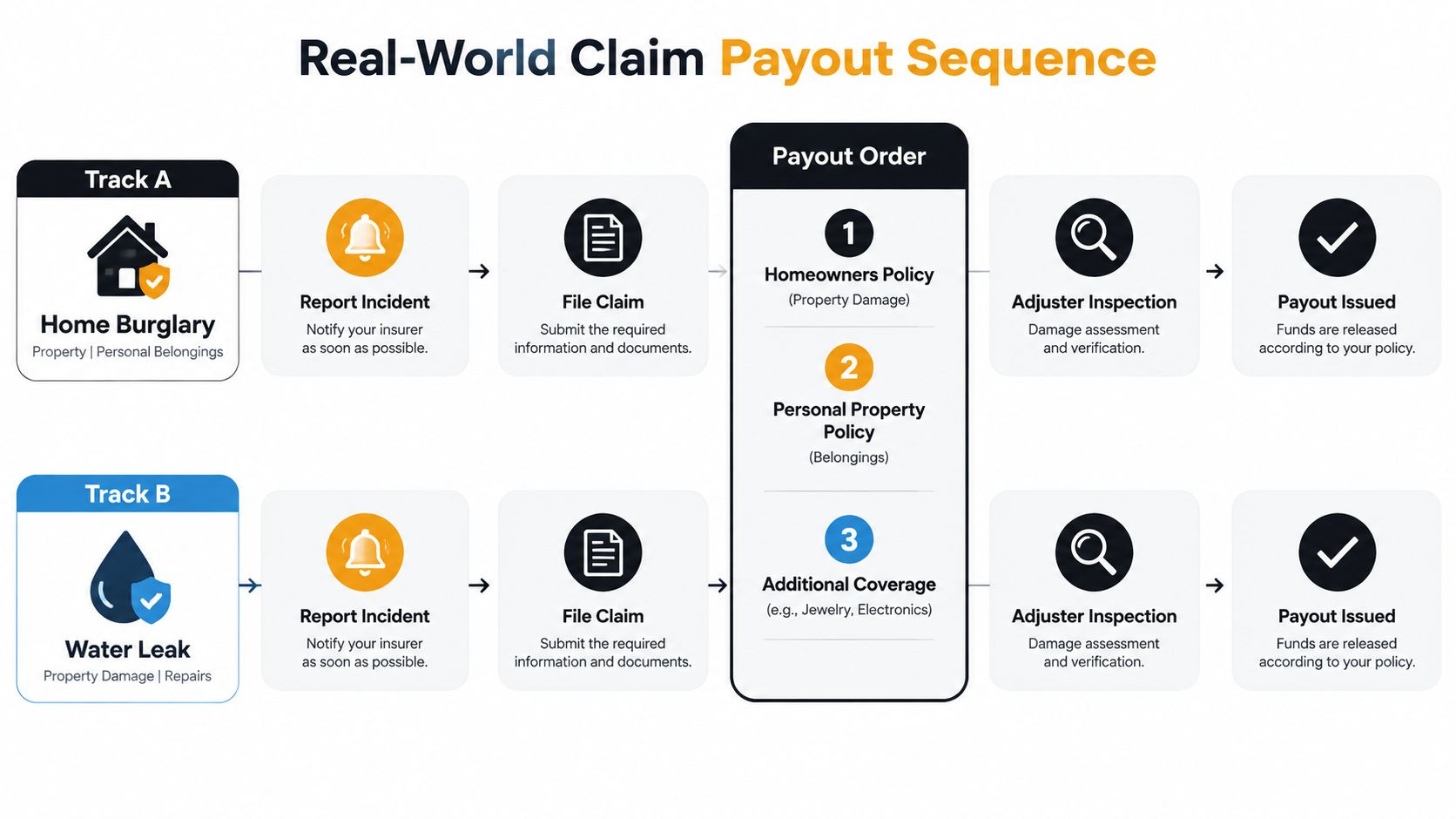
A claim becomes easier to manage when you assign each event to the policy built for it. The carrier, adjuster, and policy language still control the final decision, but the operating logic is straightforward when the peril is clearly identified.
Scenario one, wildfire damages the structure
A wildfire reaches the property and damages the dwelling. The homeowner should report the loss under the California FAIR Plan first because that policy is the primary fire layer in this arrangement.
The FAIR Plan carrier investigates the structural damage and adjusts the covered fire loss under its limits, deductible, valuation rules, and conditions. The DIC carrier may become involved if the DIC contract contains supplemental protection that applies, such as a difference in limits or another related covered component. It doesn't automatically take over the FAIR Plan claim.
The homeowner should notify both carriers or follow the reporting instructions provided by the broker. That prevents a coordination problem where one insurer says the other should have received notice earlier.
Scenario two, a plumbing failure floods the kitchen
A pipe breaks inside the wall while nobody is home. The resulting water damage is the type of everyday loss a limited FAIR Plan may exclude. In that situation, the DIC carrier is generally the first carrier to contact for the water claim, assuming the DIC policy includes the relevant coverage.
The sequence typically looks like this:
- Secure the property and stop the source, using emergency services when necessary.
- Report the loss to the DIC carrier, because the DIC policy is the likely responding contract for covered water damage.
- Document the damage, including photos, damaged materials, mitigation invoices, and personal property.
- Coordinate any related liability claim, such as damage to another unit or an injury allegation, through the liability coverage if the DIC policy includes it.
A burglary follows the same principle. The DIC carrier may respond to covered theft, while the FAIR Plan generally remains focused on its covered fire-related risks. Don't call only the FAIR Plan because it's the policy you remember buying first. Call the carrier responsible for the peril, and involve your broker when the event touches both policies.
During a crisis, identify the peril before you identify the policy. Fire usually points to the FAIR Plan layer. Water, theft, and liability usually point to the DIC layer, subject to the actual contracts.
Identifying Who Needs a DIC Policy
DIC insurance is valuable when it closes a real gap. It's wasteful when it duplicates broad protection already provided by a standard admitted homeowners carrier. Your decision should begin with the policy you can obtain, not with a generic recommendation to buy more insurance.
DIC is usually the right fit for these homeowners
You already carry a California FAIR Plan. This is the clearest profile. The FAIR Plan may protect against the catastrophe that made ordinary coverage difficult to obtain, while DIC can address everyday property and liability exposures left outside the limited form.
Your property sits in a severe wildfire risk area. If traditional carriers won't fully underwrite the location, a FAIR Plan and DIC combination may provide a more workable structure than accepting a fire-only solution. Ask the agent to map the risks instead of quoting a package name.
Your home has unusual underwriting characteristics. Older construction, prior losses, remote access, brush exposure, or other property details can make a standard homeowners form unavailable or incomplete. DIC can be useful when the primary policy is restricted, but only if the companion form matches the actual exposure.
You own a complex property or have significant liability concerns. A home-based business, rental activity, substantial personal assets, or frequent guests can make liability review especially important. DIC isn't automatically the answer, but a limited property policy without a deliberate liability solution is unacceptable.
You may not need DIC
If an admitted California carrier offers a standard homeowners policy for the relevant property, personal liability, personal property, and common water-related losses, buying a separate wrap may create unnecessary overlap. Compare exclusions and limits before deciding.
Ask three direct questions:
- Which perils does my primary policy exclude?
- Which of those perils does the DIC policy restore?
- Where do both policies stop?
The answer should identify remaining needs, such as earthquake or flood insurance, rather than leaving you with the vague comfort of “full coverage.” The best recommendation is the one that closes your actual exposure without charging you for redundant insurance.
Aligning DIC with Your Broader California Insurance Portfolio
A home claim can threaten more than the building. An uninsured liability allegation, an underinsured auto accident, or an overlooked renters limit can put savings and future income at risk. DIC belongs inside a portfolio review, not in a separate drawer labeled “wildfire.”
Start with auto liability
California's current minimum auto liability structure is 30/60/15: $30,000 bodily injury per person, $60,000 bodily injury per accident, and $15,000 property damage per accident, according to the California Department of Insurance auto limits page. Those limits satisfy the legal minimum, but they may not be appropriate for a homeowner whose assets include substantial home equity.
Your DIC liability coverage and car insurance should be reviewed together. A serious accident can create a personal liability problem separate from a home claim, and low auto limits can leave your broader financial plan exposed. Ask whether an umbrella policy is available and whether its underlying auto and home requirements align with your actual limits.
Check renters and personal property structure
Renters don't insure the building, but they still need protection for belongings, personal liability, and additional living expenses where included. California's consumer guide says renters can purchase up to $100,000 of personal property coverage, giving you a concrete benchmark when reviewing contents protection.
Create a household inventory rather than guessing. Electronics, furniture, tools, clothing, collectibles, and bicycles can add up quickly, and a DIC policy's personal property terms may contain sublimits or occupancy conditions.
For a useful perspective on water damage questions outside California, review what your Florida guide covers. The regional rules differ, but the practical lesson travels well: determine whether the policy covers the sudden event, the resulting damage, the mitigation, and any excluded maintenance issue.
Don't overlook life insurance mechanics
California individual life insurance policies must include an incontestability provision. Under California Insurance Code Section 10113.5, an individual policy issued in the state becomes incontestable after it has been in force during the insured's lifetime for not more than two years after the issue date, with exceptions including nonpayment of premiums and certain supplemental benefits.
That rule doesn't replace accurate underwriting or timely premium payments. It does show why your life insurance contract deserves the same careful review as your home and auto policies. Use the California insurance guides to organize those reviews, then have a licensed professional coordinate the details.
Steps to Evaluate and Secure Comprehensive Protection
Start with documents, not assumptions. Put the FAIR Plan declarations, DIC policy, auto declarations, renters policy, life insurance contract, endorsements, and recent correspondence in one file. A coverage review is only useful when the adviser can see the limits, exclusions, deductibles, and conditions together.
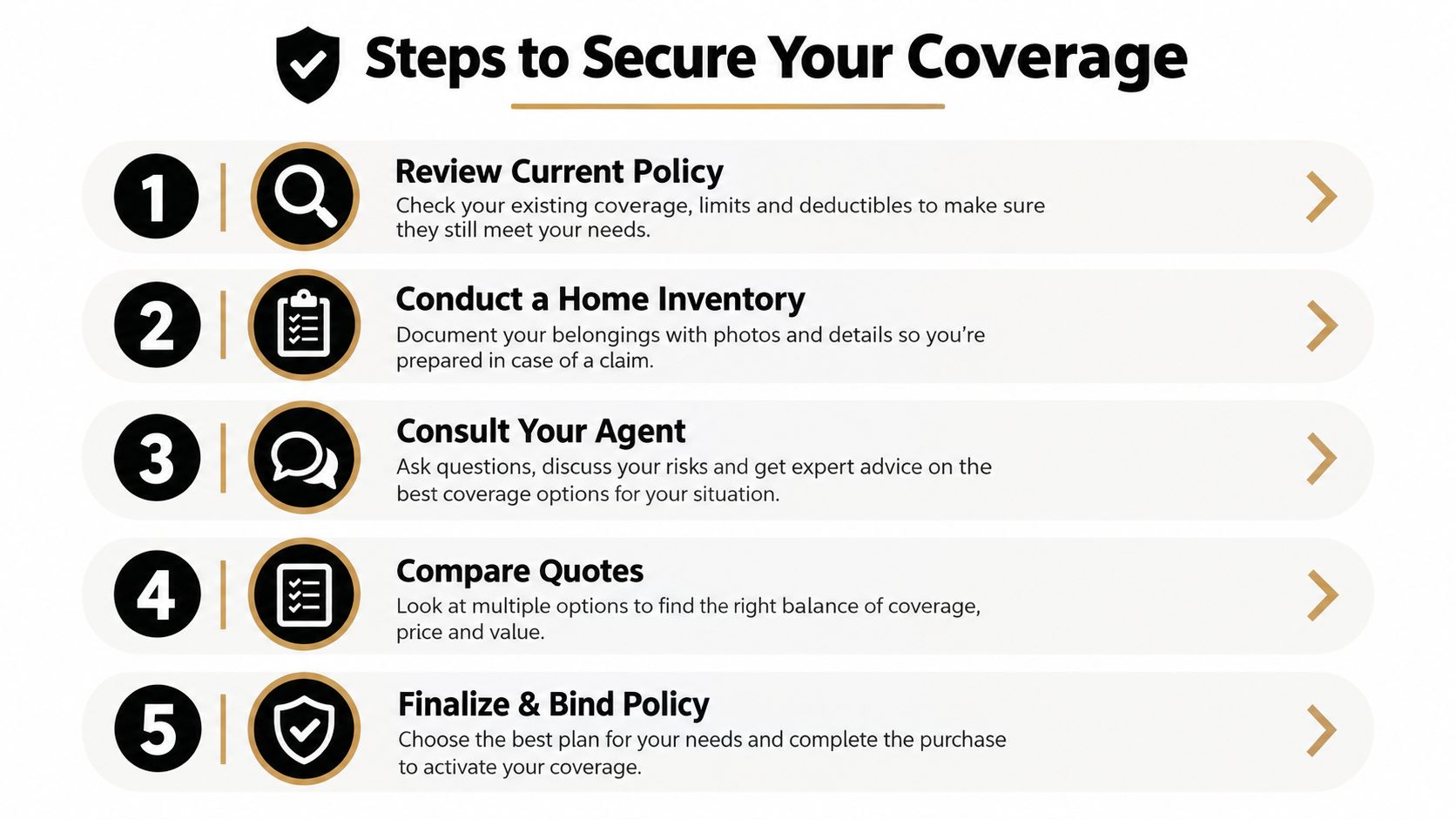
Follow this coverage checklist
Review the current policy. Mark every exclusion involving fire, smoke, water, theft, liability, personal property, loss of use, earthquake, and flood. Don't rely on the declarations page alone. The exclusions and conditions carry the operational detail.
Inventory the home. Photograph rooms, appliances, furniture, electronics, tools, and valuables. Store copies away from the property so a wildfire doesn't destroy the evidence needed for a contents claim.
Ask the licensed agent targeted questions. Ask which carrier pays first for wildfire, plumbing damage, burglary, personal liability, and additional living expenses. Ask whether the DIC form requires an active FAIR Plan and whether any peril remains uninsured.
Compare multiple quotes carefully. Compare the coverage map, not just the premium. One quote may restore water damage but provide weaker liability protection, while another may use different deductibles, valuation terms, or occupancy restrictions.
Finalize and bind only after reading the exclusions. Confirm effective dates, payment requirements, mortgagee information, named insureds, and claim-reporting instructions. Keep the final policy and agent contact details accessible.
A good review should also test coordination. The FAIR Plan and DIC policy must reflect the same property, ownership, occupancy, and replacement assumptions. If those details conflict, a claim can become harder to administer.
Use the California insurance quote request to begin a comparison, then ask for written answers to the gaps identified in your documents. Don't bind coverage because a label sounds attractive. Bind it when you understand which policy responds, what it pays, what you must do, and which risks still require separate insurance.
Mai & Associates reviews California FAIR Plan and DIC combinations, along with auto, home, renters, and life insurance, to identify coverage gaps before a claim exposes them. Visit Mai & Associates for a no-obligation review, multilingual guidance, and a quote from multiple carriers.