What Is Credit Life Insurance? Your 2026 Guide
You’re signing loan papers, you’re already thinking about the monthly payment, and then the lender slides over one more offer. It might happen at a dealership when you’re buying a car, or at a mortgage office when you’re finally getting the keys to a California home. The form says credit life insurance.
A lot of people freeze right there.
They know what car insurance is. They know what homeowners insurance or renters insurance is supposed to do. Many also understand basic life insurance. But what is credit life insurance, and why is it being offered right at the moment you’re taking on debt?
The short answer is simple. Credit life insurance is a policy tied to a specific loan. If you die while the loan is still outstanding, the policy pays that debt off directly to the lender. That can be helpful, especially when a family wants to make sure a car, home, or personal loan doesn’t become an added burden during an already painful time.
It’s also a product that gets judged too quickly. Some people dismiss it immediately. Others buy it without understanding what it does or what it doesn’t do. The truth sits in the middle. For many Californians, especially people who may struggle to qualify for traditional life insurance, credit life can be a meaningful backup plan.
Your Lender Offered Credit Life Insurance What Now
You’re at the last stage of a big purchase. Maybe you’re in Glendale wrapping up an auto loan, or in Escondido signing mortgage documents for your first home. The lender reviews the final paperwork, then points to an optional line for credit life insurance.

At that moment, most borrowers ask some version of the same question. “Is this just an extra cost, or is it something I need?”
What the lender is offering
Credit life insurance is usually presented at the point of sale because it’s linked to the debt you’re taking on right then. It’s not broad family protection in the same way a personal term life policy can be. It’s narrower. It exists to erase a particular loan if the insured borrower dies during the repayment period.
That narrow purpose explains why the product is common. The global credit life insurance market was valued at $96.4 billion in 2024, and personal credit life insurance accounts for 68% of total applications, according to Dataintelo’s credit life insurance market overview. This isn’t some obscure add-on. It’s built into consumer lending around the world.
Why Californians pause here
California borrowers often carry a lot at once. A car payment. High housing costs. Maybe renters insurance if they’re leasing, homeowners insurance if they bought, and auto insurance because driving is part of daily life in much of the state. If they also have children or a partner depending on their income, they may already be weighing whether they need more life insurance.
That’s why this offer can feel confusing. It sits at the intersection of lending and insurance.
A simple way to think about it is this:
- Your loan stays on the table: If you borrow money, that debt doesn’t disappear just because your family is grieving.
- The policy targets one obligation: Credit life doesn’t send money to your household for groceries, rent, or future bills.
- The lender is protected first: The debt is the thing being insured.
Practical rule: If a lender offers credit life insurance, slow down and ask what debt it covers, who receives the benefit, and whether you already have life insurance that could handle the same obligation.
If you want a plain-English starting point for common insurance terms before saying yes or no, a general California insurance FAQ can help you sort out how debt protection fits beside home, renters, auto, car insurance, and life insurance decisions.
How Credit Life Insurance Actually Protects Your Loan
Credit life insurance makes more sense when you stop thinking of it as regular life insurance and start thinking of it as a loan-attached safety net.
Think of it as a self-shrinking safety net
With a normal term life policy, your chosen beneficiary receives a set amount if you die during the policy term. With credit life, the coverage is tied to one debt, and the benefit usually decreases as the loan balance falls.
That’s why people call it a decreasing term policy. As noted in Dayair’s explanation of credit life insurance, the benefit matches the loan’s principal balance. The same source notes that for a $300,000 30-year mortgage, the policy’s value drops below 50% by year 15, even while premiums may remain level.
So if your loan shrinks, your insurance shrinks with it.
Where the money goes
This part trips people up all the time. If a covered event happens, the insurance company pays the lender directly. Your spouse, children, or other heirs do not receive a check from the credit life policy to spend however they want.
That direct payment is the whole design.
If the policy pays off the remaining balance on a mortgage, your family may keep the home without needing to keep making those loan payments. If it pays off an auto loan, the vehicle can remain with the estate free of that debt. If it’s tied to a personal loan, that debt can be extinguished so it doesn’t hang over the household.
The biggest benefit of credit life insurance isn’t extra cash. It’s the removal of one specific debt.
A simple step-by-step example
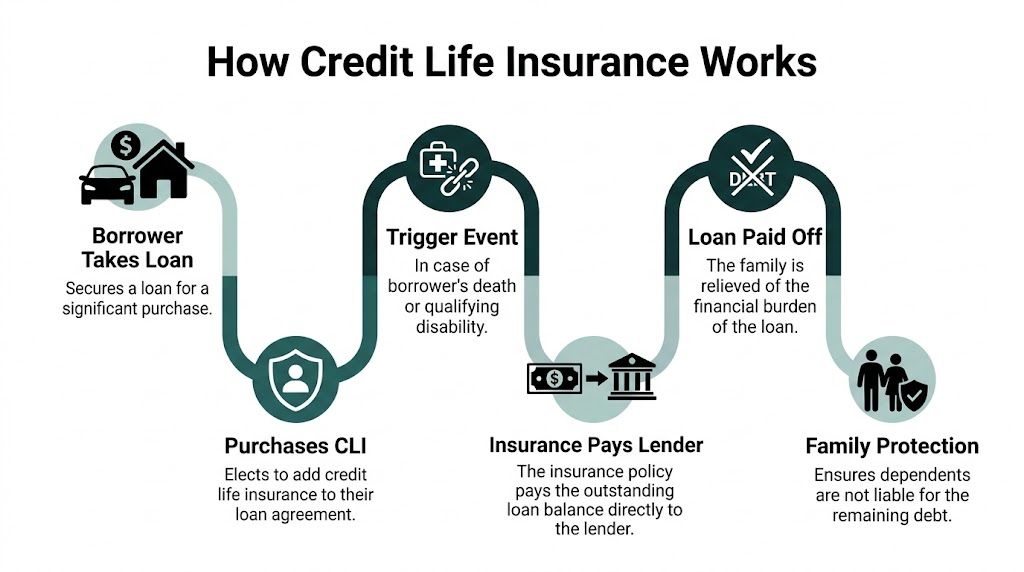
Here’s the basic flow:
- You take out a loan for a car, home, or personal expense.
- You add credit life insurance to that loan.
- You make payments on the loan over time.
- The loan balance declines, and the policy benefit usually declines with it.
- If you die while the policy is active, the insurer pays the remaining covered balance to the lender.
- The debt is satisfied, which can protect your family from having to deal with that specific payment.
Not every debt works the same way after death, and legal details can vary by situation. If you want a broader legal overview, this guide on what happens to debt when you die gives useful context beyond insurance.
What kinds of loans it can cover
Credit life insurance is often associated with mortgages, but it can also show up with other borrowing:
- Auto loans: Useful when a household relies on one financed car to get to work, school, or medical appointments.
- Mortgages: A way to tie protection directly to the home loan.
- Personal loans: Sometimes offered when borrowers are consolidating debt or financing a major expense.
That’s why it helps to learn the vocabulary. A quick California insurance glossary can make lender paperwork much less intimidating when terms start stacking up.
What it does not do
Credit life is focused. That can be a strength, but it also creates limits.
It does not typically provide a flexible pool of money for:
- child care
- groceries
- funeral costs
- future rent or mortgage alternatives
- ongoing income replacement
If your family would need broad financial support, you have to measure credit life against other kinds of life insurance, not just against the fear of leaving debt behind.
Weighing the Benefits and Drawbacks for Californians
When Californians hear about credit life insurance, the conversation usually swings too far in one direction. Some lenders frame it as easy peace of mind. Some consumers dismiss it as automatically overpriced. Neither view is complete.

Where credit life can help
For the right borrower, the convenience is real. You’re already taking out the loan, and the offer is right there in the paperwork. There’s no separate shopping process at that moment, and that matters to people juggling a move, a vehicle purchase, or a mortgage closing.
It can also help borrowers who feel exposed by a single major debt. A family that just bought a home may care less about building a complex insurance strategy and more about one simple result. If something happens to the borrower, they don’t want the house payment hanging over everyone else.
In California, that emotional appeal can be strong because many households already manage multiple expensive lines in the budget, such as:
- Auto insurance and car insurance premiums that are mandatory to keep a vehicle on the road
- Home insurance or renters insurance costs that protect property but don’t erase loan debt
- Daily living costs that leave little room for financial surprises
Where people get disappointed
The drawbacks usually show up after the policy is explained in plain language.
First, the payout goes to the lender, not your family. That means your household gets debt relief, but not cash flexibility. If survivors need help paying bills, replacing income, or covering non-loan expenses, credit life won’t solve that problem by itself.
Second, the coverage narrows over time because it follows the loan balance. Many people don’t love paying for a policy that becomes less valuable to them as years pass.
Third, it can duplicate protection you already have. If you own a strong life insurance policy and your beneficiaries could use it to pay the loan off, adding credit life may create overlap instead of filling a real gap.
Two California examples
A tech worker in Westlake Village takes out a modest personal loan. They already have substantial life insurance through work and additional individual coverage. In that situation, credit life may be redundant. The debt could likely be handled through existing life insurance without adding another product tied to one lender.
A family buying in a higher-risk part of California may face a different picture. They may already be navigating difficult home insurance decisions, California Fair Plan questions, and tight monthly costs. If one borrower also has trouble qualifying for traditional life insurance, a policy that guarantees the mortgage debt gets paid can look a lot more practical.
Credit life insurance is best judged by the gap it fills, not by whether it wins a generic “good” or “bad” label.
A quick way to think about the trade-off
| Consideration | Why it helps | Why it may not |
|---|---|---|
| Simplicity | It’s often offered with the loan | Easy sign-up can lead to rushed decisions |
| Debt focus | It targets one major obligation | It doesn’t create broad family protection |
| Accessibility | Approval may be easier than traditional life insurance | You may pay for narrow coverage you don’t fully need |
| Peace of mind | It can keep a home or car from becoming a debt burden | It may overlap with an existing life policy |
For many California households, the right answer depends less on the product itself and more on everything else already in the insurance picture.
Credit Life Insurance vs Traditional Life Insurance
The cleanest way to understand credit life insurance is to compare it side by side with term life insurance and whole life insurance. They may all involve a death benefit, but they solve different problems.
The core difference
Credit life is designed to pay off a specific debt. Traditional life insurance is designed to support people.
That sounds subtle, but it changes almost everything. It changes who gets paid, how much stays in force over time, and how useful the benefit is after a loss.
A cost example helps show how different these products can be. According to CCIA’s overview of credit insurance, a typical $6,000 loan insured with credit life for three years costs $90 total. The same source says a separate $50,000 term life policy for that individual might cost around $475 over the same period. That doesn’t mean credit life is always “cheaper” in the broad sense. It means it can be cost-effective when the goal is very narrow and the debt is relatively small.
Side-by-side comparison
| Feature | Credit Life Insurance | Term Life Insurance | Whole Life Insurance |
|---|---|---|---|
| Primary purpose | Pays off a specific covered loan | Provides income protection for a chosen period | Provides permanent life insurance with a long-term structure |
| Who gets the payout | The lender | Your chosen beneficiary | Your chosen beneficiary |
| Coverage amount over time | Usually decreases with the loan balance | Usually stays level during the term | Generally stays in force as long as policy requirements are met |
| Flexibility of use | Very limited | High | High |
| Connection to debt | Tied to one loan | Can be used for a loan, rent, education, or bills | Can be used for many financial goals |
| Approval style | Often simpler | May require more underwriting depending on the policy | Usually more involved than a loan add-on policy |
Beneficiary control matters more than people think
If you have a term or whole life policy, your beneficiary can decide what to do with the money. They might pay off the mortgage. They might keep making the monthly payment and use the rest for child care or household expenses. That control is often the biggest advantage of traditional life insurance.
With credit life, there’s no such choice. The lender gets paid first because that’s exactly what the policy was built to do.
The shape of coverage is different
Term life is usually level coverage. If you buy a policy for a certain amount, that amount doesn’t typically shrink just because your mortgage or auto loan balance declines.
Credit life moves the opposite way. It’s linked to the debt, so its benefit usually gets smaller over time. For a borrower who wants one neat solution attached to one loan, that can be fine. For a parent trying to protect a household budget, it’s often too narrow.
Where whole life fits
Whole life isn’t a direct substitute in every case because people usually buy it for longer-range planning, not just to protect one loan. If someone is comparing all options, the practical question is less “Which product is best?” and more “Which problem am I trying to solve?”
If the problem is “I want my family to have money for many needs,” traditional life insurance usually has the edge. If the problem is “I may not qualify elsewhere, but I need this one debt paid,” credit life can make more sense.
If you want to compare broader policy options available in the state, a guide to life insurance in California is a helpful next step.
Decision shortcut: If your main concern is family flexibility, look first at traditional life insurance. If your main concern is access and guaranteed loan payoff, credit life deserves a closer look.
When Credit Life Insurance Is a Smart Choice in California
A lot of articles conclude that term life is generally the better option. That advice can be fine for healthy borrowers with straightforward options. It’s not enough for everyone.

When access matters more than elegance
Some Californians don’t have the luxury of choosing between several ideal life insurance options. They may have health conditions that complicate underwriting. They may work in occupations that don’t fit neatly into standard insurance pricing. They may need coverage quickly at the same moment they’re taking on debt.
That’s where credit life insurance earns more respect than it usually gets.
As explained in KPCU’s educational article on credit life insurance, credit life insurance often doesn’t require a medical exam, which can make it a viable option for borrowers who might otherwise be declined for conventional coverage due to health, occupation, or similar factors.
Situations where it can be the right move
Some examples stand out.
- A borrower with medical history challenges: They may not be able to secure the kind of term policy they wanted, or they may face delays and uncertainty they can’t tolerate while closing on a loan.
- A household relying on one financed vehicle: If that car is essential for commuting, school drop-offs, or caregiving, eliminating the auto loan can protect daily life.
- A new homeowner who wants the mortgage handled directly: Some people care most about making sure survivors can stay in the home without that debt.
- A worker without employer life insurance: Not everyone has job-based benefits. Credit life may be the only protection they can get quickly for a major loan.
California-specific realities
California has borrowers in very different circumstances. A professional in a major metro area with strong workplace benefits might see credit life as unnecessary. A self-employed person, a gig worker, or someone with a complicated health background may see it as the first realistic yes they’ve received.
That difference matters.
The product is also emotionally easier for some families because it answers one direct question. “If I die, will this loan still hurt the people I love?” Credit life can turn that answer into no, at least for the debt it covers.
Some insurance products are designed for perfect shopping conditions. Credit life often serves people making real decisions under time pressure, with imperfect options.
When it’s probably not the best fit
Credit life may be less attractive when:
- you already have strong life insurance
- your beneficiary needs flexibility more than debt-specific protection
- the loan is small and easy to absorb from savings or existing coverage
The smart use case is not “everyone with a loan.” It’s borrowers who need direct loan protection and may not have a cleaner path to traditional life insurance.
Understanding California Rules and Consumer Protections
If you’re offered credit life insurance in California, the first thing to remember is simple. You should treat it like any other insurance purchase. Read it carefully, ask questions, and don’t assume the lender’s desk is the place for rushed decisions.
What to check before you sign
California borrowers should focus on the basics first:
- Whether the coverage is optional: Ask directly whether the loan depends on buying the policy.
- What debt is covered: Confirm the policy is tied only to the loan you’re taking out.
- How premiums are handled: Make sure you understand whether the cost is included in the loan payment or charged separately.
- How cancellation works: Ask for the cancellation terms in writing.
- Who receives the benefit: It should be clear that the payment goes to the creditor.
Those sound obvious, but confusion often starts when borrowers assume “life insurance” always means their family gets cash. Credit life usually works differently.
Consumer protection mindset
A good habit is to compare the lender’s offer against your existing protection. If you already carry life insurance, ask whether this policy fills a real gap or duplicates what you already have. If you’re buying a home, also keep it separate in your mind from homeowners insurance. One protects property risks. The other addresses loan payoff after death.
You should also expect clear disclosure of key terms. If the policy language feels vague, or if anyone pressures you to buy quickly without time to review, step back. Insurance decisions should survive a second look.
When disputes come up
The need for legal assistance over a policy is infrequent, but it’s useful to know when a claim problem moves beyond customer service. If a claim is delayed, denied, or tangled in unclear language, this guide on when to hire a lawyer for an insurance claim offers practical signs that a dispute may need outside help.
If a product is optional, your “yes” should come after understanding it. Not before.
Questions worth asking the lender
Keep these in front of you during closing or loan signing:
- Is this required for approval, or optional?
- What exact event triggers the benefit?
- Does the benefit decrease as the loan balance goes down?
- Can I cancel later if I decide it doesn’t fit?
- If I already have life insurance, why would I need this too?
Those questions won’t make the room awkward. They make the transaction clearer.
Find the Right Protection with Mai & Associates
By the time you’ve looked at credit life insurance closely, the decision usually becomes much simpler. Not easy, but simpler.
Use a three-part checklist
Start with what you already own. Review any existing life insurance through work or through a personal policy. If your family could already use that coverage to pay off a mortgage, auto loan, or personal loan, credit life may not add much.
Then look at the debt itself. Ask whether this is the one payment you most want removed if something happens to you. A mortgage, car loan, or personal loan can each create a different level of strain for a household.
Finally, be honest about insurability. If getting traditional life insurance will be difficult, delayed, or uncertain, credit life may be more valuable than it looks at first glance.
Protection should work together
Most Californians aren’t making this decision in isolation. They’re balancing:
- Auto or car insurance they need to drive legally
- Home insurance or renters insurance that protects property and liability
- Life insurance that may already cover broader family needs
- Loan obligations that don’t disappear just because the budget gets tight
That’s why the best answer is usually portfolio-based, not product-based. One household may need stronger term life. Another may need a targeted loan solution because other life insurance doors aren’t open.
A practical next step is to review trusted educational California insurance guides so you can compare how debt protection fits with the rest of your coverage.
The big takeaway
What is credit life insurance? It’s a loan-specific policy that can pay a creditor directly if the insured borrower dies while the debt is still outstanding. It isn’t automatically the best option. It also isn’t automatically a bad one.
For healthy borrowers with solid life insurance choices, it may be too limited. For Californians who need simple access, fast approval, or a direct way to protect a major debt, it can be exactly the right tool.
If you want help sorting through credit life insurance, life insurance, auto insurance, home insurance, or renters insurance in one clear review, Mai & Associates can help you compare your options across California. Their licensed team can look at your current coverage, identify gaps, and help you choose the most practical way to protect your family, home, car, and budget.