What Is Comprehensive Auto Insurance: A Clear Guide for California Drivers
Let's get right to it. Think of comprehensive auto insurance as your car's safety net for the unexpected. It’s the coverage that kicks in for almost everything that can happen to your vehicle besides a collision with another car or object. For anyone navigating the world of California insurance, understanding this piece is crucial.
Your Quick Guide To Comprehensive Auto Insurance
If your auto insurance policy is a toolkit, liability coverage is the basic wrench required by law to cover damage you cause to others. Collision coverage is the specialized hammer you use to fix your own car after an accident. So, what is comprehensive auto insurance? It's the rest of the essential tools in that kit—the ones you need for all the curveballs life throws your way, often when you're not even behind the wheel.
For those of us in California, this kind of protection is especially smart. It specifically addresses local risks that other policies just don't touch, including:
- Wildfire damage that can scorch your car's paint, melt the interior, or ruin the engine.
- Theft or vandalism, which are unfortunate realities in many urban and suburban areas.
- Falling objects, like a heavy branch from a palm tree or debris from a winter storm.
To put it simply, here’s a quick rundown of what comprehensive insurance is all about.
Comprehensive Insurance At A Glance
This table breaks down the common scenarios where comprehensive coverage steps in and where it doesn't.
| What Comprehensive Covers (Non-Collision Events) | What Comprehensive Does NOT Cover |
|---|---|
| Theft of your vehicle or its parts | Damage from a collision with another car |
| Vandalism (e.g., spray paint, slashed tires) | Hitting a stationary object (e.g., fence, pole) |
| Fire, including wildfires | Normal wear and tear or mechanical failure |
| Damage from natural disasters (e.g., floods, earthquakes) | Routine maintenance (e.g., oil changes, new tires) |
| Hitting an animal (e.g., deer, coyote) | Personal items stolen from inside your car |
| Falling objects (e.g., tree limbs, hail) | Medical expenses for you or others (covered by other policies) |
| Cracked or shattered windshields |
As you can see, it fills a crucial gap, protecting your investment from a wide array of non-driving-related incidents.
A Key Piece of The California Insurance Puzzle
Comprehensive auto insurance isn't just a niche product; it's a fundamental part of what we call "full coverage" and a major driver of the California insurance market. In fact, the global motor vehicle insurance market—where comprehensive plays a huge role—is expected to hit a staggering US$993.43 billion in gross written premiums by 2025. That enormous figure shows just how much people rely on this coverage for peace of mind. You can learn more about these global insurance trends from industry analyses.
At its core, comprehensive coverage is financial protection for your vehicle's value against random, unpredictable events. It ensures a single incident doesn't force you to pay for a major repair or replacement out of pocket.
This protection is truly a cornerstone of any robust auto insurance plan. If you're wondering how this might look for your own car, you can easily get an instant insurance quote to explore your options.
What Does Comprehensive Insurance Actually Cover?
So, what does this coverage really do for you? Let's get practical. Think of it as your car's shield against all the wild, unpredictable stuff that can happen when you're not even driving.
Imagine you park your car overnight in a San Francisco neighborhood only to find a broken window and a missing stereo in the morning. Or maybe one of Southern California's infamous Santa Ana winds knocks a huge tree branch right onto your hood. These are precisely the kinds of "out of your control" moments where comprehensive insurance saves the day.
Comprehensive coverage is your financial backstop for damage to your car from almost anything except a collision. It handles the unexpected, from acts of nature to crime, so you aren't stuck footing the entire bill.
What's Covered Here in California
Living in the Golden State comes with a unique set of risks, and that’s where comprehensive coverage really shines. It's built to handle a whole host of specific, non-crash-related incidents.
Here’s a look at what this coverage typically handles:
- Theft and Vandalism: Your car gets stolen, or someone decides to key it, slash the tires, or spray-paint it. Comprehensive covers the repairs or the value of your car if it's gone for good.
- Fire and Explosions: This is a big one for Californians. It covers damage not just from a vehicle fire but also from external blazes, like the devastating wildfires we see all too often.
- Natural Disasters: We get them all. Comprehensive steps in for damage from floods, earthquakes, hailstorms, and heavy windstorms.
- Falling Objects: A chunk of rock tumbles down a Big Sur cliffside and hits your car. A heavy palm frond lands on your roof during a storm. Construction debris falls from an overpass. All covered.
- Animal Collisions: Hitting a deer on a rural road near Yosemite is a classic example. The damage from that impact falls under your comprehensive, not collision, policy.
- Glass Damage: That annoying rock kicked up by a semi on the I-5 that leaves a giant crack in your windshield? That’s usually a comprehensive claim.
A Real-World Wildfire Example
Let's make this crystal clear. Say a wildfire sweeps through your area, and you have to evacuate, leaving your car behind. You return to find the paint blistered from the heat and the interior plastics melted from flying embers.
Without comprehensive coverage, that repair bill is 100% on you, and we're talking thousands of dollars. With it, you just file a claim, pay your deductible, and your insurance company handles the rest. It’s a financial firewall against some of California's most serious environmental threats.
Sometimes, insurance lingo like "peril" or "deductible" can be confusing. If you ever need a quick and clear definition, our extensive California insurance glossary is a great resource. This kind of protection is a cornerstone of any solid auto policy, especially in a state as dynamic as ours. It ensures one stroke of bad luck doesn't turn into a financial disaster.
Comparing Comprehensive, Collision, and Liability Insurance
It’s easy to get lost in all the insurance jargon. When you hear terms like liability, collision, and comprehensive, just think of them as three different layers of protection for your car, each with a very specific job. Getting a handle on what each one does is the secret to understanding your car insurance policy.
The Three Core Coverages
Let's break them down, one by one.
First up, you have liability insurance. This is the one every single driver in California is legally required to carry. Its sole purpose is to pay for the damage you cause to other people and their property if you’re at fault in an accident. It covers their medical bills and car repairs, not yours.
Next, there's collision coverage. This is the policy that pays to fix or replace your own car after a crash, whether it’s with another vehicle or a stationary object like a telephone pole. It kicks in no matter who was at fault.
Finally, we have comprehensive coverage. This is your car’s shield against just about everything else—the unpredictable, non-collision incidents that are completely out of your hands. We’re talking about things like theft, vandalism, fire, hitting a deer, or damage from a hailstorm.
This diagram helps visualize how comprehensive steps in to protect your car from threats that have nothing to do with a typical traffic accident.
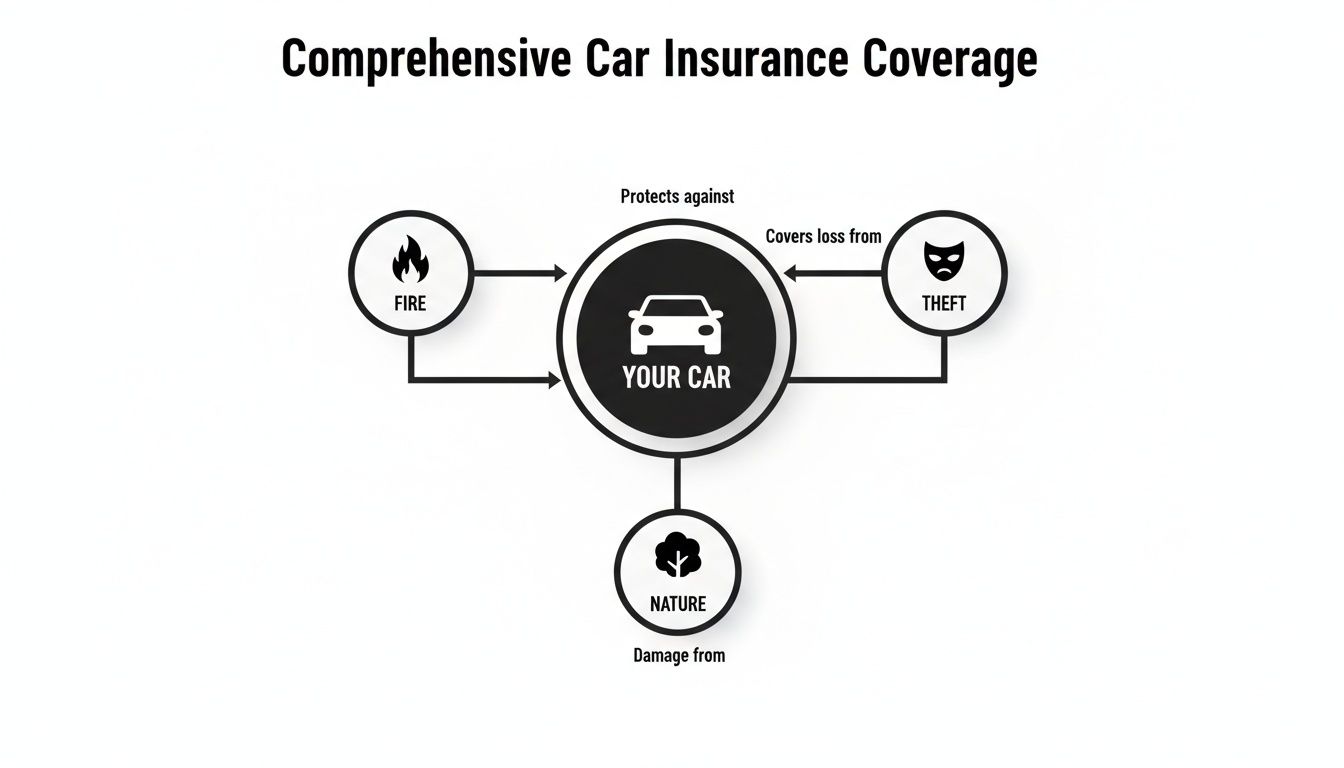
As you can see, comprehensive is your specific protection against life's random curveballs, from fires and theft to wild weather.
Auto Insurance Coverage Showdown
So, how do these three coverages actually play out in real-world situations? The best way to understand the difference is to see them in action. This table breaks down a few common scenarios to show you which policy does the heavy lifting.
| Scenario | Comprehensive Coverage | Collision Coverage | Liability Coverage |
|---|---|---|---|
| A tree branch falls on your parked car during a storm. | Covers your repair costs. | Does not apply. | Does not apply. |
| You accidentally back into your neighbor's fence. | Does not apply. | Covers your car's damage. | Covers the fence repair. |
| Your car is stolen from a public parking garage. | Covers the loss of your vehicle. | Does not apply. | Does not apply. |
| You cause a multi-car pileup on the I-5. | Does not apply. | Covers your car's damage. | Covers the other cars' damage. |
Seeing it laid out like this really clarifies when each type of insurance is needed. Comprehensive handles the "acts of God" and crime, Collision handles crashes, and Liability handles your responsibility to others.
By the way, when you hear an agent talk about “full coverage,” they’re almost always referring to a policy that bundles all three of these protections—liability, collision, and comprehensive. This combination creates a robust safety net that gives you true peace of mind, both on and off the road.
Having all three means you’re covered for your legal duties to others, for damage to your own vehicle in an accident, and for all the bizarre, non-collision events that can happen at any time. It's this type of layered protection—similar to bundling home insurance, renters insurance, and life insurance—that builds a strong financial shield against the unexpected.
How Much Does Comprehensive Insurance Cost In California?
So, you're trying to figure out comprehensive auto insurance, and one of the first questions on your mind is probably, "What's this going to cost me?" In California, there's no simple, one-size-fits-all price. Think of your premium as a custom quote built just for you, based on a mix of factors where your car, your driving history, and even your address are the main ingredients.
At its core, an insurer's job is to calculate risk. For comprehensive coverage, they’re zeroing in on the odds of something other than a crash happening to your specific car, in your specific neighborhood. It makes sense that a brand-new, high-end SUV will cost more to insure than a ten-year-old sedan—the potential replacement cost is just so much higher.
Where you live and park your car also plays a surprisingly big role. If your zip code has a reputation for car thefts or sits in a high-risk wildfire zone (a major concern for us here in California), you can expect your comprehensive premiums to be higher. Insurers use a ton of location-based data to predict how likely a claim is, and that prediction directly impacts your bill.
Key Factors That Shape Your Premium
A few key things come together to determine your final quote. Every insurance company has its own secret sauce for weighing these, but a few factors always carry the most weight.
- Your Vehicle's Actual Cash Value (ACV): This is a big one. The more your car is worth, the more it would cost the insurance company to replace it if it gets stolen or totaled in a fire. This is often the single biggest driver of your comprehensive premium.
- Your Driving History: You might think, "What does my driving have to do with a tree falling on my car?" While comprehensive claims aren't about your skill behind the wheel, a history of frequent claims of any kind can make you look like a higher risk, potentially nudging all your rates up.
- Your Location (ZIP Code): It all comes down to risk. Rates are naturally higher in areas prone to theft, vandalism, or natural disasters. Living in a quieter, lower-risk area can mean real savings.
The Power of Your Deductible
One of the most direct ways you can control your premium is by picking your deductible. A deductible is simply the amount you agree to pay out-of-pocket on a claim before your insurance coverage steps in to handle the rest.
Think of your deductible as your share of the risk. When you agree to a higher deductible, you're telling the insurer you'll handle the smaller stuff yourself. In return for taking on more of that initial risk, they reward you with a lower premium.
For instance, bumping your deductible from $500 to $1,000 will almost always lower your rate. It’s a trade-off, really—balancing what you pay each month against what you could comfortably pay out-of-pocket if something unexpected happens. It’s a powerful tool for managing your car insurance costs.
The bigger economic picture also plays a part. While we've seen a slight slowdown in the year-over-year rise of motor vehicle insurance costs nationally, inflation and the increasingly complex technology in modern cars keep pushing repair and replacement costs up. In fact, while the number of comprehensive-style claims is slowly dropping, the cost of those claims is rising, with total losses hitting 23.5% of non-comprehensive losses through Q2 2025. You can dig into all the data in the CCC Intelligent Solutions Crash Course report.
This is exactly why working with an independent agency like Mai & Associates is so valuable—we can shop around with different carriers to find the best possible rate for your unique situation.
When Should California Drivers Get Comprehensive Coverage?
Figuring out if you need comprehensive coverage can feel a bit tricky. Is it a must-have, or just a nice-to-have? For drivers here in California, the right answer really boils down to your car, your finances, and how much risk you're comfortable with.
Sometimes, the choice is already made for you. If you're leasing or financing your vehicle, the bank or leasing company will almost always insist that you carry both comprehensive and collision. It’s not just a friendly suggestion—it’s a required part of your loan or lease agreement to protect their investment until the car is fully paid off.
Is It Worth It for Your Car and Your Location?
If your car is paid off, the decision is up to you. The big question to ask yourself is this: if your car was stolen, vandalized, or totaled in a wildfire tomorrow, could you easily afford to repair or replace it out of pocket? If that thought makes you nervous, comprehensive coverage is probably a wise move.
Your environment here in California is also a huge factor. Comprehensive becomes especially valuable if you:
- Live in a city or neighborhood with high rates of car theft and break-ins.
- Are in an area prone to wildfires—a very real risk for many of us.
- Regularly park on the street where your car is exposed to storms, falling tree branches, or other unexpected mishaps.
Think of comprehensive insurance as your specific shield against all the unpredictable things that can happen to your car when you're not even driving it.
When Can You Safely Drop Comprehensive Coverage?
On the flip side, there comes a time when paying for comprehensive coverage might not make financial sense anymore. This is usually the case with older, paid-off cars that aren't worth very much.
Here's a simple way to do the math. Take your annual comprehensive premium and add your deductible. If that total number is getting close to—or is even more than—the actual cash value (ACV) of your car, you're likely paying for more protection than the car is worth. At that point, you might be better off dropping the coverage and putting that money aside for any future repairs yourself.
Get The Right California Auto Insurance Coverage

Figuring out car insurance can feel overwhelming, especially on your own. Here in California, we deal with everything from packed freeways to the constant threat of wildfires, so getting the right protection isn't just a good idea—it's essential. That's where having a knowledgeable partner like Mai & Associates truly makes a difference.
Our job is to cut through the jargon, spot coverage gaps you might have missed, and find you a rate that actually fits your budget. Because we work with multiple top-rated insurance carriers, we can shop around for you, making sure you get great value without compromising on your protection.
We believe great service means speaking your language. Our team offers support in English, Spanish, Armenian, Russian, and Vietnamese to provide clear, personalized guidance every step of the way.
Your Local California Insurance Ally
With offices across the state, our licensed agents are part of your community and ready to help. We make the process of getting solid California auto insurance coverage straightforward. We can also show you how bundling your auto insurance policy with home insurance, renters insurance, or life insurance can lead to even bigger savings.
At the end of the day, our goal is simple: to make sure you have strong, affordable protection that you can rely on. We want you to feel completely confident every time you get behind the wheel, knowing you’re covered for whatever the road throws your way.
Frequently Asked Questions About Comprehensive Insurance
We hear a lot of the same questions from drivers trying to make sense of their auto insurance, and that's a good thing. Asking the right questions is the only way to feel confident you're truly protected. Here are some of the most common things Californians ask about comprehensive coverage, with straight-to-the-point answers.
Is Comprehensive The Same As Full Coverage?
That's a common mix-up, but no, they aren't the same thing. Think of "full coverage" as an unofficial industry term, not a specific policy you can buy off the shelf. It's really just shorthand for an auto policy that bundles together three core protections:
- Liability Insurance: This covers the damage you cause to other people and their property.
- Collision Insurance: This pays to fix your own car after an accident, regardless of who was at fault.
- Comprehensive Insurance: This is for all the other stuff—the non-accident damage.
So, comprehensive is a vital part of what people call "full coverage," but you need the other two pieces to complete the puzzle.
Does Comprehensive Cover A Cracked Windshield?
Yes, this is one of the most classic examples of what comprehensive insurance is for. That rock that flies up on the freeway and leaves a chip or crack in your windshield? That’s a perfect comprehensive claim.
Even better, many insurers in California offer a separate glass deductible that’s very low—or even $0—to encourage you to get it fixed quickly before the crack spreads. It's often a surprisingly painless process.
Will A Comprehensive Claim Raise My Insurance Rates?
It’s much less likely to than an at-fault collision claim would. Why? Because insurance companies view comprehensive events like theft, vandalism, or storm damage as things that were largely out of your control.
That said, a pattern of frequent claims—even small ones—can make an insurer see you as a higher risk. If you file several comprehensive claims in a short time frame, you might see an impact on your premium when it's time to renew.
Before filing a claim for minor damage, it’s always a smart move to call your agent. They can help you do the math: weigh the out-of-pocket repair cost against your deductible and the possibility of a future rate change.
Should I Keep This Coverage On An Older Car?
This is a fantastic question, and the answer comes down to simple economics. The key is to compare two numbers: your car's actual cash value (ACV) and the cost of your coverage.
Add up your annual comprehensive premium and your deductible. If that total is getting uncomfortably close to what your car is actually worth, paying for the coverage might not make financial sense anymore. You could be paying more for protection than the maximum payout you’d ever receive.
We get into the nitty-gritty of topics just like this one all the time. You can find more answers to your questions about auto insurance on our FAQ page.
Ready to find the right protection for your vehicle? The licensed agents at Mai & Associates are here to help you navigate your options for auto insurance, home insurance, renters insurance, and life insurance, ensuring you get quality coverage at a competitive price. Get your free, no-obligation quote today!