What Is Collision Coverage and How Does It Protect Your Car
Collision coverage is the part of your car insurance policy that pays to fix or replace your car after you’ve been in an accident. It kicks in whether you're at fault or not.
Think of it as the coverage that handles the aftermath of hitting another car or a stationary object, like a fence, a guardrail, or even a pesky pothole.
Defining Your Car's Financial Safety Net
Picture your auto insurance policy as a team of specialists, each one ready to tackle a different kind of financial problem. Collision coverage is the specialist you call when your own car gets damaged in a crash.
Without it, you're on the hook for the entire repair bill yourself. This can be a huge financial blow, especially if the other driver doesn't have insurance or if you were in a single-car accident. For anyone driving on California's packed freeways and busy city streets, having this protection can be the difference between a minor inconvenience and a major financial crisis. This is a critical component of any comprehensive California insurance plan for drivers.
What Scenarios Does It Cover?
So, when does collision coverage actually step in? It's pretty straightforward: it applies anytime your car collides with another object.
This includes common situations like:
- Accidents with other cars, no matter who was responsible.
- Single-car incidents, like sliding on a wet road and hitting a telephone pole.
- Rollover accidents where your vehicle flips.
- Damage from hitting a deep pothole that messes up your car's suspension or body.
To help you visualize this, here’s a quick summary of what collision does—and doesn’t—handle. And if you run into any other unfamiliar terms, our online insurance glossary can help clear things up.
Collision Coverage At-a-Glance
This table breaks down a few common scenarios to give you a clearer picture.
| Scenario | Is It Covered by Collision? |
|---|---|
| You rear-end another car at a stoplight. | Yes |
| A tree branch falls on your parked car. | No (This is for Comprehensive) |
| You hit a guardrail on a sharp turn. | Yes |
| Your vehicle is stolen from your driveway. | No (This is for Comprehensive) |
| Someone hits your car in a parking lot. | Yes |
Ultimately, this coverage is your go-to for fixing physical damage to your car from most traffic accidents. It’s designed to get you back on the road without having to empty your bank account.
How Collision Coverage Really Works
Knowing what collision coverage is on paper is one thing, but seeing how it springs into action after an accident is where the rubber really meets the road. The process can feel intimidating at first, but it follows a clear, logical path designed to get you from the scene of the crash back to your daily life. Let’s walk through it.
First, let's look at the bigger picture. The global auto insurance market is valued at a staggering USD 838.05 billion, and a huge slice of that comes from collision claims. The average claim in the U.S. hovers around $5,200, and here in California, we account for a massive 10% of that national total. With nearly 38 million vehicles on our roads and over 500,000 fender-benders a year just around Los Angeles, understanding this process isn't just helpful—it's essential for any driver with car insurance. If you're interested in the numbers, you can dive deeper into the auto insurance market's growth and trends.
This simple flow chart breaks down what happens after a collision.
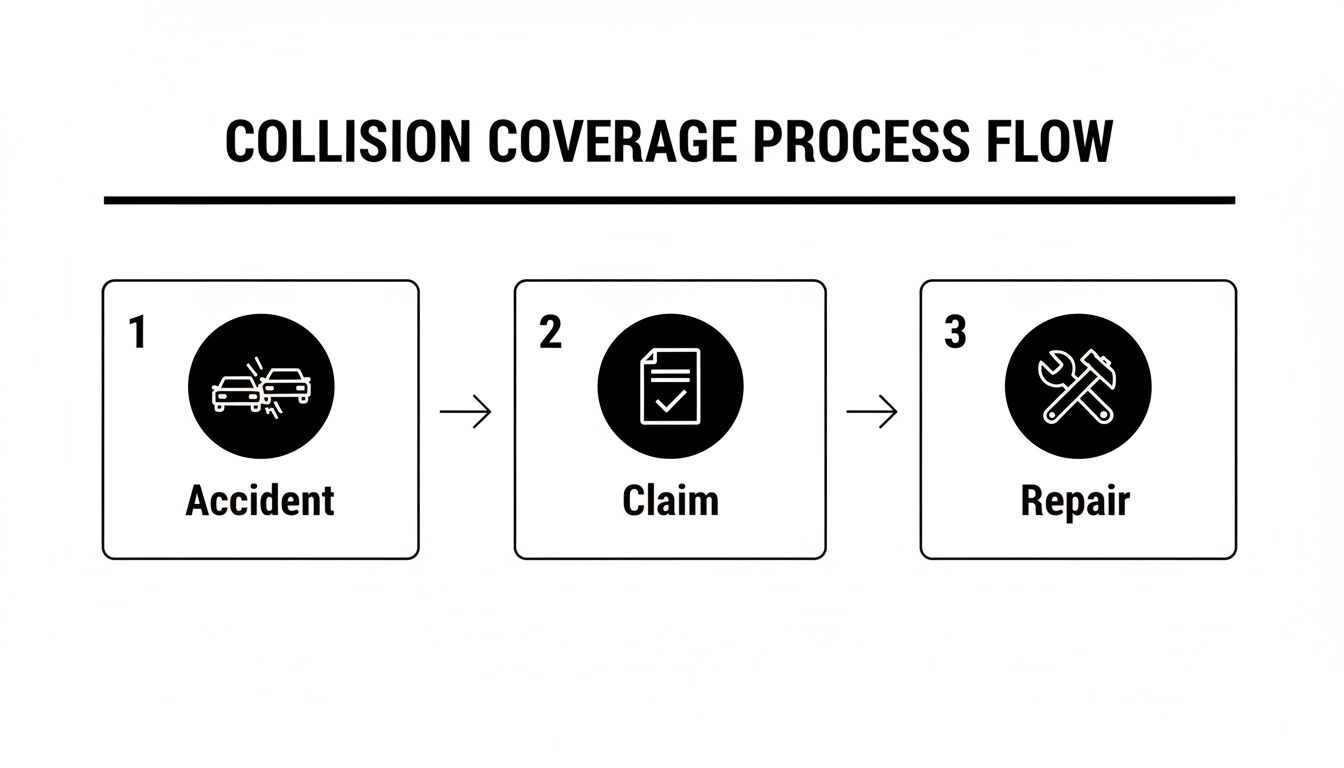
As you can see, it’s a straightforward sequence: the accident happens, you file a claim, and then the repairs get done.
The Claims Process Step-by-Step
Let's make this real. Imagine you're driving through Glendale when another car suddenly swerves into your lane. After making sure everyone is safe, the insurance part kicks in. Here’s a play-by-play of what to expect:
- File Your Claim: The first step is to call your insurance provider (like us here at Mai & Associates) and report what happened. You’ll share the key details—who, what, where, and when.
- Assessment and Adjuster: Your insurer will assign a claims adjuster to your case. This person is a professional who inspects your vehicle's damage to figure out the cost of repairs. Their job is to determine if the car can be fixed or if it’s a "total loss."
- Repair Authorization: With an approved estimate in hand, you can take your car to a repair shop. Most insurers let you choose your own trusted mechanic, but they often have a network of pre-approved shops that can make the process smoother.
This structured process is designed to take the chaos out of the situation, so you can focus on getting things back to normal.
Key Takeaway: A claims adjuster's main job is to calculate the repair cost based on your car's "actual cash value" (ACV). Think of ACV as the market price for your vehicle the moment before the accident, factoring in its age, mileage, and condition.
Understanding Your Deductible and Payout
Before the insurance company writes a check, you have to cover your part of the deal: the deductible. This is the fixed amount you agree to pay out-of-pocket for a claim.
For example, if the body shop hands you a repair bill for $4,000 and your collision deductible is $500, you pay the first $500. Your insurance then covers the remaining $3,500. You'll typically pay your deductible directly to the repair shop when you pick up your fixed car.
Now, if the other driver was clearly at fault, your insurance company will often go after their insurer to get that money back—including your deductible. This process is called subrogation. But the beauty of having your own collision coverage is that you don't have to wait for the insurance companies to sort out who's to blame. Your car gets fixed right away.
Collision vs. Comprehensive Insurance Explained
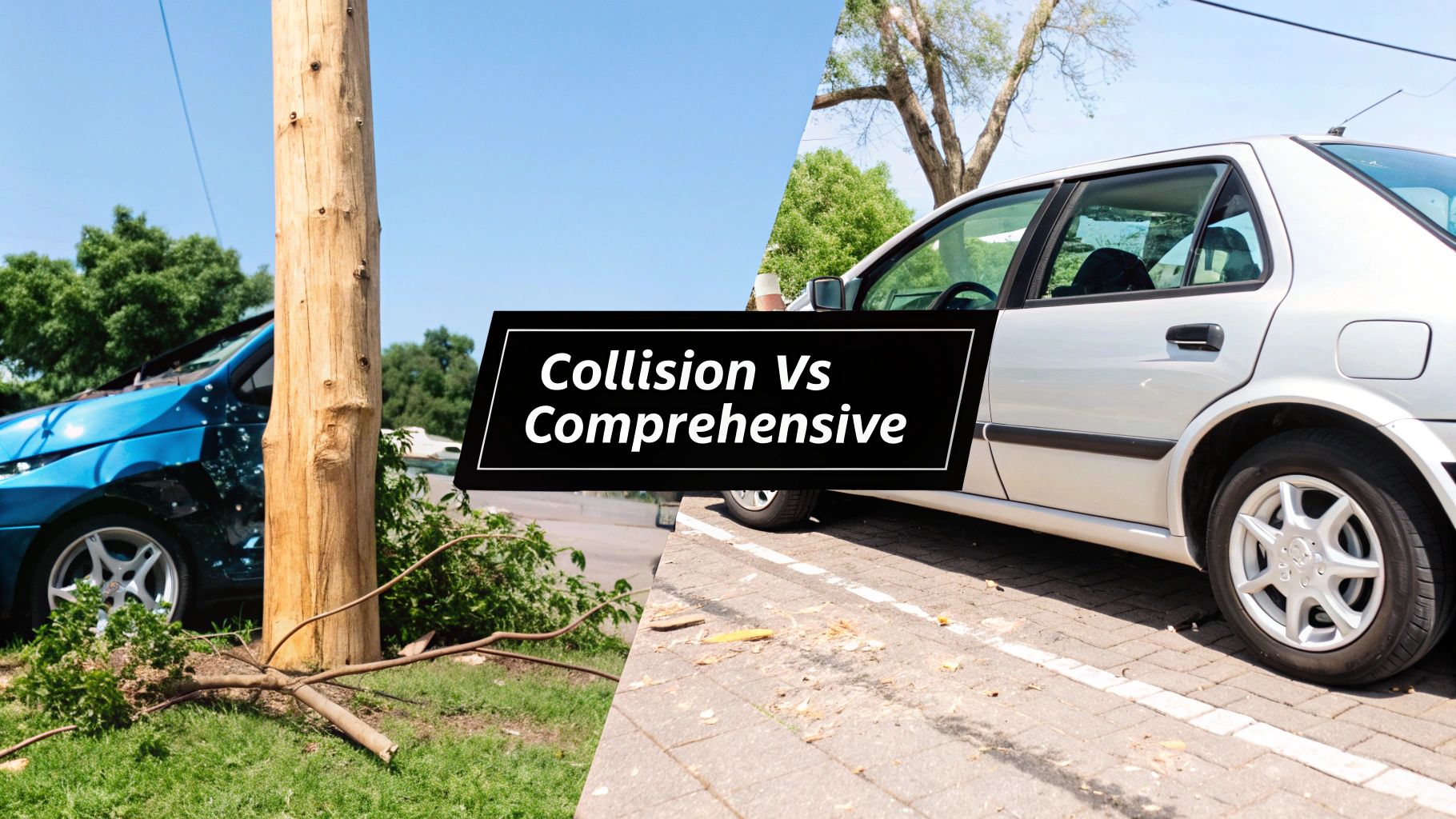
One of the most frequent questions we get from California drivers is, "What's the real difference between collision and comprehensive coverage?" It’s easy to get them confused, but once you get the core idea, it all clicks into place.
Here’s a simple way to think about it.
Collision insurance is your "driving protection." It kicks in to fix your car when you hit something—another vehicle, a guardrail, a telephone pole, you name it.
Comprehensive insurance, on the other hand, is your "non-driving protection." It covers damage to your car from just about everything except a collision. Think theft, fire, falling trees, or even hitting a deer.
Together, they form a powerful safety net for your vehicle, an essential part of any solid California insurance package.
When Does Each Coverage Apply?
The real dividing line is the cause of the damage. Collision is for accidents where your vehicle is in motion and makes an impact. Comprehensive covers a whole host of external events that are usually beyond your control.
Collision insurance is built for scenarios like:
- Hitting another car, whether it’s a fender-bender in a Trader Joe's parking lot or a multi-car pileup on the 405.
- Crashing into a stationary object, like a fence, a mailbox, or a building.
- A single-car rollover accident that damages your vehicle.
Comprehensive insurance is designed for a completely different set of risks, those unpredictable moments life throws at you.
This includes things like:
- Your car getting stolen or vandalized.
- Damage from falling objects, like a heavy branch crashing down during a storm.
- Fire, floods, hail, and other nasty weather events.
- Hitting an animal, like a deer darting across a dimly lit road in Northern California.
Why They Work Together: You'll find that most insurance carriers, including the top-rated ones we work with at Mai & Associates, often bundle collision and comprehensive together. Why? Because they cover two different sides of the same coin: your vehicle's physical safety. This pairing eliminates major gaps in your protection.
Comparing Collision and Comprehensive Coverage
To really grasp how collision coverage works, it helps to see it next to other policies. For instance, bodily injury liability (BIL) coverage is all about paying for injuries you cause to other people. Collision and comprehensive, however, are focused entirely on protecting your own car.
Here’s a simple table to make the roles of collision and comprehensive perfectly clear.
| Type of Incident | Collision Coverage | Comprehensive Coverage |
|---|---|---|
| You hit a massive pothole that damages your axle. | Yes | No |
| Your car is stolen from your driveway. | No | Yes |
| You accidentally back into your neighbor's mailbox. | Yes | No |
| A freak hailstorm leaves dents all over your roof. | No | Yes |
| Your vehicle is damaged in a rollover on a slick road. | Yes | No |
For most California drivers, having both is simply the smartest way to go. It means that whether your car gets banged up in a freeway jam or damaged by a wildfire, you have the financial backup to get it fixed or replaced and get on with your life.
How Much Does Collision Coverage Cost In California?
Pinpointing the exact cost of collision coverage in California is a bit like asking "how much does a car cost?"—it really depends on the specifics. There’s no flat rate. Instead, California insurance carriers look at a whole host of factors unique to you and your vehicle to figure out your premium. Essentially, they're building a personalized risk profile to estimate how likely you are to file a claim.
A few big-ticket items immediately jump out. Your driving history, for instance, is a huge one. A clean record tells a much different story than one with a few accidents or tickets. The car you drive is another major piece of the puzzle. It's just a fact that luxury cars, high-performance sports cars, and even many electric vehicles cost more to fix due to expensive, specialized parts and the technicians needed to install them. That reality is directly reflected in your premium.
Key Factors That Drive Your Premium
Where you live and park your car in California also plays a surprisingly large role. Someone navigating the dense traffic of Los Angeles faces a different set of daily risks than a driver in a quiet, rural town. And of course, the deductible you choose has a direct, immediate impact on your bill.
Let's break down the main factors:
- Your Driving Record: Nothing keeps rates down like a clean history. No at-fault accidents or moving violations is your best bet for a lower premium.
- Vehicle Type: A brand-new luxury SUV will simply cost more to insure than a five-year-old economy sedan. Why? Because the repair bill for that SUV after a fender-bender will be significantly higher.
- Location: Living in a zip code with more accidents, theft, or vandalism claims will unfortunately mean higher insurance costs.
- Your Deductible: This is the amount you agree to pay out-of-pocket before your insurance kicks in. Opting for a higher deductible, say $1,000 instead of $500, will lower your monthly premium because you're taking on more of the initial financial risk.
Finding that sweet spot with your deductible is a critical part of managing your budget. If you want to learn more about how all these pieces fit together, you can read our guide on California auto insurance.
The Power of Bundling Your Insurance Policies
One of the smartest and simplest ways to bring down the cost of collision coverage is by bundling your policies. This just means you're buying your car insurance from the same company that provides your home insurance, renters insurance, or maybe even your life insurance. Insurers love this kind of loyalty and reward it with some pretty substantial discounts.
This strategy is a game-changer, especially for Californians in higher-cost areas. Bundling can often lead to savings of up to 25%. While adding collision coverage might increase your total auto insurance premium by 20-30%, the protection it offers is invaluable—it covers the vast majority (around 80%) of common accidents that result in repair bills under $10,000. You can see how these trends play out in various car insurance market trends.
Here at Mai & Associates, we’re experts at finding these bundling opportunities. Our job is to make sure you get the best possible rate without ever having to compromise on the protection you truly need.
Do You Actually Need Collision Coverage?

This is the million-dollar question every car owner has to answer. Deciding to keep or drop collision coverage isn't just about ticking a box on a form; it's a major financial call. The right answer for you depends entirely on your specific circumstances, and while there's no single magic formula, we can walk through the key factors to help you make the smartest choice.
For a lot of drivers in California, the decision is actually made for them. If you’re financing or leasing your vehicle, the lender or leasing company will almost certainly require you to carry both collision and comprehensive coverage. Think of it from their point of view: until you pay off that loan, the car is their asset. They need you to protect their investment from damage.
Making the Call When You Own Your Car
The real decision-making starts once you own your car free and clear. You've got the freedom to choose, but that freedom comes with the responsibility of weighing the risks. The most crucial question to ask yourself is brutally honest: Could you afford to repair or replace your car out-of-pocket tomorrow?
If the thought of a major repair bill sends you into a cold sweat or would leave you stranded without a way to get to work, then keeping collision coverage is probably a very smart move.
To figure this out logically, you need to compare what you're paying for the coverage against what your car is actually worth.
- Find Your Car’s Value: Start by getting a realistic number for your car's actual cash value (ACV). A great tool for this is Kelley Blue Book. This isn’t what you paid for it; it’s what it would sell for today.
- Check Your Premium: Dig into your insurance policy declaration page and find the line item for collision coverage. How much does it cost you per year?
- Use the 10% Rule of Thumb: A common guideline in the industry is to take a hard look at collision coverage if the annual premium costs more than 10% of your car's ACV. For instance, paying $500 a year for collision on a car that's only worth $3,000 might not make financial sense.
For many people, this coverage is an essential financial backstop. In fact, statistics suggest that having collision coverage saves 65% of drivers from a total financial loss on cars valued under $30,000. And with repair costs constantly on the rise—especially for EVs, where battery damage can spike a repair bill by 45% to nearly $20,000—the case for keeping coverage gets even stronger. These are just some of the trends shaping the commercial auto insurance market, which often trickle down to personal policies.
In the end, it’s all about a calculated risk. When you drop collision coverage, you're essentially self-insuring. You get the immediate win of a lower premium, but you're also accepting 100% of the financial responsibility if you cause an accident.
Get the Right Protection for Your California Journey
Figuring out your insurance options can feel like a maze, but getting a solid handle on what is collision coverage is a massive step in the right direction. Think of it as your car's personal bodyguard—it's the part of your policy that pays to fix your own vehicle after a crash, no matter who was at fault.
Collision coverage works hand-in-hand with comprehensive insurance to create a full safety net for your car. The choice to add it really boils down to a simple question: could you afford to repair or replace your car out-of-pocket tomorrow?
For most of us, especially if we're driving a newer car or still have a loan on it, the answer is a clear "no." That makes collision coverage less of a luxury and more of an essential shield against a sudden, hefty expense.
Partner with a California Insurance Expert
Picking the right coverage is one thing, but you also need an expert who gets the realities of driving in California. Your policy needs to be ready for anything, from a fender bender on the 405 in Los Angeles to navigating the foggy twists of the Pacific Coast Highway.
That's where we come in. At Mai & Associates, we live and breathe California insurance. We help drivers, homeowners, and families all over the state find that sweet spot between solid protection and a price that makes sense. We’re not here to just sell you a policy; we’re here to give you advice you can actually use.
We are experts in a wide range of California insurance products, including:
- Auto Insurance: We'll help you find the right mix of liability, collision, and comprehensive coverage for your life.
- Home & Renters Insurance: Protecting your home and everything in it from risks like theft, fire, and natural disasters.
- Life Insurance: Helping you build a financial safety net for your family’s future.
Your car is more than just a way to get around; it's a significant investment that fuels your daily life. Ensuring it's properly protected is one of the smartest financial decisions you can make.
Don't leave your financial security up to chance. Let our team of licensed agents help you figure out the next best step. You can easily get a fast, no-obligation insurance quote to compare rates or have us review your current policy to see where you might be exposed.
Secure your peace of mind today and get back to what matters—enjoying the ride.
Frequently Asked Questions About Collision Coverage
Once you get the basics of collision coverage, a few specific questions almost always come up. We hear them all the time from California drivers. Let's tackle the most common ones so you can feel completely confident in your policy decisions.
Will Filing a Collision Claim Raise My Rates?
This is the big one, isn't it? The honest answer is, it very well could. When you file a claim—especially if you were at fault—it signals to your insurance company that you're a higher risk to insure. But how much it affects you isn't a simple formula.
Insurance companies in California look at a few key things before deciding on a rate increase:
- Who was at fault? If the other driver was clearly at fault, your rates are much less likely to go up. In that case, your insurer will typically go after their insurance company to get reimbursed.
- Your driving record: A spotless record goes a long way. If you've been a safe driver for years, the impact will be much softer. Some policies even have an "accident forgiveness" feature for your first at-fault claim.
- The size of the claim: A minor parking lot scrape is one thing; a multi-car pileup that totals your vehicle is another. The costlier the claim, the more likely it is to affect your premium.
What Happens if My Car Is a Total Loss?
Sometimes, the damage is so bad that fixing your car would cost more than it's worth. When an adjuster makes that call, your vehicle is declared a "total loss."
This is where your collision coverage steps in. It will pay you the Actual Cash Value (ACV) of your car, minus your deductible.
Actual Cash Value isn't what you paid for the car originally. It’s what your specific car—with its age, mileage, and condition—was worth on the open market right before the crash.
Let’s say your car's ACV is calculated to be $15,000 and you have a $1,000 deductible. Your insurance company would cut you a check for $14,000. That money is yours to put toward a replacement vehicle.
Can I Have Collision Coverage Without Comprehensive?
You technically might be able to find a carrier that will sell you one without the other, but it's rare and not a great idea. Most insurers bundle collision and comprehensive together for a good reason. They're two sides of the same coin, protecting your vehicle from different kinds of physical damage.
Collision covers crashes. Comprehensive covers almost everything else—theft, fire, a tree branch falling on your roof.
Having collision but no comprehensive leaves a huge, risky gap in your protection. Think about it: you'd be covered if you hit a pole, but you’d get nothing if your car was stolen the next day. For more on this and other common questions, check out our general insurance FAQ page.
Ultimately, pairing them together gives your vehicle the complete protection it really needs.
Figuring out the fine print of auto, home, or life insurance can feel overwhelming, but you're not in it alone. The licensed agents at Mai & Associates are here to give you straight answers and help you find the right coverage for your life in California.
Protect what matters most. Visit us at https://cahomeauto.com to get a fast, no-obligation quote today.