What Is an Insurance Endorsement and How It Works

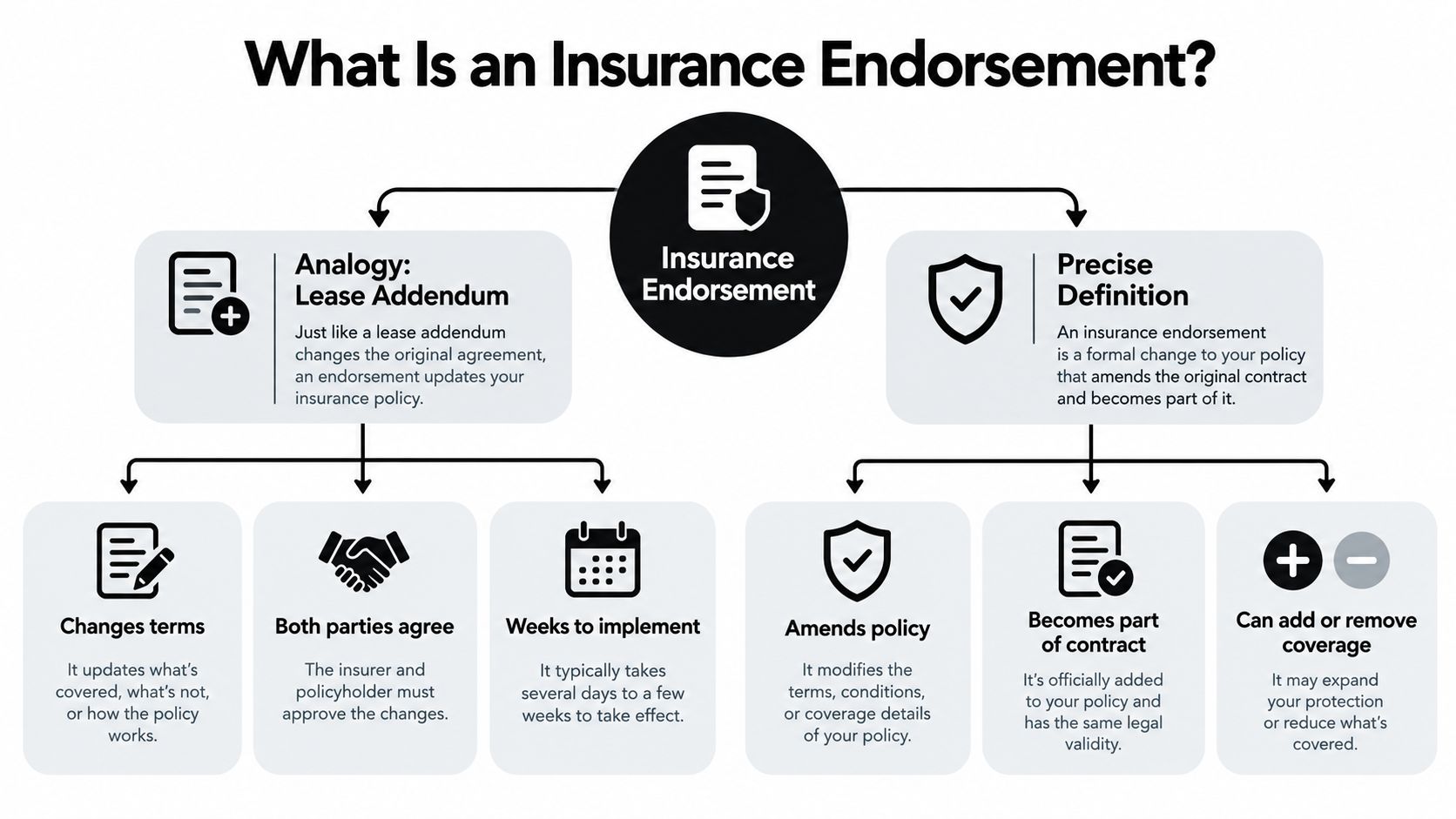
An insurance endorsement is a legally binding written amendment attached to your existing policy that adds, removes, or changes coverage and becomes part of the contract for the policy period. It modifies the policy you already have instead of replacing the entire insurance contract.
You may encounter one after buying a car, remodeling a home, adding valuable property, changing drivers, or reviewing wildfire protection. The document can look like routine paperwork, but its wording can determine whether a claim is covered, limited, excluded, or handled under different conditions.
A California homeowner might discover after wildfire damage that the base policy doesn't fully address current building-code requirements or replacement-cost concerns. A driver might learn that the policy doesn't match the vehicle's financed balance or the person regularly using the car. A renter may assume belongings and water-backup damage are treated the same way, only to find that the policy needs a targeted change.
Understanding what is an insurance endorsement helps you read your declarations page, question unfamiliar exclusions, and avoid treating every endorsement as an automatic upgrade. The sections below move from the basic meaning to legal effects, examples, California procedures, and practical questions to ask a licensed agent such as Mai & Associates.
Introduction to Insurance Endorsements in California
A California homeowner opens a renewal packet after a difficult wildfire season. The policy remains in force, but the premium and several form names have changed. Filing the packet away without reading it can hide an important adjustment, such as narrower protection for a type of property loss or a new condition on how a claim is handled.
Car insurance can change just as smoothly. You replace a vehicle, add a household driver, or begin using the car differently. What sounds like an administrative update may change the listed vehicle, insured drivers, limits, or premium. California auto plan rules treat some vehicle and driver updates as formal policy transactions. California's auto plan operations text describes written policy-change requirements for replacement vehicles and driver changes.
Why the base policy may not fit every risk
Standard policy forms help insurers administer coverage consistently. Your home, vehicles, belongings, household, and financial responsibilities are specific to you. An endorsement adjusts the contract for a particular person, vehicle, property, item, or peril without replacing the entire policy. This insurance glossary explanation describes this function in policy construction.
An endorsement can be an upgrade, such as added wildfire-related protection, broader replacement-cost treatment, or coverage for a valuable item. It can also reduce protection by excluding a peril, lowering a limit, changing valuation, or adding conditions. A title that sounds helpful does not prove that the coverage closes your gap.
For a California homeowner, the gap may involve wildfire exposure, earthquake protection, ordinance or law costs, or the amount required to rebuild after severe damage. A renter may need protection for valuable belongings or a home-based activity. A driver may need the policy to reflect a vehicle's current value or actual household use. Life insurance riders can adjust a policy for a specific financial objective.
Practical rule: Never judge an endorsement by its title alone. Read what it adds, what it removes, what it excludes, and which date controls.
You do not need to be an insurance lawyer to review one responsibly. Check where the form fits, whether it broadens or narrows protection, how it changes the premium, and whether its limits match the risk you are trying to address.
This guide will help you compare California auto, home, renters, car, and life insurance options by focusing on the coverage gap, not merely the label on the document.
Understanding What an Insurance Endorsement Really Is
Your homeowners policy may cover the house, yet leave a gap for wildfire debris removal, full replacement cost, or a high-value item. An endorsement can address that gap, but it can also narrow protection through an exclusion, lower limit, changed valuation, or added condition. The document's title does not tell you which result applies.
An insurance endorsement works like an addendum to a lease. If the addendum changes parking rules or repair responsibilities, the original lease remains in place, but the new wording controls that specific term. An endorsement is a written amendment attached to an existing policy. It changes, adds, restricts, or clarifies coverage without replacing the entire contract. The British Insurance Brokers' Association explains the role of endorsements and extensions in this contract-based way.
How to recognize the document
An endorsement usually identifies the policy, affected coverage, effective date, and wording being changed. It may apply to the whole policy or only to a person, vehicle, property, item, or peril.
Commercial property and casualty policies often use standardized Insurance Services Office, or ISO, forms. Their letters and numbers identify the insurance line, category, form number, and edition date. The form number matters because similar titles can contain different terms. If your declarations page shows an endorsement code, request the complete form instead of relying on its short description.
A California home and auto insurance glossary can explain unfamiliar terms, but the actual endorsement and policy wording control the coverage.
Why endorsements exist
Insurers use endorsements to make focused contract changes rather than rewrite every policy. One may add wildfire-related protection, broader replacement-cost treatment, or protection for a valuable item. Another may exclude a peril, change how a vehicle's value is calculated, or impose a condition that reduces what the policy pays.
The same tool serves different needs. A driver might use an endorsement to reflect current vehicle value or household use. A renter may need protection for valuable belongings or a home-based activity. Life insurance riders can adjust a policy for a specific financial objective. Rental-property owners can review property protection for landlords while checking whether endorsements match the leased home's risks.
Use this plain-language test: the base policy supplies the foundation, while an endorsement edits a defined part of that foundation. Read what it adds, removes, excludes, and changes, including the effective date and applicable limits. That review helps you choose an endorsement that closes a real coverage gap instead of accepting a label that only sounds helpful.
How Endorsements Change Your Policy and Premium
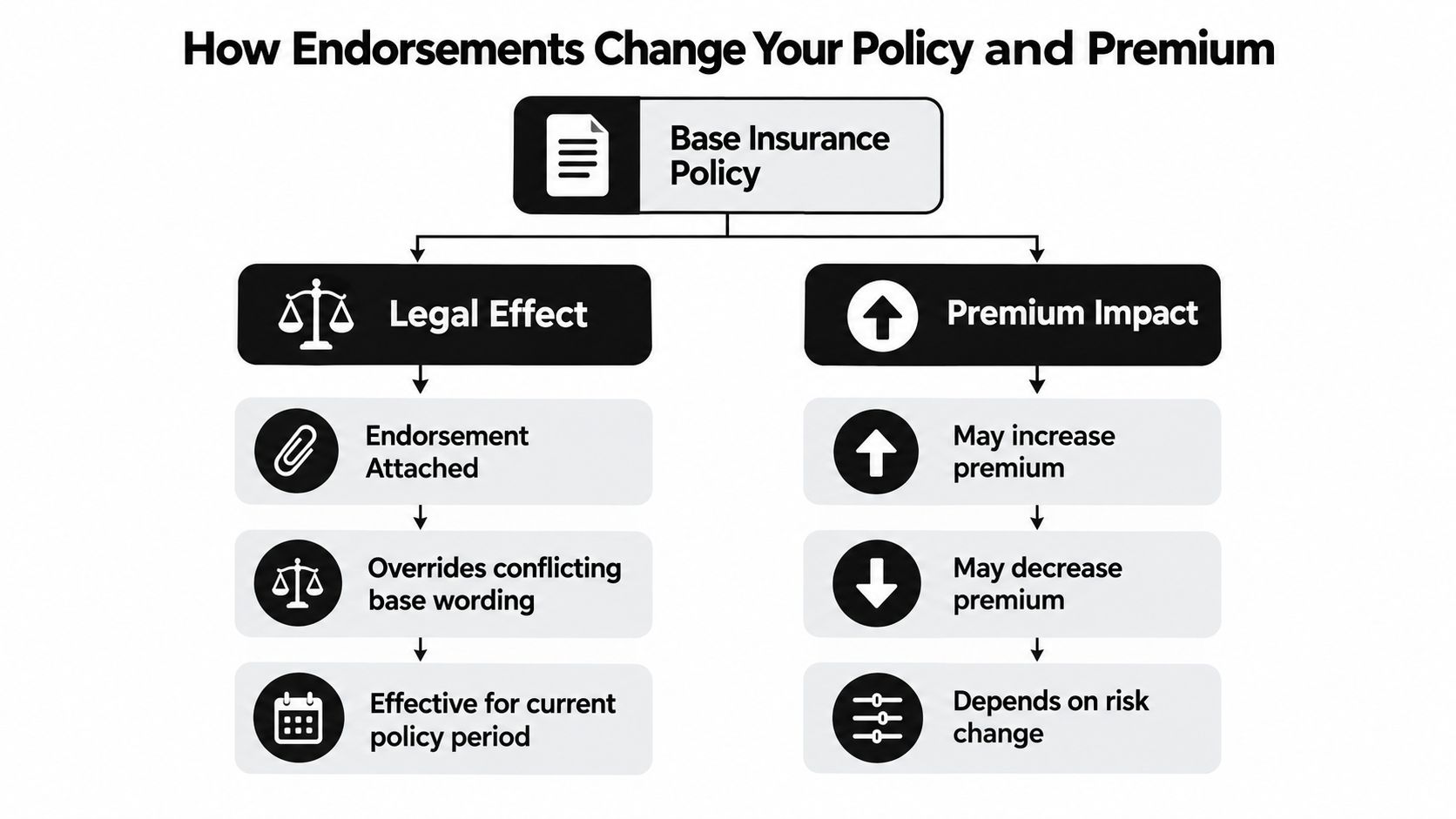
An endorsement isn't merely a note added to your file. It can add, delete, exclude, or otherwise change coverage terms, and conflicting language in the original policy generally gives way to the endorsement. The National Association of Insurance Commissioners describes an endorsement or rider as part of the insurance contract, remaining in force until the contract expires. NAIC consumer guidance explains this legal effect.
The legal effect
Suppose the base policy contains broad wording, while a later endorsement introduces a specific exclusion for a defined circumstance. The specific endorsement language can control that issue for the period stated in the form. The same principle applies when an endorsement adds an insured person, changes a vehicle, increases a limit, or narrows a condition.
That means you should treat every endorsement as a contract rewrite for a defined purpose. It may be favorable, unfavorable, or mixed. A form can broaden one part of coverage while adding a restriction somewhere else.
The effective date is critical. A mid-term endorsement may apply from its stated effective date through the remaining policy period. At renewal, the carrier may issue different wording or continue the change under revised terms. The date you asked for a change isn't automatically the date the new protection began, so verify the date printed on the endorsement.
The premium effect
A coverage change can affect the premium, billing schedule, limits, deductibles, or other policy details. Adding an exposure or broader protection may increase the cost. Removing an insured vehicle or narrowing coverage may reduce it. Some administrative changes may leave the premium unchanged.
California filing guidance requires an insurer introducing a new endorsement form to describe the coverage change and any premium adjustment caused by the form. For a revised form, the insurer must describe the differences from the current form and identify affected sections. California filing guidance provides that framework.
Before accepting the change, compare the old and new wording. Ask:
- What changed: Does the form add protection, remove it, alter a limit, or impose a condition?
- What date applies: When does the change start, and when does it end?
- What will I pay: Is there a premium adjustment, billing adjustment, or deductible change?
- What claim would this address: Which realistic risk prompted the endorsement?
- What could be excluded: Does new restrictive language affect a related loss?
A homeowner researching water-related gaps may also benefit from a separate Florida homeowners insurance water damage guide for general context, but California policyholders should rely on their own policy wording and California-specific advice.
Common Endorsement Examples for Auto Home Renters and Life
Endorsements serve different purposes across insurance types. A driver may use one to address a financed vehicle's value gap, while a homeowner may add protection for earthquake damage, water backup, wildfire-related rebuilding concerns, or a valuable item. A life insurance rider can change how benefits respond to a defined event or financial need.
An endorsement works like an attachment to the base policy. It can add protection, clarify how a risk is covered, raise a limit, or restrict coverage. That last function matters: an endorsement is not automatically an upgrade. Read it for exclusions, conditions, deductibles, and limits before judging its value.
| Policy Type | Example Endorsement | What It Does |
|---|---|---|
| Auto insurance | Gap coverage endorsement | Addresses a potential difference between a vehicle's value and an outstanding finance or lease obligation, subject to the form's terms. |
| Auto insurance | Roadside assistance endorsement | Adds defined roadside services under the stated conditions and limits. |
| Home insurance | Earthquake endorsement | Adds earthquake-related protection when offered and accepted under the endorsement wording. |
| Home insurance | Water backup endorsement | Addresses specified backup from drains, sewers, or sump systems when the form includes that protection. |
| Home insurance | Scheduled personal property endorsement | Lists a specified valuable item and establishes specific coverage for that item. |
| Home insurance | Ordinance or law endorsement | Helps address certain required building-code upgrades after a covered loss, subject to the form. |
| Renters insurance | Scheduled belongings endorsement | Provides more specific protection for a listed item whose value or characteristics need special treatment. |
| Renters insurance | Water backup endorsement | Adds defined protection for covered backup-related damage when the policy form allows it. |
| Life insurance | Term or supplemental benefit rider | Adds a defined benefit or changes the policy's response for the circumstances described in the rider. |
Auto and car insurance decisions
A driver with a newer financed car may ask about gap protection because the vehicle's market value and loan balance can move in different directions. This endorsement addresses a vehicle-value and finance obligation gap. Roadside assistance addresses a service need, such as towing or other stated services. They solve different problems and should not be treated as interchangeable.
A policy change may also be needed after replacing a vehicle or adding a household driver. Check whether the endorsement applies to every vehicle, one listed vehicle, one driver, or a particular event. The form's exclusions and limits matter more than its marketing name.
Home and renters insurance decisions
A California homeowner may focus on earthquake protection, wildfire-related rebuilding costs, water backup, scheduled jewelry, or code-upgrade expenses. A standard policy may not address each concern in the same way. An endorsement can close one gap while leaving another, so check whether wildfire losses, replacement-cost terms, debris removal, or building-code requirements are included or excluded.
Renters insurance generally focuses on personal belongings and liability rather than the building itself. A scheduled belongings endorsement can address an item whose value or characteristics need special treatment, while water backup coverage applies only as described in the form. If you are comparing renters insurance in California, inventory the belongings and activities the policy should address first.
The goal is not to collect add-ons. Connect each endorsement to a real exposure, then confirm the limit and exclusions.
Life insurance riders also require careful reading. A rider may contain eligibility rules, definitions, waiting conditions, or limits that affect how it works. Ask the insurer to explain it using a realistic family scenario, then compare that explanation with the actual rider wording.
How to Add or Remove an Endorsement in California
A claim may depend on a small detail, such as the correct vehicle, effective date, item description, or coverage limit. If you add a car, remodel a room, buy expensive property, face a wildfire concern, or no longer need protection, tell your agent what changed. The question is whether an endorsement closes the right gap without reducing another part of your coverage.
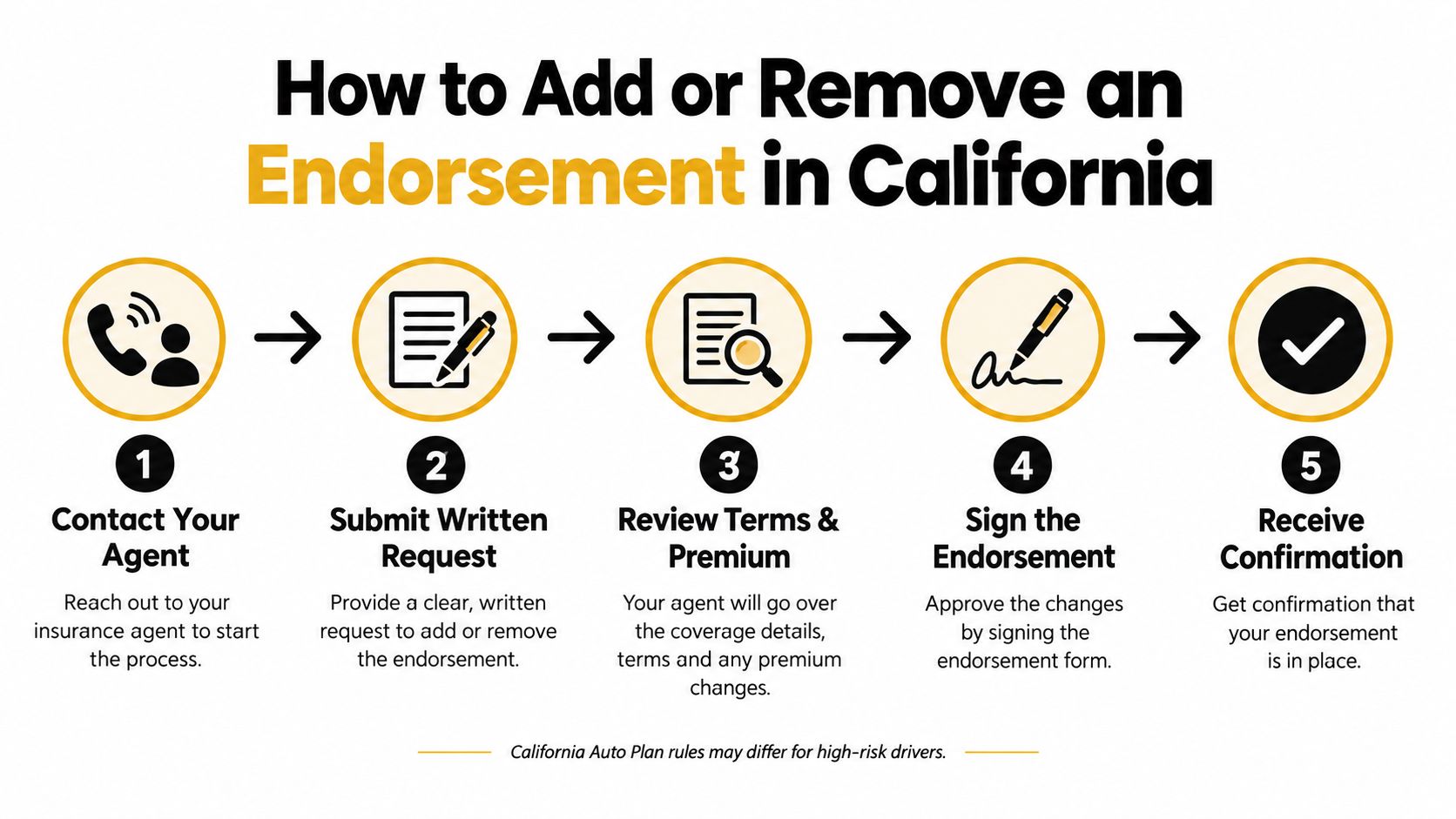
A practical request sequence
Describe the change in writing. Identify the affected policy, property, vehicle, person, or item. Include the date you want the change to begin. Written details create a record of your request.
Ask for the complete form. A quote screen or declarations-page label is not the full contract. Request the endorsement wording, effective date, revised limits, exclusions, deductibles, and premium impact. Read for restrictions involving wildfire losses, replacement-cost treatment, vehicle value, or other risks relevant to your situation.
Compare before and after. Mark each changed provision. If an endorsement is being removed, ask exactly what protection ends and whether another policy or form addresses that exposure. An add-on can improve one area while narrowing another.
Confirm acceptance and payment. Ask whether the carrier approved the request, whether you must sign anything, and how the premium will be billed. Keep the request, quote, signed form, and confirmation together.
Review the issued documents. Check the vehicle, driver, address, item description, limit, deductible, and effective date. A clerical error can cause a dispute when a claim turns on precise policy details.
California auto timing
For California Auto Plan requests involving a replacement vehicle or driver change, the rules call for a written policy change request and a completed Policy Change Request–Certification Form. The insurer must mail the requested endorsement within 25 business days after receiving the completed request, as stated in the California auto plan rules.
Private-market policies may use a different workflow. High-risk drivers and California Auto Plan applicants can face different requirements, so ask which process applies to your policy before assuming the change is active.
Keep an endorsement file
Save the issued form with the declarations page and renewal documents. Review the file after a move, remodel, vehicle change, marriage, new driver, major purchase, or change in property use. That review can show that an old endorsement no longer fits, or that a new exposure, such as rebuilding cost or vehicle value, has not been addressed.
For preparation before speaking with an agent, the California insurance guides provide a useful starting point.
Common Misconceptions About Endorsements That Cost You Coverage
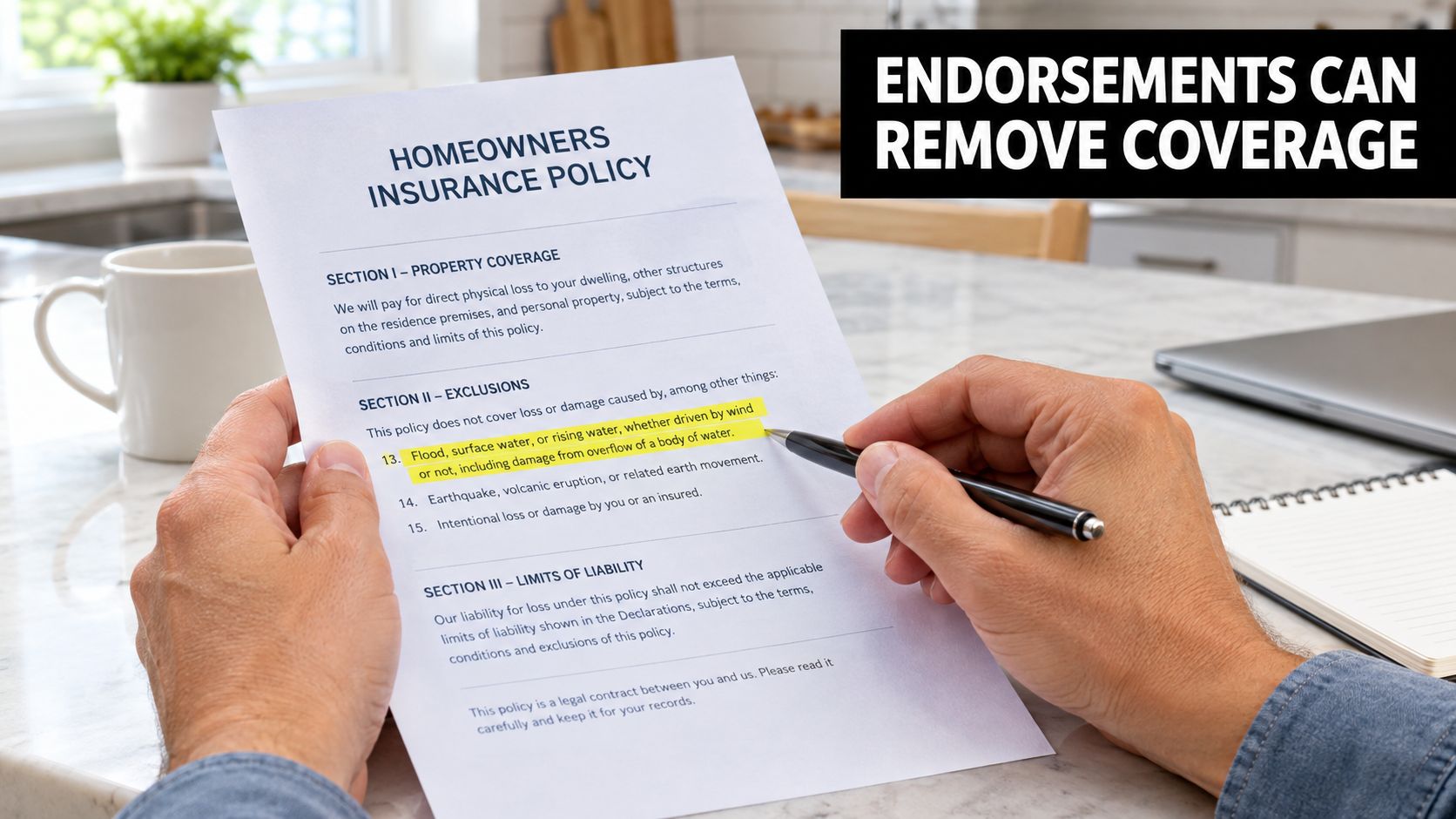
Many consumers hear “endorsement” and assume it means extra protection. That assumption can create a dangerous reading habit. An endorsement may add, delete, restrict, exclude, or clarify coverage, and its wording can override conflicting language in the base policy. This neutral endorsement guide highlights that less obvious function.
Misconception one, every endorsement is an upgrade
A form can add earthquake protection but also introduce a separate deductible or special conditions. Another can clarify coverage while limiting the situations in which the policy responds. A carrier may use an endorsement to remove a property, reduce a limit, or exclude a peril that previously appeared within broader wording.
Read restriction words closely:
- Excluded: The policy won't cover the stated loss or circumstance.
- Limited: Coverage exists, but only up to a stated amount or under defined conditions.
- Modified: The original rule changes for the person, property, vehicle, or event identified.
- Subject to: Coverage depends on conditions you must understand and satisfy.
Misconception two, a standard policy covers every wildfire rebuilding cost
A California homeowner facing wildfire risk should ask how the policy handles rebuilding, code-required work, debris-related expenses, and the home's current features. An endorsement may help address a gap, but it won't automatically solve every replacement-cost concern, and it may contain exclusions or limits that matter during a large loss.
Don't wait until renewal paperwork becomes a stack of unread pages. Ask the agent to identify every endorsement that narrows coverage and explain why it was added. If the change feels unfavorable, request an alternative quote or ask whether another carrier uses different wording.
Misconception three, removing an endorsement is harmless
Removing a form can reduce cost or eliminate outdated coverage, but it can also leave a gap. Before canceling it, identify the risk it addressed and decide whether another policy, limit, or endorsement replaces that protection.
The California insurance FAQ can help with general questions, but personalized advice requires reviewing your policy, declarations page, endorsements, and circumstances together.
Choosing the Right Endorsement and Questions to Ask Your Agent
The right endorsement starts with a specific risk. If you can't explain what loss the form is meant to address, pause before accepting it. Compare the benefit, exclusions, limits, deductible, effective date, and premium rather than choosing based on the endorsement's name.
Use this short decision check:
- Identify the gap: Is the concern wildfire rebuilding, earthquake damage, water backup, a valuable item, a vehicle-value mismatch, or a life insurance need?
- Read the limitation: What isn't covered, and what conditions apply?
- Match the policy: Does the endorsement apply to the whole policy or one person, vehicle, property, item, or peril?
- Test the timing: Would it be active before the risk arises, and does it continue through the relevant policy period?
- Compare alternatives: Could another carrier or policy combination address the same exposure more clearly?
Ask your agent:
- Which endorsements currently apply to my California auto, home, renters, or life policy?
- Which forms add protection, and which forms reduce or exclude it?
- How do earthquake and wildfire options interact with my existing homeowners coverage?
- Should we review my California Fair Plan arrangement and any complementary coverage?
- Does my replacement-cost protection reflect the home's present condition and code-related needs?
- For my vehicle, does the proposed change address its current value, financing, use, and listed drivers?
- Can we compare carriers and policy combinations without assuming the cheapest premium provides the broadest protection?
A clear review should leave you knowing what changed, why it changed, what it costs, and what would happen at claim time. Ask for a no-obligation comparison, and request explanations in the language you understand best.
Mai & Associates can review your California auto, home, renters, and life insurance endorsements, including wildfire, earthquake, California Fair Plan, replacement-cost, and vehicle-value concerns. Visit Mai & Associates to compare coverage with licensed agents, request a no-obligation quote, and get help reviewing the policy language before you accept a change.