What Is a Surety and How Surety Bonds Work in California
A surety is a third party that promises to pay or perform if someone else fails to, and a surety bond is the written contract that enforces that promise. In legal and commercial use, it's a three-party arrangement, the principal does the work, the obligee is protected, and the surety stands behind the obligation if the principal defaults, a structure that has been around for more than 3,700 years in documented history and is tied to the ancient Code of Hammurabi around 1754 BC (ORSurety history of surety).
If you're a California homeowner, contractor, or small business owner, that probably sounds abstract until you run into a real requirement, like a contractor license bond, an auto dealer bond, a court bond, or a notary bond. The idea is simpler than the jargon: one party makes a promise, a second party needs protection, and a third party backs the promise so the deal can move forward.
What Is a Surety in Plain English
A contractor in California can be fully capable, properly licensed, and still be asked to post a bond before starting a project. A small business owner can also run into a surety requirement when a city, court, or licensing agency wants a financial backstop instead of just a verbal promise. That is why surety matters in real life. It is not a theory, it is a practical requirement that can decide whether work gets approved.
Plain-English definition first
A surety is the party that stands behind someone else's obligation. If the principal does not do what they promised, the surety steps in, up to the bond amount, to protect the obligee, and the principal still owes the surety back if a claim gets paid (Cornell Law surety overview). The bond is the written contract that makes that promise enforceable.
For a California contractor, the project owner does not want a vague reassurance. The owner wants a bond that says, in plain terms, if the contractor fails, there is a financial backstop. The same setup can show up in licensing, court obligations, and other regulated duties.
Practical rule: a surety protects the party waiting for performance, not the party making the promise.
If you want a consumer-friendly overview of how the term shows up in family court and bail situations, the guide for California families on bail explains that side of the word in plain language.
A quick visual can help if the wording still feels abstract. This California insurance glossary is useful for separating everyday insurance language from bond language, and the diagram below shows how surety works, what it does, and how it differs from insurance.
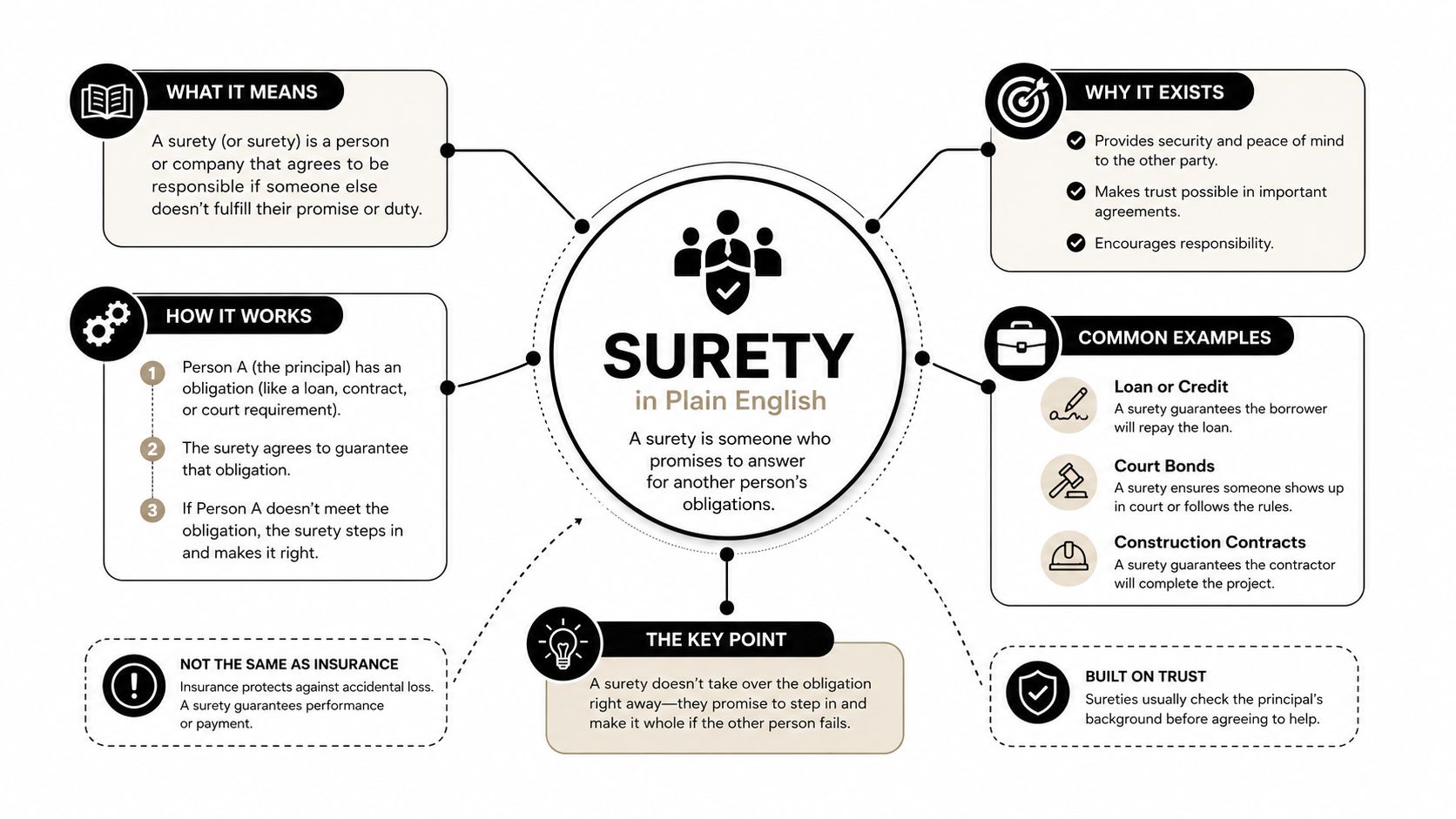
A simple sentence you can use with a spouse or business partner is this, a surety bond is a three-party promise that protects the person who needs the job, license, or legal duty completed.
Why people get confused
People often hear “bond,” “guarantee,” and “insurance” in the same conversation, so the terms blur together. They are not the same thing. A surety bond is built around the principal's duty, and the surety is there because someone else needs the work, payment, or legal compliance to happen.
That matters in California because the same word can show up in very different settings. A contractor may need a license bond, a car dealer may need a dealer bond, a court may require a bond, and a notary may need a bond, even though each requirement serves a different public purpose. A homeowner, contractor, or small business owner usually only needs one clear question answered, which obligation is being backed, and who wants the protection.
The Three Parties Behind Every Surety Bond
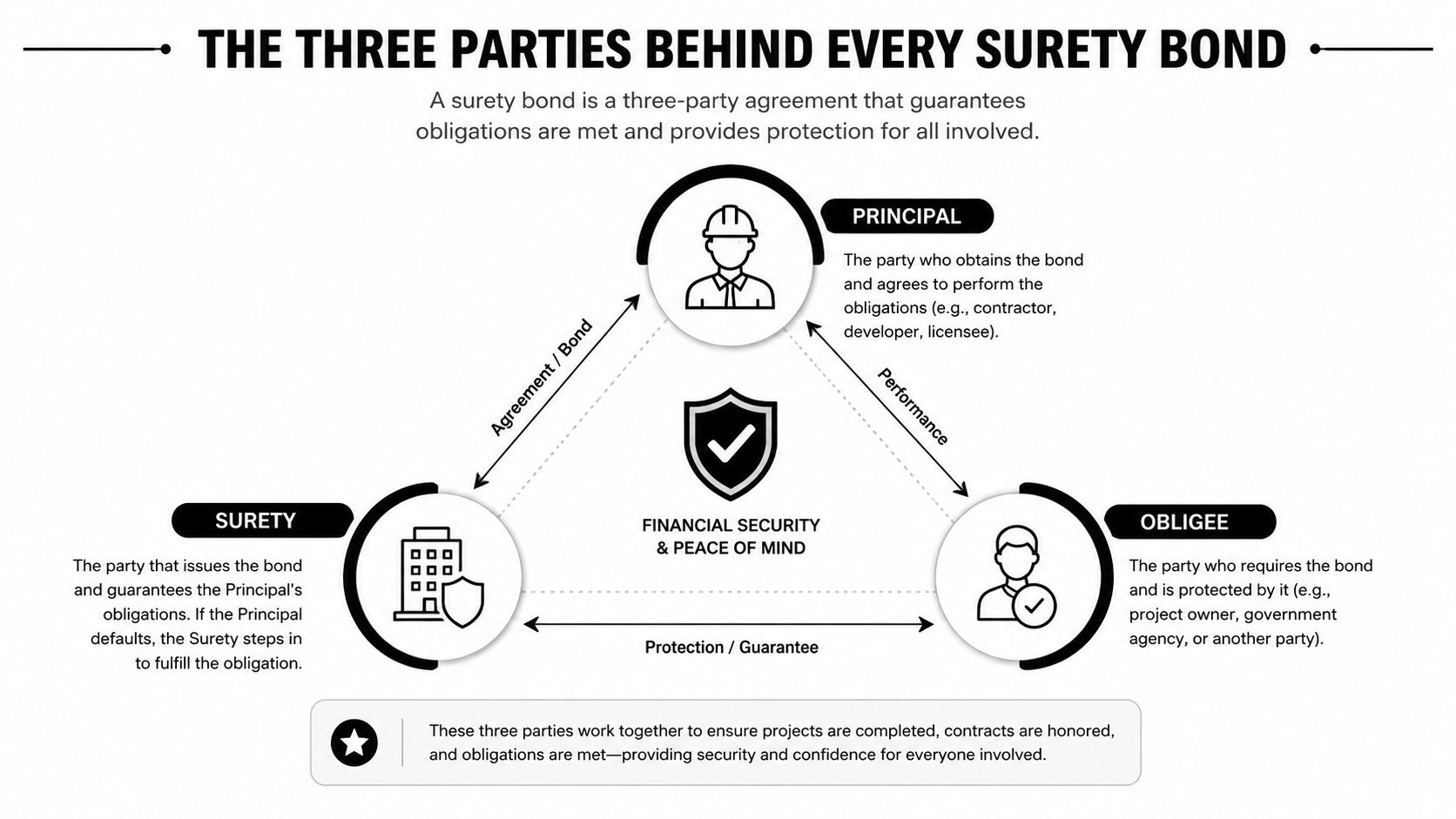
A Los Angeles contractor bidding on a public works project cannot just say, “trust me.” The agency wants to know who stands behind the promise if the work stops, and that is why the three-party structure matters. Each person or business in the bond has a separate role, a separate benefit, and a separate risk.
Principal, obligee, and surety
The principal is the party that must perform. In a California construction example, that is the contractor or business hired to complete the job. The principal benefits because the bond can help them qualify for work they might not otherwise get, but the principal also carries the biggest risk, because if the surety pays a claim, the principal is generally expected to reimburse it.
The obligee is the party protected by the bond. That could be a public agency, a project owner, a licensing board, or another party that wants assurance the obligation will be met. The obligee gains a defined financial backstop, and if the principal walks away, the obligee has a way to make a claim against the bond, but only up to the bond amount.
The surety is the company or legally liable party that issues the bond and reviews claims. Federal definitions distinguish between individual surety, corporate surety, and cosurety, and corporate sureties are licensed entities with authority to issue bonds (Cornell law definitions).
The surety does not absorb the loss in the way a traditional insurer does. It advances money or fulfills the bond's promise, then turns to the principal for reimbursement.
Why underwriting focuses on the principal
That reimbursement right changes the way the bond is reviewed. Because the surety can seek repayment after a claim, it cares a great deal about whether the principal can finish the work or handle the obligation. In a contractor bond, that means financial strength, work capacity, and operational reliability matter a great deal.
A California homeowner, contractor, or small business owner can also run into the same structure outside construction. A court bond, a notary bond, or a dealer bond still centers on the same three roles, even though the reason for the bond changes. For readers who want another plain-English explanation of how the parties fit together, Express Bail Bonds bail assistance lays out the bond relationship in simple terms.
How Surety Differs From Insurance
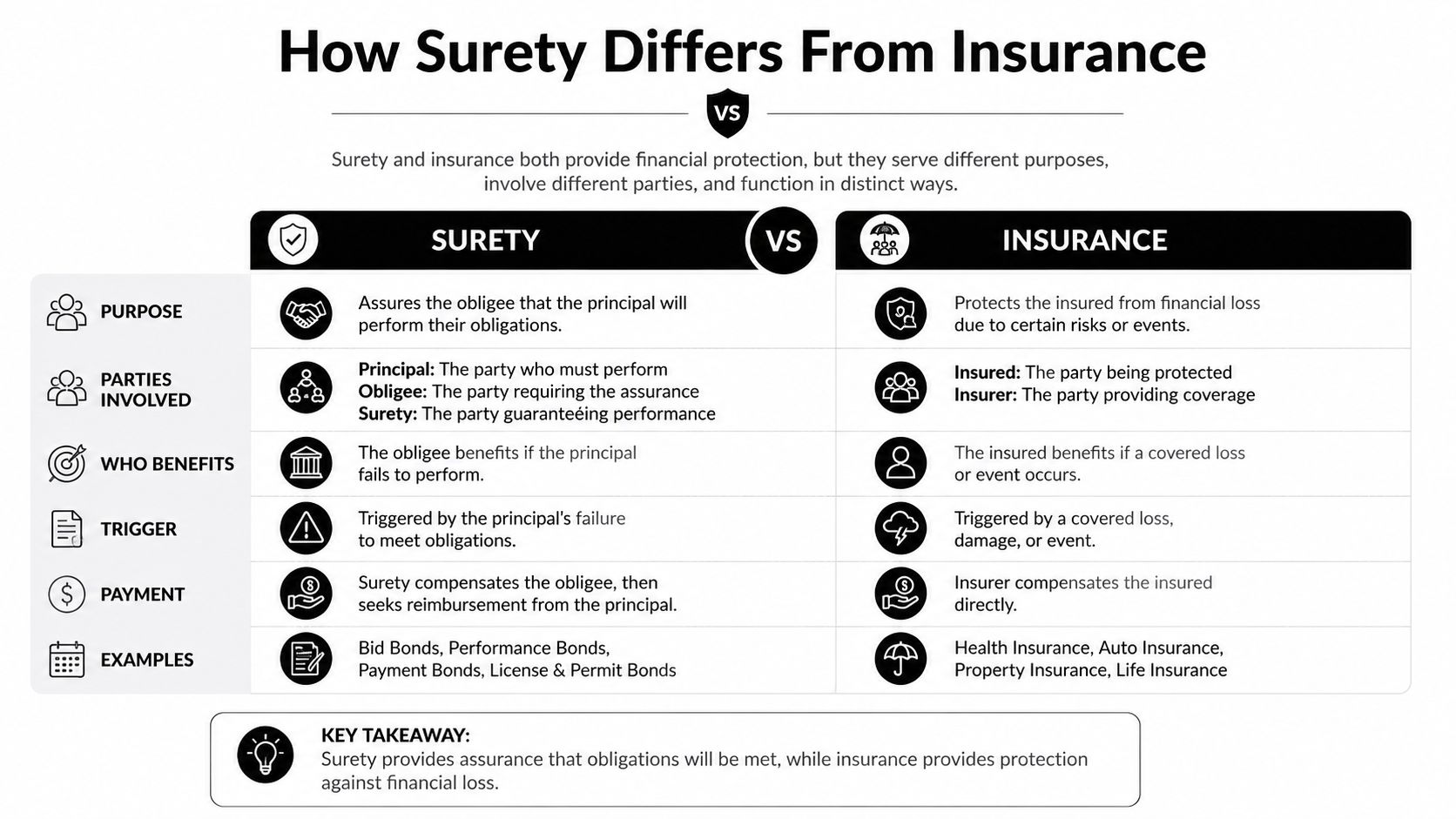
People mix these up because both involve money and both deal with risk. The key difference is who gets protected first, who may have to repay a claim, and whether the obligation ends with the payment or continues afterward.
The core difference
Insurance protects the policyholder against a covered loss. A homeowner files a claim after water damage, and the insurer pays the covered loss under the policy terms. Surety works differently because the bond is meant to protect the obligee, not the principal, and if the surety pays a valid claim, the principal still owes the surety back under the indemnity structure.
That is why surety is often described as a credit-style obligation rather than ordinary insurance. The focus is on whether the principal will perform the promised duty. The surety backs that promise, but it does not treat a valid claim like a loss that disappears after payment. For a plain-English overview that helps place this in context, see the California insurance and bond guides.
Side-by-side mental model
| Question | Surety | Insurance |
|---|---|---|
| Who is protected first | The obligee | The policyholder |
| Who is expected to repay a paid claim | The principal | Usually no repayment for a covered loss |
| What triggers the protection | Default on a promised duty | A covered loss or event |
| What happens after payment | Reimbursement can follow | The claim is typically resolved under the policy |
A California contractor can see the difference in a job-site dispute. If the contractor fails to complete the work, the surety may step in to protect the project owner, then seek reimbursement from the contractor. A California homeowner with home insurance, renters insurance, or car insurance is dealing with a different product, one built to pay for covered losses and stop there.
Main Types of Surety Bonds Explained With Examples
A California small business owner usually doesn't need every kind of bond. You'll run into one of three groups, and each group matches a different kind of obligation. If you can name the obligation, you can usually narrow down the bond type fast.
Contract, commercial, and court bonds
Contract bonds show up in construction and supply jobs. A general contractor on a public project may need to bond performance so the agency knows the work will be completed if the contractor runs into trouble.
Commercial bonds cover licensing, permit, and fiduciary obligations. In California, that can include an auto dealer bond, a contractor license bond, or a notary bond, all of which exist to support compliance with a regulated duty.
Court bonds are tied to legal proceedings. A bail bond, an appeal bond, or a probate bond fits here, because the bond protects the court process or the parties affected by it.
Here's a quick way to sort them out:
| Bond Type | What It Guarantees | California Example |
|---|---|---|
| Contract bond | Performance or payment tied to a project | A contractor completing a public works job |
| Commercial bond | A license, permit, or regulated obligation | An auto dealer, contractor, or notary bond |
| Court bond | A duty required by a court | Bail, appeal, or probate-related bond |
A California filter for the right category
If the bond is attached to a job site, start with contract bonds. If it's attached to a license or permit, start with commercial bonds. If a judge, court clerk, or legal process is involved, you're probably looking at a court bond.
For a broader licensing and coverage comparison, the California insurance guides page can help you separate a bond requirement from everyday coverage decisions. The key point is simple, a bond usually exists because someone else needs proof that a duty will be met.
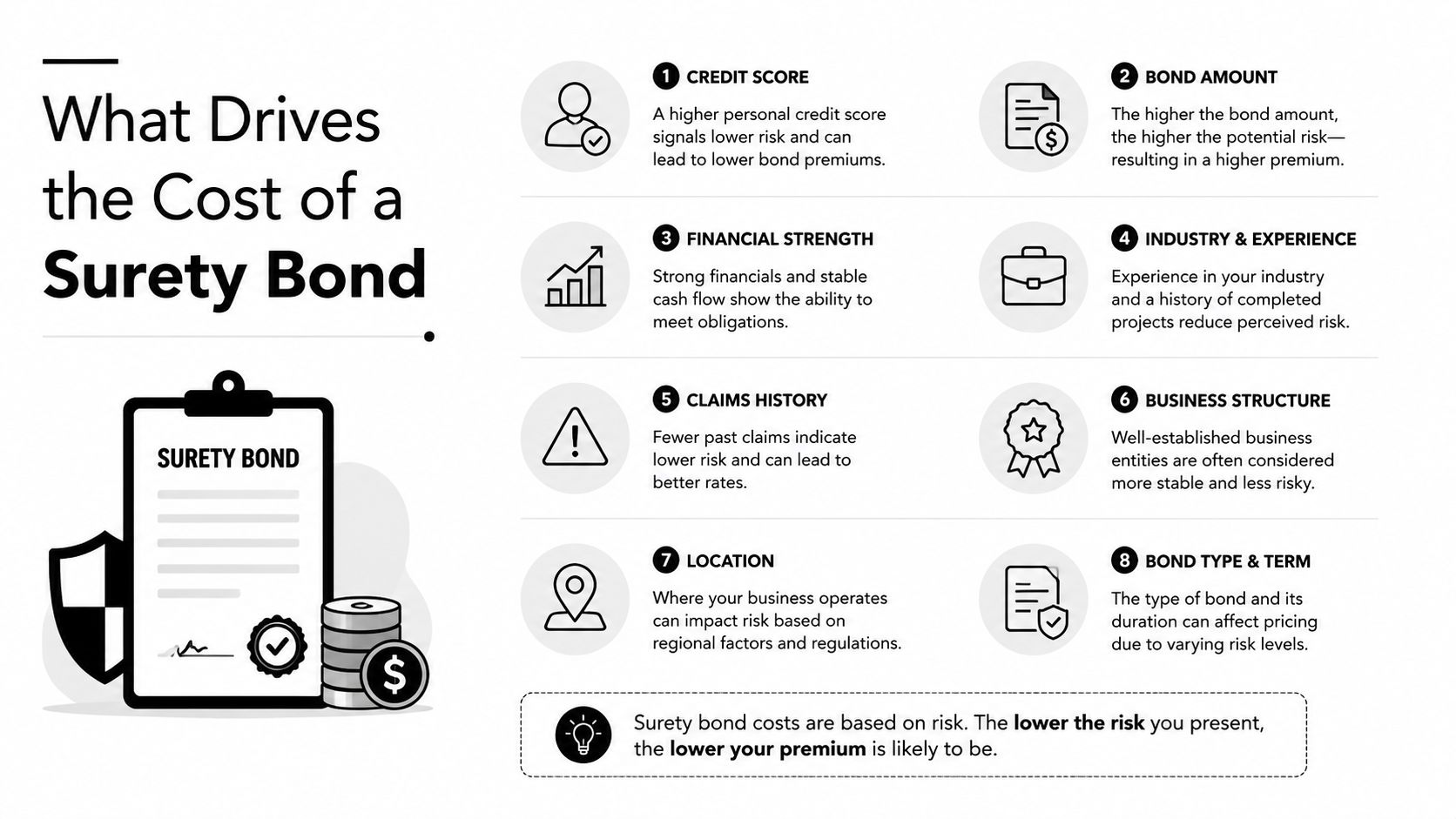
What Drives the Cost of a Surety Bond
A California business owner often asks one blunt question first, “What will this cost me?” That's the right question, because the price of a bond depends on risk, not just paperwork. The surety looks at the size of the obligation, the applicant's credit, the financial picture, and the type of bond before setting a premium.
The main cost drivers
The bond amount matters because it sets the ceiling of the surety's exposure. A larger bond generally means the surety is backing a bigger obligation.
The applicant's credit score matters because it helps the surety judge reliability. Strong credit tends to make the file easier to underwrite, while poor credit can push the applicant into a higher-risk category.
Financial statements matter because they show whether the business has the resources to finish the job or meet the obligation. A contractor with clean books and steady cash flow usually looks different from one with tax liens or recent financial stress.
The bond type matters because not all risks are the same. A contractor license bond, a court bond, and a specialized commercial bond each bring different underwriting questions.
Budget rule: get your documents together before you shop, because incomplete financial information slows underwriting and can make the premium harder to estimate.
Planning for price without guessing
Many well-qualified applicants see premium pricing in the low range of the bond amount, while higher-risk applicants may pay more. That's a planning estimate, not a quote, and the final number depends on the file in front of the surety.
A practical California checklist usually includes these items:
- Credit history: strong personal and business credit help.
- Balance sheet and income details: the surety wants to see stability.
- Past bankruptcies or tax liens: these can make underwriting tougher.
- Bond purpose: the reason for the bond changes how the surety reviews the request.
How a Surety Bond Claim Works
A surety bond claim usually begins with a straightforward problem. Someone says the principal did not do what the bond required. In California, that might mean a contractor left a job unfinished, a license holder failed to follow required rules, or a person involved in a court matter missed an obligation. From there, the process moves through notice, review, and a decision.
The claim sequence
First, the obligee gives notice that the principal has defaulted or failed to meet the bonded duty. The surety opens a file and checks whether the claim fits the bond terms and whether the facts support the request (ProSureGroup claim process overview).
Next, the surety reviews the bond language and the supporting records. In a California construction dispute, that can include invoices, job records, correspondence, schedules, or proof that required notices were sent. In a licensing or court matter, the paperwork looks different, but the question stays the same, does the evidence show that the bond responds to the claim? A homeowner dealing with a contractor bond or a small business owner handling a license issue usually has to gather the same kind of paper trail, just for a different obligation. For readers who want a plain-English filing refresher, the California bond claim blog guide is a useful place to start before a dispute is already underway.
Then the surety chooses a remedy that matches the bond. It may help the principal finish the work, bring in another contractor, or pay a valid claim up to the bond limit. After payment, the surety seeks reimbursement from the principal if the bond language and indemnity agreement allow it. That reimbursement right is part of the basic surety structure described in the Cornell Law surety overview.
Court and bail contexts use the same word differently
A court-bail surety in California is not the same as a contractor bond surety. In bail, the surety relates to court appearance and release conditions. In commercial bonding, the surety relates to performance, licensing, or compliance. The word is the same, but the obligation is different, so the outcome of a claim is different too.
The main point is simple. A surety bond claim is a documented process with deadlines, evidence, and a financial limit.
Where Surety Fits in Your California Insurance Plan
Most California households already manage auto insurance, home insurance, renters insurance, and life insurance. Surety sits beside those policies, not inside them, because it serves a different purpose. It's there when a third party needs a guarantee that a duty, job, or legal obligation will be completed.
How it fits with everyday coverage
Traditional insurance helps you recover from a covered loss. A car collision, a kitchen leak, a stolen rental unit item, or a family financial loss can all belong in the insurance side of the house. A surety bond belongs on the compliance side, where a city, court, landlord, licensing board, or project owner wants proof that a promise will be kept.
That distinction matters for California shoppers because the right product depends on the requirement. If you're buying car insurance, you're protecting yourself or your vehicle under a policy. If you're getting a contractor license bond, you're satisfying a licensing condition tied to your business conduct.
The practical path to getting a bond
Start by identifying the exact bond type requested. Then gather your identification, business details, and financial records so the surety can underwrite the file accurately.
After that, you usually work with a surety carrier or a licensed surety producer who can submit the application and explain the bond form. Some California insurance agencies, including Mai & Associates, can help clients coordinate bond-related requests alongside auto, home, renters, and life insurance needs when the coverage picture has more than one piece.
Use this rule of thumb: if the requirement protects another person, agency, or court from your nonperformance, you're probably looking at a bond, not a policy.
The last step is time. Underwriting and issuance can move quickly when the file is clean, but the process still depends on the type of bond and the strength of the application. That's why it helps to treat surety as part of your broader California protection plan, not as a last-minute surprise.
California Surety Bond FAQs
A California homeowner, contractor, or small business owner usually wants one clear answer first, how fast can the bond be issued. The answer depends on the bond type, the applicant's paperwork, and how quickly the surety can review the file. Clean applications usually move faster because the underwriter can focus on the obligation instead of chasing missing documents.
Credit history can matter, but it does not automatically shut the door. A weaker credit file usually means the review becomes more detailed, and it may affect pricing or lead to extra safeguards, yet the file still gets looked at on its own facts.
For a plain-English distinction, an individual surety is a person who takes on the obligation, while a corporate surety is a licensed entity with legal authority to issue bonds. In California, those dealing with licenses, courts, or contractors encounter corporate surety structures rather than an individual standing behind the bond.
If a bond is cancelled in the middle of a contract, the party that required it may be left without the protection it expected. The principal usually has to fix the problem quickly by replacing the bond or by resolving the underlying requirement with the obligee.
If you want more California-specific help, the California surety bond FAQ page is a practical place to start before you talk to a licensed agent. If the bond is tied to a license, court case, or business requirement, bring the bond form with you so the guidance matches the actual obligation.