What Is a Life Insurance Policy: Your 2026 Guide

A California family can look fully protected on paper. The cars are insured. The home or apartment is covered. The emergency fund is slowly growing. Then one loss hits the part of the plan that pays for everything else.
That is the job of life insurance.
A life insurance policy is a contract between you and an insurance company. You pay premiums, and if you die while the policy is active, the company pays a tax-free death benefit to the person or people you chose. In plain English, it creates money for your family at the moment your income and support would suddenly disappear.
For many families, that can be hard to picture at first. Auto insurance helps repair a car after a crash. Home insurance helps repair or rebuild property after a covered loss. Life insurance works more like an income replacement fund. It helps your family keep paying for the mortgage or rent, groceries, child care, debt payments, and everyday living costs while they adjust.
That matters in California, where one paycheck often supports a lot more than people realize.
Life insurance also fits into a bigger safety net. A good protection plan usually includes car insurance, home or renters insurance, emergency savings, and coverage for the people who depend on your income. If you want a local starting point, our guide to life insurance in California explains how families here often approach that decision.
Many people put this off because it feels abstract. You cannot see it the way you see a repaired bumper or a new roof. But the peace of mind is practical. It means your family would have breathing room to make decisions without having every bill arrive at once.
It also helps to keep your paperwork organized alongside your policy details, beneficiaries, and other household records. Family Folder's document organization guide is a helpful resource for that.
At Mai & Associates, we explain life insurance the same way we explain auto or home coverage. What does it protect, how does it work, and what fits your family without adding confusion.
Your Guide to Financial Security in California
A family in California can look financially steady right up until one income disappears. The cars are covered. The home or apartment is covered. Bills are on autopay. Then a death in the family turns next month's mortgage, child care bill, and grocery budget into immediate problems.
Life insurance helps keep that one loss from becoming a chain reaction for everyone else in the household. For many families, it is the part of the safety net that protects income, not property.
That difference matters here. California housing costs, commuting costs, and day-to-day living expenses can make a single paycheck do a lot of heavy lifting. A policy can give a surviving spouse, partner, or children time to keep the household running while they grieve and make decisions carefully instead of under financial pressure.
It helps to compare life insurance to the coverage many families already understand:
- Auto insurance helps protect transportation: It can help after a covered accident so you can repair or replace a vehicle.
- Home insurance helps protect where you live: It can help repair or rebuild after a covered loss.
- Renters insurance helps protect what you own: It can help replace belongings after certain covered events.
- Life insurance helps protect your family's financial footing: It can help with mortgage or rent payments, debts, education costs, child care, and everyday expenses.
Life insurance works like an income backup plan for the people who rely on you. That is why it belongs in the same conversation as auto, home, renters, and emergency savings.
A lot of people delay this because the benefit feels less visible than a repaired car or a new roof. But the practical value is peace of mind. Your family has breathing room.
If you want a California-specific starting point, review life insurance choices for California families as part of your wider protection plan, not as a separate purchase made in isolation.
It also helps to keep policy details, beneficiary information, and household records in one place. Family Folder's document organization guide is a useful resource for organizing those documents before your family ever needs them.
At Mai & Associates, we look at life insurance the same way we look at the rest of a family's coverage. The goal is simple. Help protect the home, the cars, and the income that supports everything else.
How a Life Insurance Policy Actually Works
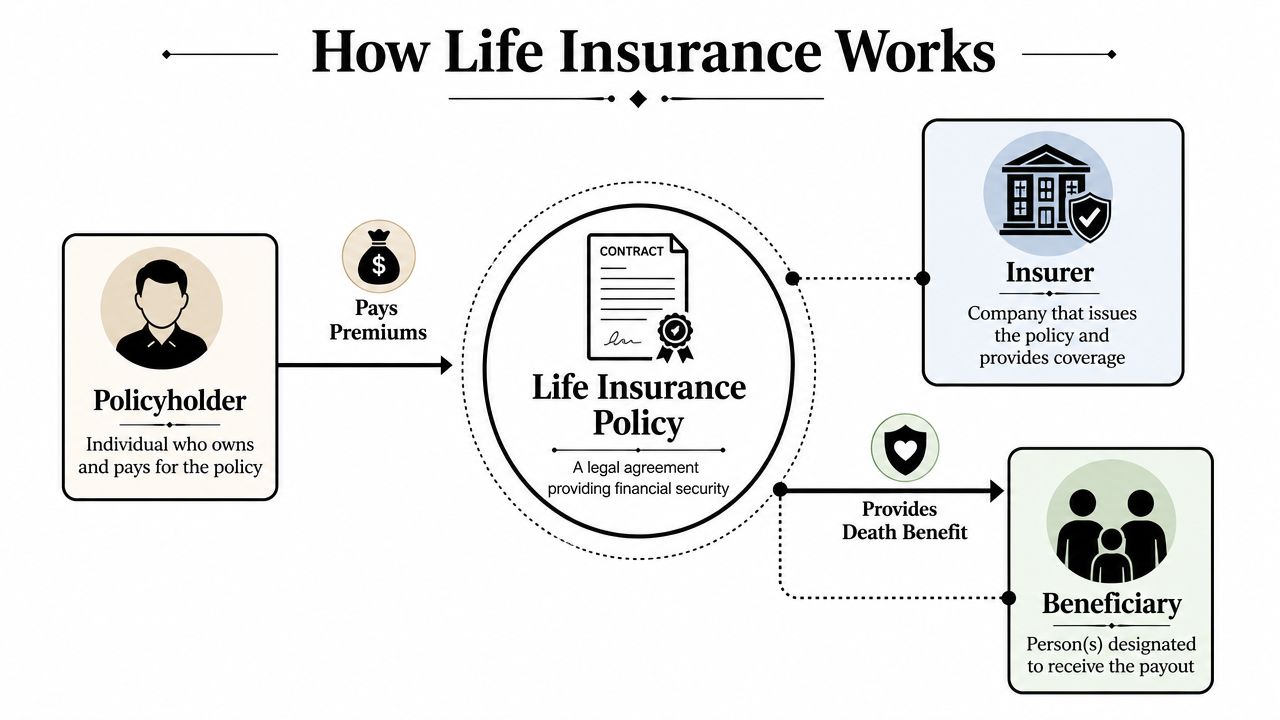
A life insurance policy is a simple, legally binding contract between you and an insurance company. You pay premiums, and the insurer promises to pay a death benefit to your named beneficiaries if the insured person dies while coverage is in force, as explained by Guardian Life's overview of how term life works.
The easiest way to picture it
Think of life insurance like a seatbelt for your family's finances. You hope it never has to do its job. But if something serious happens, you're glad it was there.
The contract usually identifies several key roles:
- Insurer: The company issuing the policy.
- Policyholder: The person who owns the contract and pays for it.
- Insured: The person whose life is covered.
- Beneficiary: The person or people chosen to receive the payout.
Sometimes the policyholder and insured are the same person. Sometimes they're not. For example, one spouse might own a policy insuring the other spouse.
What the contract spells out
A life insurance policy isn't a vague promise. It usually lays out the basic terms clearly, including who is covered, who receives the money, how much coverage exists, how premiums are paid, and how long the coverage lasts.
Guardian notes that term life policies commonly last 10, 20, or 30 years, while permanent life policies are designed to last for life as long as premiums are paid in line with the policy terms.
Practical rule: If you don't know who owns the policy, who the beneficiaries are, or how long the coverage lasts, you don't yet understand the policy well enough.
What happens when a claim is paid
When the insured person dies and the policy is active, the beneficiary files a claim with the insurer. After the insurer reviews the claim and required documents, it pays the death benefit based on the contract.
That's the basic exchange. You make regular payments now so your loved ones have financial support later if the worst happens.
Term vs Whole vs Universal Life Insurance Explained
Individuals don't get stuck on the idea of life insurance itself. They get stuck choosing the type.
The simplest analogy is renting versus buying a home. Term life is like renting. You get protection for a set period. Whole life and universal life are more like owning. They're designed to last longer and include an added value component that term doesn't have.
Term life insurance
Term life is straightforward coverage for a specific number of years. If you die during the term, the policy can pay the death benefit. If the term ends and you haven't died, the coverage ends unless you take action under the policy's rules.
This is often the easiest type to understand because it's focused on pure protection. It fits common real-life goals such as covering the years while children are growing up, protecting a mortgage, or replacing income during peak earning years.
Whole life insurance
Whole life is a type of permanent life insurance. It's designed to last for your lifetime as long as required premiums are paid. It also builds cash value over time.
That cash value is one of the major differences between permanent and term coverage. According to South Carolina Department of Insurance consumer guidance, permanent policies can build cash value that may be borrowed against or surrendered, while term policies have no cash value.
Universal life insurance
Universal life is also permanent coverage, but it's generally more flexible than whole life. The core idea is still lifelong protection, but the structure can be less simple to follow.
That flexibility can appeal to some households, especially those who want policy features that may adjust over time. The tradeoff is complexity. If you choose universal life, you should understand how the policy works in plain language before buying it.
Permanent life insurance can do more than term life, but "more features" doesn't always mean "better fit."
Why policy loans matter
Cash value sounds attractive, and it can be useful. But it also creates a point of confusion for many buyers.
If you borrow against the policy, that outstanding loan can reduce what your beneficiaries receive later. That's why permanent life should never be sold or bought as if the cash value is free money with no consequences. The details matter.
Life insurance types at a glance
| Feature | Term Life | Whole Life | Universal Life |
|---|---|---|---|
| Coverage length | Temporary, for a set term | Permanent, designed for life | Permanent, designed for life |
| Cash value | No | Yes | Yes |
| Main appeal | Simple protection | Lifelong coverage plus cash value | Lifelong coverage with more flexibility |
| Complexity | Lowest | Moderate | Higher |
| Typical use | Income protection during key years | Long-term planning | Flexible permanent planning |
| Cost approach | Usually focused on protection only | Higher because it includes permanent features | Varies by policy design |
A practical way to choose
If your main goal is protecting your family while you pay off a home, raise kids, or cover working years, term life is often the first place to look.
If you want coverage built to last for life and you're comfortable with the added moving parts, whole life or universal life may be worth exploring. The right answer usually depends less on what sounds impressive and more on what problem you're trying to solve.
Understanding Premiums Death Benefits and Cash Value
For many California families, this is the part that turns life insurance from a vague idea into something concrete. You pay a certain amount, your family is promised a certain amount, and some policies may build a pool of value along the way.
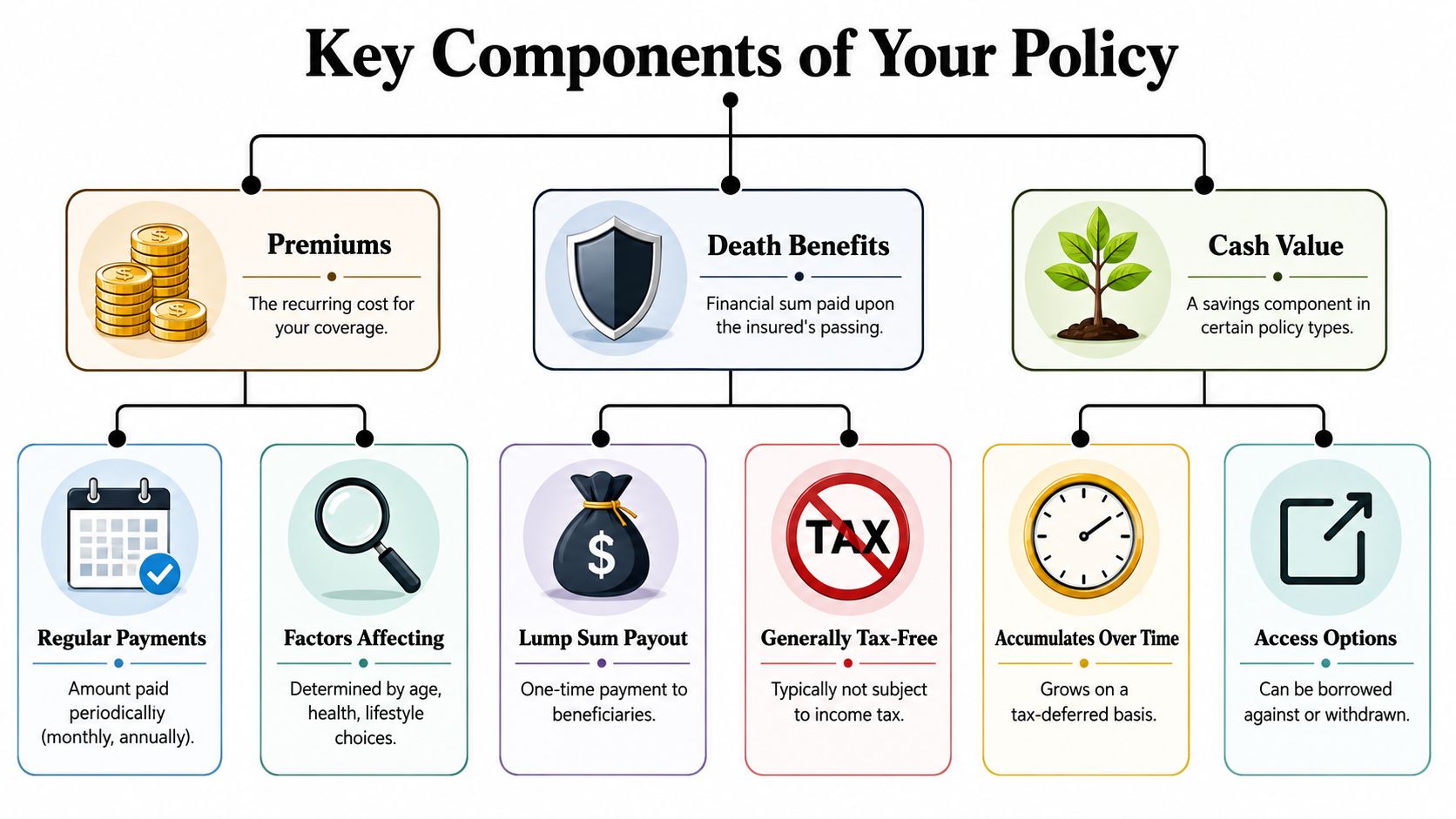
A simple way to read it is this: premium is what you pay, death benefit is what your beneficiary may receive, and cash value is a feature some permanent policies build over time. Once those three pieces make sense, policy quotes get a lot less confusing.
Premiums
Your premium is the payment that keeps the policy in force. It works a lot like paying for auto or homeowners insurance. You are paying to keep protection in place so your household has a financial backstop if something serious happens.
The price usually depends on factors such as your age, health, lifestyle, the type of policy you choose, and how much coverage you want. In plain English, a younger healthy parent applying for a term policy will often pay less than an older applicant seeking the same death benefit.
This is one reason life insurance fits into a broader California protection plan. Families often insure the car, the house, and income risks at the same time because each policy covers a different part of the same safety net. If you want to compare options across that bigger picture, you can start with a California insurance quote for life, auto, or home coverage.
Death benefit
The death benefit is the amount the insurance company pays to your named beneficiary if the insured person dies and the claim meets the policy terms.
This is the heart of the policy.
That money can help a surviving spouse stay current on the mortgage, cover daily bills, pay off debts, handle funeral costs, or buy time to make careful decisions. For a California family dealing with high housing costs, that breathing room can matter just as much as the dollar amount itself.
Cash value
Cash value shows up in permanent policies such as whole life and many universal life policies. Term life does not build cash value.
A good comparison is renting versus buying a home. Term life is closer to renting. You are paying for protection for a set period. Permanent life is closer to owning something that may build value over time, but it also costs more and comes with more moving parts.
Cash value may grow inside the policy and may be available through withdrawals, policy loans, or surrendering the policy, depending on the contract. That sounds appealing, but families should understand the tradeoffs before treating it like a savings account.
- Loans can reduce the payout. If you borrow against the policy and do not repay it, the death benefit paid to your beneficiaries may be lower.
- Surrendering can end the coverage. Taking the cash out may cancel the policy that was protecting your family.
- Permanent policies need attention. The details matter, especially with flexible designs that can change over time.
Riders and add-ons
Riders are optional features you can add to some policies. They work like add-ons on an auto policy. The base coverage handles the main job, and the rider changes how the policy fits your household.
Some riders add flexibility. Others add access to part of the benefit under specific conditions. The best choice depends on the problem you are trying to solve, not on how impressive the rider sounds on paper.
For many families, the clearest path is to keep the policy easy to understand. If a feature protects your household in a real, practical way, it may be worth considering. If it only makes the policy more expensive or harder to manage, it may not belong in the plan.
Calculating the Right Coverage Amount for Your Family
A common California family question sounds like this: if one paycheck disappeared next month, how long could the household keep running without changing everything at once?
That is the job of life insurance. It creates a financial cushion so your family has time to make careful decisions about the house, the bills, school plans, and daily life.

A helpful way to estimate coverage is to sort your needs into a few practical buckets instead of chasing one perfect number. Many families use a DIME-style approach: debt, income, mortgage, and education. It works because it starts with the actual bills and goals your family would still face.
A simple DIME-style checklist
Start with the costs that would not disappear if you were no longer here.
Debt
Include credit cards, personal loans, car loans, and other balances you would not want left behind. This part is about removing pressure from your family.Income replacement
For many households, this is the largest piece. The goal is not only to cover a few months of bills. It is to replace enough income that your spouse, partner, or children have breathing room while they adjust.Mortgage
In California, this category can change the whole picture. Many parents want enough coverage to help the family stay in the home, or at least avoid being forced into a quick sale because one income is gone.Education
If college, trade school, or other future education support matters to you, include it. Life insurance can help protect that plan too.
You may also want to subtract savings, existing life coverage through work, or other assets your family could use. That keeps the estimate grounded in your actual situation.
A rule of thumb you may hear
Some people use a rough income multiple, sometimes called the human life value approach. The basic idea is simple. Your life insurance amount should reflect the income, support, and financial stability your family would lose if you were gone.
That shortcut can be useful for a quick starting point, but it should not be the final answer. A household with young kids in Orange County usually needs a different plan than a retired couple in Sacramento or a renter in Los Angeles. The same income can lead to very different coverage needs depending on housing costs, debts, and how much of the family budget depends on one person.
Keep it simple: The right amount is the amount that lets your family keep functioning without panic.
Why California families should be careful not to underinsure
A policy amount can look large until you place it next to real California expenses. Mortgage payments, rent, child care, transportation, and everyday living costs can shrink that cushion faster than people expect.
That is why life insurance should be viewed as part of a bigger safety net, alongside your auto, home, or renters coverage. Each policy handles a different risk, but together they help protect the same household. If you want to compare amounts based on your income, debts, and home situation, you can get a California life insurance quote based on your family's needs. Mai & Associates helps local families match life insurance to the rest of their protection plan, so the numbers make sense in real life, not just on paper.
Securing Your Policy with Mai & Associates
Buying life insurance is usually easier than people expect. The process tends to feel manageable once you break it into a few clear steps.
For California households, it also helps to view life insurance as part of the same broader protection conversation as car insurance, auto insurance, home insurance, and renters insurance. That way, you're not shopping in silos.

The basic purchase path
Most buyers move through a process like this:
- Assess your need: Estimate the coverage amount based on income, debts, housing, and family goals.
- Compare policy types: Decide whether you want temporary protection, permanent coverage, or a closer look at both.
- Review quotes carefully: Don't focus only on the price. Check policy length, features, and beneficiary setup.
- Complete the application: You'll answer health and lifestyle questions, and the insurer may request additional information.
- Accept and organize the policy: Once approved, store the policy details where your family can find them.
Why local guidance matters in California
California insurance decisions often overlap. Someone shopping for life insurance may also be dealing with a home renewal, rising car insurance costs, a new rental, or questions about property coverage in a higher-risk area.
A local independent agency can help you compare options across carriers instead of forcing one company fit onto every customer. That matters because life insurance isn't the only thing most families are trying to get right at once.
Mai & Associates serves Californians across the state and helps clients review coverage across multiple categories, including life, auto, home, and renters insurance. The agency also offers multilingual support and can help households review broader property issues, including California Fair Plan concerns and wildfire-related protection questions.
What to have ready before you apply
Bring a short list of basics to speed things up:
- Personal details: Your age, occupation, and basic health history.
- Coverage goals: The amount you want to protect and who the beneficiaries should be.
- Existing policies: Current auto insurance, home insurance, renters insurance, or life insurance information can help you review the full picture.
- Budget range: It helps to know what monthly cost feels realistic for your household.
If you'd like to talk through options with a licensed California team, you can contact Mai & Associates to start the conversation.
Your Top Life Insurance Questions Answered
A lot of people wait on life insurance because of a few common assumptions. Most of them sound reasonable at first. Many of them fall apart once you look closer.
Isn't life insurance too expensive
Not always. It depends on the type of policy, your age, your health, and how much coverage you buy.
Term life is often the policy people start with because it's centered on protection for a set period, not permanent features. If your goal is to cover income and major obligations during your highest-responsibility years, a simpler policy may be enough.
I'm young and healthy, so can't this wait
You can wait. Many people do.
But younger and healthier applicants often have more favorable pricing, so waiting can mean fewer options or higher costs later. If you already know people rely on your income, waiting is a choice worth examining carefully.
Buying life insurance while you're healthy is often less about urgency and more about preserving flexibility.
Doesn't my work policy cover me
Employer-provided life insurance can be valuable, but it may not be enough on its own. Coverage through work is also tied to your job, which means it may change if your employment changes.
That doesn't make it bad coverage. It just means you shouldn't assume it's a complete plan without checking the amount, portability, and beneficiary details.
Can I still get life insurance with a health issue
In many cases, yes. A medical history doesn't automatically mean you're out of options.
Different insurers evaluate health conditions differently, and the best fit often depends on the details. That's one reason it helps to work with someone who can compare carriers instead of looking at only one set of underwriting rules.
Do stay-at-home parents need life insurance
Often, yes. A stay-at-home parent may not bring in a paycheck, but they usually provide real economic value through child care, transportation, scheduling, household management, and day-to-day support.
If that person were gone, the surviving family might need to pay for many of those services. Life insurance can help cover that transition.
What if I'm single
Life insurance may still make sense if someone would be responsible for your debts, final expenses, or other obligations. It can also matter if you want to leave support to parents, siblings, a partner, or another loved one.
For more practical answers on coverage questions across life, home, auto, and renters insurance, Mai & Associates also maintains a useful California insurance FAQ page.
If you're ready to protect your family with the same care you use to protect your car, home, or rental, Mai & Associates can help you compare California life insurance options with clear guidance and no-pressure support. Whether you need term life, want help reviewing permanent coverage, or want to coordinate life insurance with your auto insurance, home insurance, or renters insurance, their licensed team can help you find coverage that fits your budget and your goals.