What Does Renters Insurance Cover in California? A Complete Guide
Let's get right to it. What exactly is renters insurance? Think of it as your personal financial safety net, designed specifically for your life as a renter in California. It’s there to protect your stuff from being stolen or damaged and to shield you from lawsuits if someone gets hurt in your home. This type of California insurance is a crucial part of a smart financial plan, just like auto insurance or home insurance.
Your Guide to Renters Insurance Coverage
Imagine the worst happens: a kitchen fire destroys your belongings, or someone breaks in and steals your laptop and TV. Without insurance, you're on the hook for replacing everything yourself. That’s a massive financial hit. Renters insurance is what steps in to cover those costs, giving you incredible peace of mind for a surprisingly small monthly premium.
A lot of renters think their landlord's insurance policy has them covered, but that's a common and costly mistake. The landlord's policy only protects the building itself—the walls, the roof, the plumbing. Your personal belongings are entirely your responsibility. Renters insurance fills that crucial gap.
A standard policy is really built on three core pillars of protection, as this diagram shows.
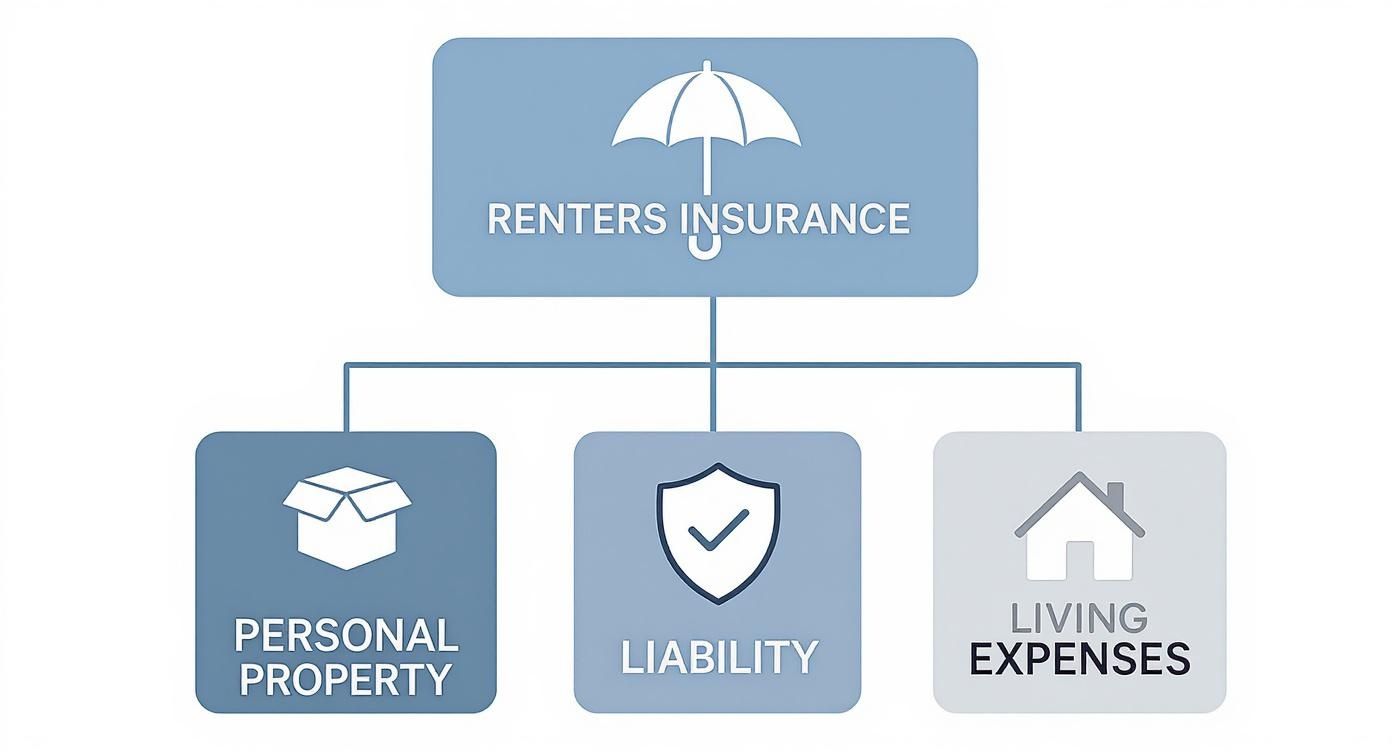
As you can see, it's all about protecting your property, your personal liability, and your ability to live somewhere else if your rental becomes uninhabitable after a disaster.
The Core Components of Coverage
When you boil it down, renters insurance has two main jobs: protecting your property and protecting you from lawsuits. In fact, liability coverage is so important that it accounts for about 40.4% of the entire global renters insurance market. The other major piece is, of course, personal property coverage, which covers your belongings against things like fire, theft, and certain types of water damage. You can read the full research about the renters insurance market to see the data for yourself.
One of the biggest myths about renters insurance is that it's expensive. The truth is, an average policy in California often costs less than a few fancy coffees a month, yet it provides tens of thousands of dollars in protection. It’s one of the best bargains in the California insurance world.
To make things even clearer, let's break down the main coverage types you’ll see in just about every standard policy. If any of these terms are new to you, feel free to pop over to our handy insurance glossary for more detailed definitions.
Renters Insurance Coverage at a Glance
This table gives you a quick snapshot of what a typical policy includes, what each part does, and how it works in the real world.
| Coverage Type | What It Protects | Example Scenario |
|---|---|---|
| Personal Property | Your belongings—like furniture, electronics, and clothes—from covered perils. | A pipe bursts in your apartment, flooding your living room and ruining your new couch and laptop. |
| Personal Liability | Your assets if you're sued for accidentally injuring someone or damaging their property. | A guest slips and falls on a wet spot in your kitchen, and you're found liable for their medical bills. |
| Additional Living Expenses | The costs of temporary housing if a covered event forces you out of your rental. | A fire in your building makes your apartment unlivable. This covers your hotel and meal expenses while it's being repaired. |
These three components work together to provide a comprehensive safety net, ensuring a single bad day doesn't turn into a long-term financial catastrophe.
Protecting Your Personal Property
Your California rental isn't just an address; it's where you keep everything that makes your life yours. That's where personal property coverage comes in—it's the absolute core of any renters insurance policy and it's designed to protect the stuff you own.
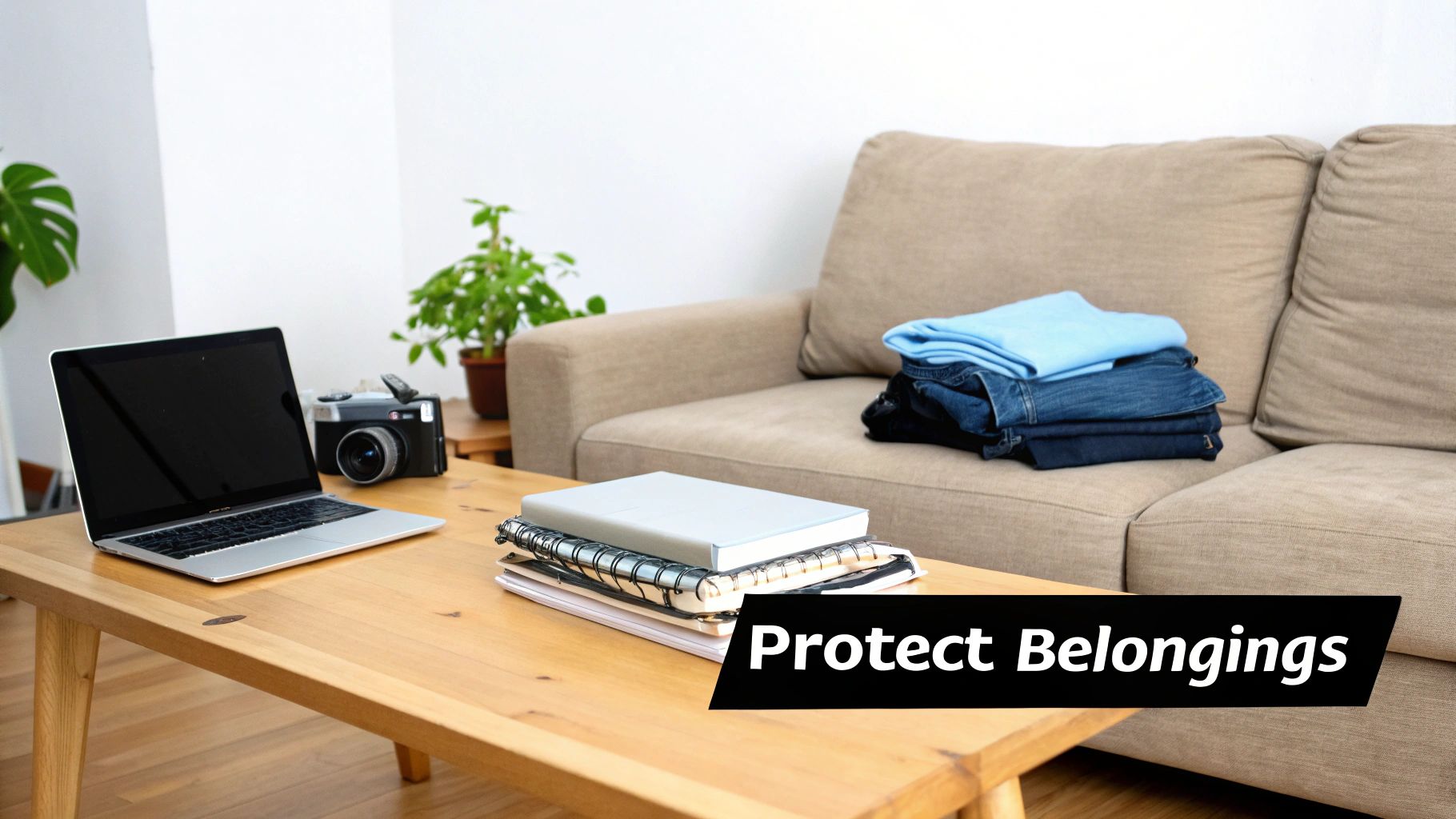
This coverage is your financial safety net if your belongings—think your laptop, furniture, clothes, even your dishes—are stolen or damaged. Without it, recovering from a disaster like a fire or a break-in means paying to replace every single item out of your own pocket. This part of your policy is what makes sure you don't have to start over from zero.
What Events Are Covered
Now, this protection doesn't cover every possible type of damage. Your policy will have a specific list of what it protects against, which we in the insurance world call "perils." These are the specific incidents that trigger your coverage.
While policies can vary a bit, most standard California renters insurance plans will cover loss or damage from common situations like:
- Fire and lightning
- Theft and vandalism
- Smoke damage
- Windstorms and hail
- Water damage from inside your apartment (like a burst pipe or a malfunctioning washing machine)
It’s really important to get this distinction. Your policy is there to protect you from these specific events. So, if your TV just gives out from old age, that’s not a covered peril. But if that same TV is ruined in a fire, your renters insurance is there to help you replace it.
Replacement Cost vs. Actual Cash Value
When it's time to file a claim, how the insurance company actually pays you is a massive detail. When you first buy your policy, you'll have to choose between two valuation methods: Replacement Cost Value (RCV) and Actual Cash Value (ACV). Honestly, the difference between them can be thousands of dollars.
Let’s use a real-world example. Say your three-year-old laptop, which you originally bought for $1,200, gets stolen.
- With Actual Cash Value (ACV), the insurance company pays you what that laptop was worth the moment before it was stolen. After factoring in three years of depreciation (wear and tear), you might only get a check for $400.
- With Replacement Cost Value (RCV), the policy pays you what it would cost to go out and buy a brand new, comparable laptop today—which could be the full $1,200.
For most people, Replacement Cost coverage is hands-down the better option. It might cost a few extra dollars on your premium, but it gives you the money you actually need to go out and buy new things, preventing a huge financial hit after you've already been through a stressful event.
Opting for RCV means you can genuinely get your life back to how it was before the incident. It closes that painful gap between what your old stuff was worth and what it really costs to replace it today. This is one of the most important decisions you'll make when setting up your policy.
Understanding Your Liability Shield
We spend a lot of time thinking about protecting our stuff, but the personal liability coverage in your renters insurance policy might be the most powerful financial tool you have. It's the part of your policy that has your back if you're found legally responsible for an accident that injures someone or wrecks their property. Honestly, this is the main reason most California landlords insist you have a policy.
Without it, one simple mistake could spiral into a lawsuit that drains your savings. Your renters policy acts as your financial and legal bodyguard when things go sideways.
How Liability Coverage Protects You
Let's be clear: liability protection is for accidents, not for things you do on purpose. It works inside your rental unit and often follows you outside of it, too. Think of it as a broad safety net for those "oops" moments.
So, what does it actually do for you? It typically breaks down into three critical jobs:
- Legal Defense Costs: If someone sues you, your policy helps pay for the lawyer and court fees, whether you're ultimately found at fault or not.
- Bodily Injury Damages: It covers the medical expenses for someone who gets hurt in your apartment because of your negligence, right up to your policy limit.
- Property Damage: If you accidentally break someone else’s property—say, you leave the sink running and it floods the apartment below—this coverage helps pay to fix the mess.
This protection is a fundamental part of a smart financial plan. It shields your savings and future income from a lawsuit that could otherwise set you back for years.
Real-World Liability Scenarios
Talking about coverage in the abstract is one thing, but let's see how it plays out in situations any California renter could face.
Example 1: The Slip and Fall
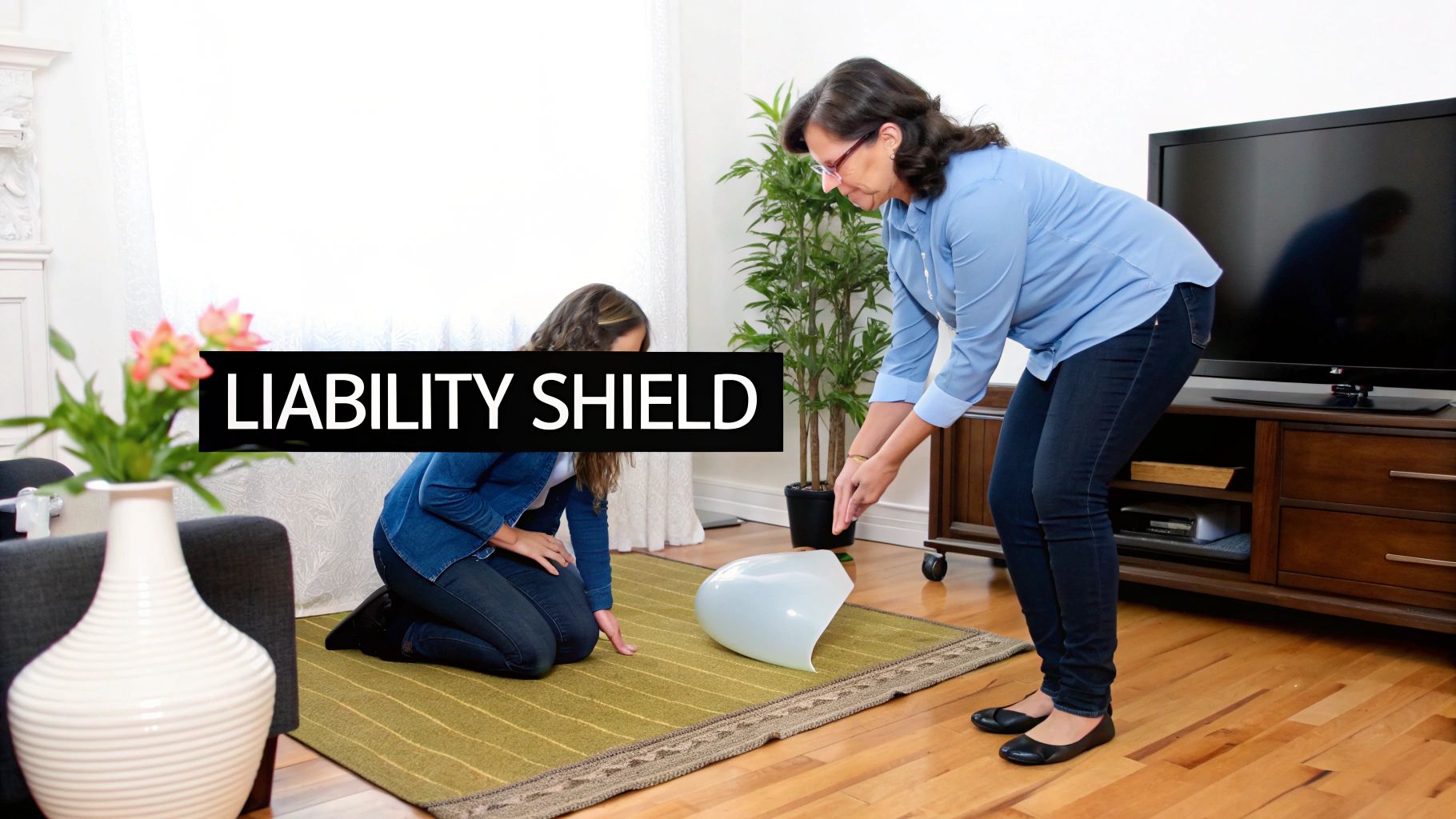
You have a friend over for dinner. They slip on a puddle you didn't notice, fall, and break their wrist. Now they have medical bills and can't work for two weeks. Your liability coverage can step in to help with their medical costs and even their lost wages, saving you from a massive out-of-pocket expense.
Example 2: The Overflowing Bathtub
You get distracted by a phone call and forget you're running a bath. Water pours over the side, seeps through the floor, and ruins the ceiling and expensive TV in your neighbor's unit downstairs. Your liability coverage is designed to pay for those repairs.
Most standard renters policies come with $100,000 in liability coverage, but I almost always recommend clients increase that to $300,000 or even $500,000. The few extra dollars it costs per month are tiny compared to the massive leap in protection you get.
These examples really highlight why this coverage is so essential. It’s not just for some once-in-a-lifetime disaster; it’s a financial buffer for everyday accidents that can happen to any of us. This is a huge piece of the puzzle when you're asking, what does renters insurance cover?
Covering Additional Living Expenses
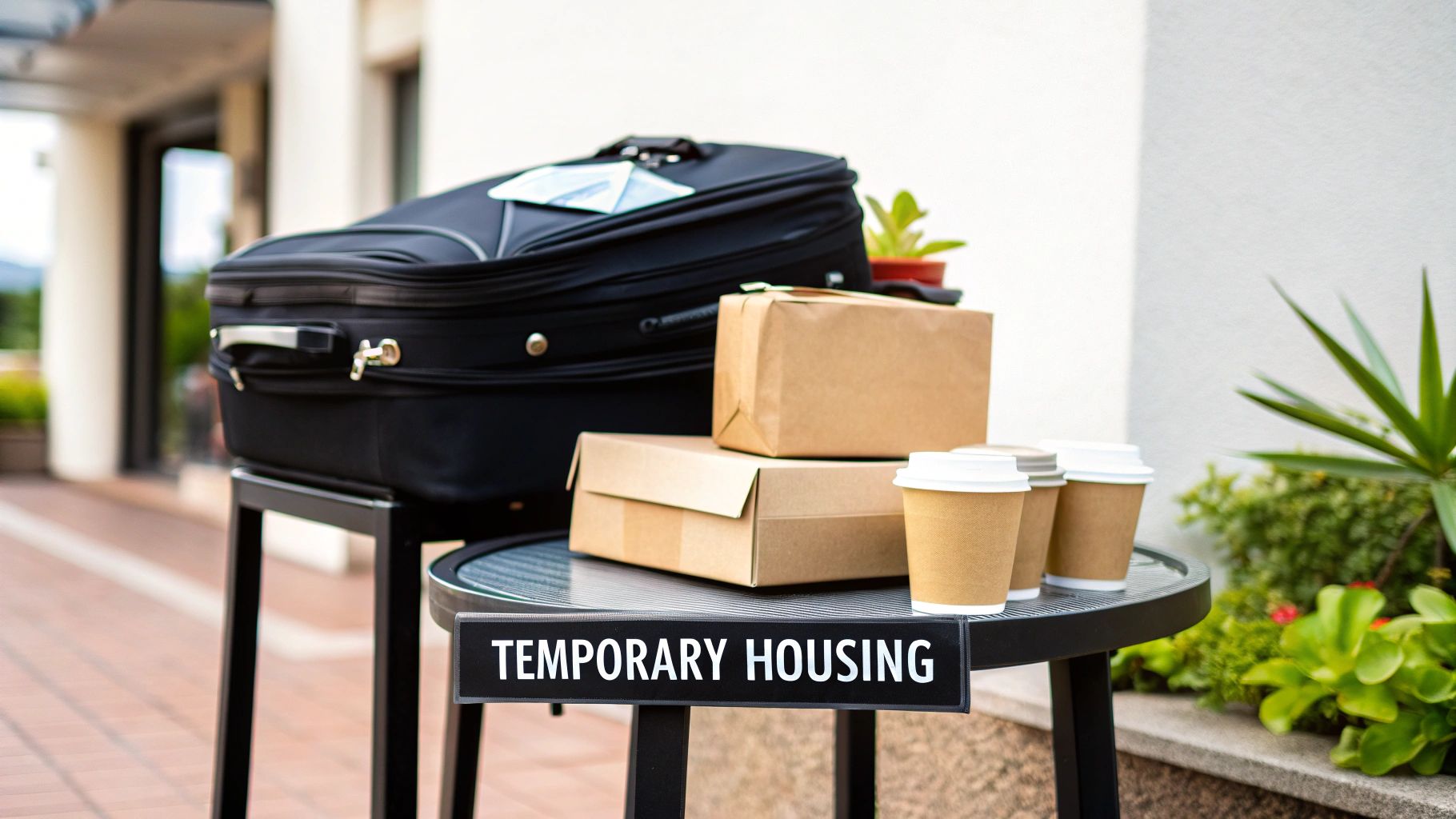
We've talked about coverage for your stuff and for liability, but there's a third piece of the puzzle that's an absolute lifesaver when things go wrong. It’s called Additional Living Expenses (ALE) coverage, though you might also hear it called "Loss of Use." Think of it as your safety net if a covered disaster—like a bad fire or a major plumbing flood—forces you out of your rental.
Let’s say a kitchen fire makes your California apartment uninhabitable for a month during repairs. Where do you go? How do you cover that cost? Without ALE, you'd be footing the bill for a hotel or a short-term rental out of your own pocket. This is exactly where your renters insurance steps in to keep you financially stable.
How ALE Works in a Real-World Scenario
Here’s the key thing to understand about ALE: it doesn’t just pay for any old expense. It’s designed to cover the increase over what you’d normally spend. It reimburses you for the extra costs you rack up simply because you can't live at home.
So, if that fire forces you to move out temporarily, your ALE coverage would typically kick in to help with:
- A Place to Stay: The cost of a hotel room or a short-term furnished apartment similar to your own.
- Extra Food Costs: If your temporary spot doesn't have a kitchen, your policy can cover the difference between your usual grocery budget and the higher cost of eating out.
- Miscellaneous Essentials: This could be anything from boarding your pets to paying for laundry services or even extra gas money if your temporary home is further from work.
The whole point of ALE is to help you maintain your normal standard of living. It stops a disaster from spiraling into a financial crisis, so you aren't forced to burn through your savings just to have a roof over your head while your place is being fixed.
This coverage is one of the most overlooked—and most valuable—parts of a good California renters insurance policy. It gives you the peace of mind and the resources to handle the chaos after a major event, letting you focus on getting life back to normal without the constant stress of mounting bills.
What Standard Policies Do Not Cover
Knowing what your renters insurance covers is a great start, but understanding what it doesn't cover is just as important. Think of it this way: your policy is a strong safety net, but it has specific holes you need to be aware of. Assuming you're protected from every possible scenario is a common and often costly mistake.
For California renters, one of the biggest gaps is natural disasters. Your standard policy will not cover damage from earthquakes or floods. These are considered separate, high-risk events that require their own specialized insurance. Living in a state known for seismic activity makes this a critical exclusion to understand.
Beyond major catastrophes, a few other common issues are almost always left out of a standard plan.
Common Policy Exclusions
It helps to think of your policy as a rulebook. It's designed to cover sudden, accidental events—not problems that build up over time due to neglect or are caused by specific outside forces.
Here are a few things your renters policy likely won't pay for:
- Pest Infestations: Damage from termites, bedbugs, mice, or other critters is seen as a maintenance problem, not a covered insurance event.
- Mold Damage: Unless the mold is the direct, immediate result of a covered problem (like a burst pipe you just fixed), you're usually on your own for removal and repairs.
- Intentional Acts: It probably goes without saying, but if you intentionally damage your own things or someone else's property, your insurance won't step in.
- Your Roommate’s Property: Your policy is just for you and your resident relatives. Your roommate needs to get their own policy to protect their stuff.
Getting a handle on these gaps helps you see the bigger picture of property protection. For instance, learning about the differences between renters and comprehensive home insurance in California can offer great insight into how insurance works in our state.
Coverage for High-Value Items
Here's another big one: valuable possessions. If you own expensive jewelry, fine art, collectibles, or high-end electronics, your standard policy has limits. Most plans cap the payout for certain categories, often around $1,500 for your entire jewelry collection. If your engagement ring alone is worth more than that, you've got a serious coverage gap.
The solution is to "schedule" these items with a special add-on, often called an endorsement or a floater. This insures an item for its full appraised value, giving you real peace of mind that it's properly protected.
By recognizing these common exclusions, you can avoid frustrating surprises down the road. It’s the first step in working with an agent to build a policy that truly covers what matters most to you, without any dangerous assumptions.
Building the Right Renters Policy
Knowing what renters insurance covers is one thing, but actually putting together a policy that fits your life is where the real work begins. Let's walk through how to build a plan that gives you solid protection here in California, without you having to overpay for coverage you don't need.
It all starts with a simple exercise: take a mental (or physical) inventory of your stuff. Go room by room and roughly add up what it would cost to replace your couch, TV, laptop, clothes, and all those kitchen gadgets. This quick calculation is the key to choosing a personal property limit that's realistic and won't leave you short if you ever had to start from scratch.
Choosing Your Liability and Deductible
Next up is your liability limit. Most standard policies will offer a baseline of $100,000, but I almost always recommend my clients consider increasing that to $300,000 or even $500,000. Why? Because this isn't just about protecting what you have now; it's about protecting your future earnings if someone gets hurt in your home and decides to sue. It’s a powerful financial shield.
Then there's the deductible—the amount you agree to pay out-of-pocket before the insurance company steps in. A higher deductible, say $1,000, means a lower monthly premium, which is great for your budget. On the other hand, a lower $500 deductible means you'll pay a bit more each month but have a smaller bill to deal with if you file a claim.
Think of your deductible as a trade-off. You're balancing what you can comfortably pay each month versus what you could realistically come up with on short notice after an emergency.
It's surprising how many renters skip this crucial step. One study revealed that while 95% of homeowners have insurance, only 41% of renters do. That's a huge number of people leaving themselves completely exposed to financial disaster. You can dig into this renters insurance coverage gap to see just how widespread the issue is.
Trying to balance property limits, liability coverage, and deductibles can feel like a puzzle. But you don't have to figure it out alone. At Mai & Associates, our licensed agents live and breathe California insurance. We can help you compare options for renters insurance, car insurance, and even life insurance from different carriers to build the perfect plan.
Ready to see what that looks like for you? You can easily get an insurance quote online and we'll help you take the next step.
A Few Common Questions We Hear
When you start digging into renters insurance, a few key questions always seem to pop up. Here are some straightforward answers to the things California renters ask us most often.
Is Renters Insurance Required In California?
Here’s the deal: California as a state doesn't legally require you to have renters insurance. However, your landlord almost certainly will. It's a standard clause in most modern lease agreements, and for good reason. It protects them if you accidentally cause damage to their property, and it protects you from the financial fallout of a lawsuit.
How Much Does Renters Insurance Cost?
You'll be pleasantly surprised. In California, a solid renters insurance policy usually costs somewhere between **$15 and $30 a month. What you'll actually pay depends on a few things, like your zip code, how much coverage you want, and the deductible you choose.
Pro tip: The easiest way to save some money is to bundle it. If you get your renters and auto insurance from the same company, you can often score a nice discount.
One Quick Note on Roommates: Your policy covers you and relatives living with you. It does not cover your roommates. They'll need to get their own separate policy to make sure their stuff is protected.
Are Belongings In My Car Covered?
Yes, and this is a big one that most people don't realize! Your car insurance covers damage to the car itself, but it does not cover your personal property inside it.
So, if someone smashes your window and snags your laptop, it’s your renters policy that comes to the rescue. You’d file a claim for the stolen laptop under your renters insurance, not your auto policy.
This is just scratching the surface, of course. We've compiled a ton more answers to questions just like these over on our California insurance FAQ page. Getting clear on these details is the best way to feel confident you're truly covered.
Trying to figure out the right amount of coverage for your home insurance, life insurance, or renters policy can feel like a puzzle. That’s where we come in. The licensed agents at Mai & Associates are experts at helping you compare quotes from the best carriers in California. We'll help you build a plan that actually fits your life and your budget. Protect what matters most by visiting us at https://cahomeauto.com.