What Does Personal Liability Insurance Cover? A California Guide
Think of personal liability insurance as your financial bodyguard. It's the part of your California homeowners, renters, or condo insurance policy that steps in to cover the costs if you're found legally responsible for injuring someone else or damaging their property.
This coverage is designed to handle the unexpected accidents that happen away from your vehicle, protecting your hard-earned assets from potentially devastating lawsuits and claims. While not part of a life insurance policy, it is a critical component for protecting the assets you've built for your family.
What Personal Liability Insurance Actually Covers in California
Let's make this real. Imagine a delivery person slips on your freshly washed porch in California, or your teenager’s drone accidentally crashes through a neighbor's brand-new picture window. Without proper coverage, you're on the hook for the medical bills, repair costs, and even legal fees.
That's precisely where personal liability insurance provides a critical safety net, potentially saving you from draining your savings or even putting your home at risk.
It’s a fundamental piece of your California home insurance or renters insurance, shielding you from the financial fallout of these kinds of mishaps. While your California auto insurance handles liability from driving, personal liability covers a huge range of non-auto situations.
Core Components of Your Liability Protection
At its core, this insurance is about protecting you from claims of negligence. If something you did—or didn't do—causes an accident that harms someone or their property, this coverage helps manage the financial consequences.
Most policies are built around a few key protections:
- Bodily Injury: This helps pay for the medical expenses of someone who gets hurt on your property. We're talking about ambulance rides, hospital stays, follow-up visits, and even rehabilitation costs.
- Property Damage: This covers the cost to repair or replace someone else's property that you or a family member in your household accidentally damaged. That broken window? Covered.
- Legal Defense: If you get sued over an incident, your policy helps pay for a lawyer and other legal fees. This is a huge benefit, as the costs to defend yourself can be enormous, even if the lawsuit has no merit.
Think of it this way: Your policy doesn't just pay out if you lose a lawsuit; it actively funds your defense from the start. That legal support alone can be worth tens of thousands of dollars, saving you from navigating a complex and stressful legal battle all on your own.
Understanding what's inside your personal liability coverage is the first step toward true financial security. It ensures a simple, everyday mistake doesn't spiral into a crisis that threatens everything you've worked for.
The Four Pillars of Your Liability Shield

So, what does personal liability insurance actually cover when things go wrong? Think of your policy as a fortress built on four essential pillars. Each one protects you from a different kind of financial attack, and together, they keep your savings and assets secure.
These four pillars are the core of the liability protection you'll find in a standard California home insurance or renters insurance policy. Let's look at each one with some real-world examples to see how they work in practice.
Pillar 1: Bodily Injury Liability
This is the big one. If someone gets hurt on your property or because of something you did, bodily injury liability is what pays for their medical bills. We're talking about the kinds of costs that can spiral out of control fast—ambulance rides, hospital stays, surgeries, and physical therapy.
Imagine you're having friends over for a barbecue at your home in Los Angeles. A guest slips on a wet patch on the patio and breaks their wrist. Your bodily injury coverage is designed to handle the ER visit and any follow-up care, saving you from a potentially massive out-of-pocket expense or a lawsuit.
Pillar 2: Property Damage Liability
Life is full of "oops" moments, and sometimes those moments involve someone else's stuff. That's where property damage liability comes in. It covers the cost to repair or replace another person's property that you or a family member in your household accidentally damages.
Here’s a classic example: your son is playing baseball in the yard and sends a line drive straight through your neighbor's brand-new picture window. Or maybe you're helping a friend move in San Diego and you accidentally drop and shatter their high-end television. This part of your policy steps in to pay for the damage.
Key Takeaway: Bodily injury and property damage protection isn't just for accidents at home. This coverage usually follows you, covering incidents that happen when you're away from your property. The main exception is anything involving a car—that’s what your California car insurance is for.
Pillar 3: Legal Defense Costs
When someone decides to sue you after an accident, the legal bills can start piling up before you even step foot in a courtroom. This pillar is all about covering the cost of defending you in court.
Think attorney fees, court filing costs, and expert witness expenses. This protection is a lifesaver, because defending yourself against a lawsuit can drain your finances, even if you’re eventually found not at fault. Your insurance company has a "duty to defend" you, meaning they'll manage and pay for your legal fight up to your policy limit.
Pillar 4: Medical Payments to Others
This one is a little different from bodily injury liability. Medical payments to others coverage is for small medical bills when someone is injured on your property, no matter who was at fault.
It's often called "goodwill" coverage because it helps you do the right thing quickly without getting into a blame game. If a visitor trips on a rug and needs a few stitches, this coverage can pay for their trip to urgent care right away. The limits are typically much lower—usually between $1,000 to $5,000—but it’s a great tool for resolving minor incidents before they escalate into major claims.
If you'd like to get more familiar with these and other insurance terms, our comprehensive glossary is a great place to start.
Why Your California Insurance Policy Limits Are So Important

It’s one thing to know you have liability coverage, but it’s another thing entirely to know how much you have—and if it’s enough. Every policy has a coverage limit, which is simply the maximum amount your insurer will pay for a claim. Think of it as the upper boundary of your financial safety net.
When someone files a claim against you, this limit is what stands between the lawsuit and your personal assets—your savings, your investments, even your home. If a legal judgment blows past that limit, you're on the hook for the rest. In a state like California, where medical bills and legal awards can skyrocket, that gap can be financially devastating.
Are Standard California Policy Limits Enough?
Most standard California home insurance and renters insurance policies come with a default liability limit that seems pretty substantial on the surface. But is it really enough to cover your actual risk?
Most homeowners policies provide limits somewhere between $100,000 and $500,000. That sounds like a big number, but a single serious accident—imagine a guest having a bad slip-and-fall on your patio—can rack up medical bills and legal fees that easily eclipse that amount. With the rising cost of claims, many financial experts now suggest a minimum of $1,000,000 in liability protection to truly secure your assets. You can dig deeper into how these recommendations affect premiums by exploring more insights about personal liability costs.
The real danger of being underinsured is that a single unlucky moment could jeopardize your entire financial future. The gap between your coverage limit and a large settlement must come directly from your pocket.
Introducing the Umbrella Policy: A Powerful Upgrade
So, how do you get that higher level of protection without completely overhauling your existing insurance? This is where a personal umbrella policy comes in, and it's a game-changer. It’s not a separate, standalone policy. Instead, it sits on top of your other policies, providing a massive, extra layer of coverage.
An umbrella policy only activates once the liability limits on your primary auto insurance or home insurance are completely used up. It then provides an additional cushion of coverage, usually starting at $1 million and going up to $5 million or more.
Here’s a simple way to picture it:
- Your California car insurance and homeowners insurance are your front-line soldiers.
- Your umbrella policy is the powerful reinforcement that steps in to win the war and prevent a catastrophic loss.
For a surprisingly affordable annual premium, an umbrella policy delivers incredible peace of mind. It’s a smart move for anyone in California who wants to make sure one major lawsuit doesn't wipe out a lifetime of hard work and savings.
Common Gaps in Personal Liability Coverage
It’s one thing to know what your personal liability insurance covers. It’s another, far more important thing to know what it doesn’t cover. That’s where the expensive surprises live.
Think of your policy as a powerful shield—it’s strong, but it has edges. Your standard California homeowners, renters, or auto insurance isn't a "get out of jail free" card for every possible mishap. They all have very specific and important exclusions built right in.
A lot of people fall into the trap of thinking their policy will cover any accident, no matter what. But insurers draw a very clear, bold line when it comes to intentional acts. If you deliberately damage someone's property or cause them harm, you're on your own. This coverage is for accidents and negligence, not bad behavior.
What Your Policy Typically Excludes
Beyond intentional harm, there are a handful of other common situations that fall squarely outside the protection of a standard liability policy. Spotting these gaps now can save you a world of financial pain later.
Here are the usual suspects you’ll find on the exclusion list:
- Injuries to You or Your Family: Personal liability is designed to protect you from claims made by other people. It won't pay the medical bills for you or anyone else who lives in your household.
- Business Activities: If you run a business out of your home, your personal policy wants nothing to do with it. A client slipping in your home office or a lawsuit over your consulting work won’t be covered. You’ll need a separate business liability policy for that.
- Car Accidents: Liability from a car crash is handled exclusively by your California auto insurance policy. Your homeowners insurance or renters insurance will not step in, period.
One of the biggest myths we see is that a home policy covers literally everything that happens on the property. The moment you start earning income from an activity, your insurer sees it as a commercial risk and will deny the claim.
California-Specific Coverage Gaps
Living in the Golden State means dealing with unique risks that standard insurance policies just weren't built for. Natural disasters here often require their own specialized coverage, and it's a huge mistake to assume your general liability will pick up the slack.
For instance, damage or liability from earthquakes is almost universally excluded from standard California homeowners insurance. If a quake causes a retaining wall to collapse and injure your neighbor, your personal liability policy likely won't respond. You'd need a separate earthquake policy for that.
Wildfire liability can be just as tricky. Depending on the circumstances, you might need a special endorsement or even a standalone policy to be fully protected. To get a better feel for how these standard policies operate, our guide on renters insurance in California is a great place to start. Recognizing these exclusions is the first step to building an insurance plan that actually protects you.
How Liability Coverage Works in Real Life California Scenarios
Theory is one thing, but seeing how personal liability insurance actually plays out in the real world is what makes its value click. Let’s walk through a few scenarios that happen every day in California to show you what this coverage really does when things go wrong.
These examples pull together different policies—like California auto insurance, home insurance, and renters insurance—to show how they create a financial shield around you and your family.
Scenario 1: The Orange County Pool Party
Picture this: you're hosting a classic summer barbecue at your home in Irvine. A guest who doesn't know your backyard well slips on a wet patch by the pool. They fall hard and end up with a serious back injury.
Before you know it, the medical bills for their surgery and physical therapy are soaring past $125,000. On top of that, they decide to sue you for negligence.
This is exactly where your standard California home insurance policy, with its $300,000 personal liability limit, jumps into action.
- Legal Defense: Your insurance company immediately hires an attorney to defend you. That alone could save you tens of thousands of dollars right off the bat.
- Medical Payments: Your policy’s "Medical Payments to Others" coverage takes care of the first $5,000 in medical bills. It’s a no-fault, goodwill gesture that can sometimes prevent a bigger lawsuit.
- Final Settlement: After the legal back-and-forth, a settlement is reached for $125,000. Your policy covers the entire amount, meaning your savings, your home, and your future earnings are completely safe.
Scenario 2: The San Francisco Dog Park Incident
You’re enjoying a sunny afternoon at a dog park in San Francisco when your usually friendly dog gets startled and bites someone. It’s a nasty wound that needs stitches and later gets infected.
The injured person’s medical bills hit $15,000, and they also claim $10,000 in lost wages because they couldn't work while recovering.
Even though this didn't happen at your apartment, your California renters insurance liability coverage kicks in. The policy follows you. It covers the full $25,000 claim, heading off a potential lawsuit and saving you from a massive out-of-pocket hit.
It's a common misconception that your policy only covers events on your property. In reality, personal liability often follows you, offering protection for non-auto accidents you cause almost anywhere.
Scenario 3: The Freeway Pileup on the I-5
This is where you see just how critical having layers of protection is. You're driving on the I-5 near Los Angeles and cause a multi-car pileup. The total fallout is devastating: two people are severely injured, and three cars are totaled. The damages quickly add up to $800,000.
Here’s how your California insurance stack would respond:
- Car Insurance: Your California auto insurance policy has liability limits of $250,000 per person / $500,000 per accident for bodily injury, plus $100,000 for property damage. It pays out its combined maximum of $600,000.
- The Gap: After your auto insurance is maxed out, you're still on the hook for $200,000. Without another layer of protection, that money would have to come out of your pocket.
- Umbrella Policy: This is where the hero comes in. Your $1 million personal umbrella policy activates right where your car insurance left off. It covers the remaining $200,000, completely shielding your assets from the lawsuit.
While these events seem dramatic, they happen. Statistical estimates show that while liability claims aren't filed every day, their financial impact can be massive when they occur, with average bodily injury payouts reaching $31,663 or more.
How Different California Insurance Policies Protect You
It can be confusing to know which policy covers what. This table breaks down how your different California insurance policies would step in during a few common liability situations.
| Scenario | Auto Insurance Response | Home/Renters Insurance Response | Umbrella Policy Response |
|---|---|---|---|
| A guest slips and falls in your home. | No coverage. This is not a car-related incident. | Primary Coverage. Pays for legal defense and settlements up to your policy limit. | Secondary Coverage. Kicks in if the claim exceeds your home policy's limit. |
| Your dog bites a neighbor at the park. | No coverage. Animal liability is not covered by car insurance. | Primary Coverage. Responds to the claim since your pet is considered your responsibility. | Secondary Coverage. Covers any damages that go beyond your renters/home liability limit. |
| You cause a major car accident. | Primary Coverage. Pays for injuries and property damage up to your auto policy limits. | No coverage. This is explicitly an auto-related incident. | Secondary Coverage. Essential for large claims; it pays the amount leftover after your auto policy is maxed out. |
| Your teenager's social media post leads to a libel lawsuit. | No coverage. This is a personal injury claim, not a car accident. | Potential Coverage. Some policies cover "personal injury" like libel or slander. | Secondary Coverage. Often provides broader coverage for these types of claims if they exceed your home policy limit. |
As you can see, each policy has a specific job to do. Relying on just one could leave you dangerously exposed when a serious incident occurs.
How to Choose the Right Liability Coverage for Your Needs
Figuring out how much liability coverage you need feels like a guessing game, but it doesn't have to be. It’s really about building a financial shield that’s custom-fit to your life. The best place to start is with a simple inventory of everything you own—this gives you a clear picture of what’s at stake.
Think about your net worth for a moment. Add up the value of your house, your cars, what’s in your savings and investment accounts, and any other major assets. That total is your financial exposure. If someone were to sue you and win, everything on that list could be on the line. A solid rule of thumb is to carry enough liability insurance to cover, at a minimum, your entire net worth.
Assess Your Current Policies
Now, go find your current California auto insurance and home insurance (or renters insurance) documents. Dust them off and look for the line item that says "personal liability" or "bodily injury liability." You might be surprised to see the number is lower than you expected—most standard policies default to limits between $100,000 and $300,000.
Does that number come close to your net worth? If there's a big gap, that's a red flag signaling it's time to increase your protection. Doing this quick check before an accident happens is one of the smartest financial moves you can make.
Your California insurance should be strong enough to protect your lifestyle and future. If a lawsuit could wipe out your savings, your coverage isn't doing its job effectively. Securing the right limit is one of the most important financial decisions you can make.
Take Action to Secure Your Future
Once you've spotted a coverage gap, the next steps are pretty straightforward. You have two great options for boosting your liability protection and making sure a lawsuit doesn't derail your financial future.
- Increase Existing Limits: The simplest move is to call your insurance agent and ask for a quote to raise the liability limits on your current policies. It's usually a quick and surprisingly affordable adjustment.
- Get an Umbrella Policy: For maximum peace of mind, an umbrella policy is the way to go. It adds a whole extra layer of protection—typically $1 million or more—on top of your existing home and auto policies. It's robust security for a surprisingly low cost.
This chart shows how a liability claim typically plays out, from the initial incident to the final resolution.
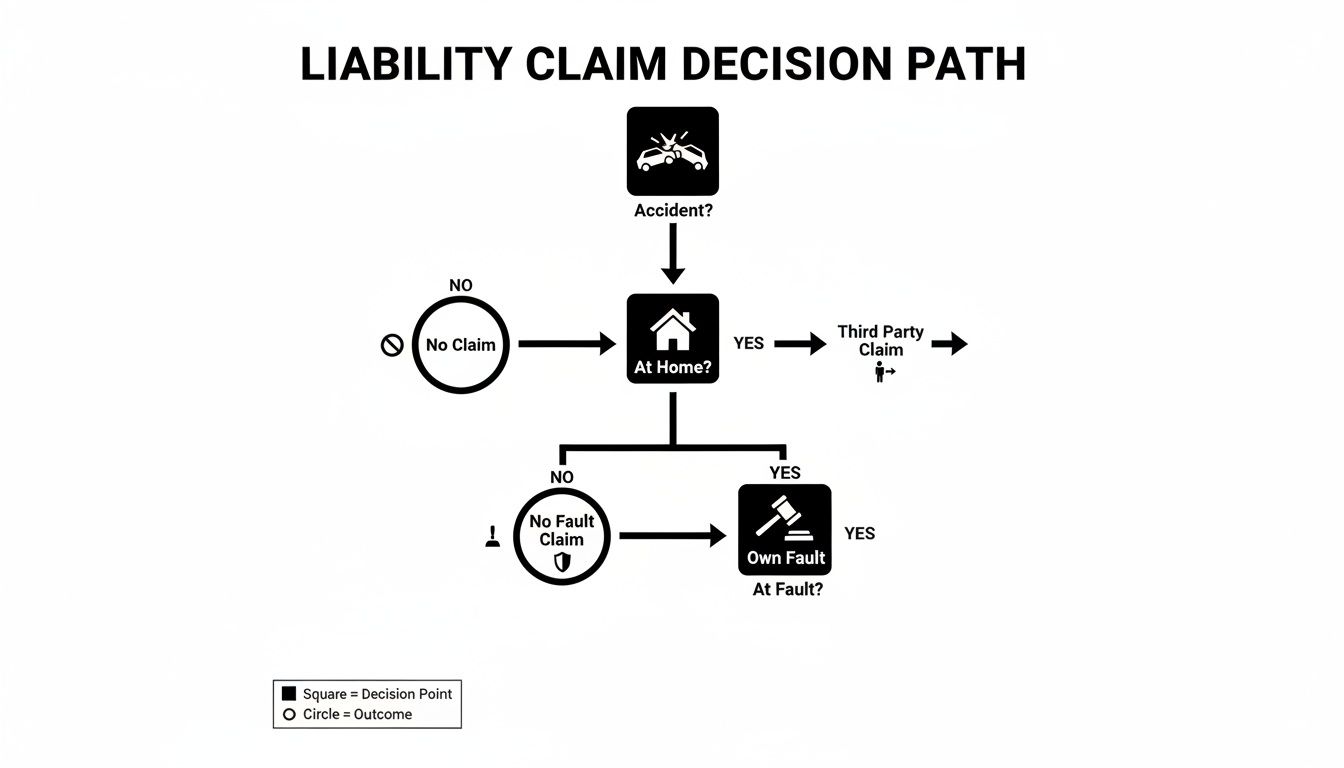
As you can see, if you're found at fault for an incident, your liability coverage is what steps in to handle the costs. To learn more about crafting a complete financial safety net, feel free to explore our other insurance guides.
Your Personal Liability Questions, Answered
It's natural to have questions when you start digging into the details of personal liability insurance. Let's break down some of the most common ones we hear, especially from our clients here in California.
Does My Policy Cover Something I Post Online?
That’s a great question, and the answer is: it depends. Your standard California homeowners insurance or renters policy usually doesn't cover things like online slander or libel. Think of it this way: the base policy is designed for physical-world accidents.
However, you can almost always add what's called a "personal injury" endorsement. This small addition extends your coverage to include risks from the digital world. If you're active on social media, this is a must-have piece of protection.
How Is This Different from My Car Insurance Liability?
They operate in two totally separate lanes. Your California car insurance liability is your financial shield for accidents that happen while you're driving. It covers injuries or property damage you cause with your vehicle.
Personal liability, which is part of your homeowners insurance, handles pretty much everything else. It’s for the non-driving incidents, like a guest falling down your stairs, your kid hitting a baseball through a neighbor's window, or your dog biting the mail carrier.
A personal umbrella policy is the only tool designed to extend its protection over both your California auto insurance and home liability policies, acting as a crucial backup for major claims in either area.
What Should I Expect an Umbrella Policy to Cost in California?
Considering the massive amount of protection they offer, umbrella policies are one of the best bargains in the insurance world. For a $1 million policy, most Californians can expect to pay somewhere between $200 and $400 a year.
It’s an incredibly cost-effective way to buy true peace of mind and protect yourself from a lawsuit that could otherwise wipe you out financially.
Protecting your assets is simpler than you think. The licensed agents at Mai & Associates are ready to review your current California auto insurance, home insurance, and life insurance policies to find any gaps and provide a no-obligation quote for the right level of protection. Secure your financial future today by visiting our website.