What Does Life Insurance Cover in California? A Guide to Your Options
At its heart, life insurance is a promise to your family. It's designed to provide a tax-free cash payment, called a death benefit, to the people you choose as beneficiaries when you're no longer around. For California families, this protection is a cornerstone of a sound financial plan, working alongside your auto insurance and home insurance to create a complete safety net.
This payout acts as an immediate financial backstop, replacing your income so your loved ones can navigate a difficult time without the added stress of financial hardship.
A Financial Safety Net for Your California Family
Think of it like this: your income is the main power source for your household. If that power is suddenly shut off, a life insurance policy acts like a backup generator, kicking in to keep the lights on. It provides the money needed to cover bills, pay for groceries, and maintain your family's way of life in California.
This kind of protection is crucial if you have people depending on you. Whether it's a spouse, young children, or even aging parents, a policy ensures they won't be left in a financial lurch. It’s a fundamental part of responsible financial planning—as important as your car insurance or renters insurance—that offers real peace of mind.
What the Death Benefit Is Used For
One of the best things about the death benefit is its flexibility. Your beneficiaries can use the money for whatever they need most, without restrictions. Typically, the funds are used to tackle three key areas.
- Immediate Costs: This covers the urgent expenses that pop up right away, like funeral and burial costs, final medical bills, or clearing out credit card balances.
- Ongoing Needs: This is all about maintaining the household. The money can be used for mortgage or rent payments, car loans, utilities, and daily living expenses—essentially replacing the income you used to provide.
- Future Goals: The death benefit can also secure your family's long-term dreams. It can be used to pay off the house, fund your kids' college education, or ensure your spouse has a comfortable retirement.
The global life insurance market was valued at a staggering $3.1 trillion, a testament to how many families rely on it for financial security. While the core purpose has always been protection, policies have evolved to meet the complex needs of modern families.
We've put together a handy table to show how the death benefit can be put to work for your family.
Your Life Insurance Death Benefit at a Glance
| Coverage Category | Common Examples | Purpose |
|---|---|---|
| Immediate Expenses | Funeral, burial, medical bills, credit card debt | To cover final costs without dipping into savings. |
| Income Replacement | Mortgage/rent, utilities, groceries, car payments | To maintain the family's standard of living. |
| Debt Repayment | Student loans, personal loans, business loans | To eliminate major debts and free up cash flow. |
| Future Planning | College tuition, retirement savings, down payment | To secure long-term financial goals and dreams. |
As you can see, the payout is designed to provide comprehensive support, covering everything from today's bills to tomorrow's aspirations.
At Mai & Associates, we know that every California family is different. Whether you want to make sure the mortgage gets paid, fund your child's education, or just leave a lasting legacy, we're here to help you find the perfect California insurance fit.
Terms like death benefit and beneficiary can feel a bit intimidating at first, but getting comfortable with them is the first step. For straightforward definitions of these and other insurance terms, check out our comprehensive glossary. We believe that having a clear understanding of your options—whether for life insurance, home insurance, or auto insurance—is the key to making the right choice for your California lifestyle.
Comparing the Main Types of Life insurance
Getting your head around the fact that you need life insurance is a huge first step. But then comes the hard part: figuring out which type of policy is right for you. It's easy to get lost in the jargon, but the main decision boils down to three core types of coverage.
Think of it like deciding how to house your family. You could rent for a specific period, buy a forever home with a fixed mortgage, or get a flexible loan that adapts to your financial life. Each serves a different purpose, and the best choice is all about your family's needs and long-term goals.
Let's unpack these options so you can see clearly what each type of life insurance covers and how it works in the real world.
Term Life Insurance: "Renting" Your Coverage
Term life is the simplest and most affordable option out there. The best way to think about it is that you’re essentially renting protection for a set amount of time. You pick a "term"—usually 10, 20, or 30 years—and pay a locked-in premium for that period.
If you pass away during that term, your family gets the full payout. Simple as that. If the term ends and you're still kicking, the policy just expires with no payout. It’s built for a specific job: to cover your biggest financial responsibilities during your most vulnerable years.
For instance, a 30-year term policy is a perfect companion for a 30-year mortgage. It guarantees that if the unthinkable happens, your family won't have to worry about losing their home. It's also great for covering the years until your kids are grown and financially independent.
This visual helps show how the money from a life insurance policy can be a lifeline for immediate, ongoing, and future expenses.
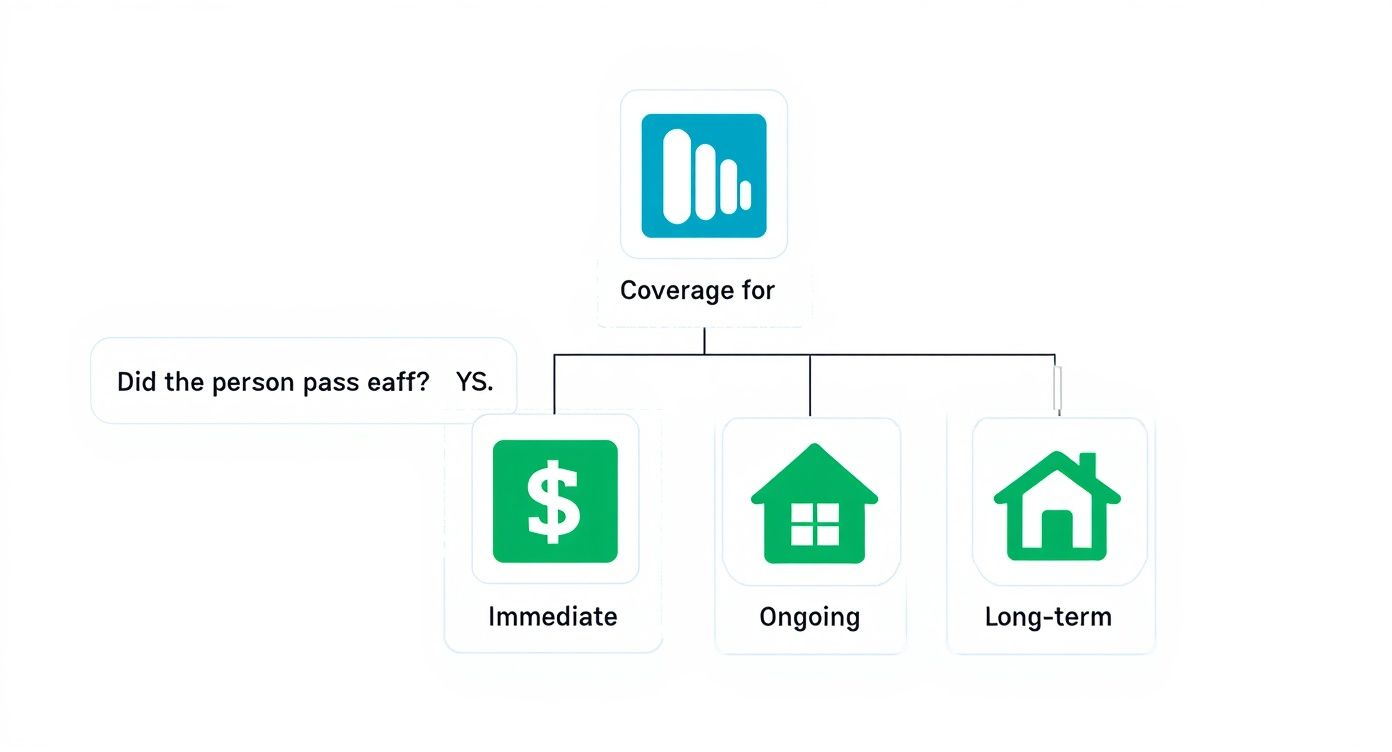
As you can see, life insurance is really about giving your loved ones a financial toolkit to handle whatever comes next.
Whole Life Insurance: "Owning" Your Protection
If term life is like renting, then whole life is like owning your coverage. This is a type of permanent insurance, which means it’s designed to last for your entire life—no expiration date, as long as the premiums are paid. It comes with a guaranteed death benefit, no matter when you pass away.
But that’s not the whole story. Whole life policies also have a built-in savings element called cash value. A slice of every premium you pay goes into this account, where it grows at a guaranteed rate.
Think of the cash value as a living benefit. You can take out tax-free loans against it for emergencies, or even surrender the policy for its cash value to supplement your retirement. It’s a financial asset you can actually use while you're alive.
This dual-purpose protection comes at a cost, of course. Whole life premiums are significantly higher than term life. It's a great fit for people who want iron-clad, lifelong coverage and a conservative, long-term savings vehicle. Many use it for estate planning or to leave a guaranteed legacy for their heirs.
Universal Life Insurance: Flexible, Lifelong Coverage
Universal life is another permanent option, but its defining feature is flexibility. Imagine owning a home with an adjustable-rate mortgage that you can tweak as your finances change. It also builds cash value, but it gives you the power to adjust your premium payments and even your death benefit over time.
For example, if you have a great financial year, you can pay more into the policy to build cash value faster. If money gets tight, you might be able to lower your payments for a while by letting the accumulated cash value cover some of the cost. The cash value growth here is typically tied to current interest rates, so it can fluctuate.
This adaptability makes universal life a solid choice for someone with a variable income or anyone who wants the ability to dial their policy up or down as life unfolds. You get the lifelong protection of a permanent policy with a level of control you just don't find elsewhere.
Term vs Whole vs Universal Life: a Quick Comparison
Seeing the key differences side-by-side can make the decision much clearer. Here’s a straightforward breakdown of what sets these three policies apart.
| Feature | Term Life | Whole Life | Universal Life |
|---|---|---|---|
| Coverage Duration | A specific period (e.g., 20 years) | Your entire lifetime | Your entire lifetime |
| Premiums | Lowest cost; fixed for the term | Highest cost; fixed for life | Flexible; can be adjusted |
| Cash Value | No | Yes; grows at a guaranteed rate | Yes; grows based on interest rates |
| Primary Goal | Affordable protection for temporary needs | Guaranteed permanent coverage and savings | Flexible permanent coverage |
Ultimately, the right policy for you hinges on your budget, your goals, and where you are in life. Whether you need a simple, temporary safety net for your mortgage or a permanent plan for lifelong peace of mind, there’s a structure designed to do the job. Here at Mai & Associates, our California-based team can help you look at the whole picture—including your auto insurance and home insurance—to build a protection plan that truly fits your life.
Unlocking Your Policy's Living Benefits
When most people think of life insurance, they picture a check being paid out after they're gone. That's the traditional view, and it's certainly a core part of it. But modern policies have evolved to do so much more. Today, many plans include powerful features known as living benefits, which can be a financial lifesaver during a crisis while you're still here.

These benefits are usually added to your policy through riders—think of them as optional upgrades. It’s a lot like adding roadside assistance to your car insurance; you pay a little extra for a huge amount of protection and peace of mind. By understanding how these riders work, you can turn a simple death benefit into a dynamic safety net for whatever life throws your way.
The Accelerated Death Benefit Rider
One of the most valuable living benefits you can have is the Accelerated Death Benefit (ADB) rider. This feature gives you the ability to access a huge chunk of your own death benefit—often 50% to 90%—if a doctor diagnoses you with a terminal illness and a short life expectancy, usually 12 to 24 months.
Picture this: a California homeowner gets a devastating diagnosis. Medical bills are piling up, and all they want is to spend their final months creating memories, not stressing about money. An ADB rider would allow them to receive a large, tax-free cash advance from their own policy. They could use it for anything from medical treatments and in-home care to taking one last family vacation.
The big idea behind an ADB is that sometimes, the money is far more valuable to you and your family right now. It provides the funds to improve your quality of life when you need it most.
It’s important to know that any money you access through this rider will reduce the final payout your beneficiaries get. But for many families facing a terminal diagnosis, that immediate financial relief is priceless.
Critical and Chronic Illness Riders
Life can also throw other health crises your way that, while not terminal, can still wreck your finances. That's where riders for critical and chronic illnesses step in, giving you the funds to recover without having to drain your life savings.
- Critical Illness Rider: This pays out a lump-sum benefit if you're diagnosed with a major, life-threatening condition like a heart attack, stroke, or invasive cancer. You can use the money for anything—covering your health insurance deductible, paying for treatments your plan won't cover, or even just keeping up with the mortgage while you recover.
- Chronic Illness Rider: This benefit kicks in if you can no longer perform two of the six Activities of Daily Living (ADLs), like eating, bathing, or dressing on your own. It’s specifically designed to help with the sky-high costs of long-term care, whether that's in a facility or at home.
For example, if someone has a major stroke and needs months of intensive rehab, a critical illness rider could provide the cash to handle bills while they're out of work. It’s a perfect example of how life insurance can offer stability right when your world feels anything but.
Other Powerful Policy Add-Ons
Health-related riders are the most common, but insurers offer a whole menu of other add-ons to customize your policy. Whether you're considering a basic term policy or a more complex plan, these options can add a ton of value.
A few popular ones include:
- Disability Income Rider: If you become totally disabled and can't work, this rider pays you a monthly income for a specified period. It's a great way to add another layer of income protection on top of any separate disability insurance you might have.
- Waiver of Premium Rider: This is one of the most common and useful riders. If you become totally disabled, the insurance company simply waives your premium payments but keeps your policy active. Your coverage stays in place even if your income stops.
- Child Term Rider: This lets you add a small amount of term life insurance for your kids under your own policy. It's a very affordable way to secure coverage for final expenses if the unthinkable were to happen.
Understanding these options is a huge part of building a solid financial plan. For more insights on how different California insurance products fit together, you can explore our collection of expert insurance guides. These riders prove that a life insurance policy can be a flexible, responsive part of your financial toolkit, ready to help in all sorts of situations.
What Life Insurance Doesn't Cover
While a life insurance policy is a powerful tool for protecting your family, it isn't designed to cover every single scenario. Knowing what your policy doesn’t cover is just as critical as knowing what it does. This isn't about finding loopholes; it's about setting realistic expectations and preventing any heartbreaking surprises for your loved ones down the road.
Think of it this way: a life insurance policy is a contract based on good faith. Insurance companies have a few key rules in place to manage their risk and prevent fraud, which ultimately helps keep coverage accessible and affordable for everyone.
The First Two Years: The Contestability Period
One of the most important concepts to grasp is the contestability period. In California, like most states, this is the first two years your policy is active. During this initial window, the insurance company reserves the right to take a much closer look at your application if a claim is filed.
If they find a material misrepresentation—which is just industry-speak for intentionally leaving out or falsifying important information—they can legally deny the payout. This could be anything from not mentioning a serious health diagnosis to hiding a smoking habit or a risky hobby like private piloting. The key is that the information, had it been known, would have changed the insurer's decision to offer you a policy or at least the rate they charged.
This isn't to say a simple, honest mistake will void your policy. But it highlights why being completely upfront during the application process is non-negotiable. Once those two years are up, the policy becomes "incontestable," meaning the insurer can't challenge the claim based on misrepresentation, except in very rare cases of deliberate fraud.
The contestability period is like a probationary window. It gives the insurer a chance to confirm that the agreement was based on honest information, protecting the integrity of the system for all policyholders.
Common Policy Exclusions
Even after the contestability period, there are a few standard situations, or "exclusions," that nearly all life insurance policies will not cover. These are specific circumstances where the death benefit won't be paid. It's always a good idea to read the fine print of your own policy, but here are the exclusions you're most likely to see.
- The Suicide Clause: Almost every policy has a suicide clause that applies for the first two years. If the insured person dies by suicide within this timeframe, the insurer will not pay the death benefit. Instead, they will typically return the premiums that were paid to the beneficiary.
- Illegal Activities: If death occurs while the policyholder is committing a felony, the claim will almost certainly be denied. For example, if someone dies from injuries they got while robbing a bank, the insurance company is not obligated to pay the benefit.
- Dangerous Hobbies: When you apply, you have to be honest about high-risk hobbies like scuba diving, rock climbing, or auto racing. If you don't disclose them and die while participating in that activity, the claim could be denied for misrepresentation. Sometimes, the insurer will still offer coverage but charge a higher premium or add a specific rider that excludes death from that one activity.
- Acts of War: Some policies may include an "act of war" exclusion. This means if the insured is killed during a declared war (whether as a soldier or a civilian), the benefit might not be paid. However, this is less common in modern policies, and special coverage options are often available for military members.
Understanding these boundaries helps you create a financial plan that's grounded in reality. Here at Mai & Associates, we make it a priority to have these clear conversations, so you understand the full picture of your auto, home, and life insurance policies.
How the Payout Process Works for Beneficiaries
When your family needs to use a life insurance policy, the last thing they should have to deal with is a confusing and complicated claims process. Thankfully, it's usually a pretty straightforward affair, especially if you've set things up correctly from the start. Just knowing how it all works can bring a lot of peace of mind.

The whole thing gets rolling when your beneficiary—the person you've designated to receive the funds—gets in touch with the insurance company. That first call kicks off a simple but crucial process to verify everything and get the money where it needs to go.
Filing the Claim: A Step-by-Step Guide
The idea of filing an insurance claim can sound intimidating, but it really boils down to just a few key steps. Insurance companies are well-practiced in handling these situations with sensitivity and have teams ready to help your loved ones through it.
Here’s a look at what they can expect:
- Contact the Insurer: The first move is to let the insurance company know that the policyholder has passed away. Having the policy number makes this easier, but don't worry if it's not immediately available; they can usually find the policy with a name and date of birth.
- Gather Key Documents: The insurance company will need some paperwork to move forward. The most important document is a certified copy of the death certificate, which is the official proof needed to process the claim. They'll also provide a claim form that needs to be filled out.
- Submit the Paperwork: With the documents in hand, the next step is to send them over to the insurer for review. These days, this can often be done online, but sending them by mail or working with an agent are also common options.
- Receive the Payout: Once the company verifies the documents and confirms the policy is active, they'll pay out the death benefit. Here in California, insurers are required to handle claims promptly, usually within 30 days of getting all the required proof.
One of the most powerful features of life insurance is that the death benefit is paid to beneficiaries 100% income-tax-free in nearly all situations. This means every dollar is there to support your family, just as you intended.
Understanding Payout Options
Your beneficiaries aren't just handed a check and left to figure things out on their own. They typically have a few different options for how to receive the money, so they can choose what works best for their financial reality.
The most popular choice by far is a lump-sum payment. This means the entire death benefit is paid out all at once, giving your family immediate access to the funds to pay off a mortgage, cover final expenses, or invest for their future.
But other options are often available, too:
- Specific Income Provision: The beneficiary can choose to receive a set amount of money at regular intervals—say, monthly or yearly—until the full benefit is paid out.
- Life Income Option: This option essentially turns the death benefit into a personal pension (an annuity), providing the beneficiary with a guaranteed income stream for the rest of their life.
- Interest Income Option: With this choice, the insurance company holds the principal amount, and the beneficiary receives regular payments of the interest it earns.
Knowing how these steps and options work helps demystify the whole process. It turns life insurance from an abstract idea into a concrete, actionable plan that’s ready to protect your family. At Mai & Associates, we help our California clients navigate every part of this, from picking the right coverage to making sure their beneficiaries are set up for a smooth and stress-free future.
Navigating California Life Insurance with an Expert
Choosing the right life insurance isn't just a financial decision; it's a personal one. Here in California, we're fortunate to have some extra layers of consumer protection built right into the system, which can give you some real peace of mind. Knowing how these local rules work is the first step to building a plan that truly protects your family.
One of the best consumer rights we have is California's "free look" period. Think of it as a no-risk trial run. You typically get 10 to 30 days after your policy is delivered to read through every detail. If anything doesn't feel right, you can cancel and get a full premium refund. No hoops to jump through, no questions asked.
State Protections and Local Expertise
Beyond the free look period, California has a powerful safety net in place called the California Life and Health Insurance Guarantee Association (CLHIGA). In the rare event that a life insurance company becomes insolvent, this state-run association steps in. It ensures that your family will still receive the benefits they were promised, up to specific limits.
It’s one thing to know these protections exist, but it's another to know how they apply to your life. That's where working with a local California agency like Mai & Associates really makes a difference. We live and breathe the nuances of our state's insurance market every day.
Having a local expert in your corner means you get guidance that's not just generic, but specifically relevant to California. We help you understand what your life insurance covers while making sure your policy aligns perfectly with state laws and protections.
Bundling Your California Insurance Needs
Real financial security isn't about having just one policy; it's about creating a complete shield around your family and your assets. A solid life insurance policy is the foundation, but it becomes even stronger when it works in concert with your other coverage. At Mai & Associates, that's exactly what we specialize in—building comprehensive protection plans.
We can take a look at your entire insurance picture, from your auto insurance and home insurance to your renters insurance, to spot any gaps or opportunities. Bundling these policies together often does more than just simplify your paperwork; it can unlock some serious savings. Our goal is to make sure your family is covered from every angle, whether you're dealing with a fender bender, a wildfire, or the unthinkable loss of a loved one.
To see the full picture, check out our complete guide to life insurance in California. Let our team help you build a plan that secures everything you've worked so hard for.
Common Questions About Life Insurance Coverage
Even after you get the hang of the basics, it's totally normal to have some lingering questions. Thinking through the "what ifs" is just part of making sure you're getting the right protection for your family. Let's dig into some of the most common questions we hear from California residents every day.
Can the Insurance Company Cancel My Policy If I Get Sick?
This is a big one, and thankfully, the answer is a firm no.
Once your policy is officially active, the insurance company can't just cancel it or jack up your rates because your health changes later on. As long as you were honest on your initial application and keep paying your premiums, your coverage is locked in. This is exactly why it pays to get a policy in place while you're young and healthy—you secure lower rates for the long haul.
How Much Life Insurance Do I Actually Need?
There’s no magic number here; the right amount is completely personal. You might hear a rule of thumb like having coverage that's 10-12 times your annual income, but that’s just a starting point. A much better approach is to sit down and do the math on what your family would truly need.
Think about covering these key areas:
- Major Debts: Your mortgage is probably the biggest, but don't forget car loans or student debt.
- Income Replacement: How many years of your salary would your family need to stay on their feet without you?
- Future Goals: Are you planning to pay for a child's college education or a wedding?
- Final Expenses: These are the immediate costs for a funeral and any leftover medical bills.
Working with an expert can help you run a detailed needs analysis to land on a precise number that makes sense for you.
Here's one of the biggest perks: in almost every case, the death benefit from a life insurance policy is paid to your beneficiaries completely income-tax-free. That means the full amount you intended for them is what they actually receive.
For answers to more specific questions about auto, home, or other California insurance policies, you can explore our detailed California insurance FAQ page for more insights.
Is My Coverage Still Good If I Move Out of California?
Yes, absolutely. Your life insurance policy follows you. It's a legal contract that stays in force no matter where you live in the United States. Just be sure to update the insurance company with your new address so you don't miss any important mail. Your coverage and benefits won't change just because you've crossed state lines.
Figuring all this out can feel like a lot, but you don’t have to go it alone. The licensed agents at Mai & Associates are here to offer clear, personal advice on all your California insurance needs—from life and auto to home and renters insurance. Get a no-obligation quote online today and protect what matters most.