What Does HOA Cover for California Homeowners
21.6 million of the nation's 86.6 million owned households paid either a condo or HOA fee in 2024, and the national median monthly fee was $135. In plain English, an HOA's master insurance usually covers shared property and common areas, while everything inside your walls is your responsibility, and in California that split matters even more when wildfire, earthquake, and Fair Plan issues enter the picture.
You can pay your dues on time and still be underinsured. That's the part most homeowners miss, especially in a condo or townhome where the marketing pitch says “low-maintenance living” but the legal documents decide who pays when a loss happens.
The Question Most California Homeowners Get Wrong
A Riverside buyer signs for a townhome, sees “HOA includes exterior maintenance,” and assumes the association has the rest covered. A San Diego condo owner hears the same thing from the sales agent, then finds out after move-in that the true answer sits in the CC&Rs, the bylaws, and the master insurance declarations, not in the brochure. That gap is where bad surprises start.
What does HOA cover? Not “everything.” The better question is where the association's responsibility ends and your own policy begins. The answer depends on three documents and one personal policy, and if you skip any of them, you're guessing with your biggest asset.
Start with the documents, not the dues
The dues tell you almost nothing by themselves. The governing documents tell you whether the association handles the building shell, shared systems, and liability for common areas, or whether your unit policy has to pick up more of the load. The master insurance declarations then tell you how the policy is written, which is what decides who pays when a claim lands.
Practical rule: if you can't point to the clause that assigns a repair or insurance duty, you don't really know who covers it.
That's why California buyers should stop asking whether an HOA “covers” something in the abstract. Ask whether the item is a common element or a unit element, then ask which policy responds. If you want a plain-English glossary while you're reading your own documents, the California home insurance glossary is a useful place to start.
California's risk environment makes this distinction nonnegotiable. Wildfire exposure can push associations into tighter insurance markets, earthquake losses usually sit outside standard property coverage, and a Fair Plan setup can leave big holes unless your personal policy is built around it. If you own in an HOA, you're not buying one layer of protection, you're managing several.
How HOA Master Insurance Is Actually Structured
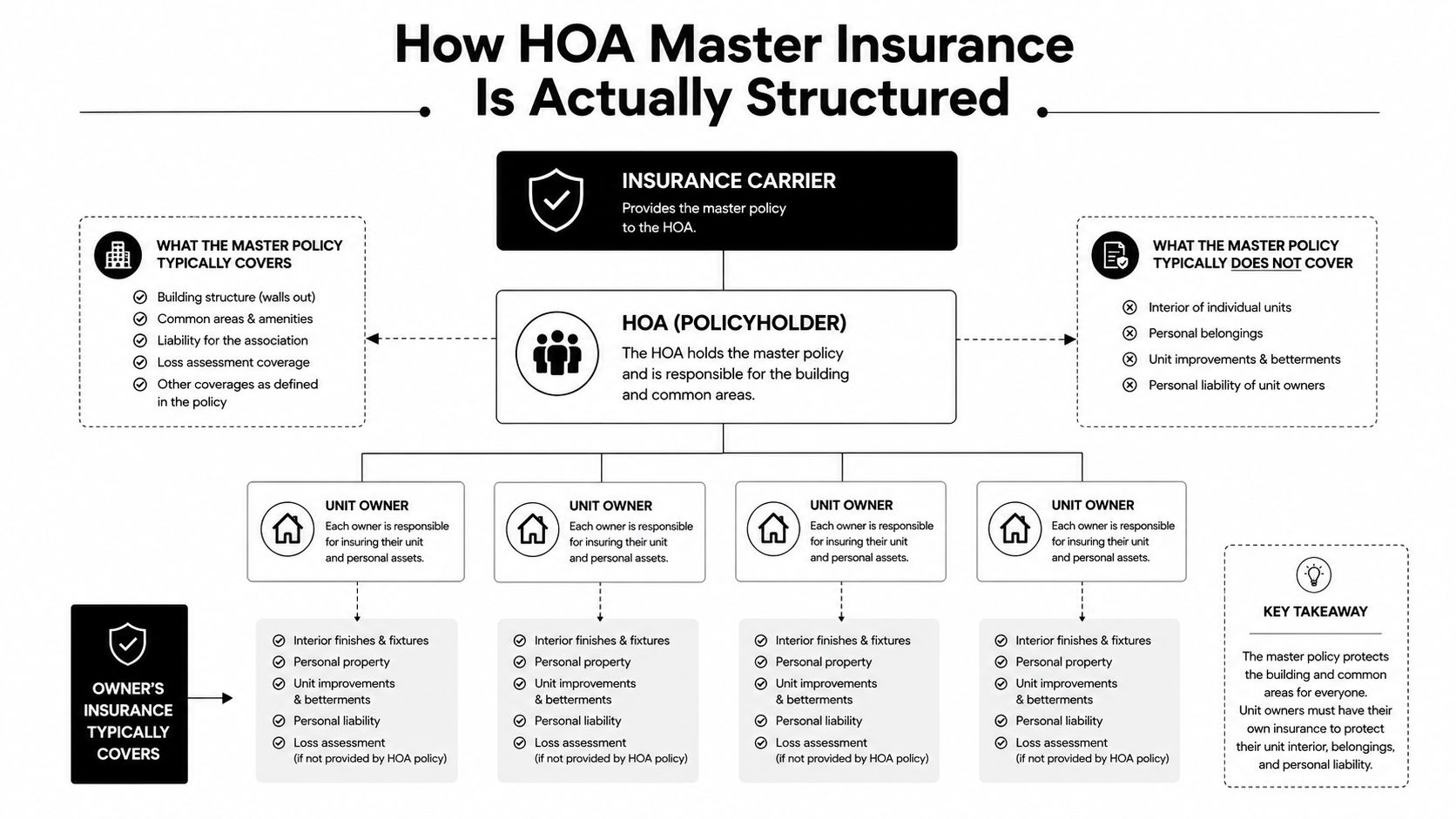
A standard HOA master policy is basically the building's shell and skeleton coverage. It usually handles the shared parts that everyone relies on, while your HO-6 policy protects the part you live in and fill with your belongings. That split is the whole game, and if you misunderstand it, you'll misunderstand the claim.
What usually sits on the HOA side
The association's policy typically covers building exteriors, common areas, hallways, elevators, pools, and common mechanical systems. It also usually includes association liability for incidents tied to those shared spaces. That's the part most owners are paying for through dues, even if they never read the policy packet.
A master policy can be written in different forms, and those forms matter. Bare-walls-in, original-specifications, and all-in are not technical trivia, they change where the claim stops and where your policy starts. A bare-walls-in community leaves more for the owner to insure, while an all-in form pushes more interior finish coverage back onto the association.
What usually sits on your side
Your HO-6 generally covers interior improvements, personal property, and personal liability inside the unit. That means flooring, cabinets, countertops, furniture, clothing, and owner-installed finishes may fall under your policy, depending on the form of the master policy and the governing documents. If the HOA policy doesn't reach inside the walls, your HO-6 has to do that work.
The cleanest way to read a master policy is to ask one question, who owns the risk of the building envelope, and who owns the risk of the interior finish?
That question also helps you spot moral hazard in association management. If owners think the HOA will absorb every loss, they'll underinsure themselves and push disputes into the claim process later. For a sharper look at that incentive problem in insurance, BatchData's insights for insurers are worth a read.
If you're comparing policies, don't just ask whether the HOA “has insurance.” Ask what form it is, what it excludes, and whether the certificate matches the way your home is built. For a California-specific overview of policy structure, see this home insurance guide.
The hidden bridge to owner exposure
The pressure point is loss assessment. A master policy can be written correctly and still leave owners exposed if the association's deductible is high or the governing documents let the board spread part of a claim back to members. That's where the HO-6 becomes more than a nice-to-have.
What the HOA Covers Versus What You Insure
The fastest way to audit an HOA is to stop thinking in labels and start sorting items by responsibility. Roof, siding, landscaping, shared utilities, and common systems usually belong on the association side. Interior walls, fixtures, appliances, and personal property usually belong on yours.
HOA responsibilities versus homeowner responsibilities
| Item or Area | Typically HOA Master Policy | Typically Owner HO-6 Policy |
|---|---|---|
| Roof and exterior structure | Usually yes, if the community documents assign it to the association | Usually no |
| Common hallways, pools, elevators, shared amenities | Usually yes | Usually no |
| Landscaping and shared grounds | Usually yes for common areas | Usually no |
| Interior walls and trim | Usually no in many communities, unless the master policy is broader | Usually yes |
| Cabinets, flooring, and owner-installed finishes | Sometimes, depending on master policy form | Often yes |
| Appliances and personal belongings | Usually no | Usually yes |
| Personal liability inside the unit | Usually no | Usually yes |
The awkward items are the ones owners fight about later. Water heaters, windows, balconies, and attached fixtures can fall either way depending on the CC&Rs and the master policy form, so don't assume the answer from the item itself. Check the governing documents first, then confirm the insurance language.
I've seen owners make one mistake over and over. They hear “HOA covers it” and stop there, even though the master policy might only cover the shared portion of the loss, not the finishes or contents inside the unit. If you need a property-management lens on how upkeep and coverage are usually organized, the latest from Facility Management Insights is a useful reference point.
Where the claim usually lands
If a shared system fails and damages multiple units, the association policy is usually the first policy in the room. If the same event only damages your interior, your HO-6 is usually carrying the burden. That's why the answer to “what does HOA cover” is never just about amenities, it's about claim allocation.
The practical audit is simple. Read the maintenance clause, read the insurance clause, then match both against the actual component that failed. If the documents don't line up clearly, assume there's a gap until your agent proves otherwise.
How HO-6 and Loss Assessment Fill the Gaps
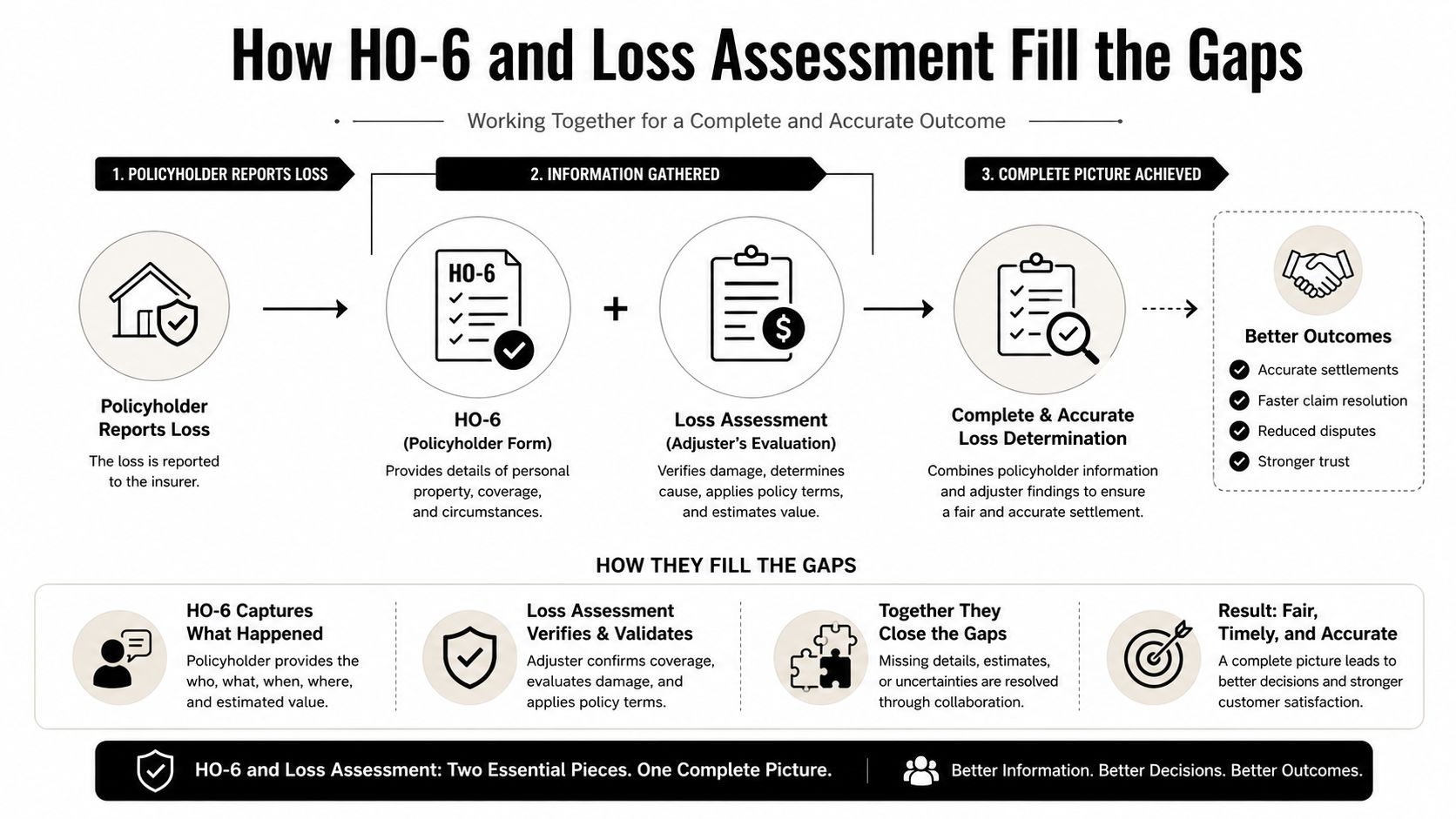
HO-6 is the policy layer that keeps a condo owner from being trapped by a thin master policy. It's the walls-in policy, and it usually includes dwelling coverage for the interior, personal property, and loss assessment. If you own in a condo or attached townhome, those three pieces aren't optional in practice.
Why loss assessment matters
Loss assessment exists because the HOA's deductible or a CC&R cost-sharing rule can push part of a master-policy claim back onto individual owners. The HO-6 loss-assessment limit should be compared directly with the master-policy deductible, because the association's deductible and CC&R loss-assessment provisions can shift part of a master-policy claim back to individual owners. That's the cleanest benchmark you can use.
Here's the scenario I see people underestimate. A pipe bursts in a third-floor unit, damages the unit below, and triggers the association claim process. The association may fix the shared portion, but if the deductible is large or the board assesses members for part of the loss, owners without enough loss-assessment coverage pay out of pocket. That's how a “covered” problem still becomes a personal bill.
If your HO-6 loss-assessment limit is lower than the HOA deductible, you're gambling on a cost you don't control.
The practical coverage stack
Owners should think in layers, not in labels. The master policy handles shared structure and association liability. HO-6 handles your unit's interior, your belongings, and your liability. Loss assessment helps with the part that gets pushed back through HOA rules or deductible allocation.
For California condo and townhome owners, that matters even more because higher-risk communities can face more pressure on carrier terms and claim handling. If you want an agent-level review process that's built around identifying those gaps, the Mai & Associates guides page is the right place to start.
Special assessments are the other trap. If reserves fall short, the HOA can bill owners directly, and that bill is separate from normal dues. HO-6 loss-assessment coverage can help in some cases, but only if the limit is high enough and the wording matches the association's rules. Don't guess here, verify it.
California-Specific Gaps Most Owners Miss
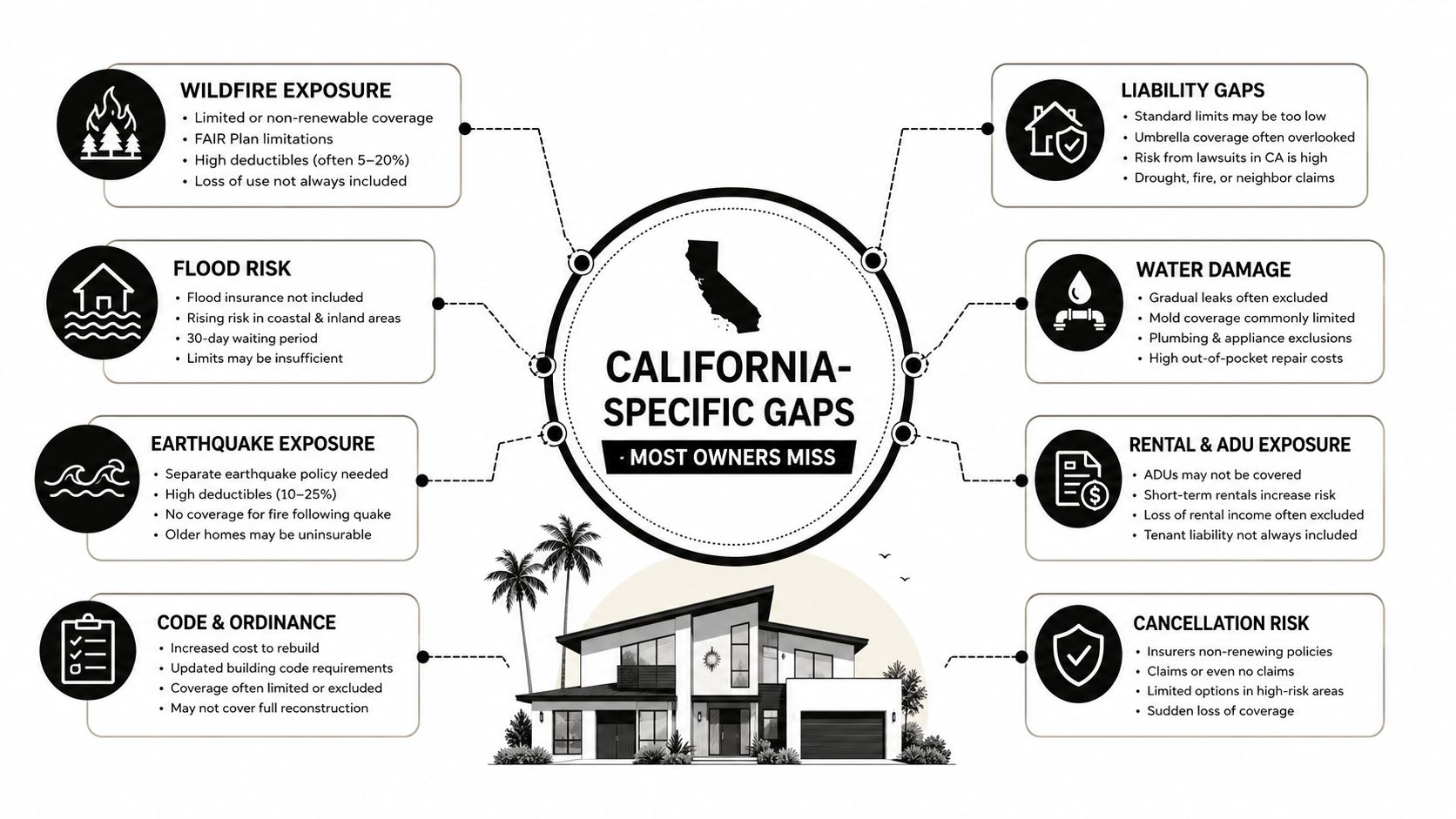
California changes the HOA conversation because wildfire, earthquake, and carrier restrictions don't play by generic condo rules. In high-risk areas, the question isn't just what the HOA covers, it's what the insurer will still write, renew, or price in the first place.
Wildfire and Fair Plan pressure
In wildfire-exposed neighborhoods, the California FAIR Plan often becomes the fallback when private carriers pull back. That matters for HOA communities because a master policy can become harder to place or more expensive to maintain when the property sits in a tough ZIP code. California homeowners in Wildland-Urban Interface areas in Los Angeles, San Bernardino, Ventura, and Butte counties should assume insurance availability can change faster than dues notices.
When that happens, the HOA may keep the community running, but the insurance architecture can shift under your feet. Owners often assume their dues buy catastrophe protection. They don't. Dues fund the association, but the actual risk transfer depends on the policy market and the form of coverage.
Earthquake is its own problem
Earthquake coverage is generally excluded from standard homeowners and HOA master policies, and it usually has to be purchased separately through the California Earthquake Authority or another carrier offering it. That's true whether you're in a condo, townhome, or attached home. If the building shakes, the association policy and your HO-6 may both leave a major gap unless earthquake coverage is in place.
What California owners should do
The right stack in many California communities is HO-6 plus FAIR Plan where needed, plus earthquake coverage if available and appropriate. That won't solve every scenario, but it's the only realistic way to close the most common state-specific gaps. If you own in a wildfire zone and your HOA insurance renewal changed recently, your personal policy deserves a fresh review immediately.
California owners should never assume the HOA has handled the catastrophe layer. In this state, that assumption gets expensive fast.
For a broader look at how condo, renters, and homeowners coverage choices interact in California, the facility and policy discussion on special property issues is a useful place to compare notes before renewal season.
When HOA Coverage Fails Even When It Is Promised
HOA coverage can look solid on paper and still break down in practice. The reason is simple, dues are a funding mechanism, not a guarantee that every covered item will be fully paid for when something goes wrong. If the association is underfunded, the promise gets stretched.
The warning signs are usually visible
Rising insurance costs, labor costs, and aging infrastructure push associations toward special assessments when reserves aren't enough. That means a repair that sounds routine in the bylaws can turn into a direct owner bill when the board doesn't have the cash to absorb it. The guide to special assessment rules is useful background if you want to understand how boards justify those charges.
Watch for these signals:
- Repeated special assessments. That tells you the association is leaning on owners instead of reserves.
- Deferred maintenance. If the roof, paint, or shared systems are aging without visible replacement planning, the promised coverage may not be financially supported.
- Master-policy nonrenewal or tighter terms. That often means the community is becoming harder to insure, which usually pushes costs back toward owners.
- HOA fee increases that feel disconnected from service changes. When dues jump but upkeep doesn't improve, the budget is probably absorbing insurance or repair pressure.
Why this matters before you buy or renew
A community can say it covers a service and still fail to fund it well enough to deliver it. That's the difference between paper coverage and operational coverage. In California, where wildfire and replacement costs can make insurance markets unstable, this gap matters more than it does in a quieter state.
Your response should be direct. Ask for the reserve study, review the budget, and check whether the board has relied on special assessments in the recent past. If the answers are messy, assume your own policy needs more protection, not less.
Questions to Ask Your HOA and Your Agent
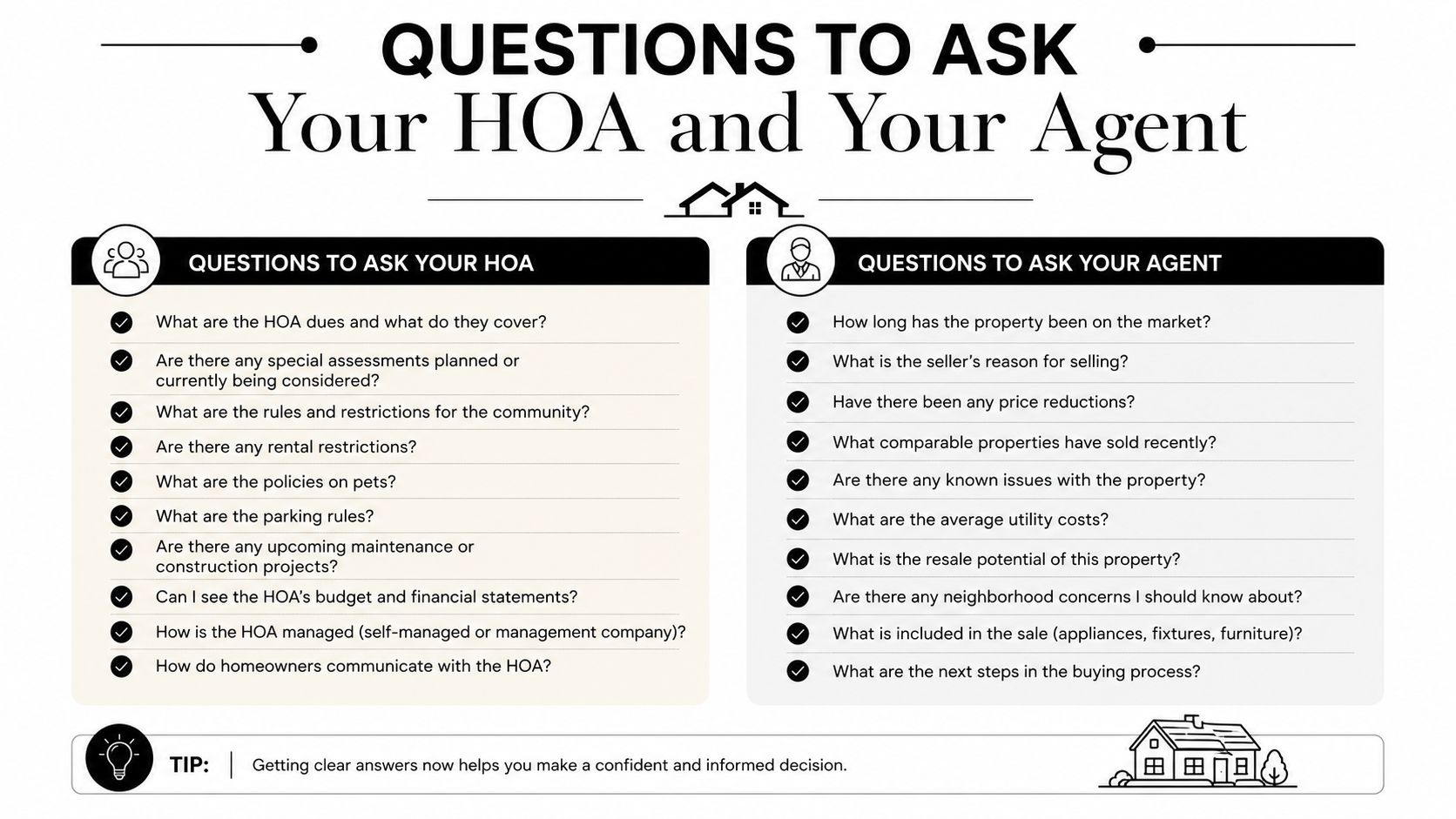
You don't need a week of research to get this right. You need the right questions, asked in the right order, to the right people. One conversation with the HOA and one conversation with your agent can close most of the gap.
Ask the HOA board or management company
- What form is the master policy? Ask whether it's bare-walls-in, original-specifications, or all-in.
- What's the deductible? You need the number because it affects loss assessment exposure.
- Does the CC&Rs allow owners to be billed for part of a claim? That's the loss-assessment question many people skip.
- When was the last reserve study updated? If they can't answer clearly, that's a warning sign.
- Have there been recent special assessments? Recent assessments often tell you more than the budget summary.
Ask your insurance agent
- How much HO-6 dwelling coverage do I need for the interior? Don't guess based on the mortgage amount.
- What should my loss-assessment limit be? Compare it to the HOA deductible and the governing documents.
- Can I add earthquake coverage? In California, that answer matters even when the HOA sounds well insured.
- Do I need Fair Plan support or a companion policy? Wildfire exposure changes the conversation fast.
- Should I bundle with auto or renters coverage? A good review should look at the whole household risk picture, not one policy at a time.
The best time to ask is before renewal or before escrow closes. If you're comparing carriers or trying to build the right mix of auto insurance, home insurance, renters insurance, car insurance, and life insurance around an HOA property, a licensed California agency can help you align the pieces without overbuying the wrong ones. For a straight policy review and quote comparison, visit Mai & Associates and ask for an HOA coverage check that looks at the master policy, your HO-6, and the California gaps that matter most.