What Does Comprehensive Insurance Cover? A California Driver's Guide
When you think about car insurance in California, crashing into another vehicle is probably the first thing that comes to mind. But what about all the other things that can happen to your car when you're not even driving it? That’s where comprehensive auto insurance comes in.
Think of it as your car's protection plan for the unexpected. It covers damage from events that aren't related to a typical collision, like theft, vandalism, fire, or even a tree branch falling on your hood during a storm. This type of California car insurance is a key part of a well-rounded protection plan.
Understanding Comprehensive Insurance For Your California Vehicle
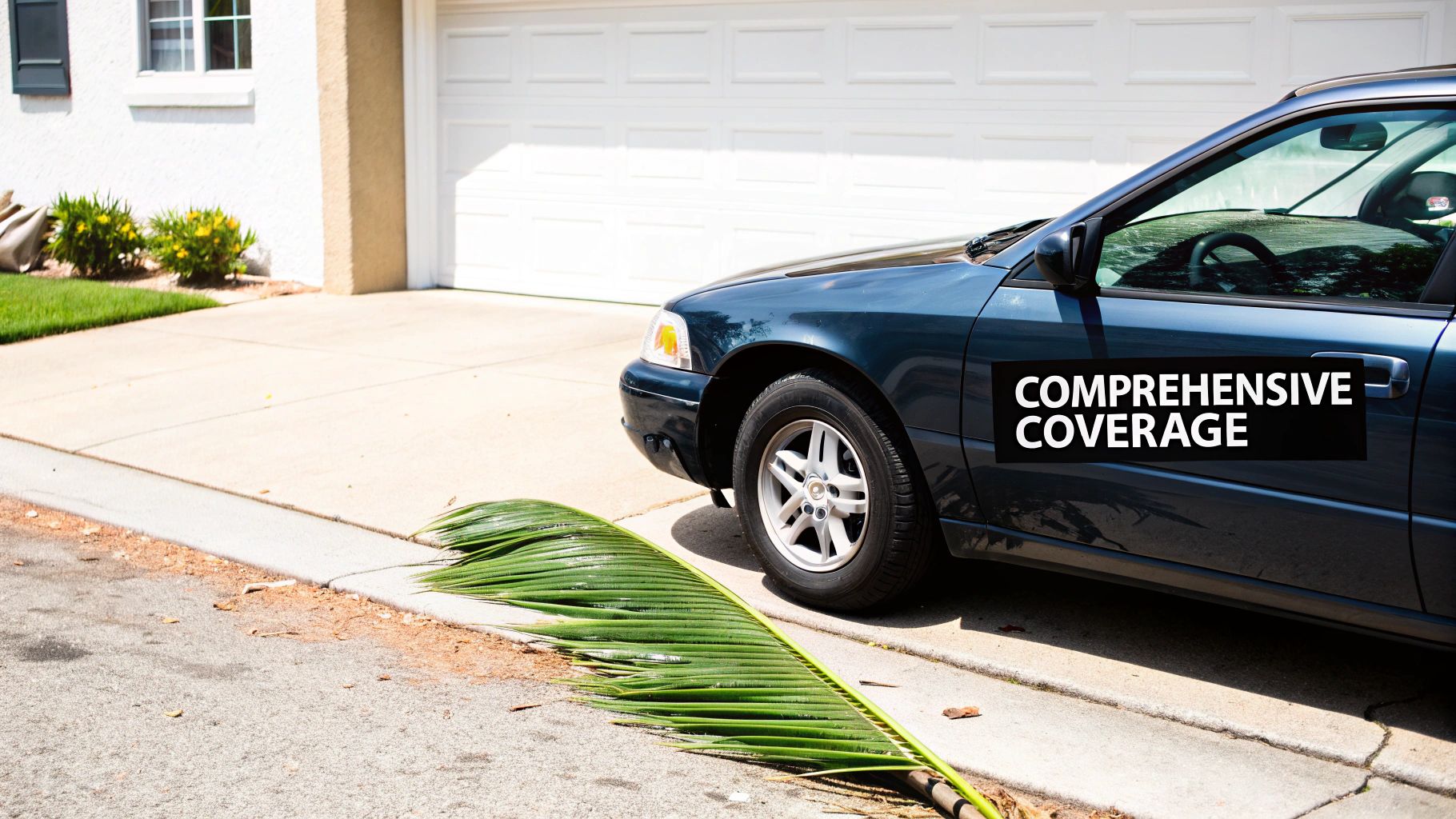
Here's a common mix-up I see all the time: California drivers hear "comprehensive" and think it means "covers everything." In the insurance world, though, it has a very specific job. It's a type of physical damage coverage that partners with collision and liability insurance to give you a complete auto insurance safety net.
While collision coverage pays for damage when you hit something else (like another car or a guardrail), comprehensive handles almost everything else.
The difference really matters. Let's say you're driving on a rural California road and a deer jumps out in front of you. If you hit the deer, your comprehensive coverage would pay for the repairs. But if you swerve to miss it and hit a telephone pole instead, that claim would fall under your collision coverage. Knowing these little details about your California auto insurance can save you a huge headache later.
To get more comfortable with these terms, you can always check out our glossary of insurance definitions.
What Is Typically Covered
So, what exactly does comprehensive insurance step in for? It's designed to protect you from a whole host of incidents that are usually completely out of your control.
Here are the most common scenarios where this coverage is a lifesaver:
- Theft and Vandalism: Your car is stolen, or someone intentionally damages it.
- Weather Events: Damage from hail, windstorms, floods, or even earthquakes.
- Fire and Explosions: Covers damage from both vehicle fires and external ones.
- Animal Collisions: Hitting a deer, coyote, or another animal on the road.
- Falling Objects: Think tree limbs, rocks, or other airborne debris.
- Glass Damage: A cracked or shattered windshield is a classic example.
The bottom line is this: Comprehensive coverage provides a financial backstop for "acts of God" and other random events that aren't your typical traffic accident. It's the part of your car insurance policy that prepares you for life's unpredictable curveballs.
It's clear that people are seeing the value in this kind of protection. The global insurance industry recently saw an estimated 8.6% expansion, with insurers collecting a staggering EUR 7.0 trillion in premiums. This shows a growing trend of people wanting stronger financial safeguards against the unknown. For a deeper dive into these numbers, you can read the full global insurance industry report.
Real-World Scenarios Where Comprehensive Coverage Saves The Day
Definitions are one thing, but seeing how comprehensive insurance works in the real world is what really makes it click. California drivers face a unique mix of risks, from crowded city streets to winding mountain roads. Let's look at a few common situations where this coverage can turn a potential disaster into a manageable problem.
The Urban Nightmare: Vandalism and Theft
Picture this: you've parked your car in a San Francisco neighborhood for the night. You come back in the morning to find a shattered window and your glove box rifled through. Your stomach drops.
This is exactly what comprehensive car insurance is for. It will handle the cost of replacing that broken window and fixing any other damage to the car itself from the break-in. It’s important to remember that comprehensive auto insurance won’t cover personal items stolen from the car—that’s a job for your renters insurance or home insurance—but it saves you from shelling out hundreds just to get your vehicle secured again.
The Rural Surprise: Collisions with Wildlife
Now, imagine you're driving late at night on a quiet road in San Diego County. Suddenly, a deer bolts out from the trees. There's no time to swerve. The impact leaves your front end a crumpled mess.
Believe it or not, this isn't a "collision" claim in the insurance world. Hitting an animal falls squarely under comprehensive coverage.
Hitting an animal is one of the most common—and most misunderstood—comprehensive claims. People often assume it's a collision, but the insurance industry classifies it differently. This distinction often works in your favor, as a comprehensive claim is less likely to impact your California auto insurance rates than an at-fault collision.
Without this coverage, you’d be on the hook for thousands in repairs. With it, you just pay your deductible, and the insurance company takes care of the rest. It’s a lifesaver for anyone who frequently drives through California's more rural areas.
When Mother Nature Has Other Plans
California is famous for its sunshine, but our weather can have a wild side. A powerful Santa Ana wind could easily topple a tree branch right onto your parked car, leaving a massive dent in the roof. A sudden hailstorm could leave your car looking like a golf ball.
This is the very essence of what comprehensive insurance covers: damage from random, external events. Your car insurance policy is there to pay for repairs from things like:
- Falling objects, like tree limbs or debris from a storm.
- Hail damage that leaves dings and dents all over your car's body.
- Flooding from heavy rains that can ruin an engine and interior.
- Fire damage, a serious risk for anyone living in wildfire-prone areas.
In every one of these cases, the damage had nothing to do with your driving. It was caused by forces completely out of your control. That’s why comprehensive coverage exists—to protect your investment from the unpredictable, giving you peace of mind no matter what California throws at you.
Comprehensive vs. Collision Insurance In California
One of the most common questions I get from California drivers is, "What's the real difference between comprehensive and collision?" It’s a great question because the names don’t exactly spell it out. The easiest way to think about it is that your California auto insurance policy is like a specialized toolkit. Comprehensive and collision are two different tools for two very different jobs. They often work together, but you can't use one for the other's task.
Put simply, collision insurance pays to fix your car when it physically collides with something else. That could be another car, a guardrail, a telephone pole, or even the wall of your own garage. The key element is impact: your car hit an object.
Comprehensive insurance, on the other hand, is for damage from pretty much everything else. Think of it as "other-than-collision" coverage for things that are generally out of your control. This is the policy that steps in for theft, vandalism, hail damage, or hitting a deer.
This simple decision tree can help you see which path a potential claim might follow.
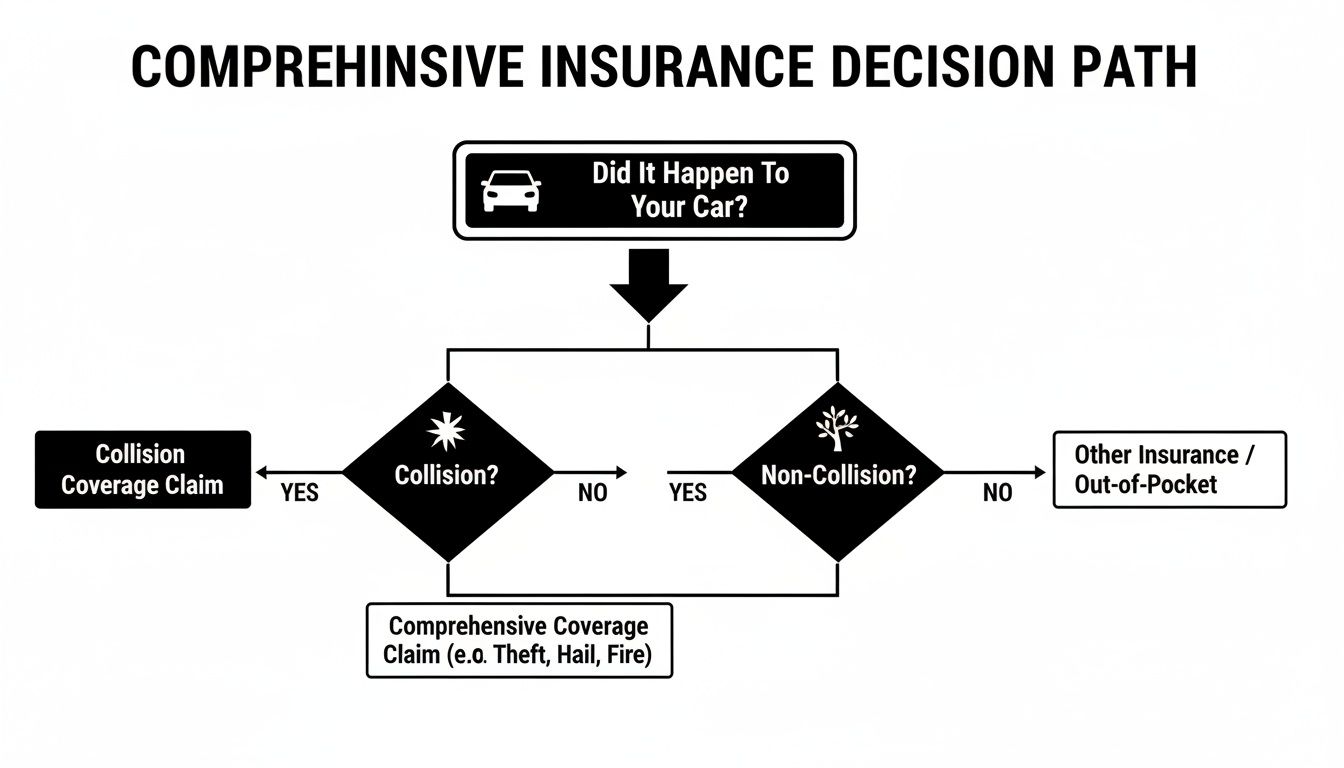
As the flowchart shows, the first question is always whether the damage happened to your car. From there, it branches out based on whether it was a collision or something else, pointing you to the right coverage.
Putting It Into Practice: Scenarios
To help make this distinction crystal clear, let's compare some real-world examples. Imagine your car is parked at a shopping center in Costa Mesa.
- Scenario 1: A freak windstorm whips through the parking lot, sending a heavy shopping cart barreling right into your passenger door. That dent? It's a comprehensive claim because a "flying object" caused the damage.
- Scenario 2: You're carefully backing out of your spot but misjudge the distance to a concrete light pole and crunch your bumper. That's a classic collision claim because your vehicle collided with a stationary object.
The cause of the damage is the dividing line. Grasping this simple concept is the key to understanding what comprehensive car insurance covers versus what it doesn't. You can dig deeper into how various policies interact in our collection of California insurance guides and resources.
To illustrate this further, here's a quick breakdown of common incidents and which policy would typically apply.
Coverage Breakdown: Comprehensive vs. Collision Scenarios
| Scenario | Applies to Comprehensive? | Applies to Collision? |
|---|---|---|
| You hit a deer that runs into the road. | Yes | No |
| Your car is stolen from your driveway. | Yes | No |
| A tree branch falls on your car during a storm. | Yes | No |
| You hit a patch of black ice and slide into a guardrail. | No | Yes |
| You accidentally back into a neighbor's mailbox. | No | Yes |
| Someone keys the side of your car. | Yes | No |
As you can see, the nature of the incident directly determines which part of your policy kicks in to cover the repairs.
Why Lenders Require Both Coverages
If you're financing or leasing your vehicle, you'll almost certainly be required by your lender to carry both comprehensive and collision coverage. Why the strict rule? It’s all about protecting their asset. Until you've paid off that loan, the bank or finance company is the legal owner of the car.
From their point of view, it doesn't matter if the car is totaled in a multi-car pile-up or stolen and never recovered—their investment has vanished. Requiring both policies as part of your California car insurance ensures they can get their money back no matter how the loss happens.
When you have liability, comprehensive, and collision all on one policy, people often call it "full coverage." While that’s not an official industry term, it’s become popular shorthand for a California auto insurance policy that protects against damage you cause to others and covers physical damage to your own vehicle.
How They Work Together For Full Protection
Comprehensive and collision are the two pillars that protect the actual value of your vehicle. The liability insurance that's legally required in California only pays for injuries and property damage you cause to other people. It does absolutely nothing to repair or replace your own car.
That's where these two coverages create a complete safety net. By adding them to your mandatory liability policy, you're covered whether you cause an accident, get hit by an uninsured driver, or your car is damaged by a wildfire. Each coverage has its own separate deductible, but together they create a powerful shield for your vehicle.
How Your Deductible Impacts A Comprehensive Claim
So, you know what comprehensive insurance covers. But what actually happens financially when you need to use it? This is where two key concepts come into play: your deductible and your policy limit. Getting a handle on these will help you understand what you pay versus what your insurer pays.
Think of your deductible as your share of the repair cost. It's the amount you agree to pay out of your own pocket before your insurance coverage kicks in to handle the rest.
The Deductible and Premium Balancing Act
Let's walk through a common California scenario. A nasty Santa Ana windstorm blows through, and a heavy tree branch crashes down on your car, leaving $3,000 worth of damage. If your comprehensive deductible is $500, here’s how it works:
- You pay the first $500 of the repair bill.
- Your insurance company then covers the remaining $2,500.
Simple, right? The tricky part is choosing that deductible in the first place. Your deductible and your premium—the fee you pay for your policy—are like a seesaw. When one goes up, the other usually goes down. A higher deductible means you're taking on more personal risk, so your insurer rewards you with a lower premium. A lower deductible means less out-of-pocket risk for you, which in turn means a higher premium for your car insurance.
Choosing a deductible is all about striking a balance. You need to weigh what you can comfortably pay for your premium against what you could realistically afford to shell out on short notice for a repair.
This trade-off between monthly cost and potential out-of-pocket expense isn't unique to California auto insurance. The health insurance market, for instance, operates on a very similar principle of shared financial risk. As that global market grows—projected to hit US$1.17 trillion by 2025—the relationship between deductibles and premiums is central to keeping coverage accessible. This structure is a fundamental way insurance protects people from catastrophic costs, especially in the U.S., which makes up about two-thirds of global health insurance premiums. You can dig deeper into global insurance trends on Statista.com.
Understanding Your Policy Limit: The ACV
After your deductible, the next piece of the puzzle is your policy limit. For comprehensive coverage, this limit is almost always your vehicle's Actual Cash Value (ACV).
Now, it's crucial to understand that ACV isn't what you paid for the car. It's what your car was worth in the seconds before it was damaged. This value accounts for depreciation, which includes its age, mileage, and overall condition.
Let's say your ten-year-old car gets stolen. The insurance payout won't be based on its original sticker price. Instead, it will be based on the going rate for a similar ten-year-old car in today's market. Your California insurance provider will calculate the ACV, subtract your deductible, and that final amount is the maximum you'll receive from the claim. Knowing this from the start helps set clear expectations if your car is ever totaled.
Deciding If You Need Comprehensive Insurance In California

Now that we’ve broken down what comprehensive insurance covers, we get to the real question: do you actually need it? While every driver in California has to carry liability coverage by law, comprehensive is technically optional. The catch? That's only if you own your car free and clear.
Making the right call here is all about taking a practical look at your car, your finances, and where you live. There's no single right answer for everyone, but asking yourself a few key questions will help you figure out if the premium is a smart investment for your California auto insurance or an unnecessary expense.
Lender Requirements First
Let's get the easy one out of the way first. If you’re leasing your vehicle or still making payments on an auto loan, the decision has already been made for you. Your lender or leasing company will almost certainly require you to carry both comprehensive and collision coverage.
It makes sense when you think about it. Until you've paid off that loan, the bank is the true legal owner of the car. They mandate "full coverage" to protect their asset from getting damaged, stolen, or totaled.
Weighing Your Car's Value Against The Cost
If you own your car outright, the decision lands squarely on your shoulders. The key here is to weigh your vehicle's Actual Cash Value (ACV) against the cost of the premium and your deductible. It's a simple cost-benefit analysis.
A good rule of thumb is this: if your comprehensive premium plus your deductible adds up to more than 10% of your car's value, you might want to think about dropping it.
Let's put that into perspective. Say your trusty old car is worth about $2,000. Your annual comprehensive premium is $150, and your deductible is $500. That means you're paying $650 to protect yourself against a maximum payout of $1,500 (the car's value minus your deductible). At that point, the math just doesn't add up for many people. You might be better off saving that premium for a rainy day.
California-Specific Risks To Consider
Beyond just the numbers, your personal risk level plays a huge role, especially here in California. Where you live, work, and park can dramatically change the odds of needing to file a comprehensive claim.
Think about your daily reality:
- Where do you park? Leaving your car on a busy street in downtown Los Angeles or San Francisco carries a much higher risk of theft and vandalism than tucking it away in a secure garage every night.
- What are the local crime rates? Some neighborhoods are, unfortunately, hotspots for car theft. A quick look at local crime statistics can be very revealing.
- Are you in a high-risk weather zone? California has its share of unique environmental threats. If you live in an area prone to wildfires, mudslides, or flash floods, comprehensive coverage is an essential financial shield.
At the end of the day, keeping comprehensive coverage is a personal financial decision. By looking at your car's value, your budget, and your local risks, you can make an informed choice that feels right for you. To see how these factors affect your premium, you can easily get a personalized insurance quote and compare your options side-by-side.
Expanding Your Protection Beyond Auto Insurance
Think of comprehensive auto insurance as just one piece of a larger puzzle. It’s fantastic at protecting your car, but true financial security comes from making sure all the important parts of your life are covered. Your California insurance policies should work like a team of specialists, each with a specific job, all contributing to your overall financial health.
This idea of building a complete safety net isn't just a local trend; it's a global one. The Organisation for Economic Co-operation and Development (OECD) tracks insurance penetration rates worldwide, and the numbers show a clear pattern. Among OECD countries, for instance, insurance penetration recently hit 6.2%, an increase from 6.0% the year before. This slow but steady climb shows that more people are realizing the importance of a solid insurance strategy to protect everything from their cars to their homes. You can discover more insights about global insurance trends from the OECD.
Connecting The Dots Between Policies
A smart financial plan doesn't just have insurance policies; it connects them. When each policy works in concert with the others, you close up the gaps that could otherwise lead to a major financial headache.
- Auto Insurance: Your comprehensive policy is the expert for physical damage to your car from things like theft, vandalism, or a nasty hailstorm.
- Home Insurance or Renters Insurance: This is basically comprehensive coverage for your personal belongings. If someone smashes your car window and steals your laptop, this is the policy that helps you replace it.
- Life Insurance: This policy provides the ultimate financial backstop, ensuring your family is taken care of if you're no longer around to provide for them.
It's all part of the same protective mindset. Comprehensive auto fixes your car after a tree branch falls on it, and home insurance fixes the roof that same branch damaged. If a thief steals your entire car, comprehensive helps replace it; if they just steal what's inside, a renters insurance policy has your back.
The goal is to create a seamless safety net. When you view your auto insurance, home insurance, and life insurance as interconnected parts of a single strategy, you move from simply insuring individual items to protecting your entire financial well-being.
Building Your California Insurance Strategy
Here in California, the risks are diverse—from break-ins in a busy city to the ever-present threat of wildfires. Taking a piecemeal approach to your insurance can leave you dangerously exposed.
Consider this classic scenario: a thief smashes your car window to grab the expensive camera you left on the seat. Your comprehensive auto policy will cover the broken window, but what about the camera? That's where a good renters or home insurance policy comes in. Without both, you’re only solving half the problem.
Understanding how these policies interact is the key to being fully protected. Many people are surprised to learn just how affordable it can be to safeguard their personal property. Our team can help you learn more about what a renters insurance policy in California can do for you.
At Mai & Associates, our licensed agents don't just sell policies. We look at your full California insurance picture—your car, your home, and your family—to craft a strategy that protects what matters most without straining your budget.
Answering Your Top Questions About Comprehensive Coverage
Car insurance can feel complicated, and it's natural to have questions. Let's clear up some of the most common things California drivers ask about comprehensive coverage. Getting these details straight will help you feel much more confident about your policy.
Will Making a Comprehensive Claim Jack Up My Rates?
This is probably the number one question on everyone's mind. The short answer is: probably not. Insurers see comprehensive claims—like a hailstorm denting your roof or hitting a deer—as things that were mostly out of your control. Because you weren't at fault, these claims are far less likely to cause a rate hike on your California car insurance than a collision claim where you caused the accident.
That said, it's not a complete "get out of jail free" card. If you file several comprehensive claims in a short span, your insurance company might start seeing you as a higher risk, and that could lead to a higher premium when your policy renews. But a single claim, especially for something minor like a cracked windshield, almost never moves the needle.
Is My Windshield Covered?
Yes, absolutely. Damage to your car's glass, especially the windshield, is a classic example of what comprehensive insurance is for. Whether it's a chip from a rock kicked up on the I-5 or a tree branch that shatters the whole thing, your policy has you covered.
In fact, many California insurers offer special glass coverage options, some even with a $0 deductible for simple repairs. They do this because it's cheaper to fix a small chip before it spiders into a huge crack that requires a full replacement. It’s a great, low-cost feature to ask about when you're shopping for your car insurance policy.
Pro Tip: When you file a glass claim, ask your agent if your policy covers OEM (Original Equipment Manufacturer) glass. This ensures your new windshield is the exact same quality as the factory original, which is critical for cars with modern safety cameras and sensors mounted on them.
What’s the Process for Filing a Claim?
Filing a comprehensive claim is usually pretty painless. The exact steps can differ slightly from one company to the next, but the overall process is designed to be simple and get your car fixed quickly.
- Document Everything: Right away (and once it's safe), grab your phone. Take lots of clear pictures and videos of the damage from every angle. If your car was stolen or vandalized, your first call should be to the police to file a report—your insurer will need that report number.
- Notify Your Insurance Company: You can usually kick off the claim online, through their mobile app, or by calling your agent directly. Have your policy number handy.
- Arrange for an Inspection: An adjuster will need to look at the damage. They might come to you, meet you at a body shop, or even have you submit photos through an app for a virtual estimate.
- Get Your Own Estimate: Remember, in California, you get to choose where you have your car repaired. It's always a good idea to get an estimate from a shop you trust to make sure it lines up with what the insurer is offering.
- Get it Fixed and Pay Your Deductible: Once the costs are approved, give your chosen shop the green light. When you go to pick up your fixed car, you’ll pay your deductible directly to them. Your insurance company handles the rest of the bill.
Knowing what your policy truly covers is the foundation of being financially protected. Whether you're looking to fine-tune your auto insurance, protect your house with a solid home insurance policy, or plan for the future with life insurance, getting the right advice is key.
The team at Mai & Associates is here to make it simple. We can help you compare quotes from California’s best carriers and put together an insurance plan that actually fits your life and your budget. Protect what you’ve worked so hard for—visit us at cahomeauto.com for a free, no-pressure quote today.