What Affects Car Insurance Rates and How to Lower Yours in California
Ever wonder why your car insurance premium is what it is? It can feel like a number pulled out of thin air, but it really comes down to a single concept: risk. From an insurer’s point of view, your premium is the price they charge to take on the financial risk of covering you and your vehicle.
It’s not random at all. Instead, it’s a carefully calculated figure based on a handful of core elements about you, your car, and your driving habits, especially for those seeking California insurance.
The Building Blocks of Your Car Insurance Rate
Think of your insurance rate as a unique puzzle. Each piece—your driving history, the car you drive, even your zip code—fits together to form a complete picture of your specific risk profile. Once you understand what these pieces are, you can start figuring out how to manage them and, ultimately, lower your costs for car insurance in California.
This chart gives a great high-level view of how these different categories come together.
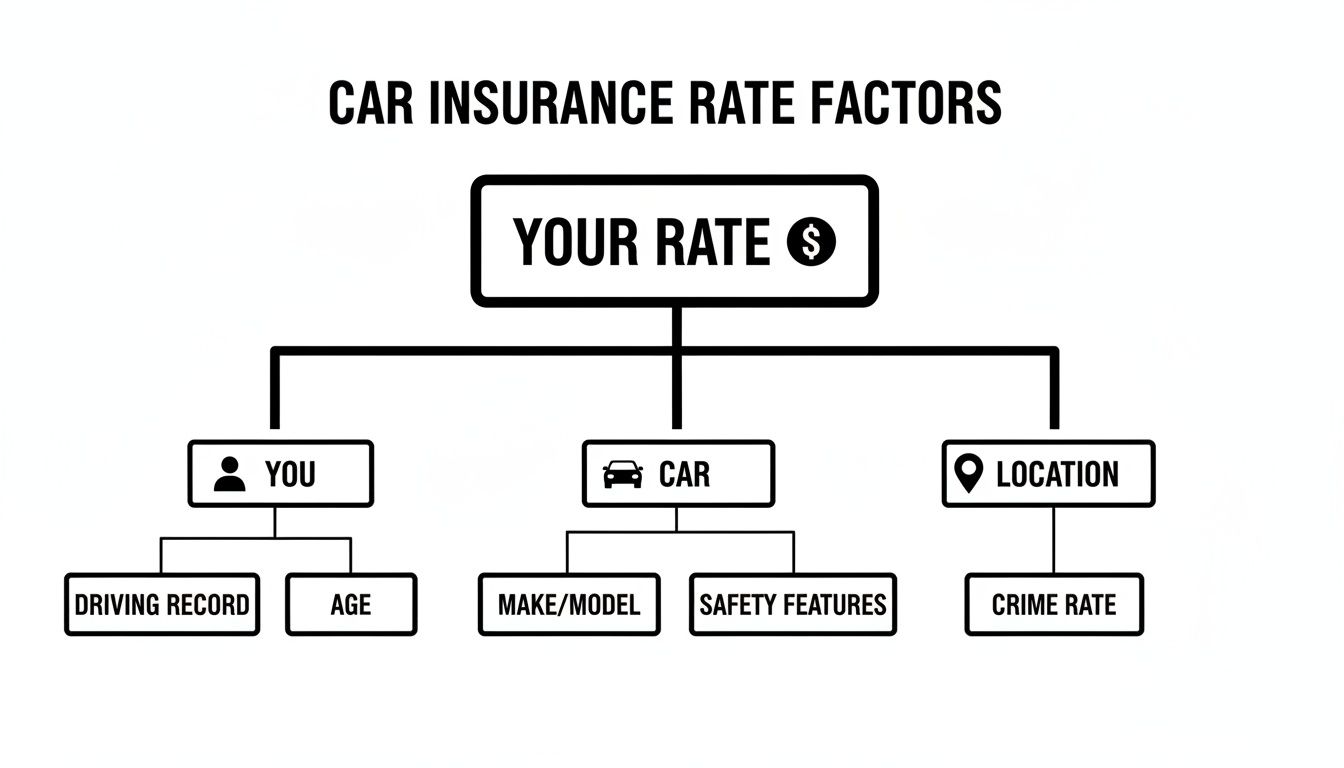
As you can see, it’s a mix of personal details, vehicle specs, and your location. No single factor determines your rate on its own; they all interact. This is exactly why you and your neighbor might pay wildly different premiums for what seems like identical coverage.
Let's take a closer look at the key factors that influence what you pay for car insurance. This table provides a quick summary before we dive into the details of each.
Summary of Key Factors Affecting Your Car Insurance Premium
| Factor Category | Specific Elements That Influence Your Rate |
|---|---|
| Driver Profile | Your age, gender, marital status, and years of driving experience. Crucially, this includes your driving record (accidents, tickets, and DUIs). |
| Vehicle Information | The car's make, model, year, and value. Also includes its safety ratings, repair costs, and theft likelihood. |
| Location | Where you primarily drive and park your car. This accounts for local traffic density, crime rates (theft/vandalism), and weather patterns. |
| Coverage Choices | The types of coverage you select (liability, collision, comprehensive) and the limits and deductibles you choose for each. |
Each of these categories contributes to the final premium you're quoted, and understanding them is the first step toward finding potential savings on your California insurance.
The 4 Core Factors Insurers Analyze
In California, insurers use a specific set of data to calculate your auto insurance premium. Unlike some other states, California law actually prohibits the use of your credit score in this calculation. Instead, the focus is squarely on factors directly related to driving.
Here are the four primary areas we’ll break down in this guide:
- Your Personal Profile: This is all about you as a driver. Your age and years behind the wheel are big ones, but nothing matters more than your driving record. A clean history with no accidents or tickets shows you're a low-risk driver.
- Your Vehicle: The car itself plays a huge role. A brand-new luxury sports car is going to cost a lot more to insure than a 10-year-old sedan. Why? Because its repair costs are higher and it's a bigger target for theft.
- Your Location: Where you park your car at night matters. Densely populated cities like Glendale or Los Angeles typically have higher rates than quiet, rural towns because there's more traffic, a higher accident frequency, and more potential for crime.
- Your Coverage Choices: This is the part you have the most direct control over. The types of coverage you buy and the limits you set have a major impact. Opting for higher liability limits or adding comprehensive and collision will increase your price, but it also gives you far more financial protection.
Navigating these factors can feel overwhelming, especially when trying to find the best value. An independent agency like Mai & Associates works with drivers across California—from Costa Mesa to Escondido—to compare quotes from different carriers. We help you find that sweet spot between solid protection and a price that fits your budget for all types of California insurance, including auto insurance, home insurance, and renters insurance. For more in-depth explanations, feel free to explore our other helpful insurance guides.
How Your Personal Profile Shapes Your Premium

When an insurance carrier sets out to quote you a car insurance premium, the first thing they look at is... you. It’s a bit like applying for a loan; the lender wants to understand who they're working with before they hand over the money. Insurers are doing the same thing, but instead of lending money, they’re assessing the risk they’ll take on by covering you.
This collection of personal details—your driver profile—is the starting block for your rate. These factors help an insurer predict how likely you are to file a claim. While you can’t change some of these things, others, like your driving history, are entirely in your hands. Getting a handle on how this works is the first real step to lowering your California insurance bill.
Age and Driving Experience
Age is one of the heaviest hitters in your profile because it's the clearest stand-in for experience. It isn't personal; it's purely statistical. Decades of data show that younger, less experienced drivers are simply involved in more accidents than older drivers who have spent more time on the road.
A teenage driver, for instance, is seen as a higher risk because they're still learning to spot hazards and react to the unexpected chaos of the road. This is why their auto insurance premiums are often some of the highest you'll see.
On the flip side, drivers in their 40s and 50s usually get a break on their rates. With years of experience under their belts, they are statistically safer and more cautious—a fact that translates directly into savings.
Marital Status and Your Rate
Here’s a small but interesting one: in many states, getting married can actually nudge your car insurance premium down. Why? Because carrier data suggests that, on average, married couples file fewer claims than single people.
It’s not going to be a massive discount, but it's another piece of the puzzle that insurers fit together to build your unique risk profile.
Your Driving Record: The Most Powerful Factor
Now for the big one. Of all the personal details that go into your premium, nothing holds more weight than your driving record. This is your report card as a driver, and it gives insurers a clear picture of your habits behind the wheel. A clean record is your golden ticket to the best rates.
On the other hand, just a couple of missteps can send your premium soaring.
- Speeding Tickets: A single ticket signals risky behavior and can cause a rate increase. Get a few, and you’re looking at a significant price jump.
- At-Fault Accidents: If you cause an accident, your rate will almost certainly skyrocket. It’s a direct and undeniable indicator of risk that insurers take very seriously.
- DUIs or DWIs: A conviction for driving under the influence is the most severe violation you can have. It will make finding affordable coverage extremely difficult and will inflate your premium for years to come.
Your driving record is a powerhouse in determining car insurance rates, with a single at-fault accident spiking premiums by 40-50% on average. Clean records save big—drivers with no violations pay up to 30% less than those with DUIs or speeding tickets.
This data, highlighted in reports from sources like ConsumerAffairs.com, shows just how much direct control you have. Your actions on the road have a very real, dollar-for-dollar impact on what you pay for auto insurance in California.
Prove Your Safe Driving with Telematics
What if you could give your insurer a real-time look at how safe you actually are on the road? That's the whole idea behind telematics. These are optional, usage-based insurance programs that many carriers now offer.
By using a small device you plug into your car or an app on your smartphone, you allow the insurer to monitor your actual driving habits—things like how smoothly you brake and accelerate, your average speed, and what times of day you're on the road. This data gives them a much more accurate picture of your personal risk than broad statistics ever could.
For genuinely safe drivers, these programs can unlock some serious discounts, putting you in the driver's seat of what affects your car insurance rates. If you want to get more familiar with this and other key concepts, our full glossary of insurance terms is a great resource.
Why Your Car and Zip Code Heavily Impact Your Rate

While your driving history and personal details create a baseline, your final premium comes down to two things many people overlook: the specific car you drive and the neighborhood where you park it. Think of your car insurance rate as a story—and your car and your zip code are two of the main characters.
Insuring a brand-new, high-performance sports car is a lot like insuring a priceless painting; the risk (and cost) is high. On the other hand, covering a reliable family sedan is more like insuring a trusty toolbox—it's essential, but the financial risk is much lower. Let's dig into how your ride and your address really shape what you pay.
How Your Vehicle Drives Your Premium
The car you choose is a massive piece of the insurance puzzle. Carriers aren’t just looking at the sticker price; they’re analyzing the vehicle’s entire "risk profile" to predict how likely you are to file a claim and how much that claim might cost.
It’s no surprise that a new sports car with a roaring engine will cost more to insure than a five-year-old minivan with top-tier safety ratings. The reasons for this are purely statistical.
- Repair Costs: This is a big one. High-end vehicles, luxury brands, and sports cars are built with expensive parts and need specialized technicians to fix them. A simple fender-bender in a BMW can easily cost thousands more to repair than the same accident in a Toyota. Insurers have to charge more to cover that potential payout.
- Theft Rates: Some cars are just hot targets for thieves. If your model consistently ranks on the most-stolen vehicles list, your comprehensive coverage premium will be higher to offset the greater risk of it disappearing one day.
- Safety Features: Here’s where you can save. Cars with excellent crash-test ratings and modern safety tech, like automatic emergency braking or blind-spot monitoring, can earn you a nice discount. Insurers have seen the data—these features prevent accidents and reduce injuries, which saves them money.
Beyond the standard features, adding things like advanced car security systems can also help chip away at your premium.
The Special Case of Electric Vehicles (EVs)
Electric vehicles are an interesting new wrinkle for auto insurance. They often come loaded with the latest safety technology, which is great. However, their repair costs can be surprisingly high. That specialized battery pack, all the sensors, and the complex electronics are not cheap to replace, and not every shop has technicians trained to work on them.
This means that while your EV is saving you money at the pump, it might actually lead to a higher insurance bill than a similar gas-powered car. As more EVs hit the road, insurance carriers are constantly updating their calculations to price them accurately.
Why Your California Zip Code Is a Major Factor
Where you live is just as important as what you drive. A driver in a packed urban center like Los Angeles will almost always pay more than someone in a quiet, rural California town. This isn't personal; it's all based on the collected data for your specific area.
Location dramatically sways car insurance rates, with California drivers facing a projected 6.13% hike in 2026. Urban hotspots like Los Angeles see 20-30% higher premiums than rural areas due to theft, accidents, and congestion.
Insurers slice and dice claim data by zip code, looking for trends in:
- Traffic Density and Accidents: Simply put, more cars on the road means a higher chance of a collision. Busy cities and congested suburbs just have more claims per person.
- Crime Rates: If your zip code has a high rate of car theft and vandalism, you can bet your comprehensive premium will be higher to reflect that risk—even if your own car has never been touched.
- Weather and Natural Disasters: In California, this is a growing concern. Living near a high-risk wildfire zone, like certain areas around Escondido or Costa Mesa, can push up rates for the whole region. Insurers have to prepare for catastrophic events that cause a huge surge in claims, and they do that by adjusting local premiums.
The difference can be shocking. For instance, data consistently shows that urban areas have a much higher density of claims, which drives up the average cost for everyone there. You can get a deeper look at how to secure the right auto insurance in Los Angeles in our dedicated guide. Ultimately, your location sets the stage, and your personal and vehicle details fine-tune the final price.
The Economic Forces Driving Insurance Rates Up for Everyone
It’s one of the most common frustrations we hear from clients: you’ve kept a perfect driving record, haven’t had an accident in years, and avoided tickets like the plague, yet your car insurance bill still creeps up. This isn't a mistake. It’s a clear sign that larger economic forces are at play, impacting every driver on the road, including all of us here in California.
Think of it like your favorite local restaurant suddenly raising its prices. The owner hasn’t changed a thing about the food or the service you love, but the cost of ingredients, labor, and rent has shot through the roof. To stay in business, they simply have to pass some of those costs along. Insurance carriers are in a very similar boat.
Inflation: The Silent Rate Hiker
The biggest single factor pushing premiums up for everyone is inflation. When the cost of everything from groceries to gasoline rises, it directly inflates how much an insurer has to pay out for claims. This economic ripple effect is a key reason what affects car insurance rates isn't always something within your personal control.
This inflationary pressure is a major force, driving the average annual premium in the U.S. to $1,760 in 2026—a significant 15% jump from the year before. That’s not just an abstract number; inflation touches every part of a claim, from fixing a dented bumper to covering medical bills. If you want to take a closer look at these trends, you can discover more about why car insurance is getting more expensive.
An insurer's financial health depends on its ability to cover future claims. When the expected cost of those claims rises due to inflation and supply chain issues, they must adjust premiums for everyone to remain solvent.
These widespread cost increases mean that even if your personal risk profile hasn't changed one bit, the potential cost to your insurer has. They have to adjust rates to cover the more expensive reality of paying for today's claims.
The Soaring Cost of Repairs and Parts
When you file a claim for vehicle damage, your insurer is the one paying the body shop's invoice. In just the last few years, those repair bills have skyrocketed. This trend is a direct contributor to higher auto insurance premiums for everybody.
Here’s a breakdown of why:
- Supply Chain Disruptions: Lingering global supply chain snags have made it much harder and more expensive to get critical car parts, from microchips to basic body panels.
- Advanced Technology: Today's cars are essentially computers on wheels, packed with sensors, cameras, and advanced safety systems. A simple fender-bender that once required a new bumper might now involve recalibrating a dozen sensitive and costly electronic systems.
- Labor Shortages: A nationwide shortage of skilled auto technicians means repair shops have to pay higher wages to attract talent. That cost gets passed on to the insurer and, eventually, to you.
These factors have created a perfect storm, making car repairs far more expensive than they were just a short time ago. It’s a critical piece of the puzzle in what affects car insurance rates across the entire market.
Medical Expenses and Legal Costs
It’s not just car parts getting more expensive; the cost of medical care continues to climb year after year. If an accident results in injuries, your car insurance policy is on the hook to cover everything from emergency room visits to long-term physical therapy.
As healthcare costs inflate, so does the potential payout for any bodily injury claim. Insurers have to analyze these trends and adjust their rates to make sure they have enough funds to cover these larger potential expenses. When you add in the rising legal fees often associated with accident claims, the financial risk for insurers grows, forcing rate adjustments that affect every single driver.
Actionable Strategies to Lower Your California Car Insurance
Understanding the 'why' behind your car insurance premium is one thing, but actually lowering it is another. The good news is you have more control than you think. You don’t have to just accept a high rate as a fixed cost of driving in California.
By making a few smart adjustments, you can put real money back in your pocket without compromising on the protection you and your family need. Let's walk through the most effective strategies we use every day to help drivers save.
Fine-Tune Your Coverage and Deductibles
The most direct path to a lower premium is right inside your policy documents. Think of your coverage as a menu—you can customize your order to fit your appetite and your budget. You don't have to get the most expensive item if a more modest choice will do.
Here’s what to look at first:
- Re-evaluate Your Liability Limits: You absolutely need enough liability coverage to protect your assets if you're at fault in an accident. But are you over-insured? We can help you review your limits to ensure they align with your actual financial picture, not just a generic recommendation.
- Drop Collision & Comprehensive on Older Cars: Is your trusty car paid off and worth only a few thousand dollars? If so, paying for full coverage might not make financial sense anymore. A good rule of thumb: if the car’s value is less than your deductible plus a year's worth of coverage cost, it's probably time to switch to liability-only.
- Raise Your Deductible: This is one of the quickest ways to see an immediate drop in your premium. Your deductible is simply the amount you agree to pay out-of-pocket on a claim before your insurance pays the rest. By increasing it from, say, $500 to $1,000, you’re telling the insurer you'll handle smaller claims yourself. They see this as lower risk and reward you with a lower rate.
Hunt Down Every Available Discount
Insurance companies have a whole host of discounts, but they’re not always great about advertising them or applying them automatically. You often have to ask. These little savings can really stack up, making a big dent in your California insurance bill.
Make sure you're not leaving these common discounts on the table:
- Good Driver Discount: This is a big one. A clean record for three or more years (no accidents or tickets) should earn you a significant price break.
- Good Student Discount: If you have a young driver on your policy, their hard work at school can pay off. A 'B' average or better usually qualifies them for a solid discount.
- Defensive Driving Course: Completing a state-approved defensive driving course shows the insurer you're a proactive, safer driver, which can trim your premium.
- Vehicle Safety Features: Modern cars are packed with safety tech. Features like anti-lock brakes, airbags, and anti-theft systems all help reduce your rate. Even something as simple as installing a car alarm can lower your comprehensive premium by making your car a less attractive target for thieves.
- Low Mileage Discount: Don't drive much? Make sure your insurer knows! California's insurance pricing is heavily influenced by how many miles you drive each year. The fewer miles, the lower your rate.
- Professional and Affinity Discounts: Many carriers offer special pricing for members of certain groups, like alumni associations, credit unions, or specific professions (teachers, engineers, first responders, etc.).
Bundling is almost always the king of discounts. When you combine your auto insurance with a home insurance or renters insurance policy from the same company, you can often slash up to 25% off both premiums.
The following table breaks down some of the most effective strategies you can use to start saving today.
Actionable Strategies to Reduce Your Auto Insurance Premium
| Strategy | How It Works | Potential Savings | Best For |
|---|---|---|---|
| Increase Deductibles | You agree to pay more out-of-pocket for a claim, reducing the insurer's risk. | 5% - 20% | Drivers with a healthy emergency fund who can comfortably cover a higher deductible. |
| Bundle Policies | You combine auto with home, renters, or life insurance with one carrier. | Up to 25% | Homeowners, renters, and anyone with multiple insurance needs. |
| Shop Around Annually | Rates change constantly. An independent agent compares multiple carriers for you. | $100 - $500+ | Everyone. Loyalty doesn't always pay; the market is always shifting. |
| Improve Your Credit | In many states, a better credit score signals financial responsibility and lowers rates. | Varies widely | Drivers who have been actively working to improve their credit history. |
| Ask for All Discounts | Proactively ask your agent to check for every discount you might qualify for. | 5% - 15% | Everyone, especially drivers with safe vehicles, good students, or low mileage. |
| Reduce Coverage | On older, low-value cars, dropping collision and comprehensive saves a lot. | Significant | Drivers with older, paid-off vehicles that would be inexpensive to replace. |
By being proactive and exploring these options, you're not just accepting a quote—you're actively shaping it to fit your needs and budget.
Partner with an Independent Agency Like Mai & Associates
Trying to shop for California insurance by yourself can feel like a part-time job. You spend hours filling out forms on different websites, only to get a flood of calls and emails, and you're still not sure if you found the best deal. This is where working with an independent agency like Mai & Associates changes the game.
Unlike a "captive" agent who works for a single company (like State Farm or Farmers), we work for you. We represent dozens of top-rated insurance carriers, giving us a complete view of the market.
Here’s the advantage of that approach:
- One-Stop Shopping: You give us your information once. We do all the legwork, shopping your policy across our network of carriers to find the one that offers the best coverage for the most competitive price.
- Uncovering Hidden Savings: We're experts in this field. We know which companies favor certain driver profiles and which ones offer niche discounts you'd never find on your own. We match you with the carrier that's the best fit for your specific situation.
- Expert Bundling Advice: We don’t just tick a "bundle" box. We strategically find the carrier that gives you the absolute biggest savings for combining your auto insurance and home insurance. We can also loop in renters insurance or even life insurance to maximize your multi-policy discounts.
Stop overpaying and leaving money on the table. If you're ready to see how much you could be saving, let our team do the hard work for you. Get a personalized insurance quote from our team today, and we'll make sure you're getting the best possible coverage at the best possible price.
Frequently Asked Questions About Car Insurance Rates
When it comes to auto insurance, it feels like the questions about cost never end. We get it. That’s why we’ve pulled together the most common questions we hear from California drivers, with straightforward answers from our years of experience in the industry.
Let's clear up some of the confusion around how your premiums are actually set.
Why Did My Car Insurance Go Up with a Perfect Driving Record?
This is easily the most frustrating situation for a safe driver, and we hear this question all the time. You’ve done everything right—no tickets, no accidents—yet your renewal came with a higher price tag. What gives?
More often than not, the reason has nothing to do with you personally. It’s about bigger economic trends. Right now, inflation is driving up the cost of everything. Car parts are more expensive, repair shop labor costs have risen, and medical care after an accident costs more than ever. When an insurer's cost to settle claims increases, they have to adjust rates for everyone just to stay afloat.
On top of that, your local area plays a huge role. If your zip code has seen a spike in car thefts, fender benders, or even widespread damage from California's wildfires, insurance companies see that as a higher risk. They adjust rates for the entire area to cover potential losses. Your perfect record is still saving you a ton of money compared to your neighbors, but you aren't completely immune to these broader market shifts.
Does My Credit Score Affect My Car Insurance Rate in California?
No, it does not. This is a huge deal for California residents and something many people don't realize. California is one of the few states that has banned insurers from using a driver's credit history to set their rates for personal auto policies.
In most other states, a poor credit score is seen as a red flag that you're more likely to file a claim, leading to much higher premiums. But California law forces insurers to focus on factors that are actually related to your driving.
In California, the law requires insurers to prioritize these three factors above all others:
- Your driving record.
- Your average annual mileage.
- Your years of driving experience.
This is a powerful consumer protection that ensures your rate is a reflection of how you drive, not your personal finances. It’s a key reason why what affects car insurance rates in the Golden State is so different.
How Much Can I Save by Bundling My Auto and Home Insurance?
Bundling your auto insurance with another policy from the same company—like home insurance, renters insurance, or even life insurance—is one of the fastest and most reliable ways to get a significant discount.
Most carriers offer a multi-policy discount that can slash your bill by anywhere from 5% to 25%. For the average Californian, that can easily add up to hundreds of dollars in savings each year. The logic is simple: insurance companies want to keep your business, and they're willing to offer a great price to earn more of it.
At Mai & Associates, we often find that bundling two policies with one company is way cheaper than buying them from two separate providers. We can run the numbers across dozens of carriers to find the bundle that gives you the biggest bang for your buck.
Will Switching Insurance Companies Hurt My Rates?
Not at all. In fact, it’s one of the smartest things you can do. Regularly shopping around for your auto insurance is a great financial habit that prevents you from unknowingly overpaying year after year.
The insurance marketplace is always changing. The company that was most expensive for you last year might have updated its pricing and could be the cheapest option this year. There's no penalty or black mark on your record for switching.
The one golden rule is to never let your coverage lapse. Make absolutely sure your new policy is active before you cancel your old one. Even a one-day gap can flag you as a higher-risk driver and cause your rates to spike. An independent agent can manage this whole process for you, ensuring a smooth and seamless transition with no gaps.
At Mai & Associates, we specialize in helping Californians find the right coverage at the right price. From auto insurance and home insurance to renters insurance and life insurance, our team is here to do the shopping for you, ensuring you get every discount you deserve. To get started, compare your rates with a free, no-obligation quote from Mai & Associates.