Your Guide to Vacation Home Insurance in California
You finally got the place.
Maybe it's a Tahoe cabin you'll use on long weekends. Maybe it's a Palm Springs retreat with a pool and mountain views. Maybe it's a small coastal condo you plan to keep in the family for years. However it looks, the feeling is the same. Pride, relief, and then a quick realization that this home needs its own insurance strategy.
A second home in California doesn't fit neatly into the same policy logic as your primary residence. It sits empty for stretches. It may be in a wildfire area, near a fault line, or in a community where storms and delayed repairs create bigger losses than you'd expect. And in a market where Rate.com reported a national average annual homeowners premium of $2,072 in 2024, up 20% from 2023, getting the policy right matters even more.
Protecting Your California Dream
The most common mistake new second-home owners make is assuming the insurance part will be simple. They already have a home policy, so they expect the new property to work the same way.
It usually doesn't.
A vacation home has a different risk profile from day one. If nobody is there for weeks, a small leak can turn into a major repair before anyone notices. If a wind event damages the roof, that damage may sit longer than it would at your primary home. If the home is in the mountains, desert, or near the coast, the insurer looks closely at weather exposure, fire response, and rebuild logistics.
Why California changes the equation
California makes vacation home insurance more technical because the risks stack together. A home near forested terrain raises wildfire questions. A home in an older neighborhood may raise rebuilding-cost questions. A home in a scenic area may be harder and slower to repair after a loss.
That's why vacation home coverage is no longer treated like a casual add-on. Insurers increasingly separate homes by personal use, seasonal use, and rental use, and that distinction affects what policy form you need, what exclusions apply, and how a claim gets handled.
A vacation home is still a home. But from an underwriting standpoint, occupancy patterns matter almost as much as the building itself.
What owners usually worry about first
Most buyers ask one question first: “Will this policy cost more than my primary-home coverage?”
Often, yes. But cost is only part of the issue. The bigger concern is whether the policy matches how you use the property.
A useful way to think about it is this:
- Primary residence coverage assumes regular occupancy and quicker discovery of problems.
- Vacation home insurance assumes longer gaps between visits, different liability concerns, and often more location-driven risk.
- Rental use changes the analysis again because paying guests create a different exposure than family or friends.
That's why a second-home owner in California needs more than a basic declarations page. You need a policy that reflects vacancy, local hazards, rebuilding costs, and whether anyone outside your household ever stays there.
What Exactly Is Vacation Home Insurance
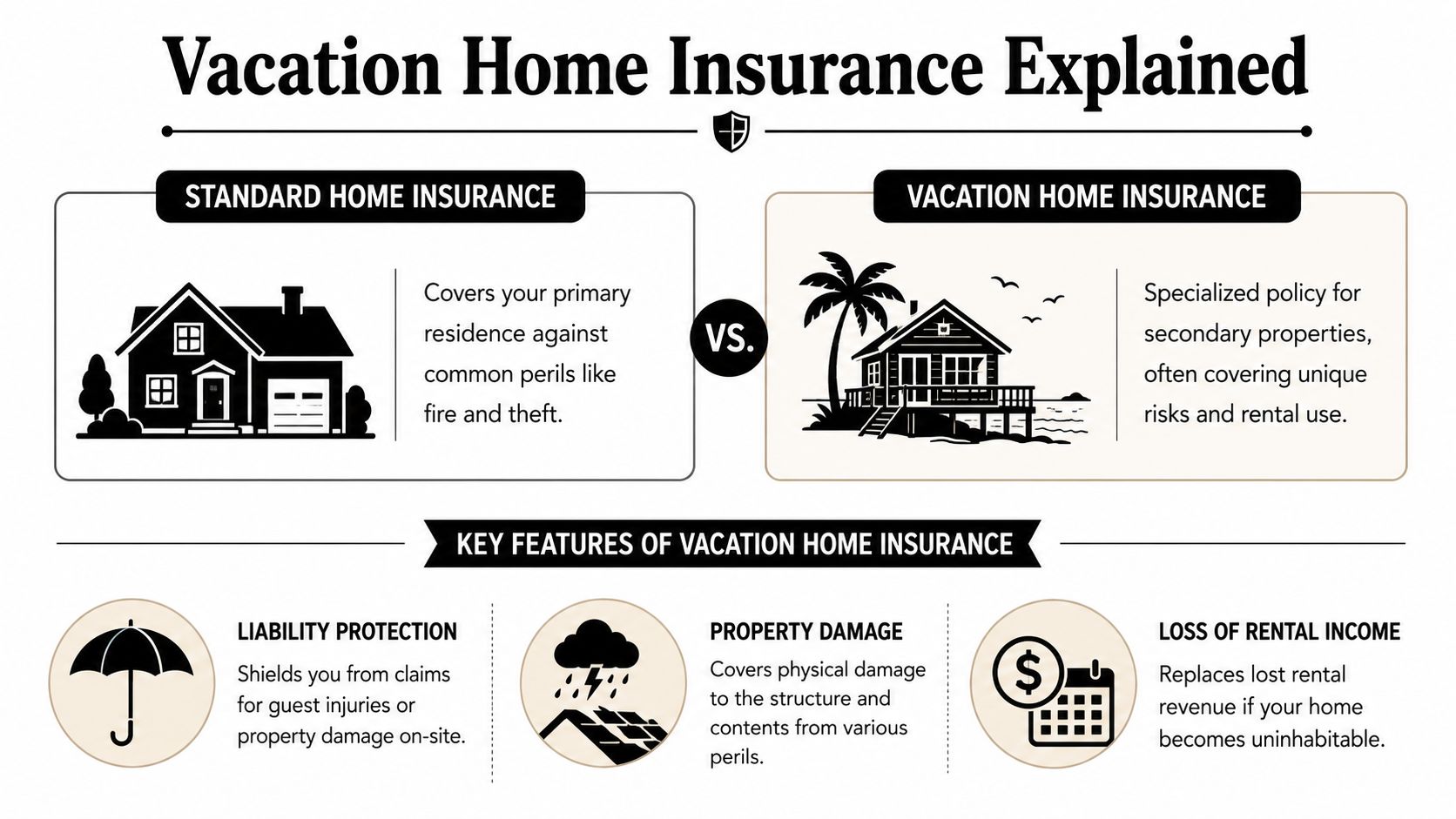
Vacation home insurance is a policy built for a property you don't live in full time. It protects the structure, your belongings at that location, and your liability if someone gets hurt there. But the details can look different from the standard homeowners policy on your primary residence.
Some second homes are insured with policy forms that look more like landlord or dwelling coverage than owner-occupied homeowners coverage. That's where many buyers get confused.
HO-3 vs DP-3 in plain English
A primary residence is often insured on an HO-3 policy. A vacation home is often written on a DP-3 or another dwelling-style form, depending on occupancy and insurer rules.
The easiest analogy is restaurant ordering.
- Named peril coverage works like ordering à la carte. The policy covers the events specifically listed.
- Open peril coverage works more like a prix-fixe menu. The policy covers causes of loss unless they're specifically excluded.
That difference matters because two policies can both say they insure a house, but one may respond to a much narrower set of problems.
Where replacement cost matters most
If you have a mortgage, your lender will care less about what the home could sell for and more about what it would cost to rebuild. Fannie Mae requires insurance of at least the lesser of 100% of current replacement cost of improvements or the unpaid principal balance, provided that balance is at least 80% of replacement cost, and it caps required deductibles at 5% of the coverage amount.
In practical terms, that means a vacation home can be fully paid for in market value terms and still be underinsured for reconstruction. In California, that gap can get worse after renovations, labor inflation, or local code changes.
For broader guidance on homeowners coverage basics, see this overview of California home insurance options.
Primary home vs vacation home coverage
| Coverage Area | Primary Home (HO-3) | Vacation Home (DP-3) |
|---|---|---|
| Occupancy assumption | Owner lives there full time | Home may be seasonal, part-time, or intermittently occupied |
| Policy intent | Personal residence protection | Secondary-property protection, often with stricter use rules |
| Structure coverage | Typically broader owner-occupied form | Often tailored to dwelling and occupancy risk |
| Personal property | Usually built around everyday household use | May be more limited or structured differently |
| Liability | Personal liability for resident household | Liability depends heavily on occupancy and guest use |
| Rental activity | Usually not designed for regular rental use | May require endorsement or separate rental-focused coverage |
Quick check: Ask whether the home is insured for replacement cost, whether the form is named peril or open peril, and whether short-term guest stays are allowed under the policy.
The Unoccupied Risk Why a Separate Policy Is Non-Negotiable
If you strip away all the insurance language, one issue drives most of the difference between a primary-home policy and vacation home insurance.
It's vacancy.
Insurers know an empty home behaves differently in a claim. Not physically, of course. But the timeline changes. A pipe can leak longer. A break-in can go undiscovered. Wind damage can let water in before anyone arrives to cover the roof. Even a simple maintenance issue can become a much bigger repair bill when nobody is checking the property.
Why insurers focus on empty time
Vacation homes often sit unused for long stretches, especially in shoulder seasons. That makes the insurer ask questions your primary-home carrier may never emphasize.
They want to know:
- How often you visit
- Whether someone checks the home
- Whether utilities stay on
- Whether the property is winterized
- Whether the home is ever rented to others
Those details affect both pricing and eligibility.
The part many owners miss
Vacancy isn't handled the same way by every insurer. Some carriers may accept six or seven months of vacancy, while others won't, according to industry guidance summarized by IASTL. That means there isn't one universal rule you can safely assume.
People often get into trouble because they hear “vacant” and think it only refers to an abandoned property. In insurance, a clean, furnished, well-kept second home can still trigger vacancy concerns if it sits empty long enough.
If a claim happens during a period the carrier considers excessive vacancy, the policy language matters more than your intentions.
A separate vacation home policy is what aligns the insurance contract with the way the property is used. Without that match, the risk isn't just paying more later. The risk is discovering after a loss that the home didn't qualify for the coverage you thought you had.
Navigating California's Unique Insurance Landscape
A vacation home in California has risks that owners in many other states don't face in the same combination. For a second home, those risks are harder to manage because the property isn't occupied every day.
That's why California owners need to think beyond the standard structure-and-liability conversation.
Wildfire can affect both price and availability
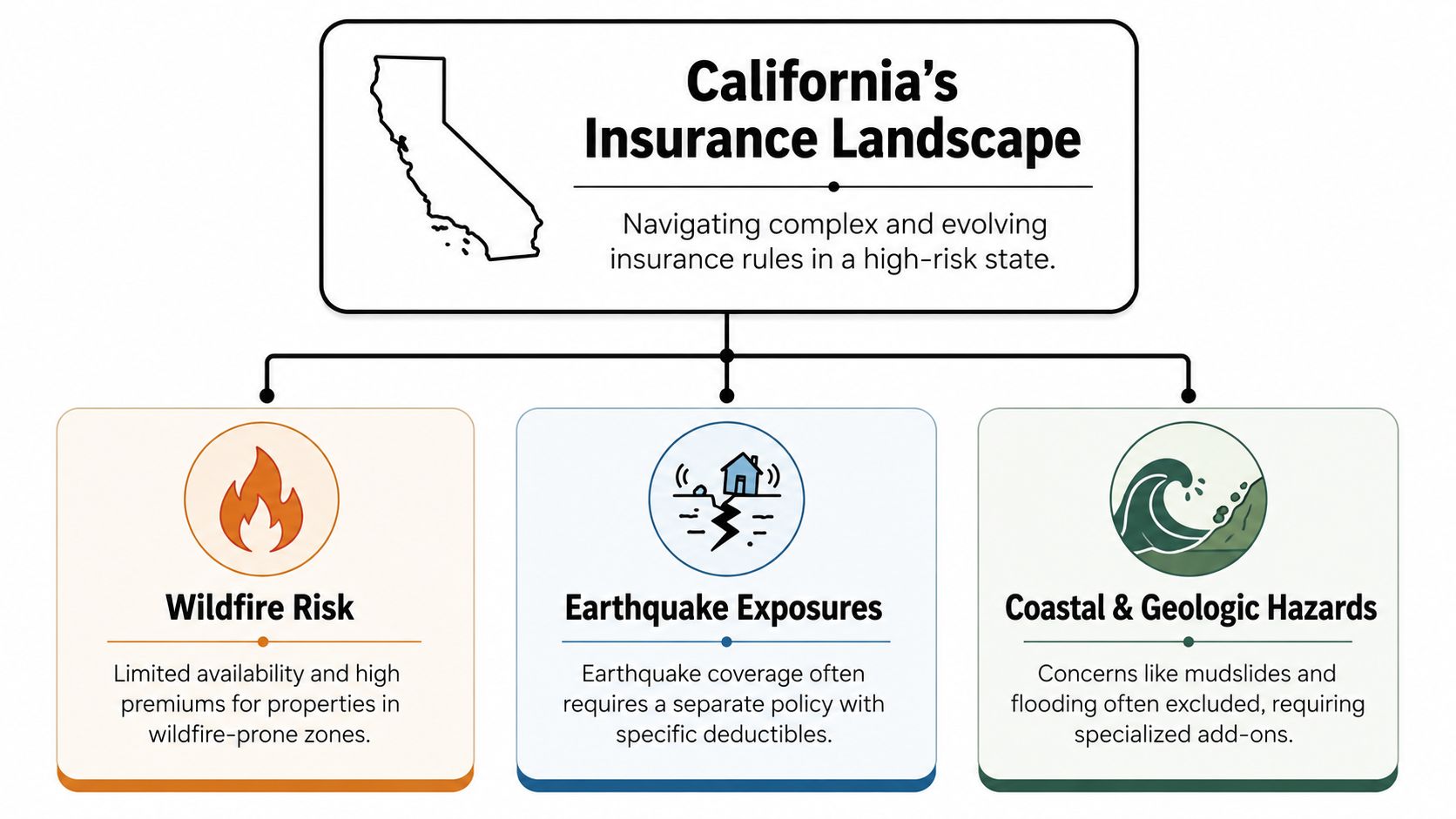
In many parts of California, wildfire risk changes the shopping process before you even compare deductibles. Some homes face limited private-market options. Others may only qualify through layered solutions or a California FAIR Plan structure paired with separate coverage to fill important gaps.
A second home in a wooded area, canyon area, or foothill community often gets closer review because the insurer is considering access, vegetation, rebuild complexity, and how long the home may be unattended.
If your property is in Northern California or another urban market with nearby brush exposure, this guide to San Francisco home insurance coverage is a useful starting point for understanding local policy issues.
Earthquake is not part of standard home coverage
This catches many buyers off guard. Standard home policies generally don't cover earthquake damage. If your vacation property is exposed to quake risk, that protection usually has to be purchased separately.
That doesn't mean every owner needs the same earthquake setup. The right approach depends on the home's construction, location, foundation type, and your ability to absorb a large out-of-pocket loss.
Flood and mudslide questions need direct answers
Owners often assume “water damage” means all forms of water are covered. It doesn't.
Flood is generally a separate issue. Mudslide and earth movement can also be excluded or restricted depending on the policy language and the cause of loss. In California, that becomes especially important after wildfire, when hillsides can become unstable and runoff can create damage patterns homeowners didn't anticipate.
The California review every owner should request
For a vacation property here, ask an agent to walk through these points specifically:
- Wildfire market access. Are you being quoted in the private market, through a FAIR Plan arrangement, or through a layered package?
- Earthquake options. Is separate coverage available, and do the deductibles fit your risk tolerance?
- Geologic exclusions. Does the policy clearly explain what happens with flood, earth movement, and post-fire slope issues?
- Rebuild practicality. Will the dwelling limit make sense if contractors, permits, and debris removal all cost more than expected?
California vacation homes need more than a “good enough” policy. They need a policy reviewed against the actual hazards of the property's location.
Insuring Your Vacation Home as a Short-Term Rental
A lot of owners buy a second home for personal use, then later decide to list it a few weekends a month on Airbnb or Vrbo. That sounds like a small change. From an insurance standpoint, it's not.
The moment paying guests enter the picture, you've shifted from occasional personal occupancy to a form of hospitality exposure. A standard vacation home policy may not be designed for that.
Where the biggest gaps show up
Liability is usually the first issue. If a guest slips on stairs, gets injured near a pool, or claims the property was unsafe, the insurer will look closely at whether the home was disclosed as a rental property.
Property damage is the next problem. Guest-caused damage doesn't always fit the same way owner-caused accidental damage would. And if the home becomes unusable after a covered loss, owners may also care about lost booking income.
Policygenius notes that if a second home is rented out, additional landlord or short-term rental coverage may be required as part of the risk-based approach insurers use for these homes.
Long-term tenant coverage is not the same thing
People often hear “landlord policy” and assume that solves everything. Sometimes it doesn't.
A landlord setup is generally built around longer occupancy and more stable tenant arrangements. A short-term rental creates faster guest turnover, more frequent access by non-household occupants, and a different liability pattern. That's why you need to ask for coverage built for actual rental use, not just “something close.”
For a practical outside resource, Global's short-term rental insurance insights do a good job of outlining where host assumptions can break down.
One more exposure people forget
Short-term rental owners often focus on the house itself and ignore the personal property inside it. Furniture, appliances, electronics, linens, and decor are part of the risk too.
If you're furnishing the property for guest use, it also helps to think through what would happen if damage made the unit unlivable and a guest stay had to be canceled. Insurance and rental operations intersect more than most owners expect. If you also want to understand how personal-property protection works for occupants in different living situations, this overview of California renters insurance gives useful context.
How Vacation Home Insurance Costs Are Calculated
Vacation home insurance usually costs more than insurance on your main residence because the insurer is pricing a home that may sit empty, may be harder to monitor, and may be located in an area with concentrated weather or catastrophe exposure.
Policygenius notes that some carriers estimate these policies can be two to three times more costly than primary-home coverage because of vacancy risk and delayed discovery of maintenance issues in second homes, as explained in its guide to second home insurance costs and coverage.
The price is built from several moving parts
No single factor determines the premium. Insurers usually layer several details together.
- Location risk matters first. A mountain cabin, coastal home, or property near dense vegetation can be harder to insure than a house in a lower-risk area.
- Construction and age matter next. Roof condition, wiring, plumbing, and exterior materials all influence the quote.
- Occupancy pattern matters a lot. A home used regularly by the owner may be viewed differently from one that sits empty most of the year.
- Coverage choices affect the final number. Higher dwelling limits, broader contents protection, and stronger liability limits all change cost.
- Deductible structure changes what you pay upfront versus what you keep in reserve for a claim.
Replacement cost is a premium driver too
Many owners focus only on market value, but insurers price the home based on rebuilding exposure. If materials, labor, code upgrades, or debris removal would be expensive, the needed dwelling limit rises. In California, that can have a noticeable effect.
This is also why a quote that looks “cheap” at first glance can be misleading. Sometimes it's only cheaper because the dwelling limit, peril form, or liability structure is thinner than it should be.
A lower premium isn't a savings if it comes from a policy that won't rebuild the home the way you expect.
Ways owners often improve the quote
Some strategies don't guarantee a lower rate, but they often help create a stronger insurance profile.
- Bundle related policies. If the same carrier handles your auto insurance, car insurance, primary home, or even life insurance needs, bundled pricing may be available.
- Add protective features. Alarm systems, water monitoring devices, and regular property oversight can make the risk more manageable.
- Be honest about rental activity. Misclassifying use may create problems later, even if the initial premium looks better.
- Review presentation of the property. If you rent the home, the quality of listing photos and setup can influence guest behavior and maintenance planning. For owners refining that side of the property, discover Roomstage AI's rental staging as a practical design resource.
Your Checklist for Getting the Right Coverage
Buying vacation home insurance gets easier when you stop trying to compare every policy line by line and instead focus on the few details that decide whether coverage will work after a loss.
Use this as your working checklist.
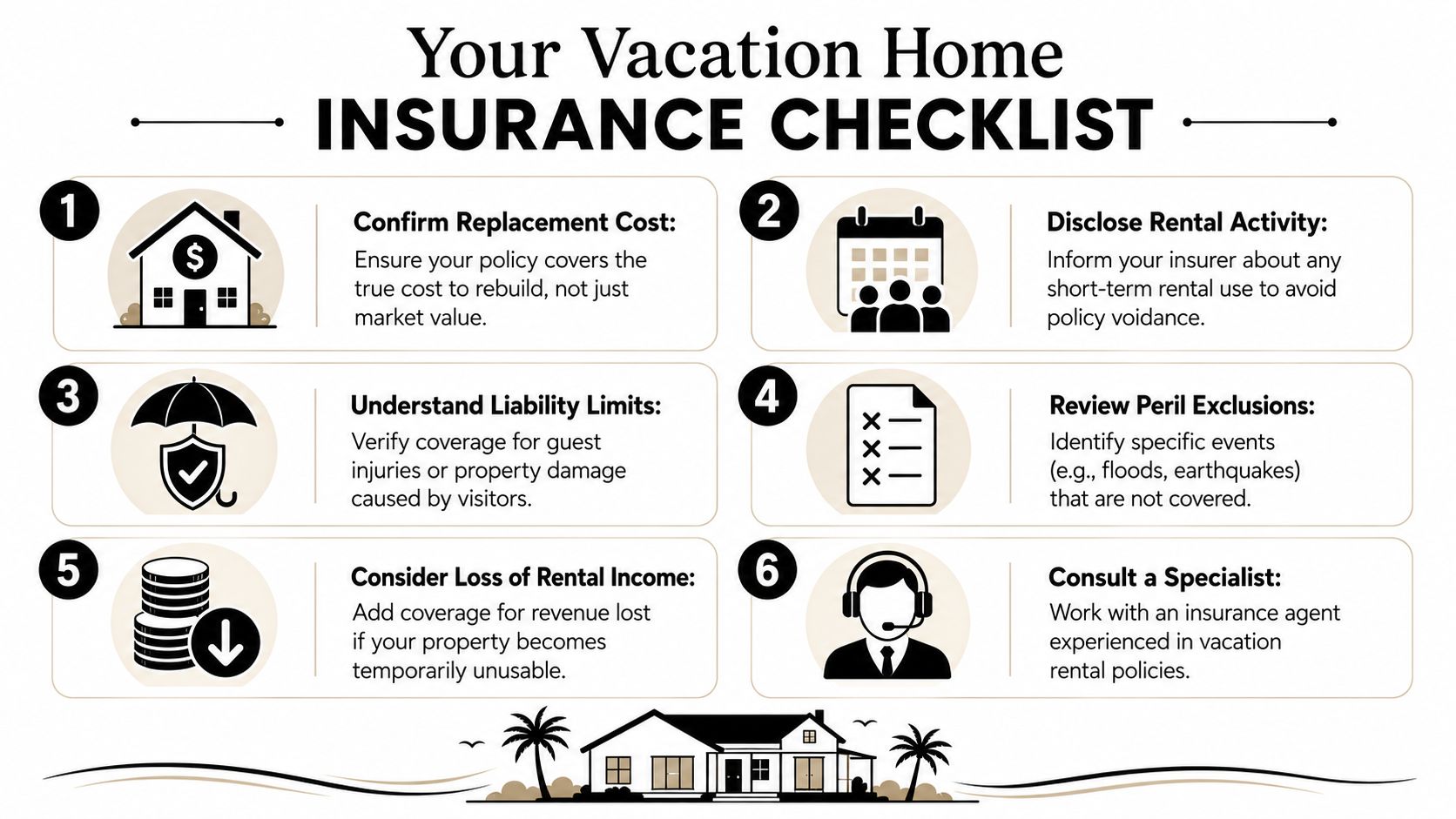
The six things to confirm before you bind coverage
Replacement cost is current
Make sure the dwelling limit reflects today's rebuild reality, not an old estimate or the home's market price.Occupancy is described accurately
Tell the insurer whether the home is seasonal, occasionally vacant, or used only part of the year.Rental use is fully disclosed
If you ever accept paying guests, even occasionally, ask whether the policy allows that and what endorsement or separate form is needed.Liability limits fit the property
Pools, decks, stairs, docks, and guest turnover can all change the liability discussion.Exclusions are reviewed in plain language
Don't settle for “it should be covered.” Ask direct questions about wildfire arrangements, earthquake, flood, and earth movement.Deductibles make sense for your budget
A deductible should be high enough to help pricing, but not so high that a realistic loss becomes hard to absorb.
What a quote review should look like
A good quote review isn't just a premium comparison. It should include a conversation about how the property is used, how often it's empty, what's inside it, and which California hazards apply.
That review should also compare policy form, dwelling limit, liability protection, and endorsements. If you're shopping online, use a page that lets you request personalized guidance rather than forcing a one-size-fits-all result. A good next step is to request a California insurance quote review.
A quick visual reference helps too.
The right policy should match how you actually use the home, not how the application assumes you use it.
If your vacation property is part retreat, part investment, and part long-term family asset, your insurance needs to reflect all three. That takes a little more work up front, but it's the part that protects you when the easy assumptions fall apart.
If you want help comparing vacation home insurance in California, Mai & Associates can help you review options for home insurance, auto insurance, renters insurance, car insurance, life insurance, California FAIR Plan questions, and complex second-home risks. Their licensed team can compare carriers, look for coverage gaps, and help you find a practical fit for your property and budget.