Vacant Property Insurance: CA FAIR Plan & Costs Guide
You moved out of your California home. Maybe it’s listed for sale in Glendale. Maybe contractors just started a major renovation in Costa Mesa. Maybe you inherited a house and haven’t decided whether to keep it, rent it, or sell it. The place is empty, but the bills, liability, and wildfire exposure didn’t move out with you.
That’s where people get blindsided. They assume their home insurance still works the same way it did when someone was sleeping there every night. Often, it doesn’t. An empty house creates a different risk profile, and insurers treat it that way for good reason. A burst pipe can run for days. A break-in can sit unnoticed. A fire can spread before anyone sees smoke.
This isn’t a niche issue anymore. The global vacant property insurance market was valued at $1.65 billion in 2024 and is projected to reach $2.58 billion by 2033, according to Market Intelo’s vacant property insurance market report. That growth reflects a simple reality. Property owners increasingly understand that an empty home needs different protection than an occupied one.
If you already review your California auto insurance, home insurance, renters insurance, car insurance, and life insurance with care, treat a vacant house the same way. It’s still one of your biggest financial exposures. Leaving it under the wrong policy is a costly mistake.
Protecting Your Empty Property A Guide for Californians
A vacant home looks quiet from the street. To an insurer, it looks exposed.
When nobody lives in a property, small problems become expensive problems. A leak isn’t found quickly. A fence breach invites trespassers. Deferred maintenance starts compounding. In California, wildfire risk makes the situation even more serious because a home can sit empty in a high-risk zone while the owner assumes their existing policy is enough.
That assumption causes claim disputes all the time. Owners usually aren’t being reckless. They’re in transition. They’re waiting for a closing date, managing probate, finishing a remodel, or between tenants. Life changes faster than policy language.
The situations that trigger concern
Vacant property insurance usually enters the conversation when the home is in one of these categories:
- For sale after move-out: The furniture is gone, but escrow hasn’t closed.
- Under renovation: The house may be partly stripped down, unlivable, or visited only by contractors.
- Inherited property: Ownership changed, but occupancy hasn’t.
- Between tenants: The rental is empty longer than expected.
- Seasonal or second-home complications: The home isn’t consistently occupied enough to satisfy underwriting rules.
Empty doesn’t mean harmless. It means fewer eyes on the property when something goes wrong.
California owners need a practical answer, not theory. That answer starts with identifying whether the home is merely unoccupied or vacant, because the policy decision flows from that distinction.
Vacant Versus Unoccupied The Critical Insurance Distinction
This is the mistake that drives a lot of denied claims. Owners use vacant and unoccupied as if they mean the same thing. Insurance companies usually don’t.
Here’s the cleanest way to think about it. An unoccupied home is on pause. A vacant home is powered down. One is still set up for normal living. The other usually isn’t.
In major markets like California, an estimated 40% of insurance claim denials for empty properties stem from misclassifying a home as vacant or unoccupied, according to this vacant property insurance guide summarizing a 2025 US Assure report. That’s not a technicality. That’s money.
Vacant vs. Unoccupied At a Glance
| Factor | Unoccupied Property | Vacant Property |
|---|---|---|
| Basic condition | No one is currently staying there, but it still functions as a home | No one is staying there and it’s typically not set up for normal living |
| Furnishings | Usually still furnished or substantially furnished | Often mostly empty or fully empty |
| Intent | Temporary absence | Longer-term break in occupancy or uncertain use |
| Insurance treatment | May still fit under a standard policy for a limited time, depending on carrier rules | Often requires vacant property insurance or a specific vacancy endorsement |
| Claim risk | Lower than a truly vacant home, but still higher than occupied property | Higher because damage, theft, and maintenance issues can go unnoticed |
| Common examples | Owner traveling, short-term temporary relocation | Home listed for sale after move-out, inheritance, between tenants, major renovation |
The practical test
Ask yourself these questions:
- Could someone move in tonight without bringing furniture and basic living essentials?
- Is the home still being used as a residence, even if only temporarily not occupied?
- Would a field inspector describe it as livable and in normal residential use?
If your honest answer is no, stop calling it unoccupied. That label won’t save your claim.
Why insurers care so much
A furnished home with utilities on and regular check-ins creates one kind of exposure. An empty home with sparse contents and limited supervision creates another. The risk of theft, water loss, vandalism, and unnoticed deterioration changes fast once a property stops functioning as a residence.
That’s why your wording matters when you talk to your agent and when you fill out an application. If you’re unsure how insurers define common property terms, a plain-English insurance glossary from Mai & Associates is a useful starting point.
If the house is empty enough that you’d hesitate to call it “lived in,” don’t rely on a standard homeowners policy without a direct coverage review.
Anatomy of a Vacant Property Policy Coverages and Exclusions
A California homeowner moves out, leaves the house empty for a few months, and assumes the insurance will still work if something goes wrong. Then a pipe leaks behind a wall, squatters break in, or a small brush fire sends smoke through the attic. The policy response depends on the exact form, the exclusions, and whether the carrier agreed to insure a vacant home in the first place.

That is why you should read a vacant property policy from the inside out. Start with what it covers. Then study what it strips away. In California, that discipline matters even more because wildfire exposure can force owners into narrower options, including FAIR Plan arrangements paired with separate liability or wraparound coverage.
What a vacant property policy usually covers
Vacant home insurance is often built on a narrower form than a standard owner-occupied homeowners policy. Many carriers use named-peril or dwelling-style forms, which means the policy covers the hazards listed in the contract, not every accidental loss that is not excluded.
Typical covered causes of loss often include:
- Fire and lightning
- Smoke or explosion
- Wind or certain storm damage
- Limited liability coverage, if the carrier offers it and the premises conditions qualify
Fire coverage deserves special attention in California. For many vacant homes, especially in brush areas or other hard-to-place locations, fire is the coverage you cannot afford to misunderstand. Review the quote the same way you would review any California home insurance coverage options. Look past the premium and confirm the actual form, limits, and settlement terms.
The coverages owners need to confirm, not assume
A vacant house has a different loss pattern. Problems sit longer. Damage spreads further. The policy needs to reflect that reality.
Ask whether the quote includes these items or excludes them:
- Vandalism and malicious mischief
- Theft or attempted theft
- Water damage from sudden plumbing failures
- Glass breakage
- Detached structures such as garages, fences, or sheds
- Liability for visitors, workers, or delivery injuries
- Renovation-related exposure if work is happening on site
Many claims go awry when an owner sees “dwelling coverage” on the declarations page and assumes the major vacant-home risks are covered too. That assumption is expensive.
If the property sits in a wildfire-prone part of California, pair your insurance review with practical loss prevention work. 5 Ways to Disaster-Proof Your California Home is a useful checklist for reducing the kind of damage that can turn a vacant-home claim into a major rebuild.
The exclusions that cause the most trouble
The biggest mistakes happen in the exclusions section and in the conditions that limit payment after a loss.
Common trouble spots include:
- Long-term leaks or seepage
- Mold
- Poor maintenance or deferred repairs
- Theft of certain contents or building materials
- Losses that happen during contractor work when renovation coverage was not added
- Vacancy-related limitations that reduce or remove payment for water, vandalism, or glass claims
- Actual cash value settlement instead of replacement cost
Pay close attention to water claims. A standard policy for an occupied home may treat sudden and accidental discharge one way. A vacant property form may narrow it sharply or attach inspection and maintenance conditions. If no one catches the leak for weeks, the policy language starts to matter more than your assumptions.
Form and valuation matter as much as the hazard list
Two quotes can list similar covered perils and still produce very different claim outcomes.
One policy may settle the building on a replacement cost basis. Another may pay actual cash value, which subtracts depreciation and leaves you funding part of the repair yourself. One carrier may allow short-term vacancy with inspections and documentation. Another may write the policy only if utilities stay on, yard maintenance continues, and interior photos prove the property condition.
That is why the right question is not, “Does it cover vacant property?” The right question is, “Under what conditions will this insurer pay my claim?”
What to ask before you bind coverage
Do not accept a one-line quote. Get direct answers to these points:
- What policy form is this, and which perils are specifically covered?
- Are vandalism, theft, and sudden water damage included or excluded?
- Is the building settled at replacement cost or actual cash value?
- Are detached structures covered?
- Is liability included, and are there restrictions for contractors or other visitors?
- What inspections, photos, utility records, or maintenance proof does underwriting require?
- Does any renovation, vacancy period, or wildfire condition trigger a different rule or endorsement?
- Can the policy be cancelled or rewritten easily once the home is occupied, sold, or rented?
My recommendation is simple. Treat a vacant property policy like a custom contract, not a commodity. In California, especially where wildfire risk and FAIR Plan rules may be part of the bigger insurance picture, the safest approach is to confirm every major coverage in writing before the home sits empty for a single week.
The California Challenge Wildfire Risk and the FAIR Plan
California changes the conversation because vacant property insurance here isn’t just about theft, leaks, and vandalism. It’s also about wildfire exposure and the limits of the market available to owners in brush zones, mountain areas, and other hard-to-place locations.

If your home is in a high-risk area, you may already be dealing with the California FAIR Plan for basic fire coverage. That’s where vacant status becomes especially dangerous. The California FAIR Plan explicitly denies coverage for homes vacant for more than 50% of the year, and this is often verified through utility bills or inspections, according to Kin’s overview of California FAIR Plan rules.
That single rule can undo a lot of assumptions.
Why the FAIR Plan creates confusion
Many California owners hear “FAIR Plan” and think, “I have fire insurance, so I’m covered.” Not necessarily.
The FAIR Plan is already narrower than a standard homeowners package. Then vacancy rules add another layer. If the home doesn’t meet occupancy expectations, the policy may not respond the way the owner expects. That matters most for people who are:
- Holding a vacant home in a wildfire-prone zip code
- Renovating a property and not living in it
- Between tenants for an extended stretch
- Using the home seasonally but not often enough to satisfy underwriting
- Trying to close a sale while relying on existing FAIR Plan protection
The rule that matters more than most people realize
The FAIR Plan’s vacancy threshold is blunt. If the home is vacant for more than half the year, eligibility becomes a serious problem. Owners don’t get much value from arguing intent after the fact. Insurers look at occupancy records, property condition, inspections, and other evidence.
That’s why “I was checking on it” usually isn’t enough by itself. A house can be monitored and still be vacant under the policy’s rules.
A California property can be physically standing, mortgage-compliant on paper, and still have a major coverage problem because vacancy status was handled casually.
Wildfire makes every vacancy mistake more expensive
A vacant inland home in a mild-risk area is one thing. A vacant home in a canyon, foothill, or brush-adjacent neighborhood is another. If you’re already in a FAIR Plan scenario, you need to think in layers.
One layer may address limited fire exposure. Another may be needed for the broader property risks that empty homes face, depending on carrier availability and underwriting. Some owners also need separate policy coordination if the home is being renovated or temporarily held pending sale.
People need to stop shopping by headline and start reviewing by coverage gap.
What owners should do in real life
If your vacant property sits in a California wildfire zone, take these actions early:
- Confirm occupancy status: Don’t force the property into the wrong category.
- Review your FAIR Plan paperwork line by line: Especially vacancy wording, occupancy conditions, and inspection requirements.
- Document the property condition: Photos, utility usage, and maintenance records matter.
- Address wildfire defensibility: Keep vegetation managed, secure debris, and reduce visible ignition hazards.
- Coordinate all policies together: Fire-only protection and broader property coverage are not the same thing.
For practical hardening ideas, Aldridge Construction’s guide to disaster-proofing a California home offers useful steps owners can apply before underwriting or renewal review.
The most common California mistake
Owners think a vacancy issue will be sorted out later, after the sale, after the remodel, after the tenant move-in, after fire season. That’s backwards. Occupancy classification should be handled before the home sits empty, not after a claim.
If your property falls anywhere near FAIR Plan territory, don’t assume your existing setup is good enough just because a declarations page exists. In California, vacant property insurance isn’t a side issue. It’s often the difference between a manageable problem and a catastrophic uninsured loss.
Your Step-by-Step Checklist for Securing Coverage
Securing vacant property insurance is manageable if you treat it like a documentation project, not a last-minute phone call. Insurers want a clear picture of the property, the timeline, and the risk controls in place.
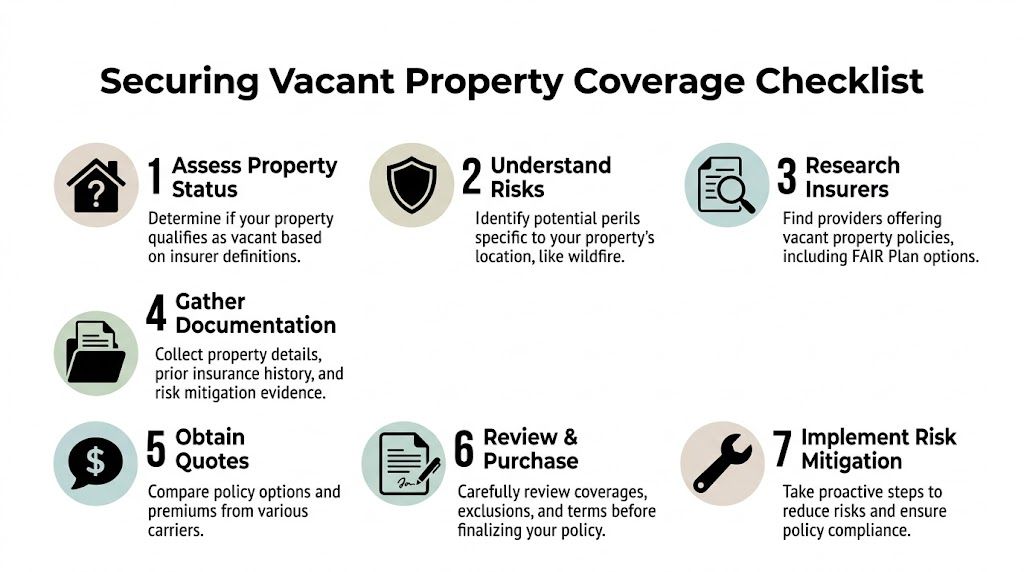
Step 1 through Step 3
Assess the property status
Decide whether the home is vacant or merely unoccupied. Be honest about furnishings, utility use, occupancy pattern, and livability. If the house is empty after a move-out or stripped for renovation, say so plainly.List the actual risks
Write down what could realistically go wrong at this property. In California, that may include wildfire exposure, trespass, water damage, contractor-related hazards, or long intervals between visits.Identify the likely policy path
Some homes fit a specialty vacant dwelling policy. Others require a more layered approach because of FAIR Plan involvement, renovation activity, or location issues. If you want to start the process quickly, request a California insurance quote through Mai & Associates.
Step 4 through Step 5
Before you ask for pricing, gather the file an underwriter will ask for anyway.
- Property details: Address, year built, square footage, roof type, current condition.
- Occupancy timeline: When the home became empty, and when you expect occupancy to resume or sale to close.
- Photos: Exterior from multiple angles and clear interior condition shots.
- Insurance history: Current carrier, prior losses, cancellation notices if any.
- Renovation plans: Scope of work, contractor schedule, permits if applicable.
- Risk mitigation evidence: Alarm system details, camera setup, water shutoff plan, wildfire defensible space work.
Then get quotes from more than one market if possible. A cheap quote with major exclusions is not a bargain. It’s a trap.
Step 6 through Step 7
Read the exclusions before you pay
Focus on vacancy definition, vandalism, water damage, liability, theft, renovation restrictions, settlement basis, and cancellation terms. If a policy is written for a short term, confirm how it ends or transitions when the house becomes occupied again.Implement the protections you promised
If the application says you’ll inspect the property regularly, do it. If you told the insurer the water would be shut off or the alarm would be active, follow through. Underwriting conditions matter before and after purchase.
Good coverage starts with accurate disclosure. Good claims outcomes depend on following the conditions you agreed to.
What to keep in one folder
Make one digital folder and one physical folder with:
- Policy documents
- Application copy
- Photos and inspection notes
- Utility records
- Contractor contacts
- Proof of maintenance or mitigation work
- Any communication about occupancy changes
That habit makes renewals, underwriting questions, and claims much easier to handle.
The owners who get into trouble usually aren’t the careless ones. They’re the ones who waited too long, assumed too much, or bought a policy they never fully read.
How to Lower Your Premiums and Reduce Claim Risk
A California house sits empty through a dry, windy week. No one notices a small plumbing failure, a trespasser testing a side gate, or a notice from the carrier asking follow-up questions about vacancy and brush conditions. That is how an affordable problem turns into an expensive claim or a canceled policy.

You probably will not make vacant property insurance cheap in California. You can make it insurable, defensible, and less expensive than it would be otherwise. That is the right goal, especially if the property is in wildfire country and your options already run through the CA FAIR Plan or a FAIR Plan plus Difference in Conditions setup.
The biggest pricing mistake owners make is treating premium and claim risk as separate issues. They are tied together. Carriers charge more when a home looks easy to damage, easy to enter, or easy to ignore. They also scrutinize vacant risks more aggressively after a loss, particularly when the file shows missed inspections, deferred repairs, or a mismatch between what the application said and what the property looked like.
Focus on the controls that change underwriting decisions
Start with the issues that cause the worst vacant-home losses and the fastest underwriting pushback.
- Prevent water losses before they start: If the house will sit empty, make a clear plumbing plan that matches the policy conditions and your climate exposure.
- Show a real inspection routine: Documented check-ins matter because they prove the house is being managed, not abandoned.
- Harden entry points: Reinforce locks, gates, garage access, and any side or rear entrances that are easy to miss from the street.
- Keep the property visibly maintained: A clean exterior lowers the odds of trespass, city complaints, and the appearance of neglect.
- Fix small problems fast: Minor roof damage, fence failures, and exterior deterioration become major claim issues when no one acts early.
In California, wildfire discipline affects both price and availability
Vacant home owners in brush areas face a different problem than owners in lower-risk states. You are not just trying to reduce ordinary property losses. You are trying to keep the home acceptable to insurers that are already cautious about wildfire concentration, response times, slope, and surrounding fuel.
That is why unattended properties need tighter oversight. If the home will be empty for long stretches, extra on-site monitoring can support your broader protection plan. Some owners add temporary patrol or standby support through California Fire Watch Security Services when the exposure justifies it.
What actually helps lower premiums
Insurers reward control. They do not reward optimism.
A better premium usually comes from showing that the property is actively managed and that the vacancy has an exit plan. If you expect the home to be sold, rented, renovated, or reoccupied within a defined period, say so clearly and keep your documentation current. If the home is in a FAIR Plan situation, be even more careful. FAIR Plan placement solves part of the wildfire problem, but it does not erase vacancy concerns or guarantee broad protection for every loss.
Good questions save money here. Review common California coverage issues before renewal or placement through these vacant home insurance FAQs for California owners.
Vacant property owners get better results when they manage the house like an active risk, not a dormant asset.
A vacant home becomes expensive when it looks unsupervised. Keep it documented, maintained, and clearly under control. That is how you reduce claim trouble and give underwriters a reason to offer better terms.
California Vacant Property Insurance FAQs
Does a home under renovation need vacant property insurance
Often, yes. A major renovation changes both occupancy and physical risk. If the home isn’t livable, isn’t regularly occupied, or has exposed systems and contractor activity, don’t assume your standard home policy still fits. Confirm whether the carrier allows the renovation and whether the property now needs vacant or builder-oriented coverage.
Do landlords need vacant property insurance between tenants
Sometimes. A short turnover period may not create a problem, but a longer stretch can. The key issue is how the carrier defines vacancy, what remains inside the unit, and whether the property is still being actively maintained and inspected. If the home is emptied out and the tenant turnover drags on, review coverage immediately.
Will the California FAIR Plan cover a vacant house
Not if the property crosses the vacancy rule discussed earlier. That’s the issue California owners miss. FAIR Plan coverage is not a free pass for an empty home in a wildfire zone. If vacancy is part of the picture, eligibility and coverage need to be reviewed directly.
How long can a house sit empty before insurance becomes a problem
That depends on the policy language and the carrier’s definition. Many owners get into trouble because they rely on what they think is a standard rule instead of reading their own forms. Don’t guess. Verify the occupancy language before the house sits empty.
What documents should I keep in case I need to file a claim
Keep a clean file with policy forms, photos, inspection logs, repair invoices, utility records, contractor agreements, and communication with your insurer or agent. If the insurer later asks whether the house was vacant, maintained, or secured, documentation wins that argument faster than memory does.
Can I cancel the policy once the home sells or becomes occupied again
Usually, there’s a process to end or replace the vacant policy when the property status changes. But don’t assume it happens automatically. Tell your agent as soon as occupancy resumes, escrow closes, or tenants move in so the policy can be updated properly.
What if I’m not sure whether my home is vacant or unoccupied
Ask before there’s a loss. That’s the only answer that matters. If you want a broader explanation of common coverage questions across home, auto, renters, and life insurance, the Mai & Associates FAQ page is a useful place to start.
Does vacant property insurance cover liability
It can, but don’t assume it does in the same way a standard homeowners policy would. Liability for delivery visitors, inspectors, contractors, or even injuries involving trespassers should be reviewed carefully. Vacant property owners often focus on fire and theft while ignoring premises liability.
Is this only a homeowners issue
No. Empty property problems often overlap with the rest of your insurance life. If you’re moving out of one home and into another, you may also need to review California car insurance, renters insurance for temporary housing, and life insurance if the move affects your household budget or long-term planning. Property transitions rarely happen in isolation.
What’s the smartest move if my situation is changing fast
Report the occupancy change early. Document the property. Get the right form of coverage in place before the house sits empty. Waiting until after a vacancy dispute starts is the worst possible timing.
If your California home may be vacant, don’t rely on assumptions or outdated policy language. Mai & Associates helps homeowners compare coverage options, review California FAIR Plan exposure, and coordinate practical protection for home insurance, auto insurance, renters insurance, car insurance, and life insurance needs across the state.