Universal Life Insurance Pros and Cons: A 2026 CA Guide
A lot of California families are doing the same math at the kitchen table right now. Mortgage or rent. Car insurance for two drivers. Home insurance that keeps getting harder to place in some ZIP codes. Maybe renters insurance for an adult child. Then the bigger question shows up: if something happens to you, would the people you love have enough money to stay in the home, cover bills, and keep moving forward?
Universal life insurance enters that conversation because it promises something many families want. Lifetime coverage, plus room to adjust as life changes. That sounds appealing when your budget isn't static and your insurance needs keep shifting with jobs, kids, housing costs, and everything else California throws at you.
But universal life isn't simple. It's not like basic term life, where you pay a set premium for a set period and the purpose is straightforward. Universal life has moving parts. Those moving parts can help you, or surprise you, depending on how the policy is funded and monitored.
For Californians, that matters more than people sometimes realize. Insurance isn't one isolated purchase here. Your life insurance decision sits next to your auto insurance bill, your homeowners policy, your earthquake questions, and the backup plans you need if you live in a wildfire-prone area. Every premium competes with another premium.
It also helps to think about life insurance as part of a broader transfer plan, not just a death benefit. If you're sorting out how assets pass to loved ones, Bryan Fagan's non-probate asset insights offer a useful companion read because beneficiary-based assets often move differently than property that goes through probate.

If you're trying to balance long-term protection with today's budget, start by getting a California insurance quote for the full picture, not just one policy in isolation.
Securing Your Family’s Future in the Golden State
A family in Glendale might be paying close attention to every recurring bill right now. Their car insurance renewed higher. Their home insurance options narrowed after wildfire concerns in the area. They want life insurance too, but they don't want to lock themselves into something they can't maintain if income changes.
That's where universal life often gets attention. It offers permanent coverage, but with more flexibility than whole life. For a family with uneven income, a growing business, or shifting expenses, that flexibility can sound like the answer.
Why the California context changes the conversation
In a lower-cost state, a family might have more room to absorb a complicated policy. In California, many households are already carrying a heavy insurance load.
A good life insurance choice here has to work alongside:
- Auto insurance costs: Your car insurance isn't optional, and for many households it's already a meaningful monthly expense.
- Home insurance pressure: If you're a homeowner, especially in a higher-risk area, premiums and placement issues can affect every other financial decision.
- Renters insurance needs: Renters still need liability and property protection, even when they're trying to keep fixed costs low.
- Emergency reserves: Families need cash reserves because housing, repairs, and replacement costs can hit hard in this state.
Universal life can fit a California budget. It can also strain one if the policy is designed too aggressively or left on autopilot.
The real question most families are asking
Individuals aren't asking, "Is universal life technically flexible?" They want to know something more practical.
Can this policy protect my family without becoming another expensive surprise later?
That's the right question. The rest of this guide answers it in plain language.
What Is Universal Life Insurance
Universal life insurance is a type of permanent life insurance. That means it's built to last your whole life, not just a temporary term, as long as the policy stays funded and in force.
The easiest way to understand it is to picture a bucket with three streams flowing through it. Money goes in through your premiums. Some of that money pays for the insurance costs and policy charges. The rest can build cash value, which stays inside the policy and can help support it over time.
If insurance terminology starts to blur together, a plain-English insurance glossary can help decode the jargon.
The three parts that matter most
Death benefit
This is the money your beneficiaries receive if you die while the policy is active. For many families, this is the main reason to buy life insurance in the first place.
The death benefit can help your family stay in the house, cover debts, replace lost income, or handle final expenses. In universal life, that death benefit may be adjustable, depending on the policy and underwriting.
Cash value
This is the savings-like component inside the policy. It grows on a tax-deferred basis and is credited based on the type of universal life policy you own.
Some policies credit interest using a fixed method. Others tie growth to a market index. The important point is that this cash value is not just a side feature. It's part of what helps keep the policy functioning over the long term.
Premium flexibility
This is the feature people notice first. Unlike a rigid permanent policy structure, universal life can let you vary payments within policy limits.
That doesn't mean you can casually pay whatever you want forever. It means the policy gives you room to adjust, provided there is enough value in the policy to cover internal charges.
A practical analogy
Think of universal life like a hybrid between a protection tool and a funding account.
- The protection side: keeps life insurance in place for your family.
- The funding side: builds cash value that may help support future policy costs.
- The flexible side: lets you respond to changes in income, business cycles, or family needs.
That flexibility is why some people like it. It's also why some people misunderstand it.
Practical rule: Flexible doesn't mean self-sustaining. A universal life policy still needs enough money inside it to pay its internal costs.
Where readers often get confused
Many people hear "permanent life insurance" and assume the policy will remain in place for life once they buy it. With universal life, that assumption can get people into trouble.
The policy is designed for lifelong coverage, but its durability depends on funding, charges, crediting, and regular review. That's very different from saying, "I bought it once, so I'm done."
Another common confusion is mixing up universal life with investment accounts. Universal life can build value, but its first job is still insurance. The growth side supports the policy. It doesn't turn the policy into a simple savings account.
How a Universal Life Policy Actually Works
A universal life policy works a lot like a household insurance budget in California. Money comes in, several bills come out, and whatever remains helps you handle future costs. If too little goes in for too long, the cushion shrinks and the plan gets harder to keep in place.
That is the part many families miss.
With each premium payment, the insurer first takes out the policy's internal charges. The rest stays in the policy as cash value, where it can earn interest under the contract's rules. That cash value is not separate from the life insurance. It helps support the policy as costs change over time.
Where each premium dollar goes
The flow usually works like this:
- You pay a premium
- The policy deducts insurance and policy charges
- The remaining amount goes to cash value
- The cash value earns interest based on the policy design
- Future monthly charges continue to come out of the policy
That order matters more than it seems. A family may feel fine paying a lower amount while income is strong and the policy is young. Years later, the same payment may no longer be enough if charges rise and the cash value has not built enough support.
The part that causes the most confusion
Many policyowners focus on the minimum payment shown on an illustration. That number can be useful, but it does not answer the bigger question: will this policy still be healthy later?
It helps to separate three funding approaches:
- Minimum premium: the amount that may keep the policy active for now
- Target-style funding: a higher payment designed to build more stability inside the policy
- Extra funding within policy limits: added money that can create a larger cushion early on
A simple comparison helps here. Paying only the minimum on universal life can resemble carrying the lowest acceptable balance in a checking account while several automatic bills keep hitting each month. One surprise expense may not break the plan. A series of them can.
What the policy charges are paying for
Universal life has several internal costs, and they affect whether the policy lasts.
Cost of insurance
This is the charge for the death benefit itself. In many universal life policies, that cost increases with age. As the insured gets older, the policy often needs more support to keep the same coverage in place.
Administrative charges
The insurer also deducts charges for policy administration. These can look small in the early years, but they still reduce the amount left in cash value.
Surrender charges
Some policies charge a fee if you cancel in the early years. That matters for families who later realize the policy no longer fits their budget or their larger insurance plan.
How the cash value grows
Growth depends on the type of universal life you own. Some policies credit a declared interest rate. Others, including indexed versions, use a formula tied to an outside market index while still applying caps, floors, participation rates, or other policy rules.
The practical point is simple. Interest credits can help, but they do not cancel out rising policy costs. A policy can still run into trouble if funding is light and charges keep pulling more from the account.
Why regular reviews matter so much in California
Universal life asks for active attention. It works better when someone checks it the way a homeowner checks rising property coverage needs or a parent reviews auto limits after adding a teen driver.
A good review should answer a few plain questions:
- Are current premiums still enough?
- Is the cash value tracking close to the illustration's assumptions?
- Does the death benefit still match the family's needs?
- Could the policy require larger payments later, at the same time home and auto costs are rising?
For California households, that last question matters. Insurance costs rarely move in just one area. A family dealing with higher home premiums in a wildfire-exposed ZIP code, higher auto premiums after an accident trend shift, and a life policy that needs more funding can feel pressure from all sides. If you want a place to review related coverage questions in one spot, our California insurance FAQ guide can help.
A real-world budget example
A couple buys universal life during their highest-earning years. They choose a lower payment because cash flow feels tight after a mortgage, child care, and rising home and auto premiums. For a while, the policy looks fine on paper.
Later, one spouse cuts back at work, college costs show up, and insurance bills across the household rise. The universal life policy may now need more money at the exact time the family has less room in the budget.
That is how universal life really works in practice. The flexibility is real, but it comes with responsibility. Families who treat it as an actively managed part of their total insurance portfolio usually understand it better and avoid more unpleasant surprises.
The Major Pros and Cons of Universal Life
A universal life policy can be helpful for the right household and expensive for the wrong one.
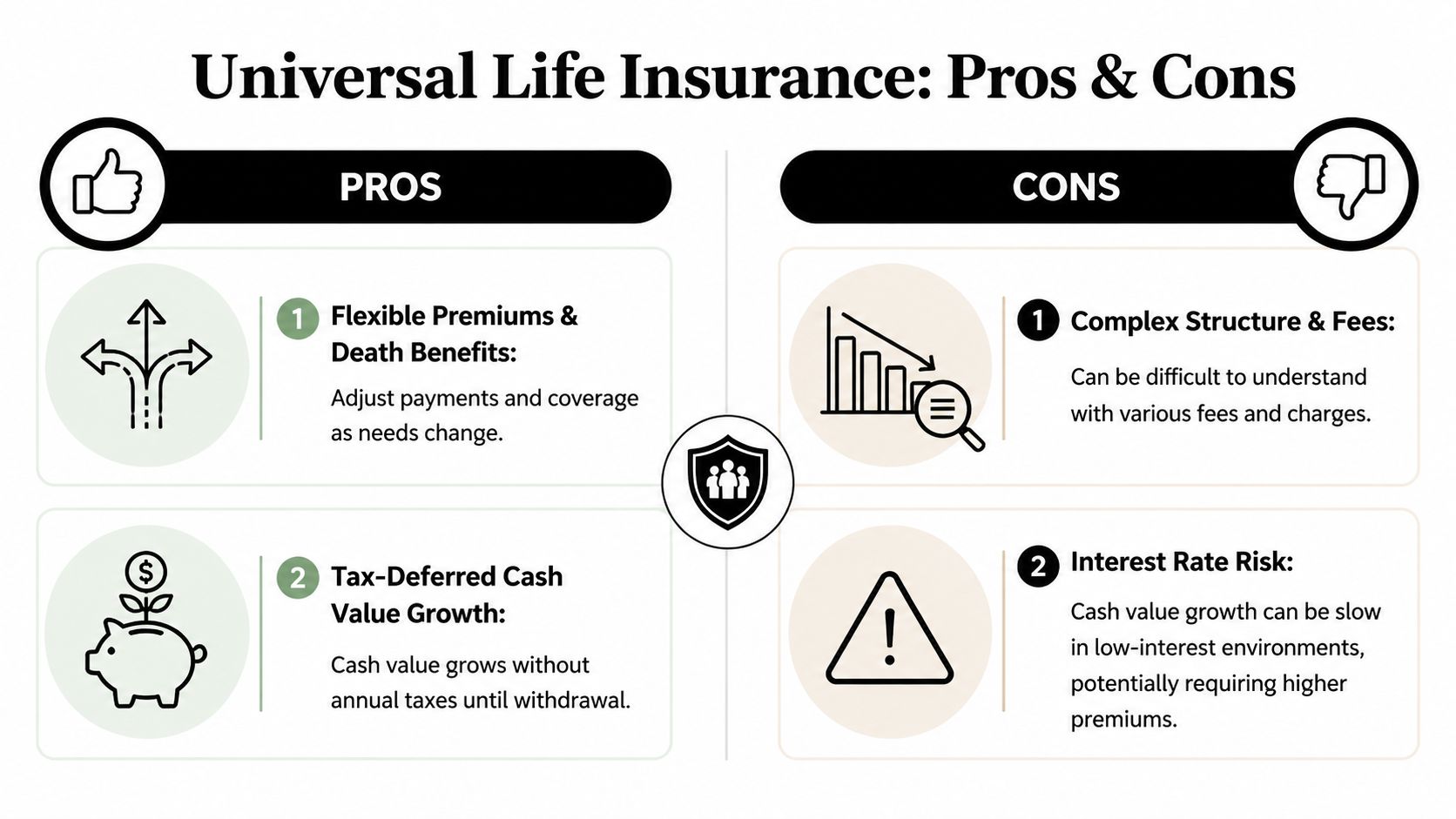
For California families, the question is rarely just, "Is this policy good or bad?" The more practical question is whether this policy fits alongside a mortgage, rising auto premiums, higher home insurance costs, and the need to protect your family for decades.
Universal life sits in the middle ground. It can cost less than whole life and offer more flexibility than a fixed permanent policy. But it also asks more from the policy owner. If term life is closer to renting protection for a set period, universal life is closer to owning a machine with adjustable settings. That flexibility can help. It can also create trouble if no one checks the settings for years.
The strongest advantages
One of the clearest benefits is affordability compared with whole life. As noted earlier, universal life often comes in at a meaningfully lower premium than whole life for the same person and age. That matters for families who want permanent coverage but also need room in the monthly budget for the rest of their insurance portfolio.
That lower starting cost can make permanent protection realistic for a household that would otherwise choose only term coverage.
Universal life also gives owners more control than many people expect. Depending on the policy, you may be able to adjust premiums within limits, and some policies allow death benefit changes as your family situation changes. A young family in Sacramento may want more coverage while the mortgage is large and the children are small. Later, after savings grow and debts shrink, the policy may offer options to revisit the amount of protection.
In plain English, the main benefits are:
- Lower initial cost than whole life: Permanent coverage may fit the budget more easily.
- Flexible premium structure: The policy can offer some breathing room if cash value is available.
- Adjustable death benefit: Some contracts allow changes, though increases often require underwriting.
- Tax-deferred cash value growth: Value inside the policy can grow without current income tax while it stays in the contract.
Why people are drawn to the cash value
The cash value feature is a big reason buyers look past term insurance.
Some families like knowing that part of what they pay may build value inside the policy over time. That value may help support premiums later or create access options under the policy terms. For a household that wants lifelong coverage and dislikes the idea of paying for a policy that ends with no value, that can sound appealing.
The attraction is easy to understand.
But cash value is not a savings account with a guaranteed outcome. It is part of a life insurance contract with internal charges, performance assumptions, and ongoing maintenance. That distinction matters because many buyers focus on the flexibility and miss the mechanics that keep the policy healthy.
The hardest downsides to ignore
The biggest risk is lapse.
Britannica's explanation of universal life insurance notes that these policies often lapse after 10 to 15 years if premiums are kept too low and the cash value cannot cover rising policy costs and fees. That is the central weakness of universal life. A policy can look affordable early on, then become harder to keep later if it was underfunded.
This catches families off guard because the problem develops slowly. The policy may send no dramatic warning in the first few years. Then the insured gets older, monthly insurance charges rise, credited interest may not keep pace, and the cash value has less cushion than the original illustration suggested.
For a California household, that timing can be rough. The pressure may show up in the same years that home and auto premiums are climbing, a child is nearing college age, or retirement saving needs more attention. A life policy that suddenly needs more funding is not just a policy problem. It becomes a household cash flow problem.
Rising costs can change the deal
A universal life policy has an internal cost of insurance, often shortened to COI. That charge usually rises with age. Early on, the increase may not feel dramatic. Later, it can become the main force draining cash value.
A simple way to picture it is this. The policy has money coming in and charges going out. If too little comes in for too long, and the charges rise each year, the gap eventually has to be filled by higher premiums or a lower policy value. If neither happens in time, the policy can collapse.
Britannica also explains that fees, mortality charges, and interest sensitivity can worsen the strain. In lower-rate periods, slower growth inside the policy may mean the owner has to contribute more out of pocket to keep coverage in place.
Complexity is a real cost
Universal life is not a set-it-and-forget-it product.
That does not make it bad. It means the owner needs to review it the same way a careful California driver reviews rising deductibles, liability limits, and renewal changes on auto and home coverage. A family that actively manages its total insurance picture may handle universal life well. A family that wants to pay a bill and ignore the policy for ten years may be a poor fit.
The main drawbacks are straightforward:
- Regular monitoring is needed: Annual or periodic reviews matter.
- Minimum funding can backfire: Paying too little for too long can weaken the policy.
- Growth may fall short: Interest crediting may not match early expectations.
- Policy charges reduce cash value: Fees and insurance costs eat into the account.
- Lapse can erase the plan: Coverage may end if the policy runs out of support.
Variable and indexed versions can add another layer of risk
Not every universal life policy works the same way, which can confuse buyers.
For variable universal life, Britannica explains that there is no downside protection against market losses. If the investment portion drops, cash value can fall, and the policy may need more funding to stay in force.
For indexed universal life, the structure may limit some downside compared with variable universal life, but it still has moving parts that many households underestimate. Titan Wealth International's indexed universal life review describes rising COI charges as a major reason policies can run into trouble over time. The practical lesson is simple. A cap, participation rate, or attractive illustration does not remove the need for monitoring.
A balanced takeaway
Universal life can work well for a household that wants permanent coverage, values flexibility, and has the discipline to review the policy over time. It can be a poor fit for a family that needs the highest death benefit for the lowest current premium, or that wants a product requiring very little attention.
For Californians, the decision is even more practical than theoretical. You are not buying life insurance in isolation. You are fitting it into a total insurance budget that may already include expensive home and auto coverage in a high-cost state. Universal life can play a useful role in that mix, but only if you plan for the upkeep as carefully as the initial premium.
Is Universal Life Insurance Right for You
Universal life isn't a yes-or-no product for everyone. It's more like a tool that fits certain households well and frustrates others.

If you're comparing options and still sorting out the basics, a solid California insurance FAQ resource can help answer common policy questions before you make a decision.
People who may be a better fit
Universal life often fits buyers who have room in the budget and a reason to want permanent coverage with flexibility.
A few examples:
- The higher-earning professional: This person wants lifelong coverage and values the tax-deferred cash value feature as part of a broader planning strategy.
- The business owner: Income may vary from year to year, so premium flexibility can be useful if the policy is actively monitored.
- The family with evolving obligations: They may want permanent protection now, with the ability to revisit coverage later as debts, children, or estate plans change.
These buyers usually share one trait. They won't ignore the policy.
People who may want something simpler
Universal life is often a poor fit for buyers whose top priority is maximum death benefit for the lowest current premium.
That includes:
- Young families on a tight budget: If every dollar is already allocated to mortgage or rent, groceries, child care, auto insurance, and home or renters insurance, term life may be the more practical choice.
- Hands-off buyers: If you don't want ongoing reviews or policy management, universal life may create more stress than value.
- People with unstable cash flow and no cushion: Flexibility helps, but it doesn't erase the consequences of underfunding.
If missing a future policy review sounds likely, that's a sign to lean toward simpler coverage.
California-specific fit matters
In California, insurance choices compete with one another more directly than many people expect. A family in a wildfire-exposed area might need to devote extra budget to homeowners coverage and companion policies. A commuter household may need extensive car insurance because losing a vehicle would disrupt income.
That means the right life policy isn't just the one with attractive features. It's the one that still makes sense after you account for the rest of your insurance portfolio.
A quick self-check
Ask yourself these questions:
- Do I want permanent coverage, or do I mainly need protection for a defined period?
- Can I afford reviews and possible funding adjustments later?
- Am I comfortable with policy complexity?
- Would a simpler product help me keep all my insurance obligations stable?
- Do I have other financial priorities that need to come first?
If your answers point toward simplicity and affordability, term life may be your better lane. If your answers point toward flexibility, long-term planning, and active management, universal life may deserve a closer look.
Comparing Alternatives to Universal Life Insurance
Universal life makes more sense when you compare it side by side with the main alternatives. Most buyers aren't choosing in a vacuum. They're deciding among term life, whole life, and different forms of universal life.
The short version
Term life is usually the cleanest answer for pure income replacement over a set period. Whole life is more rigid but easier to frame around guarantees. Universal life sits in the middle, offering flexibility but asking for more attention.
Indexed and variable universal life are not separate planets. They're variations within the universal life family, mainly changing how cash value growth is credited and how much risk the owner takes on.
Life Insurance Policy Comparison
| Feature | Term Life | Whole Life | Universal Life (UL) |
|---|---|---|---|
| Coverage length | Temporary | Permanent | Permanent |
| Main purpose | Pure death benefit protection | Lifetime coverage with fixed structure | Lifetime coverage with flexible structure |
| Premium style | Typically fixed during the term | Typically fixed | Flexible within policy limits |
| Cash value | No | Yes | Yes |
| Complexity | Lower | Moderate | Higher |
| Budget fit | Often best for tighter budgets | Usually higher cost | Often lower than whole life, but variable over time |
| Monitoring need | Lower | Lower to moderate | Higher |
| Best for | Families needing straightforward protection | Buyers wanting rigid permanent coverage | Buyers wanting flexibility and willing to review the policy |
How indexed and variable versions differ
A standard universal life policy generally uses an insurer-declared crediting method. An indexed universal life policy links interest crediting to an index under policy rules. A variable universal life policy places value into investment-style subaccounts, which creates more direct market exposure.
That means:
- Indexed UL: May appeal to people who want growth potential tied to market performance but don't want direct downside in the same way as variable designs.
- Variable UL: Suits buyers who understand investment risk and accept that poor performance can hurt policy sustainability.
- Traditional UL: Often feels more straightforward than those two, though it still requires monitoring.
What this means for a California household
A family already managing expensive housing, car insurance, and home insurance often benefits from simplicity. If the life policy has too many moving parts, it can become the policy that gets neglected while everyone focuses on the more urgent monthly bills.
A business owner or higher-income household may see that differently. They may accept complexity because they want flexibility and permanent coverage that can adapt over time.
The best policy isn't the one with the most features. It's the one you'll understand, fund, and keep in force.
Your California Guide to Choosing Life Insurance
Universal life can be useful. It can also become a problem if it's sold as "flexible" without equal discussion of monitoring, costs, and lapse risk.
For a California resident, the smarter approach is to treat insurance like a portfolio. Life insurance protects your family from income loss. Auto insurance protects your ability to drive, work, and replace a vehicle after a serious claim. Home insurance or renters insurance protects the place where your family lives and the belongings that keep daily life functioning. In this state, those decisions are connected because your budget is connected.
Questions to ask before buying
Use this checklist when you speak with an agent:
- How is this policy designed to stay in force long term?
- What happens if I pay only the minimum for several years?
- How often should I review the illustration and in-force performance?
- What charges come out of the policy over time?
- How could rising cost of insurance affect this policy later?
- Would term life or whole life better match my goals and risk tolerance?
- How does this fit with my home, renters, and car insurance budget?
If you're still weighing the purpose of coverage itself, this guide on how to protect your family with life insurance is a helpful plain-language companion to the policy comparison process.
For Californians who want local guidance, it's worth reviewing options through a dedicated life insurance resource for California residents. The right answer may be universal life, but it may also be term life with stronger auto and home coverage, especially if you're protecting a household in a high-cost or wildfire-sensitive area.
The best insurance plan is the one that protects your family without becoming unmanageable.
If you want help reviewing your full insurance picture, not just one policy, Mai & Associates can compare life, auto, home, and renters coverage across California so you can build protection that fits your budget and holds up in real life.