Trees Falling on Houses: Claim Guide 2026
You hear the crack first. Then the thud. Then the silence that tells you something expensive and dangerous just happened.
If a tree just hit your house, you're probably standing in that ugly mix of shock, adrenaline, and logistics. You need to protect your family, avoid making the damage worse, and start the insurance process the right way. If you're in California, you also need to think a little differently than homeowners in other states. Drought stress, wildfire damage, and carrier limitations change how you should respond after trees falling on houses.
This is the practical version. No fluff. No panic. Just the steps that protect your safety, your home insurance claim, your property, and the rest of your financial picture, including car insurance, auto insurance, renters insurance, and life insurance.
First Response After the Crash
When a tree lands on a roof, people waste time doing the wrong thing. They grab a ladder. They walk under the impact area. They start pulling branches. Don't.
Your first job is to decide whether the house is safe to stay in for the next ten minutes. If you have a ceiling bowing downward, exposed framing, broken glass, shifting walls, a gas smell, sparking wires, or a downed line outside, get everyone out. Take pets, medications, phones, wallets, and keys if you can do it fast. Leave everything else.
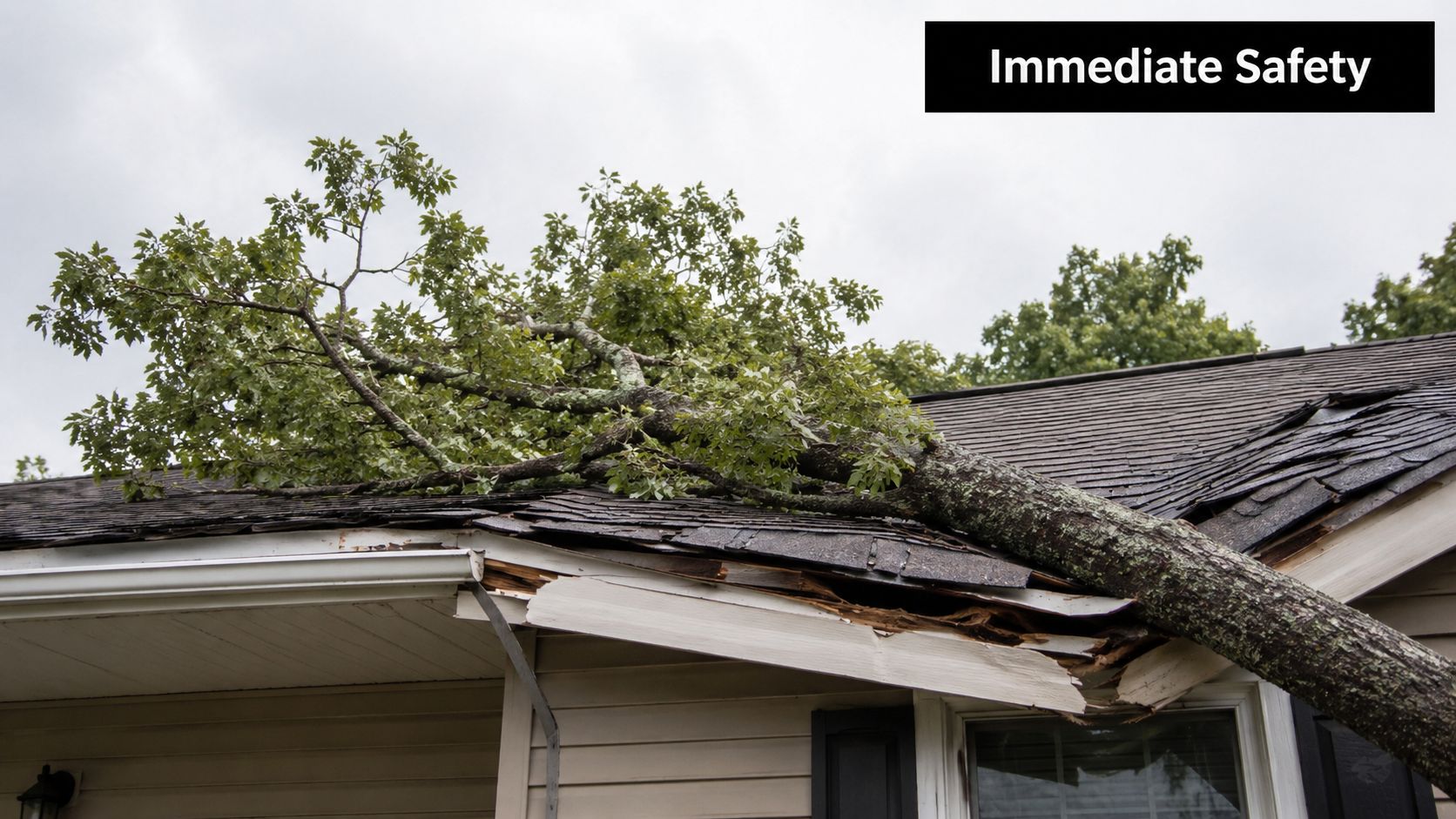
What to do in the first few minutes
- Check for injuries first. If anyone is hurt, call 911 immediately.
- Get clear of the impact zone. Don't stand in rooms below the tree strike or near cracked exterior walls.
- Stay away from power hazards. If the tree touched utility lines, treat the entire area as energized.
- Shut off utilities only if it's safe. If you know where your main water shutoff, gas shutoff, and electrical panel are, and you can reach them without entering a damaged area, use them.
- Don't climb on the roof or move the tree. A partially supported trunk can shift fast.
Practical rule: If you're debating whether the structure is safe, assume it isn't and step out.
A lot of homeowners freeze because they don't want to overreact. I'd rather see you sitting in your car for an hour than standing under a compromised roof for thirty seconds.
What matters most right now
Emergency responders handle injuries, active hazards, and immediate public safety. They do not handle the insurance case for you. That's your next problem, but only after you've secured the scene and kept people out of danger.
If you want a clear homeowner-focused checklist before you start making calls, expert guidance from For The Public Adjusters is a useful reference for the immediate aftermath.
One more point. Don't let neighbors, handymen, or random storm chasers talk you into quick cleanup before you've documented the damage. Fast action matters. Blind action costs money.
Secure the Scene and Document Everything
After people are safe, switch from emergency mode to evidence mode. At this point, many home insurance claims get weaker than they should. Homeowners clean too soon, throw away damaged items, or take five blurry photos and assume that's enough. It isn't.
Insurance industry data says approximately 1 in 500 homes in the United States experiences damage from a falling tree or large branch each year, and that risk rises during storm events. For California homeowners, that matters because frequent high winds and wildfire-prone conditions can weaken tree structure before failure occurs, as noted in this tree damage risk summary.
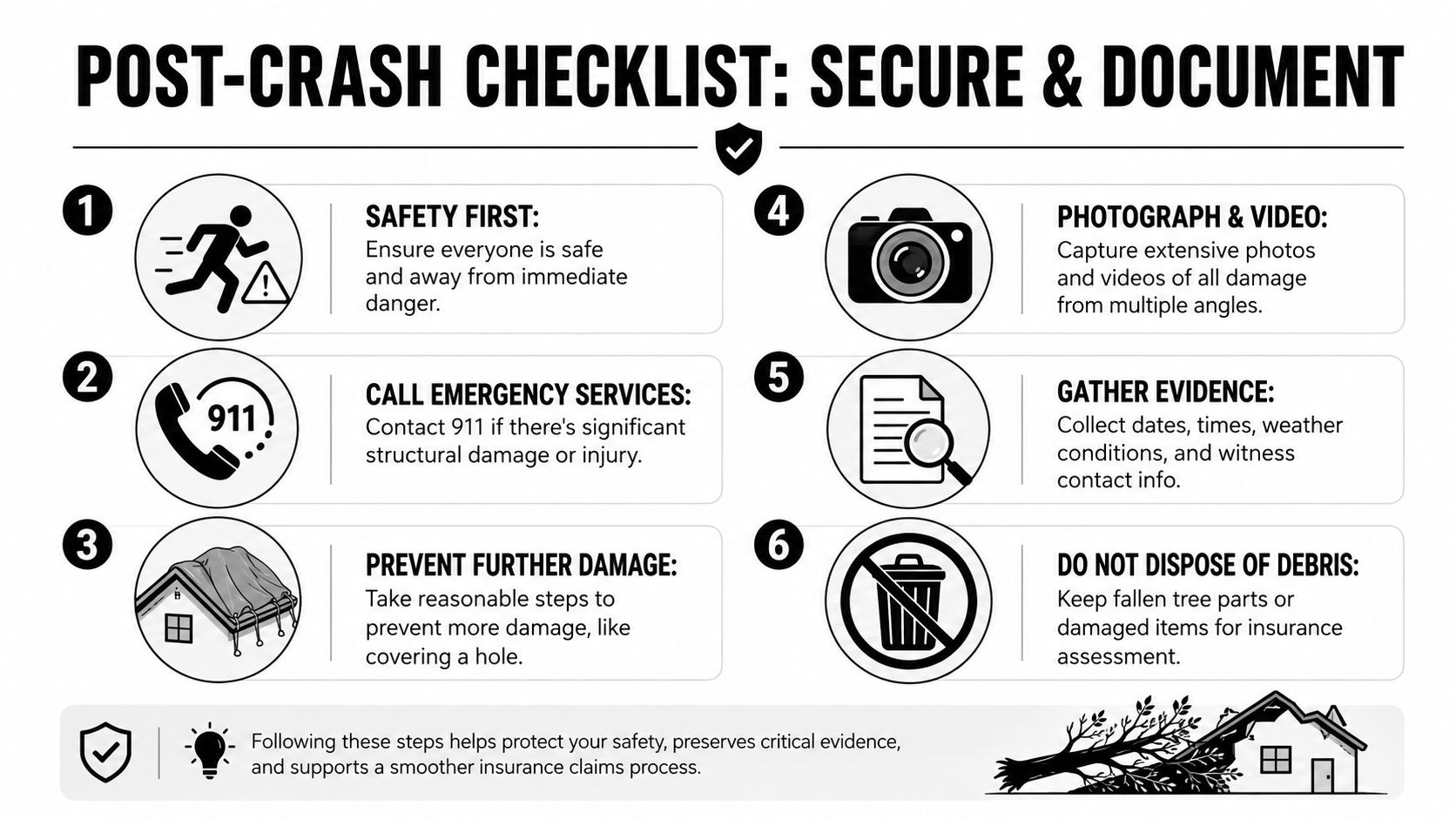
Build the claim file before cleanup
Start outside and work inward. Use your phone, but use it like you're collecting evidence for a dispute, not posting a neighborhood update.
- Take wide shots first. Stand back and capture the full tree, the roofline, nearby structures, fences, driveway, and street view.
- Get the impact points. Photograph crushed roofing, broken gutters, shattered windows, punctures, and any areas where branches entered the home.
- Record a slow video walkaround. Narrate what you're seeing, the date, and the time.
- Document weather details. Save alerts, screenshots, or timestamps that show when the event happened.
- Photograph every room affected. Ceilings, attic access points, wet drywall, flooring, furniture, electronics, and stored items all matter.
If a branch or trunk hit your vehicle, document that separately. That's where car insurance or auto insurance may come into play depending on the policy and the facts of the loss. Take photos of the vehicle from all sides, then close-ups of glass, roof, hood, and interior intrusion if windows broke.
What not to throw away
Don't discard damaged materials until your carrier or adjuster says it's fine. That includes:
- Roofing fragments
- Broken windows or frames
- Damaged personal property
- Pieces of the tree if they show rot, cavities, or internal decay
- Receipts for plywood, tarps, hotel stays, and emergency supplies
Save the ugly stuff. Debris often tells the story better than your memory does three days later.
A quick evidence checklist
| Item | Why it matters |
|---|---|
| Exterior photos | Shows the scale and direction of impact |
| Interior photos | Connects roof damage to water and structural damage inside |
| Vehicle photos | Supports car insurance or auto insurance claims |
| Timestamped video | Preserves the original condition before mitigation |
| Receipts | Supports reimbursement for emergency measures |
| Witness names | Helps if a neighbor saw the tree fail or had prior concerns |
If you rent part of the property, or if a tenant's belongings were damaged, note that clearly. A landlord's policy and renters insurance don't cover the same things. Separate the damage by ownership now and you'll avoid confusion later.
Contacting Your Agent and Filing a Home Insurance Claim
This is the part where calm communication matters more than dramatic storytelling. Call your insurer as soon as you've documented the scene and handled immediate hazards. Be concise. Be organized. Don't speculate about the cause if you don't know it yet.
Have these basics ready before you call: your policy number, property address, date and approximate time of loss, whether anyone was injured, whether emergency services responded, whether the home is currently habitable, and whether any vehicle was involved. If you have a California Fair Plan policy plus a separate companion policy, tell the representative that immediately. Those claims can require tighter coordination.

What to say on the first call
Use plain facts. For example: a tree struck the roof, the living room ceiling is damaged, one bedroom has water intrusion, the home may not be safe to occupy, and emergency tarping may be needed. That's enough to open the claim.
Don't say the tree was healthy if you don't know that. Don't say the neighbor was negligent unless you can prove it. Don't guess.
Recent reporting notes a sharp rise in denied home insurance claims for negligence or failure to maintain when arborist reports show pre-existing signs like cavities, lean, or rot were ignored, and those issues can trigger preventable-loss arguments, according to this dangerous tree claim discussion. That's why your wording and documentation matter.
What happens after you file
Most homeowners want to know one thing. Who shows up next, and what do they do?
Usually, the carrier assigns an adjuster, requests photos, and schedules an inspection. The adjuster is evaluating the damage, the cause, and the scope of covered repair. That person is not your contractor and not your structural engineer. Treat the inspection as important, because it is.
Here's the usual flow:
- Claim is opened and assigned a number
- Adjuster contact follows with document requests
- Inspection happens at the property
- Emergency mitigation review looks at tarp, board-up, and drying steps
- Repair estimates are compared between carrier, contractor, and sometimes specialists
A strong claim starts with a clean timeline. Loss date, first call, mitigation date, inspection date, and every receipt in order.
California issues that trip people up
California homeowners face extra friction because some properties have layered coverage. If you carry the California Fair Plan for fire exposure and a separate policy for liability or other protections, don't assume one claim call handles the whole situation. Read your documents and confirm which policy responds to which part of the loss. If you need a plain-language starting point, review California home insurance options.
It also helps to understand how other professionals explain tree losses. This overview of tree damage policy information gives a straightforward rundown of common claim questions.
One last warning. If the tree had visible warning signs before the loss and you ignored them, the claim can get harder. That's not fearmongering. That's reality.
Making Temporary Repairs and Hiring a Tree Service
You do need to stop further damage. You do not need to play arborist, roofer, and disaster contractor in one afternoon.
Temporary repairs should be limited, deliberate, and documented. Think protection, not restoration. A tarp over an opening. Plywood over a shattered window. Moving dry belongings away from active leaks. Shutting off water to a broken line if the tree caused one. Those are smart steps. Cutting load-bearing limbs off the roof with a borrowed chainsaw is not.
What counts as a reasonable temporary repair
The standard is simple. Prevent extra damage without changing the evidence too much.
Good examples include:
- Tarping roof openings to keep rain out
- Boarding broken windows to secure the structure
- Moving furniture and electronics away from leaks
- Using buckets and towels to control active water intrusion
- Hiring emergency drying help if water is entering the home
Bad examples include tearing out large sections of building material before inspection, disposing of damaged property without photos, or letting an unlicensed crew start full reconstruction before the insurer has seen the loss.
Keep every invoice. Keep every receipt. Write down who did the work, when they arrived, and what they touched.
Why tree removal isn't a DIY project
Let me be blunt. If a tree is on your house, the removal needs trained professionals with the right equipment and insurance.
In 2025, 34 people in the U.S. died from wind-blown trees and 101 were injured, according to this report on falling trees and high winds. That same reporting is a good reminder that removal work carries real danger.
A trunk under tension can roll, split, or spring when cut. Branches pinned against a roof can release unpredictably. If wires are involved, the risk jumps again. Saving money on the wrong crew is how homeowners turn one claim into two.
How to choose the right tree service
Use a screening process, not desperation.
Ask for:
- Proof of liability insurance
- Workers' compensation coverage
- Written scope of emergency work
- Confirmation they won't remove everything before documentation
- Photos during the removal process
- A clear invoice separating emergency mitigation from full repair
If you want to see how restoration professionals frame storm response and cleanup workflow, these Sarasota storm cleanup experts offer a useful outside example of the emergency services homeowners often need after impact damage.
For broader preparedness issues around property claims and policy questions, the insurance blog resources can help you stay organized after the immediate crisis passes.
Cheap emergency labor often creates expensive coverage disputes. Hire insured professionals or don't hire them at all.
Liability Questions When a Neighbor's Tree Falls
Neighbors may stop being friendly and start texting legal opinions. Ignore the amateur advice.
If your neighbor's tree falls on your house, liability depends on why it fell and what the neighbor knew before it happened. Ownership of the tree doesn't automatically decide who pays. Facts do.
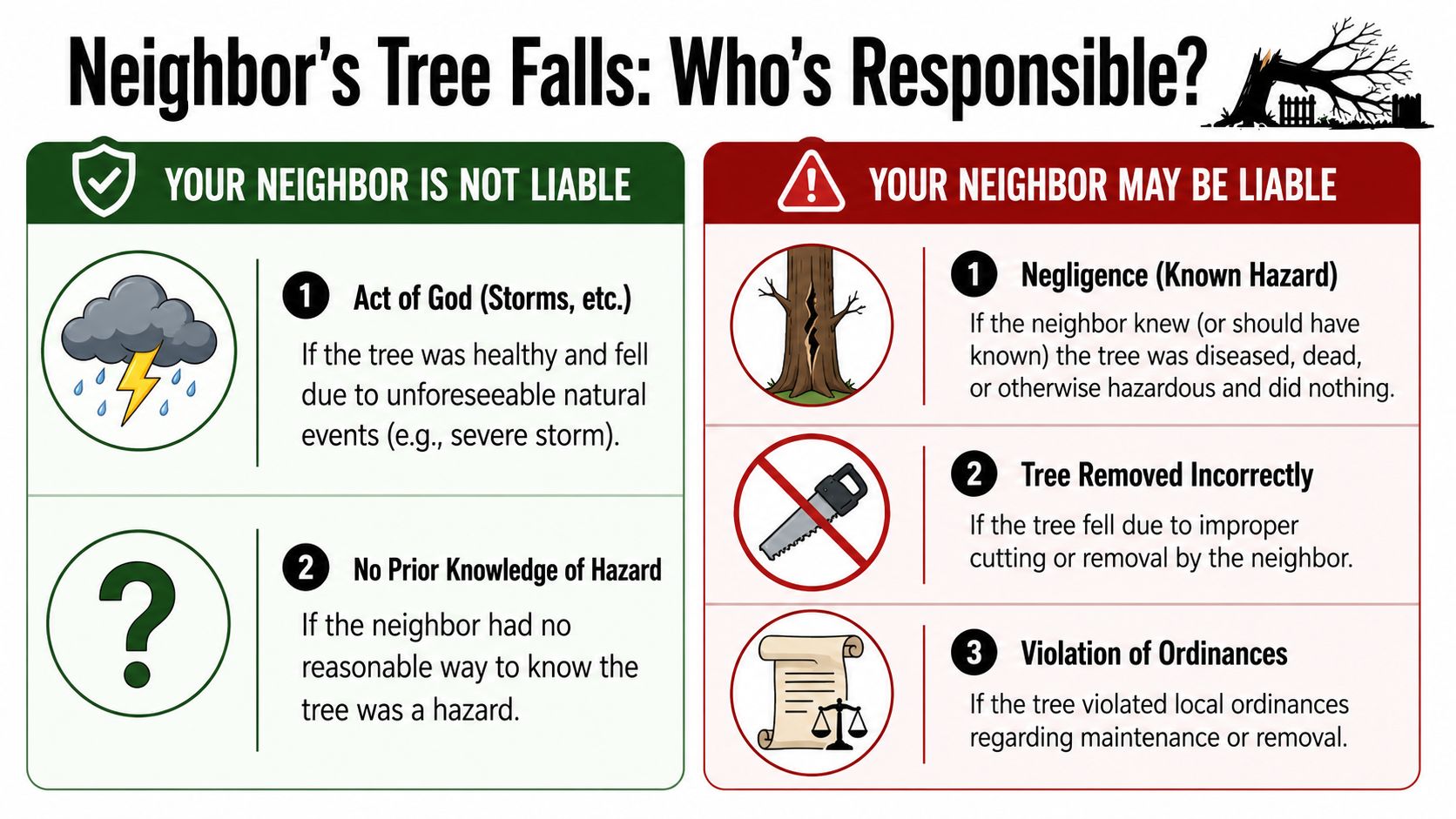
When it's likely your claim first
If a healthy-looking tree came down during severe weather with no known warning signs, the event is usually treated like a storm loss. In that situation, homeowners generally start with their own home insurance claim, and the carriers sort out any reimbursement fight later if facts justify it.
That basic rule frustrates people, but it makes sense. Your house needs repairs now. The negligence debate can happen after the structure is stabilized and the claim is moving.
When the neighbor may have a problem
Negligence matters when the tree showed obvious danger before the failure. Think visible rot, a severe lean, dead limbs, a split trunk, prior warnings, or ignored arborist advice. If the neighbor knew, or reasonably should have known, the tree was hazardous and did nothing, their liability exposure goes up.
A systematic meta-analysis found that Height and Stem Weight are the primary positive predictors of stem failure, followed by Age and Diameter at Breast Height, and it also noted that people inside buildings account for roughly 14% of all tree-fall incidents, which is one reason trees near homes deserve serious assessment, as described in this tree failure research review.
Use an if-then approach
| Situation | Practical outcome |
|---|---|
| Storm knocks down a tree with no known defect | Your home insurance usually responds first |
| Neighbor ignored obvious decay or prior warnings | Your insurer may investigate recovery from the neighbor |
| Tree fell during improper cutting | Liability can shift toward whoever performed the work |
| Local ordinance was ignored | That can strengthen a negligence argument |
Documentation decides these cases. Save photos of the stump, trunk interior, cavities, bark loss, dead canopy, root plate, and angle of fall. If you had prior texts, emails, or complaints about the tree, keep them. If another neighbor mentioned prior concerns, note their contact information.
Don't start a property-line argument in the driveway. File your claim, preserve evidence, and let the professionals do their jobs.
If you need plain answers on common policy questions while you're sorting through next steps, the California insurance FAQ page is a practical place to start.
California-Specific Prevention and Long-Term Protection
California changes the equation. Trees don't need to look dead to become dangerous. Drought stress weakens root systems. Wildfire exposure can damage structure without immediate collapse. Heat swings, dry soil, and neglected irrigation patterns can create slow-moving risk that homeowners miss until the day a trunk shifts or a foundation starts moving.
That means prevention isn't just pruning branches over the roof. It's property risk management.
Watch for California-specific warning signs
For homeowners in dry climates like California, high-water-demand species such as poplar and willow planted near clay soils significantly increase subsidence risk, and seasonal soil moisture deficits can cause heave or settlement that weakens foundations long before a tree falls, according to this guidance on trees near buildings.
That point gets overlooked all the time. A tree can damage a home without ever crashing through the roof.
Watch for these patterns:
- Soil pulling away from the foundation during dry periods
- Interior cracks that widen seasonally
- Doors and windows that suddenly bind
- Large trees close to the home in areas with clay-heavy soil
- Trees exposed to recent wildfire heat even if they still leaf out
Protection isn't just a tree issue
This is often viewed as a one-policy problem. It isn't.
If a tree crushes part of the house, you may be dealing with your home insurance policy, a vehicle claim under auto insurance or car insurance, tenant property concerns that involve renters insurance, and a larger family financial question that points back to life insurance. That isn't overcomplicating things. That's how real households are structured.
Insurance works best when the policies fit together. Gaps show up during losses, not during quiet months.
What to review once the emergency is over
Use this event as a forcing function. Sit down and review:
Home insurance details
Confirm dwelling limits, deductibles, exclusions, and whether your current setup still fits wildfire and wind exposure.California Fair Plan coordination
If your coverage is split, make sure you understand which policy handles what.Vehicle protection
Check whether your parked cars have the right physical damage coverage for falling objects.Renters or landlord issues
If part of the property is rented, separate building coverage from tenant belongings clearly.Life insurance basics
If your household depends on one or two incomes, this is the moment to ask whether your family could absorb a major disruption.
For more planning help beyond this single event, browse the California insurance guides and use them to build a cleaner protection strategy.
Trees falling on houses are chaotic. Your response doesn't have to be. Inspect your trees. Document concerns early. Fix obvious hazards before a carrier calls them neglect. Review all your policies together, not one at a time.
If you want a California-specific review of your home insurance, auto insurance, renters insurance, car insurance, life insurance, or a California Fair Plan companion setup, talk with Mai & Associates. They help Californians compare coverage, spot gaps, and make sure the protection you think you have is the protection you have.