Term vs Whole Life Insurance in California
The simplest way to think about the difference between term and whole life insurance is to ask yourself one question: are you looking for temporary or permanent protection? Term life insurance is a straightforward, affordable policy designed to cover you for a specific period, while whole life is a permanent financial tool that includes a cash value savings component and lasts your entire life.
Which one is right for you really comes down to your family's needs, your budget, and what you want the policy to accomplish. This guide will help you understand your life insurance options in California.
A Quick California Guide to Life Insurance

Picking a life insurance policy is a huge decision, and for California families, it's one of the cornerstones of a solid financial plan that should include protection for your home and vehicle. Getting it right starts with truly understanding the fundamental differences between term and whole life. This isn't just about comparing prices; it's about aligning the policy's design with your long-term financial goals and ensuring it complements your other coverage like home insurance or renters insurance.
I often tell my clients to think of it like renting versus buying a home. Term life is a lot like renting. You get essential, cost-effective protection for a set period—usually when your financial responsibilities are highest, like when you have a mortgage to pay or young kids to raise.
Whole life, on the other hand, is more like owning a home. It's a permanent asset that's with you for the long haul. It builds equity over time in the form of cash value, making it a more complex but powerful financial instrument that provides lifelong security.
Quick Comparison Term vs Whole Life At a Glance
Sometimes seeing the core differences side-by-side makes everything click. Here’s a straightforward table that breaks down the most important distinctions between these two policy types.
| Feature | Term Life Insurance | Whole Life Insurance |
|---|---|---|
| Policy Duration | Temporary coverage for a specific term (e.g., 10, 20, 30 years). | Permanent coverage that lasts your entire lifetime. |
| Premiums | Significantly lower and typically fixed for the term's duration. | Much higher, but premiums are guaranteed to remain level for life. |
| Primary Purpose | To cover temporary debts and income replacement needs. | To provide a lifelong death benefit and build cash value. |
| Cash Value | None. It is pure insurance protection with no savings component. | Builds a tax-deferred cash value that you can borrow against or withdraw. |
Getting a handle on these key differences is the first major step. For many California families, the sheer affordability of term life makes it the perfect tool for protecting against specific financial risks, like ensuring the mortgage gets paid off or that college tuition is covered.
But for others, particularly those with more complex needs like estate planning or providing for a special-needs dependent, the lifelong guarantees of a whole life policy are absolutely essential.
The right choice isn't about which policy is universally "better," but which one aligns with your family's unique financial landscape. This includes not just your life insurance but also how it fits with your California auto insurance, home insurance, and overall financial plan.
How Each Policy Actually Works
To really get to the bottom of the term vs. whole life debate, you have to look under the hood. It’s one thing to know the names, but it’s another thing entirely to understand how they function day-to-day and over your lifetime.
Think of it like renting an apartment versus buying a house. Both give you a place to live, but one is a temporary arrangement for a specific need, while the other is a long-term asset you build equity in. That’s the core difference here, and it’s critical for picking the right policy for your family in California.
The Mechanics of Term Life Insurance
Term life insurance is beautifully simple. You pay a consistent premium for a set period of time—the term—which is usually 10, 20, or 30 years. If you pass away during that term, the insurance company pays a tax-free death benefit to your beneficiaries. End of story.
Most policies you'll find are level term, which keeps things predictable. This means two key things are locked in from the day you sign:
- The Premium: Your payment stays exactly the same for the entire term. No surprises.
- The Death Benefit: The payout amount for your loved ones never changes.
This straightforward structure makes it perfect for covering debts with a clear finish line. Think of a 30-year mortgage or the 18 years until your kids are grown and out of the house. Once those responsibilities are gone, you may not need the coverage anymore.
When the term is up, you have a few choices. Most people simply let the policy expire if the need for it has passed. Some policies offer an annual renewal option, but be warned—the premiums usually skyrocket. A far better choice, if you have it, is a conversion rider. This feature lets you swap your term policy for a permanent one later on, no new medical exam required.
Cracking Open Whole Life and its Cash Value
Whole life is a different beast altogether. It’s built to do two things at once: give you a death benefit that lasts your entire life and build a savings component called cash value. Each premium you pay is split. Part of it covers the cost of the insurance itself, and the rest gets funneled into your cash value account.
This cash value is the game-changer. It grows at a guaranteed rate set by the insurance company, and that growth is tax-deferred. You don’t have to ride the waves of the stock market, and you don’t pay taxes on the interest as it accumulates. For a plain-English breakdown of all the jargon, our insurance glossary is a great resource.
Over time, this cash value becomes a living asset you can actually use. You can:
- Borrow against it: Take out a policy loan without a credit check. You don’t have to pay it back, but any outstanding loan amount is simply subtracted from the death benefit when you pass.
- Withdraw from it: Pull out some of the cash for an emergency or opportunity.
- Surrender the policy: If you no longer need the coverage, you can cancel the policy and walk away with the accumulated cash value.
At its heart, whole life is a two-for-one deal. You get permanent, lifelong protection for your family, and at the same time, you're building a conservative, guaranteed financial asset for yourself. This dual purpose makes it more than just insurance—it's a foundational piece of a larger financial plan.
Analyzing the Real Costs and Premiums
Let's get right to the point: the first thing you'll notice when comparing term and whole life insurance is the price. For most California families, the monthly premium is a huge part of the decision, so understanding why the costs are so different is key to making the right choice for your finances. It’s not just about one being cheaper; you're paying for two fundamentally different products.
Term life insurance is pure, straightforward protection. That’s it. You're paying for a death benefit to be paid out if you pass away during a specific window of time. This stripped-down approach is what makes it so incredibly affordable and a powerful tool for covering temporary financial needs—like a mortgage or raising kids—without breaking the bank.
Whole life is a different animal altogether. It packages a guaranteed, lifelong death benefit with a savings account, known as the cash value. A slice of your (much higher) premium goes into this account, which grows slowly and steadily at a fixed, tax-deferred rate. You're paying for permanent protection and a conservative financial asset, which naturally costs a lot more.
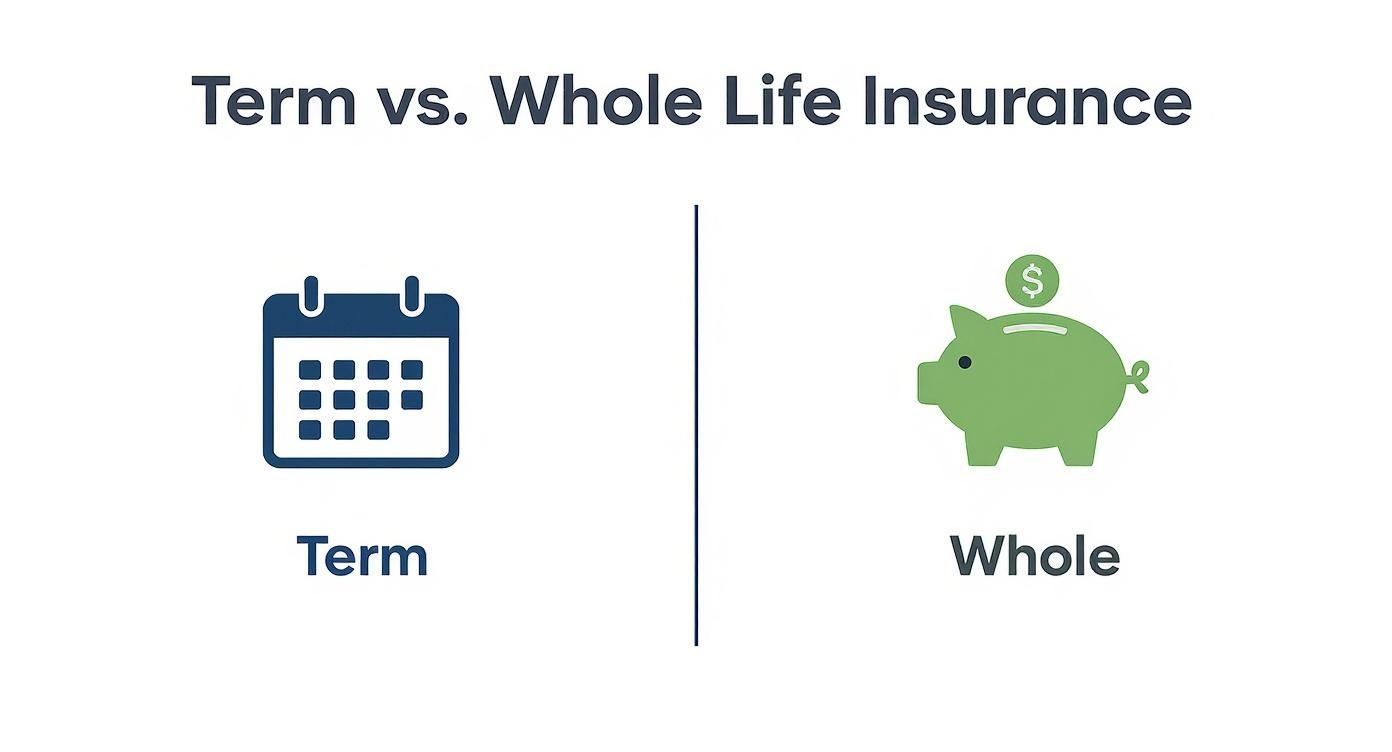
The calendar versus the piggy bank says it all. One is about coverage for a set time, while the other is about building a financial asset for life.
Premium Examples: A California Perspective
To make this tangible, let's look at some real-world numbers. The cost gap isn't just a few dollars; it's significant and can shape what a family can realistically afford.
A healthy 30-year-old in California could likely get a 20-year term policy with a $500,000 death benefit for about $20 to $30 a month. That's often less than a weekly coffee run, putting serious financial protection within easy reach for almost anyone.
Now, take that same 30-year-old and look at a whole life policy for the same $500,000 death benefit. The premium could easily be $400 to $500 per month, maybe even more. That’s a major financial commitment, which is why whole life is better viewed as a long-term financial planning tool, not just a safety net.
Recent industry data paints an even starker picture: a 30-year-old non-smoker might pay around $21 per month for a 20-year, $500,000 term policy. The equivalent whole life coverage? A whopping $440 per month. That's a staggering 20-fold increase. You can explore more about these cost comparisons to see how the market stacks up.
The core question for your budget is this: Are you looking for the most protection for the lowest cost to cover temporary needs, or are you investing in a permanent asset with lifelong guarantees at a premium price?
Why the Massive Cost Difference?
The price gap all comes down to the promise each policy makes.
With term life, the insurance company is essentially betting you'll outlive the policy. And statistically, most people do. Because their risk is confined to a specific period, they can keep the premiums incredibly low.
With whole life, the insurer makes a rock-solid promise: as long as you pay your premiums, it will pay out the death benefit, whether you pass away tomorrow or at age 100.
That guarantee of an eventual payout, plus the forced savings of the cash value component, requires much higher premiums to fund. You’re paying for certainty. In the term vs. whole life insurance debate, this is the bottom line—you get exactly what you pay for.
When Term Life Insurance Is the Right Choice
Term life insurance is the perfect tool when your financial safety net needs to cover a specific window of time. It's not designed to last forever. Instead, it offers a huge amount of protection during your most financially critical years, and it does so at a price most California families can easily afford.
The strategy is simple: align the length of your policy with the length of your biggest financial responsibilities. Rather than paying for lifelong coverage you might not end up needing, you're buying exactly what you need, for exactly as long as you need it. This efficiency is why term life is so often the clear winner for young families and anyone with significant, but temporary, debts.
Aligning Coverage with Life's Biggest Milestones
Think about your major financial commitments. Most of them won't last forever—they have a clear end date. A term policy can be set up to mirror these timelines, making sure your family is protected when the financial risk is at its peak.
- Protecting Your Mortgage: For most of us in California, our home is our biggest asset and our largest debt. A 30-year term policy can run alongside a 30-year mortgage, guaranteeing your family can stay in their home, no matter what happens to you.
- Raising a Family: The costs of raising children are no joke. A 20-year term policy, purchased when your first child is born, creates a financial backstop to cover everything from daily expenses to college tuition until they're on their own.
- Securing a Small Business: If you have business partners, term life is essential for funding a buy-sell agreement. It provides the cash for the remaining partners to buy out a deceased partner's shares, ensuring the business can carry on without a hitch.
The Power of Affordability
The single biggest selling point for term life insurance is its low cost. Because you're paying for pure death benefit protection—with no complex cash value component—the premiums are just a fraction of what you'd pay for a whole life policy. This affordability means you can get a truly meaningful amount of coverage without wrecking your monthly budget.
For a young family, this is a game-changer. It means you can actually afford a death benefit large enough to replace your income, wipe out all debts, and fund your kids' education. You're getting the absolute most protection for every dollar you spend, right when that protection matters most.
Term life insurance answers one simple question: "How can I get the most protection for my family during our most critical years?" It's all about providing a large, immediate safety net, not building a long-term financial asset.
Outliving Your Policy Is a Win
A common question I hear is, "What happens if the term ends and I'm still here?" The truth is, the vast majority of these policies expire without paying a death benefit. Industry data shows that over 97% of term life policies never result in a claim. You can discover more insights about these policy statistics to understand why this is by design.
While that might sound like a bad thing, it’s actually the best-case scenario. It means you made it through that period of major financial risk. Your mortgage is mostly paid off, your kids are independent, and your retirement savings have had time to grow. You won the bet. Your need for that massive safety net has shrunk, freeing up your money for other goals.
When Does Whole Life Insurance Actually Make Sense?
While term life insurance is a fantastic, affordable way to cover temporary needs, whole life insurance plays a completely different game. Think of it less as a simple safety net and more as a permanent piece of your long-term financial strategy. Yes, the premiums are higher, but that's because you're investing in certainty and building an asset, not just renting protection.
This isn't the right choice for everyone, and it shouldn't be. But for certain Californians, it’s an incredibly powerful tool for preserving wealth, planning a legacy, and locking in lifelong security. Opting for a whole life policy is really a mindset shift—it’s about moving beyond replacing income for a few decades and instead creating a guaranteed foundation for complex, multigenerational goals.
Scenarios Where a Permanent Policy is a Must-Have
Some financial obligations don't just disappear after 20 or 30 years. In these situations, the guarantees that come with a whole life policy—a permanent death benefit and tax-deferred cash value—aren't just nice-to-haves; they're essential.
Estate Planning for High-Net-Worth Families: For Californians with substantial assets, a whole life policy can be the linchpin of an estate plan. It provides instant, tax-free cash to heirs, which they can use to pay estate taxes or other final expenses. This prevents a forced, and often fire-sale, liquidation of family assets like a business or real estate.
Funding a Special Needs Trust: Parents of a child with special needs have a unique and lifelong financial responsibility. A whole life policy is often the most reliable way to fund a special needs trust, making sure there's always money available for a caregiver and other critical resources, long after the parents are gone.
Business Succession Planning: Many California business owners use whole life insurance to fund their buy-sell agreements. When a partner dies, the policy’s death benefit gives the surviving partners the immediate capital needed to buy out the deceased's shares from their family. It’s a clean, effective way to ensure the business continues without a hitch.
The Strategic Power of Cash Value
Beyond the death benefit, the cash value is what really sets whole life insurance apart. It grows at a guaranteed rate, tax-deferred, creating a stable asset that’s completely insulated from stock market swings. This gives you a reliable pool of funds you can borrow against for emergencies or opportunities.
For some, it's a conservative way to supplement retirement savings, providing a predictable source of cash later in life. It's this dual purpose—protection and accumulation—that makes it a cornerstone of more sophisticated financial plans.
Whole life insurance is built for problems that don't have an expiration date. It's a strategic move for people whose financial responsibilities are permanent, making it a critical tool for creating lasting security and generational wealth.
It's interesting to note that despite all the talk about "buy term and invest the difference," the demand for permanent policies remains strong. The 2023 Insurance Barometer Study found that term policies accounted for only about 19% of the U.S. life insurance market in recent years. That means for every five policies in force today, only one is a term policy. You can read the full research about these insurance market trends to get a better sense of how people are choosing their coverage.
How to Choose the Right Policy for Your Family
Figuring out whether term or whole life insurance is right for you boils down to one thing: your family's actual financial situation. There's no magic "best" policy out there—the right one is simply the tool that solves your specific problems. The most critical step is taking a clear, honest look at what you truly need.

This is a deeply personal decision, but you can cut through the noise by asking yourself the right questions. Start by thinking about what you need this insurance to do for you, both today and down the road.
Your Personal Policy Checklist
Before you even think about getting quotes, take a few minutes to map out your family’s circumstances. Answering these questions will give you a solid foundation for a productive chat with an insurance professional.
- What's my main goal? Am I just looking for affordable protection to cover temporary debts like a mortgage? Or do I need a permanent financial tool for something like estate planning or taking care of a lifelong dependent?
- What can I actually afford? Be realistic about your monthly budget. Term life offers the biggest death benefit for the lowest premium, whereas whole life is a major, long-term financial commitment.
- How long do I need the coverage? If your biggest worry is getting your kids to adulthood (around 20 years) or paying off that 30-year mortgage, a term policy’s timeline lines up perfectly.
- Do I have permanent financial needs? Things like funding a special needs trust or ensuring a business can continue without you are situations that demand the lifelong guarantee that only a permanent policy provides.
Answering these honestly will point you in the right direction. For many families in California, the right answer is often a straightforward, affordable term policy. But for others with more complex financial needs, the unique benefits of whole life are indispensable.
How Mai & Associates Can Help
Understanding the theory behind term vs. whole life is one thing. Finding the right policy from a reputable carrier at a price that makes sense is the next, and often harder, step. At Mai & Associates, we make that part easy for Californians. We don't just sell insurance; we partner with you to build a protection plan that fits your life.
This means we also look at the bigger picture—how your life insurance policy works with your other coverage, like your auto insurance and home insurance. Our focus is making sure your family is fully protected, with no weak spots.
The best life insurance decision is an informed one. Our role is to provide clear options and expert guidance, empowering you to choose with confidence. We translate the complexities into straightforward choices that align with your budget and long-term goals.
We work with dozens of top-rated carriers, which allows us to shop the market for you and find the best fit. Whether that means locking in an affordable term policy or carefully structuring a whole life plan, we provide personalized guidance every step of the way.
To see how we can help protect your family, you can easily get a personalized insurance quote online and start the conversation today.
Frequently Asked Questions
Even with a side-by-side comparison, it's natural to have a few lingering questions about term and whole life insurance. These are the details that often come up as California families get closer to making a choice. Let's tackle some of the most common ones we hear from our clients.
Can I Switch My Term Policy to Whole Life Later On?
Absolutely. Most quality term policies today come with a conversion rider. Think of it as a built-in escape hatch—it gives you the right to convert your term coverage into a permanent policy without having to go through another medical exam.
This is a huge advantage if your health changes down the road or if you realize your need for coverage is permanent, not temporary. Just keep in mind that conversion isn't open-ended; there's usually a deadline set by the insurer. Your new premiums for the whole life policy will also be higher, reflecting the lifelong coverage and cash value component you're switching to.
What Happens to the Cash Value When I Pass Away?
This is probably one of the most misunderstood parts of whole life insurance. When you die, your beneficiaries receive the policy's death benefit. The cash value you've built up over the years is generally absorbed by the insurance company—it isn't paid out on top of the death benefit.
The best way to think about cash value is as a living benefit. It’s an asset you can tap into while you’re alive through loans or withdrawals. The death benefit is what’s specifically set aside for your loved ones.
Is the "Buy Term and Invest the Difference" Strategy a Good Idea?
This classic strategy suggests you buy the less expensive term policy and then invest the money you saved (the "difference") into the market. For someone who is a disciplined, hands-on investor and comfortable with market ups and downs, this can potentially generate greater returns over the long haul.
But it's not for everyone. The appeal of whole life is its predictability—you get guaranteed, tax-deferred growth that isn't tied to the stock market's performance. The right path really boils down to your own financial habits and how much risk you're willing to take. You can find more answers on our detailed life insurance FAQ page.
How Does Life Insurance Fit in With My California Auto and Home Policies?
Think of your insurance as a complete shield. Your California auto insurance and home insurance protect the assets you have right now from accidents, theft, or lawsuits. Life insurance does something different: it protects your family's future income and their ability to keep those assets if you're gone. Proper life insurance is a key part of this shield.
At Mai & Associates, we don't look at these policies in isolation. We review your car insurance, homeowners, and life insurance together to make sure your family is fully protected without any dangerous gaps. Often, we can find savings by bundling your policies with a single carrier.
Deciding between term vs whole life insurance is a big step, but it’s one you don’t have to take by yourself. The experienced agents at Mai & Associates are here to cut through the jargon and offer straightforward advice tailored to your situation. Let us help you compare quotes for life, auto, and home insurance to create a plan that truly protects what matters most. Visit us at https://cahomeauto.com to get started.