Term Life Insurance California: Your 2026 Guide

If you're a California parent, homeowner, renter, or driver, you probably already insure the things you can see. Your car. Your home. Your apartment. The bigger financial risk is often the one people postpone. If your income stopped because you died too soon, would your family still be able to cover the mortgage, rent, car payments, and daily bills?
That's where term life insurance in California fits. I don't view it as a separate purchase. I view it as part of the same protection plan as your auto insurance, home insurance, renters insurance, and, in higher-risk parts of the state, wildfire and earthquake planning. A solid insurance plan protects your property. A smart one also protects your family's income.
What Exactly Is Term Life Insurance
A California family buys a house in Riverside, adds a second car, and welcomes a baby. Their home and auto coverage get updated right away. The bigger gap is often income protection. If one parent dies during the years the family depends on that paycheck, term life insurance is what keeps the mortgage, car payment, childcare, and daily bills from turning into a financial crisis.
Term life insurance covers you for a set number of years. If you die during that term, your beneficiary gets the death benefit. If you outlive the term, the policy ends unless you renew it, convert it, or replace it with a new policy.
A simple way to understand it
Term life works a lot like renting. You pay for protection for a defined period, usually the years when your financial responsibilities are highest. Permanent life insurance is built differently and usually costs more because it can include features beyond the death benefit.
That difference matters. For young families, new homeowners, renters supporting a partner, and anyone trying to protect a real budget, term life is usually the smarter buy. You get a large death benefit for the years your family needs it, without paying for features you may not need right now.
California term life policies are generally sold as pure death-benefit coverage for a fixed period. Common term lengths include 10, 20, and 30 years, and these policies typically do not build cash value, according to this California term life overview.
Why I usually recommend term first
Term life is straightforward. You are paying for income protection, not an investment component. That makes it a practical fit for the years when your family relies on your paycheck to keep everything else in your protection plan in place, including the house, the cars, and the emergency savings you would otherwise burn through.
In California, that bigger-picture approach matters. I do not separate life insurance from the rest of a household risk plan. A wildfire claim, a major auto accident, or a temporary housing move after a property loss can strain a family financially even when property insurance responds. Term life protects the piece that home, renters, and auto insurance cannot replace. Your income.
Practical rule: Buy term life for the years your family would struggle without your paycheck.
One feature deserves more attention than it gets. Conversion. Some term policies let you switch to permanent coverage during a set conversion period without taking a new medical exam, as noted in the earlier California term overview. If your health changes later, that option can save you from getting boxed out of better long-term coverage.
If you want a broader view before you start comparing quotes, this guide to life insurance options in California is a good place to start.
Typical Costs for Term Life Insurance in California
A lot of California clients come to me with the same concern. They already pay plenty for home, auto, or renters insurance, so they assume life insurance will be one more expensive bill. In most cases, term life is not the budget breaker. It is often one of the cheaper ways to protect your family's financial stability.
For a healthy adult, term life can be surprisingly affordable, especially if you buy before health issues show up and before birthdays push rates higher. That matters in California, where families are already trying to protect a mortgage, keep cars on the road, and stay prepared for disruptions like wildfire evacuations or temporary housing costs after a property loss. Life insurance covers the paycheck that holds that whole plan together.
A practical benchmark for California buyers
A healthy 35-year-old shopping for a 20-year, $500,000 term policy may see monthly premiums around $27 for women and $32 for men.
Here's a simple benchmark table:
| Age | Average Monthly Premium (Female) | Average Monthly Premium (Male) |
|---|---|---|
| 35 | $27/month | $32/month |
Use that as a starting point, not a promise.
Quoted rates are based on a clean health profile and a favorable underwriting class. If you want help with policy language while you compare options, this California insurance glossary is useful for terms like premium, rider, beneficiary, and conversion.
What actually changes the price
Your premium is shaped by a few core decisions and personal details:
- Age: Buy younger and you usually lock in lower rates for the full term.
- Health: Current conditions, prescriptions, and past diagnoses affect price.
- Tobacco or nicotine use: This can raise rates fast.
- Coverage amount: More coverage costs more, but the jump is often smaller than people expect.
- Term length: A 30-year term usually costs more than a 10- or 20-year term.
- Riders: Extra features can add cost.
Here's my advice. Do not shop for the cheapest number on the screen. Shop for the amount your family would need if your income disappeared tomorrow.
A policy that fits your full protection budget is the right policy. If you are paying to protect your house, your car, and your belongings, but leaving your income thinly covered, your plan has a hole in it. I see that mistake all the time in California. Property coverage matters. Income protection matters more.
Understanding Underwriting and Rate Factors
The biggest mistake shoppers make is assuming the cheapest advertised policy will be the cheapest policy for them. It won't. Underwriting decides that.
An insurer looks at your risk profile and places you into a rating class. That's why two people shopping for the same face amount and term length can get very different prices.

What carriers are actually pricing
Underwriting is about one question. How likely is the carrier to pay a claim during the term?
That assessment can be shaped by:
- Current health
- Past medical issues
- Tobacco or nicotine use
- Build and lifestyle
- Whether you choose fully underwritten or no-exam coverage
A healthy applicant who's comfortable with a traditional underwriting process may qualify for stronger pricing than someone who wants convenience or has a more complicated health profile.
Why one carrier can fit one buyer and not another
Online shopping can become confusing. A rate chart can make one company look like the obvious winner, but that can flip once your underwriting class is assigned.
A California comparison focused on non-standard shoppers notes that content often pushes “best rates” without explaining how health, tobacco use, or underwriting class changes the result. That same comparison says Transamerica is particularly competitive for smokers and higher-risk applicants, and it claims tobacco-user rates are about 10% lower than the nearest competitor, according to this California term life comparison for non-standard applicants.
That doesn't mean Transamerica is automatically your answer. It means the right carrier depends on your profile.
If you smoke, have a health history, or want no-exam coverage, don't shop by headline price. Shop by underwriting fit.
A good way to keep the process straight is to understand the language carriers and agents use. This plain-English insurance glossary helps if terms like underwriting class, rider, conversion, or beneficiary still feel fuzzy.
California State Regulations and Consumer Protections
A California parent buys term life to keep the mortgage paid, the car covered, and the family stable if income disappears. Then a practical question comes up. What if the insurance company itself runs into trouble years from now?
That question matters, especially in California, where families already see insurer instability on the home side because of wildfire exposure and tighter underwriting. If you already review the strength of a home or auto carrier, use the same discipline with life insurance.
The California Department of Insurance regulates life insurers that do business in this state. That means policy forms, licensing, and claims practices are not a free-for-all. You still need to read the policy, but you are buying inside a real consumer-protection system.
Term life also stays cheaper than permanent coverage for a simple reason. It covers a defined period of risk, such as your child-raising years, your highest debt years, or the years your household depends most on your income. Many policies expire without a death claim because the insured outlives the term, and that lower claim exposure helps keep premiums down.
There is also a backstop if a licensed life insurer becomes insolvent. As noted earlier, California policyholders may have limited guaranty association protection. The key point is simple. Do not assume your full death benefit is automatically protected without limits.
That is why I recommend treating life insurance the same way you treat the rest of your protection plan. Check that the carrier is licensed in California. Look at financial strength before you buy. If you are buying a larger policy to protect a mortgage, college funding, or years of family income, be pickier about the insurer, not just the premium.
Ask these questions before you apply:
- Is the insurer licensed in California?
- How clear is the policy on beneficiary changes, ownership changes, and conversion options?
- If the carrier failed, what protection might apply and where are the limits?
- Does this policy fit with the rest of your household coverage, including home, auto, or renters insurance?
That last point gets ignored too often. Your insurance plan should work together. If your family lives in a wildfire-prone area, worries about earthquake risk, or depends on two cars to get to work, life insurance is part of the same financial safety net, not a separate purchase sitting in a drawer.
If you want help sorting out common California coverage questions while comparing life policies, this California insurance FAQ for consumers is a good place to start.
Beyond the Basics Customizing Your Policy with Riders
A bare-bones term policy can be fine. It can also be the wrong choice if you never look at the riders.
Too many shoppers focus only on price. That's lazy shopping. The important question is whether the policy does what your family would need during the term.
Riders can change the value of the policy
Common riders people should ask about include:
- Waiver of premium: If you become disabled under the rider's terms, the policy may stay in force without you continuing to pay premiums.
- Accelerated death benefit: This may allow access to part of the death benefit if you meet the policy's qualifying conditions.
- Children's term rider: This can add limited coverage for children under one rider instead of buying separate policies.
Those features don't automatically make a policy better. They make it more customized. For a household with one primary earner, waiver of premium may be more important than a child rider. For someone worried about severe illness, the accelerated death benefit language deserves close review.
Not all living benefits are equal
Buyers often trip up. “Living benefits” sounds broad and reassuring. The details can be much narrower.
A California-focused page points out that many shoppers ask for the cheapest term policy when the actual decision is whether the policy has usable benefits during the term. It also notes one Premier Term option with living benefits that excludes critical illness, which is exactly why you need to read rider language carefully, according to this California discussion of living benefits and exclusions.
Don't buy a rider because the name sounds good. Buy it because you understand exactly when it pays and when it doesn't.
Ask these questions before you add anything:
- What event triggers the rider benefit?
- What exclusions apply?
- Does the rider cost extra, and is the tradeoff worth it?
- Would this rider matter to my spouse, kids, or household budget in a real claim scenario?
If you already carry home, renters, and auto insurance, think the same way here. The smartest insurance buyer isn't the person who buys the cheapest premium. It's the person who understands what gets paid when something goes wrong.
How to Get Quotes and Compare Policies in California
Shopping for term life insurance in California should be straightforward. A lot of people make it complicated because they start with carrier ads instead of their own needs.
Start with your numbers. How much income would your family need to replace? How much mortgage or rent obligation are you protecting? Do you want coverage just until the kids are grown, or until the house is paid off?

A clean process that works
Use this order:
- Choose the purpose first. Income replacement, mortgage protection, debt coverage, or a combination.
- Pick a term length that matches the obligation. Don't guess. Match the policy to the years the risk is real.
- Decide whether you want bare-bones coverage or selected riders.
- Compare multiple carriers. One company's pricing sweet spot may not fit your profile.
- Review underwriting requirements before you apply. Especially if you smoke, have a health issue, or want no-exam convenience.
Direct carrier versus independent agency
Going direct to one carrier is simple, but it limits your view. If that carrier doesn't like your health profile, age, or tobacco history, you may never see a more suitable option elsewhere.
Working with an independent agency gives you broader comparisons in one place. Mai & Associates is one California option that helps clients compare multiple carriers for auto, home, renters, and life insurance, including same-day quote requests and broader coverage reviews through its California insurance quote process. That matters if you want to coordinate life insurance with the rest of your protection plan instead of handling every policy in isolation.
A practical comparison checklist:
- Compare the premium
- Check whether the term length really fits
- Review conversion options
- Read rider details
- Ask how the policy works if your health changes later
If you live in a wildfire-prone area, have earthquake concerns, or already use the California FAIR Plan for property coverage, this matters even more. Your insurance decisions shouldn't happen in silos. Life insurance belongs in the same household risk review as your car insurance, home insurance, and renters insurance.
Your Final Checklist for Buying Term Life Insurance
The best term life insurance California buyers choose usually isn't the flashiest policy. It's the one that fits the household budget, covers the right years, and closes financial gaps.
Use this checklist before you apply.
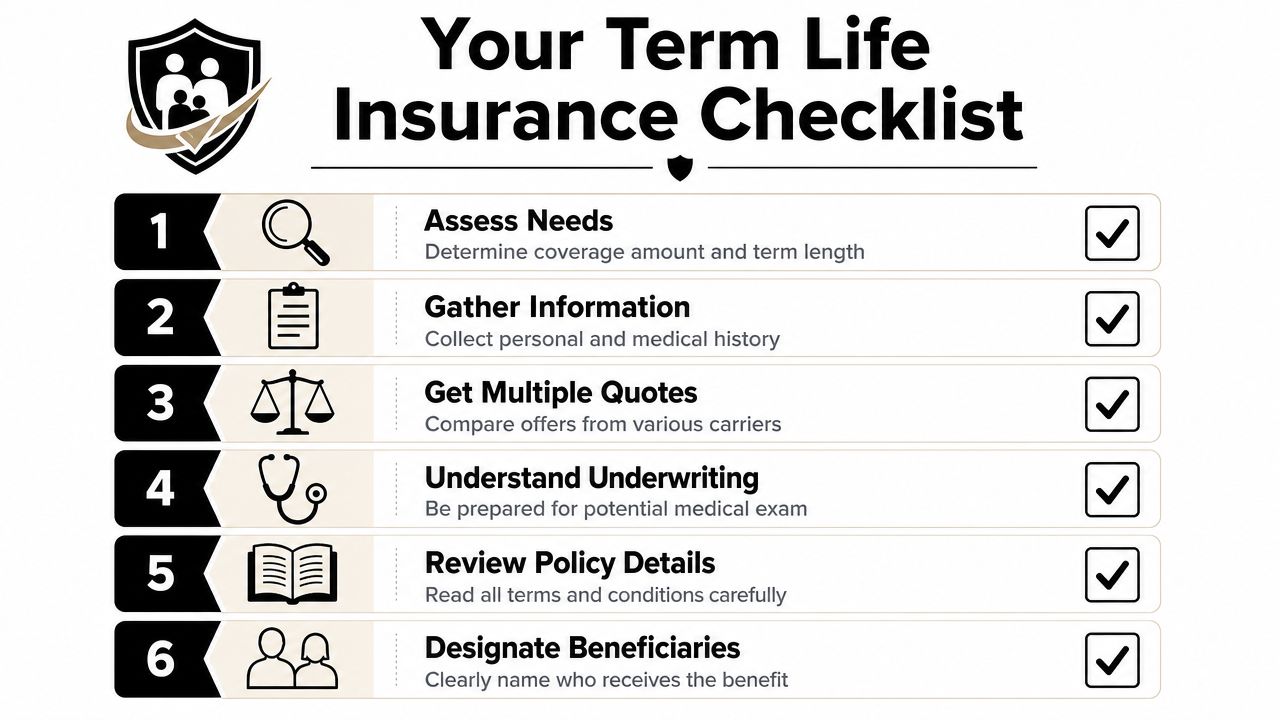
The six decisions that matter
- Assess the gap: Add up what your family would need if your income disappeared. Mortgage or rent comes first. Then debts, childcare, and everyday living costs.
- Gather your information: Have your basic personal and medical history ready before you request quotes. Clean applications move faster.
- Choose the term intentionally: Match the policy length to your biggest obligation. A mortgage timeline or child-raising years are common anchors.
- Compare several policy designs: Don't look at premium alone. Review conversion privileges and any riders you're considering.
- Be ready for underwriting: Some policies may involve a medical exam or added health questions. Others may trade convenience for different pricing.
- Name beneficiaries clearly: Keep this current. Life changes fast, and beneficiary mistakes create unnecessary claim problems.
Fit it into your larger protection plan
A good insurance plan protects more than one category of risk. Your auto insurance handles liability on the road. Your homeowners or renters insurance protects property and personal liability at home. Your term life insurance protects the people who depend on your income.
If you're also thinking long term about what your family keeps after you're gone, estate planning matters too. For a practical overview of inheritance planning, this guide to Protect Your Wealth tax strategies is a useful companion resource.
My blunt advice is simple. Don't wait until your health changes. Don't buy based on ads. Don't treat life insurance like an optional add-on after home and auto. If people depend on you financially, this belongs on your checklist now.
If you want help comparing life, auto, home, or renters coverage in one place, Mai & Associates offers California insurance guidance across those categories so you can review your protection plan as a whole instead of piecing it together policy by policy.