Stand Alone Earthquake Insurance California: What to Know
You're reviewing your California homeowners policy after another unsettling tremor. The declarations page shows dwelling coverage, personal property, and liability, but earthquake damage is excluded. If the chimney on a 1965 ranch collapses, the slab cracks, or the attached garage shifts, a standard policy may leave you paying for the structural loss yourself.
That's why stand alone earthquake insurance in California isn't another checkbox beside home insurance, renters insurance, car insurance, auto insurance, or life insurance. It's a separate risk-transfer decision built around your home's replacement value, foundation, construction era, retrofit status, deductible tolerance, and existing wildfire coverage.
| California coverage question | What to verify |
|---|---|
| Standard home insurance | Earthquake damage is excluded |
| Standalone CEA policy | Dwelling, contents, and loss-of-use options |
| Earthquake endorsement | Carrier-specific limits, deductible, and exclusions |
| California FAIR Plan | Basic fire protection, not earthquake protection |
| Auto insurance | Earthquake damage to a vehicle may require applicable physical-damage coverage |
| Renters insurance | Personal property and liability, with earthquake coverage requiring separate review |
| Life insurance | Family income protection, separate from property damage |
Why California Homeowners Need a Separate Earthquake Decision
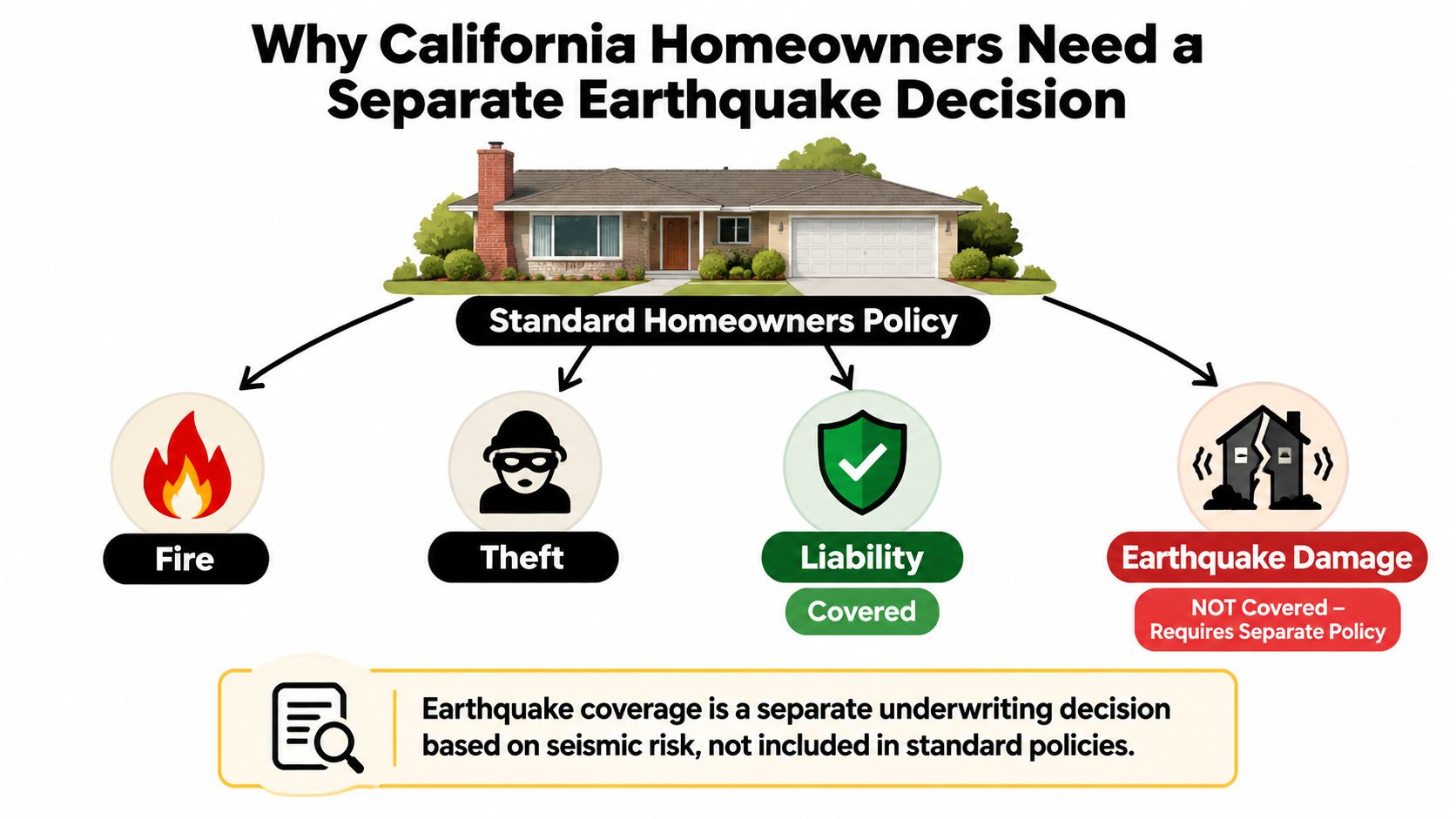
A Sacramento County homeowner buys a 1965 ranch with a wood-burning fireplace and attached garage. The HO-3 policy covers familiar risks such as fire, theft, and liability, yet its earth-movement exclusion can leave the homeowner paying for a collapsed chimney, shifted garage, or cracked slab after an earthquake.
That exclusion is standard in homeowners insurance. It is not an error on the declarations page. Earthquake damage requires separate underwriting because one seismic event can affect many properties at once. California's exposure includes major fault systems such as the San Andreas and Hayward, with wider regional seismic concerns extending toward the Cascadia-adjacent area.
The decision is structural
Choose coverage based on the property's actual gap, not on the label alone:
- Standalone CEA coverage: A separate policy with dwelling, personal property, and additional living expense options.
- An earthquake endorsement: Protection added to the existing homeowners policy, with limits, deductibles, and exclusions set by that carrier.
- FAIR Plan plus earthquake coverage: A basic fire policy paired with separate earthquake protection when the standard market will not insure the home.
A pre-1980 home with an unretrofitted foundation may need a different arrangement from a newer, reinforced property. A homeowner enrolled in the FAIR Plan must also solve the earthquake gap separately. The comparison should start with dwelling value, retrofit status, foundation type, and deductible capacity. A Northridge-style chimney collapse and a cracked slab do not create the same financial exposure, so the policy structure should not be chosen generically.
The California Earthquake Authority was created in 1996 after the Northridge earthquake era to stabilize residential earthquake coverage. Its position as a major source of California residential earthquake insurance is historical context described in this historical overview of California earthquake insurance, not support for later market-share figures.
Review the dwelling limit, foundation description, attached structures, and exclusions in your California home insurance policy. Strong fire or liability coverage does not pay for a cracked slab or fallen chimney. Those losses require a separate earthquake decision.
How Standalone Earthquake Insurance Actually Works in California
Standalone earthquake insurance is modular. Instead of treating every part of your financial exposure as one unlimited package, the policy separates the building, belongings, temporary living costs, and certain optional upgrades into distinct coverage buckets.
The CEA is the dominant channel for standalone residential earthquake coverage in California. It works through participating member insurers, while private carriers such as GeoVera, Palomar, and ICW may offer their own earthquake forms, often with different underwriting rules and coverage designs. The right comparison is not just carrier versus carrier. It's limit versus exposure and deductible versus savings.
Start with the coverage modules
Coverage A addresses the dwelling, including the insured residence and eligible attached structures. For homeowners, CEA Coverage A and B must match the homeowners dwelling limit under the policy structure described by the California Department of Insurance. Coverage B addresses personal property, while Coverage C addresses loss of use or additional living expense when an insured earthquake makes the home uninhabitable. Optional Coverage D can address building-code upgrade or ordinance-and-law expenses.
| Coverage module | What it pays for | Typical limit range |
|---|---|---|
| Coverage A, dwelling | Repair or rebuilding of the insured home and eligible attached structures | Tied to the homeowners dwelling limit and CEA policy maximum |
| Coverage B, personal property | Covered belongings damaged by the earthquake | CEA materials describe limits beginning at $5,000 and increasing to $25,000 |
| Coverage C, loss of use | Additional living expenses while the home is uninhabitable | Selected according to the policy option |
| Coverage D, optional upgrades | Certain ordinance-and-law or building-code upgrade costs | Some consumer guidance describes lines reaching $100,000 |
The CEA also describes emergency repairs with no deductible on the first $1,500, which can matter when immediate work is needed to prevent further damage. Coverage caps and sublimits still matter. A homeowner can buy earthquake insurance and remain underinsured if the contents limit, loss-of-use amount, or code-upgrade option doesn't match the actual exposure. Review the CEA homeowners coverage and deductible details before binding.
Why standard home insurance doesn't absorb the loss
Your underlying homeowners policy continues to govern non-earthquake perils. Fire, theft, personal liability, and other covered causes remain separate from the earthquake form. A quake-related fire may require careful causation analysis, so don't assume every loss after a seismic event automatically belongs to one policy.
For renters, the same logic applies. Renters insurance protects belongings and liability, but earthquake damage to personal property usually requires a separate earthquake option or policy. Car insurance is separate again, and home earthquake coverage doesn't insure a vehicle.
Standalone CEA Policy vs Earthquake Endorsement
A homeowners endorsement can look attractive because it keeps coverage with the existing carrier. That convenience doesn't automatically make it the better structure. The endorsement may reuse the homeowners policy's dwelling and personal-property limits, apply one shared deductible, or omit code-upgrade protection.
A standalone CEA policy usually gives you more deliberate control over the earthquake decision. You select the dwelling relationship, personal-property option, loss-of-use tier, and deductible within the available form. Private standalone carriers may provide another route when a CEA design doesn't fit the property.
| Criterion | Standalone CEA policy | Homeowners earthquake endorsement |
|---|---|---|
| Dwelling limit | Matches the homeowners dwelling limit, subject to CEA program maximums | Usually follows the existing homeowners Coverage A |
| Personal property | Separate coverage bucket with its own options and deductible structure | Often tied to the underlying Coverage B |
| Deductible | Percentage options selected for the earthquake policy | Carrier-specific, often shared across covered property |
| Code upgrades | Optional ordinance-and-law or building-code coverage may be available | Often excluded or restricted |
| Loss of use | Separate options can be selected | Follows the endorsement form |
| Underwriting | CEA eligibility and property details apply | Existing homeowners carrier must accept the endorsement |
| Best fit | Homes with meaningful seismic exposure or complex coverage needs | Lower-value, fully retrofitted homes with a suitable carrier |
The practical verdict
I favor an endorsement only when the home is relatively straightforward, fully retrofitted, and the form provides enough dwelling, contents, and temporary-living protection. It can work for a lower-value home where the carrier's deductible and exclusions are acceptable.
For most homeowners facing meaningful earthquake loss, standalone coverage is the stronger structure. A Northridge-style chimney collapse can involve masonry, roof, interior, and temporary-housing questions. A cracked slab in an older raised-foundation home can create a much larger structural dispute. Don't choose the endorsement just because the quote looks easier to understand.
Policy wording matters in every home claim. If you're also reviewing water-related exclusions, plumbing failures, or what your homeowners policy does and doesn't cover, this guide to plumbing insurance coverage offers useful context. For unfamiliar insurance terminology, keep the California insurance glossary open while comparing forms.
Deductible Structures and What They Cost You in a Real Quake
The deductible is the part of earthquake insurance that changes the decision most sharply. California earthquake policies commonly use a percentage of the dwelling limit rather than a flat dollar amount. The California Department of Insurance earthquake guide identifies common deductible choices of 5%, 10%, 15%, 20%, or 25% of the dwelling limit.
Consider a home with a $750,000 dwelling limit. A 15% deductible equals $112,500, while a 5% deductible equals $37,500. Those are retained-loss thresholds before the policy begins paying for covered dwelling damage.
| Deductible percentage | Out-of-pocket before payout | Typical premium impact |
|---|---|---|
| 5% | $37,500 | Usually higher premium |
| 10% | $75,000 | Usually midrange premium |
| 15% | $112,500 | Usually lower premium |
| 20% | $150,000 | Usually lower premium |
| 25% | $187,500 | Usually lowest premium among these choices |
Premium impact varies by property and carrier, so don't treat the table as a quote. It shows the trade-off: a lower premium can transfer less risk. A homeowner who chooses 25% may save on insurance cost but retain a very large loss before receiving dwelling benefits.
Match the deductible to cash, not optimism
Ask whether you could produce the retained amount after a major quake without selling the home, draining retirement funds, or relying on uncertain family assistance. A 15% deductible on a high-value dwelling can create a six-figure obligation. That's not a technical footnote. It determines whether the policy will help with the type of damage you're most worried about.
The application of deductibles depends on the policy form and coverage bucket. Dwelling and contents may have separate deductible treatment, and loss-of-use coverage may follow its own terms. Read the policy rather than assuming one deductible applies identically to every loss.
Practical rule: Choose the highest deductible you can fund immediately, not the highest deductible that makes the quote look affordable.
A Northridge-style event could involve a collapsed chimney, foundation movement, roof damage, and contents loss at the same time. Use the California insurance guides to organize the questions, then ask an agent to show the retained loss in dollars before you bind.
Standalone Coverage vs California Fair Plan Gaps
The California FAIR Plan is not a substitute for earthquake insurance. It provides basic fire-related protection for eligible properties that struggle to obtain coverage in the standard market, but it leaves important gaps. A homeowner who receives a FAIR Plan policy should view it as one layer in a larger insurance arrangement.
Fair Plan protection generally centers on fire and related basic perils such as smoke, internal explosion, and vandalism. It doesn't turn earthquake damage into an insured loss. It also doesn't solve every personal-property, liability, or additional-living-expense need a homeowner has.
| Peril or coverage | Fair Plan only | Fair Plan plus standalone CEA |
|---|---|---|
| Fire | Covered under the Fair Plan form | Covered under the Fair Plan form |
| Smoke | Covered under applicable Fair Plan terms | Covered under applicable Fair Plan terms |
| Internal explosion | Covered under applicable Fair Plan terms | Covered under applicable Fair Plan terms |
| Vandalism | Covered under applicable Fair Plan terms | Covered under applicable Fair Plan terms |
| Earthquake dwelling damage | Not covered | Addressed through standalone earthquake coverage |
| Earthquake personal-property loss | Not covered | Available through the selected contents module |
| Temporary living costs after a quake | Not supplied by the Fair Plan for earthquake loss | Available through loss-of-use coverage if selected |
| Building-code upgrades after quake damage | Not supplied by the Fair Plan | May be addressed through optional code-upgrade coverage |
Treat the policies as a stack
The Fair Plan policy handles its covered fire exposure. The standalone CEA policy handles the earthquake exposure. Neither replaces the other.
This pairing matters for a homeowner in a wildfire-prone foothill area whose older home has already been declined by standard carriers. The same construction characteristics that complicate fire underwriting may also demand closer earthquake review, especially where the foundation, framing, and retrofit history are uncertain.
Don't cancel a Fair Plan policy because you purchased earthquake coverage. That would remove fire protection while leaving you with a policy designed for a different peril. Instead, review the entire stack, including any supplemental liability, contents, or loss-of-use arrangement, and confirm that the limits work together.
Two Claim Scenarios That Show the Differences
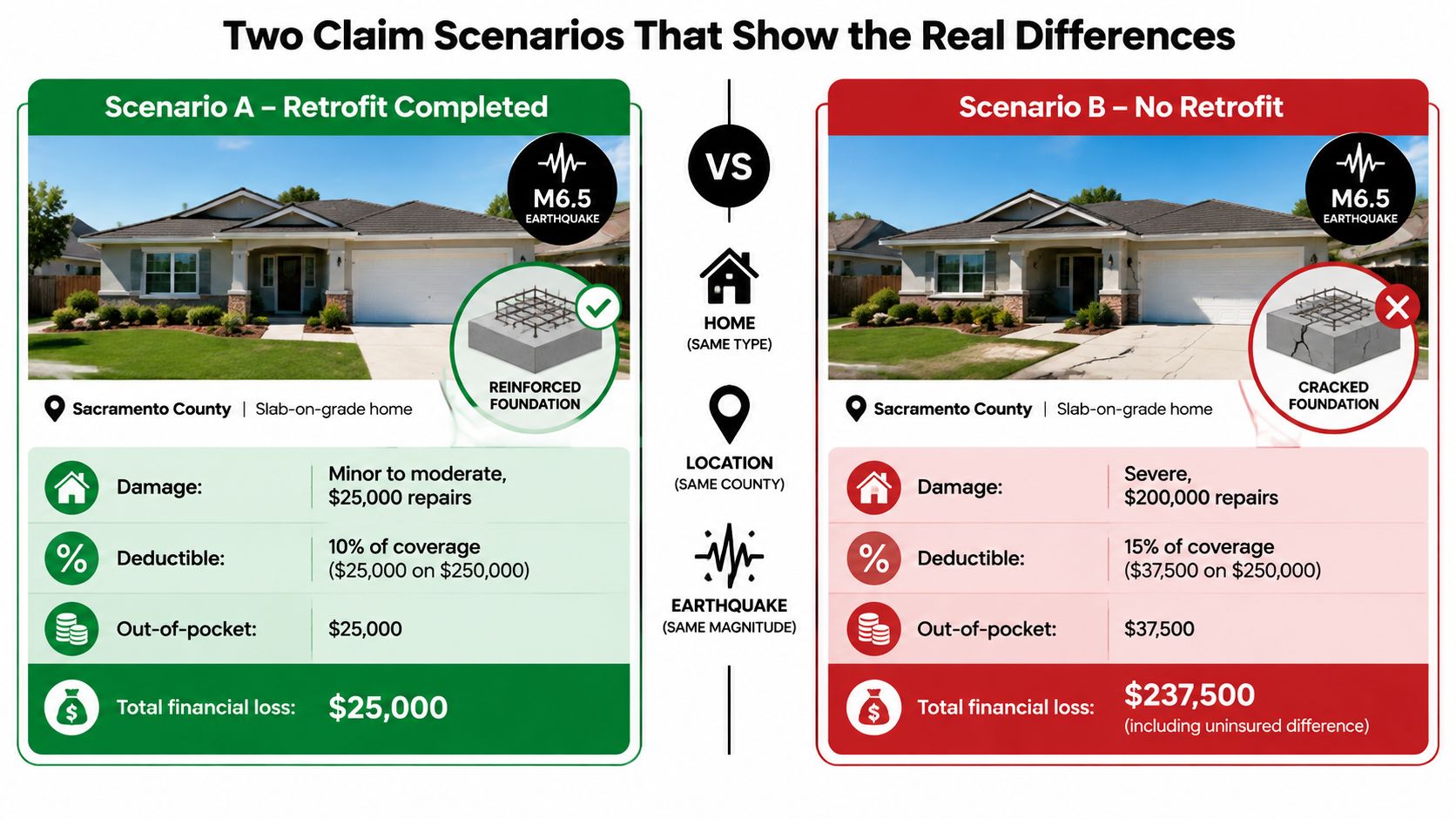
Two California homes can experience the same earthquake yet face different financial outcomes. The decisive variables are the homeowner's specific gap: dwelling value, retrofit status, deductible, sublimits, code coverage, and whether the policy is a standalone CEA form or an endorsement.
Scenario A with a completed retrofit
A slab-on-grade home in Sacramento County has documented retrofit work and a standalone CEA policy with a 10% deductible. After a significant earthquake, engineers identify slab movement, roof damage, and damaged contents. The claim is reviewed under the dwelling and personal-property modules. The homeowner pays the applicable deductible, and the policy responds to covered repairs and replacement.
Recovery still takes work. Inspections, contractor scheduling, temporary housing, and proof of loss can delay payment and repairs. The difference is that the homeowner has a defined claim path for covered damage instead of paying every covered repair from savings.
Scenario B without a retrofit
A pre-1980 raised-foundation home in the San Fernando Valley carries only a homeowners earthquake endorsement. The endorsement has a 25% cap and a low sublimit for masonry and chimney damage. The same event causes foundation movement, chimney damage, and work required to meet current building requirements.
Payment may stay within the endorsement's stated limits. Code-upgrade costs can fall outside the available protection, while the deductible and masonry and chimney sublimit leave the homeowner responsible for a large share of the structural work. The homeowner has insurance, but the selected form does not transfer enough of the specific risk.
For a Northridge-style chimney collapse or a cracked slab in an older home, construction details determine the claim outcome. A pre-1980 raised foundation, missing retrofit documentation, or an uncertain house-to-garage attachment can affect eligibility and payment expectations. Review those details before treating a familiar homeowners carrier as adequate earthquake protection.
Choosing the Right Structure With Mai and Associates
Start with the dwelling limit on the current homeowners declarations page. Use the cost to rebuild the structure, not the home's market value, as the anchor for the earthquake conversation. Then identify the amount you could retain after a major event.
A practical deductible review looks like this:
- Use the existing dwelling limit as the starting point. Confirm whether it reflects current replacement cost, attached structures, and reconstruction features.
- Compare 5%, 10%, 15%, and 25% options. Translate each percentage into a dollar obligation before reviewing premium.
- Document the property. Record year built, foundation type, retrofit status, prior losses, construction characteristics, and whether the property is a mobilehome or manufactured home.
- Compare structures, not just prices. Review Coverage A, personal property, loss of use, code upgrades, exclusions, and sublimits side by side.
| Homeowner factor | Standalone CEA | Endorsement | Fair Plan plus CEA |
|---|---|---|---|
| Standard carrier available | Strong fit when quake exposure is material | May be suitable if the form is broad | Usually unnecessary for the fire layer |
| Older or complex home | Review eligibility and retrofit details | Carrier underwriting may be restrictive | Useful when standard fire coverage isn't available |
| Need for code-upgrade protection | Optional coverage may address it | Often limited or unavailable | CEA handles the earthquake side |
| Wildfire-related FAIR Plan placement | Can add earthquake protection | May not be available through the FAIR Plan | Directly addresses separate fire and quake gaps |
| Deductible flexibility | Selected within CEA options | Controlled by homeowners carrier | CEA deductible applies to earthquake coverage |
| Mobilehome or specialty dwelling | Eligibility must be confirmed | Form may not fit | Review specialty and earthquake markets together |
Where professional review changes the result
A carrier comparison should include the CEA premium quote, any endorsement quote from the current homeowners carrier, and a Fair Plan gap analysis when applicable. Mai & Associates can review those policy combinations, identify whether the dwelling limit and deductible fit the property, and help turn an informal comparison into a binding decision.
The agency also handles broader California insurance needs. That matters when your earthquake choice interacts with home insurance, the California FAIR Plan, renters insurance, auto insurance, car insurance, or life insurance for family income protection. Request a California insurance quote with the declarations page and retrofit records ready.
Your Next Steps Before the Next Big One
Pull your current homeowners declarations page today. Confirm that earthquake is explicitly excluded, then identify the dwelling limit used for replacement-cost coverage. Don't use the sale price as a substitute for reconstruction analysis.
Next, ask for both a CEA quote and an earthquake endorsement quote from your current carrier. Compare the premium, deductible in dollars, Coverage A limit, personal-property limit, loss-of-use terms, code-upgrade language, and exclusions. If the home sits on a FAIR Plan, review the fire policy and earthquake policy as a coordinated stack.
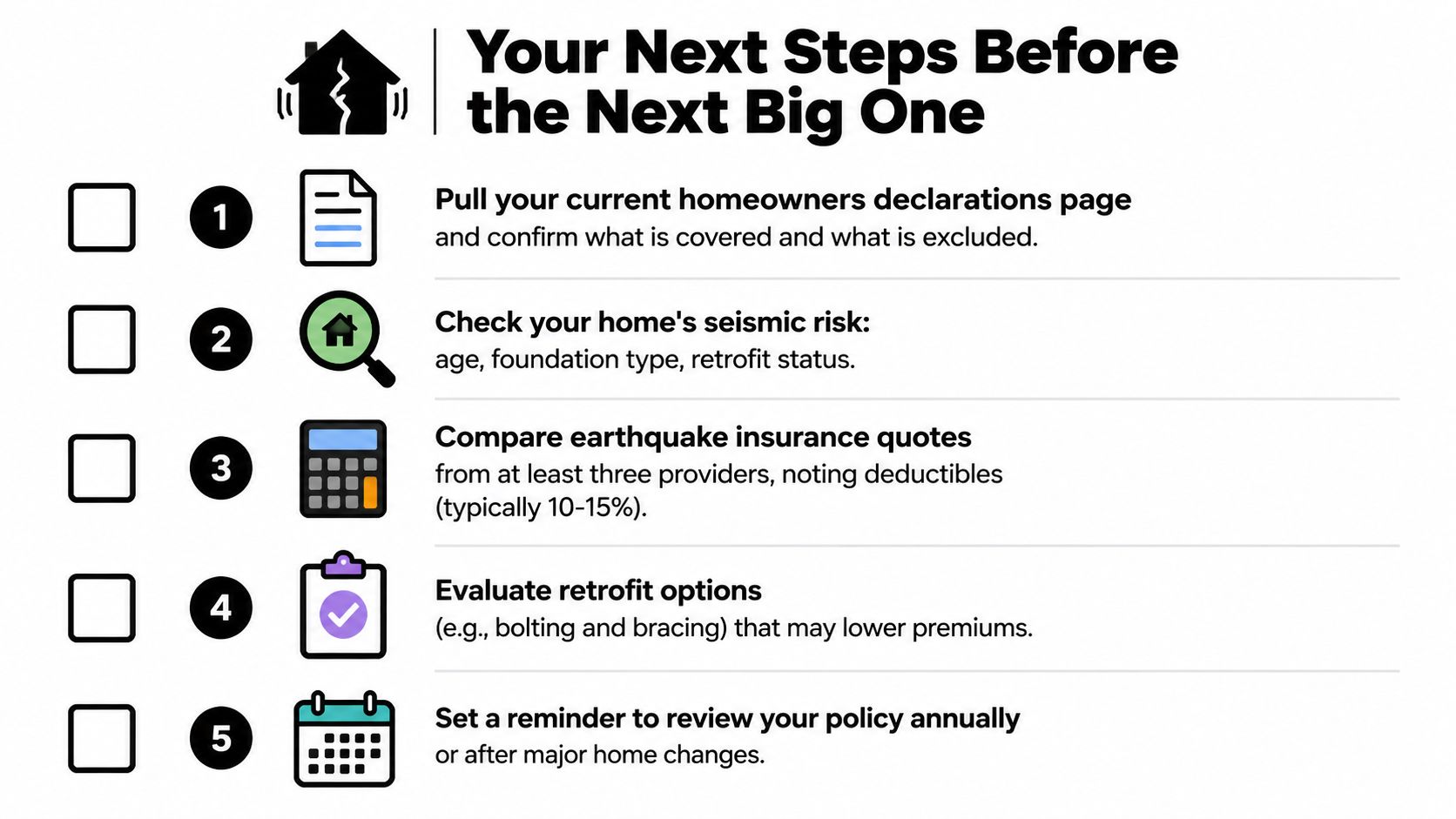
Use this short checklist:
- Confirm the exclusion: Read the homeowners policy instead of relying on assumptions.
- Establish replacement value: Tie Coverage A and the deductible to rebuilding needs.
- Verify construction details: Note whether the home is pre- or post-1980, raised or slab-on-grade, and retrofitted.
- Test your retained loss: Decide whether you can absorb a 15% to 25% deductible without earthquake coverage paying first.
- Preserve retrofit records: Keep permits, invoices, engineering documents, and photographs available for underwriting review.
The right answer usually becomes clear after those questions. A fully retrofitted, lower-value home may fit an endorsement. A higher-value or older home with meaningful structural exposure usually deserves standalone CEA review. A FAIR Plan homeowner should generally analyze earthquake coverage as an addition, not a replacement.
Mai & Associates can compare CEA and endorsement options, review your FAIR Plan gaps, and coordinate earthquake protection with your California home, renters, auto, car, and life insurance needs. Visit Mai & Associates to request a policy review and discuss the deductible and coverage structure your home can support.