SR22 Insurance California: Complete Guide
An SR-22 in California is not a separate insurance policy. It's a DMV-filed certificate proving you carry the state's minimum liability coverage, typically required for three years after reinstatement.
That explanation rarely feels sufficient when a suspension notice is sitting on your kitchen counter and you're trying to figure out how you'll get to work, keep your car, or afford your next insurance bill. The filing itself is usually inexpensive. The serious financial impact comes from the violation that caused it and from the insurance carrier willing to cover your risk.
What SR22 Insurance Actually Means in California
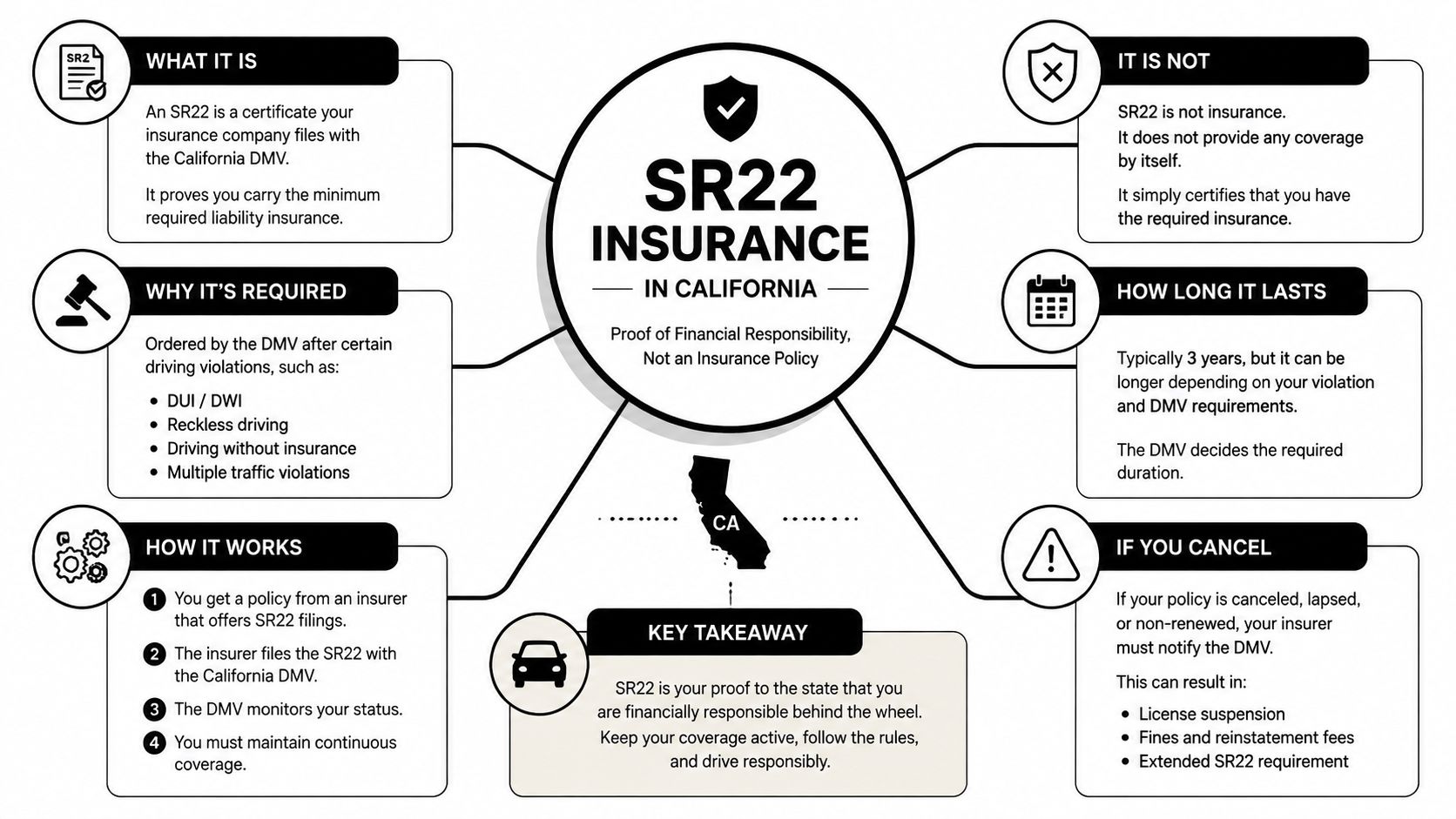
A California SR-22 is a certificate of financial responsibility. Your insurer files it with the California Department of Motor Vehicles to show that you maintain the liability coverage required for legal driving. You don't buy “SR-22 insurance” as a standalone product, and the SR-22 doesn't repair your driving record or erase the suspension.
The DMV lists SR-22 documentation among the materials it may require to verify insurance compliance. If the filing becomes inactive because your policy cancels or lapses, the insurer can notify the DMV, and your driving privileges may be interrupted until you re-establish compliance. The California DMV insurance requirements explain the filing's role in the reinstatement process.
The liability limits your filing must support
As of January 1, 2025, California's minimum auto liability limits are 30/60/15. That means:
- $30,000: Injury or death to one person.
- $60,000: Injury or death to more than one person in an accident.
- $15,000: Property damage in one accident.
Your SR-22 must support at least those limits. These are liability limits, not collision coverage, so they won't pay to repair your own vehicle after a crash. They also may not be enough to protect your personal finances after a serious accident.
Practical rule: Treat the SR-22 as proof that your policy meets a DMV requirement, not as protection that makes every driving risk financially safe.
The filing generally remains active for three years from reinstatement, which makes it a time-bound compliance obligation. Your specific DMV notice controls the dates, so don't rely only on an insurer's estimate. Read the reinstatement paperwork carefully and record the effective date.
Why the distinction matters
Confusing the filing with a policy leads to bad decisions. Some drivers assume paying a filing fee fulfills the insurance requirement. Others cancel a policy after selling a vehicle without checking whether the DMV still requires an active filing.
If you're dealing with a driving-without-proof issue alongside the insurance requirement, reviewing legal help from Gerald Miller P.A. can help you separate legal questions from insurance steps. For broader California insurance terminology, keep the California insurance glossary available while comparing policy documents.
Who Needs an SR22 Filing and Why
The DMV or a court typically triggers the requirement. Your insurance company doesn't decide that you need an SR-22 just because it wants to charge you more. The insurer's job is to issue a qualifying policy and file the certificate when the state requires proof of future financial responsibility.
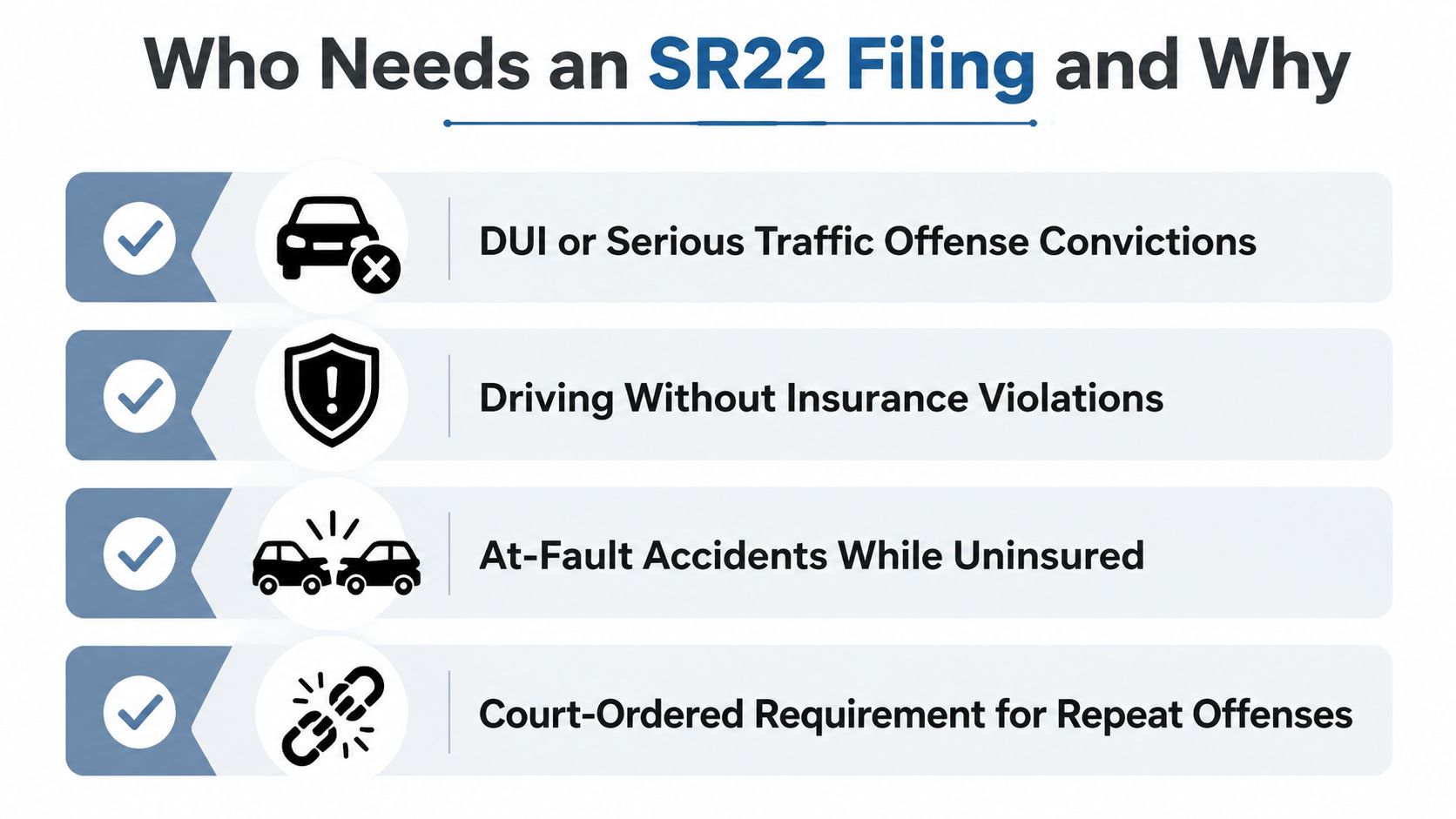
Common triggers include serious violations and license actions:
DUI and serious traffic convictions
A DUI conviction is one of the clearest situations associated with an SR-22 requirement. Reckless driving and other serious traffic offenses can also create reinstatement obligations. If your notice follows a conviction, don't ask only, “Which insurer is cheapest?” First ask whether the carrier accepts your violation and can file the certificate with the California DMV.
Driving without insurance
A driver stopped without valid coverage may need an SR-22 before the DMV restores driving privileges. The same can apply after an accident where the driver had no active policy. The financial consequences can arise even when the driver didn't cause the collision, because the lack of insurance is a separate compliance problem.
Uninsured at-fault accidents
Suppose you caused a crash while uninsured. The accident creates one set of legal and financial issues, while the absence of insurance creates another. An SR-22 may become part of the steps required to regain lawful driving status.
Repeat offenses and suspension
Repeated traffic violations, license suspension, or revocation can also lead to an SR-22 requirement. Your suspension or reinstatement notice should identify the proof the DMV needs. If the paperwork is unclear, contact the DMV or a qualified professional rather than guessing.
A useful explanation of the broader causes of license suspension is available in this guide from BDISchool. It can help you identify whether your issue involves the court, the DMV, or both.
For policy choices after reinstatement, compare liability, collision, and uninsured motorist options through California auto insurance guidance. Meeting the SR-22 requirement is the starting point, not necessarily the right long-term protection level.
How the SR22 Filing Process Works
Start with the document that tells you the filing is required. It may come from the DMV, a court process, or reinstatement instructions. Confirm the required limits and the date your coverage must become active before accepting a quote.
Follow the filing sequence
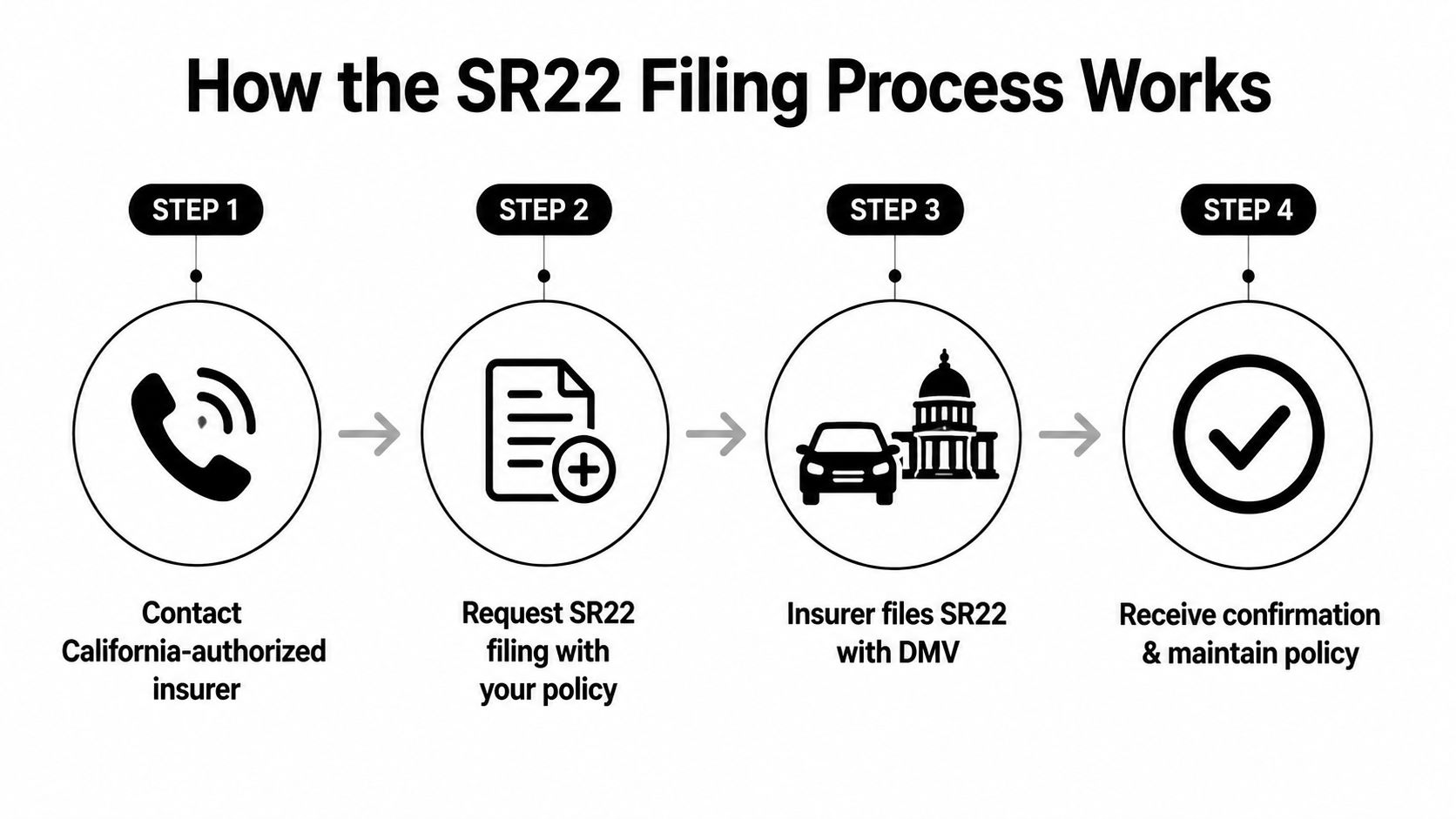
Contact a California-authorized insurer: Ask whether the company writes policies for your violation and files SR-22 certificates with the California DMV.
Provide accurate driving information: Give the carrier the details from your DMV notice, including the violation and reinstatement status. Omitting information can create problems during underwriting or later policy review.
Request the SR-22 with the policy: The insurer attaches the filing to your qualifying auto policy. The certificate must reflect at least California's required liability limits.
Pay the policy and filing charges: The filing fee is separate from the premium. Ask for an itemized quote so you can see both amounts.
Confirm submission: Get written confirmation that the insurer filed the SR-22 and ask when the DMV record should reflect it. Then verify your reinstatement status with the DMV before driving.
Avoid a gap when changing insurers
The usual requirement lasts three years from reinstatement, but your notice controls the actual obligation. During that period, keep the policy active without a break. If the insurer cancels or the filing lapses, the DMV can treat you as noncompliant and may suspend your license again.
Switching carriers is allowed, but coordinate the transition. Activate the new policy and confirm its SR-22 filing before ending the old policy. Never cancel first and hope the new carrier files later.
A lower premium isn't a bargain if the switch creates a filing gap and puts your license back at risk.
The insurer handles the filing. You handle accurate information, timely payment, policy continuity, and confirmation that the DMV has updated its records.
Real SR22 Costs and What Drives Your Premium
The most important cost distinction is simple. The SR-22 filing fee is usually small, while the underlying violation can reshape the entire premium.
One California-focused comparison estimates average SR-22 premiums at about $201 per month, while another reports a full-coverage average of $5,809 per year and a 126% cost increase for drivers who need an SR-22. The figures come from different comparison methods, so don't treat either as a personal quote. Use them to understand why the filing label alone doesn't explain what you'll pay. See the detailed California SR-22 cost comparison for that context.
The filing itself commonly costs about $15 to $25, according to industry guidance summarized by Shouse Law Group's California SR-22 information. That one-time charge is not the reason a policy suddenly becomes unaffordable.
SR22 monthly cost ranges by violation type
| Violation Type | Monthly Premium Range | Key Cost Factors |
|---|---|---|
| Single non-DUI violation | About $58 to $94 | Violation severity, ZIP code, vehicle, and carrier |
| DUI-related SR-22 with non-standard carriers | About $145 to $312 | DUI history, carrier class, ZIP code, and underwriting |
| Broader minimum-liability SR-22 bills | About $95 to $245 | ZIP code, carrier, offense history, and coverage selection |
The violation-specific ranges come from current 2026 rate snapshots in this California SR-22 carrier comparison. The broader monthly range is reported in the Shouse guidance linked above.
What you can control
You can't change the conviction on the day you request a quote, but you can control how widely you shop. Compare standard carriers, non-standard carriers, and independent agencies that can access multiple markets. Ask each provider to separate the filing charge from the recurring premium.
Your ZIP code, violation type, driving history, vehicle, coverage limits, and carrier class all matter. Don't reduce liability protection automatically just to chase the lowest payment. California's minimum limits satisfy the filing, but a higher limit may make more sense if your assets, commute, or household responsibilities justify stronger protection.
Maintaining Coverage and Removing the SR22 Requirement
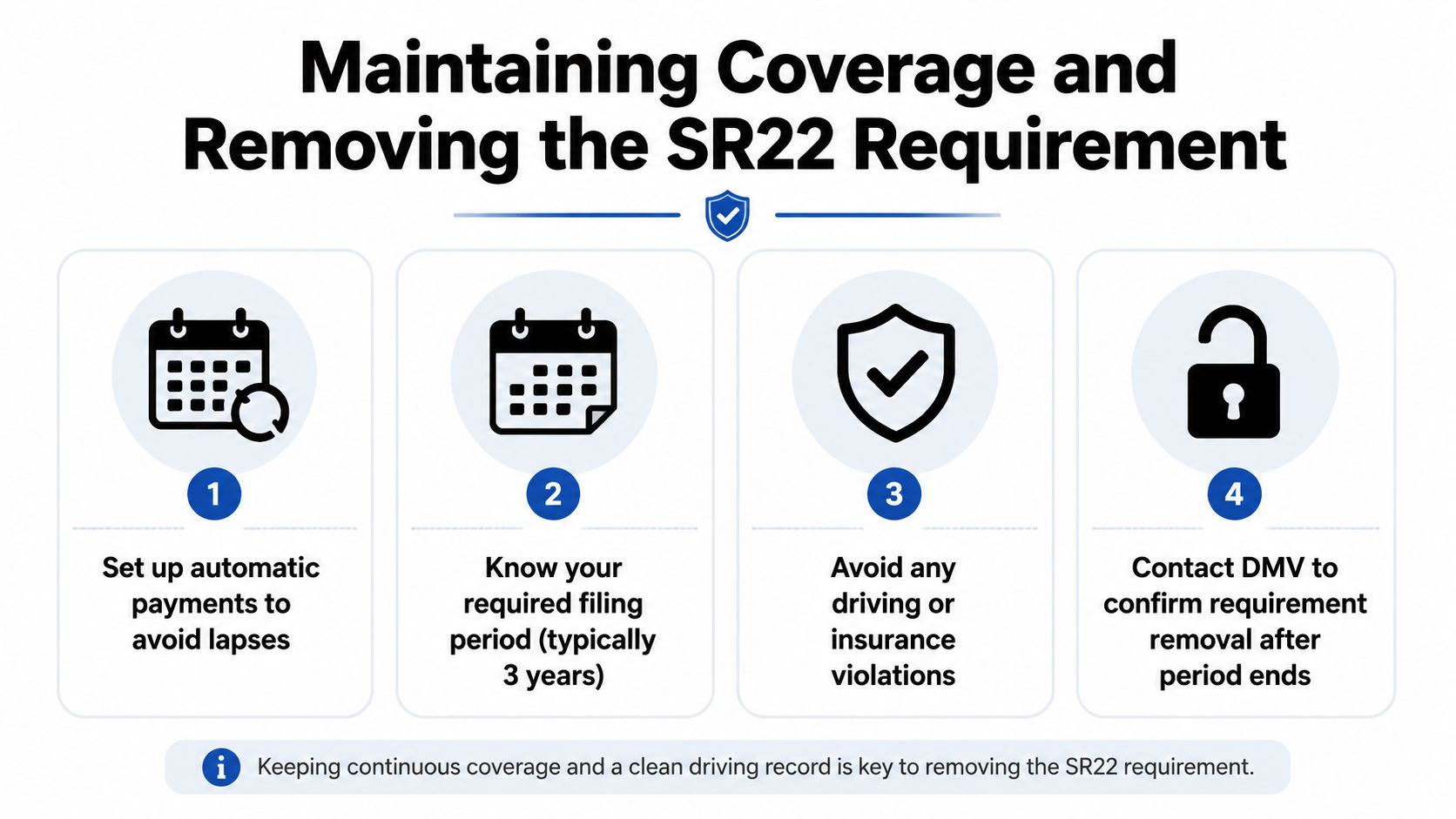
The easiest way to make an SR-22 period harder is to treat the renewal date casually. Set up automatic payments, keep your account funded, and read every cancellation or nonpayment notice. A missed payment can become a DMV problem, not just an insurance inconvenience.
Keep a personal record of the filing start date, policy number, insurer contact information, and the date shown on your reinstatement paperwork. Don't assume the insurer's renewal date is the same as the date your three-year obligation ends.
Protect the filing during ordinary life changes
Tell your insurer before you sell your car, move, stop driving, or change vehicles. A driver who no longer owns a vehicle may need a non-owner policy rather than canceling coverage outright. A driver who moves out of California may still need to satisfy the original California requirement, depending on the DMV record and the new state's filing rules.
Use this checklist:
- Automate payments: Remove avoidable cancellation risk.
- Confirm policy changes first: Ask whether a new vehicle, address, or usage pattern affects the filing.
- Coordinate carrier changes: Make sure the replacement policy and SR-22 are active before the old policy ends.
- Save written confirmations: Keep insurer and DMV records together.
Confirm removal instead of assuming it
When the required period is complete, contact the DMV and your insurer. Ask the DMV to confirm that the obligation has been satisfied, then ask the insurer what documentation it needs to remove the filing from your policy. Keep proof of both conversations.
The SR-22 requirement can sit alongside other obligations, particularly after a DUI. For questions involving SR-22 and DUI school requirements, consult a qualified legal resource. Insurance agents can handle the policy and filing, but they can't determine whether your court or DMV obligations are complete.
Common SR22 Questions and Edge Cases
Do you need an SR-22 if you don't own a car?
Possibly. A non-owner auto policy can provide liability coverage for a driver who doesn't own a vehicle while allowing an insurer to file the SR-22. It may fit someone who borrows vehicles occasionally, but it won't cover ownership-related risks for a car titled to you.
Don't buy a non-owner policy because it sounds cheaper. Tell the agent how often you drive, whose vehicles you use, and whether you plan to buy a car soon. A policy that doesn't match your actual situation can leave a coverage gap.
Can you rent a car with an SR-22?
The filing doesn't automatically grant rental privileges. The rental company's requirements, the policy's terms, and the driver's license status all matter. A non-owner policy may provide liability coverage in some borrowing or rental situations, but it doesn't automatically cover damage to the rental vehicle or every contractual obligation.
Ask before picking up the car. Confirm liability, physical damage, excluded drivers, and the rental company's acceptance rules in writing.
What happens if your insurer cancels you?
The insurer can report the filing's termination to the DMV. That can lead to noncompliance and another suspension unless a replacement policy and filing are established promptly. Contact another carrier immediately, explain that you need uninterrupted SR-22 coverage, and confirm the effective date before allowing the original policy to terminate.
Do out-of-state violations transfer?
They can affect your California driving record or licensing status, but the result depends on the violation, the states involved, and the DMV's action. Don't assume an out-of-state ticket is irrelevant, and don't assume it automatically creates an SR-22. Read the California notice and ask the DMV what proof it requires.
What's the difference between SR-22 and SR-22P?
An SR-22 generally applies to an individual driver and an auto liability policy. SR-22P is commonly associated with motorcycle operators or certain personal liability situations. The correct form depends on the vehicle and the DMV requirement, so identify the filing type before purchasing coverage.
For other insurance questions involving auto, home, renters, and life policies, use the California insurance FAQ as a starting point. Unusual circumstances deserve a direct review, not a generic online answer.
How Mai & Associates Simplifies Your SR22 Filing
SR-22 shopping is difficult because you're comparing two things at once: whether a carrier will accept your driving history and whether its premium fits your budget. A single insurer can give you a valid filing, but it may not offer the most competitive option for your violation, ZIP code, vehicle, and coverage needs.
Mai & Associates can compare rates from multiple top-rated carriers for California auto insurance and help identify a policy that meets the filing requirement. The agency offers same-day quotes, a 24-hour response, and support in English, Spanish, Armenian, Russian, and Vietnamese.
Help beyond the filing
A useful agency should explain the difference between the one-time filing charge and the recurring premium. It should also confirm the filing date, identify payment risks, and help coordinate a carrier change without leaving the DMV record exposed.
Mai & Associates has offices in Glendale, Westlake Village, Escondido, and Costa Mesa, and serves clients across California. The agency also handles home insurance, renters insurance, and life insurance, which can be useful when a household needs to review more than its car policy after a major driving event.
Request a California insurance quote with your DMV notice, current policy information, vehicle details, and violation date ready. Ask for the premium, filing fee, coverage limits, and effective filing date as separate details.
Don't wait for a cancellation notice or assume the first SR-22 quote is your only option. Visit Mai & Associates for a no-obligation quote, carrier comparison, and practical help keeping your California SR-22 filing active while you work toward reinstated driving privileges.