SR 22 Insurance in California Explained
First things first, let's get one thing straight: an SR-22 is not insurance. It's a common point of confusion, but the two are very different. While it's tied to your auto insurance policy, the SR-22 form itself doesn't provide any coverage.
Think of an SR-22 as a special form, almost like a "proof of insurance" certificate on steroids, that your insurance company files directly with the California DMV on your behalf. It’s the state’s way of keeping a closer eye on you to make sure you’re staying insured.
What An SR-22 Filing Really Means In California
At its core, an SR-22 is simply a Certificate of Financial Responsibility. You don't buy it like a policy; it's a consequence. A court or the California DMV will order you to get one after a major traffic violation, like a DUI or getting caught driving without any insurance.
This filing serves one purpose: to prove to the state that you're carrying at least the minimum required liability insurance. If your policy ever lapses, your insurer is legally required to notify the DMV immediately, which could lead to another license suspension. This requirement is a critical component of California insurance regulations for high-risk drivers.
Who Needs An SR-22?
The SR-22 requirement is reserved for drivers the state considers "high-risk." If you've been ordered to get one, it's because of a serious incident that calls your driving privileges into question.
You'll typically be required to file an SR-22 in California for things like:
- A DUI or DWI conviction
- Driving without car insurance (and getting caught)
- Causing a major accident, especially without coverage
- Racking up too many points on your driving record in a short time
And it's more common than you might imagine. As of 2023, about 1.2 million drivers across the country had an active SR-22 filing. This isn't some rare penalty; it's a standard procedure for getting drivers back on track.
Think of the SR-22 as a probation slip for your driving privileges. It doesn't change your insurance coverage, but it forces you to prove you have it—or risk losing your license again.
For a quick overview of the most important SR-22 details in California, take a look at this summary table.
California SR-22 At A Glance
| Aspect | Description |
|---|---|
| What It Is | A certificate filed by your insurer to prove you have the minimum required liability auto insurance. |
| Who Requires It | The California DMV or a court, following a serious driving offense. |
| Common Triggers | DUI, driving without insurance, major at-fault accidents, or excessive license points. |
| Filing Fee | A one-time fee of $25 to $50 paid to your insurance company to process the form. |
| Typical Duration | Usually three years, but can be longer for more severe offenses. |
| Key Responsibility | You must maintain continuous insurance coverage for the entire duration of the SR-22 requirement. |
This table covers the basics, but there's a lot more to the process.
This guide will walk you through everything you need to know, from figuring out why you need an SR-22 to the day you can finally have it removed. If you come across any unfamiliar terms, our insurance glossary is a great resource.
The Common Reasons You Might Need An SR-22
An SR-22 isn't something the California DMV hands out randomly. It’s a direct consequence of a specific high-risk driving incident, basically the state's way of saying, "We need proof you're financially responsible before you get back on the road."
Think of it as being put on a probationary watch list for your insurance. Each violation that triggers an SR-22 insurance filing is serious, and understanding why it was required is the first step to getting your driving privileges back in good standing.
Driving Under The Influence
A conviction for a DUI or DWI is the most common fast-track to an SR-22 requirement in California. From the state's point of view, getting behind the wheel while impaired is one of the most dangerous things a driver can do.
The logic here is pretty simple. A driver who made such a risky choice has to prove, without a doubt, that they can cover any damages they might cause in the future. The SR-22 is that proof—a guarantee to the DMV that you have an active car insurance policy, which is non-negotiable for getting your license reinstated.
Major Violations And At-Fault Accidents
It’s not just DUIs. A handful of other major mistakes can also put you in SR-22 territory. These are typically actions that show a serious disregard for either traffic laws or the financial responsibility that every driver agrees to.
Here are a few of the big ones:
- Driving Without Insurance: If you get pulled over and can't show proof of at least California's minimum liability coverage, an SR-22 is almost always part of the deal to get your license back.
- Causing an Accident While Uninsured: This is a huge red flag for the DMV. Causing a wreck is bad enough, but doing it without insurance to pay for the damage you caused means the state will demand an SR-22 to make sure it never happens again.
- Reckless Driving: A conviction for reckless driving—which means you were intentionally driving in a way that put others in danger—is another common trigger. It points to a pattern of risky behavior that the state needs to keep a close eye on.
The SR-22 is the DMV's go-to tool for managing high-risk drivers. After a serious incident, it's how they confirm you've secured the right California insurance before you're allowed to drive again.
Accumulating Too Many Points
California's DMV keeps score with a point system. Every ticket and violation adds points to your driving record, and if you rack up too many too quickly, you're flagged as a habitual offender.
Getting four points in 12 months, six in 24, or eight in 36 will typically trigger a license suspension and, you guessed it, an SR-22 requirement. This isn't about one bad day; it's about a consistent pattern of speeding, running red lights, or other moving violations. The state sees this pattern as a major risk and uses the SR-22 to ensure you're committed to maintaining insurance from that point forward.
How to Get Your SR-22 Filed in California
Being told you need an SR-22 can feel overwhelming, but the actual process is more straightforward than you might think. It really boils down to a few key steps. Think of this as your game plan for getting the certificate filed correctly with the California DMV and getting your driving privileges back on track.
The first move is finding an insurance company that actually handles SR-22 filings. This is a crucial point because not all insurers do. Some companies aren't set up to work with what they consider high-risk policies, and some might even drop you after a major violation like a DUI. So, your first task is to partner with an insurer who knows the ins and outs of SR-22 insurance.
Gathering Your Info for a Quote
Once you’ve found a potential insurance provider, you'll need to give them some specific details to get a quote. Having this information organized and ready will seriously speed things up.
Make sure you have this on hand:
- Your California Driver’s License Number: This is how they'll find you in the DMV's system.
- Case or Citation Number: This gives the insurer the context of your violation, which they need to assess risk.
- Official DMV or Court Documents: Any paperwork you've received will spell out exactly what the state requires from you.
With this information, the insurance company can get a clear picture of the situation and calculate a premium for your new auto insurance policy. The more complete your info is, the faster you can get a solid quote and take the next step.
This infographic shows some of the most common reasons a driver might be ordered to get an SR-22.
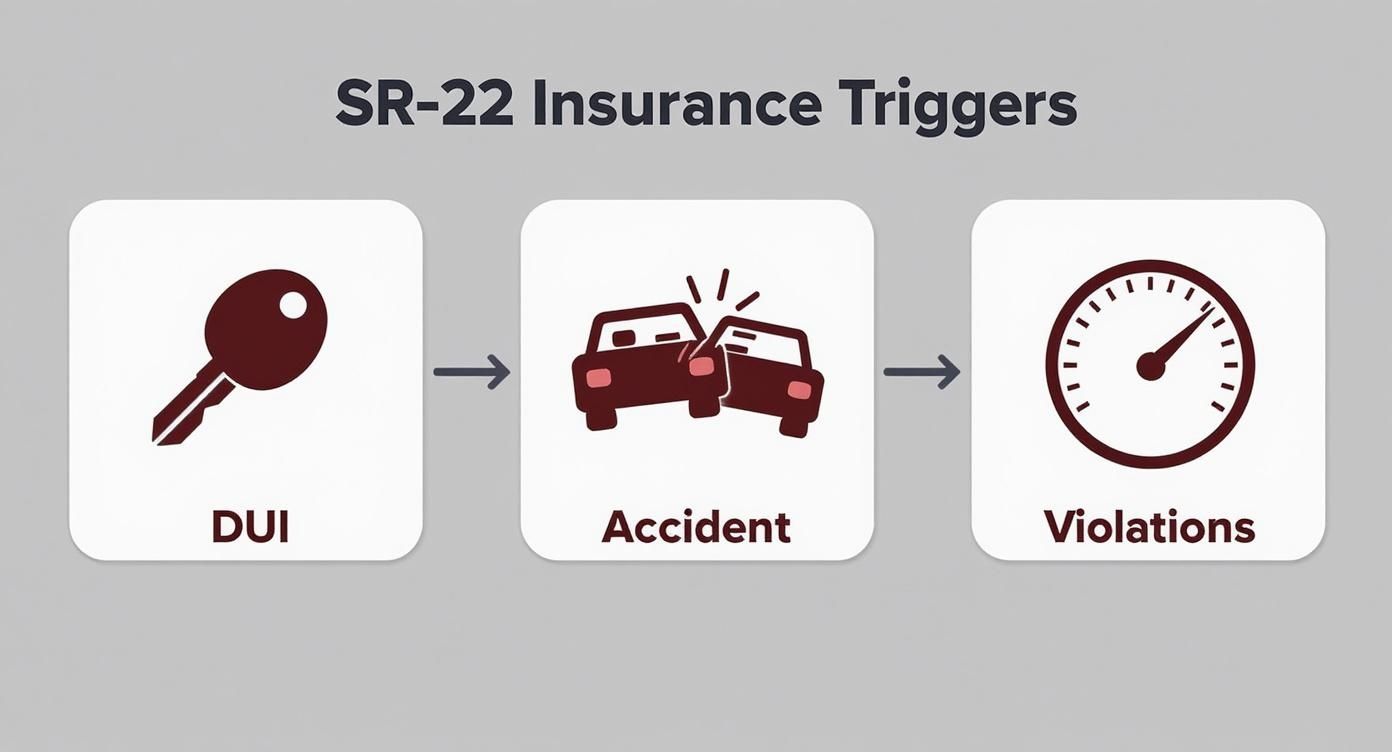
As you can see, major offenses like a DUI or causing an accident while uninsured are fast tracks to the DMV mandating an SR-22.
Understanding the Fees and Filing Process
After you find a policy that works for you, there are two costs to expect right away. The first is a one-time filing fee, which usually runs between $25 and $50. Your insurance company charges this to cover the administrative work of preparing the SR-22 form and sending it to the DMV.
Next, you'll pay the first premium on your new high-risk car insurance policy. It’s important to be prepared for this, as it will almost certainly be higher than what you were paying before the incident.
The most important part of the process is handled entirely by your insurance company. They will file the SR-22 certificate electronically and directly with the California DMV for you. This typically takes about one to three business days to complete.
Once the DMV receives and processes the filing, your insurance status is officially updated in their records—a huge step toward getting your license reinstated. It’s always a good idea to follow up with your insurance agent a few days later just to confirm that the DMV has it. If you're ready to see what your options are, you can easily get an insurance quote online from providers who specialize in SR-22 filings.
Understanding the Real Cost of SR-22 Insurance
When a driver finds out they need an SR-22, the first question is almost always, "How much is this going to cost me?" The answer is a bit of a good news/bad news situation.
The good news? The actual filing fee for the SR-22 certificate is pretty small. Most insurance companies charge a one-time administrative fee, usually somewhere between $25 and $50, to handle the paperwork and submit it to the California DMV. It's a minor inconvenience.
The bad news is that this small fee is just the tip of the iceberg. The real financial hit comes from the reason you need the SR-22 in the first place. A serious driving violation immediately flags you as a "high-risk" driver, and that’s what sends your insurance premiums soaring.
Why Your Premiums Increase So Much
Think of insurance as a big game of risk. When an insurer sees you as a high-risk driver, they believe there's a much higher chance you'll be involved in an accident and they'll have to pay out a claim. To protect themselves from that potential cost, they charge you significantly more.
It's not a one-size-fits-all penalty, though. The exact amount your rates will jump depends on a few key things:
- The Seriousness of the Offense: A DUI conviction is going to cause a much bigger rate hike than, say, getting caught driving without insurance.
- Your Driving Record: If your record was spotless before this incident, the increase might be less severe. But if you already have a history of tickets or accidents, buckle up.
- Where You Live in California: Premiums can change from one zip code to the next based on local accident rates, theft statistics, and even traffic congestion.
The SR-22 filing fee is minimal. The true cost is the sustained increase in your auto insurance premiums, which reflects your new status as a high-risk driver.
To give you a ballpark figure, California's average monthly premium for SR-22 insurance hovers around $199 per month. On top of that, remember to factor in the one-time filing fees, which can be anywhere from $15 to $50. As you start shopping around, you can learn more about finding the right auto insurance in California that fits your new circumstances.
Estimated California Auto Insurance Premium Increases With An SR-22
The table below gives you a realistic idea of what to expect. It compares average monthly car insurance costs for a standard driver in California versus a high-risk driver who needs an SR-22 insurance filing.
| Violation Type | Average Monthly Premium (No SR-22) | Estimated Monthly Premium (With SR-22) |
|---|---|---|
| First-Time DUI | ~$175 | ~$450 - $600 |
| At-Fault Accident (Uninsured) | ~$175 | ~$350 - $500 |
| Reckless Driving | ~$175 | ~$300 - $450 |
While these numbers are just estimates, they clearly show how a serious violation can dramatically impact your monthly budget. Getting ahead of this and planning for a much higher insurance bill is a crucial step in managing your finances while you have an SR-22 requirement.
How Long You Must Keep Your SR-22 Filing

Once you’ve gone through the process of getting an SR-22 filed, the first question on just about everyone's mind is, "When does this finally go away?" For most drivers in California, the standard requirement for an SR-22 insurance filing is three years.
But here’s a crucial detail that trips a lot of people up: when does that three-year clock actually start? It does not begin on the day you got the ticket or the date of your conviction. The countdown officially starts on the day the California DMV reinstates your driving privileges.
This is a common point of confusion that can cause some serious headaches. Let's say your license was suspended on June 1st, but you didn't get your SR-22 filed and your license officially reinstated until August 15th. That means your three-year requirement starts from August 15th, not back in June.
The Mandate for Uninterrupted Coverage
During these three years, there's one golden rule: you must maintain continuous insurance coverage. No gaps. No excuses. Even a single day of lapsed insurance can have some pretty severe consequences.
If your car insurance policy cancels or lapses for any reason, your provider is legally obligated to immediately report it to the DMV. They do this by filing a form called an SR-26. This form instantly triggers another suspension of your driver's license. The worst part? The entire three-year clock resets, and you have to start all over again from the new reinstatement date.
Maintaining continuous coverage is non-negotiable. A lapse in your policy doesn't just pause the clock; it resets it entirely, forcing you to begin the three-year SR-22 requirement from scratch.
This strict rule gets right to the heart of why the SR-22 exists in the first place—to make absolutely sure that high-risk drivers stay financially responsible without any breaks. The state sees any gap in coverage as a direct violation of the terms of your reinstatement.
Tracking and Completing Your Requirement
Keeping a close eye on your timeline is key. It’s a good idea to mark the end date on your calendar and double-check it with the DMV or your insurance agent as you get closer. You can always request an official copy of your driving record directly from the DMV, which will clearly list the start and end dates of your SR-22 requirement.
When you're finally approaching the end of your three-year period, don't just assume the filing will vanish on its own. You need to be proactive.
- Confirm the end date: Contact the DMV to verify that you have officially satisfied the full requirement.
- Notify your insurer: Let your insurance company know your SR-22 period is complete so they can remove the filing.
- Shop for new rates: This is the best part. Once the SR-22 is off your record, you may no longer be considered a high-risk driver, which could qualify you for significantly lower auto insurance premiums.
We Can Help You Navigate the California SR-22 Maze
Dealing with an SR-22 requirement can feel overwhelming, especially when you're just trying to get your license back and move on. The good news is you don't have to figure it all out on your own. Partnering with an experienced independent insurance agent can completely change the experience, saving you a ton of hassle and money.
Think of us as your personal guide through the insurance marketplace. Instead of you calling one company after another, getting stuck with whatever rate they decide to offer, we do the heavy lifting. We work for you, not the insurance companies, shopping around with multiple carriers who actually specialize in high-risk auto insurance.
Your Advocate from Start to Finish
This is the key to finding the best possible rate for SR-22 insurance. But it's about more than just finding a cheap price; it's about getting the right support when you need it most.
Here's how we can help:
- We'll handle the mountain of DMV paperwork needed for a proper California filing.
- We can give you practical advice on how to keep your policy active and stay compliant so there are no surprises.
- We make sure the SR-22 is filed correctly the first time, so it's accepted by the DMV without delay.
Our mission is simple: to be your trusted partner, making this tough situation as painless as possible so you can get back on the road. Let us worry about the details.
And when your SR-22 requirement is finally over? We'll be right there to help you switch back to a standard car insurance policy, which almost always comes with much lower rates. We can also help with your home insurance, renters insurance, and life insurance, making us a single point of contact for all your California insurance needs.
Frequently Asked Questions About SR 22 Insurance
Even with the basics down, you probably still have a few lingering questions about SR 22 insurance. That’s completely normal. Let’s tackle some of the most common ones we hear from California drivers to clear things up and help you move forward with confidence.
SR 22 Certificate Vs. Regular Car Insurance
The biggest point of confusion for most people is how an SR-22 relates to a standard car insurance policy. Think of it this way: your insurance policy is the actual product that protects you financially in an accident. It’s what pays for liability and damages.
An SR-22, on the other hand, isn't insurance at all. It's simply a piece of paper—a certificate, really—that your insurance company files with the California DMV. All it does is prove you have the required insurance coverage. It’s a reporting tool, not a protection plan.
What If I Move Out Of California?
If you pack up and move to another state while you still have an SR-22 requirement in California, you can't just leave that obligation behind. The requirement is tied to your California driving record, and you have to see it through to the end, no matter where you live.
You'll need to find an insurer in your new state that is willing and able to file an "interstate SR-22" with the California DMV for you. If you let it lapse, California will suspend your driving privileges, which can create a domino effect and jeopardize your license in your new home state.
An SR-22 is a legal obligation tied to your California driving record. It follows you wherever you go until the full term is satisfied, and maintaining compliance is crucial to avoid further penalties.
Can I Get An SR 22 Without A Car?
Yes, absolutely. If the court or DMV mandates an SR 22 insurance filing but you don't own a vehicle, you can get what's called a "non-owner" auto insurance policy.
This type of policy provides liability coverage for you anytime you're behind the wheel of a borrowed or rented car. Once you have this non-owner policy in place, your insurer can file the SR-22 form with the DMV for you. This satisfies your legal requirement and is a key step toward getting your license reinstated.
For more detailed answers to other common insurance questions, check out our comprehensive FAQ page.
From figuring out non-owner policies to handling interstate filings, navigating the world of SR-22s is a lot less stressful when you have an expert in your corner. Mai & Associates specializes in helping California drivers find the right coverage and manage their DMV requirements. We do the shopping for you, comparing rates to find affordable options for your auto insurance, home insurance, renters insurance, or life insurance. Let us help you protect what matters most.