Should I Get Earthquake Insurance California

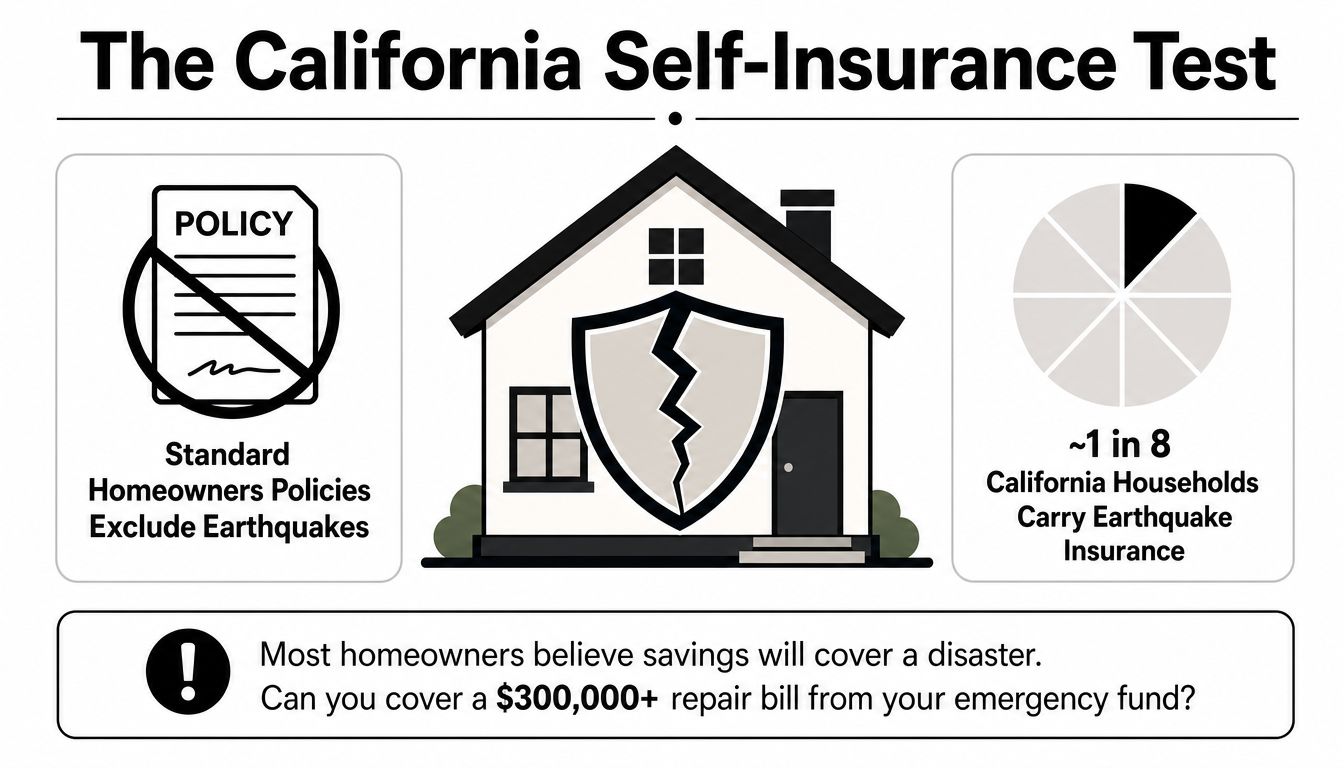
If you couldn't absorb a 10% to 25% deductible in cash, you should generally get earthquake insurance in California. Yet only about 13% of California homes had earthquake insurance in 2018, leaving most homeowners to absorb the loss themselves. California Department of Insurance data makes the central tension clear: California has serious seismic exposure, but relatively few households transfer that risk to an insurer.
The right question isn't just, “Can I afford the premium?” It's, “Can I afford the deductible layer and the damage below it?” Standard home insurance in California generally excludes earthquake damage, so without a separate earthquake policy, you're choosing to self-insure the structure, your belongings, and potentially your temporary living costs. For many homeowners, that's a risk their savings can't handle.
Why Most California Homeowners Skip Earthquake Coverage
Most homeowners skip earthquake coverage for emotional and financial reasons, not because the risk has disappeared. People get used to earthquake warnings, assume a damaging event won't happen during their mortgage term, or decide the premium feels too high for a disaster they may never experience. The most expensive mistake, however, is overlooking the deductible.
California residential insurers must offer earthquake coverage with residential property insurance, but the state has still experienced a long-running low adoption rate. The California Department of Insurance earthquake study reported that earthquake insurance covered 13.29% of homes in 2017, after remaining near 10% to 13% through much of 2011 to 2018. That means most homeowners are effectively making a self-insurance decision, even if they never use that phrase.
Run the self-insurance test
Start with your dwelling limit, not the home's market value. If your policy covers a $600,000 dwelling, a 15% deductible means you'd absorb $90,000 before the policy begins paying for covered damage. The California Department of Insurance deductible guide confirms that CEA options include 5%, 10%, 15%, 20%, and 25% deductibles.
A moderate shake might cause a repair bill that falls below that threshold. FEMA explains that much earthquake damage can fall below common deductibles, which means earthquake insurance works primarily as catastrophe protection, not routine repair coverage. If you can't access the deductible from liquid savings, the policy may still be valuable even when it won't respond to every cracked wall or repair invoice.
Practical rule: Skipping earthquake coverage means you're self-insuring. Make that choice deliberately, with the cash required for the first loss already available.
The premium can be uncomfortable, but a home loan doesn't disappear because an earthquake damages the house. If you couldn't repair the property, continue the mortgage, and pay for temporary housing, you're carrying a large uninsured balance sheet risk. That's why my recommendation is direct: homeowners without substantial liquid reserves should get a quote before rejecting the coverage.
What Earthquake Insurance Actually Covers in California
A California earthquake policy is not a replacement for your homeowners policy. It fills a specific gap created by the earthquake exclusion in standard home insurance. CEA-style coverage generally separates the property into the dwelling, personal property, and loss of use categories, with optional features that can change the result of a claim.
Dwelling coverage addresses the insured building and attached components, subject to the policy form and limits. It doesn't insure the land beneath the house. Personal property coverage protects belongings, but you'll need to select a limit that reflects what you own. For renters, the California residential insurance guide says personal belongings coverage may be purchased up to $100,000, while a contents limit for homeowners is generally around 50% of the dwelling amount as a guideline.
Coverage components and common gaps
| Coverage Component | What It Pays For | Limits & Notes | Type |
|---|---|---|---|
| Dwelling | Repairs to the insured home and attached structures | Based on the policy limit and deductible. The land itself isn't covered | Core coverage |
| Personal property | Furniture, electronics, clothing, and other belongings | Limits, sublimits, and valuation rules apply | Core coverage |
| Loss of use | Temporary housing and related living expenses when the home is uninhabitable | Review the selected limit and covered conditions | Core coverage |
| Building code upgrades | Qualifying costs required to rebuild to current standards | Usually optional and subject to policy terms | Optional coverage |
| Landscaping, pools, fences, and land movement | Usually excluded or restricted | Damage unrelated to covered shaking can fall outside the policy | Common exclusions |
| Vehicles | Damage to cars and other vehicles | Review comprehensive auto insurance separately | Excluded from earthquake policy |
The CEA homeowners coverage and deductible information shows that homeowners select deductibles and coverage structures rather than receiving one universal package. A building-code upgrade option can matter when older construction must meet current requirements during a rebuild, but don't assume every upgrade, detached structure, pool, fence, or slope problem is covered.
New policies can also have a waiting period before certain earthquake losses are covered. Ask the agent about the effective date and any post-event restrictions before binding. Then read the Declarations page. It tells you the dwelling limit, contents limit, loss-of-use limit, deductible, and endorsements you're buying.
For broader home insurance context, review California home insurance coverage options before comparing earthquake policies. The two policies work together, but they don't cover the same causes of loss.
Understanding Earthquake Deductibles and What You Pay First
Earthquake deductibles are where most buyers misread the policy. A percentage deductible usually applies to the dwelling coverage limit, not to the final repair invoice. That distinction can turn a policy that looks affordable into coverage you can't use after a moderate loss.
California Department of Insurance guidance identifies CEA deductible choices of 5%, 10%, 15%, 20%, and 25%. On a $600,000 dwelling limit, the deductible could be $30,000, $60,000, $90,000, $120,000, or $150,000, depending on the option selected.
| Dwelling Limit | 10% Deductible | 15% Deductible | 20% Deductible | 25% Deductible |
|---|---|---|---|---|
| $400,000 | $40,000 | $60,000 | $80,000 | $100,000 |
| $600,000 | $60,000 | $90,000 | $120,000 | $150,000 |
| $800,000 | $80,000 | $120,000 | $160,000 | $200,000 |
These examples are simple calculations from the deductible percentages listed by the California Department of Insurance. The policy may also apply a separate deductible to personal property, depending on the form. Ask specifically whether deductibles are shared or separate across dwelling, contents, and other covered categories.
Premium versus usable protection
A higher deductible generally reduces the premium, but it shifts more risk back to you. A lower deductible costs more but makes the policy more likely to respond to a serious repair bill. Neither choice is automatically right.
Before you buy: Write the deductible amount on a household budget worksheet. If you'd need to sell investments, borrow against the house, or rely on a credit card, the deductible is not financially available.
Flat-dollar deductibles work differently, but California earthquake policies commonly use percentage deductibles. Don't compare an earthquake quote with a standard home insurance quote by premium alone. A standard home policy might have a flat deductible, while the earthquake policy could require a large percentage of the dwelling limit before payment starts.
For help reviewing declarations pages and policy wording, use the California insurance FAQ. The useful quote isn't just the cheapest annual price. It's the quote that makes clear what you'll owe first and what the insurer will pay afterward.
Location and Home Factors That Change Your Real Risk
Two California homes can have very different earthquake profiles even when they sit in the same city. Fault proximity, soil, foundation design, construction age, and retrofit work all affect the potential severity of damage and the price an insurer may charge.
A home near the San Andreas, Hayward, or San Jacinto faults deserves a different conversation from a property farther from active fault systems. Distance alone doesn't settle the decision, because soil conditions can amplify shaking. Homes near bay margins, riverbeds, or other liquefaction-prone ground may face more movement than a similar structure on stable ground.
Compare the physical profile
| Factor | Lower Risk Profile | Higher Risk Profile | Typical Premium Impact |
|---|---|---|---|
| Fault exposure | Farther from active fault systems | Near a major active fault | Can increase pricing |
| Soil | Stable, firm ground | Soft soil or liquefaction-prone fill | Can increase pricing |
| Foundation | Properly connected and reinforced | Unbraced raised foundation or weak connections | Can increase pricing |
| Structure | Modern, well-braced wood-frame construction | Older masonry or vulnerable multi-story construction | Can increase pricing |
| Slope | Level site with stable support | Hillside property with slope movement concerns | Can increase pricing |
| Retrofit | Bolting, bracing, and secured utilities completed | No seismic improvements | Can increase pricing |
Older two-story buildings, including soft-story structures common in parts of Los Angeles and the Bay Area, can require more scrutiny than a newer, compact wood-frame home. A raised pier-and-post foundation may need bolting and cripple-wall bracing, while a slab-on-grade home has a different vulnerability profile. Heavy masonry and poorly connected additions can also complicate a claim.
Retrofit before you only shop price
A completed seismic retrofit is one of the strongest risk controls a homeowner can take. Bolting the house to its foundation, bracing weak crawl-space walls, and strapping the water heater can reduce the chance that contents, utilities, or the structure suffer preventable damage. Confirm what an insurer recognizes as a qualifying retrofit before assuming you'll receive a discount.
A single-story home on stable ground with documented structural improvements may justify a different deductible decision than a 1920s two-story property on fill near a creek bed. For a city-specific home insurance discussion, compare the considerations outlined in San Francisco home insurance guidance, then ask an agent to apply them to your property rather than relying on a generic online estimate.
How Much Earthquake Insurance Costs in California
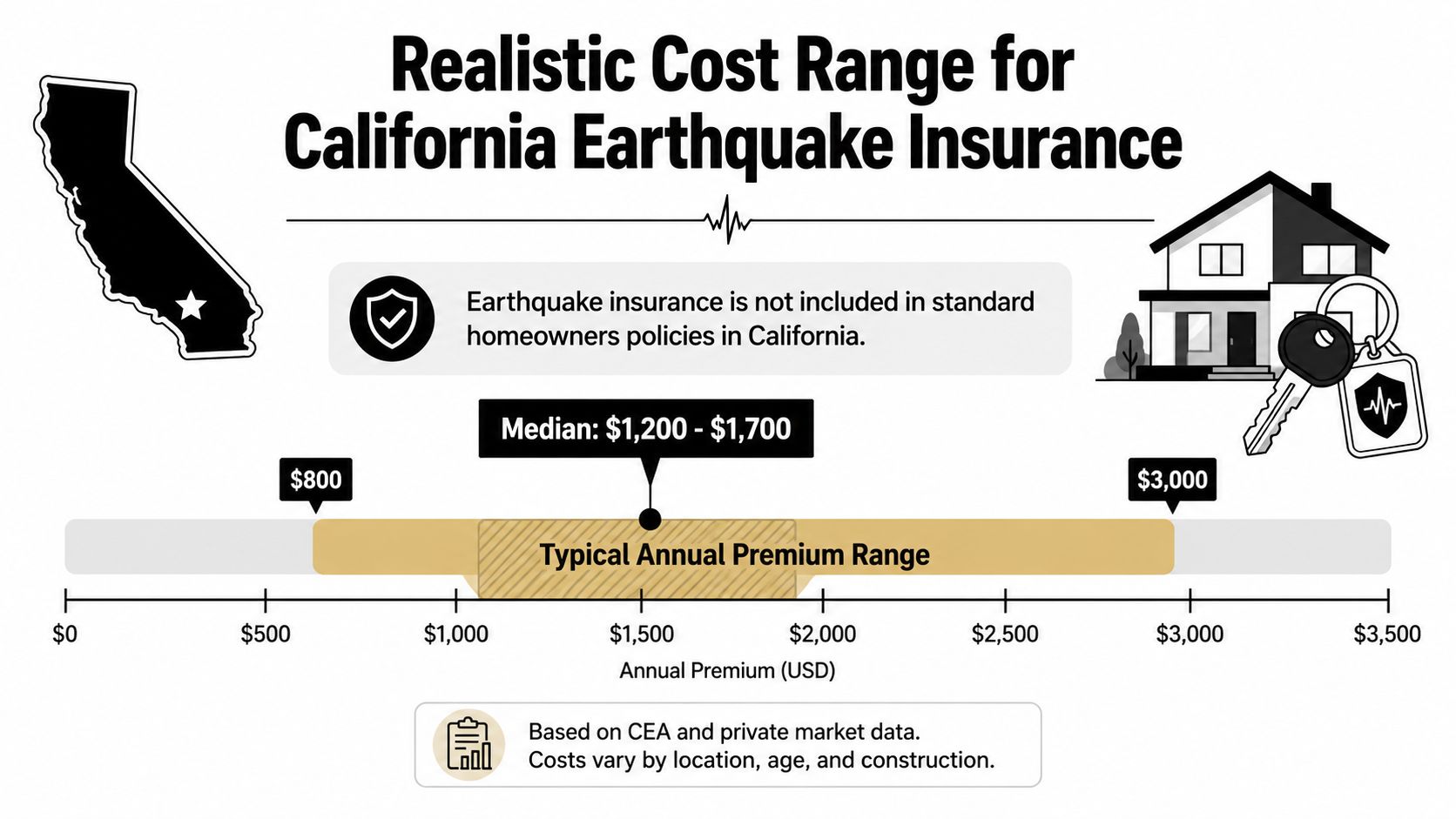
Earthquake insurance is financially significant in California. A 2024 premium and policy summary reported an average premium level of roughly $1,490.87 and a rate of $3.27 per $1,000 of coverage for one category of coverage connected with the California Earthquake Authority. The same state summary reported insured earthquake exposure of about $13.5 billion, while earlier California Department of Insurance experience data recorded $10.67 billion in 2022. The California earthquake exposure summary shows why pricing, deductibles, and replacement costs matter to the market.
What drives your quote
The insurer will look at the dwelling limit, deductible percentage, location, construction type, foundation, age, and selected contents and loss-of-use coverage. A higher dwelling limit raises the possible claim exposure. A lower deductible shifts more of that exposure to the insurer and usually raises the premium.
Construction matters too. Wood-frame homes, masonry buildings, hillside properties, and homes on soft or unstable soil don't present the same underwriting picture. The CEA's selectable deductibles and location-sensitive rating structure reinforce a practical point: two neighbors can receive materially different quotes.
Don't treat the premium as the entire cost. A policy with an average premium of about $1,490.87 and a large percentage deductible may protect you from structural catastrophe while providing no payment for a loss that falls below the deductible. That's not a flaw in the policy. It's how catastrophe coverage is designed.
Shop the coverage form, not just the price
Ask for quotes with the same dwelling limit, personal property limit, loss-of-use limit, deductible, and optional endorsements. Otherwise, you're comparing different products.
Check the insurer's financial strength, claims process, exclusions, and California licensing status. An inexpensive quote with a narrow coverage form may be less useful than a higher-priced quote that matches your actual exposure. For most homeowners, the sensible approach is to compare a deductible you can realistically fund with a premium that fits the household budget.
Weighing the Pros and Cons for Your Situation
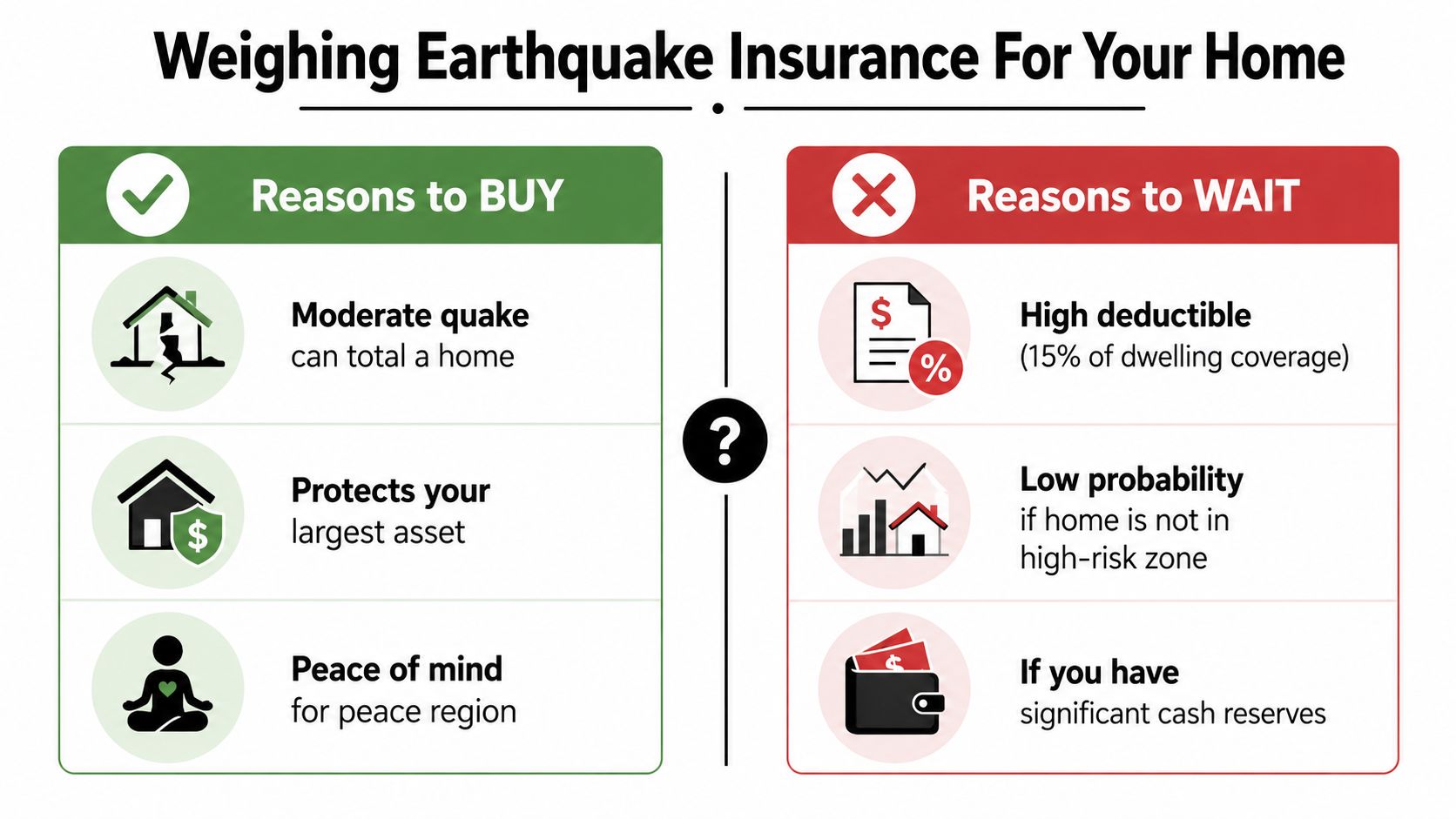
The case for earthquake insurance is strongest when the house is your largest asset and your savings can't absorb a major structural loss. The case against it is strongest when you have substantial liquid assets, understand the deductible, and can continue paying the mortgage while rebuilding or repairing.
| Your situation | Buying earthquake insurance | Self-insuring |
|---|---|---|
| Limited liquid savings | Strong recommendation | Dangerous exposure |
| Large dwelling limit | Protects against severe structural loss | Requires substantial reserves |
| Older or vulnerable construction | More compelling | Only defensible with serious cash capacity |
| Stable home and strong retrofit | Still worth pricing | More reasonable to consider |
| High deductible would be unaffordable | Choose a lower deductible if available, or reassess the policy | Not a practical choice |
| Large emergency reserve | Provides catastrophe transfer | Can be financially defensible |
The case for buying
A severe earthquake can leave you with a damaged structure and an ongoing mortgage. Earthquake insurance can provide dwelling coverage, contents protection, and loss-of-use benefits when covered damage exceeds the applicable deductible. It also creates a defined recovery path instead of forcing you to fund every repair from savings, investments, or borrowed money.
The coverage is particularly compelling for homeowners who have little flexibility after a loss. Families with dependents, owners of high-value homes, and borrowers who couldn't maintain housing expenses during an extended repair period should take the policy seriously.
The case for waiting
You may choose to self-insure if you have enough accessible cash to cover the deductible and continue carrying the property during repairs. You'll also need to accept that some moderate damage may never generate a claim payment because it falls below the deductible, a point emphasized by FEMA's earthquake insurance guidance.
My recommendation: If the deductible would force you into debt, don't reject earthquake insurance based on the premium alone. Get the lower-deductible quote and compare the cost of transferring the risk.
Don't use an emergency fund that exists only on paper. Retirement accounts, home equity, and assets that would take time to liquidate aren't the same as cash available immediately after a disaster. If your reserves can cover the deductible and your ongoing obligations, self-insuring is defensible. If they can't, buying coverage is the more responsible choice.
Lender Rules, FAIR Plan Connections, and Getting a Quote
Earthquake insurance isn't generally part of the standard California mortgage requirement, but your loan documents and servicer can impose their own conditions. Read the hazard insurance clause, ask the lender in writing, and don't assume the answer based on what another homeowner was told. A lender may require coverage under particular loan terms, property conditions, or transaction requirements.
The California FAIR Plan is a separate issue. It can serve as a basic property insurance backstop for eligible homeowners who can't obtain standard coverage, especially in difficult wildfire markets. FAIR Plan protection doesn't replace earthquake insurance. If your home uses the FAIR Plan, ask whether a separate CEA or private earthquake policy can be layered with the existing arrangement, and have the agent explain gaps between the policies.
Build a quote that can actually be compared
- Confirm the replacement cost. Earthquake dwelling coverage should reflect the cost to repair or rebuild the structure, not just its sale price or assessed value.
- Collect your declarations page. An agent needs the current dwelling limit, contents limit, deductible, endorsements, and mortgage information.
- Request comparable quotes. Ask a licensed California agency that can access CEA or private earthquake policies to quote the same limits and deductible options.
- Review exclusions. Ask about pools, fences, detached structures, land movement, masonry, contents sublimits, and building-code upgrades.
- Check the binding details. Confirm the effective date, any waiting period, payment schedule, escrow handling, and lender evidence requirements.
- Coordinate your other coverage. Earthquake insurance doesn't replace auto insurance, renters insurance, home insurance, or life insurance. Your car may need comprehensive coverage for earthquake damage, renters need separate protection for belongings, and life insurance addresses a different financial risk entirely.
Use Mai & Associates' California insurance quote page to start the comparison. The agency offers earthquake coverage options, home insurance, renters insurance, auto insurance, car insurance, and life insurance through a licensed California insurance team, so you can review the gaps together rather than treating each policy as an isolated purchase.
Mai & Associates can compare CEA and private earthquake coverage options, review your deductible against your available cash, and coordinate the result with your home, renters, auto, car, or life insurance needs. Visit Mai & Associates to request a no-obligation quote and speak with a licensed California agent about the coverage you can use.