Roof Hail Damage Insurance Claim: Get Expert Help

The storm passes. The street looks normal again. Then you notice the gutter dents, the grit at the bottom of a downspout, and a few fresh marks on the shingles you can see from the driveway.
That is where a lot of California homeowners get stuck. The roof might not be leaking today, but a roof hail damage insurance claim is won or lost long before the insurer makes a decision. It starts with what you document, what your policy says, and how you handle the adjuster, the contractor, and the repair money.
In California, this is not just a roof problem. A hail event can trigger a much bigger review of your protection plan. Home insurance matters first, but so do your car insurance deductibles, your renters insurance if you are a tenant dealing with damaged personal property, and your life insurance if your household depends on one income and cannot absorb surprise repair costs. One weather event tends to expose every weak spot at once.
The Unmistakable Sound of Hail and What It Means for Your Home
A homeowner calls the morning after a storm and says the same thing in different words: “We heard the hail, but we are not sure if it really damaged anything.”
That uncertainty is normal. Hail damage is often easy to miss from the ground, especially when the roof still looks “mostly fine.” What people do notice are the side clues. A dented metal vent. Scuffed gutters. Shingle granules in places they were not the week before. A wet mark on a ceiling that was not there before the storm.
National claim data shows why this deserves prompt attention. State Farm reported a $1 billion increase in nationwide hail-related claims from 2021 to 2022, and total convective storm damages, including hail, doubled from $30 billion in 2022 to $60 billion in 2023, according to the Insurance Information Institute (NICB reporting on roof claims and hail losses).
For California homeowners, the practical lesson is simple. Do not treat hail as a rare curiosity that can wait until next month. Treat it as a coverage event that can affect your roof, your interior, and the value of the claim if damage worsens before it is documented.
Why the first day matters
A delayed response causes two common problems.
First, the physical evidence changes. Sun, wind, and foot traffic can make impact marks harder to identify. Temporary leaks can dry out and look less urgent, even though the roof system has been compromised.
Second, your memory fades faster than you think. The exact time of the storm, where the loudest impacts hit, which side of the home took the brunt of the weather, and when the first interior signs appeared are all details that matter later.
If you suspect hail, act like you may need to prove the timeline to someone who never saw the storm. Because you probably will.
Think beyond the roof surface
A storm claim often becomes stronger when the homeowner documents the entire property, not just the shingles. Damage patterns on gutters, downspouts, window screens, fences, soft metal vents, patio covers, and exterior AC components can support the story of what happened.
That broader view also helps with family protection planning. If hail hit the house, it may have hit vehicles parked outside. A household that reviews the home loss but ignores the auto side can leave money on the table or miss deductible issues that affect the total budget after the storm.
Assessing and Documenting Damage Before You Call Your Insurer
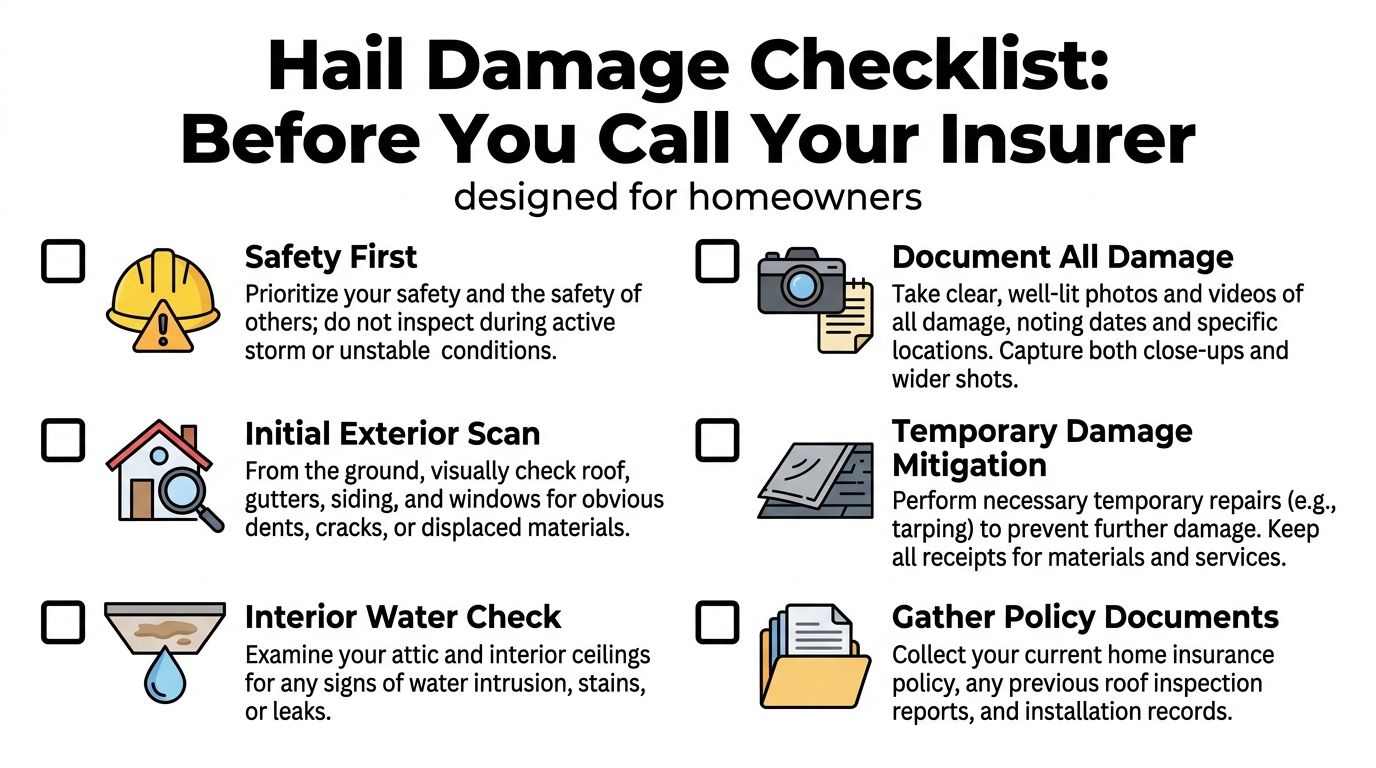
Before you report the loss, build your file. Not a messy camera roll. A file.
That file should tell a clean story: when the storm happened, what you observed, what changed, what parts of the property were affected, and what you did to prevent further damage. If you start the claim with clear evidence, you put yourself in a better position when the adjuster inspects and when a contractor prepares an estimate.
Stay off the roof unless it is safe
Most homeowners do not need to climb onto the roof to start a strong claim. In fact, many should not.
Begin from the ground and from inside the house. Use your phone camera to capture the visible slopes, gutters, vents, skylights, siding, garage door, and window trim. Inside, check ceilings, attic spaces, insulation, and the top corners of rooms where moisture often shows first.
What to photograph
The best storm documentation includes both overview shots and close-ups. Adjusters need context. A tight photo of a mark on metal helps, but a wider shot showing where that mark sits on the house helps more.
Use this checklist:
- Wide exterior views: Stand back and photograph each elevation of the home.
- Close-ups with scale: A coin in the frame can help show size consistently.
- Soft metal hits: Vents, flashing, gutters, and downspouts often show impact marks clearly.
- Interior signs: Water staining, damp insulation, bubbling paint, or fresh ceiling marks.
- Ground evidence: Granules, broken pieces, or debris near downspouts and eaves.
- Temporary mitigation: If you tarp or cover an area, photograph conditions before and after.
Add the date to your file name or notes. If your phone timestamps images automatically, keep the originals.
Build a written damage log
A simple written log makes your claim easier to follow. It does not need legal language. It needs clear facts.
A useful log includes:
| Item | What to note |
|---|---|
| Storm details | Date, approximate time, and what you observed |
| Exterior changes | Dents, displaced materials, cracked surfaces |
| Interior changes | Stains, drips, attic moisture, odors |
| Emergency action | Tarping, cleanup, water removal |
| Contacts | Roofer, mitigation company, insurer, claim number |
The strongest logs read like a timeline, not an argument.
Verification reports matter
A lot of homeowners make the same mistake. They assume visible marks are enough. Sometimes they are not.
To file a successful claim, it is critical to document evidence according to industry standards. That includes obtaining a hail verification report to confirm hail size, often a minimum of 1-inch for asphalt shingles, and density, because incomplete data can lead to claim denials (guidance on hail verification reports and claim documentation).
That does not mean you need to order every technical report before making one phone call. It means you should understand that the claim may eventually turn on measurable facts, not just a visual impression from the yard.
Temporary repairs are allowed, and often necessary
If water is entering the home, prevent further damage. Tarp the roof if it can be done safely. Move belongings. Dry wet areas. Save receipts.
Insurers generally expect homeowners to take reasonable steps to stop additional damage after a covered event. What they do not want is a permanent repair completed before they can inspect the loss, unless emergency conditions leave no choice.
Make temporary repairs that protect the property. Delay major permanent work until the inspection and scope are clearer.
Gather the paperwork before the first call
Have these documents ready:
- Current declarations page: Know your carrier, policy number, deductible, and named insureds.
- Prior roof records: Installation invoices, inspection reports, warranties, or prior repairs.
- Storm photos: Keep them organized in one folder.
- Maintenance history: Clean gutters, patch work, prior leak repairs, anything relevant.
If you want to compare your current policy language or review broader California coverage issues before filing, the consumer resources at Mai & Associates guides are a practical starting point.
Decoding Your California Home Insurance Policy for Hail Damage
Homeowners often focus on the roof and skip the contract. That is backwards.
Your roof can have obvious storm damage and you can still face a frustrating payout if your policy settles the loss on actual cash value, applies a deductible you did not anticipate, or excludes damage the carrier considers cosmetic rather than functional. Many disputes arise from this distinction.

ACV and replacement cost are not the same check
This is one of the biggest surprises in a roof hail damage insurance claim.
Many California homeowners policies cover roof damage at actual cash value, paying a depreciated amount that can be 30% to 50% less than the full replacement cost, creating a significant financial gap for older roofs (SageSure discussion of hail roof coverage and ACV).
If your roof is older, the policy may value the roof based on age and condition rather than what a contractor will charge to replace it today. That gap becomes painful fast when materials and labor are expensive.
What this means in real life
Think in terms of settlement method, not just coverage labels.
| Policy approach | How it usually works | Main trade-off | |---|---| | Actual cash value | Pays the depreciated value of damaged roofing materials | Lower premium can mean larger out-of-pocket repair cost | | Replacement cost | Aims to pay for repair or replacement subject to policy terms | Better protection, but review conditions carefully |
The wrong policy is not always the cheaper one. Sometimes a low premium means you accepted more claim risk than you realized.
Check the deductible language closely
Homeowners often know they have a deductible. Fewer know exactly how it applies.
Review whether your deductible is a flat dollar amount, whether a special wind or hail deductible applies, and whether the amount on the declarations page matches what you believe you purchased. This is the kind of detail that changes your decision about filing at all.
If the expected repair cost is close to the deductible, opening a claim may not make sense. If the damage is broader and includes interior effects, detached structures, or other covered property, the math can look different.
Cosmetic versus functional damage
A carrier may agree hail hit the roof but still argue the impacts are cosmetic. Homeowners hear “damage” and think “covered.” Insurers often ask a narrower question: has the roof’s function changed?
Functional loss is easier to support when you can show compromised shingle integrity, moisture intrusion, measurable granule loss, fractured matting, or other conditions that affect performance. Cosmetic loss is harder because the argument becomes visual and subjective.
If your roof looks marked up but the carrier says the roof still performs, the claim often turns on documentation quality, not emotion.
Older roofs need extra scrutiny
An older roof creates two separate issues at the same time.
First, the carrier may depreciate it heavily under ACV terms. Second, the carrier may argue that some conditions come from wear, age, or prior deterioration rather than a recent storm.
That does not mean older roofs cannot qualify for coverage. It means homeowners need cleaner records. If you have proof of prior inspections, maintenance, or a roof replacement timeline, your claim file becomes more credible.
Review the policy before the inspection date
Do not wait until after the adjuster visit to read your forms. Look for:
- Loss settlement wording: ACV, replacement cost, or endorsements affecting roofs
- Exclusions and limitations: Especially for cosmetic damage or aging materials
- Duties after loss: Prompt notice, mitigation, documentation, inspections
- Ordinance or law coverage: Important if repairs trigger code upgrades
- Matching issues: Ask how partial repairs are handled if materials do not match
California homeowners who want a broader review of policy structure, not just storm damage wording, can compare options through California home insurance resources.
Filing Your Claim and Working with the Insurance Adjuster
Once your evidence is organized and you understand your policy, report the claim clearly and calmly. The first conversation matters because it sets the tone for the file.
Give the carrier the basics. Date of loss. Property address. What you observed. Whether there is active leaking or interior damage. Whether emergency mitigation has already been done. Then stop. Do not guess about the full repair scope if you do not know it yet.

What to say when you open the claim
Keep your opening report factual.
A good summary sounds like this: a hailstorm passed through, you observed new exterior impact marks and possible roof damage, you have photos, and you want an inspection scheduled. If there is interior staining or leaking, say that plainly.
Do not overstate. Do not minimize. Both cause problems.
Treat the adjuster meeting like a recorded event
Even if it is not formally recorded, act like every statement could matter later. Be present if possible. Have your photos ready. Walk the exterior with the adjuster and point out all affected areas, including gutters, vents, siding, window screens, and interior signs.
Bring a notebook and capture:
- Who attended: Adjuster name, company, contractor, roofer, family member
- What was inspected: Slopes, attic, interior rooms, detached structures
- What was said: Especially comments about age, wear, cosmetic damage, or hit counts
- What happens next: Timeline for estimate, report, or follow-up inspection
Ask direct questions
You do not need to argue on the spot. You do need to ask questions that force clarity.
Use questions like these:
- What areas are you including in your inspection today?
- Are you inspecting for both exterior impact and interior water effects?
- What is your basis if you classify damage as cosmetic rather than functional?
- Do you apply a hit threshold or test square method when evaluating replacement?
- Will your estimate show line items by slope or elevation?
- If additional damage appears during repair, what is the supplement process?
These questions often improve the quality of the inspection because they signal that you are organized.
Functional loss is the key battleground
Insurers often deny claims by classifying damage as cosmetic. A key strategy is to prove functional loss, such as moisture intrusion or significant granule loss, and to understand that many carriers require a minimum threshold, like 8 hail hits per square, to approve a replacement ().
That matters because many homeowners and many adjusters look at the same roof differently. The homeowner sees obvious storm marks. The carrier asks whether those marks changed performance enough to trigger payment under the policy.
If the adjuster’s initial conclusion seems thin, request the estimate in writing and compare it against your documentation and the roofer’s scope.
A denied or reduced claim is not always the final word. It is often the start of a better-documented response.
Keep a communication log from day one
A clean claim log protects you when the process drags out.
Track every phone call, email, voicemail, text, inspection date, and promised follow-up. Note the date, time, person, and substance of the conversation. If an adjuster says something important by phone, follow up with an email summarizing it.
That habit helps when files are reassigned, when timelines slip, or when a supplement becomes necessary after hidden damage is discovered.
If the offer feels low
Do not react with anger first. React with documentation.
Compare the insurer’s estimate line by line against the contractor’s estimate. Identify missing items, scope differences, or materials that do not match the existing roof system. Ask for clarification in writing.
If you need a practical overview of the negotiation side, this guide on how to negotiate insurance settlement gives a useful consumer framework for organizing a response and keeping communications focused.
How to Choose a Reputable Roofer and Avoid Common Scams
A claim approval does not solve the problem. It creates a new one. Now you have to hire someone to work on your home.
That is where many homeowners lose control of the process. A storm hits, out-of-town contractors knock on doors, someone promises to “handle everything,” and the homeowner signs paperwork before understanding the scope, price, or legal obligations.
Why contractor choice matters so much
The average payout for hail roof damage is around $12,000, but can reach $17,000 due to inflation (Verisk reporting on roof claim costs and payouts). That is enough money to attract excellent roofers and terrible ones.
A weak contractor can hurt you in several ways. They can miss hidden damage, perform poor repairs, create warranty problems, inflate the invoice beyond what the insurer will support, or disappear after collecting a deposit.
The red flags homeowners should take seriously
Some warning signs show up immediately.
- High-pressure door knocking: “Sign now or we cannot hold your spot.”
- Deductible games: Any promise to waive or absorb your deductible should stop the conversation.
- Vague paperwork: If the contract does not clearly describe materials, labor, cleanup, and payment terms, do not sign it.
- No California license details: A reputable roofer should provide license information willingly.
- Insurance avoidance: If a contractor does not carry liability insurance and workers’ compensation, the risk shifts back to you.
One of the most common mistakes is assuming the roofer who is most confident is the roofer who is most qualified. Confidence is cheap. Documentation is what matters.
What a strong roofing bid looks like
Ask for multiple written bids and compare them carefully. Not just the total.
A solid proposal should identify the roof areas affected, materials proposed, tear-off and disposal terms, flashing treatment, underlayment, ventilation items, cleanup, and any likely supplement issues if hidden damage is discovered. If one estimate is dramatically shorter and simpler than the others, that is usually a warning, not a bargain.
This consumer guide on how to choose a roofing contractor is useful because it focuses on vetting questions homeowners often forget to ask when they are in a hurry.
Compare the bid against the insurance scope
Do not assume the insurer’s estimate and the roofer’s estimate will match line for line. They often do not.
Here is the right way to compare them:
| Review point | What to look for |
|---|---|
| Scope | Are both describing the same slopes and components? |
| Materials | Same shingle type, underlayment, flashing, vents |
| Code items | Any upgrades required to complete the job properly |
| Quantities | Squares, linear feet, disposal, accessory count |
| Repairs vs replacement | Whether each party sees partial or full work |
When differences appear, ask each side to explain them specifically. General statements like “insurance never pays enough” or “the contractor is padding the bill” are not useful by themselves.
Keep control of the money and the contract
Read payment terms carefully. Avoid oversized deposits. Make sure change orders are documented. Require proof of material delivery and a clear final invoice.
For broader homeowner advice on repairs, claims, and property protection issues after a loss, the articles on Mai & Associates blog can help you think through the insurance side before signing construction paperwork.
Strengthening Your Overall Protection with Mai & Associates
A hail claim rarely stays confined to one line on one policy. It usually exposes a bigger issue. Many households discover they were underinsured in one place, overpaying in another, or carrying a deductible structure that made sense years ago but not now.
That is why a roof hail damage insurance claim should trigger a full household review.
Start with the home policy, then widen the lens
The home side comes first. Review roof settlement terms, deductible structure, exclusions, and whether your current policy still fits the age and condition of the property.
Then check your vehicles. If a storm damaged the house, it may have damaged one or more cars. If your family has multiple vehicles with different deductibles, rental car needs, or lender requirements, that can affect your out-of-pocket burden after the same weather event.
Renters should think differently but just as seriously. A tenant may not own the roof, but hail and water intrusion can still destroy electronics, furniture, clothing, and temporary housing plans. Renters insurance matters in these scenarios.
Do not ignore life insurance in a property crisis
Life insurance seems unrelated until the repair estimate arrives, work is disrupted, and savings take a hit.
Families often maintain home and auto policies but postpone life insurance decisions because the risk feels less immediate. Then a major property claim reminds them how dependent the household is on current income and cash flow. A strong protection plan accounts for property shocks and income shocks, not just one or the other.
Know when you need extra help
Sometimes a standard claim process works. Sometimes it does not.
If the carrier responds promptly, inspects thoroughly, explains the scope clearly, and pays according to the policy, your job is mostly one of organization. If the file becomes disputed, delayed, or technically complex, you may need additional professional help. Depending on the situation, that can mean an experienced roofer, a public adjuster, or legal counsel.
An insurance agent plays a different role. A good California agent helps before the next storm by checking for coverage gaps, comparing policy forms, and making sure your home, auto, renters, and life insurance fit together instead of operating as isolated purchases.
The best time to fix a weak policy is before the next weather event, not during the argument over the current one.
California households need annual reviews
California insurance decisions are rarely static. Property values change. Roofs age. Deductibles that felt manageable can become uncomfortable. Carrier options shift. Some households also need to coordinate standard home coverage with California Fair Plan arrangements, wildfire concerns, or earthquake options.
That annual review is where many families save money and improve protection at the same time. They identify duplicated coverage, missing endorsements, outdated dwelling limits, or auto deductibles that no longer match the household emergency fund.
If you want to compare your current setup across home insurance, car insurance, renters insurance, and life insurance, request a review through Mai & Associates quote comparison.
If a recent storm left you wondering whether to file a roof hail damage insurance claim, or if the claim exposed gaps in your home, auto, renters, or life insurance, Mai & Associates can help you review your current coverage, compare options from multiple carriers, and make sure your family protection plan fits California risks and your budget.