Return of Premium Life Insurance: A California Homeowner's Guide

What if your life insurance could pay you back? It sounds almost too good to be true: a policy that protects your family and then refunds every penny if you don't end up needing it. That's the powerful promise behind return of premium life insurance. This guide will explore how this unique form of life insurance fits into a complete financial plan for Californians, alongside essentials like auto insurance and home insurance.
What Is Return of Premium Life Insurance

At its heart, return of premium (ROP) life insurance is a special kind of term life policy with a truly unique feature. With a standard term policy, you pay for peace of mind. If you outlive the term, the policy simply expires, and the money you paid is gone. ROP completely flips that script.
Here's how it works: You choose a coverage amount and a policy term, usually 20 or 30 years, to cover the years your family depends on you most. If you pass away during that time, your beneficiaries get the full, tax-free death benefit—just like with any term life policy.
But here’s where it gets interesting. If you’re still living when the term ends, the insurance company cuts you a check.
You receive a lump-sum payment for 100% of the premiums you paid into the policy over its entire term. And because the IRS views this as a simple refund, the entire amount comes back to you completely tax-free.
This creates a fantastic outcome no matter what happens. Your family gets the protection they need, and if you never use the death benefit, you get a substantial savings account returned to you. It's a built-in, disciplined way to save for the future without taking on any risk.
Who Is ROP For?
A return of premium policy is a great fit for people who know they need life insurance but can't stand the thought of paying for something they might never "use." It’s designed for those who:
- Want a sure thing: If the idea of "losing" your premium payments on a traditional term policy bothers you, the ROP money-back guarantee is a perfect solution.
- Could use a savings boost: Life is busy, and saving can be hard. An ROP policy acts like a forced savings plan, ensuring you have a significant, tax-free chunk of cash waiting for you down the road.
- Value both protection and a payoff: You don’t have to choose between protecting your loved ones and getting your money back. This policy does both.
For many Californians, juggling policies for auto insurance, home insurance, and other necessities is just part of life. Thinking of return of premium life insurance as another smart financial tool makes perfect sense. It provides the same critical safety net for your family's future but comes with the promise of a significant financial reward—an ideal strategy for building a secure future right here in California.
How Your Premiums and Refund Actually Work
The biggest draw of a return of premium (ROP) policy is right there in the name: you get your money back. But what does that look like in practice? Let's pull back the curtain on how the premiums you pay are handled and what it takes to get that refund.
At its heart, an ROP policy is a straightforward deal. You agree to pay more for your term life insurance coverage. In exchange for that higher premium, the insurance company guarantees that if you’re still around when the term ends, they’ll cut you a check for every dollar you paid in.
This unique structure has made ROP a popular middle-ground option. It's not as cheap as standard term, but it’s not as expensive as permanent life insurance. In fact, ROP policies often run 20% to 50% more than a basic term plan, but the cash-back feature is a powerful incentive. For many young families in California, especially those with renters insurance or a new mortgage, it's a way to get crucial protection without feeling like they’re just throwing money away. You can see how this fits into broader insurance trends by checking out current life insurance statistics.
The Cost of a Guaranteed Refund
So, where does that extra money go? It helps to think of it less as a cost and more as a forced savings account. You’re not “losing” the difference in price; you're simply parking it with the insurer, who promises to give it all back to you down the road.
Let’s put some real numbers to this. Picture a healthy, non-smoking 35-year-old here in California. They need a $500,000 policy for the next 20 years to cover their mortgage and protect their family while the kids are growing up.
- A Standard 20-Year Term Policy: This might cost them around $30 per month. After 20 years, they will have spent a total of $7,200. When the term expires, the coverage ends, and that money is gone.
- An ROP 20-Year Term Policy: For the same $500,000 of coverage, the premium could be closer to $75 per month. That's an extra $45 each month compared to the standard term.
While the monthly payment is noticeably higher, look at what happens after 20 years. The policyholder will have paid a total of $18,000. Because they outlived the term, the insurance company mails them a tax-free check for the full $18,000.
The extra $10,800 paid over those 20 years wasn't a fee. It was the "deposit" that guaranteed the $18,000 refund. When all is said and done, you effectively got two decades of life insurance protection for free.
Death Benefit vs. Policy Cancellation
With an ROP policy, there are really only two ways things can play out. The outcome determines who gets paid and when.
Outcome 1: The Death Benefit Payout If you pass away at any time while the policy is active, it works just like any other term life policy. Your beneficiaries receive the full, tax-free death benefit—in our example, that’s $500,000. In this case, the refund feature doesn't come into play because the policy did its primary job: providing a financial safety net for your loved ones.
Outcome 2: The Premium Refund This is the scenario where you outlive the policy term, whether it’s 20 or 30 years. Once the term is officially over, the company processes your refund, and you get that lump-sum payment. It’s important to know that once you receive the refund, your life insurance coverage ends.
There’s one last critical point: what happens if you cancel early? If you decide to surrender your ROP policy before the term is up, you’ll likely walk away with very little—or none—of the premiums you’ve paid. Insurers build these policies to reward long-term commitment. This makes ROP a poor choice for temporary needs but a fantastic tool for disciplined, long-range financial planning.
ROP Life Insurance vs. Term and Whole Life
When you start looking at life insurance, it can feel like you're staring at a menu with three very different options. One is a simple, no-frills choice that's incredibly affordable. Another is a premium, lifelong option that comes with a built-in savings account. Then there’s the third, a unique hybrid that gives you protection now and your money back later.
Figuring out which path is right for you is the key to building a solid financial safety net. Let’s break down return of premium life insurance by putting it side-by-side with the two policies you'll hear about most: traditional term life and whole life.
H3: Term Life: The Foundation of Affordability
Think of traditional term life insurance as the simplest, most straightforward protection you can buy. It does one job, and it does it well. You’re essentially paying for a pure death benefit over a specific period—usually 20 or 30 years.
If you pass away during that term, your family gets the full payout. Simple as that. But if you outlive the policy, it just expires. The premiums you paid are gone, but they bought you years of priceless peace of mind. Because of this simplicity, it’s by far the most affordable option, making it perfect for covering big, temporary responsibilities like a mortgage or providing for your kids while they're growing up.
H3: Whole Life: Permanent Coverage and Cash Value
On the complete opposite end of the spectrum is whole life insurance. This is a permanent policy designed to last your entire life, as long as you keep paying the premiums. It’s a much bigger financial commitment, but it comes with some powerful features.
A portion of your much higher premium payment goes into a separate cash value account, which grows over time at a guaranteed rate. You can borrow against this cash value or even make withdrawals. When you explore your options, you'll see a whole life insurance policy is often used for things like estate planning or covering final expenses. It’s a tool for those who want guaranteed lifelong coverage and a conservative, tax-deferred way to build savings.
Key Takeaway: Term life is all about affordable, temporary protection. Whole life is for permanent coverage and building cash value. ROP life insurance carves out a space right in the middle, offering a unique compromise.
H3: A Head-to-Head Comparison
To really see how these policies perform in the real world, let's put some numbers to them. We’ll use the example of a 40-year-old Californian who needs a $500,000 policy. The table below shows the distinct trade-offs they’d encounter.
Here's a side-by-side comparison of the three main types of life insurance to help you choose the right fit for your needs and budget.
ROP vs Term vs Whole Life Insurance at a Glance
| Feature | Term Life Insurance | Return of Premium (ROP) Life Insurance | Whole Life Insurance |
|---|---|---|---|
| Premium Cost | Lowest (e.g., $40/month) | Moderate (e.g., $95/month) | Highest (e.g., $450+/month) |
| Coverage Length | Temporary (e.g., 20 or 30 years) | Temporary (e.g., 20 or 30 years) | Permanent (Lifelong) |
| Cash Value | None. It provides pure protection only. | None. It does not build cash value. | Yes. A portion of premiums builds a cash value account. |
| At Term End | Coverage expires. No money is returned. | Refund. 100% of premiums are returned tax-free. | Coverage continues. Cash value continues to grow. |
| Best For | Maximum coverage on a tight budget. | Disciplined savers who want protection and a guaranteed refund. | Estate planning and lifelong coverage needs. |
This comparison really highlights the unique niche that return of premium life insurance fills. It gives you the same temporary death benefit as a term policy but with a powerful twist: a built-in, forced savings mechanism that guarantees you get every penny back.
For many Californians, this blend of security and a guaranteed refund is a compelling proposition. You can see how these different policies fit into a comprehensive plan in our guide to life insurance in California. While ROP isn't an investment like whole life, it’s a zero-risk way to make sure your premium dollars aren’t “lost” if you’re fortunate enough to outlive your policy.
Is an ROP Policy the Right Fit for You?
So, you've seen how return of premium life insurance works. Now comes the big question: Does it actually make sense for you? This isn't just about understanding the product; it's about figuring out if a return of premium life insurance policy fits your financial personality and long-term goals, especially here in California.
Let's be clear: ROP isn't a silver bullet. Its real value depends on how you view money and planning. Think of it this way—some people see the higher premium as just another bill. But for the right person, that higher premium is a forced savings plan with a guaranteed pot of gold at the end.
This side-by-side view shows exactly where return of premium life insurance fits in the grand scheme of things, right between the pure protection of term and the lifelong coverage of whole life.
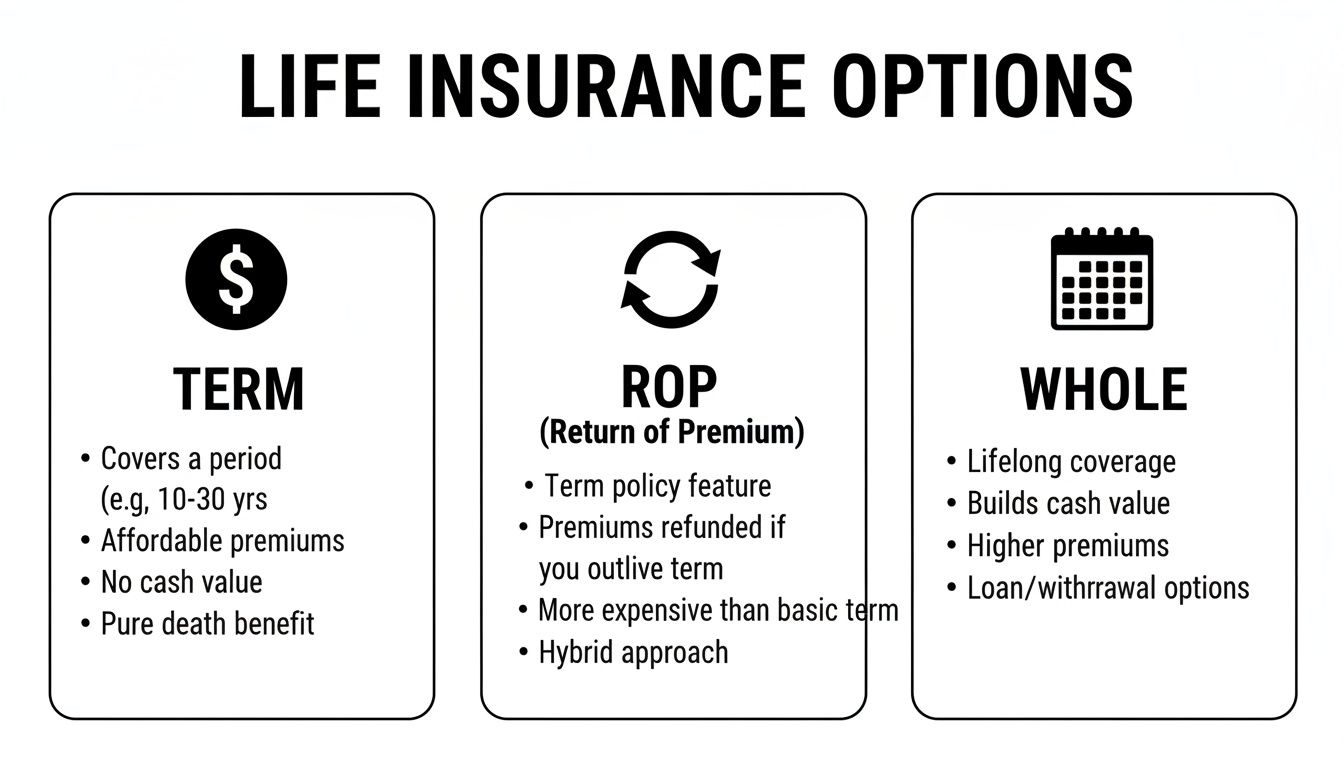
As you can see, ROP carves out a unique middle ground. It gives you the temporary protection your family needs, but with the promise of a full refund if you outlive the policy—a feature you won't find with the other two.
Who Benefits Most from an ROP Policy
A return of premium life insurance policy can be a game-changer for certain individuals. See if any of these sound familiar:
- The Risk-Averse Planner: Does the thought of paying for term life insurance for 30 years and getting nothing back feel like a bad bet? If so, the ROP money-back guarantee will speak your language. It essentially turns your insurance payments from an expense into a zero-cost savings plan.
- The Disciplined Saver (Who Needs a Nudge): You mean well. You want to save, but life—and bills—always seem to get in the way. An ROP policy acts like an automatic savings account, forcing you to set money aside for a future lump sum without any extra effort.
- The Young Family with a Mortgage: For many new homeowners in California, an ROP policy term can be set to match their mortgage. This is a brilliant strategy. It provides maximum protection when your debt is highest and then refunds every premium you paid—giving you a massive cash infusion you can use for renovations, college tuition, or just paying off the house early.
When to Consider Other Options
On the flip side, an ROP policy isn't the right tool for every job. You'd likely be better off with a different type of insurance if you see yourself in one of these descriptions:
- The Budget-Conscious Buyer: If your number one priority is getting the biggest death benefit for the lowest possible cost, standard term life is the undisputed champion. Its affordability lets you secure more protection for your family, especially when your budget is tight.
- The Confident Investor: Are you disciplined enough to invest on your own? If you're comfortable with the stock market, you could potentially see a better return by buying a cheaper term policy and investing the difference yourself. This requires discipline, but the upside can be greater.
- Someone Needing Lifelong Coverage: If your main goal is estate planning, leaving a financial legacy, or covering final expenses no matter when you pass away, a whole life policy is the way to go. Its permanent coverage is something ROP's fixed term simply can't offer.
As you weigh whether an ROP policy aligns with your financial strategy, it's also smart to explore how tools like an Irrevocable Life Insurance Trust can factor into complex estate plans. This is particularly relevant for those with significant assets in California. You can dive deeper into these and other topics in our library of California insurance guides.
Why ROP Is a Smart Choice for Californians

Living in California means navigating a unique financial landscape. Between the competitive housing market and a generally high cost of living, making every dollar count is essential. This is where return of premium life insurance shifts from being a mere insurance product to a practical, powerful tool for local families.
Sure, standard term life offers crucial protection. But an ROP policy adds another dimension by guaranteeing a full, tax-free refund of your premiums if you outlive the term. For a Californian, this isn't just a nice perk; it’s a strategic financial move that can help you get ahead.
Turning Premiums into a Major Financial Boost
Think about what a substantial, tax-free lump sum could do for you in 20 or 30 years. That’s the promise of an ROP policy. Instead of simply vanishing, your premium payments become a forced savings plan with a significant payout.
That refund can be a real game-changer for your family's goals:
- Fund a Down Payment: In California’s tough real estate market, coming up with a down payment is a huge hurdle. A tax-free check for $40,000 or $50,000 from your ROP policy could be the exact amount you need to finally buy a home.
- Cover College Education: With university costs soaring, that refund could easily fund a child’s entire college savings account, giving them a debt-free start to their adult life.
- Bolster Retirement Savings: A comfortable retirement in California demands a bigger nest egg. An ROP refund delivers a significant cash injection right when you might be winding down your career, boosting your retirement funds without any tax penalty.
For many Californians, an ROP refund isn't just getting your money back. It's a planned cash infusion that accelerates your biggest financial goals, turning years of responsible premium payments into a tangible asset you can actually use.
Building a Complete Financial Safety Net
As a homeowner in California, you're already juggling multiple insurance policies. You’ve got your home insurance, your car insurance, and maybe even renters insurance if you're not a homeowner yet. An ROP policy slots right into this layered approach to financial security.
It adds a critical layer of certainty. While your other policies protect your physical property, an ROP policy protects your family’s financial future and gives you a guaranteed savings outcome. It’s a disciplined strategy that complements the coverage you already have.
Consider a family living in a high-risk wildfire area. They'll naturally have robust home insurance, but they also need to know their mortgage will be paid if a primary earner passes away. A return of premium life insurance policy handles that perfectly, but with the added promise of a future refund that could pay off the mortgage early or fund home upgrades.
Whether you're in San Diego or Sacramento, it's this dual-purpose nature that makes ROP such a smart and practical choice for financially-savvy Californians looking for comprehensive California insurance solutions.
Finding Your ROP Policy with Mai & Associates
Figuring out if a return of premium life insurance policy is right for you shouldn't be complicated. Here at Mai & Associates, we’ve always believed in a straightforward, no-pressure conversation. Our job is to give you the clear, honest information you need to protect your family's future.
It all begins with a simple chat to understand your life and your goals. We know that when it comes to your family's security, cookie-cutter solutions just don't work.
Our Simple, Client-Focused Process
We've refined our process to be as clear and easy as possible, putting you in the driver's seat. We'll do the legwork of sifting through different carriers and plans, so you can focus on making the best choice.
- Step 1: Get a No-Obligation Quote. It all starts with getting a baseline idea of what a policy might look like for you. You can kick off this step right from our website.
- Step 2: Have a Personal Consultation. Next, one of our licensed agents will sit down with you to talk about your budget, your family’s needs, and your long-term financial picture. This is our chance to listen.
- Step 3: Compare Your Options. We then take what we learned and research the best ROP options from top-rated insurance carriers. We'll lay everything out for you—the good and the bad of each—so you can see the full picture.
The Mai & Associates Advantage in California
Because we're a California insurance agency, we have a deep understanding of what people here are dealing with. We help our neighbors manage everything from auto insurance and home insurance to complex life insurance planning. This holistic view lets us give you advice that’s genuinely relevant to life in the Golden State.
We pride ourselves on clear communication and make our services accessible to California’s diverse communities. Our team offers multilingual support in English, Spanish, Armenian, Russian, and Vietnamese to ensure every client feels understood and confident in their decisions.
Ready to explore whether a return of premium life insurance policy fits into your financial strategy? A great first step is getting a quick insurance quote from our website to see what your options look like.
Contact Mai & Associates today, and let our experienced agents help you find the peace of mind that comes with securing your family’s future.
Frequently Asked Questions About ROP Insurance
It's completely normal to have questions about how a policy like this really works day-to-day. A return of premium life insurance policy has some unique quirks, so it’s smart to get a handle on the specifics. Let's tackle some of the most common questions we hear from our clients right here in California.
What Happens If I Can No Longer Afford My ROP Premiums?
That's a really important question, and it gets to the heart of how these policies are designed. Think of ROP as a long-term commitment. If you can't keep up with the premiums and have to cancel the policy before the term ends, you will almost certainly lose the money you've paid in.
Insurers build these plans with the understanding that the full refund is your reward for seeing the term through to the end. Some policies might offer a small, "graded" surrender value after you've paid for a certain number of years, but it's usually just a fraction of what you've contributed. This is why it’s absolutely vital to choose a premium you know you can comfortably afford for the entire 20 or 30 years. If you cancel early, you walk away from the very thing you were paying for: the refund.
Is My Premium Refund Taxable?
This is where ROP really shines. The answer is no—your premium refund is not considered taxable income. The IRS doesn't see it as a profit or an investment gain. Instead, it's viewed simply as a return of the principal you already paid with your after-tax dollars.
This means if you paid $30,000 in premiums over your policy's term, you get a tax-free check for $30,000. Every single dollar comes back to you. This is a huge advantage, especially for Californians in higher tax brackets.
That tax-free status makes the refund an incredibly powerful tool for big financial goals, like putting a down payment on a house or boosting your retirement nest egg. For more answers to common questions about California insurance, including car insurance and home insurance, feel free to check out our full FAQ page.
Can I Take a Loan from My ROP Policy?
Simply put, no. You cannot take a loan against a return of premium life insurance policy. This is one of the biggest distinctions between ROP and permanent policies like whole life. At its core, an ROP policy is still term insurance; it doesn't build a separate "cash value" account that you can access.
The extra money you pay is funding the refund guarantee, not building a savings account you can borrow from. If having access to cash value for loans is a priority for you, then you’d be better served by exploring permanent life insurance options.
Should I View ROP as an Investment?
It’s healthier to think of ROP as a disciplined savings tool with an attached protection benefit, not as a traditional investment. The financial "return" on your money is effectively 0%—you just get back what you put in. A dedicated investment account in the market would almost certainly generate higher returns over a 20 or 30-year period.
The real power of ROP lies in its structure and its guarantee. It creates a forced savings habit while promising you won't lose your principal. For anyone who finds it hard to save consistently or is uncomfortable with market risk, ROP offers a compelling blend of security, protection, and a guaranteed lump sum.
At Mai & Associates, we can help you weigh the pros and cons to see if an ROP policy is the right fit for your California lifestyle. Visit us at cahomeauto.com to get started with a free, no-obligation quote today.