Replacement Cost vs Actual Cash Value for California Insurance
It all boils down to one simple question: after a disaster, do you want a check for what your stuff was worth, or a check big enough to buy brand-new replacements? That's the core difference between Replacement Cost (RC) and Actual Cash Value (ACV) coverage.
Getting this choice right is absolutely critical for any California homeowner, renter, or driver who wants to be made whole after a loss. Whether you're dealing with home, auto, or renters insurance in California, this one detail can make or break your financial recovery.
Understanding The Core Difference In Your Policy
When you file an insurance claim, the valuation method—RC or ACV—is what drives the final payout. It determines whether you can walk into a store and buy a new item or if you'll be left covering a big chunk of the cost yourself.
Let's say a kitchen fire in your Glendale home ruins your five-year-old refrigerator. With Replacement Cost coverage, your policy is designed to pay for a brand-new, comparable fridge at today's prices. But with an Actual Cash Value policy, you'll only get what that five-year-old fridge was worth moments before the fire, which is far less.
This isn't just a minor detail buried in your policy documents. For most people, especially Californians facing risks from wildfires or earthquakes, this single choice can mean the difference between a smooth recovery and a devastating financial setback. You can get familiar with other key insurance terms by checking out our insurance glossary.
Key Factors At Play
The main driver behind the difference is depreciation—the natural decrease in an item's value over time due to age, use, and general wear and tear.
Replacement Cost coverage essentially ignores depreciation. Its goal is to restore you to the same position you were in before the loss, providing you with the funds to purchase new items. On the other hand, Actual Cash Value coverage is built entirely around depreciation. It pays you for the market value of the item you lost, not the cost to replace it.
The promise of Replacement Cost is to rebuild your life without forcing you to drain your savings. Actual Cash Value simply reimburses you for the cash value of what you lost, leaving you to bridge the financial gap to buy something new.
To see how these two options stack up side-by-side, it helps to look at a direct comparison.
This table breaks down the fundamental differences you'll encounter when dealing with a claim.
At a Glance Replacement Cost (RC) vs Actual Cash Value (ACV)
| Key Feature | Replacement Cost (RC) | Actual Cash Value (ACV) |
|---|---|---|
| Payout Basis | Cost to buy a new, similar item today. | Current market value of the item, minus depreciation. |
| Depreciation | Not deducted from your payout. | Deducted from your payout. |
| Premiums | Generally higher. | Generally lower. |
| Out-of-Pocket Costs | Minimal, typically just your deductible. | Can be significant, covering the gap between ACV and replacement price. |
| Best For | Making you whole after a loss. | Minimizing premium costs when you can afford the risk. |
As you can see, the trade-off is straightforward: ACV offers lower premiums, while RC provides much greater financial protection at the time of a claim.

How Your Insurance Payout Is Actually Calculated
When you file a claim, the math behind your insurance check can feel a bit mysterious. But understanding how that number gets calculated is crucial—it determines whether you'll have enough money to get back on your feet or be left with a major financial hole. It all boils down to two very different methods: Actual Cash Value and Replacement Cost.
For Actual Cash Value (ACV), the formula is pretty straightforward:
ACV = Replacement Cost – Depreciation
In simple terms, the insurance company starts with what it would cost to buy a new, similar item today. Then, they subtract a certain amount for depreciation, which accounts for the item's age and general wear and tear.
Calculating an Actual Cash Value Payout
An adjuster figures out depreciation by looking at your item's age, its condition right before it was damaged, and its typical lifespan. Think about it this way: a five-year-old laptop that you used every day has depreciated a lot more than a fancy one-year-old couch that sat untouched in your formal living room.
Let's look at a real-world California renters insurance example. Say a renter in Glendale loses all their electronics in a fire.
- Replacement Cost of TV: $1,200 (the price to buy a comparable new model today)
- Age of TV: 4 years
- Expected Lifespan: 8 years
- Depreciation: 50% ($600)
- ACV Payout: $1,200 - $600 = $600
In this case, the renter gets a check for $600. That leaves them to come up with the other $600 out-of-pocket to buy a new TV. This is the fundamental trade-off with ACV policies: you get a lower premium, but you take on more of the financial risk yourself when a claim happens.
Calculating a Replacement Cost Payout
With a Replacement Cost (RC) policy, the math is much simpler. Depreciation isn't part of the equation at all. Your payout is based on what it costs to replace your damaged property with new items of similar quality, at today's prices.
For your personal belongings, that means the cost to go to a store and buy them new. For your house itself, it’s the cost to rebuild with current labor rates and materials. It's also critical to understand if a roof replacement covered by insurance under your specific policy, as structural items like that can be a major expense.
A Replacement Cost policy is designed to make you whole again. It provides the funds necessary to restore your property to the condition it was in before the loss, using new materials and items without penalizing you for depreciation.
Imagine a homeowner in Westlake Village, California, suffers significant damage in an earthquake.
- Cost to Rebuild Damaged Section: $150,000
- Policy Type: Replacement Cost
- RC Payout: $150,000 (minus their deductible)
Here, the homeowner gets the full amount they need to hire contractors and buy brand-new materials to complete the repairs. This kind of protection is especially important in California, where some unique local factors can make rebuilding costs soar unexpectedly.
California-Specific Cost Factors
Calculating rebuilding costs in California isn't just about lumber and labor. Several local issues can inflate expenses, making solid RC coverage absolutely essential for California home insurance. If you want to dig deeper, you can learn more about how to secure the right home insurance in California in our guide.
Here are a few key factors that drive up payout amounts in the Golden State:
- Local Labor Rates: Skilled construction labor in places like the Bay Area or Los Angeles costs far more than in many other parts of the country.
- Post-Disaster Demand Surge: After a major wildfire or earthquake, the sudden demand for contractors and building materials sends prices through the roof, often spiking by as much as 20-30%.
- Updated Building Codes: California enforces some of the toughest building codes in the U.S., particularly for earthquake and fire safety. If your older home is damaged, your policy needs to cover the higher cost of rebuilding to today's much stricter standards.
These factors can create a massive gap between an ACV payout and what you actually need to recover, which is why understanding the replacement cost vs actual cash value fine print in your California insurance policy is so critical.
The Financial Impact on California Claims
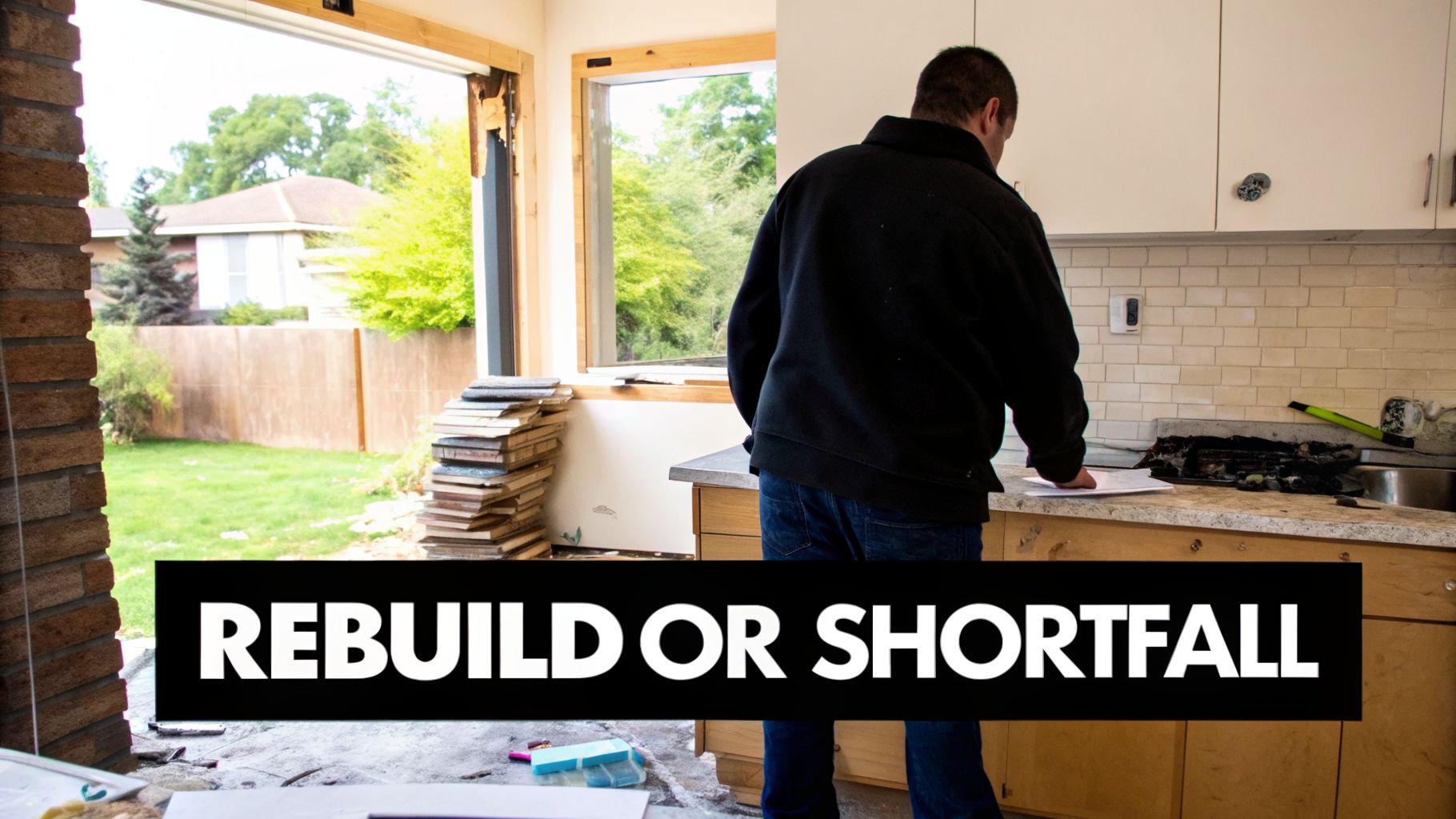
The difference between replacement cost vs actual cash value isn't just an abstract policy detail; it has very real and often painful consequences when you actually have to file a claim. To see just how much this choice matters, let’s walk through a scenario that thousands of California families face: a wildfire that damages a home in Escondido.
This single decision can determine whether a homeowner rebuilds their life or faces a massive, unexpected financial shortfall.
Putting It to the Test: An Escondido Kitchen Fire
Imagine your kitchen—the heart of your home—is gutted by a wildfire. Everything from the cabinets and countertops to the appliances and flooring is a total loss. While it was all well-maintained, the kitchen was last updated ten years ago. Today, the cost to bring in contractors and buy new materials to rebuild it properly comes to $30,000.
Your insurance payout is the only thing that stands between you and getting your home back. Here’s a look at how this plays out with each type of policy.
Scenario 1: The Replacement Cost (RC) Policyholder
If you have a Replacement Cost policy, your coverage is there to make you whole again. The insurance company calculates what it will cost to rebuild your kitchen using new materials of a similar kind and quality at today's prices.
- Cost to Rebuild: $30,000
- Depreciation: Not a factor
- Your Payout: $30,000 (minus your deductible)
You get a check that covers the full cost of the rebuild. Your only out-of-pocket expense is your deductible, allowing you to start repairs immediately and restore your kitchen completely. This is the financial peace of mind that RC coverage is designed to provide.
Scenario 2: The Actual Cash Value (ACV) Policyholder
Now, let's look at the same disaster with an Actual Cash Value policy. The insurer starts with the same $30,000 replacement cost but then applies depreciation for your 10-year-old kitchen.
The core problem with ACV in a major loss is that you don't just lose your property; you also absorb the financial hit of its lost value. This creates a gap that you are personally responsible for bridging just to get back to where you started.
Let's break down the math on the ACV claim.
The High Cost of Depreciation
The insurance adjuster determines that items like your cabinets, standard appliances, and flooring have an average useful lifespan of about 20 years. Since your kitchen was 10 years old, it has lost 50% of its value due to depreciation.
- Cost to Rebuild: $30,000
- Depreciation Deduction (50%): -$15,000
- Your Payout: $15,000 (minus your deductible)
The check you receive is for just $15,000. To rebuild your $30,000 kitchen, you now have to find the remaining $15,000 shortfall in your own savings. This unexpected expense can be crippling, forcing families into debt or settling for partial, lower-quality repairs. In the worst possible moment, a single policy detail has triggered a financial crisis.
This isn't just hypothetical. Imagine this same Escondido kitchen fire happens in 2026. A Replacement Cost (RC) policy would cover the full $30,000 rebuild, less the deductible. With an Actual Cash Value (ACV) policy, the insurer would subtract 50% depreciation for those 10-year-old components, leaving you with only $15,000 before the deductible. Data from 2026 shows RC policies fully covered 85% of average home fire losses, while ACV only covered 62%. For California wildfire claims averaging $250,000, RC saved policyholders an average of $75,000. You can learn more about how these policies compare and determine if replacement cost value is a better choice.
In high-risk areas where a total loss is a constant threat, this difference makes it clear that comprehensive RC protection is a necessity, not a luxury. It’s the tool that ensures you can truly rebuild after a catastrophe without facing financial ruin.
Choosing Coverage for Your California Insurance Policies

Deciding between replacement cost vs actual cash value isn't a simple one-and-done choice. The best option hinges entirely on the type of California insurance policy you’re looking at, whether it’s for your house, your apartment, or your car.
Getting this right is crucial for making sure you’re properly protected. What many people don't realize is that a single policy, like for a home, often uses a mix of both. This can lead to some unpleasant surprises at claim time if you don't know exactly what you signed up for.
Homeowners Insurance Coverage
When you look at a California homeowners policy, you’ll see it’s broken down into two key areas: coverage for the house itself and coverage for everything inside it. This is where the RC vs. ACV distinction really matters for home insurance.
Dwelling Coverage (Coverage A): This protects the physical structure of your home. The good news is that most standard policies default to Replacement Cost (RC) for the dwelling. This is designed to give you enough money to rebuild your home from the ground up with today's materials and labor costs—absolutely essential given how high construction expenses are in California.
Personal Property Coverage (Coverage C): This covers all your stuff—your furniture, TV, clothes, you name it. Here’s the catch: the default setting for personal property is almost always Actual Cash Value (ACV). So, if a fire ruins your five-year-old sofa, the insurance check will only cover its depreciated value, not what you need to go out and buy a new one.
To avoid that financial gap, you’ll need to add a Replacement Cost endorsement to your policy. It does add a bit to your premium, but it means you can actually replace what you lost with brand-new items. It's also important to know how your policy responds in different situations; for example, understanding your homeowner's insurance coverage for specific perils like a burst pipe can save you a lot of headaches.
Renters Insurance Coverage
If you’re a California renter, your policy is all about protecting your personal belongings. You don't own the building, so your insurance is there for your things in case of a fire, theft, or other disaster. For you, the RC vs. ACV decision directly impacts how well you can get back on your feet.
Most basic California renters insurance policies come with ACV coverage because it keeps the price down. The problem is, this often leaves you with a huge out-of-pocket expense when you need the coverage most.
Imagine a Costa Mesa renter whose 7-year-old furniture is destroyed in a 2026 earthquake. It costs $8,000 to replace everything. An RC policy would cover the full amount (minus the deductible). But an ACV policy, after calculating 45% depreciation, would only pay $4,400. That leaves a $3,600 hole in their budget.
Even though an RC renters policy might cost 20-30% more—maybe an extra $15 a month—it closes that gap. With U.S. renters facing billions in losses and data showing 55% of those with ACV policies are underinsured, the extra cost for full replacement is a smart investment.
For nearly every renter, opting for a Replacement Cost endorsement is the way to go. To see what makes sense for your situation, take a look at our complete guide on how to get the best renters insurance in California.
Auto Insurance Coverage
Now, let's talk cars. When it comes to California auto insurance, the rules are completely different. If you file a claim under your collision or comprehensive coverage—the parts that pay to fix your own car—the payout is almost always based on Actual Cash Value (ACV).
In the world of California auto insurance, ACV is king. After a total loss, your insurer will pay you the fair market value of your vehicle the moment before the accident. This payout is based on its age, mileage, condition, and local market data—not what you paid for it or what a new one costs.
This can be a tough pill to swallow, especially if you have an older car. The ACV payment might be nowhere near enough to buy a similar, reliable replacement. However, if you have a newer car, there’s an option.
- New Car Replacement Coverage: Think of this as an optional RC policy for your car insurance. If your brand-new vehicle is totaled within a set period (like the first year or 15,000 miles), this add-on will pay to replace it with a new car of the same make and model. It’s a great way to protect yourself from that initial, steep depreciation.
Navigating California's Unique Insurance Risks
If you own a home in California, you know that insurance isn't always straightforward. Our state's landscape, with its constant threats of wildfire and earthquakes, introduces risks that many standard policies just weren't built to handle. This is where the debate over replacement cost vs. actual cash value becomes critically important for home insurance.
For homeowners in high-risk zones, finding traditional insurance can feel impossible. Many are forced to turn to the California FAIR Plan as a last resort, but this is where a huge, costly misunderstanding often begins. The FAIR Plan isn't a typical homeowners policy; it's a basic fire policy, and by default, it pays out on an Actual Cash Value (ACV) basis.
The California FAIR Plan and Its Coverage Gap
What does an ACV-only policy mean after a disaster? It means you get a check for your home's depreciated value—not the money you actually need to rebuild. Think of it as getting paid for your 15-year-old roof, not the brand new one you now have to install. Given California's astronomical construction costs, this gap can easily run into hundreds of thousands of dollars, making a full recovery impossible.
To close this financial gap, you have to create a complete solution with two separate policies:
- The California FAIR Plan: This provides your basic fire coverage for the structure itself, almost always on an ACV basis.
- A Difference in Conditions (DIC) Policy: This supplemental policy, bought from a private insurer, "wraps around" the FAIR Plan. It adds back crucial missing pieces like liability and, most importantly, can upgrade your dwelling coverage to full Replacement Cost (RC).
Without a DIC policy to add back Replacement Cost coverage, a FAIR Plan policyholder is left holding the bag for the enormous difference between their home's used value and the real-world cost to build it new.
For many Californians in high-risk areas, this two-policy strategy is the only way to get the comprehensive protection required to make them whole after a total loss.
This decision tree illustrates the path a California homeowner might take when navigating these complex choices.
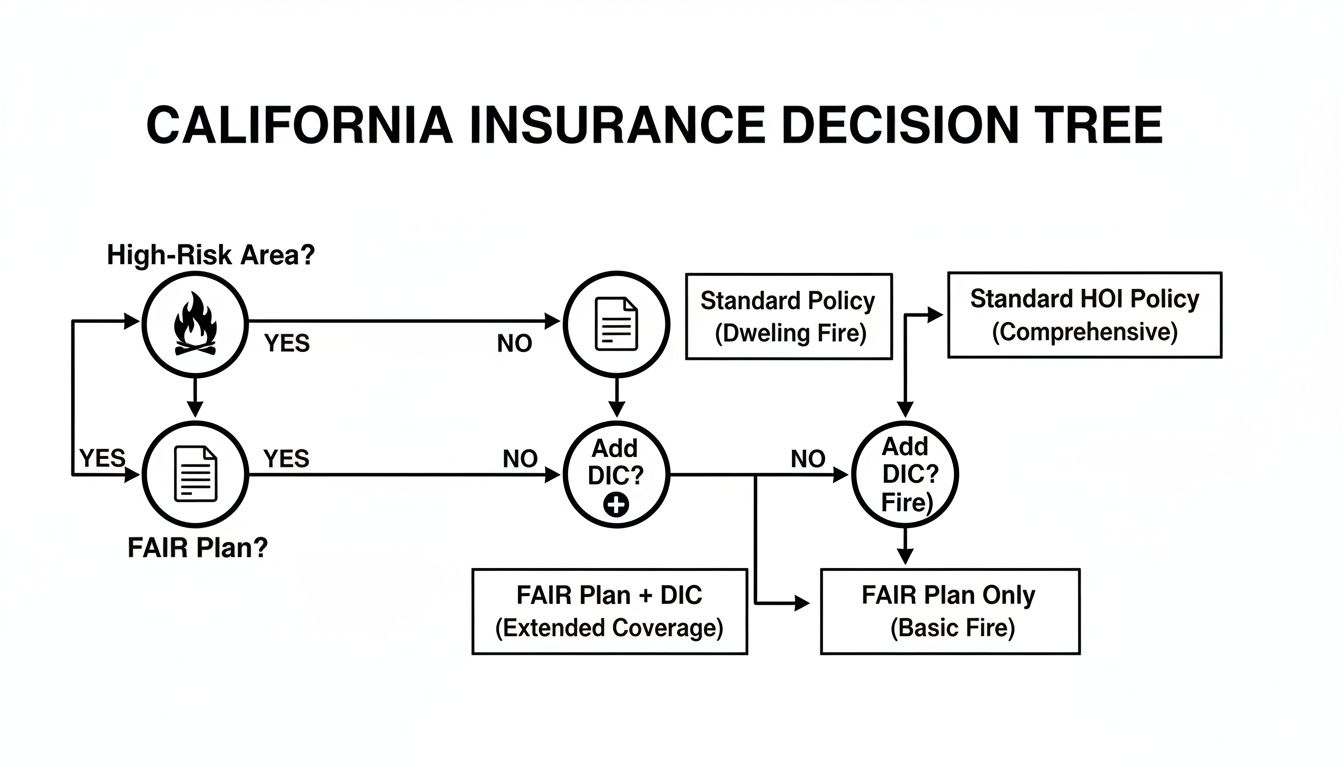
As you can see, living in a high-risk area often means you have to be proactive and look beyond a single, standard policy to secure the right protection.
The Impact of Demand Surge on Rebuilding
There's another uniquely Californian risk that can derail your finances after a disaster: demand surge. When a major wildfire or earthquake strikes a large area, the sudden need for contractors, lumber, and building supplies sends prices through the roof. It's not uncommon to see rebuilding costs inflate by 20-30% or more, seemingly overnight.
This post-disaster inflation is precisely why Replacement Cost coverage is so vital here. An ACV policy is already going to leave you short, but when you add a massive demand surge on top of it, the financial shortfall becomes catastrophic. Your RC policy is designed to cover the current cost to rebuild, giving you a fighting chance against these inflated prices that an ACV payout completely ignores.
Making the Right Choice for Your Financial Security
Deciding between replacement cost vs actual cash value boils down to one thing: your personal tolerance for financial risk. It's a straightforward trade-off. Are you willing to pay a little more for your policy to get complete peace of mind, or do you prefer a lower premium now and accept the risk of a major financial hit later?
The best way to figure this out is to ask yourself a tough but necessary question: If a fire or other disaster destroyed everything tomorrow, could I actually afford to cover the difference between what my insurance pays and what it costs to buy everything brand new? Your honest answer will point you in the right direction.
When Does Actual Cash Value Make Sense?
Let's be clear, the main appeal of an Actual Cash Value (ACV) policy is the lower premium. It's tempting to save money every month, but that savings comes with a big catch—you're on the hook for depreciation when you file a claim.
Still, there are a few specific instances where an ACV policy might be a reasonable choice:
- For Items with Little Value: If your personal belongings are older and wouldn't cost much to replace with similar used items, ACV can be a practical way to keep your insurance costs down.
- When You Have a Large Emergency Fund: If you have significant savings set aside and are comfortable covering a potential gap of thousands of dollars out-of-pocket, an ACV policy is a calculated risk you might be willing to take.
- For Secondary Properties or Assets: Think of a seldom-used vacation cabin or a classic car that stays in the garage. In these cases, the risk of a total loss might feel lower, making an ACV policy a more palatable option.
That lower premium from an ACV policy can feel like a smart move every month. But it's a dangerous illusion. A single major claim can leave you with a bill that instantly wipes out years of those small savings.
When is Replacement Cost Essential?
For the vast majority of homeowners and renters in California, Replacement Cost (RC) coverage is the only option that truly protects your financial stability. While an RC policy might cost 10-25% more than its ACV counterpart, that extra investment provides an invaluable safety net when you need it most.
Think of RC as non-negotiable in these situations:
- To Protect Your Home: Your house is likely your biggest asset. You absolutely need RC coverage for the dwelling itself to ensure you have enough money to rebuild from the ground up without draining your life savings.
- To Cover Your Valuables: Look around your home. If you have modern electronics, nice furniture, and other belongings you'd want to replace with new items, an RC endorsement is critical to making you whole again.
- If You Don't Have Substantial Savings: If a five-figure shortfall would be a serious financial crisis for you, RC coverage is your firewall. It stops a disaster from derailing your financial future.
Ultimately, choosing between replacement cost vs actual cash value is about matching your policy to your real-world financial situation. By weighing the slightly higher premium of RC against the powerful security it delivers, you can make sure your policy will actually be there for you when disaster strikes.
Frequently Asked Questions
It's only natural to have questions when you're digging into insurance details, especially when it comes down to how a claim will actually pay out. Let's tackle some of the most common questions we hear from California policyholders about replacement cost vs. actual cash value.
Does Car Insurance Use Replacement Cost or Actual Cash Value?
Your standard car insurance policy in California is almost certain to use Actual Cash Value (ACV) for any comprehensive or collision claim. If your car is declared a total loss, the insurance payout will be based on its market value just before the crash. This number accounts for depreciation from its age, mileage, and overall condition.
Some companies do offer an endorsement for "new car replacement" coverage, which functions like RC. It's a great add-on, but it's typically only for brand-new vehicles under a certain age or mileage limit, and you have to pay extra for it. It isn't the default.
Is Replacement Cost Worth the Extra Premium for Renters?
For almost every renter, the answer is an absolute yes. The extra premium for Replacement Cost (RC) coverage on a California renters insurance policy is usually minimal—we're often talking just a few dollars more each month. The difference in a potential claim payout, however, can be staggering.
Without RC, you’d only get the depreciated, garage-sale value for your belongings. That's rarely enough to buy new furniture, electronics, or clothes after a fire or major theft.
For a California renter, that slightly higher premium for RC coverage is the firewall between a major disaster and a full-blown financial crisis. It’s what lets you go out and buy new essentials instead of facing a massive out-of-pocket shortfall.
How Often Should I Review My Home's Replacement Cost Value?
You should sit down with your agent and review your home's replacement cost value annually. This is non-negotiable for California home insurance. Construction costs, local labor rates, and simple inflation are constantly pushing the cost to rebuild higher.
An annual review ensures your dwelling coverage (Coverage A) keeps pace. This simple check-in can prevent you from being dangerously underinsured when you need your policy the most. For a more detailed look at this and other policy questions, we've put together more answers in our comprehensive insurance FAQ section.
Does the California FAIR Plan Offer Replacement Cost Coverage?
By default, no. A standard California FAIR Plan policy is a bare-bones fire policy that only pays out on an Actual Cash Value (ACV) basis. It's designed to be a last resort, not comprehensive coverage.
To get full Replacement Cost (RC) protection for your home's structure, you need to buy a separate policy called a "Difference in Conditions" (DIC) policy from a private insurance company. This DIC policy essentially "wraps around" the basic FAIR Plan policy, filling in the many coverage gaps and, most importantly, upgrading your dwelling protection from ACV to RC.
Trying to make sense of California insurance shouldn't feel like a chore. The licensed agents at Mai & Associates are here to give you a no-obligation review of your policies, walk you through your options in plain English, and help you find that sweet spot between great protection and a price that fits your budget. Get your free, instant quote today by visiting https://cahomeauto.com.