Renters Insurance Water Damage Coverage Explained
Standard renters insurance typically covers sudden and accidental water damage, such as a burst pipe or overflowing appliance, but excludes floods, gradual leaks, and often sewer backups unless you add the right endorsement. The key is identifying exactly where your loss falls before you file a claim.
You come home from work and find water spreading across the floor from a washing machine hose. Your couch is soaked, your laptop was sitting nearby, and a pile of clothes is saturated. You may have renters insurance water damage coverage for those belongings, but the answer depends on what caused the water, how quickly it happened, and what part of the property was damaged.
That distinction matters for California renters. You may already be comparing auto insurance, home insurance, car insurance, or life insurance, but water damage deserves its own policy review. This guide explains the covered side of the line, the exclusions that surprise renters, the endorsements that can close important gaps, and the steps that help you document a valid claim.
Why Water Damage Is the Question Every Renter Should Ask
The washing machine hose in the opening example failed suddenly. If the hose ruptured without warning and damaged your furniture, clothing, or electronics, a standard renters policy will commonly treat the loss as sudden and accidental. Your landlord's policy generally addresses the building, while your policy is designed to protect your belongings and may also provide liability protection.
The dividing principle is simple: renters insurance responds to sudden, accidental events, not every form of water exposure. A burst pipe is different from a pipe that has dripped behind a wall for months. An overflowing toilet caused by an unexpected incident is different from water rising through the building after a storm.
Water damage and freezing accounted for 27.6% of home insurance claims in 2022, making it one of the leading claim categories, according to American Family's explanation of renters insurance and water damage. That claim history helps explain why insurers draw such a careful boundary between internal water losses and flooding.
Practical rule: Ask three questions first: Where did the water come from? How quickly did the event happen? Which of your belongings were damaged?
Your lease may also assign responsibility for utilities, maintenance, or reporting problems. If you're unsure who handles water service or related responsibilities, this guide to paying utilities in a rental house can help clarify the rental arrangement.
A good policy review should identify four things: what your policy covers, what it excludes, which endorsements are available, and how to file a claim without weakening your own documentation. Those details matter more than just knowing that you have an insurance card.
What Renters Insurance Water Damage Coverage Actually Includes
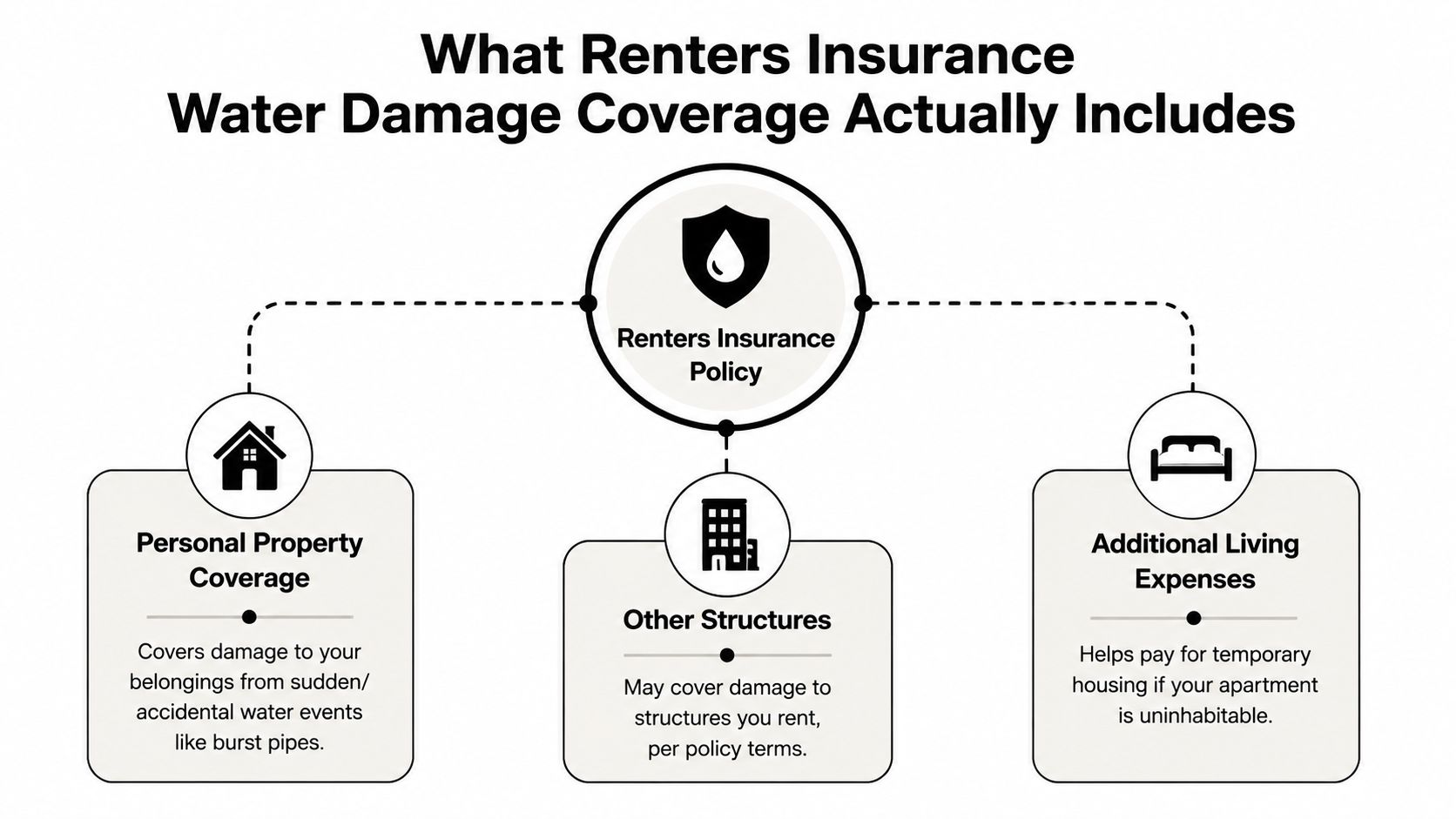
A renters policy is primarily a personal-property policy. It generally doesn't insure the building's walls, floors, ceilings, or permanent plumbing. Those parts usually fall under the landlord's property coverage and maintenance responsibilities.
Your policy may help repair or replace your belongings when water is released suddenly and accidentally from an internal source. Common examples include a burst pipe, an overflowing toilet, a broken appliance hose, or an accidental discharge from plumbing, HVAC, sprinkler, or fire-suppression equipment. California renters insurance coverage can vary by carrier, so the policy wording still controls the final decision.
The sudden event test
Think of the policy as responding when water attacks suddenly, like a storm hitting your belongings. It generally doesn't respond when water drips slowly, like erosion wearing away a surface over time.
Consider these examples:
- Burst pipe: A pipe breaks overnight and soaks a sofa, books, and clothing. The damaged personal property may be covered.
- Appliance hose: A dishwasher or washing machine hose suddenly ruptures and sprays water across the kitchen. Your belongings may qualify if the event was accidental.
- Overflowing appliance: A water-filled appliance unexpectedly overflows and damages electronics stored nearby. The contents loss may be covered.
- Building systems: A sudden discharge from plumbing, HVAC, a sprinkler, or a fire-suppression system damages your possessions. The policy may respond under its water-loss provisions.
The same event can involve two different insurance responsibilities. If a burst pipe damages your rented apartment's drywall and also ruins your laptop, the building damage usually belongs with the landlord's insurance, while your laptop and other belongings may belong under your renters policy.
Coverage can also depend on your deductible, policy limits, exclusions, and whether the insurer considers the event accidental. Read the declarations page and water-related exclusions, then ask an agent to explain any wording you can't translate into everyday language.
What Your Policy Leaves Out
The most common mistake is treating every wet floor as the same kind of loss. Insurers usually look at the source and cause, not merely the presence of water.
| Water Damage Scenario | Typically Covered? | What You Need Instead |
|---|---|---|
| A pipe suddenly bursts inside the building | Often, for damaged personal belongings | Your standard renters policy, subject to its terms |
| A washing machine hose suddenly fails | Often, for damaged personal belongings | Your standard renters policy, subject to its terms |
| Rainwater or rising water enters from outside | Generally not | Separate flood insurance |
| A hidden pipe slowly drips over time | Generally not | Prompt maintenance and possibly policy-specific coverage |
| Sewer or drain water backs up into the unit | Often excluded from standard coverage | Sewer and drain backup endorsement |
| A sump pump overflows or fails | Often excluded from standard coverage | Sump pump or water backup endorsement |
Flood losses are commonly listed in policy exclusions as water damage, even though a renter may reasonably think of a flood as a type of water loss. The National Association of Insurance Commissioners consumer guidance explains that typical renters coverage includes water-related damage from property utilities, while flood losses generally aren't included.
The exclusions that decide difficult claims
External flooding includes water from heavy rain, rising water, swollen waterways, or similar outside sources. If a flooded street sends water into your apartment, standard renters insurance generally won't pay for the belongings damaged by that floodwater.
Gradual leaks create a different problem. A slow drip behind a wall may damage clothing or furniture over many weeks or months. Even if you didn't see it immediately, the insurer may classify the damage as seepage, poor maintenance, or neglect rather than a sudden event.
Sewer backups and sump pump failures also deserve special attention. Some policies treat them as endorsements rather than standard coverage, so don't assume a toilet backup or failed pump is covered just because the water is inside your unit. For plain-language explanations of insurance terms, the California insurance glossary is a useful reference.
The Flood Gap California Renters Should Understand
Floodwater comes from outside the building. It may enter after heavy rain, rise from nearby ground, flow from a swollen creek, or move through a flooded street. Standard renters insurance generally excludes that exposure, even when the water damages only your personal belongings.
That gap can be financially serious. The National Flood Insurance Program offers renters contents coverage for personal belongings up to $100,000, according to Allstate's overview of renters and flood insurance. FEMA reports that the NFIP has 4.7 million policyholders nationwide and nearly $1.3 trillion in flood coverage. The same source reports an average NFIP payout of $66,000, illustrating how costly a flood loss can become.
Those figures don't predict your claim or establish the value of your belongings. They show why a standard renters policy shouldn't be treated as a substitute for flood insurance. A renter with expensive electronics, furniture, clothing, or other contents may need to evaluate flood protection separately.
California's FAIR Plan connection
California renters in wildfire-prone or high-risk areas may hear about the California FAIR Plan. The California Department of Insurance describes it as an association of property insurers licensed in California. Its dwelling policy is a named-peril form, and water damage is excluded unless separate coverage is added, according to the California Department of Insurance residential insurance guide.
Renters should ask what policy protects their belongings, rather than assuming that a landlord's FAIR Plan arrangement extends to tenant property. A review of home insurance in California can help explain the landlord-side context, but you still need your own renters policy for your possessions.
If floodwater has already entered a lower-level space, prioritize safety and follow practical steps for basement flooding. Don't enter standing water if electrical hazards may exist.
Endorsements That Close the Coverage Gaps
The right endorsement depends on where your unit sits, how the building handles water, and what the standard policy excludes. A third-floor apartment with no basement exposure may have a different risk profile from a ground-floor unit in an older building with a history of backups.
Sewer and drain backup coverage
A sewer or drain backup endorsement can address a risk that standard renters insurance often leaves out. It may be worth discussing if your unit is on a lower floor, the building has older plumbing, or neighbors have experienced recurring backups.
Don't focus only on whether the building manager says the plumbing is well maintained. Ask what happens if wastewater backs into your unit and damages your belongings. The answer should come from the endorsement wording, including its limits, deductible, and exclusions.
Sump pump protection
A sump pump endorsement may matter in a basement or ground-floor rental where a pump controls water movement. If the pump fails or overflows, standard coverage may not respond without added protection. This is especially important when your belongings are stored close to the floor.
A higher-floor renter may have less need for sump pump coverage, but the unit's exact plumbing layout still matters. Ask whether the endorsement covers pump failure, water backup, or both, because those aren't automatically identical events.
Separate flood insurance
Flood insurance addresses water entering from outside sources, which is the central gap in a standard renters policy. Renters may obtain contents coverage through the NFIP or explore private flood carriers, depending on availability and the property's risk.
Independent consumer guidance confirms that sudden burst pipes, appliance overflows, and sprinkler discharge may be covered, while gradual leaks, neglect, sewer backups, and sump pump failures are commonly excluded unless extra coverage is purchased. You can review that boundary in this consumer explanation of renters water damage coverage.
California FAIR Plan customers should ask specifically whether any separate water coverage is available for the arrangement affecting their rental. Don't rely on a general statement that the property is insured. Request the actual policy and endorsement details.
How to File a Water Damage Claim the Right Way
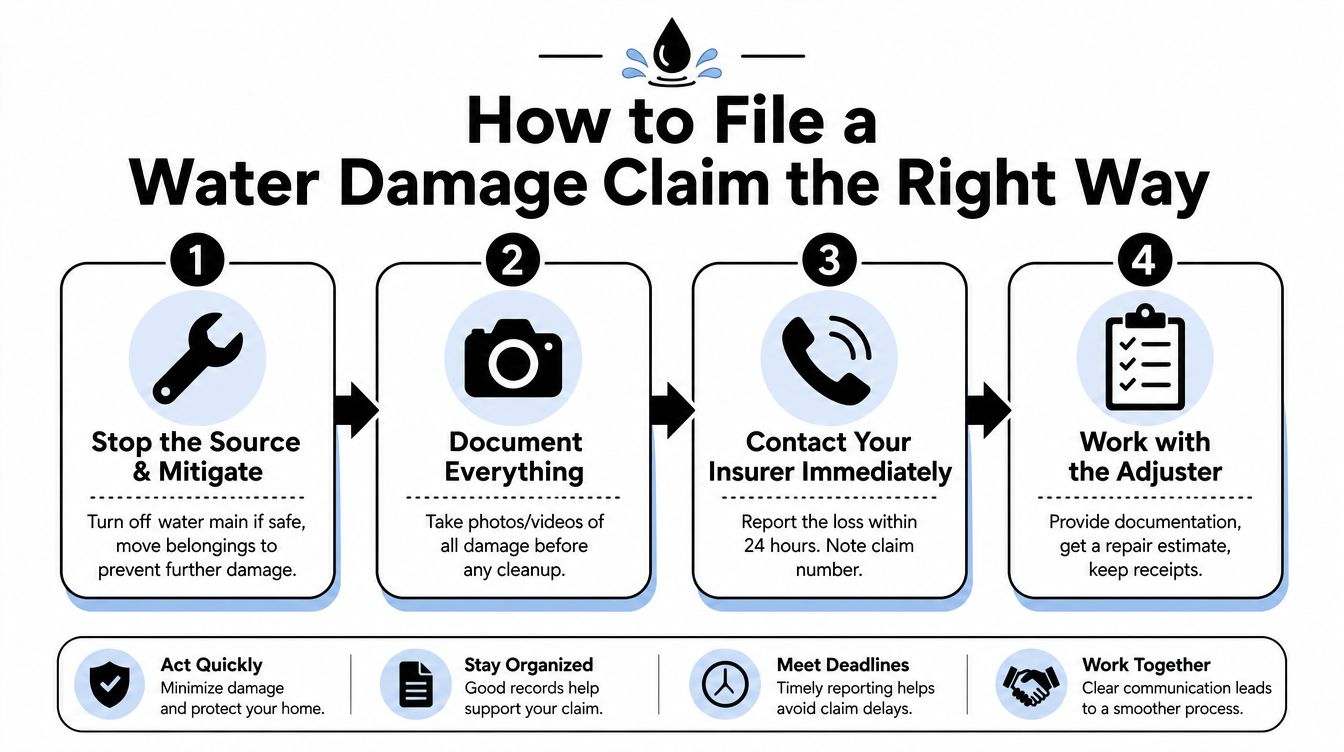
Your actions on the day of the loss can affect how clearly the insurer sees the event. The objective is to show what happened, when it happened, which belongings were damaged, and what you did to prevent the damage from getting worse.
Start with safety and mitigation
- Stop the source if it's safe. Turn off the appliance valve or water supply, and contact emergency maintenance or a plumber. Don't put yourself near electrical hazards or contaminated water.
- Protect what you can. Move undamaged belongings away from the water and raise them if practical. Your policy may expect reasonable steps to prevent additional damage.
- Photograph before cleanup. Take wide photos of each affected room, then close images of damaged furniture, electronics, clothing, flooring, and the apparent source. Capture videos if they show the water's path or the active leak.
- Notify the landlord in writing. Send an email or use the landlord's maintenance portal. State what you observed, when you discovered it, and what emergency steps you took.
- Contact your insurer promptly. Report the loss using the carrier's claims number or online portal. Ask what documentation it needs and record the claim number.
- Create an item inventory. List each damaged belonging, its description, approximate purchase information, and replacement research. Gather receipts, order histories, warranties, photographs, or other proof of ownership.
- Prepare for the adjuster. Keep damaged items available unless they create a health or safety hazard. Save cleanup invoices, temporary storage receipts, and other related records.
Avoid statements that blur the cause
Don't throw away damaged property before photographing it and asking the insurer what to do. Don't wait while mold, odors, or additional moisture spreads. Also, avoid guessing about the cause or volunteering a statement such as, “It had been leaking for weeks,” unless that is what you observed and you can explain the timeline accurately.
A better description is factual: “I discovered water on the floor at this time, found the damaged hose, moved my belongings, and notified maintenance.” The adjuster will investigate the cause. Your job is to preserve evidence and report what you know.
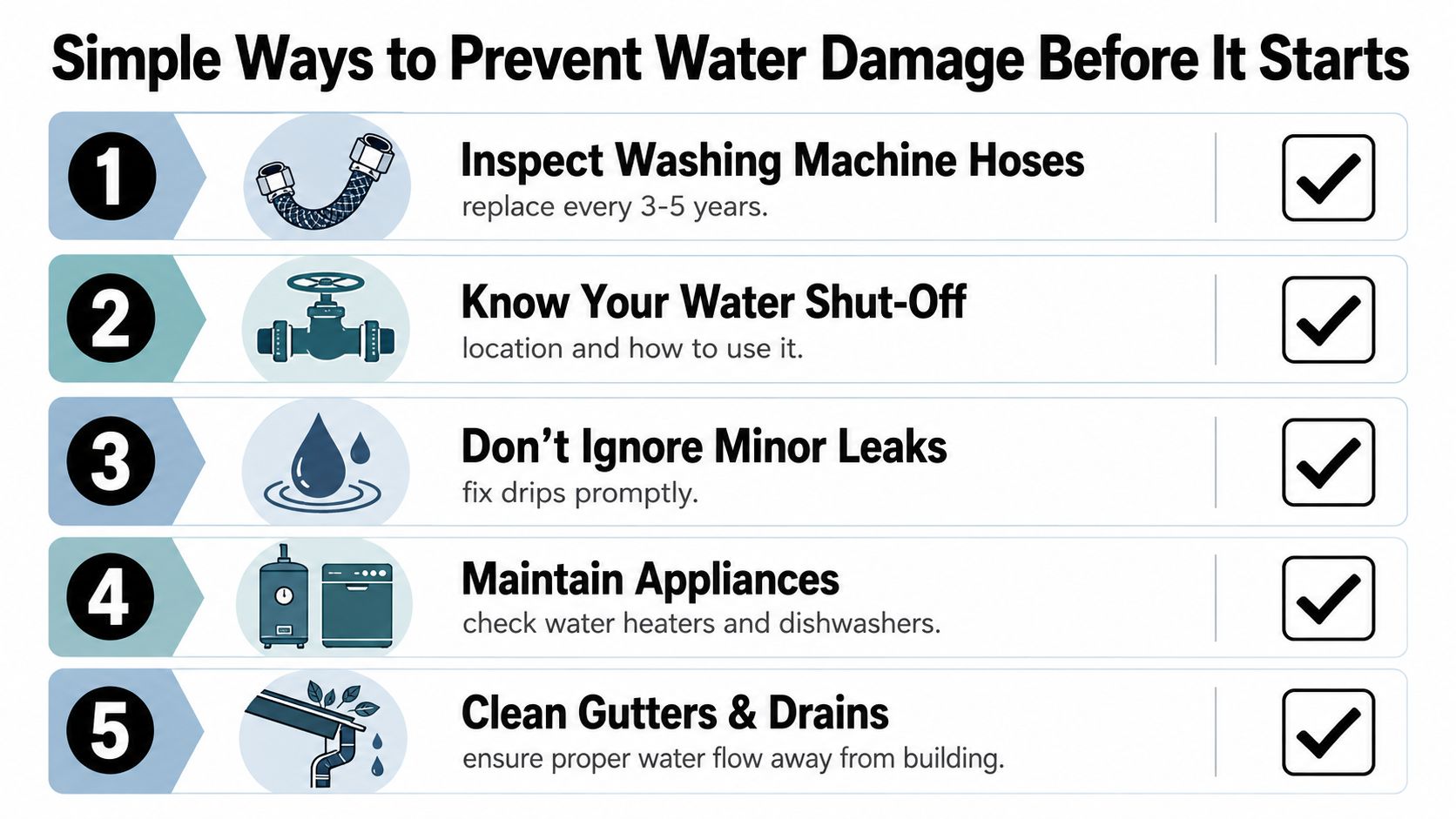
Simple Ways to Prevent Water Damage Before It Starts
Prevention won't replace insurance, but it can reduce both the loss and the dispute over whether you ignored a known problem. It also gives you a stronger record if a sudden incident occurs later.
- Inspect washing machine hoses. Look for brittleness, bulges, corrosion, or loose connections. Report concerns before the hose fails.
- Know the water shutoff. Locate the main valve and any appliance valves. Ask the landlord or maintenance team how to use them.
- Report small leaks immediately. Send written notice about dripping faucets, stained ceilings, damp walls, or recurring toilet problems. Keep the response.
- Maintain appliances responsibly. Follow the rental agreement for dishwashers, water heaters, and other water-connected equipment. Report defects rather than attempting unsafe repairs.
- Keep belongings off the floor. Use shelving or raised storage for electronics, documents, shoes, and valuables, especially in lower-level units.
- Keep drains clear. Don't pour grease into sinks, and report slow drains or recurring backups before they become an emergency.
Written maintenance requests do more than alert the landlord. They create a timeline showing that you reported the issue instead of allowing a known condition to worsen. That record may help distinguish your conduct from negligence, although the insurer will still apply the policy's terms.
Choosing the Right Limits and Deductibles for Your Situation
Start with a room-by-room inventory. Record furniture, clothing, electronics, kitchen equipment, tools, sports gear, and documents. A phone video of each room, stored securely online, can preserve evidence of what you owned before a loss.
Then check whether the policy uses replacement cost or actual cash value. Replacement cost is designed around the cost of replacing an item with a comparable one. Actual cash value accounts for depreciation, so an older item may receive a lower settlement. Ask the carrier to explain which method applies and whether certain categories have special limits.
Your deductible is the amount you pay before the policy contributes to a covered loss. A higher deductible may reduce the premium, but it can make a modest water loss difficult to claim financially. Choose an amount you could comfortably pay after an emergency, not just the amount that produces the lowest quote.
California renters should also review endorsements based on their unit's location, building age, flood exposure, and history of backups. A licensed agent can compare available carriers, identify gaps, and explain how renters insurance fits alongside California auto insurance, home insurance, car insurance, and life insurance decisions. You can begin that review through an insurance quote request.
The practical answer is clear: know where the sudden-and-accidental line falls, add protection for the gaps that fit your unit, and document the loss from the first moment water appears.
Mai & Associates can review your California renters insurance, compare coverage options, and look closely at flood, sewer backup, sump pump, and FAIR Plan-related gaps. Visit Mai & Associates to request guidance on renters, auto, home, or life insurance from a licensed California team.