Affordable Renters Insurance San Francisco 2026

You've probably had this moment already. You sign a San Francisco lease, see the move-in costs, start pricing furniture, maybe replace a laptop charger you lost in transit, and then one more line item shows up: renters insurance.
It can feel like just another bill in an expensive city.
But renters insurance san francisco shoppers are usually better off thinking about it as a budget shield, not a nuisance. In a city of shared walls, older buildings, dense blocks, tight parking, package theft, and landlord lease requirements, one small policy can protect your belongings, cover liability problems, and help with temporary living costs after a covered loss. That matters whether you rent a studio in Nob Hill, a room in the Mission, or an apartment in SoMa.
Why Renters Insurance Is a Non-Negotiable in San Francisco

Most renters start with the same question. If the building belongs to the landlord, why should the tenant buy insurance?
Because the landlord's policy protects the building. It usually doesn't protect your clothes, laptop, bike, furniture, or liability if something goes wrong inside your unit. That distinction is where a lot of claim frustration starts.
It may not be legally required, but it's often lease-required
Renters insurance isn't legally mandated in San Francisco or California, but it's increasingly required through standard lease agreements from the San Francisco Apartment Association, which makes it a practical necessity for many renters looking to secure housing, according to Cost-U-Less Direct's San Francisco renters insurance overview.
That same source notes common policy benchmarks around $20,000 to $30,000 of personal property coverage and $100,000 of liability coverage. Those aren't random numbers. They reflect the most basic ways renters get exposed financially in the city: property loss and legal responsibility.
Why San Francisco raises the stakes
In many places, skipping renters insurance is risky. In San Francisco, it's a sharper risk because losses can spread fast.
A kitchen fire in one unit can affect several apartments. A plumbing issue can damage electronics and clothing. A guest who gets hurt in your place may look to your liability coverage. Even a smaller incident can be expensive if you have to replace your essentials quickly while keeping up with rent and other bills.
A standard policy helps with situations like:
- Personal belongings loss: Theft, fire, or other covered damage to items you own
- Liability claims: If someone says you caused injury or property damage
- Temporary living costs: If a covered loss makes your rental unlivable
Practical rule: If losing your laptop, phone, clothes, and bed all at once would hurt financially, you need renters insurance.
It also fits into a bigger California insurance strategy
This is often the first policy people buy on their own, which makes it a good time to organize the rest of your protection plan. If you also need auto insurance, car insurance, home insurance later on, or even life insurance, renters coverage can be the foundation that helps you bundle cleanly and avoid gaps.
That matters in California, where insurance decisions tend to connect. The renter who starts with a basic policy today is usually in a better position when they later add a car, move into a condo, or review family protection needs.
Decoding Your San Francisco Renters Policy
A renters policy is easier to understand if you stop thinking of it as one product and start thinking of it as three working parts. Each one solves a different problem.
Personal property coverage
This is the coverage many policyholders recognize first. It protects the belongings you own, subject to your policy terms and limits.
In real life, this is the coverage that matters when your bike disappears from a building storage area, your clothes and bedding get damaged after a leak, or your electronics are ruined in a covered incident. People often underestimate how fast the total adds up. A laptop, phone, desk, headphones, kitchen items, jacket, mattress, and a few pieces of furniture can become a meaningful replacement bill.
A good first step is to total what you own by room, not by guess. If you want a broader overview of statewide coverage basics, this guide to California renters insurance options is a useful place to compare how policy structures typically work.
Personal liability coverage
This is the part renters ignore until they need it.
Liability coverage can help if someone gets hurt in your apartment or if you accidentally damage someone else's property and you're legally responsible. In a San Francisco rental, that can mean a guest slipping on a wet floor, smoke from a kitchen mistake affecting another unit, or damage that starts in your unit and spreads into a neighboring space.
What works well here is carrying enough liability protection to cover ordinary real-world mistakes. What doesn't work is choosing the bare minimum without thinking about how expensive disputes can become in California.
Liability coverage isn't about protecting your stuff. It's about protecting your savings and future income from a claim.
Additional living expenses
This is the quiet part of the policy, but it's often the difference between a stressful disruption and a financial crisis.
If a covered loss makes your apartment temporarily unlivable, additional living expenses, often called loss of use, can help with the extra costs of living somewhere else while repairs are handled. In a city where housing costs are already high, that matters.
Think through the practical version. If your apartment has fire damage and you can't stay there, you may need a hotel, short-term rental, meals out, laundry, and transportation changes. That's what this part of the policy is designed to address, within the limits of the contract.
What your premium is really buying
A strong renters policy usually gives you three forms of protection at once:
- Replacement help for your belongings
- Legal and financial protection if you're liable
- A temporary landing spot after a covered loss
That's why the cheapest possible policy isn't always the best choice. The policy has to match the way you live. If you work from a laptop, host friends, own a bike, or rely on your apartment being available every day, your coverage choices should reflect that reality.
The Big SF Exclusions What Your Policy Doesn't Cover
The biggest mistake renters make is assuming their policy covers every kind of damage that could happen in San Francisco. It doesn't.
That's not a flaw in renters insurance. It's how insurance contracts work. Coverage is specific, and the exclusions matter just as much as the protections.
Earthquake damage
This is the San Francisco exclusion renters need to take seriously.
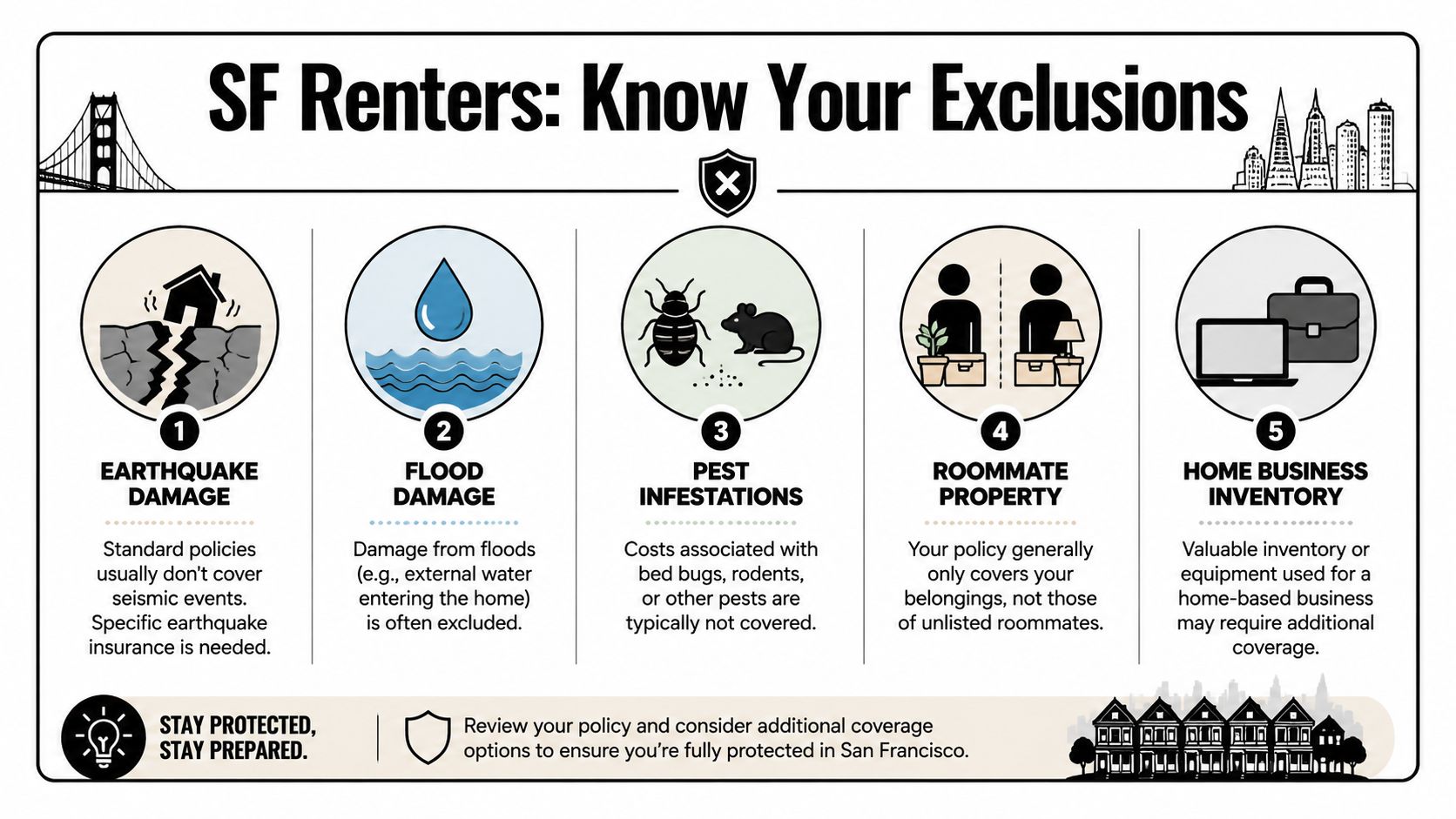
A standard renters policy usually does not cover earthquake damage. If an earthquake damages your belongings or leaves your rental unusable, you can't assume your ordinary policy responds the way it would after certain other covered causes of loss.
That leaves renters with a decision. Some carriers may offer an earthquake endorsement, while others may direct you toward a separate earthquake solution. The right choice depends on what's available, what the deductible looks like, and whether you want broader protection for belongings and loss-of-use exposure tied to a quake.
What works is reviewing this before move-in or renewal. What doesn't work is waiting until after a seismic event to learn what your contract excludes.
Flood and water are not the same thing
Renters often lump all water damage together. Carriers don't.
Water from a sudden internal problem, such as a burst pipe, is often handled very differently from flood damage, which generally refers to water entering from outside and is often excluded under a standard renters policy. That distinction matters in ground-floor units, garden apartments, and properties with drainage issues.
Another gray area is backup through drains or sewers. That usually needs separate review and may require additional protection depending on the carrier.
For people trying to sort out related moisture issues, this Onsite Pro Restoration mold coverage guide gives a useful plain-English look at how mold questions often depend on the cause of loss rather than the mold alone.
Other gaps renters miss
Some exclusions are less dramatic than earthquake risk, but they still create claim surprises.
- Roommate belongings: Your policy generally covers your property, not an unlisted roommate's belongings.
- Pest-related damage: Bed bugs, rodents, and similar issues are typically not standard covered losses.
- Business property limits: If you run a side business from home, inventory or specialized equipment may need extra attention.
- Maintenance problems: Slow wear, repeated leakage, and neglected conditions often create trouble at claim time.
Don't buy renters insurance assuming “damage is damage.” Ask what cause of loss triggered the damage, because that usually decides whether the claim is covered.
The smarter way to close gaps
The fix isn't to panic-buy every optional add-on. The fix is to identify the losses that would hurt you and then close those specific gaps.
For San Francisco renters, that often means reviewing earthquake exposure first, then water-related exclusions, then any unusual property like bikes, jewelry, instruments, cameras, or work equipment. If you're comparing how property protection decisions connect with broader dwelling risks in the city, this look at San Francisco home insurance considerations helps frame the local hazard picture.
The renters who are happiest with their policy usually aren't the ones who bought the fanciest contract. They're the ones who understood the exclusions before they had a loss.
How Much Does Renters Insurance Cost in San Francisco?
Here's the part most renters care about most. The cost is usually more manageable than people expect, but the range is wide enough that comparison shopping matters.
According to The Zebra's San Francisco renters insurance rate analysis, the average annual cost in San Francisco is about $238, and rates can be as low as $122 per year depending on the insurer and coverage setup. The same source notes that bundling with auto insurance can reduce car insurance rates, with GEICO showing an average 3.5% auto discount.
Why one renter pays more than another
Three choices usually move the price the most:
- Personal property limit: More belongings insured usually means a higher premium
- Liability limit: Higher protection can raise cost
- Deductible: Choosing a higher deductible can lower the monthly premium
The source data also shows that a standard $20,000 personal property and $100,000 liability setup can be quite affordable in the city. One example from the same market data is Lemonade at $8.34 per month with a $500 deductible.
Sample monthly premiums
Here's a practical comparison based on the verified San Francisco quote data.
| Insurer | Premium with $500 Deductible | Premium with $1,000 Deductible |
|---|---|---|
| Lemonade | $8.34/month | $7.25/month |
| State Farm | $10.83/month | $10.83/month |
| Allstate | $16/month | $14/month |
| Travelers | $17/month | $15/month |
| Stillwater | $15.25/month | $15/month |
This table shows the trade-off clearly. A higher deductible often lowers your monthly bill, but not every carrier prices that change the same way. Some make a visible adjustment. Some barely move.
What works when you're shopping
The best low-cost strategy is usually simple:
- Set the property limit based on what you own, not on a random number
- Choose a deductible you could comfortably pay after a loss
- Check bundle options if you also carry auto insurance
If you already have a car policy, ask for a bundle quote at the same time. That's one of the easiest ways to keep total California insurance costs under control without trimming useful coverage.
A cheap premium only works if you can afford the deductible when something actually happens.
Get Your Same-Day Quote with Mai & Associates
When you're ready to shop, speed helps, but so does context. A fast quote is useful only if the coverage fits your apartment, your property, and the risks you face in San Francisco.

What to have ready before you request a quote
You don't need a perfect spreadsheet. You do need a few basics:
- Your rental address: Building type and location affect the quote
- An estimate of your belongings: Enough to choose a realistic personal property limit
- Any special items: Bikes, jewelry, instruments, cameras, or work equipment should be mentioned
- Your current auto policy information: Helpful if you want a bundle comparison
How the process usually works
The easiest path is to request a same-day insurance quote online and compare multiple carrier options at once.
A good quote process should help you answer questions like:
- Does this policy fit a studio, shared apartment, or larger rental?
- Are my limits too low for what I own?
- Is the deductible helping me save money, or setting me up for a bad surprise later?
- Do I need to look at earthquake options separately?
Why an agency comparison helps
Going carrier by carrier works if you already know exactly what you want. Most renters don't. They need to compare price, deductible choices, covered property levels, and optional endorsements without opening five tabs and guessing.
That's where an independent California agency approach tends to help. It can be useful not just for renters insurance san francisco shoppers, but also for people looking at auto insurance, car insurance, home insurance, or life insurance as part of a broader review.
The practical advantage isn't just access to quotes. It's having someone flag the issues renters often miss, especially exclusions, weak limits, and mismatches between what the lease requires and what the policy provides.
Pro Tips for Savvy San Francisco Renters
The renters who make the fewest insurance mistakes usually do a few small things right before there's ever a claim. None of them are complicated. They just require attention.
Know the rent-controlled apartment rule
This is one of the most overlooked San Francisco details.
According to Goodcover's guide to San Francisco renters insurance, about 75% of San Francisco rental stock is rent-controlled, and landlords in those units can't require renters insurance unless it was part of the original lease or is a reasonable condition tied to habitability. The same source says this issue is involved in an estimated 20% of disputes handled by the SF Housing Rights Committee.
That doesn't mean renters insurance is a bad idea in a rent-controlled unit. It usually still makes sense. It means you should read the lease carefully and understand whether a requirement is enforceable.
Build a phone-based home inventory
This is one of the highest-value things a renter can do in under an hour.
Walk through your apartment with your phone and record every room. Open drawers. Film closets. Capture brand names when you can. Save receipts you already have, especially for electronics and larger purchases. Then store the photos or video somewhere outside your device, such as cloud storage.
What works is keeping it simple and current. What doesn't work is trying to rebuild your memory after a theft or fire.
Use your deductible strategically
If you have emergency savings, a higher deductible can be a smart move. The premium examples in the San Francisco market show that some carriers charge less when you move from a lower deductible to a higher one.
That strategy works for renters who can comfortably absorb a smaller loss without financial strain. It doesn't work for renters who'd struggle to come up with that amount quickly after a claim. The deductible should lower your premium without turning a covered loss into a cash-flow problem.
The best deductible is the one you can pay from savings on a bad week, not the one that only looks good on a quote screen.
Recheck your policy after life changes
Update your renters policy if you:
- Buy expensive electronics
- Start working from home with more equipment
- Adopt a dog
- Move in with a different roommate setup
- Add a car and want to explore bundling
Small changes in your life can create very real differences in your risk.
San Francisco Renters Insurance FAQs
Does my renters insurance cover my roommate?
Usually, no. Your renters policy generally covers your belongings and liability, not a roommate's property unless the policy specifically includes them. In most shared apartments, each roommate should carry their own policy.
What's the difference between actual cash value and replacement cost?
Actual cash value factors in depreciation, which means older items may be paid at a lower value. Replacement cost is designed to help you replace covered items with new equivalents, subject to policy terms. This choice can make a big difference when you file a property claim.
Is my property covered only inside my apartment?
Not always. Many renters policies offer protection for personal belongings beyond the apartment itself, subject to policy terms and limits. If something is stolen away from home, coverage may still apply. This is one of those details worth confirming on the policy before you need it.
Does renters insurance cover earthquake damage?
Standard policies usually don't. Earthquake protection typically requires a separate solution or endorsement, depending on the carrier.
If my landlord has insurance, why do I need my own policy?
Because the landlord's policy usually covers the building, not your personal property, your liability, or your temporary living expenses after a covered loss.
Where can I get answers on common California insurance questions?
If you want a quick reference point for broader policy questions, the Mai & Associates insurance FAQ page is a helpful starting place.
If you want help comparing renters insurance san francisco options without guessing, Mai & Associates can help you review coverage, compare multiple carriers, and find a policy that fits your budget along with your auto, home, or life insurance needs.