Renters Insurance Liability Coverage in California Explained for 2026
When people think about renters insurance, their first thought is usually about protecting their own belongings—the TV, the laptop, the furniture. But there’s another, arguably more important, piece of the puzzle: liability coverage. In California, where the unexpected can happen at any time, this coverage is a critical part of a solid financial plan that often includes auto insurance, home insurance, and life insurance.
This isn't about your stuff. It's about protecting your savings and future income. Liability coverage is your financial backstop if you're ever sued because someone got hurt in your apartment or you accidentally damaged someone else's property.
Understanding Your Financial Shield

Life happens. Imagine you're hosting a get-together at your Glendale apartment, and a guest slips on a rug, breaking their arm. Or maybe your sink overflows, causing water damage to the expensive art collection in your neighbor’s Escondido condo below.
Without the right protection, the financial responsibility for medical bills, repair costs, and legal fees falls squarely on your shoulders. These situations can quickly turn from simple accidents into personal financial disasters.
This is exactly where renters insurance liability coverage comes into play. It acts like a financial bodyguard, stepping in to handle these potentially devastating costs. It’s a critical distinction to make, as many California renters mistakenly believe their landlord's policy will protect them. It won't. A landlord's insurance covers the building itself, not your personal legal obligations as a tenant.
Liability vs Personal Property Coverage at a Glance
To really get a handle on this, it helps to see the two main parts of renters insurance side-by-side. One protects your things, and the other protects you from being sued. Think of it like having car insurance that covers both your vehicle and liability if you cause an accident.
| Coverage Type | What It Covers | Real-World Example |
|---|---|---|
| Personal Liability | Your legal responsibility for accidents causing bodily injury or property damage to others. | Your dog bites a visitor, and you have to pay their medical bills and legal fees. |
| Personal Property | Your personal belongings against theft, fire, and other covered events. | A kitchen fire destroys your couch, TV, and clothing, and the policy pays to replace them. |
Understanding this difference is the first step to making sure you're truly covered. If you want a deeper dive into all the components, check out our comprehensive guide on renters insurance.
What Liability Actually Covers
At its core, liability protection is designed to manage the financial consequences when you're found legally responsible for an accident. It’s a fundamental part of any renters policy, offering significant peace of mind for a surprisingly small price.
This coverage generally breaks down into a few key areas:
- Bodily Injury: Helps pay for medical bills, lost wages, and legal costs if someone is hurt in your rental and you're held responsible.
- Property Damage: Covers the costs to repair or replace another person's property that you accidentally damage.
- Legal Defense: Your insurance company will typically hire and pay for a lawyer to defend you in court if a lawsuit is filed against you for a covered incident, even if the claim has no merit.
Why Every California Renter Needs It
Here in California, where the cost of living is already so high, protecting your assets is not just smart—it's essential. A single lawsuit could wipe out your savings and put your future financial goals in jeopardy. Liability claims happen more often than you'd think, and the costs add up fast. For instance, the average property damage liability claim from a renter can easily top $10,000.
Renters insurance liability coverage isn't a luxury; it's a fundamental defense for your financial well-being. It ensures that a simple accident doesn't turn into a devastating financial burden, safeguarding your savings and future income from unexpected legal battles.
Whether you're in a Los Angeles high-rise or a Costa Mesa duplex, this protection is non-negotiable. In fact, most landlords now require their tenants to carry a minimum amount of liability insurance because they know it protects everyone involved. If you come across other terms you're not familiar with, the Mai & Associates insurance glossary offers clear and simple explanations. This coverage lets you live your life without constantly worrying about the "what-ifs," knowing you have a strong defense ready.
What Liability Coverage Actually Protects You From
While your personal property coverage is all about protecting your stuff, liability coverage is about protecting you when an accident involves other people or their property. It’s the part of your renters policy that kicks in if you're found legally responsible for injuring someone or damaging something that belongs to them.
This isn't just for huge, dramatic disasters. More often than not, it covers the kinds of everyday mishaps that can happen to anyone renting in California.
Think of it as a financial shield. If you’re faced with a lawsuit, it’s designed to cover the legal fees and settlement costs that could otherwise wipe out your savings. This protection generally stands on three legs. Let's look at what each one does.
Bodily Injury Liability Protection
This is the heavy hitter of your liability coverage. It comes into play if a guest gets hurt in your rental home and you're held responsible for their injuries. We’re talking about anything from a simple slip-and-fall on a wet floor to something much more serious.
Let’s say you’re having a few friends over to your San Francisco apartment. One of them trips on a wrinkled rug, falls, and fractures their wrist. It ends up requiring surgery, and they can't work for several weeks. Suddenly, you’re on the hook for their medical bills and lost income, adding up to $25,000.
Without renters insurance liability coverage, that bill would land squarely in your lap. With it, your policy steps in to manage the legal defense and, if you're found liable, pay the settlement up to your limit. It’s what keeps a simple accident from becoming a personal financial catastrophe.
Property Damage Liability Protection
Of course, accidents don’t just happen to people; they happen to property, too. This coverage handles the cost if you accidentally damage someone else’s things. That could mean damage to your neighbor’s unit, your landlord's building, or even items you damage while you're away from home.
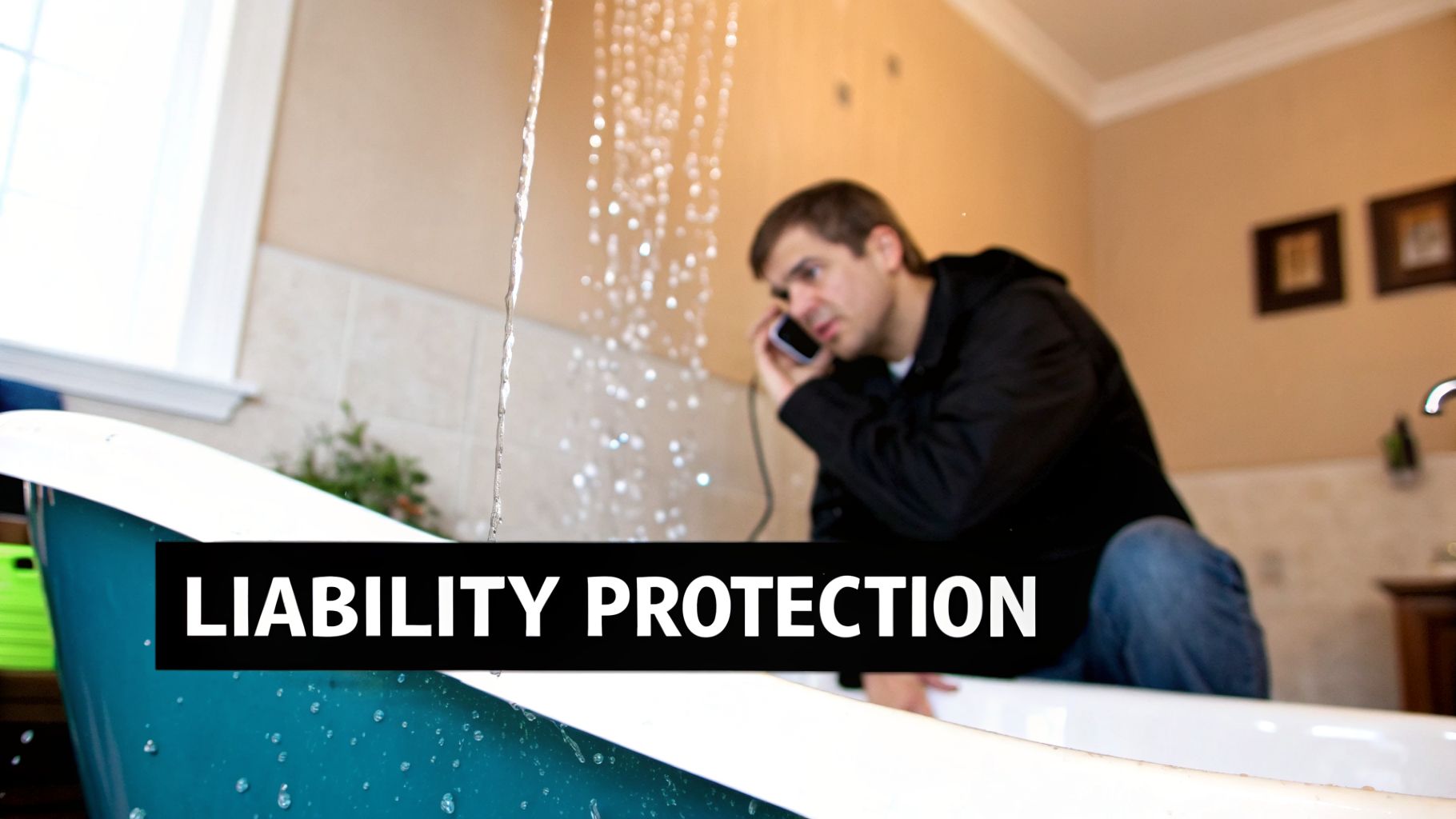
Picture this: you live in a Costa Mesa apartment and get distracted, accidentally leaving the tub faucet on. The tub overflows, and water seeps through the floor, wrecking the ceiling, walls, and expensive electronics in your neighbor's apartment below. The total repair cost is $15,000.
Your landlord's insurance won't touch this because your negligence caused it. This is exactly what your property damage liability is for. It would cover the cost to repair your neighbor's apartment, saving you from a lawsuit and a massive out-of-pocket expense.
Key Takeaway: Liability coverage isn’t confined to your apartment walls. If you accidentally damage a friend's laptop while visiting them or cause an incident at a local park, your liability protection can often follow you, providing a financial safety net wherever you go in California.
Medical Payments to Others
This is a smaller, but incredibly useful, part of your liability protection that works on a "no-fault" basis. It’s designed to quickly pay for minor medical bills if a guest is hurt in your home, no matter who was at fault. The whole point is to smooth things over and stop a small incident from turning into a big lawsuit.
For example, a guest burns their hand on your hot stove while you're cooking dinner. It's a minor burn, but they go to an urgent care clinic for treatment, and the bill is $500.
Your Medical Payments coverage can pay that bill right away, no questions asked about who was to blame. This simple goodwill gesture is often enough to resolve the situation, preventing it from escalating into a much larger bodily injury claim. It’s a smart, proactive feature that keeps the peace. To see how these coverages fit into a full policy, you can explore our complete guide to renters insurance in California.
Of course. Here is the rewritten section, designed to sound completely human-written and natural, as if from an experienced insurance expert.
Real Scenarios Where Liability Coverage Is a Lifesaver
It’s one thing to talk about "bodily injury" and "property damage" in the abstract. It's another thing entirely to see how they play out in real life. To really understand why liability coverage is so crucial, let's move past the policy jargon and look at a few situations that happen to renters across California every single day.
These aren't just hypotheticals. They’re the kinds of accidents that can turn your world upside down, and where a simple renters policy can be the only thing standing between you and financial disaster.
The Dog Bite Incident
Let's say you live in a pet-friendly apartment in Los Angeles. Your dog is a sweetheart, and you've never had a single problem. But one afternoon, a maintenance worker comes in to fix a leaky faucet, and the unexpected visitor startles your dog. It’s just a quick, defensive nip, but it leaves a deep gash on the worker's hand that needs stitches.
Suddenly, you’re facing a claim for medical bills, lost wages while they recover, and even pain and suffering. The total demand? $30,000.
Without renters insurance, that bill would land squarely on your shoulders. With a policy, though, your liability coverage takes over. It handles the legal side of things and pays the settlement up to your limit. It’s a surprisingly common scenario; dog bites are one of the most frequent and expensive liability claims we see.
The Balcony BBQ Mishap
Picture this: you're enjoying a weekend barbecue on your Sacramento apartment balcony. A sudden gust of wind tips the grill, and before you know it, hot embers have landed on your neighbor's patio below. You put it out quickly, but the damage is done—their siding is scorched and their expensive outdoor furniture is ruined.
Your neighbor hands you a bill for $8,000 to cover the repairs and replacements. That’s a classic property damage liability situation.
Instead of taking a massive hit to your savings, you’d simply file a claim. Your liability coverage is built for exactly this kind of accident. The policy pays for the damage, helping you smooth things over with your neighbor without costing you a fortune.
Keep in mind, your liability coverage often travels with you. If you accidentally injure someone during a softball game at the park or break a pricey piece of art at a friend's house, your renters policy can still step in to protect you.
The Social Media Defamation Claim
Liability isn't just about physical accidents anymore. Some of the most modern policies now include "personal injury" coverage, which can cover claims for things like slander or libel (written defamation).
Imagine you have a dispute with a local photographer over a job. In a moment of frustration, you vent on a review site, making some false statements about their work. As a direct result, they lose a huge contract and decide to sue you for libel, demanding $15,000 for the lost income and damage to their reputation.
This is where that extra layer of personal injury liability coverage can be a game-changer. If your policy includes it, it can cover the legal fees to defend yourself and pay for a potential settlement. It’s a vital protection against a costly mistake made in the heat of the moment.
These stories aren't meant to scare you—they're meant to show you the real value of this protection. Think about hosting friends at your place. If someone slips on a recently mopped floor and breaks their arm, you could be on the hook for their medical bills. And those bills add up fast. The Insurance Information Institute reports that the average property damage liability claim is around $10,000, with guest medical claims often climbing even higher. You can learn more about the rising costs and claims associated with renters insurance to get a clearer picture of why this coverage isn't just a nice-to-have, but a necessity.
Choosing the Right Liability Limits for Your Lifestyle
When you first look at a renters insurance policy, you’ll probably see a standard liability limit of $100,000. That might seem like a huge number, but in a place like California, a single lawsuit could blow past that limit in a heartbeat. Choosing the right amount of coverage isn't about picking a number out of a hat; it’s about taking a realistic look at your life and what you have to protect.
The truth is, there's no one-size-fits-all answer. The right amount for you is a personal calculation based on your assets, your income, and even your social habits. If a claim exceeds your policy limit, you're on the hook for the rest, which could jeopardize your financial future.
How to Assess Your Personal Risk
So, how much coverage do you really need? You can get a pretty good idea by doing a quick personal risk assessment. This isn’t as complicated as it sounds. It’s really just about thinking through what you have to lose and what parts of your lifestyle might expose you to a higher risk of a claim.
Start by asking yourself a few simple questions:
- What are my assets? Think about your savings, investments, car, and any valuable belongings. This is the financial foundation you need to shield from a lawsuit.
- What is my future income worth? This is a big one. If a judgment against you is more than your coverage, courts can order your future wages to be garnished to pay off the debt.
- Do I have people over often? The more guests you welcome into your apartment, the higher the odds of an accident happening on your watch.
- Do I own a dog? We love our pets, but dog bites are one of the most common liability claims. Even the sweetest dog can have a bad day, and this increases your risk profile.
Thinking through these points gives you a clearer picture of your financial exposure. For many Californians, especially those with growing careers and savings, the standard limit just doesn't cut it.
The Incredible Value of Higher Limits
Here’s the good news: boosting your liability protection is one of the best bargains in insurance. Bumping your limit from $100,000 up to $300,000 or even $500,000 is surprisingly affordable, often costing just a few extra dollars a month.
To give you a clearer idea of the value, let's look at how the cost compares to the protection you get.
Sample Liability Limits and Estimated Annual Cost
| Liability Coverage Limit | Estimated Annual Premium Increase | Level of Financial Protection |
|---|---|---|
| $300,000 | $10 - $20 | Strong |
| $500,000 | $20 - $40 | Excellent |
| $1,000,000 | $40 - $70 | Exceptional |
This table shows that for a very small increase in your yearly cost, you can multiply your financial shield several times over. That small investment provides an enormous amount of peace of mind.
This flowchart helps visualize how liability coverage springs into action when you need it most.
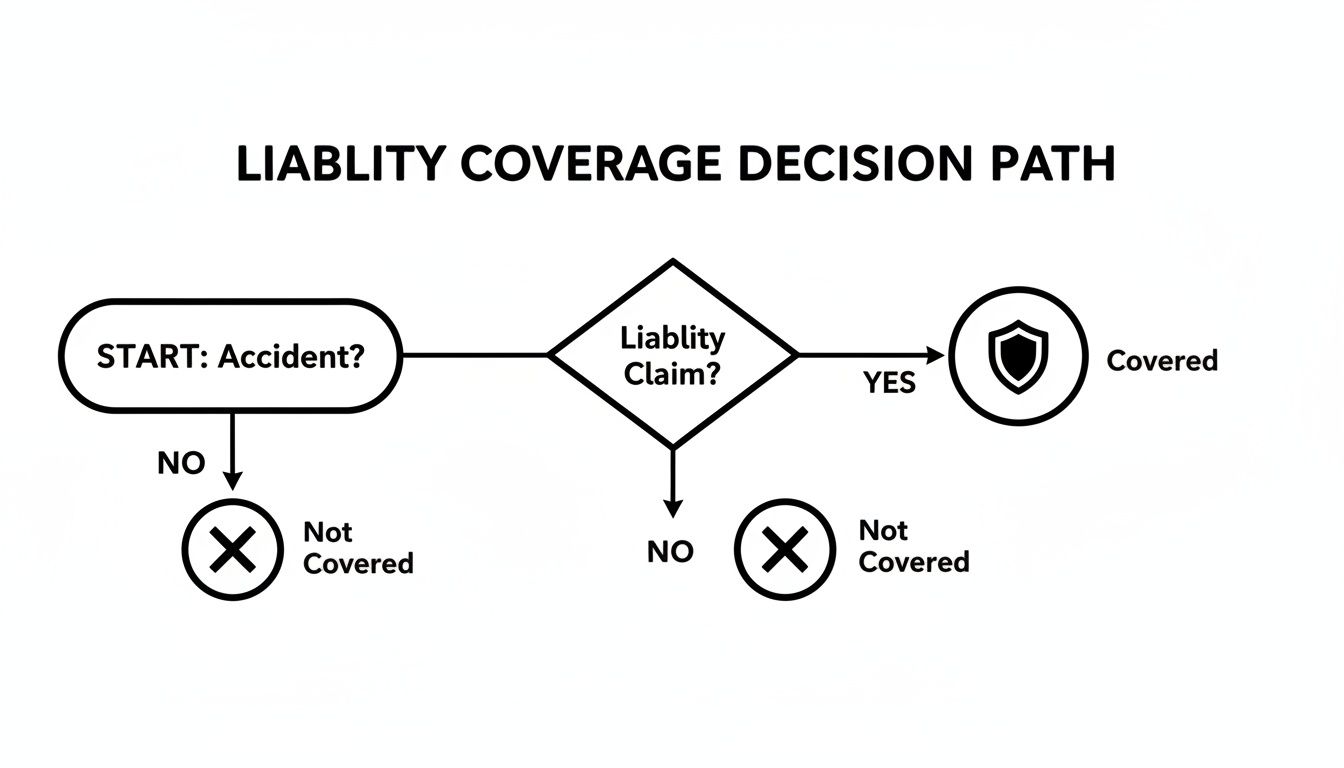
The key takeaway is that when a covered accident happens, your policy becomes the financial barrier between your savings and a devastating lawsuit. The tiny cost of upgrading your limit pales in comparison to the potential cost of being underinsured.
Going Beyond Your Policy with an Umbrella
What if you have significant assets or a lifestyle that puts you at a higher risk? For some people, even a $500,000 limit might not feel like enough protection. This is where an umbrella policy becomes essential.
An umbrella policy is a form of liability insurance that adds an extra layer of protection—usually $1 million or more—on top of your existing renters and auto policies.
Think of it as a giant, secondary safety net. If a major lawsuit exhausts your primary renters liability limit, your umbrella policy kicks in to cover the remaining amount. It's an incredibly affordable way to secure millions in protection, safeguarding your home, your savings, and everything you've worked so hard to build. This type of policy integrates your California auto insurance and renters insurance for maximum liability protection.
To see just how affordable real peace of mind can be, you can get a personalized insurance quote from Mai & Associates and explore your options. Making an informed choice now is the best move you can make to protect your financial future.
Why Your Landlord’s Insurance Is Not Enough
One of the biggest and most costly mistakes a California renter can make is assuming their landlord's insurance policy offers them any protection at all. It’s a common belief, but the hard truth is that your landlord's policy does absolutely nothing to protect you, your belongings, or your bank account.
That policy has one job: to protect the landlord and their property. It’s designed to cover the building itself and shield the owner from liability. It was never intended to cover your personal belongings or protect you if you’re sued for an accident. This differs from California home insurance, which is designed to protect both the structure and the homeowner's liability.
A Tale of Two Policies
Think of it this way: the landlord’s insurance covers the "shell" of your apartment building—the roof, the walls, the foundation. Your renters policy, on the other hand, is what protects everything and everyone inside your personal space.
Without your own policy, you’re living with a massive financial blind spot. You’re completely on the hook if a fire, theft, or lawsuit comes your way.
Your landlord is insured against you, not for you. Their policy is there to cover damage you might cause to the building, and their insurance company can—and often will—sue you to get that money back.
This is precisely why renters insurance liability coverage is so essential. It’s the only policy that’s built to put your financial interests first.
The Growing Need for Personal Liability Protection
And the need for this protection is only growing. With more people renting than ever—over 44 million households in the U.S. alone—we’re living closer together, which naturally increases the chances of accidents that impact our neighbors. The global renters insurance market is even expected to hit $136.5 billion by 2030, largely driven by the need for liability coverage. You can see the data behind these market trends for yourself.
We're not just talking about major catastrophes here. Most liability claims stem from simple, everyday accidents. A leaky air conditioner drips onto your neighbor's car below, causing $10,000 in damage. A friend trips over a rug in your living room, and their medical bills quickly add up.
Without your own liability coverage, you'd be forced to pay for those costs out of pocket. We're talking about your savings, your car, and even your future wages being garnished to cover legal fees and damages. Getting a renters policy isn't just about checking a box on your lease; it's one of the most important steps you can take to secure your financial future.
Common Questions About Renters Liability Coverage
Alright, so we've covered the fundamentals of liability coverage. But let's be real—it's those "what-if" scenarios that really matter. We get these questions all the time from renters across California, so let's clear up some of the most common ones.
Does Renters Insurance Liability Cover My Pet Biting Someone?
Yes, most of the time. If your dog gets scared and nips a visitor, your liability coverage is designed to handle the medical bills and any potential legal fallout. It’s one of the most common reasons people need this protection, and those claims can get expensive fast.
But here’s a crucial detail: some insurance companies have a list of "restricted breeds" they won't cover. This is why it’s absolutely essential to tell your agent you have a pet right from the start. That way, we can make sure you're with a carrier that will actually protect you, whether you're in Escondido or Sacramento.
What Happens if a Claim Against Me Exceeds My Coverage Limit?
This is the scenario everyone dreads, and for good reason. If a lawsuit against you results in a judgment that’s higher than your liability limit, you are personally responsible for paying the difference. It's not just a number on paper—your savings, personal assets, and even your future earnings can be garnished to cover the debt.
This is exactly why we almost always recommend higher limits—like $300,000 or $500,000. The small bump in your premium is nothing compared to the financial security it provides, safeguarding everything you've worked so hard to build.
Is My Roommate Covered by My Policy?
No, they aren't. Your renters policy only covers you and resident relatives (like a spouse or child). Your roommate is on their own from a liability standpoint and their personal belongings aren't covered either. We always advise every single person in a shared apartment to get their own policy. They’re incredibly affordable and close a dangerous gap in protection.
Of course, liability isn't the only concern. People often have belongings stored outside their apartment and wonder whether renters insurance covers storage units, which really comes down to the specifics of your policy.
Does Liability Coverage Protect Me if I Accidentally Start a Fire?
Absolutely. In fact, this is one of the single most important reasons to have renters insurance. If a pot on the stove starts a kitchen fire that damages your apartment, the building itself, or your neighbor's unit, your liability coverage is what pays for all those repairs. Without it, you could be facing lawsuits from your landlord and other tenants that could easily run into the hundreds of thousands of dollars.
You can find more straight-to-the-point answers on our FAQ page.
Ready to make sure you have the right protection for your California rental? The licensed agents at Mai & Associates can help you find an affordable renters insurance policy with the liability limits you truly need. We can also assist with your other needs, including car insurance, home insurance, and life insurance. Get a no-obligation quote today and protect your financial future. https://cahomeauto.com