A Complete Guide to Renters Insurance in California
Living in California is an amazing experience, but it comes with a high price tag. What happens if something goes wrong in the place you rent? Renters insurance in California is your personal financial backstop. It's an affordable way to protect your stuff, cover you if someone gets hurt in your apartment, and even pay for a place to stay if your rental becomes unlivable.
Think of it this way: your landlord's insurance policy covers the building itself, but it does absolutely nothing for you or your belongings. That's a common and costly misconception in the world of California insurance.
Why California Renters Need a Financial Safety Net
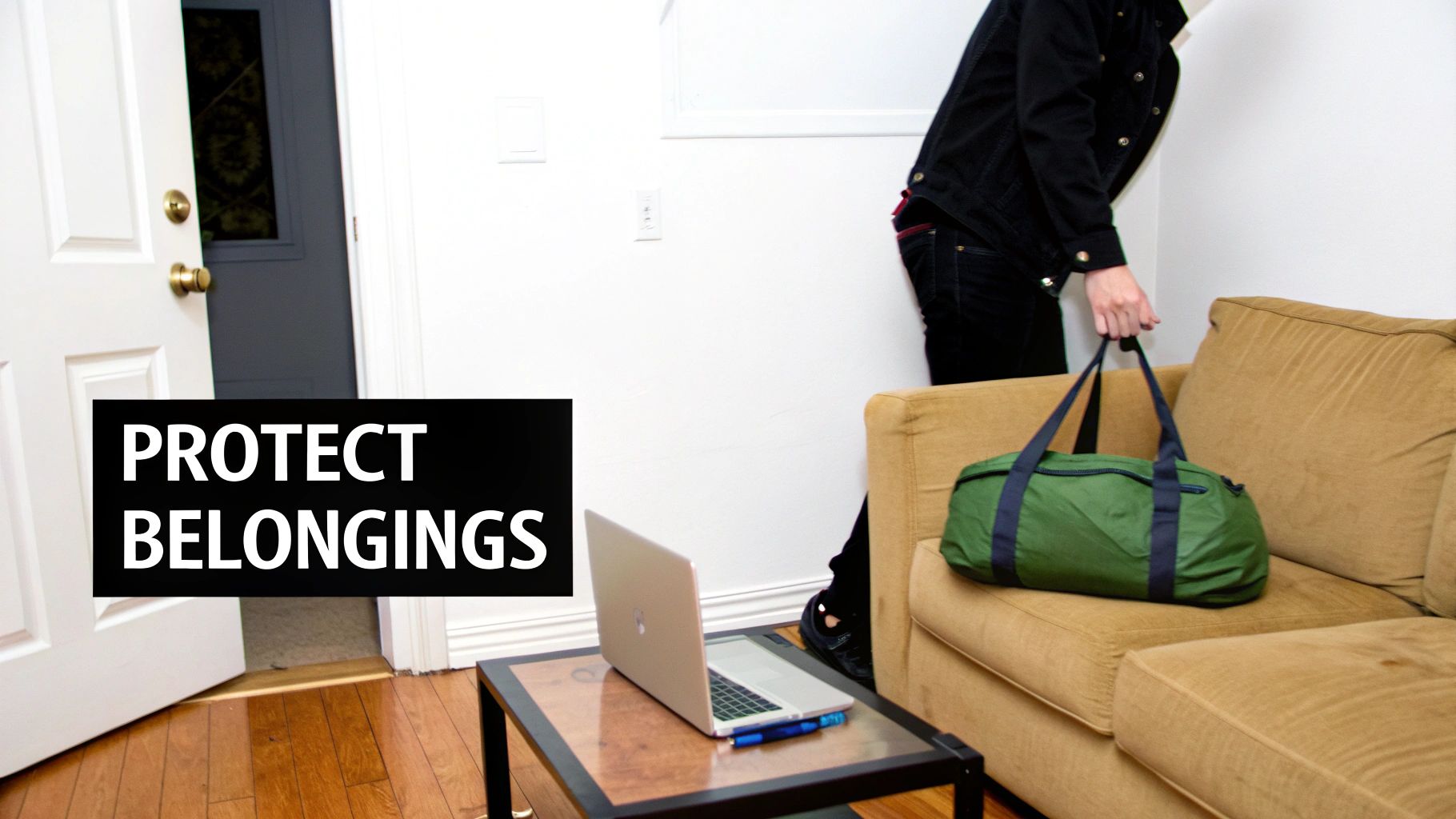
Many renters assume their landlord's policy has them covered. It doesn't. That insurance protects the physical structure—the walls, the roof, the plumbing. If a fire breaks out or a pipe bursts, your landlord is on the hook to fix the building, but you're left to replace your own valuables.
This is exactly why renters insurance is so important. It’s a policy built for you, the tenant. It safeguards everything you own, from your laptop and furniture to your clothes and bike. Without it, you'd be paying out-of-pocket to replace every single thing after a disaster.
The Three Pillars of Protection for Tenants
Let’s get real for a moment. Picture a kitchen fire in a neighboring unit that sends smoke and water pouring into your apartment. Your landlord’s policy will handle the structural repairs, but what about your ruined couch, TV, and wardrobe? That could easily set you back thousands.
A standard renters insurance policy is built on three core coverages that work together to protect you.
Your Renters Insurance Safety Net at a Glance
Here’s a quick breakdown of what a typical policy includes.
| Coverage Type | What It Protects | A Real-World California Scenario |
|---|---|---|
| Personal Property | Your belongings—electronics, furniture, clothes, etc. | A thief breaks into your San Francisco apartment and steals your laptop and camera. |
| Personal Liability | You, if you're responsible for an injury or property damage. | A guest slips on a wet floor in your kitchen and needs stitches, then decides to sue. |
| Loss of Use (ALE) | Temporary living costs if your rental is uninhabitable. | A wildfire forces you to evacuate your San Diego rental, and you need a hotel for two weeks. |
These three coverages form the foundation of your policy, giving you a comprehensive shield against some of life's most common and costly curveballs.
It's More Than Just "Nice to Have" in the Golden State
The need for renters insurance is only growing here. While California actually leads the country in the sheer number of renters who are insured, a huge portion of the population is still rolling the dice. In 2021, the state recorded over 2.7 million insured renter "house-years," but that's just a drop in the bucket considering our massive renter community.
When you factor in California's high cost of living and unique risks—from break-ins in dense urban areas to the constant threat of wildfires—having a policy shifts from a smart idea to a virtual necessity. It's the peace of mind that ensures one bad day doesn't become a full-blown financial crisis.
For more practical tips on managing all your insurance needs, from your car insurance to your apartment, check out our California insurance blog.
What’s Actually Inside a California Renters Policy?
Think of your renters insurance policy less like a dense legal document and more like a financial first-aid kit. Knowing exactly what’s inside before you need it is the key to feeling truly protected. A standard California renters insurance policy isn't just one thing; it's a bundle of three core protections designed to shield you from life's unexpected and expensive curveballs.
Let's unpack what you're actually paying for. This isn't about memorizing industry jargon—it's about understanding how each piece of the puzzle protects your real life as a renter in California.
Personal Property Coverage: Protecting Your Stuff
This is the part everyone thinks of first. It’s the coverage for all your belongings—your furniture, your electronics, your clothes, your bike—if they're damaged or destroyed by a covered event like a fire, theft, or burst pipe.
Here’s a critical distinction: your landlord's insurance covers the building itself (the walls, the roof, the plumbing). Your renters policy covers your things inside it. If there's a fire, their policy fixes the apartment, but yours is what buys you a new couch.
When setting up this coverage, you'll need to make one big decision:
- Replacement Cost Value (RCV): This is what most experts recommend, and for good reason. RCV pays you to buy a brand-new, similar item at today’s prices. So if your five-year-old laptop gets fried in a power surge, RCV gives you the money to go buy a new, comparable model.
- Actual Cash Value (ACV): This is the cheaper option, but it comes with a catch. ACV only pays you what your stuff was worth the moment it was damaged, which includes depreciation. That five-year-old laptop? ACV might only give you a fraction of what you originally paid for it.
Real-World Example: Let's say a kitchen fire ruins your three-year-old sofa that you bought for $1,500. An ACV policy might only give you $500 for it, based on its used value. An RCV policy would give you enough to buy a similar new sofa, which could be the full $1,500.
Personal Liability Coverage: Your Financial Shield
This might be the most important part of your policy, because it protects you, not just your stuff. Personal Liability coverage kicks in if you’re held legally responsible for accidentally injuring someone or damaging their property. It’s there to cover lawyers' bills and settlement costs, saving you from a potentially devastating financial hit.
Imagine a friend visits, trips over a rug in your living room, and breaks their wrist. They could sue you for their medical bills. Without renters insurance, you’d be on the hook for every penny of those costs, plus your own legal defense.
A standard policy usually comes with $100,000 in liability coverage, which is a common minimum landlords require in a lease. For a deeper dive into terms like these, a good California insurance glossary can be a huge help.
Additional Living Expenses: A Lifeline When You’re Displaced
What if a fire, a major water leak, or another disaster forces you out of your apartment? You still need a place to live, and that's where Additional Living Expenses (ALE) comes in. It's often called "Loss of Use," and it’s a total game-changer.
ALE helps pay for the increase in your living costs while your rental is being repaired. It’s not a blank check, but it covers necessary and reasonable expenses to help you maintain your normal standard of living.
This typically includes:
- Temporary Housing: The cost of a hotel stay or a short-term rental.
- Food: The extra expense of eating out if you don’t have access to a kitchen.
- Other Necessities: Things like paying for a laundromat, boarding a pet, or extra mileage for a longer commute from your temporary place.
This coverage is designed to provide stability during a chaotic time, ensuring one disaster doesn't snowball into a full-blown financial crisis.
How Much Should You Expect to Pay for Renters Insurance in California?
Trying to nail down the exact cost of renters insurance in California isn't like picking an item off a shelf with a set price. It's more of a custom calculation, with the final number depending on a handful of key factors specific to you and your situation. But once you understand what goes into that calculation, you can find a policy that protects you without breaking the bank.
Here’s the great news: for what you get, renters insurance is incredibly affordable. In a state known for its high cost of living, this is one expense that won't give you sticker shock. As of 2025, the average policy in California runs about $253 per year, which breaks down to roughly $21 a month. That's a bit less than the national average, making it a small price to pay for a huge financial safety net. You can learn more about California renters insurance trends, but the bottom line is you get a ton of value for a minimal investment.
Key Factors That Shape Your Premium
Think of your insurance premium like a recipe. The final price is determined by the specific ingredients you choose and where you're "cooking." An insurer looks at a mix of your personal choices and external risks to figure out what you'll pay. This is why a renter in Los Angeles might get a totally different quote than someone in Fresno, even if they have the exact same amount of stuff.
Here are the main things that move the needle on your premium:
- Your Location: Where you live matters—right down to the ZIP code. If you're in an area with more frequent break-ins or a higher risk of wildfires, you can expect to pay a bit more.
- How Much Coverage You Need: This is a big one. The more protection you buy, the higher your premium will be. Bumping your personal property coverage from $20,000 to $50,000, for instance, will cost more, as will choosing a higher liability limit.
- Your Claims History: Insurance companies see a history of past claims as a sign of future risk. If you’ve filed several claims before, they might charge you a higher rate.
- Credit-Based Insurance Score: In California, most insurers look at a special credit-based insurance score (which is different from your everyday credit score) to gauge risk. A solid score can often help you lock in a lower premium.
The Role of Your Deductible
One of the easiest ways to control your insurance cost is by choosing the right deductible. The deductible is simply the amount of money you agree to pay yourself when you file a claim before the insurance company steps in to cover the rest.
Think of it like the co-pay on your health insurance. A low co-pay means you pay less out-of-pocket when you visit the doctor, but your monthly health insurance bill is usually higher. A high co-pay works the other way around: you pay more upfront for a doctor’s visit, but your monthly premium is lower.
It’s the same with renters insurance. If you choose a $1,000 deductible instead of a $500 one, you’re telling the insurer that you’ll handle the smaller claims on your own. That reduces their risk, and they’ll usually thank you with a lower monthly premium.
The Bigger Picture: The California Insurance Market
It's also helpful to remember that renters insurance prices don't exist in a bubble. The entire California insurance market—from auto insurance and home insurance to life insurance—is in a state of flux. Things like inflation, skyrocketing construction costs, and the unfortunate increase in natural disasters are squeezing all insurance carriers.
While renters insurance is still one of the most affordable policies out there, these broader market forces can cause rates to creep up over time. Knowing this context helps make sense of why quotes might change from one year to the next and highlights why it’s so important to shop around regularly to make sure you’re still getting the best possible deal.
Protecting Your Stuff from California’s Wildfires and Earthquakes

If you live in California, you know the deal. Wildfires and earthquakes are just part of the reality here. Your standard renters insurance in California is a fantastic safety net for most things, but it has some hard limits when it comes to the state’s most infamous disasters. Knowing exactly where those lines are drawn is the key to making sure you’re actually protected.
Let's start with the good news: wildfires. For the most part, your standard renters policy has your back. If a fire damages or destroys your things, your personal property coverage kicks in to help you replace them. It even covers the sneaky damage from smoke, which can easily ruin furniture, clothes, and electronics even if the fire itself never gets close.
Plus, if you're forced to leave because of a mandatory evacuation, your policy’s Additional Living Expenses (ALE) coverage is a lifesaver. It helps cover the costs of a hotel, food, and other necessities while you’re displaced.
The Big One: Earthquakes Are Excluded
Here’s the single most important thing to remember: standard renters insurance policies do not cover earthquake damage. Period. This isn't buried in the fine print; it's a standard exclusion across the board. If a quake hits and your apartment is rocked, your regular policy won't pay a dime to replace your shattered TV or broken furniture.
To get that protection, you absolutely need a separate, specialized earthquake insurance policy. Think of it as the right tool for a very specific job. You wouldn't rely on your standard policy to cover a flood, and you can't count on it for a seismic event.
For California renters, assuming your standard policy covers earthquakes is one of the most dangerous financial mistakes you can make. This coverage must always be purchased separately as an add-on or a standalone policy.
How to Add Earthquake Insurance
Thankfully, adding this protection is pretty simple. Most renters get earthquake coverage through the California Earthquake Authority (CEA), a publicly managed, not-for-profit provider. A CEA policy is designed specifically to plug that huge gap in your primary renters insurance.
Here’s what a CEA renters policy typically covers:
- Personal Property: Helps you repair or replace your belongings—from your laptop to your sofa—if they get damaged in a quake.
- Loss of Use: If an earthquake makes your rental unlivable, this coverage gives you money for temporary housing and related expenses, working just like the ALE coverage in your main policy.
The cost for this peace of mind is often much more affordable than people think. While your exact premium depends on your location and how much coverage you choose, it’s a small price to pay for critical protection.
Why This Coverage Matters More Than Ever
We're seeing the increasing frequency of natural disasters ripple through the entire California insurance market, impacting everything from car insurance to home insurance. Renters are definitely not immune. For example, State Farm recently announced a 15% rate increase for its renters policies starting in June 2025, a direct response to the growing risks in the state.
This trend makes it crystal clear: being proactive about your insurance is no longer optional. Making sure you're covered for both wildfires and earthquakes is just a fundamental part of renting smart in the Golden State. For a deeper dive into these topics, our complete California insurance guides offer a wealth of practical information.
Your Landlord, Your Lease, and Your Rights
One of the first questions I always get from California renters is, "Do I really have to buy this?" While no state law forces you to get renters insurance, your lease agreement is a different story. And yes, in California, a landlord can absolutely require you to have a policy before they hand over the keys.
This isn't just your landlord being difficult. Think of it from their perspective: if you accidentally start a kitchen fire that damages the unit itself, your liability coverage can pay for those repairs. This saves them from filing a claim on their own property insurance, which keeps their rates down and provides a crucial layer of protection for their investment.
What Your Landlord is Actually Asking For
When your landlord requests proof of insurance, they're usually looking for two specific things. First is a minimum amount of personal liability coverage—the standard is typically $100,000. This is the safety net that covers legal and medical bills if, for instance, a guest slips and gets hurt in your apartment.
Second, you'll almost certainly be asked to add the landlord or property management company as an "additional interest" on your policy.
This sounds technical, but it’s a simple, no-cost addition. It does not give your landlord any rights to your coverage. It just means the insurance company will automatically notify them if your policy is canceled or lapses, ensuring you stay covered as your lease requires.
It’s a straightforward system that gives them peace of mind that the property is protected.
Know Your Rights as a Tenant in California
While landlords can require renters insurance, their power isn't unlimited. It's important to know where their rights end and yours begin so you can fulfill your lease obligations without being pushed around.
As a California renter, remember that your landlord:
- Cannot make you buy from a specific company. You have the freedom to shop around with any insurer you want. This is your policy, and you should choose the provider that gives you the best deal and service.
- Cannot demand an absurd amount of coverage. A $100,000 liability minimum is reasonable. A demand for a $1 million policy on a standard apartment? That could be considered excessive and might not even be enforceable.
- Cannot benefit from your policy. They can be listed as an "additional interest" for notifications, but not an "additional insured," which would allow them to file claims. Your policy is there to protect you.
Ultimately, it’s a balancing act. Landlords use lease requirements to protect their property. In exchange, you get essential financial protection for your belongings and your future. It's a core part of how the entire California insurance system, from massive home insurance policies to individual renter plans, functions smoothly for everyone.
How to Find and Secure the Best Policy
Ready to get covered? Finding the right renters insurance in California is a lot simpler than you might think. With a clear, step-by-step approach, you can move from uncertainty to complete peace of mind, knowing you’ve secured a policy that fits your life and your budget.
The whole journey starts with understanding what you actually own. Without a clear picture, you’re just guessing at coverage amounts, and that can leave you dangerously underinsured right when you need help the most.
Start with a Simple Home Inventory
Before you even think about getting quotes, take a few minutes to create a quick home inventory. Honestly, this is the single most important step in figuring out how much personal property coverage you need. It doesn't have to be some complicated spreadsheet; a simple video walkthrough on your phone is a fantastic start.
Just walk through each room and record your major belongings:
- Electronics: Your laptop, TV, gaming consoles, and speakers.
- Furniture: Don't forget the couch, bed, desk, and dining set.
- Appliances: Think about your microwave, coffee maker, and other kitchen gadgets.
- Valuables: Make a special note of any jewelry, artwork, or high-end bikes that might need extra coverage.
Once you have a rough list, do your best to estimate what it would cost to replace these items today. This gives you a solid baseline for your personal property coverage limit, making sure you don't pay for more than you need or, even worse, buy too little.
Compare Quotes to Find the Best Value
Now that you have your coverage number in mind, it's time to shop around. Getting quotes from multiple carriers is absolutely essential, as prices for the exact same coverage can vary dramatically from one company to the next. Working with an independent insurance agency can be a huge help here, as they let you compare options from several top companies all at once.
When you're comparing, look beyond just the monthly price tag. Pay close attention to the deductibles, the coverage limits, and any endorsements that are included. To make the whole process easier and see a range of competitive options, you can get a fast and free insurance quote online.
Actionable Tips to Lower Your Premium
Even though renters insurance in California is already pretty affordable, there are proven ways to bring the cost down even further. Insurers love to reward responsible renters with discounts that can really add up.
A common and powerful strategy is bundling your insurance policies. Many carriers offer a substantial discount—often between 10% and 20%—if you purchase both your renters and auto insurance from them.
Think about these other easy ways to save:
- Install Safety Devices: A simple smoke detector, fire extinguisher, or burglar alarm can often earn you a nice little discount.
- Raise Your Deductible: If you're comfortable with it, choosing a $1,000 deductible instead of $500 will lower your monthly premium.
- Improve Your Credit: Insurers in California often use a credit-based insurance score to help set rates, so better credit can mean a better price.
This handy diagram walks you through the simple process for meeting your landlord's requirements.
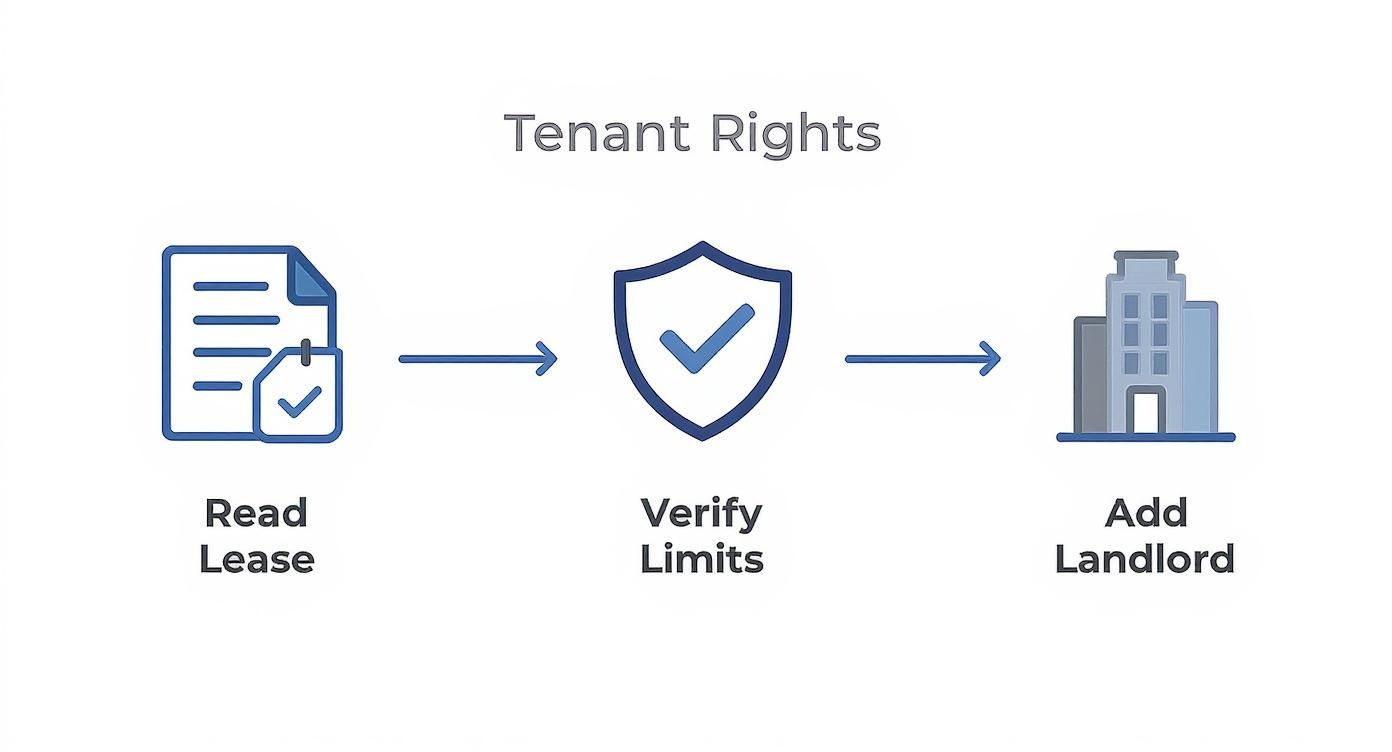
As you can see, the process—from reading your lease to adding your landlord as an interested party—is a straightforward part of finalizing your protection. By taking these smart steps, you can confidently lock in the best possible policy for your California rental.
Common Questions About California Renters Insurance
Even after you've got a good handle on your policy, a few specific questions tend to pop up for California renters. Getting clear, straightforward answers is the key to feeling confident about your coverage and knowing what to do if something unexpected happens. Let's tackle some of the most common ones.
Can I Just Add My Roommate to My Policy?
This question comes up all the time, and the short answer is almost always no. Your renters insurance policy is there to protect your stuff, not your roommate's. The cleanest and simplest way to avoid major headaches later on is for each person to get their own policy.
Think of it this way: if you both had to file a claim for a fire, how would you prove who owned what? A few companies might let you add a roommate, but it can create a messy situation. Keeping things separate ensures everyone is properly covered without any ownership drama.
Is My Laptop Covered if Someone Steals It from My Car?
Yes, most of the time it is. This is one of the best and often overlooked features of renters insurance. It's called "off-premises coverage," and it's a standard part of most policies, protecting your belongings even when they're not physically inside your apartment.
This means your stuff is generally covered whether it's stolen from your car, a hotel room you're staying in, or even a storage unit. Just keep in mind that policies often put a lower limit on these types of claims, typically around 10% of your total personal property coverage. Dig into your policy documents to know your exact limits.
The Bottom Line: Your renters policy covers your belongings, while your auto insurance covers your car. So, if a thief smashes your car window and grabs your gym bag, your comprehensive auto insurance would handle the broken window, and your renters insurance in California would cover the cost of replacing your stolen gear.
What Do I Do with My Insurance Policy When I Move?
Good news—your renters insurance moves with you! It's a portable policy. Before you start packing, just give your insurance provider a call and let them know your new address and the date you're moving in. A quick update is all it takes to make sure you're covered from day one in your new place.
Your premium might go up or down a bit depending on factors in your new neighborhood, but the process is usually painless. It's a simple step that keeps your financial safety net intact without any gaps in coverage.
Can My Landlord Force Me to Get a Certain Amount of Coverage?
They absolutely can, and it's standard practice here in California. Landlords can legally require you to carry a minimum amount of liability coverage. The most common requirement you'll see in a lease is $100,000 in liability protection.
This isn't to be difficult; it protects the property owner in case you're found responsible for an accident that injures someone or damages the building. This requirement will be spelled out in your lease, and thankfully, it's an amount that nearly every standard renters policy can easily provide.
Navigating the world of California insurance, from renters and auto to home and life, is easier with a trusted partner. At Mai & Associates, our licensed agents are ready to help you find the perfect coverage for your needs and budget.
Get your free, no-obligation quote today and protect what matters most.