Renters Insurance Earthquake Coverage: The 2026 Guide
You just got home after a moderate quake, and the first thing you think is simple, maybe your renters insurance will handle this. The lamp is broken, your laptop slid off the desk, the closet door won't close right, and your building may be fine enough to stay in, but your stuff isn't. That's the trap with renters insurance earthquake coverage, standard renters insurance often looks like protection until the damage comes from shaking itself.
In California, that misunderstanding is everywhere. The state has earthquake risk baked into daily life, yet only about 10% of residents have earthquake insurance, and the California Department of Insurance reported a 12.71% earthquake-insurance uptake rate in 2022 (California Department of Insurance earthquake insurance guide). If you rent here, you can't afford to assume your HO-4 policy will save you after a quake. If you also shop auto insurance, home insurance, car insurance, or life insurance, this is the same lesson across the board, coverage only works when the peril is included.
Why Renters Assume They Are Covered and Why That Is Risky
A renter feels the shake, grabs the cat, and waits for the aftershock to pass. Then comes the cleanup. The dresser tipped over, the television cracked, and the apartment smells like dust and drywall. The renter opens the policy documents expecting a clean answer, because that's what insurance is supposed to do, pay when life knocks your place apart.
That expectation is where people get burned. Renters often confuse “I have insurance” with “I have earthquake protection,” but those are not the same thing. Standard renters insurance is built for ordinary covered losses, not for seismic damage that tears through a room in seconds. California's earthquake-risk reality makes that gap expensive, because only about 10% of California residents have earthquake insurance, despite the state seeing 90% of the country's earthquakes (California Department of Insurance earthquake insurance guide).
If you rent, do not let the building owner's policy lull you into comfort. The landlord may repair walls and framing, but that does not replace your furniture, clothes, electronics, or the weeks of displacement that can follow. For a practical tenant-focused view of lease duties and what a landlord can require, the Restore Heroes landlord guide is useful, and California renters insurance options helps you compare the basic coverage renters usually start with before adding quake protection.
Practical rule: if the loss starts with shaking, assume your standard renters policy is silent unless you added earthquake protection.
A lot of renters also shop coverage too late, after they've already seen a news clip or felt a tremor. That is backwards. You want to know your quake protection before the next event, not after your floor cracks and your policy response turns out to be a hard no. If you rent low-value contents, the primary question is whether the likely payout would justify your out-of-pocket hit after a percentage deductible. On a modest claim, that math can make filing pointless even if you do have earthquake coverage.
How Standard Renters Insurance Treats Earthquake Damage
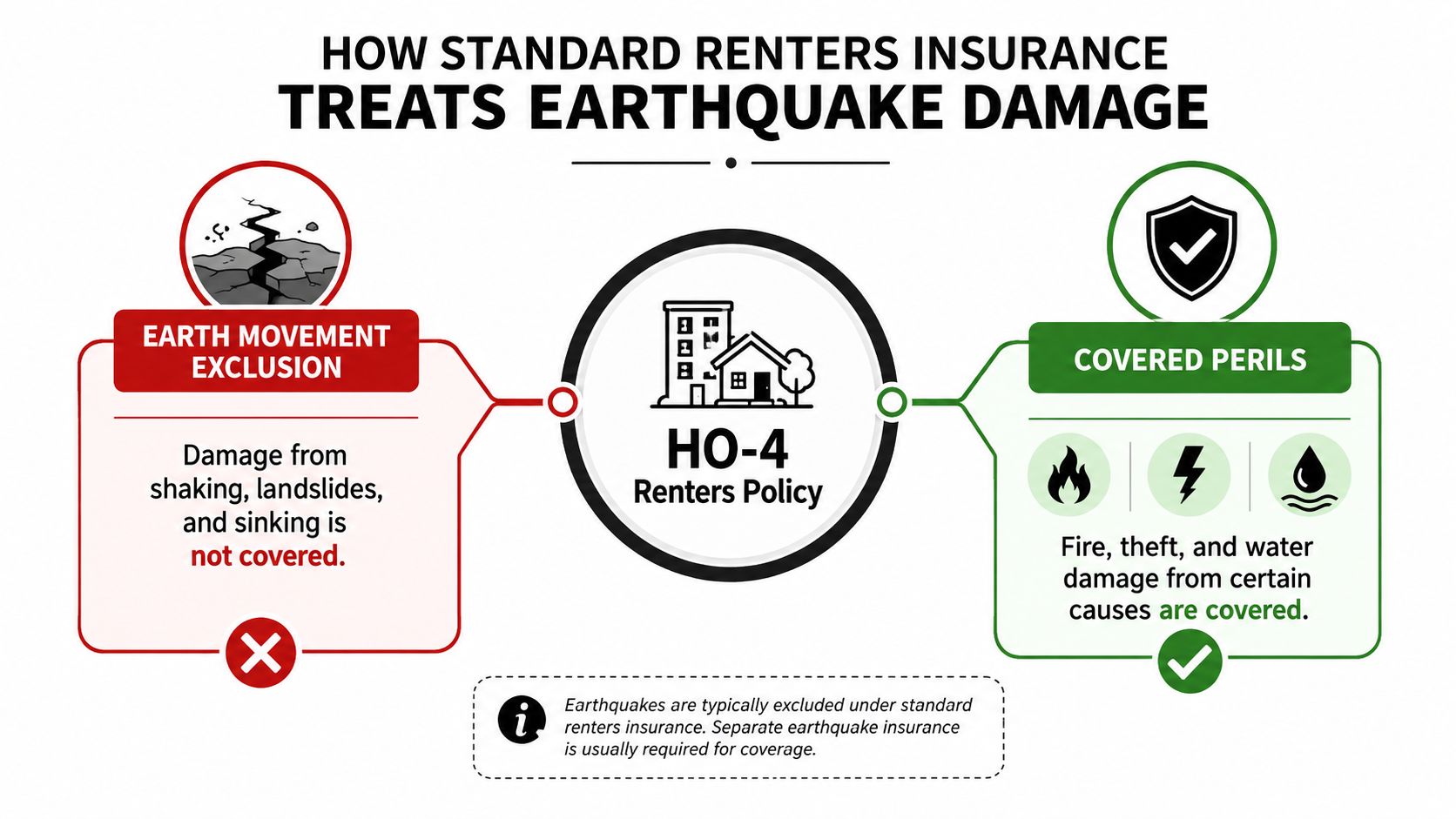
The HO-4 form is the standard renters policy. It covers your personal property for listed perils, but earthquake damage sits outside the ordinary list because it falls under the “earth movement” exclusion. California regulators say it directly, renters insurance does not cover earthquake damage, and you need separate earthquake insurance if you want protection for your belongings (California renters earthquake insurance guide).
The cause of loss decides the claim
Renters get burned here because insurance responds to the cause of loss, not the word “earthquake” on its own. If shaking cracks your floor and nothing else happens, that damage is excluded. If the quake triggers a fire, the fire can still be covered under the policy because the covered peril is the fire, not the shaking that started it (California renters earthquake insurance guide).
That distinction is what keeps a lot of claims from paying the way renters expect. A policy can still respond to fire damage, theft, or certain water losses after an event, while refusing to pay for the earthquake damage itself. The claims question is simple: what caused the loss you are asking the insurer to pay for?
Your landlord's policy protects the structure. Your renters policy protects your belongings for covered perils. Earthquake damage sits outside that default setup unless you buy extra protection.
If you rent low-value contents, the core issue is not whether the building shook. It is whether the likely payout would clear your out-of-pocket hit after a percentage deductible. On a modest claim, that math can make a claim useless even when you do have earthquake coverage. Reading the exclusions, not just the declarations page, is what separates a policy that pays from one that does not. If you want a California-friendly overview of ordinary renters coverage, the home insurance California guide shows how property policies separate structure from contents.
What Earthquake Coverage Protects for Renters
A renter earthquake policy is not a catch-all for disaster losses. It usually pays in two places, personal property and loss of use. For California renters, that distinction matters because the question is not whether a quake happened, it is whether the policy replaces enough of your stuff and housing costs to justify the deductible you will eat first. California Earthquake Authority coverage lets renters buy personal property limits up to $25,000 and loss-of-use limits up to $100,000, with the personal-property deductible ranging from 5% to 25% of the limit (California Earthquake Authority renters coverages and deductibles).
Personal property is the core benefit
This is the part that pays to replace the things you own. Furniture, clothing, a laptop, small appliances, and similar personal items are what quake damage usually hits first. For renters, that is the main claim because the unit may still be standing while the contents are trashed.
If your possessions are low value, you need to be blunt with yourself. A modest contents loss can look bigger than it really is once a percentage deductible gets applied. On a smaller claim, you may be better off absorbing the loss yourself than filing and discovering the payout barely clears the deductible.
Loss of use fills the housing gap
Loss of use matters when the place is temporarily unlivable. It can cover hotel nights, extra meals, laundry, and the extra cost of living somewhere else while repairs are underway. This part does not rebuild the apartment. It helps you keep your life moving while the landlord handles the structure.
For many renters, that is the part that keeps a quake from turning into a cash-flow problem. Temporary housing gets expensive fast in California, and renters often underestimate how quickly those out-of-pocket costs add up after they leave their unit.
Liability is not the part renters should count on
Do not assume earthquake coverage automatically turns into broad liability protection. Quake coverage is mostly about your belongings and your displacement, not every legal headache that could follow a disaster. If another person's property gets involved, read the policy language before you count on it to handle a claim.
A California renter policy can still be useful without being broad. If you want a cleaner explanation of how ordinary renters coverage fits into the bigger picture, the home insurance California guide lays out how property policies separate structure from contents.
Bottom line: earthquake coverage for renters is about replacing possessions and helping with temporary housing, not turning a standard HO-4 policy into full disaster insurance.
A CEA-linked renter program can start with $5,000 of personal property and $1,500 of loss of use, then increase to $100,000 and $25,000 respectively, with a $750 deductible on personal property (UPHelp earthquake insurance for renters). That structure is why earthquake protection for renters feels different from ordinary renters coverage. It forces you to measure the likely payout against your own out-of-pocket exposure before you ever file a claim.
Endorsements Versus Standalone Earthquake Policies
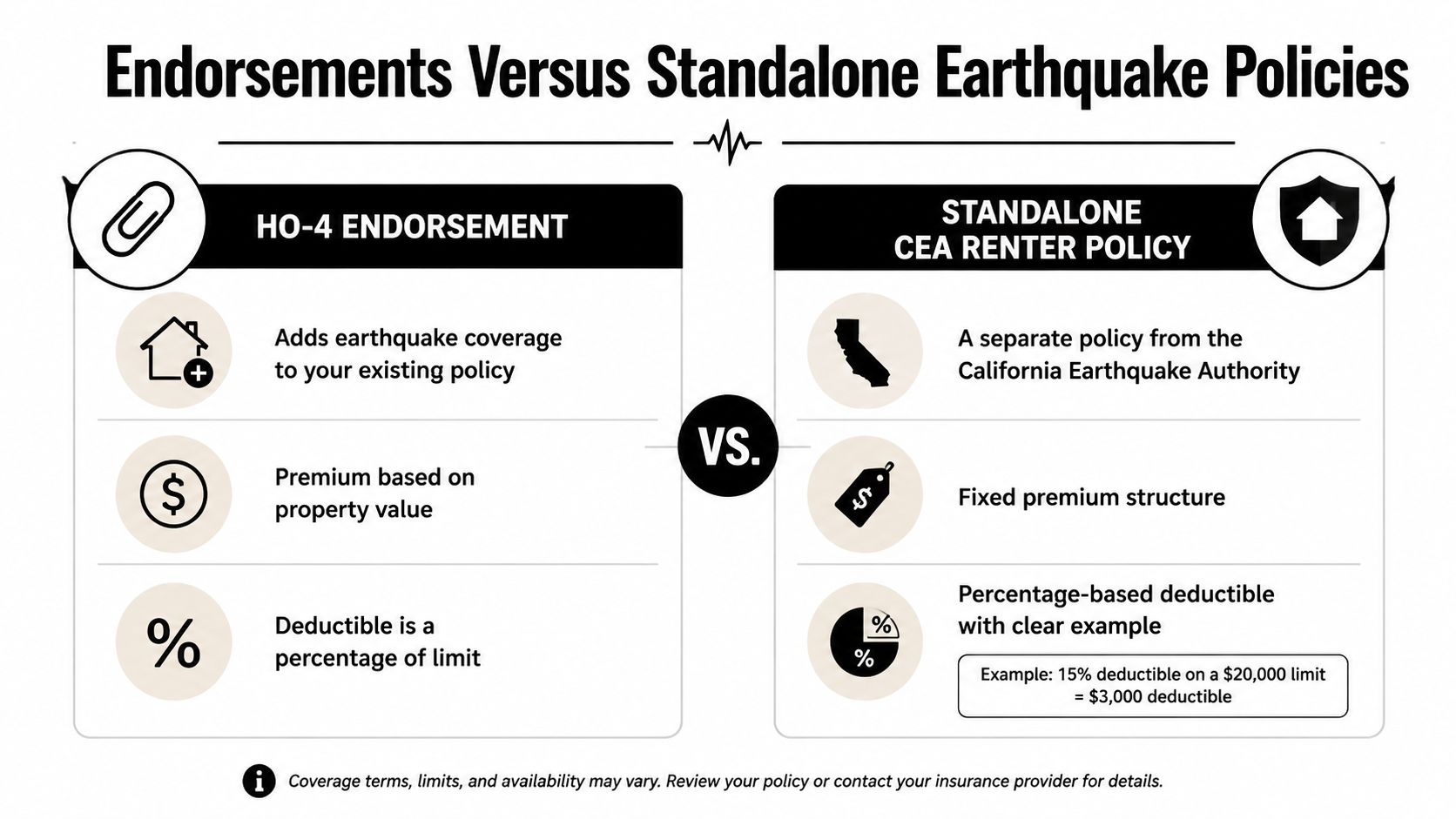
The decision is simple. Do you want quake protection folded into your current renters policy, or do you want a separate earthquake policy with its own terms and limits? An endorsement can be fine if your carrier offers it and the coverage fits what you own. A standalone earthquake policy, especially one tied to the California Earthquake Authority model, makes more sense when you want clearer earthquake-specific limits and a separate deductible structure.
When an endorsement makes sense
Use an endorsement when your current renter policy is otherwise solid and the earthquake add-on is easy to understand. That is the better fit for renters who want everything in one place and do not need unusually high limits. It is the simpler path, and simplicity matters when your budget is already stretched by rent, utilities, car insurance, and the rest of the monthly stack.
When a standalone policy is the better move
Choose a standalone earthquake policy when your current company does not offer the add-on, when you want more control over quake limits, or when you need clearer protection for displacement. A CEA-style renter policy gives you a flexible range, with low entry coverage that can scale up to much higher limits. That matters for renters who own more than they think or who live in a unit where replacement costs would hurt more than the monthly premium. The UPHelp earthquake insurance for renters guidance lays out that range plainly.
Think in terms of structure, not just price
A separate policy usually means a separate deductible conversation. That is a good thing, because it forces the quake exposure to stand on its own instead of hiding inside your general renters renewal. If your carrier's endorsement is cheap but thin, do not let the convenience fool you. The key question is whether the policy pays in a way that matches the loss you'd suffer.
If your risk is modest and your belongings are easy to replace, an endorsement may be enough. If your unit is packed with electronics, furniture, and items you would have to replace fast after a quake, the standalone route is usually the smarter one. I would rather see a renter buy a policy with clear quake limits than assume a vague add-on will rescue them later.
How Earthquake Deductibles Work for Renters
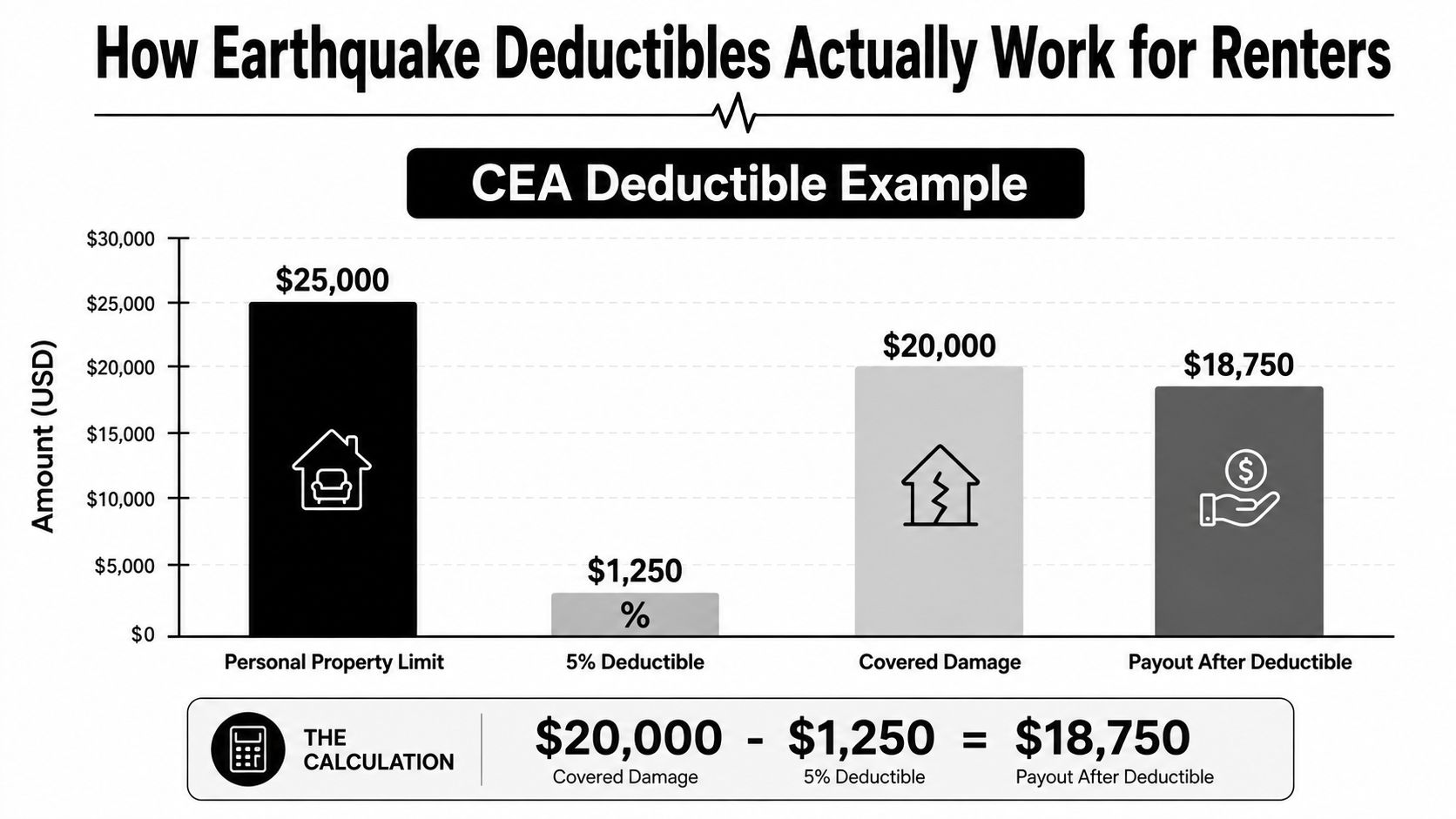
A renters earthquake policy can look affordable right up until the deductible shows you what part of the loss you pay. That is where a lot of people get caught. A claim on a $25,000 personal-property limit with a 5% deductible leaves $1,250 on your side first, and $20,000 of covered damage would still net $18,750 after that deductible.
Why the deductible changes the decision
That example is the real buying test. A percentage deductible works like a threshold, and if your loss does not cross it, the policy does nothing for that claim. Smaller losses can stay entirely on you, while larger losses are the ones that make the coverage worth filing.
Higher percentages raise the bar fast
The California Earthquake Authority says personal-property deductibles can run from 5% to 25% of the limit (California Earthquake Authority renters coverages and deductibles). That range changes the claim trigger fast. A higher limit does not help much if the deductible is set so high that you only reach it after a serious loss.
Treat emergency repairs as deductible-sensitive
Emergency repairs are not free money. They usually sit under the same deductible structure, so you still need enough covered damage before the policy starts paying. If you only plan to file after a major quake loss, a higher deductible may be fine. If you want help with smaller recovery costs, a lower deductible is the better choice.
The hard truth is simple. The deductible, not the premium, usually decides whether the claim is worth the paperwork. If your likely loss is small, do not buy quake coverage expecting low-friction reimbursement. Buy it because you want protection from the kind of damage that would really hurt your finances.
What Earthquake Coverage Costs California Renters in Practice
A lot of renters overthink the premium and underthink the exposure. Independent consumer guidance says renters earthquake insurance can carry a separate deductible ranging from roughly 2% to 20% of the policy limit, and California-focused reporting places the cost as low as $35 per year for some renters (Insurify renters earthquake insurance guide). That's the right frame. You're not just buying a policy, you're buying a ceiling on your out-of-pocket loss.
Cheap coverage can still be smart coverage
If the annual premium is low, the question is what you're protecting. A renter with modest furniture still owns more than they realize once you count electronics, clothing, kitchenware, and the cost of living somewhere else for a while. Displacement adds up fast, even when the apartment itself doesn't collapse.
Low-value renters aren't automatically low-risk renters
This is the part most guides gloss over. People assume small apartments mean small losses, but quake damage rarely respects your self-image as a “minimalist renter.” A broken laptop, a damaged bed frame, and a week or two of temporary living can easily feel bigger than the annual premium you were trying to save.
Price the policy against the loss, not against the monthly bill
If you look only at the premium, you'll underbuy. If you look only at the deductible, you'll overbuy. The right move is to compare the policy cost with the worst out-of-pocket hit you'd absorb without it. That's the value test, and it's the one California renters should use before deciding they're “too small” to insure.
How to Get Covered Through Mai & Associates
If your apartment is full of real stuff, your quote should reflect real replacement cost. Start with your renters declarations page and your lease, then make a plain inventory of what you own. That tells you whether you need a basic quake layer or a higher limit that can cover the loss instead of leaving you to patch the gap yourself.
What to gather before you call
Bring the paperwork that lets an agent quote the policy correctly, not loosely. Have your lease, your current policy summary, and a short list of the items that would cost real money to replace. If you already know you want a lower or higher earthquake deductible, say it at the start. That keeps the conversation centered on coverage that fits your budget and your risk.
How the quote comparison should work
Ask for a direct comparison of the gap in your current policy and the earthquake options that fill it. You want to see how the deductible, the limit, and the carrier structure change the final out-of-pocket number if you ever have a claim. Mai & Associates handles that kind of comparison across its California offices in Glendale, Westlake Village, Escondido, and Costa Mesa, with multilingual support in English, Spanish, Armenian, Russian, and Vietnamese. That matters because a policy only helps if you understand what you are buying.
Why the market gap still matters
The coverage gap is still wide. A recent national finance survey found that only 49% of renters held renters insurance in 2023, which means more than 22 million renter households were uncovered, and in an earthquake-risk sample only 9% of renters reported earthquake coverage (FIN Health Network climate, disaster, and renters insurance report). If that is where the market sits, waiting until after the ground shakes is the wrong move.
Use Mai & Associates' quote page if you want a fast way to compare options without dragging the process out. Go in ready to talk through your belongings, the deductible you can live with, and how much temporary housing you could afford if your place is uninhabitable. That is the standard that matters.
A Pre Quake Checklist and Claim Preparation Tips
If you wait until after a quake to get organized, you will lose time and evidence. A renter policy only pays cleanly when you can show what was damaged, what you owned, and what it cost to replace it. Start with photos of every room, then save those images and your receipts somewhere offsite where a broken phone or damaged laptop cannot wipe them out. Keep two emergency contacts outside the area, make sure everyone in the household knows the evacuation plan, and review emergency kit lighting advice before the next outage leaves you fumbling in the dark.
What to do before the ground moves
- Photograph every room and possession: Take wide shots and close-ups so you have a clear inventory if the unit is damaged.
- Store receipts digitally: Keep purchase records in the cloud or another offsite location so they survive the quake.
- Pick two out-of-area contacts: Local phone networks can get messy, so choose people who can relay information if the city is disrupted.
- Review your deductible now: A percentage deductible can turn a small claim into a bad deal, especially if your belongings are low-value and the payout would barely clear your out-of-pocket share.
- Use our full guides library: If you want more practical prep steps, check our full guides library for additional preparedness guides before you need them.
What to do right after a quake
Document everything before you throw anything away. Take photos of broken items, damaged walls, fallen furniture, and any temporary housing costs you incur. Call your insurer as soon as you can, then follow the claims instructions exactly. If it is safe, keep damaged property until the adjuster sees it, because getting rid of it too early can weaken your claim.
The decision is simple. Choose standalone or endorsement, set a deductible percentage you can absorb, and make sure your personal-property limit matches what you would lose in a hard shake. For renters with modest belongings, that deductible can decide whether filing a claim makes sense at all. If the numbers do not clear your out-of-pocket exposure, you are better off tightening the policy now than discovering that problem after the ground moves.