8 Renters Insurance Discounts in California
You're reviewing a renters insurance renewal in California and the premium looks higher than expected. You call the carrier and ask for a discount, only to learn that eligibility may depend on your auto policy, building security, payment method, claims record, membership status, or documentation you haven't collected yet. The discount's headline percentage may also apply to the auto policy rather than the renters policy.
That's why the right approach isn't just asking, “What discounts do you offer?” It's verifying which discounts you qualify for, gathering proof, comparing the total premium, and checking that your liability limits, personal-property coverage, deductibles, and exclusions still fit your situation. The eight opportunities below cover common renters insurance discounts, including individual safety devices and building-wide protection systems.
California renters should also consider how renters coverage fits with broader auto insurance, car insurance, home insurance, and life insurance decisions. Mai & Associates can compare multiple carriers, identify coverage gaps, provide no-obligation quotes, and help apply eligible discounts. If you're estimating your baseline premium first, use this renters insurance cost calculator, then request quotes based on your actual address and coverage needs.
1. Multi-Policy Bundle Discount
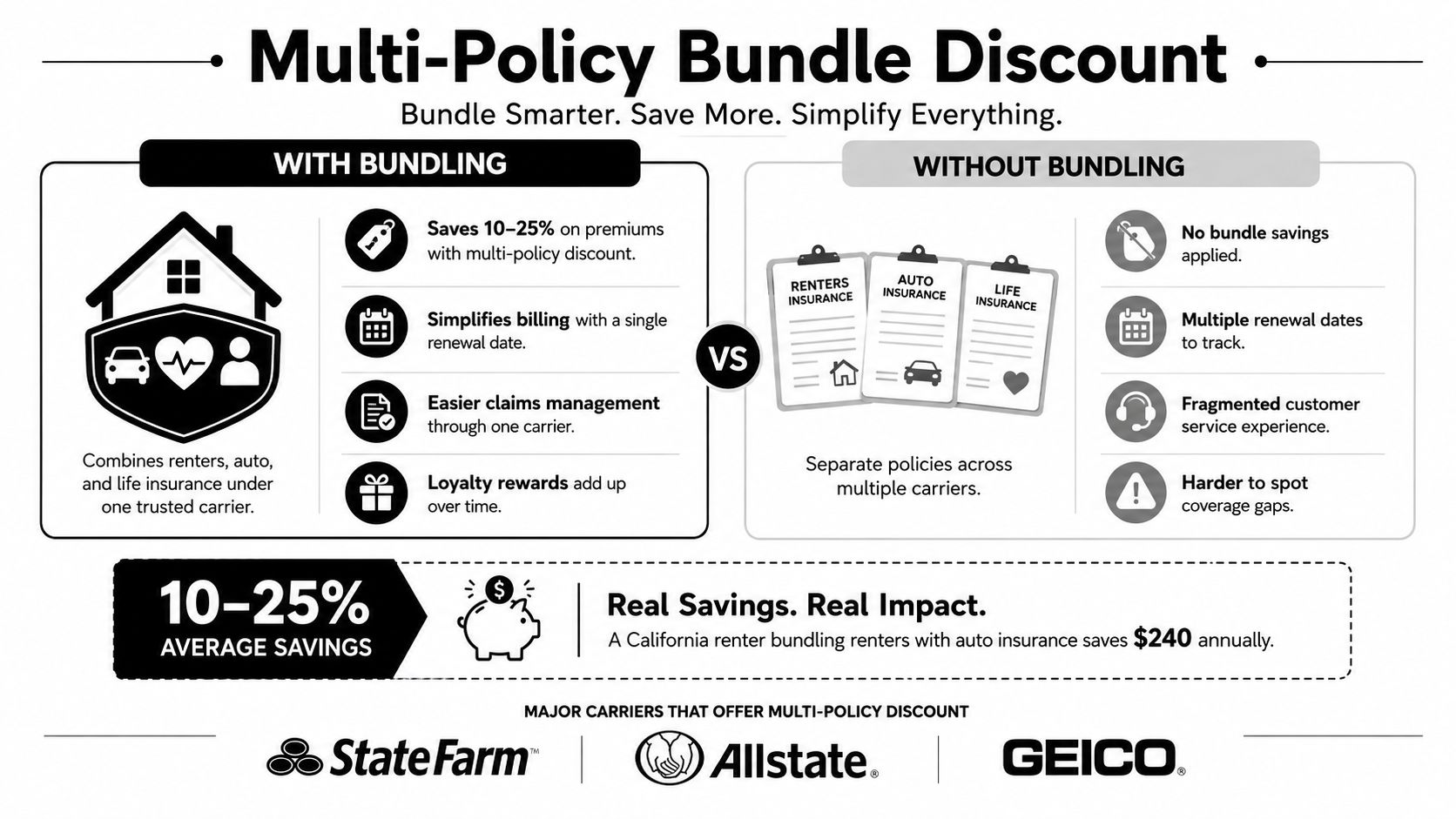
Bundling renters insurance with another policy is often the first discount California renters should investigate. A carrier may combine renters coverage with auto insurance, car insurance, home insurance, or life insurance, although the available combination and savings depend on the insurer, state, policy form, and risk profile.
A widely cited industry benchmark places combined auto-and-renters bundle savings around 5% to 25%, while other analyses place renters-specific savings on the renters portion around 5% to 15%. Some industry roundups describe savings of 10% to 25% in many markets. These ranges come from industry guidance on renters and auto bundles, and they shouldn't be treated as a guaranteed California quote.
The important detail is where the savings land. Some carriers apply most of the bundle discount to the auto policy, not the renters premium. Ask for the premium for each policy before and after bundling, then compare the combined total with standalone quotes from other carriers. A renters policy is usually much cheaper than a homeowners policy, so a percentage discount on renters coverage may look small in dollars even when the overall insurance bill falls meaningfully.
What to document before accepting a bundle
Prepare declarations pages for your current policies, vehicle information for auto quotes, and the coverage limits you want to preserve. A California renter who already owns a vehicle can compare California auto insurance options alongside renters coverage rather than judging the bundle by the renters premium alone.
Practical rule: Ask, “Which policy is receiving the discount, and what is my net premium for every policy together?”
Before moving policies, confirm cancellation terms, effective dates, liability limits, deductibles, and exclusions. A bundle isn't a bargain if it forces you into weaker coverage or a higher total premium.
2. Safety and Security Device Discount
A deadbolt, smoke detector, fire extinguisher, burglar alarm, monitored security system, water-leak sensor, or smart-home shutoff may affect eligibility for a safety or security discount. The device must usually meet the carrier's requirements, and a renter may need proof from the landlord, installer, monitoring company, or property manager.
The discount isn't automatic just because a device exists. A carrier may distinguish between an individual device inside your unit and a professionally monitored or building-wide system. It may also ask whether the alarm is monitored, whether the device is active, and whether the installation serves the entire residence.
California renters should check the lease before installing anything attached to a door, wall, plumbing system, or electrical panel. A smart lock may improve access control, but it can also create landlord, maintenance, or emergency-access issues if installed without permission. Guidance on smart lock integration and support can help you understand installation considerations before you make changes.
Individual devices require individual proof
Keep the following records in one file:
- Purchase records: Save receipts showing the device model and installation date.
- Monitoring agreements: Retain the current contract for a professionally monitored alarm.
- Installation certificates: Request a certificate from the installer when available.
- Lease approval: Keep written landlord permission for alterations or attached equipment.
- Device details: Record whether the system detects intrusion, smoke, water, or other hazards.
A renter in Escondido who installs a monitored alarm shouldn't assume the carrier will apply the same treatment as it would for a locked common entrance or a professionally maintained sprinkler system. Ask the agent which devices qualify, whether inspection is required, and whether the discount applies to renters coverage itself.
For a California-specific quote, compare coverage through renters insurance in California. The goal isn't to buy an expensive device for a small premium reduction. The device should provide useful protection even if the discount is unavailable.
3. Good Student Discount
A student renter may qualify for a good student discount, but this is one of the discounts that requires careful carrier verification. Eligibility can depend on age, enrollment status, school type, academic standing, and whether the discount applies to renters insurance, an auto policy, or both.
The student should ask the carrier what proof it accepts before submitting an application. A current transcript, enrollment verification, school letter, or other academic record may be required. Don't assume a strong academic record automatically qualifies, and don't assume every carrier uses the same threshold.
Build a renewal reminder around school records
A student moving into an apartment near a California university might provide enrollment documentation at the start of the policy and then forget that the carrier can request updated proof later. Store the documentation with the policy declarations page and set a reminder before renewal. If the student takes a semester off, changes schools, shifts from full-time to part-time enrollment, or graduates, ask how the change affects eligibility.
Good student status can matter most when the renter also insures a vehicle. In that situation, compare the combined effect across the renters and auto policies instead of assuming the renters premium will receive the main reduction. Ask whether the discount can stack with paperless billing, automatic payments, a bundle, or a qualifying security feature.
A transcript by itself may not answer every eligibility question. The carrier may need the student's date of birth, school name, enrollment status, and policy relationship to the household. Roommates should also avoid assuming that one student's qualification automatically applies to every resident or every policyholder.
Keep academic proof current, but never reduce coverage limits just to make a student policy look cheaper.
A practical quote request should include the renter's school documentation, current declarations page, personal-property inventory, and any auto policy information. That gives the agent enough context to compare the student discount with the full cost of coverage.

4. Claims-Free History Discount
A claims-free record may help a California renter qualify for lower pricing, but the value of that record shouldn't dictate every claim decision. Carriers may review prior claims history, the type of claim, the date, and whether the loss involved renters insurance or another policy. Each insurer sets its own eligibility rules.
A tenant who has lived in the same apartment for years without a claim should ask the current carrier when the record qualifies for a claims-free discount. A new insurer may also request prior insurance details during underwriting. Keep renewal documents and claims-history information available so the quote reflects the actual record rather than an incomplete answer.
Don't confuse discount protection with self-insuring
Paying for a minor loss out of pocket can sometimes avoid a claim, but that choice carries a trade-off. The renter must weigh the repair or replacement cost against the deductible, available savings, potential future pricing, and the possibility that the damage is more extensive than it first appears.
Maintenance records can help prevent disputes and support a claim when a covered loss occurs. Keep photographs of valuable belongings, receipts for major purchases, repair invoices, communications with the landlord, and records of water, electrical, or security problems. Those records help establish what happened and what the renter owned.
A claims-free discount may be useful, but renters shouldn't avoid reporting a serious covered loss merely to preserve it. Insurance exists for losses that exceed the renter's ability to absorb them. Ask the carrier whether a consultation or claim inquiry affects the record before discussing a small incident in detail, and get the answer in writing when possible.
The strongest comparison includes both the premium and the policy's claim handling terms. Check the deductible, personal-property settlement method, liability coverage, loss-of-use coverage, and exclusions. A lower premium with inadequate protection can create a much larger financial problem after theft, fire, smoke damage, or a covered water loss.
5. Loyalty Discount
Loyalty pricing rewards continuous business with a carrier, but loyalty alone shouldn't end the annual comparison process. A carrier may offer a renewal benefit after a qualifying period, while another carrier may provide a lower starting premium with broader coverage. The only reliable way to evaluate the trade-off is to compare the total policy terms.
A California renter who has stayed with one insurer through several renewals should ask for a written breakdown of current discounts. Request the eligibility period, the discount amount, whether it applies to the renters premium, and whether it disappears after a policy change. Also ask whether a move to another address resets eligibility.
Compare loyalty against market competitiveness
Review the declarations page before renewal and note:
- Current premium: Record the total amount, payment plan, fees, and any policy changes.
- Coverage limits: Check personal property, personal liability, medical payments, and loss of use.
- Deductible: Confirm whether the deductible changed from the prior term.
- Endorsements: Look for scheduled property, identity-related coverage, water backup, or other additions.
- Discount list: Verify that every listed discount still applies.
A loyal customer with auto and renters policies may receive related retention treatment across the account, but the combined premium still needs comparison. Ask for a bundled quote, a standalone renters quote, and a competing quote with equivalent limits. Compare the policies on the same effective date so temporary introductory pricing doesn't distort the result.
Loyalty can lower friction, but it doesn't replace an annual coverage review.
A carrier that offers a loyalty discount may still change its base rate, deductible options, underwriting requirements, or coverage form. Review the renewal notice carefully, then ask an agent to check whether another carrier can provide comparable protection at a more competitive total cost.
6. Automatic Payment and Paperless Discount
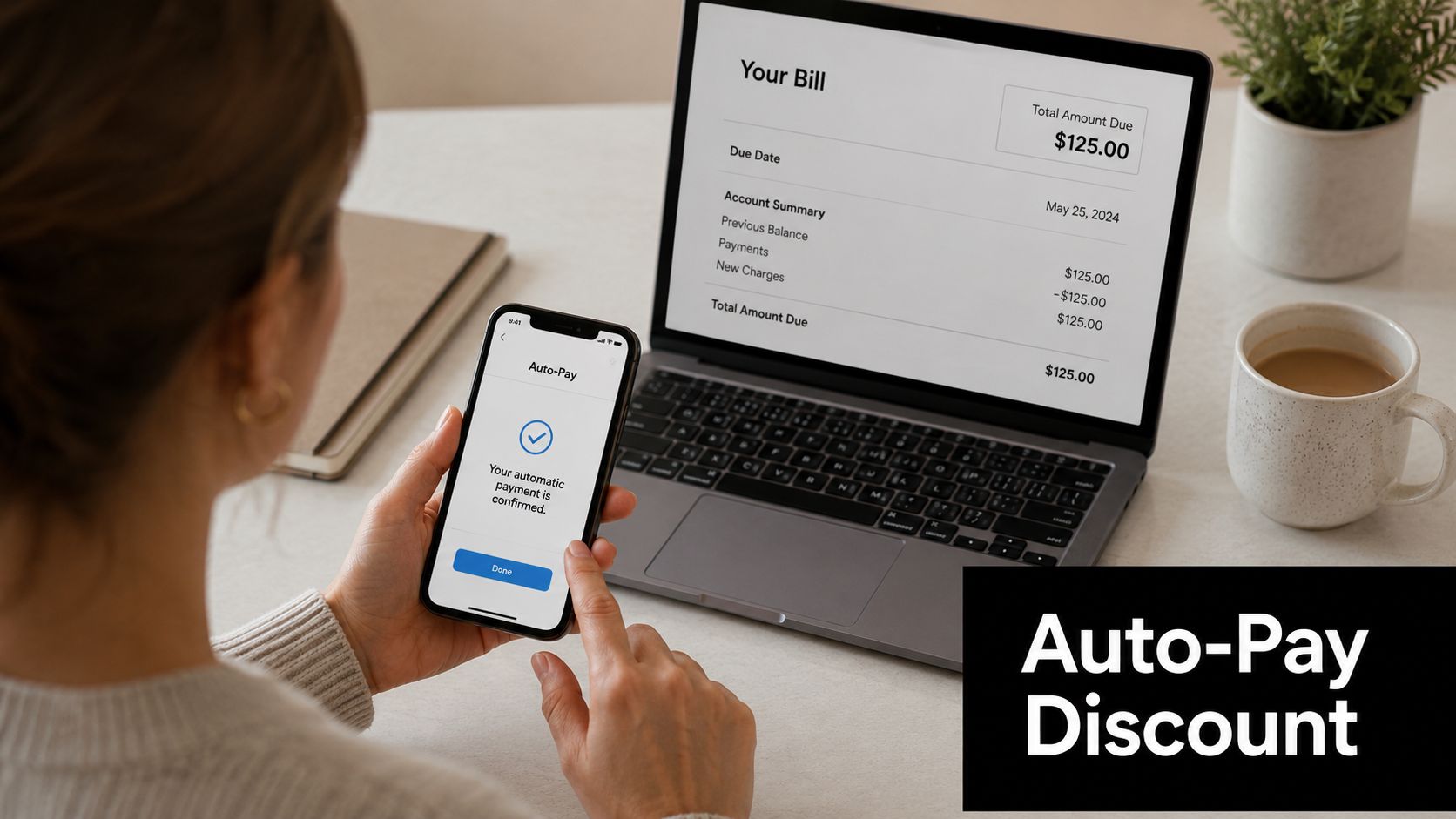
Automatic payments and paperless documents are among the easiest renters insurance discounts to request. The renter chooses electronic delivery and authorizes recurring payment, while the carrier reduces billing and mailing activity. Eligibility may differ between automatic bank withdrawals, card payments, paid-in-full plans, and digital communication preferences.
The practical risk is missed oversight. Automatic payment can prevent an accidental lapse, but it can also allow a renter to overlook a premium change, deductible adjustment, endorsement removal, or failed payment. Paperless billing helps only when the renter opens and reviews digital notices.
Set up convenience without losing control
Use a dedicated checklist:
- Confirm the account: Verify the correct bank or card information before canceling the old payment method.
- Check the first withdrawal: Make sure the amount and date match the policy documents.
- Review every notice: Save digital declarations pages, invoices, and renewal communications.
- Watch for failed payments: Update payment details promptly after a bank change or expired card.
- Ask about stacking: Confirm whether payment discounts combine with bundles, security devices, or other eligibility categories.
California renters can request a broader quote through an insurance quote review and compare automatic-payment pricing with other payment options. Don't choose a payment method that creates overdraft risk merely to obtain a small reduction. A failed payment can create reinstatement problems or a coverage lapse.
The same principle applies to paperless delivery. Digital documents are convenient, but keep copies of the declarations page, endorsements, premium notices, and proof of insurance in a secure folder. If the renter changes email addresses or loses account access, update the carrier immediately.
7. Renter's Association or Membership Discount
An employer, union, professional association, alumni network, or community organization may have a relationship with an insurer. These affinity arrangements can produce a renters insurance discount, but membership alone doesn't guarantee eligibility. The carrier may require an organization name, membership number, employment verification, or a current letter.
Start with the organizations you already belong to. A California teacher can ask a union or professional association about insurance benefits. A graduate can check an alumni association's member resources. An employee can ask human resources whether the company provides access to an insurance program. The inquiry should identify the carrier, the policy type, the enrollment process, and the documentation required.
Verify the group rate against ordinary quotes
A group rate may be convenient, but it isn't automatically the lowest or best option. Compare the affinity quote with individual quotes using the same:
- Personal-property limit: Estimate belongings realistically, including electronics, furniture, clothing, and specialty items.
- Liability limit: Consider household activities, pets, guests, and lease requirements.
- Deductible: Make sure the out-of-pocket amount is financially manageable.
- Settlement basis: Check whether covered belongings are settled at replacement cost or another basis.
- Endorsements: Identify coverage for jewelry, bicycles, computers, identity-related losses, or other valuable property.
Ask whether leaving the organization affects the policy, whether the discount renews automatically, and whether the rate can combine with automatic payment, paperless billing, or a multi-policy bundle. Keep a copy of the membership proof submitted with the application.
A membership discount is most useful when it improves the total value of the policy, not merely the advertised price. If the group program limits carrier choice or offers narrower coverage, a broader standalone option may be the better fit.
8. Protective Device and Home Safety Certification Discount
Building-wide safety systems operate differently from individual devices renters install inside their units. A professionally maintained sprinkler system, centralized fire alarm, monitored building security system, locked common entrance, or other documented feature may qualify under a carrier's property or building-security rules. Ask the insurer which systems it recognizes before assuming the feature earns a credit.
California regulators show that discounts vary by peril type, policy form, and insurer. One California insurer listed in the state's California Department of Insurance discount matrix advertises renters-related discounts of up to 28% in one category, up to 2% in a theft-peril-only category, and up to 6% in another category. These figures apply to the listed carrier and categories, not every California policy.
A locked common entrance may also affect eligibility. One California carrier states that an apartment building or complex with a locked common main entrance, or a gated community meeting specified security conditions, may qualify. Check the California renter security discount requirements and ask the carrier to confirm whether your building meets them.
Request building records from the property manager
Ask for:
- System description: List sprinklers, alarms, access controls, leak detection, and monitored systems.
- Maintenance records: Confirm professional maintenance and the current service status.
- Certification documents: Request current certificates or inspection records.
- Common-area details: Record locked entrances, guards, key control, and controlled access.
- Eligibility contact: Obtain the property manager's name and contact information for carrier verification.
Keep copies of every document and submit them with the quote request. Mai & Associates can help compare carrier rules, required proof, and the resulting coverage terms. California-focused guidance is also available in our guides section.
Accurate personal-property limits remain separate from building security. The California Department of Insurance states that renters may purchase up to $100,000 in personal-property coverage. Its renters insurance guide can help estimate belongings and select limits.
Confirm the discount in writing, then compare the full quote, including personal property, liability, additional living expenses, deductibles, and exclusions. A qualifying building feature can lower cost, while adequate coverage still protects against losses the safety system cannot prevent.
8-Point Renters Insurance Discount Comparison
| Discount Type | Implementation Complexity 🔄 | Resources Required 💡 | Expected Outcomes ⭐📊 | Ideal Use Cases 💡 | Key Advantages ⚡ |
|---|---|---|---|---|---|
| Multi-Policy Bundle Discount | 🔄🔄 (moderate coordination) | Multiple policies with same carrier; quotes & comparisons | ⭐⭐⭐, 10–25% premium reduction; 📊 high overall savings | Renters who also need auto/life insurance; families | ⚡ Significant savings + simplified billing & claims |
| Safety and Security Device Discount | 🔄🔄🔄 (installation & verification) | Purchase/install devices; proof & possible monitoring fees | ⭐⭐, 5–15% reduction; 📊 moderate safety impact | Renters in multi-unit or higher-theft areas | ⚡ Improves security while lowering premiums |
| Good Student Discount | 🔄 (simple) | Proof of GPA/enrollment (transcript) submitted periodically | ⭐⭐, 10–25% reduction for eligible students; 📊 meaningful for young renters | Full-time students under 25 or attending college | ⚡ Easy, high-value for qualifying students |
| Claims-Free History Discount | 🔄🔄 (time-dependent) | Maintain clean claims record for 3–5+ years | ⭐⭐⭐, 5–20% reduction; 📊 savings grow over time | Long-term, low-claim renters | ⚡ Automatic, increases with tenure; low admin |
| Loyalty Discount | 🔄🔄 (maintain continuous coverage) | Continuous policy tenure (2–5+ years) | ⭐⭐, 5–15% reduction; 📊 cumulative savings | Renters committed to one carrier | ⚡ Rewards retention; stacks with other discounts |
| Automatic Payment & Paperless Discount | 🔄 (very easy) | Bank account for auto-pay; opt into paperless billing | ⭐, 2–10% reduction; 📊 modest but immediate | Tech-savvy or busy renters who prefer convenience | ⚡ Simple setup; reduces admin hassle and late fees |
| Renter's Association / Membership Discount | 🔄🔄 (verification with third party) | Active membership proof; insurer partnerships | ⭐⭐, 5–15% reduction; 📊 depends on partnerships | Members of unions, employers, alumni groups | ⚡ Low-effort if already a member; can combine with others |
| Protective Device & Home Safety Certification Discount | 🔄🔄🔄 (complex, building-level) | Building-wide systems or professional certification; landlord buy-in | ⭐⭐⭐, 10–20% reduction; 📊 strong risk reduction for residents | Managed complexes, high-risk areas, newer developments | ⚡ Substantial building-wide risk reduction and resident savings |
Build a Discount Strategy Without Losing Coverage
Start with an inventory of every policy in the household. List renters insurance, auto insurance, car insurance, home insurance, and life insurance, including the carrier, renewal date, premium, deductible, limits, endorsements, and current discounts. This prevents a renter from evaluating a renters discount in isolation when the largest total savings opportunity may involve the auto policy or another household policy.
Next, assemble proof before requesting quotes. Gather student transcripts or enrollment verification where relevant, membership numbers and organization letters, security-device receipts, alarm monitoring agreements, landlord permissions, building certifications, payment preferences, and claims-history details. Ask each carrier which documents it accepts, how recently they must be dated, whether the discount applies to the renters policy itself, and whether the discount renews automatically.
Use equivalent quotes. A lower premium means little if one quote has a lower personal-property limit, a higher deductible, weaker loss-of-use protection, or exclusions that affect the renter's actual risks. Compare the same address, occupants, occupancy details, personal-property estimate, liability limit, deductible, and endorsements across carriers.
Verify how discounts interact
Some discounts may stack, while others may replace one another or apply only to a specific policy component. Ask the agent to show:
- Standalone renters pricing: The premium without a bundle.
- Bundled pricing: The combined renters and auto, home, or life premium.
- Documented discount pricing: The effect of safety, membership, student, claims, loyalty, and payment qualifications.
- Net household cost: The final amount for all policies, including fees and payment-plan effects.
- Coverage comparison: Limits, deductibles, endorsements, exclusions, and insurer requirements.
Discounts are already common in the renters market. The National Apartment Association reported that 85% of renters received at least one discount and three out of five received two or more discounts in 2023, including options such as bundling, paperless billing, and automatic payments. That finding appears in the National Apartment Association's renters insurance coverage report, but common availability doesn't mean every carrier offers every discount or permits every combination.
Customer satisfaction with discount availability also deserves attention. A 2026 consumer study reported 63% satisfaction, down from 68% the prior year, as described in Insurance.com's customer satisfaction trends coverage. The practical lesson is simple. Ask for a clear discount worksheet, not just a verbal promise.
Finally, don't avoid a legitimate claim solely to preserve a discount. A claims-free record can be valuable, but a serious covered loss may exceed your ability to pay. Before choosing a policy, confirm liability limits, personal-property coverage, replacement-cost options, deductibles, exclusions, loss-of-use coverage, and any California-specific concerns such as wildfire exposure, earthquake protection, theft, water damage, or Fair Plan coordination where relevant.
Mai & Associates can help California renters compare multiple carriers, review bundled and standalone options, identify coverage gaps, and request eligible discounts. The agency serves communities including Glendale, Westlake Village, Escondido, Costa Mesa, and other California cities, with no-obligation quotes and support across auto, home, renters, and life insurance.
Contact Mai & Associates for a multi-carrier renters insurance comparison, same-day quote options, and a review of the documents that support your eligible discounts. Ask the agency to compare your bundled and standalone premiums while keeping your California coverage limits, deductibles, and exclusions aligned with your needs.