Renters Insurance Deductible: 2026 California Guide

Your apartment looks fine when you leave for work. By evening, a burst pipe has soaked the rug, warped a side table, and damaged your laptop. Or maybe you come back to find your car was broken into and the bag you keep inside, with headphones, work gear, and a few personal items, is gone. In that moment, most renters ask the same question. “Will my insurance cover this?”
It might. But before your policy pays for a covered loss, one number matters first. Your renters insurance deductible.
That number shapes what you pay out of pocket, whether filing a claim makes sense, and how comfortable you’ll feel if something goes wrong in California’s mix of older buildings, dense apartment communities, wildfire exposure, and winter storm surprises. It’s a small policy choice that can have a very real effect on your finances.
Your First Financial Step After a Rental Disaster
A deductible is often the first cost you face after a covered loss. That’s why it deserves more attention than it usually gets.

Say a pipe bursts in your Glendale apartment and damages your desk, chair, and laptop. You’re stressed, you’re taking photos, and you’re trying to stop the water. Then your insurer asks for your deductible amount. That’s when many renters realize they understand their monthly premium, but not the part they must handle themselves first.
Renters insurance is still one of the more affordable ways to protect your belongings. As of 2025, U.S. renters insurance premiums average about $18 to $23 per month, while the average covered claim often falls between $3,000 and $5,000, according to 2025 renters insurance statistics and claims data. That gap is why the policy can offer strong value. But value only feels real when you know how your deductible works before a loss happens.
Why this number matters so much
A renters insurance deductible affects three decisions at once:
- Your monthly budget: A different deductible can change what you pay each month.
- Your emergency plan: You need to know what you could cover quickly from savings.
- Your claims strategy: Some losses are worth filing. Some aren't.
Practical rule: If you can't comfortably cover your deductible on a stressful day, it's probably set too high for your situation.
California renters run into this issue more often than they expect. A water loss in an older building, smoke damage from a nearby fire, or theft from a parked vehicle can all turn a normal week into a claim discussion. The deductible is the first financial step after the shock.
What Exactly Is a Renters Insurance Deductible
A renters insurance deductible is your share of a covered property loss before the insurance company pays the rest, up to your policy limits.

It involves splitting the first part of the bill. Insurance handles the larger covered expense. You agree to handle the opening portion.
The most common renters insurance deductible is $500, and most carriers offer options from $250 to $2,500, according to this deductible guide from Plymouth Rock. If you ever run into unfamiliar insurance language while comparing options, a plain-English insurance glossary can help decode the terms.
A simple example
Here’s the cleanest way to think about it.
If your television is stolen and the covered loss is $2,000, and your deductible is $500, you handle the first $500 and the insurer pays $1,500, assuming the claim is covered and within your policy limits.
The math works like this:
| Covered loss | Your deductible | Insurance pays |
|---|---|---|
| $2,000 | $500 | $1,500 |
If the loss is below your deductible, your policy usually won’t pay for that part of the claim.
What renters often get wrong
Many people assume the deductible is something they “send in” like a separate payment. That’s usually not how it works. In most property claims, the insurer subtracts the deductible from the approved payout.
Another common point of confusion is timing. The deductible applies to a claim event, not to every damaged item one by one within the same event. If one kitchen fire damages a chair, microwave, and clothing at the same time, that is generally one claim event. The deductible applies to that covered loss event.
Your deductible is best understood as the amount standing between a covered loss and your insurance payment.
That’s why choosing the number deserves more thought than picking the cheapest option offhand.
How Your Deductible Choice Affects Your Premium
Your deductible and premium move in opposite directions. In plain terms, a higher deductible usually lowers your premium, and a lower deductible usually raises it.
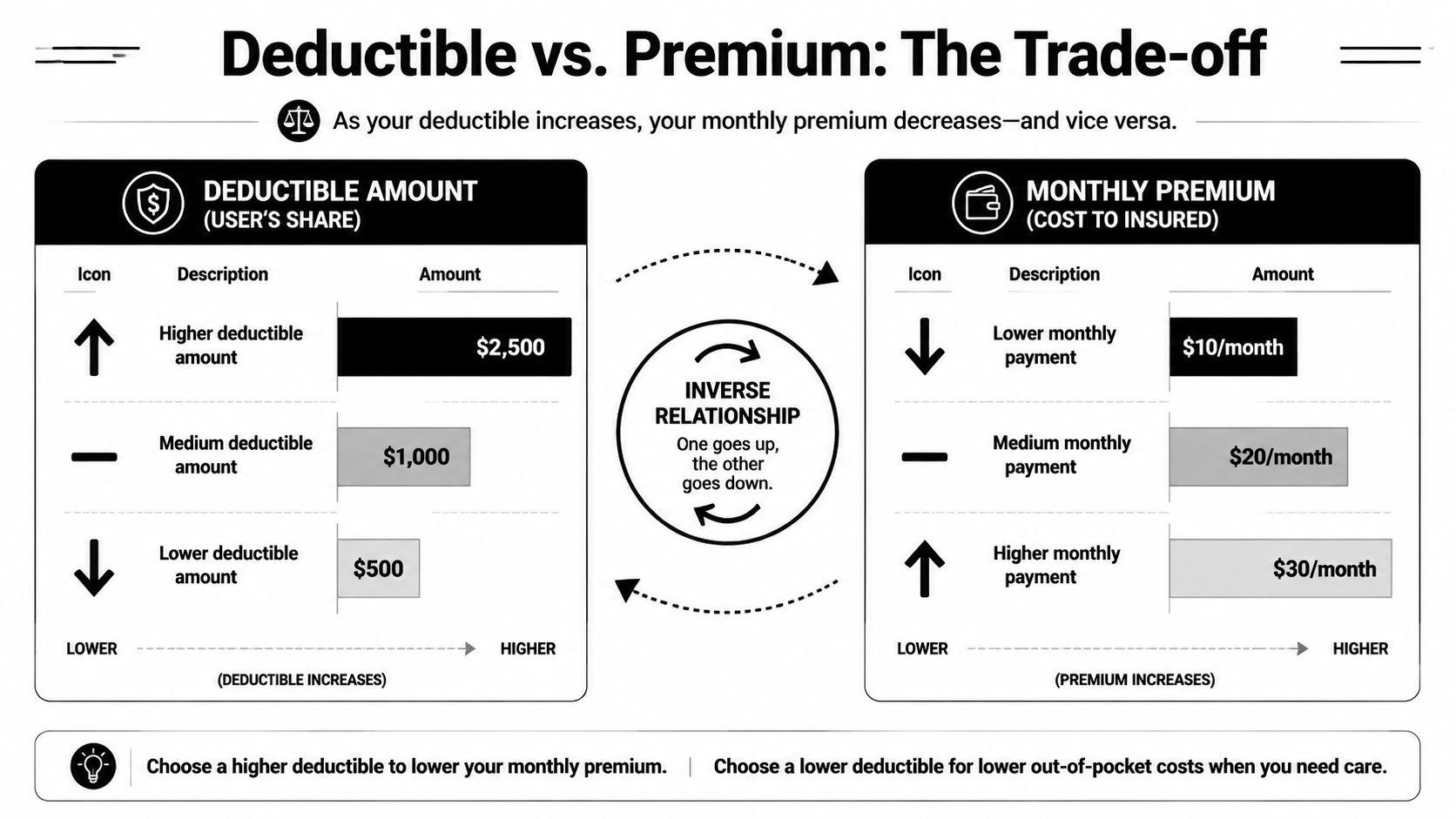
That trade-off exists because you’re taking on more of the initial loss yourself. Insurers charge less when they expect to pay less on smaller claims.
Choosing a higher deductible can produce meaningful savings. Raising a deductible from $250 to $1,000 can reduce annual premiums by 15 to 25%, and moving to $2,500 can reduce costs by 30 to 40%, depending on the carrier, according to this analysis of deductible and premium trade-offs. If you're comparing California policy options side by side, a dedicated California renters insurance page can help frame what carriers typically offer.
What the trade-off looks like
This is the core decision:
| Deductible choice | What usually happens to premium | What happens during a claim |
|---|---|---|
| $250 | Higher premium | Lower out-of-pocket cost |
| $500 | Middle-ground premium | Middle-ground out-of-pocket cost |
| $1,000 or more | Lower premium | Higher out-of-pocket cost |
The exact premium change depends on the insurer, your location, the building, and your coverage selections. But the direction is consistent. You either pay more now for easier claims later, or less now and more later if a covered loss happens.
Why the cheapest monthly payment can backfire
A low premium can feel like a win until the day you need to use the policy.
If you select a deductible that strains your cash reserves, you may hesitate to file a valid claim. That can leave you paying most of the repair or replacement cost yourself anyway. On paper, the policy looked affordable. In practice, it wasn’t set up for your finances.
Here’s a better way to judge the number:
- Look at your emergency savings: Could you pay that deductible without using a credit card?
- Think about your belongings: A renter with a laptop, phone, furniture, and work gear may want a more manageable claim entry point.
- Check your building risk: Older plumbing, upstairs neighbors, and wildfire exposure can all make the deductible feel more important.
A deductible isn't just a pricing tool. It's a stress test for your budget.
For many renters, the smartest premium isn’t the lowest one. It’s the one attached to a deductible they can live with.
How to Choose the Right Deductible for Your Budget
There isn’t one perfect deductible for everyone. The right choice is the amount you can cover without scrambling, while still keeping your monthly premium reasonable.
Start with one honest question. If something happened tonight, how much could you pay out of pocket tomorrow?
Start with your real cash cushion
A deductible should fit your emergency savings, not your ideal future savings.
If you have a stable cushion and want to keep monthly costs down, a higher deductible may work well. If paying a large surprise bill would force you to borrow, delay rent, or juggle other bills, a lower deductible may be the safer pick.
Use this quick self-check:
- You'd rather keep cash on hand: A lower deductible may bring more peace of mind.
- You rarely dip into savings: A higher deductible may help trim premium cost.
- Your income changes month to month: Predictability often matters more than the cheapest premium.
- You have roommates or shared spaces: More people can mean more chances for accidental damage or confusion during a loss.
Match the deductible to your renter profile
A college student with basic furniture and a modest electronics setup may decide that a higher deductible makes sense. The monthly savings can matter more, especially if replacing a few items wouldn't be financially devastating.
A family renting in Costa Mesa, with more furniture, children’s items, work laptops, and a tighter daily schedule, may prefer a lower deductible. The reason isn't just property value. It's the need to solve problems quickly without a large upfront hit.
A renter who works from home should also think carefully here. If your laptop, monitor, and office equipment are central to your income, a deductible that feels manageable on paper may still feel too high in a real disruption.
Don't chase the extreme
The highest deductible option can be tempting because it lowers the premium. But there’s a point where the savings may not feel worth the added strain during a claim.
Ask yourself:
- Would I still file a claim if this loss happened?
- Could I pay the deductible without delaying other bills?
- Would this amount still feel manageable during a stressful week?
If the answer to any of those is no, the deductible may be too high.
The best renters insurance deductible usually sits at the intersection of affordability and resilience. It should help your budget, not trap it.
Special Deductible Rules for California Renters
California renters deal with a more complicated insurance situation than many national articles acknowledge. Fire risk, older apartment stock, and specialty coverage questions can change how deductibles feel in the actual world.

One rule matters right away. In California, renters insurance deductibles are typically applied per claim, not per year, according to this explanation of California FAIR Plan and deductible mechanics. If you had a theft, then a separate water damage event, then a fire loss later in the same policy period, the deductible could apply to each separate covered event.
Why per-claim matters more in California
This can catch renters off guard.
Many people think of their deductible like an annual hurdle. That isn’t usually how renters coverage works. Separate losses can mean separate deductible responsibilities. In a state where renters may face smoke, water, and theft exposures in the same year, that distinction matters.
Here’s what that means in practice:
- A single rough year can multiply your out-of-pocket costs
- A “manageable” deductible can feel very different after more than one loss
- Building conditions matter more than people expect
A renter in an older apartment with aging plumbing may think mostly about one possible claim. But repeated disruptions can happen, and each one can trigger the deductible again if they’re separate loss events.
Earthquake, wildfire, and FAIR Plan questions
California renters also hear about earthquake coverage, wildfire exposure, the California FAIR Plan, and DIC policies. Those topics matter, but they can get muddled fast.
The safest way to think about them is this:
- Standard renters coverage and specialty peril coverage may not work the same way
- Some deductibles can be structured differently from the base policy
- FAIR Plan arrangements and companion policies can add layers that need careful review
For renters, the key is not to assume every peril uses the same deductible logic. If you live in a higher-risk area, ask for a policy review in plain language and confirm how your deductible applies to the specific risks you care about most.
A California renter doesn't just need a deductible they can afford. They need one they understand across the kinds of losses most likely where they live.
That’s especially true before fire season and before the first heavy winter storms hit.
Filing a Claim and Changing Your Deductible
When a loss happens, your first job is to document what happened, protect your property from further damage if you can do so safely, and review whether the claim is likely to rise meaningfully above your deductible.
Your deductible usually isn’t paid as a separate bill. It’s typically subtracted from the covered amount the insurer pays. That’s an important detail because many renters think they need to send the deductible in before anything happens.
When filing may not make sense
If the loss is close to your deductible, filing may not be worth the effort. You could go through the paperwork and still receive very little, or nothing, after the deductible is applied.
Good documentation is helpful. Photos, receipts, and an inventory of damaged items make it easier to estimate whether the claim is substantial enough to pursue. If you’re dealing with water intrusion and want a practical outside perspective on documenting damage and organizing a claim file, this Florida water damage insurance guidance is useful for the process side, even though policy rules vary by state. For broader claim questions, a well-organized insurance FAQ page can also help you sort out common next steps.
The timing rule that trips people up
A critical rule is easy to miss. Your deductible is locked in on the date of loss, not the date you report the claim or the date you later change the policy, according to Lemonade’s explanation of deductible timing.
If you lower your deductible after a wildfire evacuation order, after a winter leak, or after smoke reaches your building, the new lower deductible usually won’t apply to that existing loss. The deductible from the policy active when the damage happened is the one that counts.
Review your deductible before California's risk seasons, not after the damage starts.
That timing matters in wildfire-prone areas and in buildings where rain and plumbing issues tend to surface seasonally. A quick annual check before summer fire season or before rainy months can prevent a lot of regret later.
Protect Your Finances with the Right California Insurance
The best renters insurance deductible is the one that protects your budget in two directions. It keeps your premium reasonable now, and it stays manageable if you need to file a claim later.
That balance matters even more in California, where renters often need to think about building age, fire exposure, water losses, and the practical reality of replacing essential belongings fast. If you also keep items outside your apartment, it helps to understand how storage situations fit into your coverage. This overview of insurance for storage units from Endless Storage is a helpful companion read.
When you're ready to compare real options, a quote process that lets you review deductible choices side by side is far more useful than guessing. You can start that process through a California insurance quote request and compare how renters insurance fits with your broader needs, including auto insurance, car insurance, home insurance, and life insurance.
The right policy should feel clear before you buy it, not confusing after something goes wrong.
If you want help comparing renters insurance deductibles with real California carriers, Mai & Associates can walk you through the options in plain language. Their licensed team helps Californians review renters, auto, car, home, and life insurance choices, compare quotes from multiple carriers, and look at bundle opportunities that may reduce overall insurance costs. With multilingual support and experience across California communities, they can help you choose coverage that fits your budget before the next surprise hits.