Does Renters Insurance Cover Theft? A California Renter's Guide
Yes, renters insurance absolutely covers theft. This is one of the main reasons people get it. Think of your policy as a personal financial safety net for your stuff. It’s totally separate from your landlord's insurance, which only covers the building itself—the walls, the roof, the floors—not your personal belongings.
This protection is a core feature of your renters insurance, covering your things whether they’re stolen from your apartment, your car, or even while you're on vacation. For California residents looking to bundle their policies, understanding how this works alongside your auto insurance is key.
Your First Line of Defense Against Theft

Picture this: you get home after a long day, and your front door is wide open. Your heart sinks as you realize your laptop, TV, and grandmother's jewelry are gone. For California renters, this isn't just a scene from a movie; it's a real and all-too-common risk.
Your landlord’s policy won’t help you recover a single penny for your stolen belongings. That financial hit is entirely on you—unless you have a good renters insurance policy.
This is where the personal property coverage in your policy becomes your best friend. It’s designed to reimburse you for the value of your stolen items, turning a potential financial disaster into a manageable inconvenience. It's a surprisingly affordable layer of protection for everything you’ve worked hard to own.
Understanding Your Protection
To really get your money's worth, you need to know how your policy works. Let's break down the key concepts we'll cover in this guide, so you can feel confident you're properly protected. We'll walk through:
- Coverage Limits: The maximum dollar amount your policy will pay for a claim.
- Deductibles: What you pay out-of-pocket before your insurance takes over.
- Actual Cash Value vs. Replacement Cost: Two very different ways insurers can pay you back.
- The Claims Process: The step-by-step playbook for what to do after a theft.
The risk is real. Across the U.S., there are over 580,000 reported burglaries each year, and renters are often targeted more than homeowners. Despite this, a staggering 45% of U.S. renters don't have a policy, leaving them completely exposed to a major financial loss.
Your policy is your personal financial bodyguard. It protects your belongings not just within the four walls of your apartment but also when they're in your car, a storage unit, or with you on vacation.
To give you a quick snapshot, here’s what a standard renters insurance policy in California typically covers when it comes to theft.
Theft Coverage in a Standard California Renters Policy
| Coverage Aspect | What's Typically Covered | What's Often Not Covered |
|---|---|---|
| Location of Theft | Personal items stolen from your home, your locked car, a hotel room while traveling, or a secured storage unit. | Items stolen from an unlocked car, or property belonging to a roommate not listed on your policy. |
| Types of Items | Electronics (laptops, TVs), furniture, clothing, bikes, and other standard personal belongings up to your policy limit. | High-value items like expensive jewelry, fine art, or collectibles (unless you add special coverage). |
| Circumstances | Theft resulting from a forced-entry break-in or other clear instances of unlawful taking of property. | "Mysterious disappearance" (losing an item) or theft by someone who lives in the household. |
| Vehicle-Related | Your personal items stolen from your car (like a laptop from the trunk). The car stereo or parts are usually excluded. | The car itself or any of its components. That falls under your car insurance policy's comprehensive coverage. |
This table is a great starting point, but every policy has its own details.
Figuring out the ins and outs of insurance might seem like a headache, but it doesn’t have to be. By understanding how renters insurance cover theft, you can make sure your assets are protected when you need it most. To dive deeper into what makes sense for you, check out our complete guide on renters insurance in California to get started. It'll give you the foundation you need.
How Your Personal Belongings Are Actually Covered
So, a thief has made off with your stuff. What happens next? This is where your renters insurance policy really steps up, specifically the part called personal property coverage.
This coverage is the heart of your policy when it comes to theft. It's designed to pay you back for the things that were stolen, whether they were snatched from your apartment, your car, or even your suitcase while you were on vacation. It's your financial backstop, helping you get back on your feet without having to empty your bank account.
But how much you get back isn't a simple, one-size-fits-all number. It all comes down to a crucial choice you make when you first sign up for your policy.
Replacement Cost vs. Actual Cash Value
When you file a claim, the insurance company has two ways of figuring out what your stolen stuff was worth: Replacement Cost Value (RCV) or Actual Cash Value (ACV). The difference between these two is huge and directly affects how much money you’ll see in your check.
Replacement Cost Value (RCV): This is the good stuff. RCV pays you what it would cost to go out and buy a brand-new, similar item today. It doesn't care that your stolen TV was five years old; it gives you the money to replace it with a new one.
Actual Cash Value (ACV): This is the more basic option. ACV pays you what your item was worth the second it was stolen. It takes the new price and then subtracts value for every year of age and all the wear and tear. You get the "used" value, not the "new" value.
Most basic renters policies come with ACV coverage because it keeps the monthly premium a little lower. But for just a few bucks more a month, you can usually upgrade to RCV, which offers far more protection when you actually need it.
Choosing between ACV and RCV is one of the most important decisions a renter can make. RCV coverage ensures you can actually replace your stolen items with new ones, while ACV only gives you what your used items were worth.
Let's Look at a Real-World Example
Picture this: someone breaks into your California apartment and steals the laptop you bought two years ago for $1,200.
If you have RCV coverage, your insurance company cuts you a check for what a comparable new laptop costs today—let's say it's still $1,200 (minus your deductible). You can go buy a new machine.
If you have ACV coverage, the adjuster will factor in depreciation. After two years, they might say your laptop was only worth $500. That’s all you’ll get (minus your deductible), leaving you to pay the extra $700 out-of-pocket for a new one.
It’s pretty clear why RCV is the smarter bet for most people. The slightly higher premium is a small price to pay for the peace of mind knowing you won't face a massive expense after a theft. To get more comfortable with these and other insurance terms, feel free to check out our glossary of insurance definitions.
More and more renters are catching on to this. The U.S. renters insurance market was on track to hit roughly $5.9 billion in revenue by 2025, a growth fueled in part by theft claims and city dwellers wanting solid protection. According to these market trends and insights, it's clear people are realizing that a good policy is a must-have.
Protecting Your High-Value Belongings From Theft
Your standard renters insurance policy is fantastic for everyday stuff—your sofa, your clothes, your TV. But when it comes to the really valuable things, there's a catch that trips up a lot of California renters. Your policy has hidden speed bumps known as special limits or sub-limits.
Let's say you have $30,000 in personal property coverage. You’d think that means everything you own is covered up to that amount, right? Not exactly. Most policies put a much lower, separate cap on specific categories of expensive items.
These sub-limits can be surprisingly low, often just $1,500 for an entire category like jewelry, firearms, or fine art. So even if you have a big overall coverage limit, your insurer will only pay out that much smaller amount if those specific things are stolen.
The Problem With Sub-Limits in Action
Let's walk through a real-world example. Imagine you have an engagement ring valued at $8,000. A thief breaks in and snags it. You file a claim, feeling confident that your $30,000 policy will cover the ring.
But when the claims adjuster looks at your policy, they’ll point to the fine print: the sub-limit for jewelry is just $1,500. After you pay your $500 deductible, you'll only get a check for $1,000. Suddenly, you're out $7,000 trying to replace something priceless.
It's a gut-wrenching surprise that happens all too often. This is exactly why you have to understand the specific limits in your policy before a theft ever happens.
A standard policy provides a safety net, but it has holes when it comes to your most precious items. Sub-limits can leave you significantly underinsured, turning a covered event into a major financial loss.
The Solution: Scheduled Personal Property
So, how do you bridge that gap and make sure your valuables are fully protected? The answer is an add-on to your policy called a scheduled personal property endorsement. Some people call it a "floater."
Think of it as a VIP upgrade for your most prized possessions. Instead of lumping your expensive items into a broad category with a low limit, you list them individually—or "schedule" them—on your policy for their full, appraised value.
Getting this set up is pretty straightforward:
- Get a professional appraisal for the item to establish its value.
- Send the appraisal to your insurance agent.
- Add the endorsement to your renters insurance policy. The extra premium is usually very reasonable.
Once an item is scheduled, it’s covered for its full appraised value, completely sidestepping those frustrating sub-limits. Better yet, this endorsement often provides broader protection, sometimes even covering things like accidentally losing the item ("mysterious disappearance"), which a standard policy almost never does.
To see the difference in black and white, here’s a breakdown for valuables many California renters own.
Standard Limits vs Scheduled Coverage for Valuables
The table below shows just how little a standard policy might pay for your valuables compared to the complete protection you get from a scheduled endorsement.
| Item Category | Typical Standard Policy Sub-Limit | Scheduled Property Endorsement Coverage |
|---|---|---|
| Jewelry & Watches | $1,500 | Covers the item for its full appraised value (e.g., $8,000 for a ring). |
| Firearms | $2,500 | Covers the collection for its full appraised value, with no per-item cap. |
| Fine Art & Antiques | $2,500 | Insures each piece for its full, documented worth, protecting your investment. |
| High-End Electronics | $1,500 - $2,500 | Protects specialized camera gear or audio equipment for its full replacement cost. |
Taking the time to inventory your belongings is the first crucial step. From there, a good California insurance agent can help you add the right endorsements to make sure your most cherished and valuable possessions are truly protected if a thief strikes.
Your Step-by-Step Guide to Filing a Theft Claim
Discovering you've been robbed is a deeply unsettling experience. Your mind races, and a sense of violation can be overwhelming. But while you’re processing the shock, knowing what to do next can make all the difference in getting your life back on track. Filing a renters insurance claim doesn’t have to be another source of stress; think of this as your clear, simple roadmap to get through it.
Following a proven process helps ensure you don’t miss a critical detail that could delay or even derail your claim. From calling the police to taking stock of what's gone, each step builds on the last to create a solid case for your insurance company.
Step 1: Contact the Authorities Immediately
Before you do anything else, call the police. Your safety is always priority number one, but filing an official police report is also a non-negotiable first step for any theft claim. Insurance companies won't even start the process without it—it's their proof that a crime actually happened.
When the officers arrive, give them as much detail as you possibly can about the incident and what you immediately notice is missing. Make sure to get a copy of the police report or, at the very least, the report number. Your claims adjuster will need it to move forward. This report is what officially kicks off your entire claim.
Step 2: Document Absolutely Everything
Once the police have been notified, it’s time to shift gears and become a bit of a detective yourself. You need to carefully document the scene and create a list of your losses. This evidence is what you'll use to prove your claim to the insurer.
Start by taking clear photos or videos of any signs of forced entry, like a broken window, a jimmied door lock, or just the general mess left behind. This helps establish that a break-in occurred. Next, start building a detailed list of every single item that was stolen.
A comprehensive home inventory is your most powerful tool during a theft claim. It transforms a vague list of "stolen electronics" into a specific account of a "Dell XPS 13 Laptop, Model 9310, Serial #XXXXX," which makes the reimbursement process much faster and more accurate.
If you don't already have a home inventory, do your best to piece one together now. Hunt down old receipts, check your credit card statements, and look through photos of your apartment to help prove you owned the stolen items and what they were worth. The more proof you have, the stronger your claim will be.
Step 3: Notify Your Insurance Provider Promptly
With the police report in hand and your evidence gathered, it's time to call your insurance company. Most providers let you start a claim online, through their mobile app, or over the phone. The sooner you report the theft, the faster they can get the ball rolling.
Be ready to provide some key information:
- Your Policy Number: Have this ready to speed things up.
- The Police Report Number: This is essential for verifying the crime.
- A Description of the Incident: Briefly explain what happened, including the date and time.
- Your List of Stolen Items: Give them the initial inventory of what you know is missing.
Your insurer will assign a claims adjuster to your case. This person is your main point of contact who will guide you, review your documents, and ultimately calculate your payout. This diagram shows how to properly insure your most valuable items before a loss ever happens.
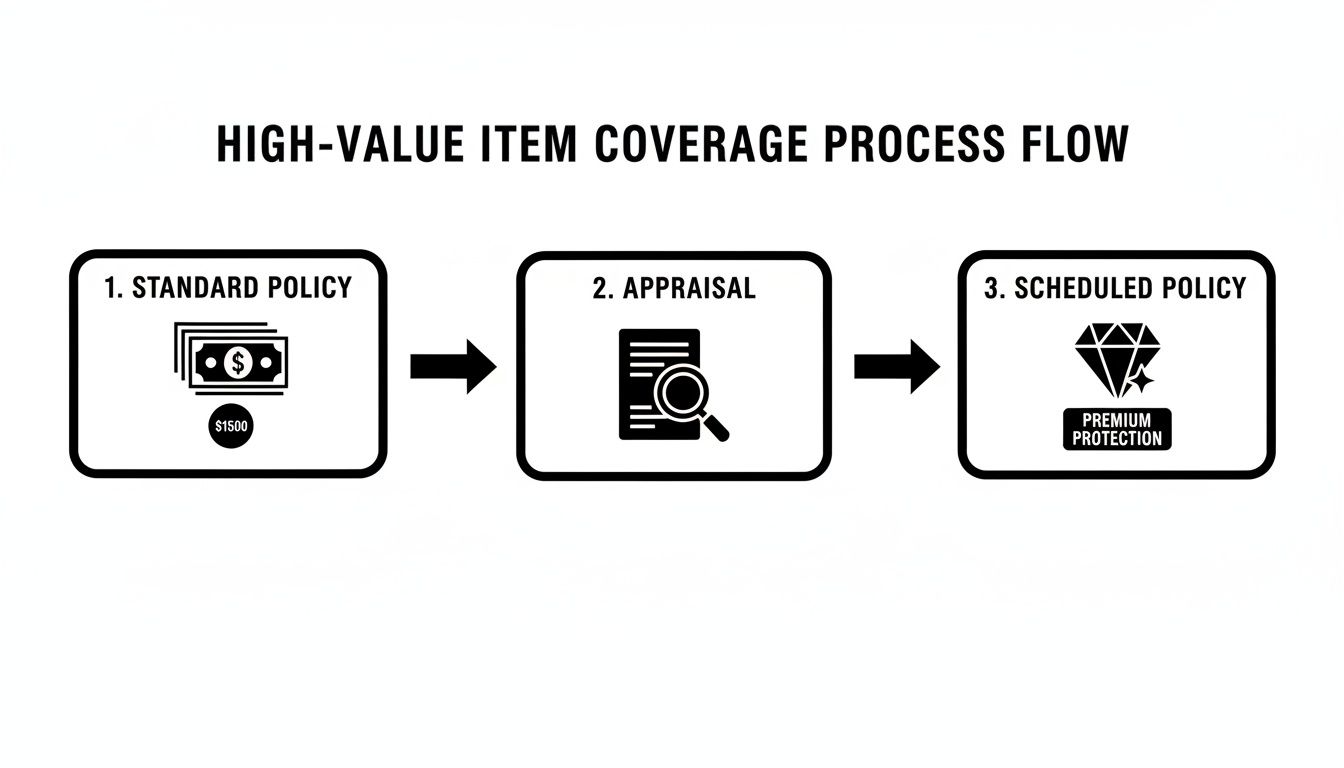
This process highlights that while a standard policy provides a good foundation, getting an appraisal and scheduling your high-value items is the only way to ensure they're fully covered.
Work closely with your adjuster, respond to their requests quickly, and keep copies of every email and note from every phone call. Navigating insurance can feel overwhelming, but great resources like our in-depth California insurance guides can help make your options and responsibilities crystal clear. By following these steps, you can turn a truly awful situation into a manageable one and make sure your renters insurance delivers the protection you've been paying for.
What’s Covered—And What Isn’t—When It Comes to Theft
To really get the most out of your renters insurance, you have to know its limits. Think of your policy like a great security system for your stuff—it handles most threats, but it’s not foolproof. Understanding what’s covered versus what’s excluded helps you set the right expectations and avoid nasty surprises if you ever have to file a claim.
Let’s start with the good stuff. Here are a few common scenarios where your renters insurance policy is designed to have your back, showing just how handy it can be.
A fantastic feature that many people don't know about is off-premises coverage. This means your belongings are protected even when you take them out of your apartment. Say a thief breaks your car window and swipes the laptop you left in the back seat—your renters policy can cover the laptop (though your auto insurance would handle the broken window). Or, if you’re working at a coffee shop and someone snatches your phone from the table, that's covered too.
Where Your Policy Draws the Line
Now, let's talk about the fine print. Every policy has exclusions, which are specific situations where the insurance company won’t pay out. These aren't sneaky loopholes; they're standard conditions that help define the scope of the policy and keep premiums affordable for everyone.
Here are the big three exclusions for theft that every renter should be aware of:
- Theft by a Roommate or Resident: Your policy is there to protect you from outsiders. Unfortunately, if someone you live with who is on the lease steals from you, the insurance company won't cover it.
- "Mysterious Disappearance": This is a tricky one. If an item simply goes missing and you have no evidence it was actually stolen (like a forced entry or a police report), it falls under "mysterious disappearance." That watch you can't find anywhere? Your policy probably won't cover it without proof of theft.
- Theft from an Unlocked Vehicle: Leaving your car unlocked is often viewed as failing to take reasonable care to protect your property. As a result, many policies will deny a claim for anything stolen from an unlocked vehicle.
Knowing these distinctions is key. It helps clarify that your policy is meant for clear-cut, verifiable cases of theft, not for disputes between housemates or situations stemming from carelessness.
Understanding Why a Claim Might Get Denied
Theft is one of the top reasons people file renters insurance claims. In fact, theft makes up a huge chunk of all personal property claims, and it's a stark reminder that your landlord's insurance offers zero protection for your personal belongings. While the average claim payout lands somewhere between $3,000 and $5,000, certain mistakes can easily lead to a denial. You can dig into these payouts and claim statistics to get a better sense of the numbers.
An insurance policy is a contract, and like any contract, it has rules. Knowing what’s excluded before you need to file a claim saves you from the shock and frustration of a denial.
One of the most common reasons for denial is a simple lack of evidence. If you can't provide a police report or some proof that you owned the stolen items (like receipts, photos, or credit card statements), it’s tough for an adjuster to approve your claim. This is precisely why creating a home inventory and reporting the crime immediately are so important.
By getting a handle on both what’s covered and what’s not, you can navigate the claims process with confidence, making sure your financial safety net works when you need it most.
Smart Ways to Prevent Theft and Lower Your Premium
Having a renters insurance policy is a fantastic safety net, but let's be honest—the best-case scenario is never having to use it. Taking a few proactive steps to secure your rental not only helps keep thieves at bay but can also knock a few dollars off your insurance premium. It’s a classic win-win: you get better peace of mind and save some money in the process.
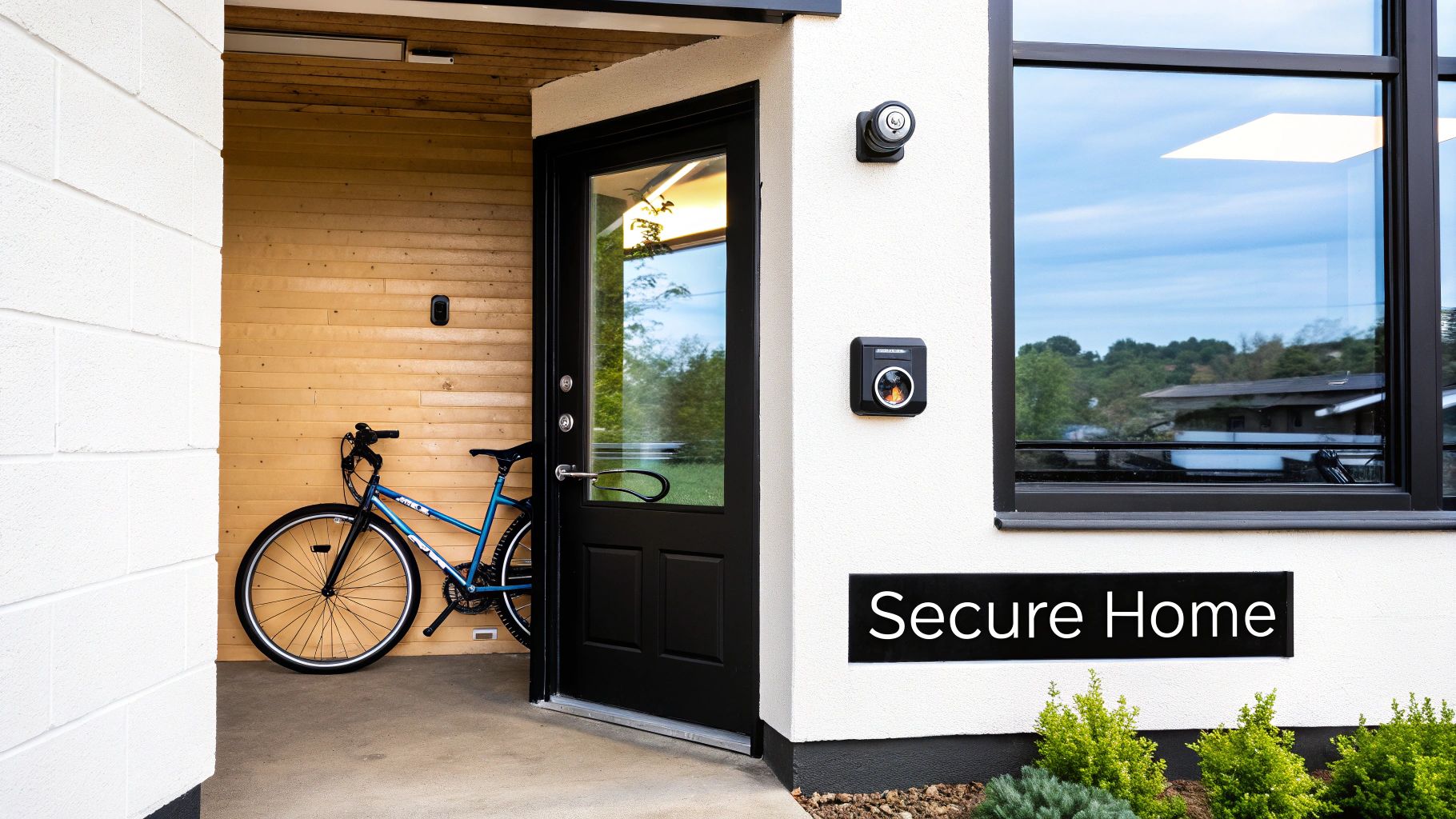
Insurance companies love to see that you're actively reducing your own risk. When you install certain security devices, you're signaling that your home is a tougher target, making a claim less likely. Many California insurers, including those you might know for auto insurance or home insurance, offer what are called "protective device discounts" for these efforts.
Fortify Your Physical Security
Your first line of defense is often the simplest. These are the tried-and-true physical upgrades that can make a would-be thief think twice before trying to get into your apartment or house.
- Install Deadbolts: A solid deadbolt is worlds away from the flimsy spring-bolt lock on most doorknobs. If your unit doesn't have one, it’s worth asking your landlord if you can add one.
- Secure Windows and Doors: Simple window locks are a must. For sliding glass doors, a cheap wooden dowel rod placed in the track is an incredibly effective, low-tech barrier.
- Use a Home Safe: For those truly irreplaceable items—passports, birth certificates, or valuable jewelry—a small, fireproof home safe is a smart investment.
These physical deterrents are all about creating friction. Burglars are looking for a quick and easy job; anything you do to slow them down makes your home a less attractive target.
Embrace Modern Security Technology
Beyond basic locks and bars, today's tech offers some powerful tools for protecting your space. Better yet, these are often the upgrades that qualify for the most significant insurance discounts.
Insurers see smart security systems not just as gadgets, but as active risk-management tools. A monitored alarm that automatically alerts the police can stop a theft in progress, saving thousands in potential losses and justifying a premium discount for you.
Think about adding a few of these to your setup:
- Smart Doorbells and Cameras: A video doorbell lets you see who's at your door from anywhere. Placing a few security cameras in key spots can capture crucial evidence and scare off anyone who doesn't want to be on film.
- Monitored Security Systems: This is the gold standard. A professionally monitored system from a company like ADT or SimpliSafe means that when a sensor is tripped, a team of pros is alerted and can dispatch the police for you.
- Smart Lighting: Nothing startles an intruder like a sudden floodlight. Motion-activated lights near your doors and windows can draw unwanted attention and send them running.
Practice Smart Digital Habits
In our hyper-connected world, home security extends beyond your front door. What you share online can easily—and accidentally—make you a target.
Think twice before posting those real-time vacation photos from the beach. Broadcasting to the world that you're away from home for a week is like putting out a welcome mat for burglars. It's much safer to wait until you're back to share all your travel stories and pictures.
By combining strong physical security, modern tech, and smarter online habits, you build layers of defense against theft. This comprehensive approach not only protects your belongings but also helps you get the best possible rates on your renters insurance policy.
Got More Questions? We've Got Answers
Even after you've got a handle on the basics, real-life situations can throw some curveballs. Let's tackle some of the most common questions California renters ask about theft coverage to clear up any lingering confusion.
Does Renters Insurance Cover Package Theft From My Doorstep?
Yes, most of the time it does. The moment that package is delivered and lands on your property, it's considered your personal possession. So if a porch pirate snags it, your personal property coverage should kick in, after you pay your deductible, of course. Just be sure to file a police report first—your insurance company will need it to process the claim.
What About My Car? If It's Broken Into, Am I Covered?
This is a classic point of confusion, and the answer is both yes and no. Your renters policy covers the stuff stolen from your car—like your laptop, phone, or that new jacket in the back seat. But it won't pay for the damage to the car itself, like a shattered window or a busted lock. That’s a job for the comprehensive coverage on your auto insurance policy. It's a perfect example of how these two policies work as a team.
Think of it this way: Your auto policy protects the car itself, while your renters policy protects your belongings inside it. Together, they create a complete safety net.
Will My Premium Go Up if I File a Theft Claim?
It might. Filing any claim can signal a higher risk to insurers, which could lead to a rate increase when it's time to renew. It's not a guarantee, but it's a possibility. Before you file, do a quick calculation. If the value of what was stolen is only slightly more than your deductible, it might be better to cover the loss yourself. But for a major theft, the financial help from your policy will almost always outweigh a small potential bump in your premium.
What if My Roommate Is the One Who Stole From Me?
This is a tough one, but unfortunately, the answer is no. Standard renters policies have a clear exclusion for theft by anyone living in the household, and that includes roommates listed on the lease. Insurance is designed to protect you from outside risks, not conflicts that happen under your own roof.
We've covered a lot here, but insurance can get tricky. If you're still curious about other scenarios, our detailed insurance FAQ page has a ton of information on everything from car insurance to life insurance.
For a personalized review of your insurance needs—from renters and auto to home and life policies—the licensed agents at Mai & Associates are here to help. Get a free, no-obligation quote and see how easy it is to secure the right protection for your California lifestyle at https://cahomeauto.com.