Renters Insurance Cost Per Month in California
Most California renters pay about $13 to $19 per month for a standard policy. That's the starting range here, and it widens fast once you change coverage limits, deductible, and city.
Too many articles throw out a national average and stop there. That's not useful if you rent in California, where a quote in Fresno won't look the same as a quote in Los Angeles or San Francisco, and a lean policy won't price like one built with higher contents limits and broader liability. If you want the renters insurance cost per month that applies to your situation, you need to look at the levers that move the bill, not just the headline number.
What California Renters Actually Pay Each Month
California renters usually budget about $13 to $19 per month for a standard policy, based on published statewide estimates that cluster in that range and a midpoint estimate of $15.55 per month (California renters insurance pricing estimates). That range is more useful than the recycled national average because it reflects California pricing first.
Here is the part renters miss. A monthly bill near the low end usually means lower contents limits, a higher deductible, or both. A bill near the high end often means more personal property coverage, more liability protection, or a pricier ZIP code. The price changes because the policy changed.
National averages still help as a rough reference point, but they should not drive your budget in California. A national cost comparison shows how wide pricing can get even within standard HO-4 renters coverage when the policy structure is richer (national renters insurance cost comparison).
Typical Monthly Renters Insurance Cost California vs National
| Market | Low End / Month | Midpoint / Month | High End / Month |
|---|---|---|---|
| California | $13 | $15.55 | $19 |
| National | $13 | about $20 | $22 |
Use that table the right way. It gives you a budgeting range, not your final number.
If you are comparing quotes, line up the three settings that matter first: personal property limit, liability limit, and deductible. If one quote has a lower premium because it cuts your belongings coverage in half, that is not a cheaper apples-to-apples option. It is a smaller policy.
My advice is simple. Start with a California benchmark, then adjust only one lever at a time so you can see what each choice costs you per month. If you want a local starting point before you quote, review this California renters insurance guide.
What Renters Insurance Really Covers
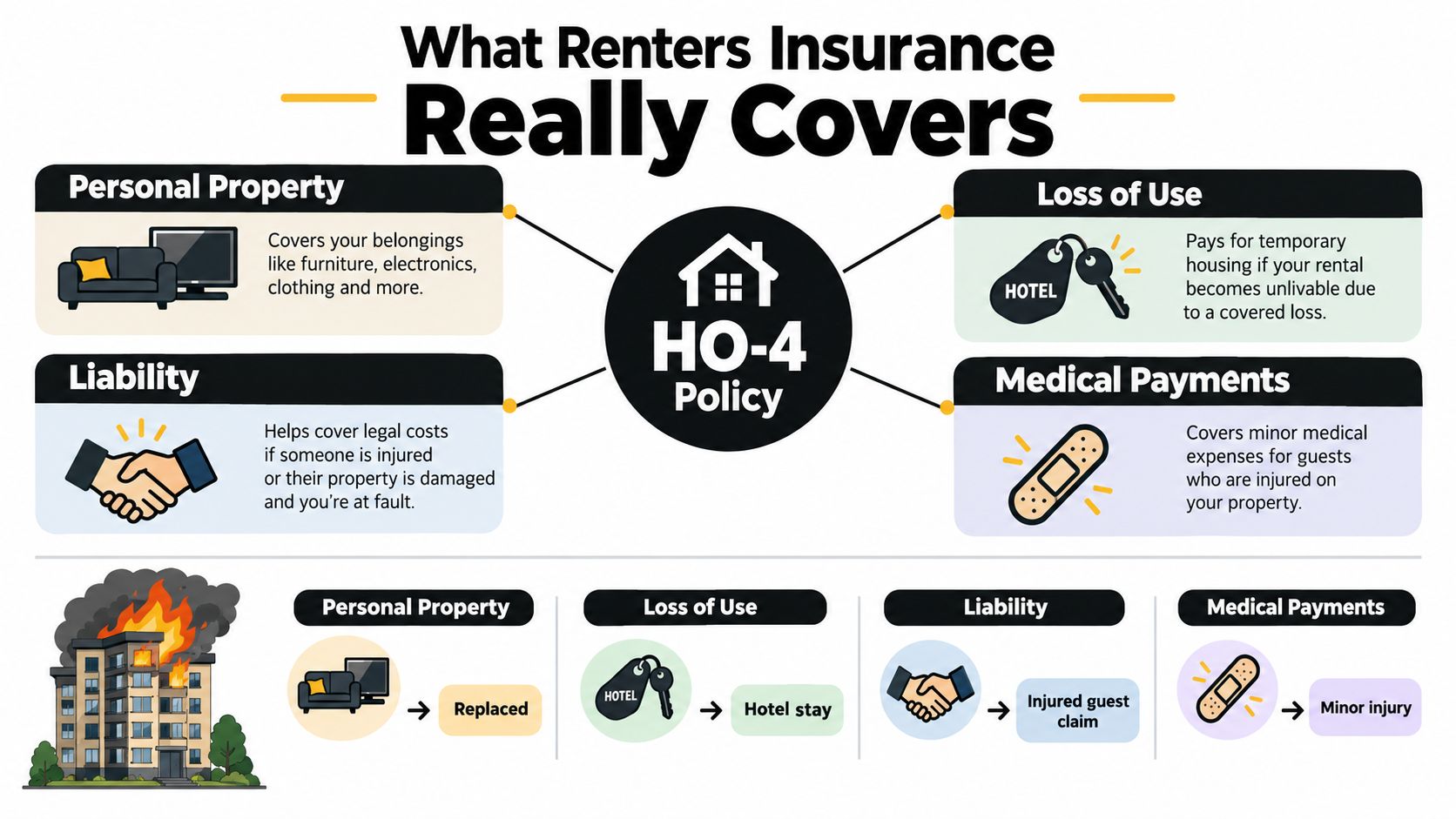
Most renters understand they need insurance for “their stuff,” but that's only part of the policy. A standard HO-4 renters policy is really four protections bundled together.
Personal Property and Loss of Use
Start with a basic apartment fire example. Your landlord's policy usually covers the building. It doesn't replace your couch, your laptop, your clothes, your dishes, your mattress, or the headphones sitting on the kitchen counter.
Personal property coverage pays for covered damage or theft to the belongings you own inside the rental. That includes:
- Furniture and bedding such as your couch, bed frame, mattress, and dresser
- Electronics like laptops, TVs, tablets, gaming systems, and phones
- Clothing and shoes that would be expensive to replace all at once
- Kitchen gear including cookware, dishes, and small appliances
If that same fire makes the unit unlivable, additional living expenses, often called loss of use, can help with temporary hotel stays and extra food costs while the place is being repaired.
Your landlord insures the structure. You insure the life you've built inside it.
That distinction matters more than most first-time renters realize. If you've never totaled up your belongings, do it once and you'll stop thinking renters insurance is optional.
Liability and Medical Payments
The part many renters overlook is liability coverage. Say smoke or water damage from your unit affects the neighbor below. Or a guest gets hurt in your apartment and blames you. Liability coverage is there for those kinds of claims.
A standard policy also includes medical payments to others. That portion handles smaller injury claims without turning every incident into a lawsuit. It's not a substitute for liability protection, but it can smooth out minor situations before they become larger ones.
Here's what standard renters insurance usually doesn't cover without separate handling:
- Flood damage
- Earthquake damage
- High-value jewelry beyond policy sub-limits
- A roommate's belongings unless they're named or separately insured
If you're comparing it with owner coverage, California home insurance options are built very differently because the property ownership risk is completely different.
The Six Factors That Move Your Monthly Premium
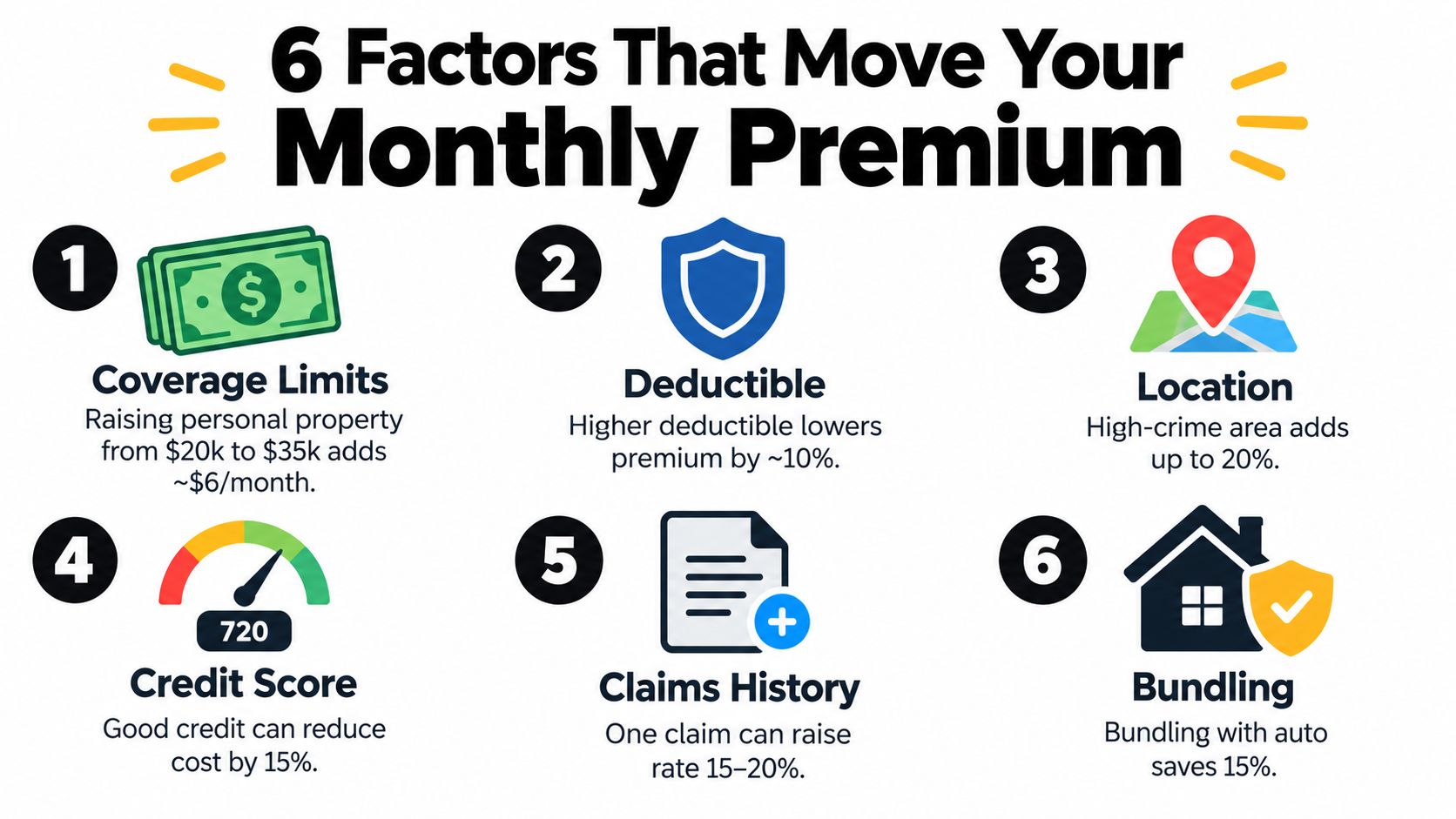
Your renters insurance bill is not random. In California, the monthly number usually moves for six clear reasons, and every one of them gives you a lever to pull.
Coverage Limits and Deductible
Start with the two settings that change price fastest: your personal property limit and your deductible.
A California-focused pricing example puts a renters policy at about $25 per month with $40,000 in personal property coverage, $300,000 in liability coverage, and a $1,000 deductible (California policy assumption example). That tracks with what I see in real quotes. More coverage for your stuff means a higher premium. A higher deductible usually pushes the monthly bill down.
Renters overspend here. They guess high on belongings, then pick a low deductible because it feels safer. That combination raises the premium fast. Price your belongings honestly, then choose a deductible you could cover from savings.
ZIP Code and Local Claim Risk
Your address matters. A lot.
In California, two renters with similar belongings can still get different prices because the carrier sees different theft risk, fire exposure, building density, and local claims history. San Francisco, Los Angeles, Sacramento, and inland cities do not price the same. Even within the same city, one ZIP code can come in cleaner than another.
Agent view: Your ZIP code is one of the fastest ways an insurer decides whether your quote starts low or starts expensive.
You cannot change your neighborhood just to save a few dollars on insurance. You can make sure the rest of the policy is tight. If your ZIP code already pushes pricing up, do not add unnecessary coverage limits on top of it.
Liability Limit Selection
Liability is cheap for what it does. Do not gut it to save a couple dollars.
Renters who focus only on personal property often miss the bigger financial risk. Water damage to another unit, a kitchen fire that spreads, or an injury claim from a guest can cost far more than your couch, TV, and clothes. Raising liability from a bare minimum level to a stronger one can increase the premium, but it usually does not increase it by much.
My recommendation is simple. Keep enough liability coverage to protect your income and savings. Cut waste in the contents limit first, not here.
Building Type and Security Features
The building itself affects the quote, even though you do not own it.
A controlled-access apartment, on-site management, smoke alarms, sprinkler protection, and a lower-theft setup can all help pricing. Older buildings, easier street access, and properties with more frequent claims can push it the other way. Carriers rate that risk differently, which is why one company may like your building and another may not.
If your complex has security gates, monitored fire protection, or other safety features, make sure they make it onto the application. Missing details can leave money on the table.
Your Claims History
Small claims can get expensive later.
If you have filed prior renters or property claims, some carriers will charge more, limit options, or decline the risk altogether. That is one reason I tell California renters not to file a claim for every minor loss. If the damage is only a little above your deductible, paying out of pocket can be the smarter move.
Insurance is there for losses that would hurt your finances, not every inconvenience.
Discounts and Payment Choices
Discounts are the easiest savings lever because they do not reduce protection.
The most common ones are bundling with auto, choosing paperless delivery, setting up automatic payments, and paying in full instead of monthly installments. Not every carrier rewards each option the same way, but the pattern is consistent. Clean up the payment setup and ask for every available discount before you buy.
For many California renters, bundling auto and renters is the fastest path to a lower monthly bill. If you want the short version, use these levers in order: set accurate contents coverage, raise the deductible to a level you can afford, keep solid liability, and then stack every discount the carrier offers.
Real Monthly Cost Scenarios for California Renters
Find the profile closest to yours below to estimate your own monthly bill.
This section is where renters usually stop guessing. State averages are useful, but profile-based examples are what make the number feel real.
Four California renter profiles
| Renter Profile | City | Coverage & Deductible | Est. Monthly Cost |
|---|---|---|---|
| Studio renter | Sacramento | Lean contents coverage with a standard deductible | $13 to $15 |
| Family in a two-bedroom apartment | Los Angeles | Higher contents coverage with a higher deductible | $19 to $23 |
| Graduate student with bundled policies | Berkeley | Lower contents coverage with bundled auto | $11 to $14 |
| Remote worker with expensive electronics | San Francisco | High contents coverage and added earthquake handling | $26 to $32 |
How to read the profiles
The Sacramento studio renter is the clean baseline. This renter owns enough to need real protection, but not so much that the contents limit gets pushed high. That's where California's lower-end monthly pricing often makes sense.
The Los Angeles family profile costs more for one obvious reason. More people usually means more stuff. More furniture, more clothing, more electronics, more kitchen gear. Even with a higher deductible helping hold the price down, the contents limit carries more weight.
The Berkeley graduate student profile works because the coverage need is narrower and a bundle can make the quote more efficient. This is the kind of renter who shouldn't overinsure just because a website told them to round up aggressively.
Match your policy to your inventory, not to someone else's apartment.
The San Francisco remote worker is the profile that catches people off guard. Once you add more expensive electronics and separate earthquake handling, the renters insurance cost per month moves out of the teens. That isn't overpaying. That's what happens when the policy reflects the risk.
If you want more examples of how California coverage choices stack up in real households, the Mai & Associates blog has broader insurance comparisons that help when you're quoting renters and auto coverage side by side.
How to Lower Your Renters Insurance Cost This Week
Start with the quote in front of you. Don't start with wishful thinking.
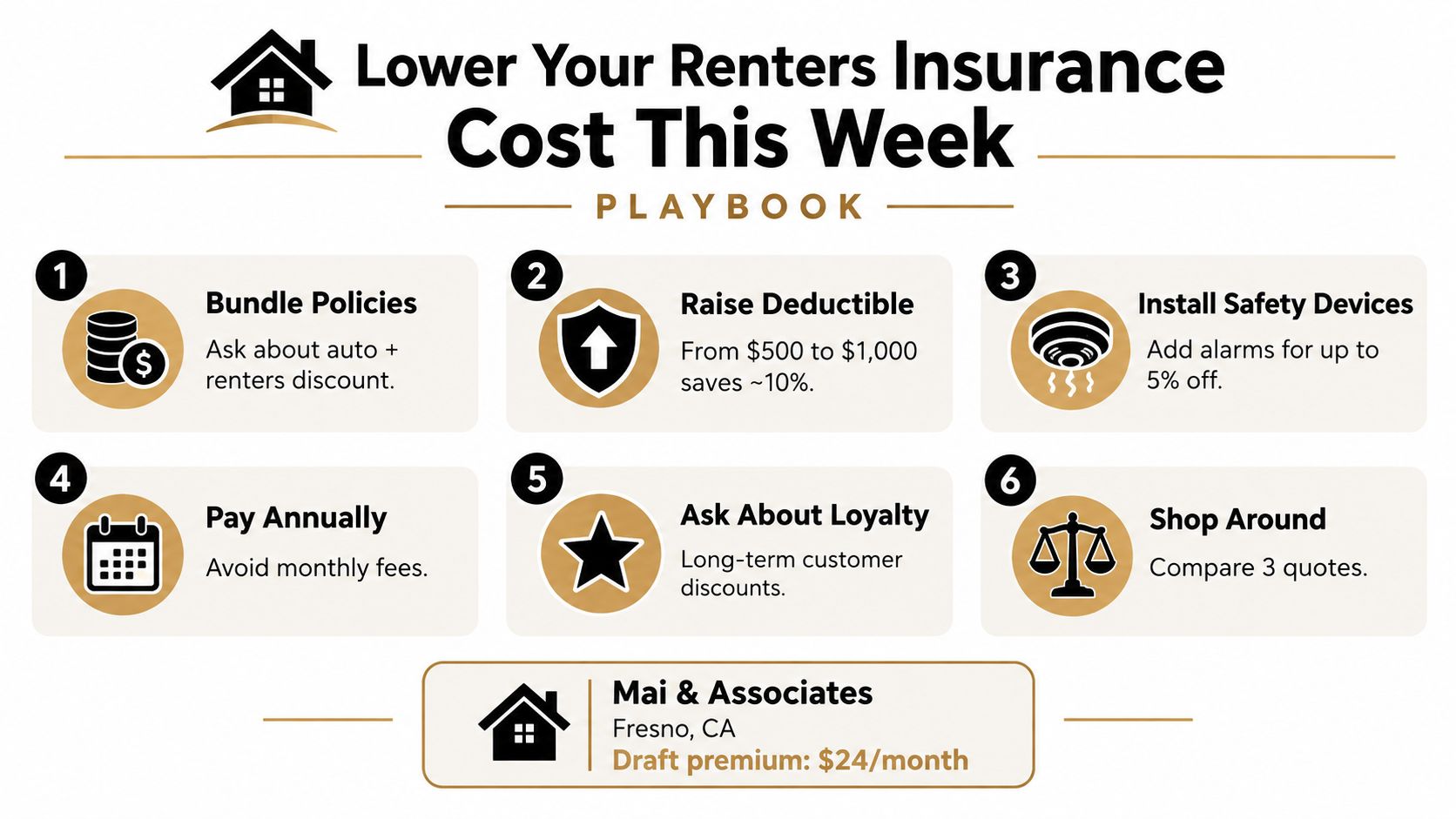
Say a Fresno renter gets an initial draft premium of $24 per month. That number might be fair. It might also include padding the renter doesn't need, or a deductible choice that's making the policy more expensive than necessary. The point is to edit the quote with intention.
A practical quote cleanup
Here's how I'd work that Fresno quote:
Raise the deductible if you can comfortably absorb more out of pocket.
If the quote is built with a lower deductible, moving to a higher one usually trims the monthly bill because the insurer is taking on less small-loss exposure.Bundle it with your existing auto policy.
This is one of the cleanest savings levers available when the carrier offers a multi-policy discount. It also helps keep your car insurance and renters paperwork under one roof.Check for safety-device discounts.
Smoke alarms, monitored systems, and smart locks can help, depending on the carrier's rules.Pay annually if the math works.
Monthly installments can carry extra fees. Paying in one shot can simplify the total cost.Fix the contents limit.
If the quote assumes more personal property than you own, cut it back to a realistic number.
Where renters waste money
The biggest mistake I see is buying a policy based on fear instead of inventory. People guess high because they don't want to be underinsured, then they spend the next year paying for coverage they never needed.
The fix is straightforward:
- Walk room by room: List furniture, clothing, electronics, kitchen items, and anything you'd replace after a loss.
- Choose a deductible on purpose: Don't default to the lowest one just because it sounds safer.
- Ask for side-by-side quote versions: Same carrier, different limits, different deductible.
One option California renters use for that quote comparison is Mai & Associates, which offers renters quotes from multiple carriers and lets you compare combinations before you bind a policy. That matters because discounts and policy design vary by company, and the fastest way to lower renters insurance cost per month is often to compare the same coverage structure across more than one carrier.
Get Your Same-Day Quote From Mai and Associates
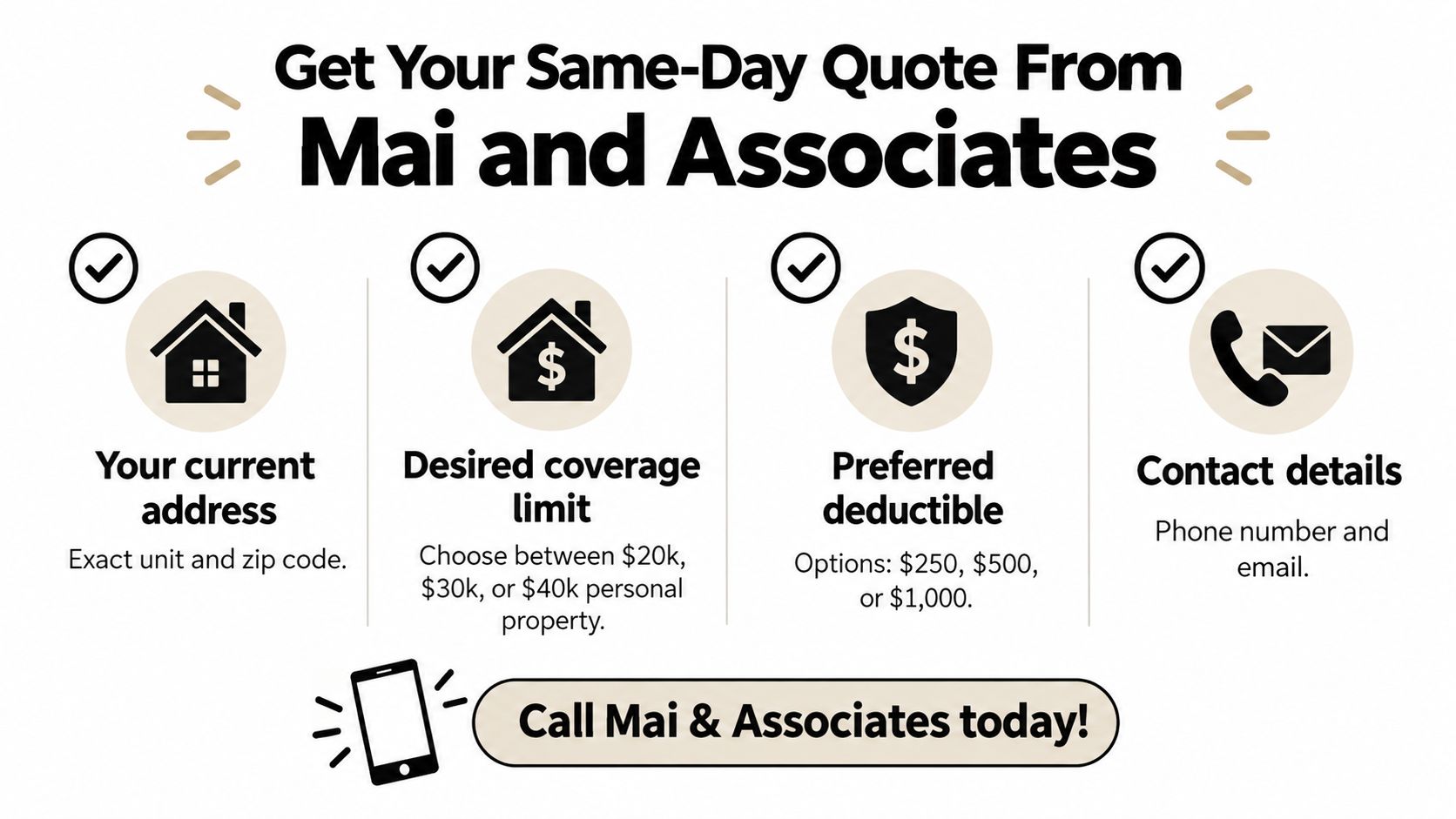
If you're ready to stop estimating and get a real number, make the process easy on yourself. Have four things ready before you call or request a quote online.
What to gather first
- Your current address: Exact unit address and ZIP code matter.
- Your desired coverage limit: Pick a personal property target that fits what you own.
- Your deductible preference: Decide whether you want a lower out-of-pocket threshold or a lower monthly premium.
- Your prior claims information: Be ready to answer clearly.
Why this step matters
A real quote gets accurate when the inputs are accurate. If you're vague about your contents limit or deductible, the policy gets built on assumptions, and assumptions are where overpaying starts.
Mai & Associates can walk through standard HO-4 terms line by line, including limits, exclusions, and earthquake options, so you're not clicking through a form without understanding what you're buying. If you want to start that process online, use the California insurance quote request page.
This is also the right time to look at the bigger household picture. Many California renters are also reviewing auto insurance, home insurance for family members, and even life insurance at the same time. That doesn't mean you should buy everything at once. It means you should quote intelligently, so each policy fits the budget and the exposure.
Contact Mai & Associates today to lock in a California renters insurance policy that matches both your budget and your risk profile.
If you want a renters policy that fits your apartment, your belongings, and your budget, Mai & Associates can help you compare real California options without guesswork. They handle renters, auto, home, and life coverage across the state, and you can start with a no-obligation quote at Mai & Associates.