Finding the Best California Renters Insurance Companies for 2026

For many California renters, insurance feels like just another line item on a lease agreement—a box to check before you get the keys. But the best renters insurance companies offer something far more valuable than just compliance. They provide a real financial safety net, often for just a few dollars a day. A solid policy protects everything you’ve worked for and shields you from personal liability in one of the most expensive states in the country. This is a key part of your overall California insurance portfolio.
Why Renters Insurance Is a Financial Lifeline in California

Treating renters insurance as an afterthought in California is a gamble you can't afford to take. While your landlord's policy covers the building itself, it does absolutely nothing for your personal belongings or to defend you in a lawsuit. A renters policy is your personal line of defense when things go wrong.
Think about it: a kitchen fire, a burst pipe from the unit above, or a break-in. Without insurance, you're on the hook for replacing your laptop, furniture, clothes, and everything else out of your own pocket. A standard policy includes crucial personal property coverage, ensuring you can get back on your feet without wiping out your savings.
Core Benefits for California Renters
Beyond just protecting your stuff, a quality policy from a reputable carrier offers layers of security that are essential for life in the Golden State. These aren't abstract concepts; they solve real, and often expensive, problems.
- Personal Liability Protection: If a guest slips and gets hurt in your apartment, or you accidentally flood your neighbor's unit below, you could be on the hook for thousands in medical bills or repairs. This coverage handles the legal fees and settlement costs, protecting your current assets and future wages.
- Additional Living Expenses (ALE): Should a fire or major water damage make your rental uninhabitable, ALE is a lifesaver. It pays for your hotel, meals, and other temporary living costs. This is invaluable when displacement can drag on for weeks or even months.
- Peace of Mind: Honestly, just knowing you're covered provides incredible peace of mind. For a small monthly premium, you're essentially transferring a huge amount of financial risk from your shoulders to the insurance company.
This kind of protection is no longer a niche product. The global renters insurance market is projected to grow from $89.22 billion in 2023 to an estimated $121.28 billion by 2028. California, with its devastating wildfire seasons and high cost of living, is a huge part of that trend as more renters seek to avoid uninsured losses.
A common myth we hear all the time is that renters insurance is too expensive. In reality, the value it delivers for the price is incredible. For what you'd spend on a few coffees each month, you get tens of thousands of dollars in protection.
This guide is designed to help you compare the top renters insurance companies and find a policy that truly fits your needs. Remember, bundling your renters policy with auto insurance can often unlock some of the best discounts available. Understanding your options for renters insurance, car insurance, and even life insurance is a cornerstone of building a solid financial future with comprehensive California insurance. You can dive deeper into these topics in our complete guide to renters insurance in California.
How to Actually Compare Renters Insurance Companies
Shopping for renters insurance in California can feel like you're just comparing a bunch of names and numbers. Every company promises the best price and the easiest service, but how do you cut through the noise? It’s about looking past the monthly premium to find a policy that will truly have your back when things go wrong.
The market is exploding for a reason. Projections show the global renters insurance industry hitting $107.53 billion by 2026, largely because more people are renting in places like California. There's also a growing awareness that a standard lease won't protect you from risks like wildfires, a very real threat here. You can dig into the numbers yourself in this report on the global renters insurance market.
Price vs. Real-World Value
Let’s be honest: the cheapest policy is almost never the best one. True affordability is about finding that sweet spot between a low premium and coverage that won’t leave you paying out-of-pocket after a disaster. A policy with a rock-bottom price might be hiding a sky-high deductible or coverage limits that are way too low.
Think about it this way: your $2,000 laptop gets stolen. If your policy has a $250 deductible, you get a check for $1,750. That’s a manageable loss. But if that "cheap" policy you bought came with a $1,000 deductible, you'd only get $1,000 back. Your premium savings just vanished in an instant.
When looking at cost, always ask yourself:
- What are my deductible options, and how much does changing it save me per month?
- Do my personal property limits actually cover what my stuff is worth?
- Are there any discounts I can get, like bundling my auto insurance or car insurance?
Is the Coverage Right for Your Life?
A generic, one-size-fits-all policy is a terrible fit for most California renters. Your lifestyle, where you live, and what you own should dictate your coverage. Sure, a standard policy covers the basics—fire, theft, some water damage—but the exclusions are what you really need to pay attention to.
For example, a standard policy will not cover earthquake damage. That's a massive gap for anyone living in California. Likewise, if you own expensive jewelry, a nice bicycle, or professional camera gear, you’ll probably need to add a special endorsement (or "rider") to insure those items for what they're actually worth. The best renters insurance companies make it easy to tailor a policy to your specific needs. If you run into any confusing terms, our comprehensive insurance glossary is a great resource.
What Happens When You Actually Need to File a Claim?
When you have to use your insurance, the last thing you want is a clunky claims process or an agent you can't get ahold of. The customer experience isn't just a bonus feature; it's a critical part of what you're paying for. A company's reputation for handling claims fairly and quickly is everything.
A seamless claims experience is not a luxury; it's a core component of the product you are buying. An insurer that makes it difficult to get help during a crisis is failing to deliver on its fundamental promise.
Before you sign on the dotted line, do a little digging. Check out claims satisfaction ratings from independent sources and read reviews about how the company communicates during the claims process. An insurer with a modern app for filing claims and 24/7 support can make a stressful situation far less painful. This is also where an independent agent, like someone from our team at Mai & Associates, can be a huge asset—they work for you and can advocate on your behalf with any California insurance provider.
Can the Company Actually Pay Its Claims?
Finally, an insurance policy is just a promise. You need to be sure the company has the financial strength to keep that promise. Financial stability ratings from firms like A.M. Best are a great way to check an insurer's ability to pay its claims, even after a major disaster.
Always look for a carrier with a top-tier rating (an "A" or better). This gives you peace of mind that the company has the cash reserves to handle a high volume of claims at once. For renters in California, where a single wildfire can trigger thousands of claims, this isn't just a minor detail—it's essential for all types of California insurance, from renters insurance to home insurance.
Comparing California's Top Renters Insurance Providers
Trying to pick between renters insurance companies can feel like a chore. They all claim to be the best, but the truth is, the "best" policy is the one that actually fits your life here in California. A policy that's perfect for a student in a downtown L.A. apartment is probably all wrong for a family renting a house in a wildfire-prone area.
Instead of just giving you a generic pro-con list, let's look at this from a real-world perspective. We’ll break down some top providers based on the kinds of people they serve best. This way, you can find the company that offers you the most genuine value, not just the cheapest price tag.
When you're weighing your options, it really boils down to four key things.
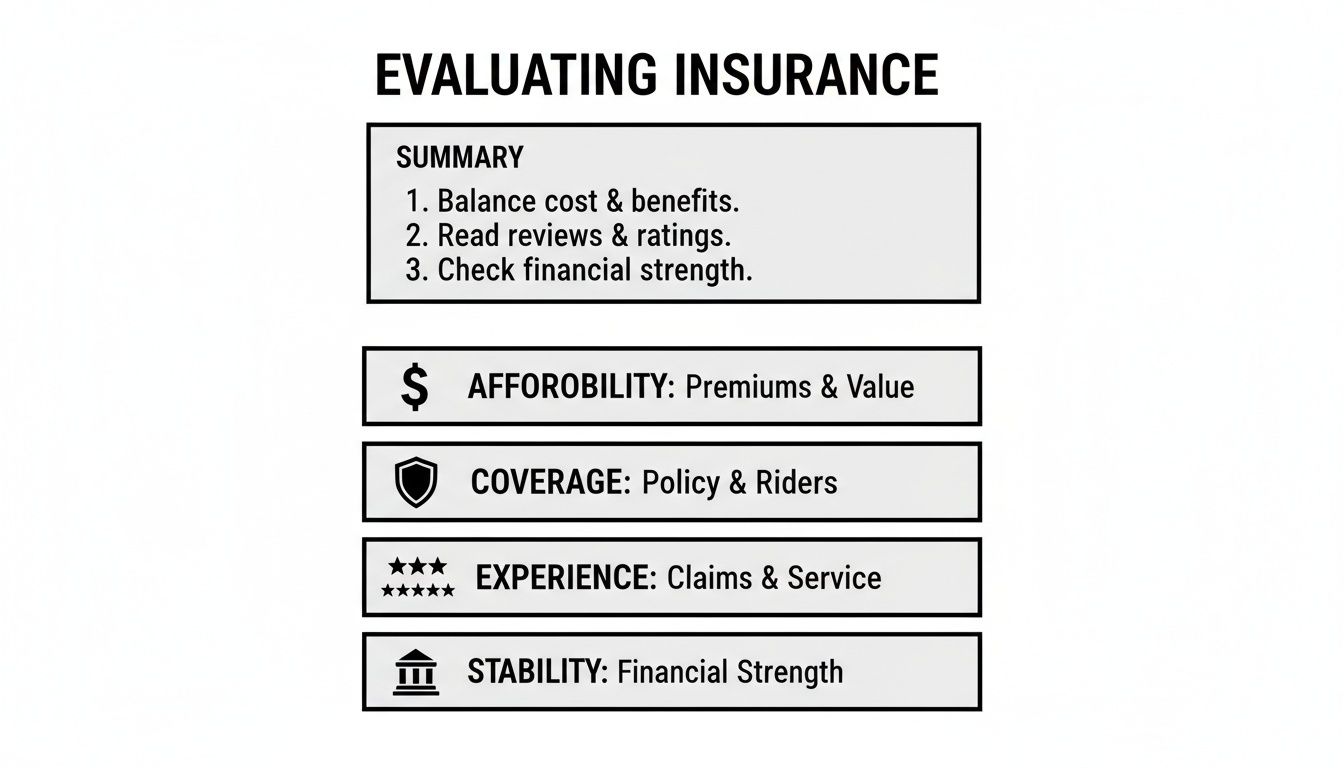
Think of it this way: you need a policy that's affordable, provides the right protection, is backed by a company that's easy to deal with, and won't go broke when you need them.
To make this easier, we've put together a table highlighting some popular carriers and where they shine for different types of California renters.
California Renters Insurance Company Comparison
| Insurance Company | Ideal California Renter Profile | Key Strength | Wildfire/Earthquake Coverage Options | Available Discounts |
|---|---|---|---|---|
| Lemonade | Budget-conscious urban renters, students | Fast, app-based experience and low premiums | Basic coverage; earthquake is often available as an add-on, but wildfire can be difficult in high-risk zones. | Often fewer than traditional carriers; focuses on a low base price. |
| State Farm | Families, bundlers, those wanting an agent | Strong agent network and excellent bundling discounts | Earthquake coverage is typically available as an endorsement. Wildfire coverage depends on location and risk score. | Multi-policy (auto/life), home safety devices, claims-free. |
| Farmers | Renters needing higher liability & customization | Customizable policies and high liability limits | Offers earthquake endorsements. May have stricter underwriting for properties in high-risk wildfire areas. | Bundling, safety features, professional group affiliations. |
| Travelers | Renters in high-risk zones or with unique assets | Experience with complex risks and flexible underwriting | Provides earthquake endorsements. Can be more accommodating in some moderate-risk wildfire areas than other carriers. | Multi-policy, good student, claims-free, protective devices. |
This table gives you a starting point. Remember, the best way to find your fit is to compare quotes based on your specific address and coverage needs.
The Budget-Conscious Urban Renter
If you're a student or a young professional living in a city like San Diego or San Francisco, every dollar probably counts. You're mainly looking for low monthly payments, a simple digital process, and enough coverage for your laptop, furniture, and other basics.
A company like Lemonade really clicks with this crowd. Their entire model is built around a slick mobile app, instant quotes, and some of the lowest starting premiums you'll find. The standard policy covers your stuff (personal property), protects you from lawsuits (personal liability), and helps with temporary living costs (loss of use), checking all the boxes for most landlords.
The flip side? For that convenience, you might get less hands-on support during a complicated claim and fewer options for covering high-value items. It's a fantastic choice for someone whose main goal is to get essential, affordable coverage in a matter of minutes.
For the tech-savvy renter who puts speed and a low monthly payment first, a digital-first insurer is tough to beat. They offer a no-fuss way to get insured.
The Family Renting a Single-Family Home
It’s a different story for a family renting a suburban house. You’ve got more stuff, which means you need higher personal property limits. More importantly, your liability risk is much higher. A guest tripping at your backyard BBQ or a kid’s friend getting hurt on the trampoline can escalate into a serious lawsuit.
This is where traditional carriers like State Farm or Farmers Insurance really prove their worth. They are comfortable offering much higher liability limits, often starting at $300,000 and going up to $1 million or more. These established companies also have a long list of discounts that families can easily tap into.
- Multi-Policy Bundles: The biggest money-saver by far is bundling your renters insurance with your auto insurance. The discount is often so significant that the combined package costs less than buying them separately.
- Home Safety Discounts: Got smoke detectors, a fire extinguisher, or a security system? That’ll knock a few more dollars off your premium.
- Loyalty and Claims-Free Discounts: Insurance companies reward you for sticking around and not filing claims.
These carriers also make it easy to add extra coverage (riders) for valuables like jewelry, art, or musical instruments. And for many, having a local agent to call for advice is a huge plus—something a chatbot just can't replicate.
The Renter in a High-Risk Zone
Renting in a part of California prone to wildfires or earthquakes demands a whole other level of planning. A standard renters policy from almost any company will explicitly exclude damage from these events, leaving a massive and dangerous gap in your protection.
This is precisely where working with a specialized California insurance agency like Mai & Associates becomes essential. We know which carriers offer earthquake endorsements and which situations call for a separate Difference in Conditions (DIC) policy. For renters in wildfire zones, we can help you navigate the California FAIR Plan and pair it with a companion policy that covers your liability and belongings.
In these complex situations, we might look at a provider like Travelers or Chubb. They have deep experience with high-value properties and complicated risk profiles, which means they can offer more flexible coverage built for California’s realities. Their premiums might be higher, but the peace of mind they provide is invaluable. This is where a deep understanding of home insurance principles becomes vital for renters, as the risks are the same. A truly comprehensive plan might even include a discussion about life insurance to ensure your family is protected no matter what happens.
Navigating California-Specific Insurance Risks
Renting in California is unlike renting anywhere else, and that goes for your insurance, too. You're not just protecting your stuff from a leaky pipe or a break-in; you're living with the very real, and often excluded, risks of earthquakes and wildfires. The standard policy you get from most renters insurance companies is a good start, but it’s what’s not in the fine print that can really hurt you.
A basic policy will cover the usual suspects—fire, theft, liability. But here's the catch: it will almost always have explicit exclusions for damage from earthquakes and floods. In a state like California, that’s a massive gap in your financial safety net. If an earthquake hits, your standard policy won't pay a dime to replace your belongings or cover your rent somewhere else.
Wildfire and Earthquake Coverage Gaps
So, what do you do about the big risks? You have to get proactive and find the right add-ons, because your basic policy simply won't cut it.
- Earthquake Coverage: This is never standard. You’ll need to add it as an endorsement to your existing renters policy or buy a separate, standalone earthquake policy. It's designed to cover your personal property and, just as importantly, pay for additional living expenses if a quake leaves your rental unlivable.
- Wildfire Coverage: This one is tricky. While "fire" is a covered event, the reality of living in a high-risk wildfire zone changes the game. Insurers might charge sky-high premiums, or worse, refuse to offer you a policy at all.
When you get turned down for coverage because of wildfire risk, you’re not out of options. That’s where the California FAIR Plan comes in. Think of it as a state-created insurer of last resort.
The FAIR Plan provides basic fire insurance when the private market won't. But—and this is a big but—a FAIR Plan policy for a renter typically only covers fire, lightning, and internal explosion. It leaves out essentials like liability and theft protection.
To patch up those huge holes, you need to combine the FAIR Plan policy with something called a Difference in Conditions (DIC) policy. The DIC policy "wraps around" the FAIR Plan, adding back the crucial coverages like personal liability, theft, and water damage to give you a more complete policy. It's a bit complicated, which is why understanding the principles of home insurance is so valuable even for renters. You can dig deeper into this on our guide to California home insurance options.
Why California’s High Cost of Living Affects Your Liability Needs
Beyond natural disasters, your liability coverage needs a serious look. This is the part of your policy that pays out if you’re held responsible for injuring someone or damaging their property. The default $100,000 limit that comes with most basic policies is dangerously low for California.
A simple slip-and-fall in your apartment could easily rack up medical bills and legal fees that blow past that number. Given the state's high medical costs and litigious environment, we strongly recommend carrying at least $300,000 or $500,000 in liability coverage. It’s the best way to protect your current assets and, more importantly, your future earnings from a lawsuit. A great way to get this higher limit affordably is by bundling your renters insurance with your auto insurance or car insurance.
The need for robust coverage is clear. North America accounts for over 40% of the global renters insurance market, and in California, that need is even more pronounced. We’ve seen how events like wildfires have doubled insurance inquiries. A good policy, which can cover $30,000 in personal belongings for a small daily cost, is a non-negotiable buffer. To learn more about these trends, you can review these renters insurance regional insights. An agency like Mai & Associates can look at your entire financial situation, including your life insurance, to make sure your renters policy is truly working to protect you.
Proven Strategies to Lower Your Renters Insurance Premium
Finding affordable protection from top-tier renters insurance companies in California doesn't mean you have to sacrifice coverage. It's really just a matter of knowing where the savings are. With a few practical moves, you can lower your premium without compromising the protection you need for your belongings.
The single biggest discount is usually the easiest to get: bundling. If you have both your renters insurance and auto insurance (or car insurance) with the same company, they'll almost always give you a multi-policy discount. You'd be surprised how often the combined price is cheaper than paying for each policy separately from different insurers.
Proactive Steps for Immediate Savings
Beyond bundling, insurance companies will reward you for being a lower-risk customer. The most direct way to prove that is by beefing up the safety and security of your rental.
- Security Systems: A professionally monitored alarm that contacts the police or fire department is a big one. It shows you're serious about preventing theft and fire, which can earn you a nice discount.
- Smoke Detectors and Fire Extinguishers: You already have smoke detectors, but some carriers will knock a little extra off your premium if you also have a fire extinguisher on hand.
- Deadbolts and Window Locks: Even simple hardware upgrades like high-quality deadbolts show an insurer you're actively trying to prevent break-ins.
Think of it from their perspective. Every step you take to prevent a loss—whether from theft or fire—makes you a more appealing customer. That proactive approach often translates directly into a better price on your policy.
Adjusting Your Policy for a Lower Rate
You also have direct control over your premium through your deductible. The deductible is simply the amount you agree to pay out-of-pocket for a covered loss before your insurance kicks in.
Opting for a higher deductible means you're taking on a little more of the initial financial risk. In return, your insurer lowers your premium. For instance, raising your deductible from $500 to $1,000 can often cut your premium by 10-15% or even more.
This is a classic trade-off. A higher deductible feels great on your monthly bill, but it means you'll pay more upfront if your laptop gets stolen. If you tend to be careful and haven't filed claims in the past, this can be a smart way to save money year after year.
Finally, don't overlook your financial habits. In California, many insurers look at a credit-based insurance score when setting rates for policies like renters insurance and home insurance. A strong credit history suggests financial responsibility, which can lead to more favorable pricing. While it's just one piece of the puzzle, it shows how good financial health can create savings in unexpected places, even on other products like life insurance. The real key is to explore all your options and get quotes from a few different companies to make sure you're getting every discount you deserve.
What to Do When You Need to File a Claim

Let's be honest—nobody wants to file an insurance claim. Whether it's from a theft, a fire, or a burst pipe, dealing with a loss is stressful enough. The last thing you need is a claims process that adds to the headache. Knowing what to expect and what to do can make a world of difference in getting you back on your feet quickly.
Your first move is always to make sure everyone is safe. After that, your next job is to stop any further damage from happening. If a pipe bursts, for example, shut off the main water supply and get your electronics off the floor. Your insurance company will expect you to take these reasonable steps to mitigate the loss.
Document the Damage and Contact Your Insurer
Once the immediate crisis is handled, it's time to become a detective. Grab your phone and start documenting everything. Take tons of pictures and videos of the damage from every conceivable angle—wide shots to show the scope and close-ups to capture details. This visual proof is your most important asset.
With evidence in hand, contact your insurance company or agent as soon as you can. Have your policy number ready and be prepared to give a straightforward, factual account of what happened. The sooner you report it, the sooner they can get to work on your claim.
The single best thing you can do to make the claims process smoother is to prepare ahead of time. A detailed home inventory specifically designed for renters is an absolute game-changer.
Having an itemized list of your belongings—with photos, serial numbers, and receipts—before anything happens takes all the guesswork out of proving what you lost.
Working with the Claims Adjuster
After you file, your case will be assigned to a claims adjuster. Their job is to investigate what happened, figure out what your policy covers, and determine the final settlement amount.
It pays to be organized and professional when dealing with the adjuster. I always tell my clients to keep a simple log of every phone call and email, noting the date, time, and what was discussed. This creates a clear paper trail.
Here’s how to make your interactions as effective as possible:
- Be Prompt: Get back to their calls and emails quickly to keep the process moving.
- Be Honest: Always provide accurate information. Exaggerating a loss can jeopardize your entire claim.
- Be Prepared: Have your home inventory, photos, and any repair estimates or receipts ready to go.
This is where having a good agent in your corner really pays off. A broker from Mai & Associates, for instance, can help you interpret confusing policy terms and advocate for you if any issues arise. They've been through this process hundreds of times. For more answers to common concerns, check out our complete FAQ page.
Your Top Questions About California Renters Insurance, Answered
When you’re trying to navigate the world of insurance, a few questions are bound to pop up. This is especially true in a unique state like California. We hear these same questions from renters all the time, so here are some straightforward answers to help you get the right coverage without the confusion.
Is Renters Insurance Mandatory in California?
No, there isn't a state law in California that forces you to buy renters insurance. But that's only half the story. Your landlord can—and almost certainly will—require it as a condition of your lease.
Think of it from their perspective. Landlords need to know that if you accidentally start a fire or cause a major water leak, your policy will cover the damages to their building, not their own. It’s become a standard, non-negotiable part of renting in today's market.
How Much Coverage Do I Really Need?
This is where renters often get it wrong. In a high-cost area like San Francisco or Los Angeles, the default coverage limits offered by most renters insurance companies are rarely enough. A quick mental inventory of your stuff—clothes, laptop, TV, furniture, kitchen gear—will show you how quickly it all adds up. You'll likely need more personal property coverage than you think.
Liability is even more critical. A standard $100,000 liability limit is dangerously low for California. With the state's sky-high medical costs and litigious environment, we strongly recommend a minimum of $300,000 to $500,000. This protects your current assets and your future earnings from a lawsuit if someone is injured in your apartment.
The goal isn't just to check a box for your landlord; it's to get coverage that will actually make you whole after a disaster. Underinsuring yourself is one of the costliest mistakes a renter can make.
Is Bundling My Car Insurance Always the Best Deal?
Bundling your renters policy with your car insurance is usually the quickest way to find a great deal. The multi-policy discount is often so significant, especially on the auto side, that it can feel like your renters insurance is practically free.
However, it's not a universal rule. Don't just assume the bundle is cheapest. Once in a while, you might find that a standalone renters policy from one company combined with an auto insurance policy from another actually saves you more money or offers better coverage. The only way to know for sure is to compare a bundled quote against individual quotes.
What Is the California FAIR Plan for a Renter?
The California FAIR Plan is an insurance program created by the state to act as an insurer of last resort. If you live in a high-risk wildfire zone and have been denied coverage by private renters insurance companies, the FAIR Plan is your backup for fire insurance.
But here’s the crucial part for renters: a FAIR Plan policy is extremely limited. It only covers fire, smoke, and explosion damage. It provides absolutely no coverage for theft, water damage, or personal liability. To be fully protected, you have to buy the basic FAIR Plan policy and then pair it with a separate "Difference in Conditions" (DIC) policy from a private insurer to fill in all those other critical gaps.
Navigating California's complex insurance market requires expertise. The licensed agents at Mai & Associates specialize in creating affordable, high-quality protection plans for renters, homeowners, and drivers. We can help you compare options for renters insurance, auto insurance, home insurance, and even life insurance to ensure you have the right coverage at the best price. Get a personalized, no-obligation quote today by visiting https://cahomeauto.com.