Renters Insurance California Cost: A Renter's Complete Guide
When you start looking into renters insurance in California, one of the first questions on your mind is probably, "How much is this going to cost me?" The good news is, it's surprisingly affordable.
On average, you can expect the renters insurance California cost to be around $15 to $20 per month. That annual premium is a little higher than the national average, but it makes sense when you consider California’s unique mix of bustling cities and natural disaster risks.
What Is The Average Cost Of Renters Insurance In California

Getting a handle on the typical cost is the first step to making sure you're getting the right protection without overpaying. While renters insurance is one of the most budget-friendly policies out there—way cheaper than home insurance or auto insurance—the prices here in the Golden State reflect some of our local realities.
According to 2021 data from the Insurance Information Institute that still holds up as a solid benchmark for 2025, the average annual cost for renters insurance in California is about $177. This puts us just a hair above the national average of $170 per year. That small difference is driven by factors unique to our state, like the higher risks of wildfires, earthquakes, and elevated crime rates in major urban centers like Los Angeles. You can discover more insights about these insurance averages on Business Insider.
A Closer Look At State And City Averages
That statewide average is a great starting point, but the actual renters insurance California cost you'll pay really boils down to your zip code. Premiums in dense, expensive cities like San Francisco or Los Angeles are almost always higher than what you'd find in smaller, inland towns.
This difference comes down to a few local risk factors:
- Crime Rates: Neighborhoods with more reported thefts and vandalism will naturally have higher insurance premiums.
- Proximity to Risks: If your apartment is in an area known for wildfires or floods, your rates will reflect that increased risk.
- Local Cost of Living: It simply costs more to repair or replace things in pricier cities, and that gets factored into your premium.
Think of it like this: just as car insurance costs more in areas with heavy traffic, renters insurance is priced higher where the risk of a claim—whether from theft or a natural disaster—is greater. Understanding this helps explain why your friend in Sacramento might pay less than you do in San Diego.
To give you a clearer picture, let's break down how the costs stack up across different locations.
Renters Insurance Cost Snapshot California vs National Averages
This table gives you a quick side-by-side look at average renters insurance premiums. You can see how costs in major California cities compare to the state and national figures, which really highlights how much your location can affect your final quote.
| Location | Average Monthly Cost | Average Annual Cost |
|---|---|---|
| Los Angeles, CA | ~$20 | ~$240 |
| San Francisco, CA | ~$22 | ~$264 |
| State of California | ~$15 | ~$177 |
| U.S. National Average | ~$14 | ~$170 |
As you can see, the big metro areas tend to drive the average cost up. But even at the higher end, renters insurance is a small price to pay for such significant financial protection. It’s a safety net that’s well worth the investment, especially when you can often bundle it with other policies like life insurance for even better savings. Next, we’ll dive into what this coverage actually protects.
Understanding Your Core Renters Insurance Coverage
Before we can really dig into the costs of renters insurance in California, you need to know what you’re actually buying. A standard policy is a lot like a three-legged stool—without all three legs, it’s not going to offer much stability. These "legs" are your Personal Property coverage, Liability protection, and Additional Living Expenses.
Each one plays a specific role in creating a financial safety net. They work together to protect your stuff, your bank account, and even your temporary housing if your apartment becomes unlivable. Let's break down each one.
Personal Property Coverage: Your Stuff
This is the part everyone thinks about first. Personal Property coverage is there to help you repair or replace your belongings if they get stolen, damaged, or destroyed by something your policy covers, like a fire, theft, or a burst pipe.
Here’s a great way to think about it: the "upside-down apartment" test. If you could flip your apartment upside down and shake it, everything that falls out is what’s covered. Your couch, laptop, clothes, TV, bike, kitchen gadgets—all of it. This coverage is for your possessions, not the building itself. The landlord’s insurance handles that part.
Liability Protection: Your Financial Safety Net
Liability coverage is, without a doubt, the most important part of your policy, but it's also the most overlooked. This is what kicks in if someone gets hurt in your apartment by accident, or if you unintentionally damage someone else's property.
Let’s say a friend comes over, slips on a wet kitchen floor, and breaks their arm. Your liability coverage can help pay their medical bills, which could prevent a lawsuit that would otherwise wipe out your savings. Or maybe you forget to turn off the bathtub, and it overflows, causing water damage to the apartment below you. Liability helps cover those repair costs. It's a critical shield against accidents that could be financially devastating.
In essence, liability coverage protects your assets and future earnings from legal claims. It’s not just about covering small accidents; it's about safeguarding your financial stability when something goes wrong.
Additional Living Expenses: Your Lifeline
The third pillar is Additional Living Expenses (ALE), sometimes called "Loss of Use." This coverage is a true lifesaver if a major event, like a fire or a massive plumbing failure, forces you out of your rental.
If you have to move out while repairs are underway, ALE helps cover the extra costs you rack up. This can include things like:
- Hotel bills or a short-term rental: It pays for you to live somewhere comparable.
- Restaurant meals: If you don't have a kitchen, it covers the cost of meals above what you’d normally spend on groceries.
- Other necessary expenses: This could mean extra commuting costs or laundry services.
This coverage makes sure you can maintain your normal standard of living without having to drain your bank account during an already stressful time. These protections are surprisingly affordable, too. According to 2025 data, renters insurance in California costs about $19 per month on average, which usually gets you $10,000 to $30,000 in personal property coverage and solid liability limits. You can explore more about these California renters insurance cost breakdowns on Lemonade.com.
Getting a handle on these core protections—which are structurally similar to what you'd find in home insurance in California—is the first step to making a smart choice.
Key Factors That Drive Your California Insurance Premium
Ever get an insurance quote and wonder where that number came from? It’s not just pulled out of a hat. Your renters insurance California cost is the result of a detailed risk calculation, where insurers weigh a handful of specific factors to predict how likely you are to file a claim.
Think of it like getting a car loan. The bank looks at your credit, income, and the car's value to set your interest rate. In the same way, a California insurance company looks at your location, the coverage you choose, and your personal history to determine your premium. Some of these are fixed, but others you can adjust to find the right price.
Your Location Is The Starting Point
Where you live is probably the biggest piece of the puzzle. When you enter your ZIP code for a quote, insurers are instantly assessing the risks tied to that specific neighborhood. A renter in a quiet part of Fresno will almost always pay less than someone in a bustling area of downtown San Francisco or Los Angeles.
It all boils down to a few key local details:
- Local Crime Rates: Insurers have a ton of data on theft, burglary, and vandalism rates. If your area sees more of these incidents, there's a higher chance of a personal property claim, which pushes rates up for everyone nearby.
- Proximity to Fire Stations: Being close to a fire station and hydrants can actually shave a bit off your premium. Why? A faster response time can mean the difference between a little smoke damage and a total loss, reducing the potential payout from the insurer.
- California-Specific Natural Disaster Risks: This is a big one for the Golden State. Living in a high-risk wildfire zone or an area prone to flooding will have a significant impact on your rate. Insurers use sophisticated mapping to price in these environmental threats for both renters and home insurance policies.
On average, California renters pay around $171 annually, which is just a hair above the national average. That slight difference is largely due to these unique geographical risks. It’s important to remember that even though a standard renters policy doesn't cover the building itself, the risks to your belongings inside that building are what drive the cost. You can dig deeper into the national and state-level renters insurance statistics to see how these trends play out.
This diagram breaks down the three core pillars of a standard renters policy, which serve as the foundation of your coverage.
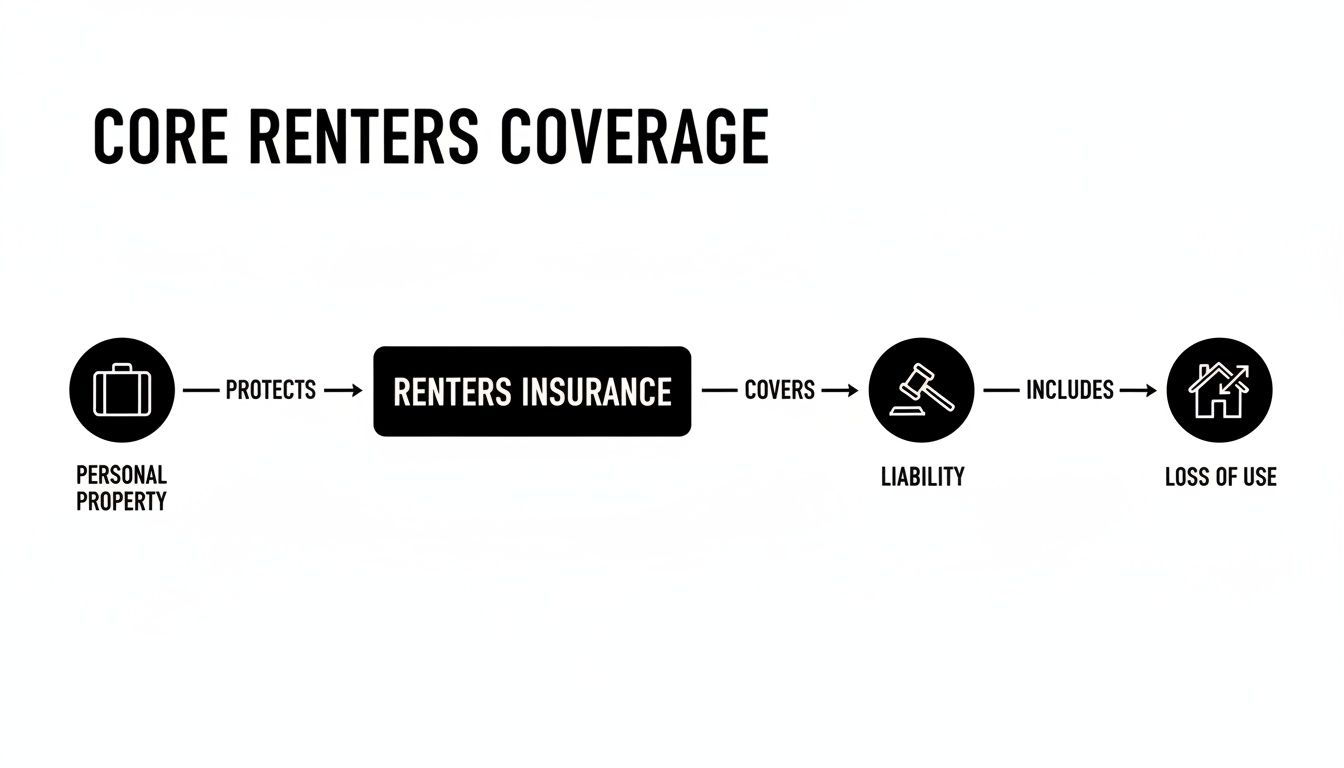
Each of these coverages—Personal Property, Liability, and Loss of Use—has limits that you get to choose, and those choices directly steer the final cost of your policy.
How Your Coverage Choices Shape Your Cost
Once your location is factored in, the next big lever is the amount of coverage you decide to buy. It's a simple trade-off: more protection for you means a higher potential payout for the insurer, which translates to a higher premium.
Think of your insurance premium as a seesaw. On one side, you have your coverage limits and protection. On the other, you have your monthly cost. As you add more weight to the coverage side, the cost side has to go up to keep things balanced.
Your goal is to find that sweet spot between what you need and what you can afford. The two main controls you have are your coverage limits and your deductible.
- Personal Property and Liability Limits: Do you own expensive electronics, furniture, and a whole wardrobe? You’ll need higher limits. A policy with $50,000 in personal property coverage and $300,000 in liability will naturally cost more than a starter plan with $20,000 in property and $100,000 in liability.
- The Deductible Trade-Off: Your deductible is the amount you pay out of pocket before your insurance takes over. By choosing a higher deductible, say $1,000 instead of $500, you’re telling the insurer you're willing to handle the smaller bumps yourself. They reward you for taking on that bit of risk with a lower monthly premium. It’s a great way to lower your renters insurance California cost if you feel comfortable covering that higher amount in an emergency.
To see this in action, look at how tweaking these numbers can affect your monthly payment.
How Your Choices Affect Your Monthly Premium
This table illustrates how changing your coverage limits and deductible can raise or lower your estimated monthly renters insurance cost.
| Coverage Scenario | Personal Property | Liability Coverage | Deductible | Estimated Monthly Cost |
|---|---|---|---|---|
| Basic Plan | $20,000 | $100,000 | $500 | ~$12 |
| Increased Property | $40,000 | $100,000 | $500 | ~$18 |
| Higher Liability | $20,000 | $300,000 | $500 | ~$15 |
| Higher Deductible | $20,000 | $100,000 | $1,000 | ~$10 |
These are just estimates, but they clearly show the direct relationship between your choices and your cost. Raising your deductible is often the quickest way to see savings.
Your Personal Profile Matters
Finally, insurers take a look at you. Just like a good driving record helps lower your car insurance premium, a history of responsibility can get you a better rate on your renters policy.
Here are the personal factors that come into play:
- Claims History: If you’ve filed several claims in the last few years, an insurer might see you as a higher risk and charge more. On the flip side, staying claims-free for a long period often makes you eligible for a nice discount.
- Credit-Based Insurance Score: California is one of the states that allows insurers to use a credit-based insurance score when setting premiums. It's not the same as your FICO score, but it's built from similar financial information. A strong score suggests you're financially responsible, which data shows correlates with a lower likelihood of filing claims—and that means a lower premium for you.
- Protective Devices: This is an easy win. Having smoke detectors, a fire extinguisher, or a burglar alarm in your apartment can often get you a small discount. These simple devices actively reduce the chances of a big loss, and insurers appreciate that.
By understanding how all these pieces fit together, your quote starts to make a lot more sense. You can see which factors are out of your hands and, more importantly, which ones you can adjust to build a policy that gives you the right amount of protection at the best possible price.
Real-World Cost Scenarios For California Renters

Talking about coverage limits and deductibles is one thing, but seeing how they play out in the real world is where it all clicks. The renters insurance California cost isn't some arbitrary number; it’s a direct reflection of your life—what you own, where you live, and what you need to protect.
Let's step away from the abstract and look at three different renters. We’ll meet a student, a young professional, and a family, each with unique needs. See if one of their stories resonates with you—it’s the best way to get a feel for what your own policy might cost.
Scenario 1: The San Diego Student
First up is Alex, a college student renting a small studio near campus in San Diego. Alex doesn't have a ton of stuff: a laptop for classes, a bike to get around, clothes, and some basic furniture. The biggest worry? Theft, which is always a concern in crowded student housing.
Affordability is the name of the game for Alex. A tight budget means the premium has to be as low as possible, even if that means a higher deductible.
- Personal Property: After a quick mental checklist, Alex figures it would cost about $15,000 to replace everything. This covers the essentials like the laptop, bike, and wardrobe.
- Liability: Friends come over to study, but big parties aren't really Alex's thing. The standard $100,000 in liability coverage feels like plenty.
- Deductible: To keep the monthly bill down, Alex picks a $1,000 deductible. It’s a manageable amount to pay out-of-pocket if something small happens.
Estimated Monthly Premium: With this basic setup, Alex is looking at a premium of around $12 to $15 per month. It’s a tiny price for major peace of mind, especially when you consider how much it would cost to replace a stolen laptop on a student's budget.
Scenario 2: The San Francisco Tech Professional
Now, let's head north to meet Maya, a software engineer in a chic one-bedroom apartment in San Francisco. Maya’s place is filled with high-value electronics—a powerful work-from-home rig, high-end camera gear, a quality sound system, and some designer furniture.
Maya's priority is making sure all that expensive equipment is fully covered. While nobody wants to overpay, Maya is willing to spend a little more for higher limits and is even thinking about bundling with an auto insurance policy to get a discount.
- Personal Property: A detailed inventory puts the replacement cost of Maya's belongings at $50,000. This includes adding a special rider to cover the full value of the camera equipment, since standard policies often have low limits for specialty items.
- Liability: Maya hosts colleagues and friends pretty often, so increasing liability coverage to $300,000 is a smart way to protect a growing savings account.
- Deductible: A $500 deductible hits the sweet spot between a reasonable monthly premium and a manageable out-of-pocket cost for a claim.
Estimated Monthly Premium: For this much more robust policy, Maya’s renters insurance California cost lands in the $22 to $28 per month range. The higher premium directly reflects the higher value of the insured property—a smart investment for someone with a lot to protect.
Scenario 3: The Sacramento Family
Finally, meet the Garcia family. They’re renting a three-bedroom house in a Sacramento suburb with their young child. Their perspective is completely different. They have plenty of furniture and toys, but their number one concern is liability.
With a kid who loves having friends over, the possibility of an accident and a potential lawsuit is always in the back of their minds. They also want to know they’ll have a place to stay if something major, like a kitchen fire, forces them out of their home temporarily.
- Personal Property: The Garcias do a walk-through and estimate their belongings are worth around $40,000.
- Liability: This is their main focus. They choose $500,000 in liability coverage for maximum protection against the unexpected.
- Deductible: They also feel comfortable with a $500 deductible.
Estimated Monthly Premium: For a family-oriented policy with high liability limits, the Garcias can expect to pay about $25 to $32 per month. This shows how prioritizing liability can shape the cost, providing a powerful financial shield for a small monthly payment, not unlike how a life insurance policy protects a family’s long-term future.
Proven Strategies to Lower Your Renters Insurance Cost

Now that you know what goes into your premium, let's talk about how to bring that number down. Getting an affordable renters insurance California cost isn't about cutting corners on protection. It’s about being savvy and making smart choices that insurance companies reward with lower rates.
Think of it as a simple savings checklist. By being proactive in a few key areas, you can make a real dent in your monthly payment without giving up the coverage you actually need. Here are the most effective ways to do it.
Bundle Your Insurance Policies
This is hands-down one of the easiest and most impactful ways to save. If you already have auto insurance, ask your provider about bundling it with a new renters policy. This simple move can trigger a multi-policy discount that often knocks 10% to 20% off both premiums.
Why does this work? Insurers want your loyalty. When you trust them with more of your business, they reward you with better pricing. It’s a true win-win: you get a great deal, and you can manage all your policies in one place. This often works with life insurance and other policies, too.
Adjust Your Deductible
Your deductible is simply the amount of money you agree to pay out-of-pocket for a claim before your insurance kicks in. Think of it as your share of the financial risk. By raising your deductible, you’re telling the insurer you’ll handle the smaller stuff, which immediately lowers your premium.
- $500 Deductible: A very common choice. It keeps your upfront cost low in a claim, but your monthly premium will be a bit higher.
- $1,000 Deductible: Bumping your deductible to this level can create a noticeable drop in your monthly bill.
The key is to pick a deductible you could comfortably pay tomorrow without stress. If you have $1,000 set aside in an emergency fund, this is a fantastic way to unlock immediate savings on your premium.
Install and Maintain Safety Devices
Insurance is all about risk. The less risky you appear to an insurer, the better your rate will be. Taking simple steps to make your rental safer shows them you're a responsible client, and they'll often reward you with a discount.
These small additions can pay for themselves over time through lower premiums:
- Smoke Detectors: Required in most rentals, but double-check that they work and have fresh batteries.
- Fire Extinguishers: A small extinguisher in the kitchen is a smart safety move that can also earn you a small discount.
- Burglar Alarms: A monitored security system is the gold standard here and typically provides the biggest discount because it actively deters theft.
- Deadbolt Locks: While standard, they are still a fundamental security feature that insurers like to see.
Don't assume your agent knows about these features. Always make a point to tell them what safety devices you have.
Ask About Every Available Discount
On top of the big three, there's a whole world of smaller discounts that can chip away at your premium. Insurance companies offer all sorts of price breaks, but they don't always apply them automatically. You have to ask.
When you're getting a quote, run through this list with your agent:
- Claims-Free Discount: Have you gone three to five years without filing a claim? You may be eligible for a discount.
- Non-Smoker Discount: Because non-smokers pose a lower fire risk, some insurers will offer a better rate.
- Retiree Discount: If you're over 55 and retired, you might get a discount. The logic is you're home more often, which reduces the risk of theft.
- Autopay Discount: Simply setting up automatic payments from your bank account can often shave a few extra dollars off your bill.
Spending a few minutes on the phone exploring these options can uncover savings you didn't know were on the table. For more tips on managing your policies, feel free to explore our other helpful insurance guides. After all, every dollar you save is a dollar back in your pocket.
How To Get An Accurate Renters Insurance Quote In California
Getting a good renters insurance quote isn't just about chasing the lowest price. It’s about making sure the renters insurance California cost you're quoted actually matches the protection you need for your life. A little prep work upfront can turn a confusing chore into a confident, easy decision.
The absolute first thing you should do is a quick home inventory. Seriously, just walk through your place with your phone and make a list of your stuff—your couch, TV, laptop, clothes, even your good kitchen knives. Jot down what you think it would cost to replace them brand new. This simple step is the key to avoiding the huge mistake of being underinsured.
Gathering Your Information
Once you have a rough idea of your stuff's value, you'll need a few other details handy. Having this ready will make getting quotes a breeze, whether you're online or talking to an agent.
- Personal Info: Your name, address, date of birth, and any insurance claims you've made in the past few years.
- Building Details: Be ready with some basics about your rental, like whether it's a wood-frame building and roughly when it was built.
- Safety Features: Do you have smoke detectors? A fire extinguisher? A security alarm? Mention these, because they can often knock a few bucks off your premium.
An accurate quote is built on accurate information. The more precise you are about your belongings and living situation, the more tailored your quote will be, preventing surprises if you ever need to file a claim.
Compare, Compare, Compare
Here’s the golden rule: never settle for the first quote you see. You should always get quotes from at least three different insurance companies to find the best deal. You’ll be surprised at how different the pricing can be for the exact same coverage.
Comparing quotes for home insurance, auto insurance, or renters coverage is the single best way to make sure you're not overpaying. It gives you the power to pick a policy that fits your budget without skimping on protection.
Once you've got a few quotes lined up, you're in a great spot to talk to an agent and lock in your coverage. Ready to see what’s out there? You can easily get an insurance quote online and compare rates from top California carriers in just a few minutes.
Your Top Questions About California Renters Insurance, Answered
Even with all the details laid out, you probably still have a few questions floating around. That’s completely normal. Let's tackle some of the most common ones we hear from renters all the time.
Is Renters Insurance Actually Required In California?
Here’s the thing: while the state of California doesn't have a law forcing you to buy renters insurance, your landlord almost certainly will. It's a standard clause in most lease agreements these days.
Think of it from their perspective. They need to protect their property, and requiring tenants to have liability coverage is a key part of that. So, legally, no. But practically? Yes, you'll likely need it to sign a lease.
Am I Covered For Earthquakes Or Floods?
This is a critical point for anyone living in California. Your standard renters insurance policy does not cover damage from earthquakes or floods. These are considered separate, high-risk events that need their own specific coverage.
To protect your stuff from an earthquake, you'll need to add an earthquake endorsement to your policy. For floods, you’ll have to purchase an entirely separate flood insurance policy. Don't assume you're covered—you have to add it on.
How Much Liability Coverage Do I Really Need?
Most policies will start you out with $100,000 in liability coverage, but honestly, that might not be enough. We usually recommend our clients consider at least $300,000.
A good way to think about it is to look at your net worth—what you own, what you've saved, and even your future earning potential. All of that could be on the line if someone sues you after an accident in your home. If you have a dog, entertain guests often, or have built up some savings, spending a few extra bucks a month for higher liability limits is one of the smartest financial decisions you can make.
If you have more questions, we've got you covered. Check out our detailed California insurance FAQ page for even more answers.
Trying to figure out renters insurance, home insurance, or auto insurance in California doesn't have to be a headache. The licensed agents at Mai & Associates are here to help. We'll give you a no-obligation quote and help you shop rates from the best carriers to find that sweet spot between great coverage and a price you can afford.
Protect what matters. Head over to https://cahomeauto.com to get your same-day quote today.