Renters Insurance California: A Clear and Simple Guide for Your Protection
Picture this: a fire breaks out in your apartment building. Thankfully, everyone gets out safely, but the damage is done. Your landlord’s insurance will step in to repair the walls and the structure itself, but what about your brand-new laptop, your couch, your entire wardrobe? That’s where renters insurance in California comes in. It’s a financial safety net designed to protect everything you own inside your rental, usually for a surprisingly small monthly cost. This guide is your first step to understanding the landscape of California insurance and securing your financial future.
Why You Need a Financial Safety Net in California
Think of renters insurance as a personal bodyguard for your stuff. It’s there to shield you financially when something unexpected happens, keeping a major setback from turning into a full-blown disaster.
It's a common misconception that your landlord's policy covers your belongings. It doesn't. Their insurance protects their investment—the building—which leaves many California tenants completely exposed without realizing it.
Even a simple accident, like forgetting to turn off the bathtub faucet and damaging your downstairs neighbor's ceiling, can lead to huge liability costs. A guest could trip over a rug in your living room and decide to sue. Without your own policy, you’d be on the hook for those expenses, paying straight out of your own pocket.
Protecting More Than Just Your Stuff
For what it costs, renters insurance delivers an incredible amount of peace of mind. In a state like California, where the cost of living is already a challenge, a sudden financial hit can throw your life off track for months, if not years. That's why having a solid plan in place is so critical.
This isn't just about replacing a stolen bike or a fire-damaged TV. A good policy gives you a foundation of security, so you can stop worrying about every little "what if." That small monthly premium is really an investment in your own financial stability.
Renters insurance bridges the critical gap between your landlord’s building coverage and your personal financial responsibility. It ensures that a fire, theft, or liability claim doesn't jeopardize your savings and future goals.
A Smart Part of Your Overall Financial Plan
For most Californians, a renters policy is just one piece of a comprehensive financial puzzle. A fantastic way to save some money is by bundling your policies with the same insurance provider. It's an incredibly common strategy to bundle essential coverages like auto insurance and renters insurance. Many people also bundle their car insurance this way, maximizing discounts.
When you combine policies, you get a significant discount and simplify your monthly bills. It’s an easy, effective way to get strong protection for both your car and your belongings without breaking the bank. This approach makes being properly insured much more affordable, whether you're thinking about future home insurance or even long-term planning with life insurance. In California, a smart insurance strategy is just part of sound financial planning.
What Does a California Renters Insurance Policy Actually Cover?
When you sign up for renters insurance, you’re not just getting one type of protection. You're actually buying a bundle of three distinct coverages that work together to create a powerful financial safety net. It helps to think of it like a three-legged stool—take one leg away, and the whole thing gets pretty wobbly.
Let's break down exactly what you're paying for.
Personal Property Coverage: The Shield For Your Stuff
This is what most people think of first: coverage for all your belongings. Personal Property Coverage is designed to repair or replace your stuff if it’s damaged or stolen due to a covered event (or "peril," in insurance-speak).
So, what’s a covered peril? Think of common disasters like fire, theft, vandalism, or even water damage from a burst pipe upstairs. Let’s say someone breaks into your apartment and makes off with your laptop, TV, and some jewelry. This is the part of your policy that kicks in to help you buy new ones, right up to the limit you chose.
And it's not just for things inside your four walls. If your bike gets stolen from the rack outside or your camera is snatched from your car, your renters policy often has your back.
You'll face a key choice here: Replacement Cost Value (RCV) or Actual Cash Value (ACV). ACV pays you what your used items were worth—think garage sale prices. RCV, on the other hand, gives you enough money to buy brand-new replacements. For true peace of mind, RCV is the way to go.
A Quick Look at What Your Policy Covers
To make it even clearer, let's look at what a standard policy typically includes versus what it usually leaves out. This isn't an exhaustive list, but it covers the most common scenarios you're likely to encounter as a renter in California.
| What's Usually Covered | What's Often Excluded |
|---|---|
| Fire and smoke damage | Earthquakes |
| Theft and vandalism | Flooding (from natural disasters) |
| Certain types of water damage (e.g., burst pipes) | Pest infestations (e.g., bed bugs) |
| Windstorms and hail | Normal wear and tear |
| Explosions | Damage from your own pets |
Remember, you can often add protection for some exclusions, like earthquakes, by purchasing a separate endorsement. We'll get into that a bit later.
Liability Protection: Your "Financial Oops" Coverage
Accidents happen. Liability Protection is there for those moments that could otherwise drain your bank account. It protects you financially if you're found responsible for injuring someone in your home or accidentally damaging their property.
For example, imagine a friend slips on your freshly mopped kitchen floor and breaks an arm. Your liability coverage can step in to help pay for their medical bills. Or what if you forget the bathtub is running and it overflows, causing water damage to your downstairs neighbor's ceiling? This coverage helps pay for those repairs.
Without it, you’d be on the hook for those costs yourself, which could easily spiral into thousands of dollars and even a lawsuit. This is precisely why most California landlords require tenants to carry at least $100,000 in liability coverage—it protects you, your neighbors, and the property owner. This principle of protecting against personal responsibility is also a cornerstone of good home insurance in California.
The image below gives a great visual of how renters insurance creates a protective bubble for you, your landlord, and your possessions.
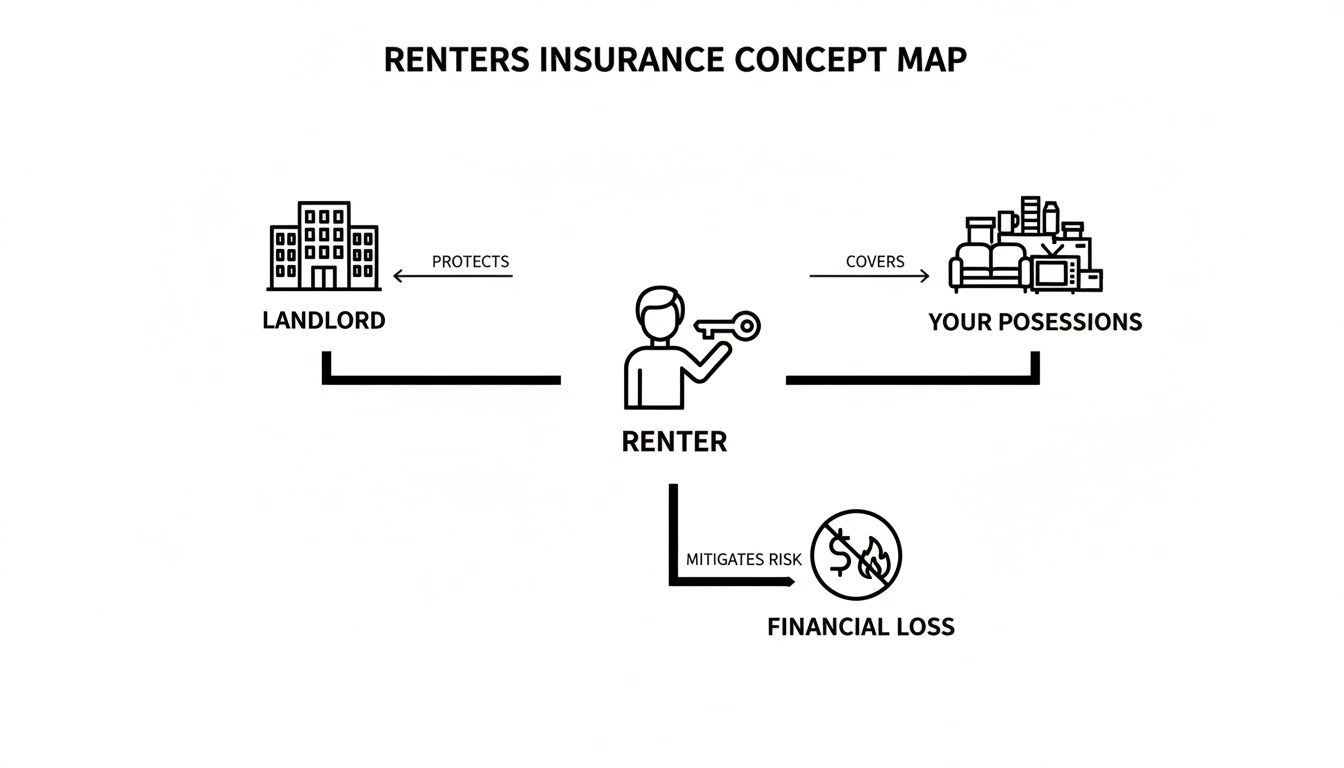
It clearly shows the line: your policy handles your personal belongings and liability, while your landlord's policy covers the building itself.
Additional Living Expenses: Your Lifeline If You're Displaced
What would you do if a fire ripped through your building, making your apartment unlivable? You can't stay there, but the rent is still due, and now you need to pay for a hotel. This is where Additional Living Expenses (ALE) coverage becomes an absolute lifesaver.
ALE helps cover the reasonable, extra costs you face when you're forced out of your home by a covered event. This isn't free money; it covers the difference between your normal and temporary expenses.
Think of things like:
- A hotel room or a short-term rental while your place is being repaired.
- Restaurant meals since you no longer have access to your kitchen.
- Other essentials, like laundry services or even pet boarding fees.
Picture a wildfire forcing an evacuation of your neighborhood for a week. Your ALE coverage could reimburse you for that hotel bill, preventing a horribly stressful situation from becoming a full-blown financial disaster. It gives you a safe place to land without having to burn through your savings.
So, How Much Does Renters Insurance Actually Cost in California?
Let's clear up one of the biggest myths right away: renters insurance isn't expensive. A lot of people figure it’s another high monthly bill they can’t afford, but the reality is, it’s one of the most affordable types of California insurance you can buy to protect yourself financially. For what often amounts to the cost of a few lattes a month, you get a powerful safety net for everything you own.
The price you'll pay isn't just a number pulled out of a hat. It's a personalized premium that's calculated based on a few key things about you and your home. Once you understand what goes into that calculation, you'll see how you can find a great policy that fits your budget.
What Goes Into Your Premium?
Insurance companies look at a handful of factors to figure out your rate. Think of it like putting together a puzzle—each piece helps build the final picture of what you'll pay.
- Where You Live: Your zip code matters. A rental in an area with low crime rates might have a lower premium than one in a neighborhood with more break-ins or closer to a high-risk wildfire zone.
- How Much Coverage You Need: This is a big one. If you have $15,000 worth of stuff, your policy will cost less than if you need to cover $50,000 in belongings. It’s all about protecting the value of what you own.
- Your Deductible: This is the amount you agree to pay out-of-pocket if you file a claim. If you choose a higher deductible (say, $1,000 instead of $500), your monthly premium will almost always be lower.
- Your Claims History: If you haven't filed any claims in the past few years, insurers see you as a lower risk, which can work in your favor. A history of frequent claims can lead to higher rates.
These factors all work together to create a price that’s specific to your situation.
The Average Cost for California Renters
So what does that look like in real numbers? On average, a renters insurance policy in California costs somewhere between $196 and $253 for the entire year.
When you break that down, you’re looking at roughly $16 to $21 per month. That's it. For perspective, rates can vary by city. In major coastal spots like Los Angeles and San Francisco, you might see monthly costs in the $16 to $20 range. Head inland to places like Fresno or San Jose, and the average often drops to between $10 and $15 a month. You can explore more details on California renters insurance costs to see how these figures stack up.
Think of your deductible as your share of the risk. A higher deductible signals to the insurer that you're willing to handle smaller losses yourself, which in turn earns you a lower premium.
Smart Ways to Lower Your Bill
The best part is that you're not stuck with the first quote you see. You have a good amount of control over what you pay, and there are some simple, effective ways to bring that number down without giving up the coverage you need.
A few smart moves can add up to real savings. The easiest win? Bundling.
- Bundle Your Policies: If you have a car, combining your renters insurance with your auto insurance is a no-brainer. Companies give some of their best discounts for this—often 10-15% or more. It’s the fastest way to save money on both your car insurance and your renters policy.
- Install Safety Devices: Got a smoke detector? A fire extinguisher? How about a security alarm? These things show an insurance company that you’re proactive about safety, and they’ll often reward you with a small discount.
- Maintain Good Credit: In California, insurers can use a credit-based insurance score to help set your rates. A solid history of managing your finances responsibly can translate directly into a lower premium.
- Just Ask About Discounts: Don't be afraid to ask your agent, "What other discounts can I get?" You might be eligible for savings for being claim-free for several years, for being a non-smoker, or for other reasons you'd never think of.
Taking these simple steps can make an already affordable policy even cheaper. That frees up cash for your other goals, whether that's saving up for future home insurance or planning ahead with life insurance.
Navigating California's Unique Insurance Challenges

Renting in the Golden State is a trade-off. You get the incredible weather and vibrant lifestyle, but you also have to live with risks that most standard insurance policies just weren't built to handle. A basic renters insurance California policy is great for covering things like theft or a kitchen fire, but it leaves some massive gaps when it comes to the state's most infamous natural disasters.
Knowing what isn't covered is just as important as knowing what is. For California renters, this means getting smart about two major threats: earthquakes and wildfires.
The Ground Shakes: Earthquake Coverage Explained
Let's be crystal clear about this: your standard renters insurance policy will not cover damage from an earthquake. This is a hard-and-fast rule that catches too many people by surprise. If a tremor knocks your big-screen TV off the wall, shatters all your dishes, or snaps the legs off your antique desk, your basic policy won't pay a dime to replace them.
To protect your stuff from earthquake damage, you need a completely separate policy or a special "endorsement" added to your renters plan. Think of it like buying snow tires for your car—it’s an extra layer of specialized protection for a specific, regional risk.
While your landlord is responsible for the building itself, their insurance does nothing for your personal belongings inside. Your earthquake policy is the only thing standing between you and the total financial loss of everything you own.
For many renters, the California Earthquake Authority (CEA) is a great place to start. They offer policies specifically designed for tenants that cover the cost of replacing your belongings and can even help with temporary living expenses if a quake makes your apartment uninhabitable.
Wildfire Risk and Finding Coverage
Now, this is where it gets a bit more complicated. Unlike earthquakes, damage from fire is a standard covered event in any renters policy. The problem is that California's wildfires have become so frequent and destructive that many insurance companies are now hesitant to offer policies in high-risk areas.
This can leave you feeling stuck, wondering how to get the protection you need. Thankfully, there’s a safety net for people who can't find coverage through the usual channels.
The California FAIR Plan was created to act as an insurer of last resort, guaranteeing that all residents can get basic fire insurance. It’s designed to provide essential protection for fire, lightning, and smoke damage when no one else will.
It’s crucial to understand what the FAIR Plan does—and what it doesn’t do.
- What It Covers: It provides a fundamental backstop for your personal property against fire damage.
- What It Doesn't Cover: It's a bare-bones policy. It does not include liability protection (if someone gets hurt in your apartment), theft coverage, or water damage.
To create a complete shield, you'll need to pair the FAIR Plan policy with a second, separate policy called a "Difference in Conditions" (DIC) policy. This companion policy fills in all the other critical gaps, like liability and theft, giving you the comprehensive protection you'd expect from a standard plan.
The renters insurance California market has been rocky lately, with rates climbing and some insurers pulling out of high-risk zones altogether. The California Department of Insurance has stepped in with major reforms to help stabilize things, including new rules for catastrophe modeling and expanding the FAIR Plan's coverage. In this kind of environment, having an expert on your side is more important than ever.
An experienced agent can help you figure out if you need to go the FAIR Plan route and then find the right DIC policy to build a complete safety net. This is one piece of a much larger financial puzzle that might also involve your auto insurance, future home insurance, or even life insurance. For more insights on building a strong insurance strategy, check out our other guides.
How to Get Your Renters Insurance Policy: A Simple Walkthrough

Getting the right renters insurance in California is way easier than you might think. It’s not about wading through stacks of paperwork or deciphering confusing legal terms. It’s really just a few practical steps to make sure you’re protected if something goes wrong.
The whole process kicks off with one simple question: What do you actually own?
First Things First: Take Stock of Your Stuff
Before you can insure your belongings, you need a rough idea of what they're worth. This is where a home inventory comes in handy. And no, this doesn't mean you have to spend your weekend creating a massive spreadsheet.
The simplest method is right in your pocket. Just grab your smartphone and walk through your apartment, recording a slow, steady video of each room. Don’t forget to open up closets, drawers, and cabinets—you want to capture everything from your laptop and TV to your couch and clothes. This video is gold if you ever need to prove what you owned.
- Got valuables? For things like jewelry, fancy electronics, or artwork, snap a few individual photos. It’s also a good idea to note serial numbers and when you bought them.
- Save your receipts. Keeping digital copies of receipts for big-ticket items makes it a breeze to show what you paid.
After you do this, you'll have a much clearer picture of what it would cost to replace everything. You might be surprised. Many people find their stuff adds up to $20,000 or more pretty quickly.
Next: Pick Your Coverage Levels and Deductible
With your inventory in hand, it’s time to dial in your policy. You'll make two main decisions that shape both your protection and your monthly cost.
- Choose Your Coverage Limits: This is the maximum amount the insurance company will pay out. You'll set a limit for your personal property (based on that inventory you just made) and another for liability. Most policies start with $100,000 in liability, but bumping that up to $300,000 usually only costs a few extra bucks a month and gives you so much more protection.
- Select a Deductible: This is what you pay out of your own pocket before the insurance money starts flowing. A $500 deductible is pretty standard. If you opt for a higher one, say $1,000, your premium will go down. Just make sure it’s an amount you could comfortably come up with if you had to.
You can think of your deductible and your premium like two ends of a seesaw. When one goes up, the other usually comes down. The trick is finding that sweet spot that works for your budget and gives you peace of mind.
Finally: Shop Around for the Best Deal
Whatever you do, don't just grab the first quote you see. The prices and coverage details can be wildly different from one company to the next. The best approach is to compare a few options to make sure you’re getting great value, not just a low price.
This is where working with an independent agency like Mai & Associates really shines. Instead of you having to call a bunch of different carriers, we do the legwork for you. We can pull quotes from top-rated providers for your renters insurance, auto insurance, and even life insurance all at once. It's easy to get an insurance quote that’s built around what you actually need.
It’s interesting to note that California is ahead of the curve, with 3.8 million households already covered by renters insurance. Still, an astonishing 24% of renters who don't have it say they've never even thought about it, which shows there’s still a lot of confusion out there. With over half of all renters in the U.S. now insured, getting a policy is becoming a basic part of managing your finances wisely.
Answering Your Top California Renters Insurance Questions
Once you get the hang of what renters insurance is, a few practical questions almost always pop up. Let's walk through some of the most common ones we hear from California renters every day, breaking them down with clear, simple answers.
Is Renters Insurance Required by Law in California?
This is a great question, and the answer is a little nuanced. No, the state of California doesn't have a law on the books forcing every renter to buy a policy.
But here’s the important part: your landlord absolutely has the right to require it in your lease. And these days, most of them do. Think of it from their perspective—they're protecting their investment. If your sink overflows and ruins the hardwood floors, your policy’s liability coverage can pay for it. It also protects them if a guest gets hurt in your apartment. So, while it's not a state law, it has become a standard, and smart, requirement for most rental properties.
What’s the Difference Between Actual Cash Value and Replacement Cost?
Understanding this one concept is probably the most important thing you can do when buying a policy. It directly controls how much money you'll get if you ever need to file a claim.
Actual Cash Value (ACV): This is the “garage sale” price. It pays you what your stuff was worth the second before it was damaged or stolen. So, that five-year-old laptop you paid $1,200 for? ACV might only give you $250 for it today because of depreciation.
Replacement Cost Value (RCV): This is the one you almost always want. RCV pays you the full amount needed to go out and buy a brand-new, similar item at today's prices. With RCV, you get the full $1,200 (or whatever a comparable new model costs now) to replace that stolen laptop.
RCV coverage costs a few extra bucks a month, but it’s worth every penny. It’s the difference between being made whole and being left short.
Does My Policy Cover My Roommates?
This is a huge point of confusion, so let's clear it up: no, your renters insurance policy does not cover your roommates. A standard policy is written to protect you, your spouse, and any resident relatives, but not unrelated people you happen to share a home with.
It's a common mistake to assume one policy covers everyone in the apartment. To avoid disputes and ensure everyone's belongings are protected, most insurers require each roommate to purchase their own separate policy.
This is truly the best way to handle it. Having separate policies is clean and simple. Everyone has their own dedicated coverage for their property and liability, and you don't have to worry about a roommate's claim affecting your insurance history.
How Will Filing a Claim Affect My Premium?
Filing a claim might cause your premium to go up at renewal time. Insurance is all about risk, and from an insurer's perspective, a past claim can suggest a higher likelihood of a future one.
The real impact depends on the type of claim, how much it was for, and your overall claims history. For a really small incident—say, minor damage that costs just a little more than your deductible—it often makes more sense to just pay for it out of pocket. This keeps your record clean and avoids a potential rate hike. It’s always smart to weigh the repair cost against your deductible before rushing to file.
This is where having a good agent really helps. They can give you practical advice on whether filing makes financial sense. For more answers, you can always check out our FAQ page for even more detailed info. The same logic applies to all your policies—a clean claims history is a valuable asset for everything from auto insurance to your future home insurance.
Ready to secure your peace of mind with a renters policy that fits your budget? The licensed agents at Mai & Associates are here to help. We make it easy to compare quotes from top carriers, find every available discount, and build the right protection for your California lifestyle. Visit us at cahomeauto.com to get your free, no-obligation quote today